


 |
市場調查報告書
商品編碼
1910542
電子書:市佔率分析、產業趨勢與統計、成長預測(2026-2031)E-book - Market Share Analysis, Industry Trends & Statistics, Growth Forecasts (2026 - 2031) |
||||||

※ 本網頁內容可能與最新版本有所差異。詳細情況請與我們聯繫。
預計電子書市場將從 2025 年的 180.2 億美元成長到 2026 年的 188.5 億美元,到 2031 年達到 236 億美元,2026 年至 2031 年的複合年成長率為 4.6%。
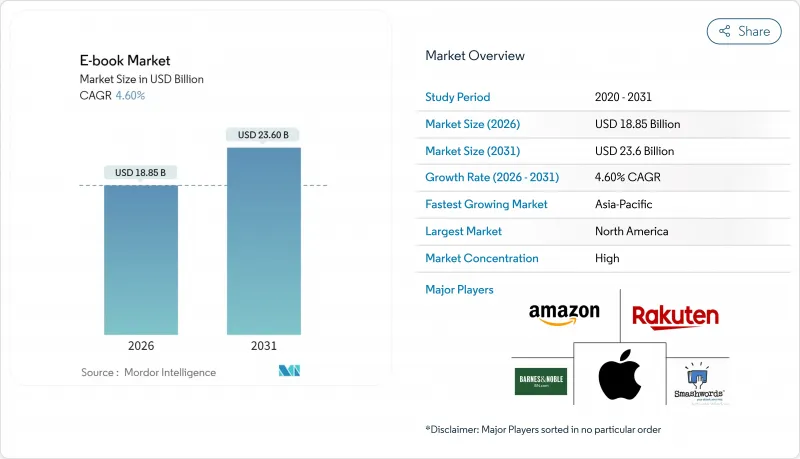
訂閱主導的經營模式、機構授權的興起以及行動優先的閱讀習慣是塑造電子書市場的三大強大力量。收入的可預測性支撐著出版商對平台專屬體驗的投資,例如互動式教科書和連載網路漫畫。智慧型手機的普及推動了微交易和社交發現功能的嘗試,從而加深了讀者的參與。同時,基於區塊鏈的版權管理正在簡化作者的報酬結構,並緩解長期存在的數位版稅糾紛。市場競爭強度適中。雖然亞馬遜的 Kindle 生態系統仍然是基礎平台,但亞太地區湧現的區域性顛覆者和以圖書館為中心的供應商正在削弱其壟斷地位。
全球電子書市場趨勢與洞察
行動裝置的日益普及
智慧型手機的興起已將數位閱讀的核心從專用電子閱讀器轉移到始終連網的裝置。出版商正利用這一趨勢,發布短小精悍的內容,最佳化垂直滾動體驗,並融入遊戲化元素,以鼓勵用戶每天持續閱讀。顯示器製造商正在改進防眩光OLED螢幕和自適應更新率,以減少長時間閱讀造成的眼部疲勞。人工智慧驅動的建議引擎的興起進一步提升了應用程式內內容發現的個人化程度,提高了閱讀完成率和平均每次閱讀時長。在設備更新換代週期較短的亞太地區,閱讀應用程式如今已預先安裝在高階設備上,為使用者進入電子書市場提供了預設入口。
不斷擴展的全球網際網路連接
新一代寬頻部署和對5G回程傳輸的投資正在擴大先前受頻寬成本限制的市場的覆蓋範圍。根據GSMA的「數位國家」框架,亞太地區的18個國家政府已將普及網路連接作為經濟競爭力的基礎。更快、更便宜的連接使出版商能夠嵌入高解析度圖片、音頻片段和短影片,而無需忍受漫長的加載時間。與區域頻寬品質掛鉤的動態定價也變得越來越普遍。網路速度較慢的讀者可以選擇價格更低的低比特率套餐,在滿足網路基礎設施實際情況的同時,保持了可訪問性。連接性的提升也消除了雲端同步的障礙,確保在多個裝置上無縫追蹤閱讀進度。
電子經銷商和作者的隱私和版權問題
圍繞數位版權管理和數據使用的複雜問題正威脅著分銷生態系統的分裂。歐洲監管機構正對難以維護合規基礎設施的小規模出版商處以GDPR罰款,罰款金額可能佔其年度數位收入的10%以上。圍繞數位借閱法規的訴訟凸顯了合理使用界限方面持續存在的模糊性,這延緩了機構的採購決策,並抑制了圖書館通路電子書市場近期的成長。作者們越來越質疑人工智慧公司是否在未經許可的情況下抓取其全文,這促使約翰霍普金斯大學出版社等早期採用者創建了清晰的人工智慧授權框架,以確保模型訓練獲得補償。具有前瞻性的出版商正在探索利用區塊鏈技術記錄內容交易時間戳,透過記錄每次訪問的時間、地點和方式,提高透明度和審核。
細分市場分析
訂閱服務將繼續推動電子書市場的擴張,預計到2025年將佔總收入的55.72%。數據豐富的環境使得新系列書籍的演算法推薦成為可能,確保新書能精準觸達目標讀者群。機構授權(主要來自圖書館和企業培訓入口網站)正以5.05%的複合年成長率快速成長,主要得益於較高的用戶單價。儘管機構授權用戶數量低於消費者訂閱用戶,但這一成長趨勢仍顯著提升了電子書市場規模。在學術收費和專業參考書等需要永久存取權限的領域,付費下載模式仍將繼續存在;而在注重成本的地區,諸如廣告位變現和社交共用後解鎖章節等免費增值模式正變得越來越受歡迎。
出版商正圍繞著「內容即服務」建立工作流程,透過即時校對和添加多媒體內容來更新其數位書目。這種延長的生命週期有助於平滑收入確認,並增強書目持久性。在平台方面,管理定期訂閱解約率正逐漸成為一門科學。預測分析能夠識別易流失的讀者,並在流失風險高峰到來之前推播精心策劃的通知和忠誠度獎勵。整合的支付系統簡化了方案變更流程,鼓勵常用使用者升級到包含有聲書和圖文內容的付費方案。這些舉措形成了一個良性循環,逐年提升用戶參與度,並擴大定期訂閱電子書的市場佔有率。
區域分析
預計到2025年,北美將維持39.45%的市場佔有率,這主要得益於當地電子閱讀器的使用習慣、較高的寬頻普及率以及密集的圖書館和學術機構生態系統。各大平台正在投資開發人工智慧閱讀助手,提供章節摘要和即時翻譯等功能,以提升時間緊迫的專業的閱讀體驗。儘管目前針對平台壟斷的監管調查尚未帶來結構性解決方案,但有望遏制平台的收購策略,並促使現有平台專注於以客戶為中心的功能增強,而非一味囤積內容。
亞太地區將成為成長最快的地區,到2031年將以4.72%的複合年成長率成長,這主要得益於智慧型手機的普及和靈活的行動支付系統。自2020年以來,日本的數位漫畫收入加倍,而韓國的網路漫畫則透過不斷創造IP價值(例如改編成電視劇和遊戲),吸引消費者回歸原創作品。據GSMA稱,新加坡、韓國和澳洲已實現近乎全面的5G網路覆蓋,為頻寬密集型互動電子書創造了有利條件。東南亞的Start-Ups正在嘗試分段定價,以幾美分的價格出售單一章節,透過提高電子書的可負擔性來增強其市場競爭力。
在機構數位化指令和跨境內容監管的推動下,歐洲正經歷穩定成長。 GDPR合規雖然需要成本高昂的一般資料保護規則處理保障措施,但正在建立消費者信任並提高訂閱轉換率。多語言支援的需求促使出版商加快對人工智慧翻譯流程的投資,以縮短在地化時間。德國和荷蘭的區塊鏈試點計畫正在實現透明的版稅分配,旨在將支付週期從數月縮短至數天。同時,英國正利用其強大的獨立出版業,嘗試將按需印刷客製印刷服務整合到直接面向讀者的銷售捆綁包中,以解決英國脫歐後複雜的許可問題。
其他福利:
- Excel格式的市場預測(ME)表
- 3個月的分析師支持
目錄
第1章 引言
- 研究假設和市場定義
- 調查範圍
第2章調查方法
第3章執行摘要
第4章 市場情勢
- 市場概覽
- 市場促進因素
- 行動裝置的普及率不斷提高
- 不斷擴展的全球網際網路連接
- 數位教育和數位學習的發展
- 訂閱式閱讀平台的日益普及
- 基於區塊鏈的版權管理和微支付
- 將出版商的 D2C 店面與 CRM 資料整合
- 市場限制
- 電子經銷商與作者之間的隱私與版權問題
- 新興市場對紙本書的偏好依然強勁。
- 電子閱讀器生態系之間的互通性有限
- 為減少因數位疲勞而導致的螢幕使用時間而採取的措施
- 監管環境
- 技術展望
- 波特五力分析
- 新進入者的威脅
- 買方的議價能力
- 供應商的議價能力
- 替代品的威脅
- 競爭對手之間的競爭
第5章 市場規模與成長預測
- 按收入模式
- 定期訂閱(無限閱讀)
- 按次收費下載
- 免費增值/廣告模式
- 機構許可
- 按類型
- 小說
- 非虛構類
- 教育與學術
- 漫畫和圖像小說
- 專業/技術領域
- 最終用戶
- 個人消費者
- 成人
- 適用於兒童和青少年
- 按機構
- 小學、國中和高中
- 高等教育
- 企業/專業培訓
- 公共圖書館
- 個人消費者
- 按地區
- 北美洲
- 美國
- 加拿大
- 南美洲
- 巴西
- 阿根廷
- 智利
- 其他南美洲
- 歐洲
- 英國
- 德國
- 法國
- 西班牙
- 義大利
- 俄羅斯
- 其他歐洲地區
- 亞太地區
- 中國
- 日本
- 印度
- 韓國
- 印尼
- 亞太其他地區
- 中東和非洲
- 中東
- 沙烏地阿拉伯
- 阿拉伯聯合大公國
- 土耳其
- 其他中東地區
- 非洲
- 南非
- 奈及利亞
- 埃及
- 其他非洲地區
- 中東
- 北美洲
第6章 競爭情勢
- 市場集中度
- 策略趨勢
- 市佔率分析
- 公司簡介
- Amazon.com, Inc.
- Rakuten Kobo Inc.
- Apple Inc.
- Barnes and Noble, LLC
- Smashwords, Inc.
- Blurb, Inc.
- DIY Media Group, Inc.
- Lulu Press, Inc.
- Macmillan Publishers Ltd
- Scribd, Inc.
- Google LLC
- Hachette Livre SA
- HarperCollins Publishers LLC
- Penguin Random House LLC
- Draft2Digital, LLC
- OverDrive, Inc.
- Storytel AB
- Wattpad Corp.
- Inkitt GmbH
- John Wiley and Sons, Inc.
- Pearson plc
- Cengage Learning, Inc.
第7章 市場機會與未來展望
The e-book market is expected to grow from USD 18.02 billion in 2025 to USD 18.85 billion in 2026 and is forecast to reach USD 23.6 billion by 2031 at 4.6% CAGR over 2026-2031.
Subscription-led business models, institutional licensing momentum, and mobile-first reading habits are the three most powerful forces shaping the e-book market. Revenue predictability underpins publisher investment in platform-native experiences such as interactive textbooks and webtoon serialization. Smartphone ubiquity drives microtransaction experimentation and social discovery features that deepen reader engagement. Meanwhile, blockchain-enabled rights management is beginning to streamline author compensation, mitigating long-running disputes over digital royalties. Competitive intensity is moderate: Amazon's Kindle ecosystem remains the anchor platform, but regional disruptors from Asia Pacific and library-centric vendors are eroding any path toward monopoly dominance.
Global E-book Market Trends and Insights
Increasing Penetration of Mobile Devices
Smartphone saturation has shifted the center of gravity for digital reading away from dedicated e-readers and toward always-connected handsets. Publishers capitalize on this reality by releasing bite-sized content episodes, optimizing for vertical scrolling, and layering in gamified achievements that reinforce daily reading streaks. Display manufacturers are refining glare-free OLED screens and adaptive refresh rates that reduce eye strain during extended reading sessions. The rise of AI-driven recommendation engines further personalizes in-app discovery, boosting completion rates and average reading time per session. In Asia Pacific, where handset upgrades occur on rapid cycles, premium devices now ship with pre-installed reading apps that create a default pathway into the e-book market.
Expanding Global Internet Connectivity
Next-generation broadband rollouts and 5G backhaul investments expand addressable audiences in markets historically constrained by bandwidth cost. GSMA's Digital Nations framework shows 18 Asia Pacific governments prioritizing ubiquitous coverage as a pillar of economic competitiveness. Faster, cheaper connections enable publishers to embed high-resolution artwork, audio snippets, and short-form video without incurring intolerable load times. Dynamic pricing tied to regional bandwidth quality is also gaining traction: readers on slower networks can opt for lower-bitrate packages at reduced prices, preserving accessibility while respecting infrastructure realities. Enhanced connectivity likewise removes frictions for cloud synchronization, ensuring seamless progress tracking across multiple devices.
Privacy and Copyright Issues Among E-sellers and Authors
Complexities around digital rights management and data usage threaten to fragment distribution ecosystems. European regulators enforce GDPR penalties that can absorb more than 10% of annual digital revenue for small presses struggling to maintain compliant infrastructure. Controlled digital lending lawsuits underscore lingering ambiguity over fair-use boundaries, delaying institutional purchasing decisions and depressing near-term e-book market growth in library channels. Authors increasingly question whether AI companies scrape full texts without consent, prompting early adopters like Johns Hopkins University Press to craft explicit AI licensing frameworks that guarantee compensation for model training. Forward-looking publishers explore blockchain timestamping of content transactions to record when, where, and how each copy is accessed, enhancing transparency and auditability.
Other drivers and restraints analyzed in the detailed report include:
- Growth of Digital Education and E-learning
- Rising Adoption of Subscription-Based Reading Platforms
- Persistent Preference for Print Books in Emerging Markets
For complete list of drivers and restraints, kindly check the Table Of Contents.
Segment Analysis
Subscription services commanded 55.72% of 2025 revenue and remain the engine behind the e-book market expansion. Their data-rich environments inform algorithmic commissioning of new series, ensuring that titles debut with pre-qualified audiences. Institutional licensing, chiefly libraries and corporate training portals, shows the sharpest momentum, growing at 5.05% CAGR on a base of high per-user spending. That uptrend contributes meaningfully to the e-book market size even though its user count trails consumer subscriptions. Pay-per-download persists for academic monographs and professional references where perpetual access is mandatory, while freemium models gain traction in cost-sensitive territories by monetizing advertising inventory or unlocking chapters after social sharing actions.
Publishers are engineering workflows around "content-as-a-service," refreshing digital backlists with real-time errata fixes and multimedia add-ons. This lifecycle extension smooths revenue recognition and strengthens catalog durability. For platforms, subscription churn management has become a science: predictive analytics flag disengaging readers so that curated push notifications or loyalty rewards arrive before cancellation risk peaks. Integrated payment rails simplify tier upgrades, nudging heavy readers toward premium plans that bundle audiobooks or graphic content. These measures reinforce a virtuous loop wherein higher engagement elevates the e-book market share of subscription formats year over year.
The E-Book Market Report is Segmented by Revenue Model (Subscription, Pay-Per-Download, Freemium/Ad-supported, and Institutional Licensing), Genre (Fiction, Non-Fiction, Education and Academic, Comics and Graphic Novels, and Professional and Technical), End-User (Individual Consumers, and Institutional), and Geography. The Market Forecasts are Provided in Terms of Value (USD).
Geography Analysis
North America retained its 39.45% share in 2025 owing to entrenched e-reader habits, high broadband penetration, and a dense ecosystem of library and academic buyers. Leading platforms invest in AI-generated reading companions that summarize chapters and translate passages on the fly, raising engagement among time-pressed professionals. Regulatory inquiries into platform exclusivity have not yet produced structural remedies, but they do temper acquisition strategies, pushing incumbents to focus on customer-centric feature upgrades rather than aggressive content hoarding.
Asia Pacific charts the fastest regional expansion at a 4.72% CAGR through 2031, propelled by smartphone ubiquity and flexible mobile payment systems. Japanese digital manga revenue has doubled since 2020, while Korean webtoons add recurring IP value thanks to drama and gaming adaptations that rebound consumers back into source titles. GSMA notes that Singapore, South Korea, and Australia achieve near-total 5G coverage, creating fertile ground for bandwidth-heavy interactive books. South-East Asian start-ups experiment with sachet-pricing, selling single chapters for cents, thereby broadening affordability and bolstering the e-book market.
Europe grows steadily on the back of institutional digitization mandates and cross-border content regulation. GDPR compliance engenders consumer trust, elevating subscription conversion rates though it imposes costly data-handling safeguards. Multilingual requirements spur publishers to invest in AI-translation pipelines that reduce localization timelines. Blockchain pilots in Germany and the Netherlands test transparent royalty disbursement, aiming to shorten payment cycles from months to days. In parallel, the UK navigates post-Brexit licensing complexities, leveraging its robust independent press scene to experiment with direct-to-reader bundles that integrate print-on-demand add-ons.
- Amazon.com, Inc.
- Rakuten Kobo Inc.
- Apple Inc.
- Barnes and Noble, LLC
- Smashwords, Inc.
- Blurb, Inc.
- DIY Media Group, Inc.
- Lulu Press, Inc.
- Macmillan Publishers Ltd
- Scribd, Inc.
- Google LLC
- Hachette Livre SA
- HarperCollins Publishers LLC
- Penguin Random House LLC
- Draft2Digital, LLC
- OverDrive, Inc.
- Storytel AB
- Wattpad Corp.
- Inkitt GmbH
- John Wiley and Sons, Inc.
- Pearson plc
- Cengage Learning, Inc.
Additional Benefits:
- The market estimate (ME) sheet in Excel format
- 3 months of analyst support
TABLE OF CONTENTS
1 INTRODUCTION
- 1.1 Study Assumptions and Market Definition
- 1.2 Scope of the Study
2 RESEARCH METHODOLOGY
3 EXECUTIVE SUMMARY
4 MARKET LANDSCAPE
- 4.1 Market Overview
- 4.2 Market Drivers
- 4.2.1 Increasing penetration of mobile devices
- 4.2.2 Expanding global internet connectivity
- 4.2.3 Growth of digital education and e-learning
- 4.2.4 Rising adoption of subscription-based reading platforms
- 4.2.5 Blockchain-enabled rights management and micropayments
- 4.2.6 Publisher D2C storefront integration with CRM data
- 4.3 Market Restraints
- 4.3.1 Privacy and copyright issues among e-sellers and authors
- 4.3.2 Persistent preference for print books in emerging markets
- 4.3.3 Interoperability limitations across e-reader ecosystems
- 4.3.4 Digital fatigue driving screen-time reduction initiatives
- 4.4 Regulatory Landscape
- 4.5 Technological Outlook
- 4.6 Porter's Five Forces Analysis
- 4.6.1 Threat of New Entrants
- 4.6.2 Bargaining Power of Buyers
- 4.6.3 Bargaining Power of Suppliers
- 4.6.4 Threat of Substitutes
- 4.6.5 Intensity of Competitive Rivalry
5 MARKET SIZE AND GROWTH FORECASTS (VALUE)
- 5.1 By Revenue Model
- 5.1.1 Subscription (all-you-can-read)
- 5.1.2 Pay-per-download
- 5.1.3 Freemium / Ad-supported
- 5.1.4 Institutional licensing
- 5.2 By Genre
- 5.2.1 Fiction
- 5.2.2 Non-fiction
- 5.2.3 Education and Academic
- 5.2.4 Comics and Graphic Novels
- 5.2.5 Professional and Technical
- 5.3 By End-user
- 5.3.1 Individual Consumers
- 5.3.1.1 Adults
- 5.3.1.2 Children and Young Adults
- 5.3.2 Institutional
- 5.3.2.1 K-12 Schools
- 5.3.2.2 Higher Education
- 5.3.2.3 Corporate / Professional Training
- 5.3.2.4 Public Libraries
- 5.3.1 Individual Consumers
- 5.4 By Geography
- 5.4.1 North America
- 5.4.1.1 United States
- 5.4.1.2 Canada
- 5.4.2 South America
- 5.4.2.1 Brazil
- 5.4.2.2 Argentina
- 5.4.2.3 Chile
- 5.4.2.4 Rest of South America
- 5.4.3 Europe
- 5.4.3.1 United Kingdom
- 5.4.3.2 Germany
- 5.4.3.3 France
- 5.4.3.4 Spain
- 5.4.3.5 Italy
- 5.4.3.6 Russia
- 5.4.3.7 Rest of Europe
- 5.4.4 Asia Pacific
- 5.4.4.1 China
- 5.4.4.2 Japan
- 5.4.4.3 India
- 5.4.4.4 South Korea
- 5.4.4.5 Indonesia
- 5.4.4.6 Rest of Asia Pacific
- 5.4.5 Middle East and Africa
- 5.4.5.1 Middle East
- 5.4.5.1.1 Saudi Arabia
- 5.4.5.1.2 United Arab Emirates
- 5.4.5.1.3 Turkey
- 5.4.5.1.4 Rest of Middle East
- 5.4.5.2 Africa
- 5.4.5.2.1 South Africa
- 5.4.5.2.2 Nigeria
- 5.4.5.2.3 Egypt
- 5.4.5.2.4 Rest of Africa
- 5.4.5.1 Middle East
- 5.4.1 North America
6 COMPETITIVE LANDSCAPE
- 6.1 Market Concentration
- 6.2 Strategic Moves
- 6.3 Market Share Analysis
- 6.4 Company Profiles {(includes Global level Overview, Market level overview, Core Segments, Financials as available, Strategic Information, Market Rank/Share for key companies, Products and Services, and Recent Developments)}
- 6.4.1 Amazon.com, Inc.
- 6.4.2 Rakuten Kobo Inc.
- 6.4.3 Apple Inc.
- 6.4.4 Barnes and Noble, LLC
- 6.4.5 Smashwords, Inc.
- 6.4.6 Blurb, Inc.
- 6.4.7 DIY Media Group, Inc.
- 6.4.8 Lulu Press, Inc.
- 6.4.9 Macmillan Publishers Ltd
- 6.4.10 Scribd, Inc.
- 6.4.11 Google LLC
- 6.4.12 Hachette Livre SA
- 6.4.13 HarperCollins Publishers LLC
- 6.4.14 Penguin Random House LLC
- 6.4.15 Draft2Digital, LLC
- 6.4.16 OverDrive, Inc.
- 6.4.17 Storytel AB
- 6.4.18 Wattpad Corp.
- 6.4.19 Inkitt GmbH
- 6.4.20 John Wiley and Sons, Inc.
- 6.4.21 Pearson plc
- 6.4.22 Cengage Learning, Inc.
7 MARKET OPPORTUNITIES AND FUTURE OUTLOOK
- 7.1 White-space and Unmet-need Assessment

 電子書市場:2026-2032年全球市場預測(依定價模式、類型、年齡層、語言、設備和最終用戶分類)
 2026年全球電子閱讀器市場報告電子書閱讀器市場:2026-2032 年全球市場預測(按設備類型、技術、螢幕大小、內容類型和分銷管道分類)。2026年全球線上圖書服務市場報告2026年全球網路漫畫市場報告
 2026-2030年全球電子書市場
 電子書市場分析及預測(至2035年):依類型、產品、服務、技術、設備、應用、最終用戶、模式及功能分類
 全球線上圖書服務市場規模、佔有率、趨勢和成長分析報告(2026-2034)
 線上靈媒占卜服務市場規模、佔有率及成長分析(按占卜類型、服務平台、支付模式、客戶類型、占卜服務提供者類型和地區分類)-2026-2033年產業預測
 網路漫畫市場-全球產業規模、佔有率、趨勢、機會與預測:按類型、主要讀者、收入模式、地區和競爭格局分類,2021-2031年