

 |
市場調查報告書
商品編碼
2152965
共享旅遊市場:按服務類型、經營模式、車輛類型、動力系統、資訊服務、距離和地區分類-全球預測至2033年Ride Sharing Market by Service Type (E-hailing, Station-Based, Car Sharing & Rental), Business Model (B2C, B2B/corporate, P2P, Fleet-Partner/Aggregator), Vehicle Type, Propulsion, Data Service, Distance, and Region-Global Forecast to 2033 |
||||||


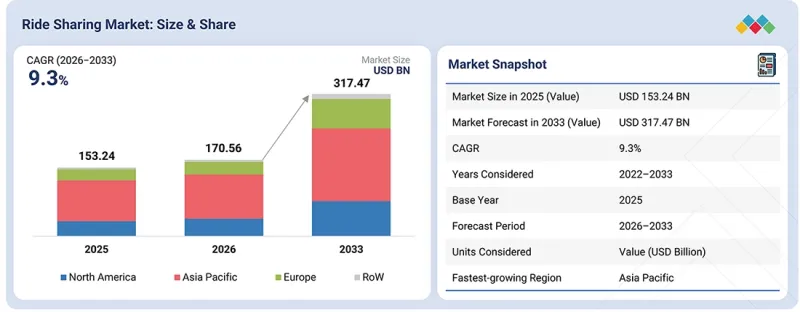
預計到 2026 年,叫車市場規模將達到 1,705.6 億美元,到 2033 年將達到 3,174.7 億美元,年複合成長率為 9.3%。
隨著消費者越來越重視按需、靈活的出行方式而非擁有私家車,市場正在不斷擴大,而營運商則透過數位平台和多服務產品提高了利用率。
| 調查範圍 | |
|---|---|
| 調查期 | 2026-2033 |
| 基準年 | 2025 |
| 預測期 | 2026-2033 |
| 目標單元 | 10億美元 |
| 部分 | 按服務類型、經營模式、車輛類型、動力系統、資訊服務、里程數和地區分類。 |
| 目標區域 | 亞太地區、歐洲、北美和世界其他地區 |
市場正在經歷電動車隊、企業出行方案以及多種出行方式整合的趨勢,而自動駕駛汽車正成為下一個重大變革。將自動駕駛汽車與駕駛人駕駛汽車結合的混合網路部署平台也開始湧現。
“預計到 2026 年,按服務類型電子召車將在共享出行市場中佔據最大的市場佔有率。”
預計到2033年,電子召車仍將保持其在共享出行市場中的最大佔有率,這主要得益於不斷成長的都市區出行需求、智慧型手機和數位支付普及率的提高、私家車擁有成本的增加以及智慧型手機預訂的廣泛應用。乘用車仍然是主流車型,因為它們能夠滿足最廣泛的出行目的和乘客群體。同時,在亞洲城市,兩輪和三輪車的重要性日益凸顯,經濟實惠的價格、交通堵塞以及短途出行等因素推動了小型車輛的使用。將自動駕駛汽車融入叫車服務是一個新的趨勢。隨著自動駕駛技術的進步、法規核准的獲得、車輛運營成本的最佳化以及消費者接受度的提高,自動駕駛計程車服務正從試驗計畫轉向在北美和歐洲特定城市的商業化部署。截至2026年9月,Waymo已將其全自動駕駛共享出行服務擴展到美國14個城市。同時,Uber、Pony.ai 和 Verne 於 2026 年 8 月在薩格勒布透過 Uber 平台推出了自動駕駛服務。 Waymo 也正準備進軍倫敦市場,並將東京和慕尼黑列為未來的目標市場。 2026 年 9 月,Lucid 和 Bolt 宣布計劃在歐洲主要城市部署 25,000 輛自動駕駛計程車,這是其全面計畫的一部分,該計畫旨在到 2035 年將其車隊規模擴大到 10 萬輛。隨著法律規範的完善以及自動駕駛車輛可靠性和成本效益的提高,預計到 2033 年,類似的部署將擴展到更多城市。
“在預測期內,按動力系統類型分類,電動車預計將成為共享出行市場中成長最快的細分市場。”
電動車(EV),包括乘用車、摩托車和三輪車,預計將成為共享出行市場成長最快的車款。儘管電動車的初始成本較高,但由於其營運和維護成本較低(通常與更長的營運時間和更高的日行駛里程相關),因此對共享旅遊營運商和駕駛者的吸引力越來越大。這使得營運成本的降低能夠隨著時間的推移抵消初始投資。亞太地區預計將繼續保持主要成長勢頭,領先的叫車平台正在擴大其電動車隊,以滿足高流量都市區交通的需求。例如,Grab 已與廣汽集團合作,在東南亞地區率先部署 2 萬輛電動車,並與比亞迪合作,為該地區的司機合作夥伴提供多達 5 萬輛電動車的使用權。 Grab 印尼公司目前已營運超過 1.1 萬輛電動車,主要行駛在交通繁忙的路線上。同時,在東南亞市場,電動二輪車和三輪車在短途共乘服務中日益普及,尤其是在通勤、住宅和封閉社區出行以及旅遊方面。在歐洲,電動車在共乘領域的應用也在快速發展,預計到2026年第一季,零排放車輛將佔優步總里程的17.9%,而在倫敦和阿姆斯特丹等城市,這一比例將超過40%。市場正逐步從個別駕駛者自主選擇電動車的模式,轉向由平台驅動的電氣化模式,透過車輛租賃、充電夥伴關係、純電動汽車乘車類別、資金籌措支援和其他獎勵來降低初期普及門檻。未來,充電基礎設施、資金籌措支援、車輛管理和車輛利用率的提升有望加速向規模更大、管理更有效率的電動車隊轉型,從而進一步提高電動車在共乘領域的商業性可行性。
“預計到2026年,亞太地區將成為叫車市場最大的地區。”
亞太地區擁有全球最大的共享出行市場,這得益於其極高的都市區出行需求、龐大的二輪車用戶群、高密度的城市結構、不斷成長的智慧型手機普及率,以及公共交通發展與門到門出行需求之間的差距。該市場以電動共享行為驅動力,其中乘用車在中國佔據主導地位,而二輪車和三輪車在印度則扮演更重要的角色。這種趨勢在短途都市區出行中尤其明顯,因為交通堵塞和經濟因素會影響車輛的選擇。中國擁有最成熟的數位預訂共享出行生態系統,而在印度,基於應用程式的乘用車、自動人力車和摩托車服務正在迅速發展。此外,隨著平台擴大將共享出行與數位支付、餐飲零售生態系統、公共交通、企業出行、電動車專案和多模態等服務相結合,市場正在超越傳統的叫車模式,用戶擴大利用出行平台。同時,營運商正利用人工智慧進行需求預測和司機導航,從而縮短用戶的等待時間。同時,電動車融資、充電夥伴關係以及車隊計畫正在幫助解決與電氣化相關的營運經濟問題。因此,該地區正從快速普及階段過渡到更加一體化的出行模式,未來的成長預計將由區域城市電動車普及率的提高、高利用率車隊的電氣化、與公共交通的合作、企業出行、人工智慧驅動的車隊管理以及未來自動駕駛叫車服務的擴展所驅動。
叫車市場的主要參與者如下:
- 按公司類型分類:行動服務供應商- 65%,技術提供者 - 35%
- 依職位分類:總監級 -15%,C級 -20%,其他 -65%
- 區域分佈:北美 -25%,歐洲 -20%,亞太地區 -55%
調查範圍:
這項市場研究從服務類型、經營模式模式、車輛類型、驅動系統、資訊服務、里程和地區等方面分析了共享旅遊市場。
本報告全面探討了影響叫車市場成長的關鍵因素,包括促進因素、限制因素、挑戰和機會。該報告還對主要行業參與者進行了詳細分析,深入剖析了他們的業務概況、解決方案、服務、關鍵戰略、協議、合作關係、產品和服務推出、併購、景氣衰退的影響以及近期發展動態。此外,報告還對叫車市場生態系統中的主要參與者進行了競爭分析。
購買本報告的理由:
本報告對市場佔有率和供應鏈進行了全面分析,並提供了零件製造商的詳細資訊。報告旨在透過提供準確的叫車市場整體收入預測,為市場領導者和新參與企業提供支援。此外,報告還透過識別關鍵的市場促進因素、限制因素、挑戰和機遇,幫助相關人員了解市場動態。
本報告深入分析了以下幾點:
- 對影響叫車市場成長的關鍵促進因素(透過多模態擴大市場規模,以及對共用交通途徑日益成長的偏好)、阻礙因素(平台經濟中的監管干預)、機遇(傳統網約車用例之外的自動駕駛汽車需求增加,以及互聯車隊數據的貨幣化)和挑戰(平衡可負擔性、司機收入和平台能力,以及將共享出行能力,以及將
- 產品開發/創新:深入了解共享旅遊市場的未來技術、研發活動和新產品發布。
- 市場發展:盈利市場的全面資訊(本報告分析了各地區的叫車市場)
- 市場多元化:關於叫車市場的新產品、未開發地區、近期趨勢和投資的全面訊息
- 競爭分析:對叫車市場主要參與者的市場佔有率、成長策略和服務產品進行詳細評估。
目錄
第1章:引言
第2章執行摘要
第3章重要考察
- 叫車市場蘊藏著巨大的商機
- 叫車市場:依服務類型分類
- 叫車市場:依推廣管道分類
- 叫車市場:依經營模式
- 共享出行市場:依資訊服務分類
- 共享出行市場:依車輛類型分類
- 共乘市場:按距離
- 叫車市集:按地區分類
第4章 市場概覽
- 市場動態
- 促進因素
- 抑制因子
- 機會
- 任務
- 未滿足的需求和未開發的領域
- 相互關聯的市場與跨產業機遇
- 一級/二級/三級供應商的策略性舉措
- 原始設備製造商和車隊製造商策略
- 大型企業的策略舉措
第5章 產業趨勢
- 宏觀經濟展望
- GDP趨勢與預測
- 叫車市場趨勢
- 價值鏈分析
- 生態系分析
- 叫車與旅遊平台
- 車輛和車隊供應商
- 自動駕駛和無人計程車技術
- 地圖繪製、導航和位置分析
- 車隊管理和遠端資訊處理
- 電動車充電和能源基礎設施
- 支付和金融基礎設施
- 價格分析
- 2025年各地區每次乘車平均費用(美元)
- 2026-2027 年主要會議和活動
- 影響客戶業務的趨勢和顛覆性因素
- 投資和資金籌措場景
- 案例研究分析
- Uber在阿薩姆邦推出私家車共乘服務,擴大共享出行範圍。
- 豐田和滴滴聯手開發專門針對叫車駕駛人的車輛服務
- LYFT 和 PSTA 利用共乘服務擴大公共運輸網路覆蓋範圍。
- AGERO 利用共乘服務來填補客戶車輛故障後出行選擇的空白。
- EZ RIDE 正在擴大其面向老年人的交通服務,透過利用共乘服務,而不增加自己的車隊規模。
- 數位金融服務與嵌入式生態系統
- 生態系統貸款和銀行
- 人工智慧驅動的資產管理平台
- 廣告和數據貨幣化
- 自動駕駛出行的營運和基礎設施
- 自主解決方案和車輛管理
- 交通情報許可
- 用於商業和特殊用途的自動駕駛
- 高階和企業行動架構
- 全球專車接送服務與高階主管出行服務
- 企業、B2B 和網路級解決方案
- 城市基礎設施解決方案
第6章:技術進步、人工智慧的影響、專利、創新與未來應用
- 主要技術
- 車輛與平台之間的即時連接
- 互補技術
- 智慧停車和彎道管理技術
- 車輛遠端資訊處理和遠端車輛診斷
- 相關技術
- 交通行動服務(MaaS) 的整合
- 技術與服務藍圖
- 短期藍圖
- 中期藍圖
- 長期藍圖
- 專利分析
- 未來應用
- 人工智慧/生成式人工智慧對共享出行市場的影響
- 主要應用場景和市場潛力
- 最佳實踐
- 人工智慧實施案例研究
- 相互關聯的生態系統及其對市場參與者的影響
- 共享出行市場中客戶對人工智慧/生成式人工智慧實施的準備情況
- 人工智慧驅動的資產建構和持續回報
- 經營模式/資產所有權
- 輕資產市場
- 平台自有車輛
- 促進要素所有
- 租賃/計程車輛
- 混合模式
- 營運經濟學
- 短途和長途的比較
- 尖峰時段和離峰時段
- 乘客人數
- 每輛車每天的行駛次數
- 空跑距離
第7章 監理情勢
- 監管機構、政府機構和其他組織
- 各國主要許可要求
- 區域層面的微型交通工具分類
第8章:顧客趨勢與購買行為
- 決策流程
- 購買標準
- 實施障礙和內部挑戰
- 各個終端用戶產業中尚未滿足的需求
- 市場盈利
- 獲利潛力
- 成本趨勢
- 提高利潤率的機會
第9章:共享旅遊市場:依服務類型分類
- 叫車服務
- 汽車共享
- 租車
- 車站式交通
- 產業趨勢
第10章:共享旅遊市場:依資訊服務分類
- 資訊
- 導航
- 沉澱
- 其他資訊服務
- 產業趨勢
第11章:共享旅遊市場:依推廣管道分類
- CNG/汽油
- 柴油引擎
- 電動車/混合動力汽車
- 產業洞察
第12章:共享旅遊市場:依經營模式
- B2C
- B2B / 面向企業
- P2P
- 車隊合作夥伴/聚合商
- 產業趨勢
第13章:共乘市場:依距離分類
- 短距離
- 長途
- 產業洞察
第14章:共享旅遊市場:依車輛類型分類
- 掀背車/轎車
- SUV/MPV
- 三輪車
- 摩托車
- 微移動性
- 產業趨勢
第15章:共享旅遊市場:依地區分類
- 亞太地區
- 中國
- 印度
- 日本
- 新加坡
- 印尼
- 澳洲
- 歐洲
- 英國
- 德國
- 法國
- 義大利
- 俄羅斯
- 西班牙
- 土耳其
- 荷蘭
- 北美洲
- 美國
- 加拿大
- 墨西哥
- 世界其他地區(ROW)
- 巴西
- 阿拉伯聯合大公國
- 南非
第16章 競爭格局
- 概述
- 主要參與企業的策略/優勢/2026年成功的原因
- 收入分析(2021-2025)
- 市佔率分析(2025 年)
- 品牌對比
- 企業評估矩陣:叫車服務供應商
- 明星公司
- 新興領導者
- 大公司
- 參與企業
- 企業企業發展狀況:叫車服務供應商,2025 年
- 企業評估矩陣:微行程服務供應商,2025 年
- 先進公司
- 應對力的公司
- 充滿活力的公司
- 起始點
- 公司規模:微行程服務供應商,2025年
- 企業估值和財務指標
- 競爭格局
- 服務啟動
- 交易
- 業務拓展
第17章:公司簡介
- 大公司
- DIDI GLOBAL INC.
- UBER TECHNOLOGIES, INC.
- LYFT, INC.
- BOLT
- GRAB
- GETT
- ANI TECHNOLOGIES PVT. LTD.(OLA)
- BLABLACAR
- INDRIVE
- SIXT
- AVIS BUDGET GROUP
- HERTZ
- ENTERPRISE MOBILITY
- 其他主要公司
- WAYMO
- CAR2GO
- CABIFY
- GOGET
- VIA TRANSPORTATION, INC.
- EASY TAXI
- FREE2MOVE
- EUROPCAR MOBILITY GROUP
- FREENOW
- GETAROUND
- CAREEM
- TURO
第18章:調查方法
第19章附錄
The ride sharing market is projected to reach USD 317.47 billion by 2033 from USD 170.56 billion in 2026 at a CAGR of 9.3%. The market is expanding as consumers increasingly prioritize on-demand, flexible mobility over private vehicle ownership, while operators improve utilization through digital platforms and multi-service offerings.
| Scope of the Report | |
|---|---|
| Years Considered for the Study | 2026-2033 |
| Base Year | 2025 |
| Forecast Period | 2026-2033 |
| Units Considered | USD billion |
| Segments | by Service Type, Business Model, Vehicle Type, Propulsion, Data Service, Distance, and Region |
| Regions covered | Asia Pacific, Europe, North America, and Rest of the World |
EV fleet adoption, corporate mobility programs, and integration of multiple mobility options are emerging within the market, while autonomous vehicles are emerging as the next major shift, with platforms beginning to deploy hybrid networks combining AVs with driver-operated vehicles.
"E-hailing to hold largest market share in the ride sharing market by service type in 2026"
E-hailing is expected to maintain the largest share of the ride sharing market by 2033, supported by rising urban mobility demand, increasing smartphone and digital payment penetration, higher private vehicle ownership costs, and stronger adoption of smartphone-based booking. Passenger cars remain the main vehicle type because they serve the widest range of trip purposes and passenger groups, while two-wheelers and three-wheelers are gaining importance in Asian cities where affordability, congestion, and shorter trip distances support the use of smaller vehicles. An emerging trend is the integration of autonomous vehicles into e-hailing services. With improvements in autonomous driving technology, regulatory approvals, fleet economics, and consumer acceptance, robotaxi services are moving from pilot programs toward commercial deployment in selected cities across North America and Europe. Waymo had expanded fully autonomous ride-hailing to 14 US cities by September 2026, while Uber, Pony.ai, and Verne launched autonomous rides through the Uber platform in Zagreb in August 2026. In addition, Waymo is preparing for expansion into London, with Tokyo and Munich also targeted as upcoming markets, while Lucid and Bolt announced plans in September 2026 to deploy 25,000 autonomous taxis across major European cities as part of a broader plan to scale the fleet to 100,000 vehicles by 2035. As regulatory frameworks mature and autonomous fleets become more reliable and cost-efficient, similar deployments are expected to expand to additional cities by 2033.
"Electric vehicles are expected to be the fastest-growing segment in the ride sharing market by propulsion during the forecast period."
Electric vehicles (EVs), including passenger cars, two-wheelers, and three-wheelers, are anticipated to be the fastest-growing vehicle type in the ride sharing market. Although EVs have higher upfront costs, their lower running and maintenance costs become increasingly attractive for ride sharing operators and drivers because vehicles operate for long hours and accumulate high daily mileage, allowing operating savings to offset the initial investment over time. Asia Pacific is expected to remain a key growth region, with major ride-hailing platforms expanding their EV fleet offerings to address high-utilization urban trips. For instance, Grab has partnered with GAC to deploy an initial 20,000 EVs across Southeast Asia and has also partnered with BYD to provide access to up to 50,000 EVs for its driver partners across the region. Grab Indonesia already operates more than 11,000 EVs, primarily on high-volume routes. On the other hand, electric two-wheelers and three-wheelers are also gaining relevance for short-distance ride services in Southeast Asian markets, particularly for office commutes, residential and gated community travel, and tourism. Europe is also witnessing strong EV adoption in ride-hailing, with zero-emission vehicles accounting for 17.9% of Uber trip kilometers in Q1 2026, while the share exceeded 40% in cities such as London and Amsterdam. The market is gradually shifting from individual drivers independently selecting EVs toward platform-supported electrification through vehicle leasing, charging partnerships, dedicated EV ride categories, financing support, and other incentives that reduce the upfront barrier to adoption. Going forward, improved charging access, financing support, fleet management, and higher vehicle utilization are expected to accelerate the transition toward larger and more efficiently managed electric fleets, strengthening the commercial case for EV adoption in ride sharing.
"Asia Pacific to be the largest region in the ride sharing market in 2026"
Asia Pacific is the largest ride sharing market because the region combines very high urban travel demand with a large addressable base of motorcycle users, dense cities, rising smartphone adoption, and gaps between public transport availability and door-to-door mobility needs. The market is led by e-hailing, with passenger cars dominant in China, while two-wheelers and three-wheelers have a much larger role in India, particularly for short urban trips where congestion and affordability influence vehicle choice. China has the most mature digitally booked e-hailing ecosystem, while India is seeing rapid expansion of app-based car, auto-rickshaw, and bike services. The market is also moving beyond conventional ride booking, as platforms increasingly connect ride hailing with digital payments, food and retail ecosystems, public transport, corporate mobility, EV programs, and multimodal journeys, increasing the number of situations in which users interact with mobility platforms. Additionally, operators are using AI-based demand prediction and driver guidance to reduce idle time, while EV financing, charging partnerships, and fleet programs are helping address the operating economics of electrification. The region is therefore moving from rapid adoption toward a more integrated mobility model, where future growth is expected to come from greater penetration in secondary cities, electrification of high utilization fleets, integration with public transport, corporate mobility, AI-enabled fleet management, and eventual scaling of autonomous ride services.
The breakdown of the profile of primary participants in the ride sharing market:
- By Company Type: Mobility Service Providers - 65%, and Technology Providers- 35%
- By Designation: Director Level - 15%, C-Level - 20%, and Others - 65%
- By Region: North America - 25%, Europe - 20%, and Asia Pacific - 55%
The ride sharing market is dominated by established players such as Uber Technologies, Inc. (US), DiDi Global Inc. (China), Lyft, Inc. (US), Grab (Singapore), and Bolt (Estonia).
Research Coverage:
The market study covers the ride sharing market by service type, business model, vehicle type, propulsion, data service, distance, and region.
The report comprehensively discusses key factors impacting the growth of the ride sharing market, including drivers, constraints, challenges, and opportunities. It provides detailed analyses of major industry players, offering insights into their business profiles, solutions, services, key strategies, contracts, partnerships, agreements, product and service launches, mergers and acquisitions, recession impacts, and recent developments. Additionally, the report includes a competitive analysis of key players within the ride sharing market ecosystem.
Reasons to buy this report:
This report offers comprehensive analyses of market share and supply chains and detailed information on component manufacturers. It is designed to aid market leaders and new entrants by providing precise revenue estimates for the overall ride sharing market. Additionally, the report helps stakeholders understand the market dynamics, highlighting key drivers, restraints, challenges, and opportunities.
The report provides insights on the following pointers:
- Analysis of key drivers (TAM expansion via multi-modal integration, growing preference for shared transportation), restraints (regulatory intervention in platform economics), opportunities (autonomous vehicles expanding demand beyond traditional ridesharing use cases, monetization of connected fleet data), and challenges (balancing affordability, driver earnings, and platform margins, scaling shared mobility beyond high-density urban markets) influencing the growth of the ride sharing market
- Product Development/Innovation: Detailed insights into upcoming technologies, R&D activities, and product launches in the ride sharing market
- Market Development: Comprehensive information about lucrative markets (the report analyses the ride sharing market across various regions)
- Market Diversification: Exhaustive information about new products, untapped geographies, recent developments, and investments in the ride sharing market
- Competitive Assessment: In-depth assessment of market shares, growth strategies, and service offerings of leading players like Uber Technologies, Inc. (US), DiDi Global Inc. (China), Lyft, Inc. (US), Grab (Singapore), and Bolt (Estonia) in the ride sharing market
TABLE OF CONTENTS
1 INTRODUCTION
- 1.1 STUDY OBJECTIVES
- 1.2 MARKET DEFINITION
- 1.3 MARKET SCOPE
- 1.3.1 MARKET SEGMENTATION AND REGIONAL SCOPE
- 1.3.2 INCLUSIONS AND EXCLUSIONS
- 1.3.3 YEARS CONSIDERED
- 1.4 CURRENCY CONSIDERED
- 1.5 STAKEHOLDERS
- 1.6 SUMMARY OF CHANGES
2 EXECUTIVE SUMMARY
- 2.1 MARKET HIGHLIGHTS AND KEY INSIGHTS
- 2.2 KEY MARKET PARTICIPANTS: MAPPING OF STRATEGIC DEVELOPMENTS
- 2.3 DISRUPTIVE TRENDS IN RIDE SHARING MARKET
- 2.4 HIGH-GROWTH SEGMENTS
- 2.5 REGIONAL SNAPSHOT: MARKET SIZE, GROWTH RATE, AND FORECAST
3 PREMIUM INSIGHTS
- 3.1 ATTRACTIVE OPPORTUNITIES IN RIDE SHARING MARKET
- 3.2 RIDE SHARING MARKET, BY SERVICE TYPE
- 3.3 RIDE SHARING MARKET, BY PROPULSION
- 3.4 RIDE SHARING MARKET, BY BUSINESS MODEL
- 3.5 RIDE SHARING MARKET, BY DATA SERVICE
- 3.6 RIDE SHARING MARKET, BY VEHICLE TYPE
- 3.7 RIDE SHARING MARKET, BY DISTANCE
- 3.8 RIDE SHARING MARKET, BY REGION
4 MARKET OVERVIEW
- 4.1 INTRODUCTION
- 4.2 MARKET DYNAMICS
- 4.2.1 DRIVERS
- 4.2.1.1 TAM expansion via multimodal integration
- 4.2.1.2 Growing preference for shared transportation
- 4.2.2 RESTRAINTS
- 4.2.2.1 Regulatory intervention in platform economics
- 4.2.3 OPPORTUNITIES
- 4.2.3.1 Autonomous vehicles expanding demand beyond traditional ride sharing use cases
- 4.2.3.2 Monetization of connected fleet data
- 4.2.4 CHALLENGES
- 4.2.4.1 Balancing affordability, driver earnings, and platform margins
- 4.2.4.2 Scaling shared mobility beyond high-density urban markets
- 4.2.1 DRIVERS
- 4.3 UNMET NEEDS AND WHITE SPACES
- 4.4 INTERCONNECTED MARKETS AND CROSS-SECTOR OPPORTUNITIES
- 4.5 STRATEGIC MOVES BY TIER-1/2/3 SUPPLIERS
- 4.5.1 OEM VS FLEET MANUFACTURERS STRATEGIES
- 4.5.2 STRATEGIC MOVES BY KEY COMPANIES
5 INDUSTRY TRENDS
- 5.1 MACROECONOMIC OUTLOOK
- 5.1.1 GDP TRENDS AND FORECAST
- 5.1.2 TRENDS IN RIDE SHARING MARKET
- 5.2 VALUE CHAIN ANALYSIS
- 5.3 ECOSYSTEM ANALYSIS
- 5.3.1 RIDE HAILING & MOBILITY PLATFORMS
- 5.3.2 VEHICLE & FLEET SUPPLIERS
- 5.3.3 AUTONOMOUS DRIVING & ROBOTAXI TECHNOLOGY
- 5.3.4 MAPPING, NAVIGATION, & LOCATION INTELLIGENCE
- 5.3.5 FLEET MANAGEMENT & TELEMATICS
- 5.3.6 EV CHARGING & ENERGY INFRASTRUCTURE
- 5.3.7 PAYMENTS & FINANCIAL INFRASTRUCTURE
- 5.4 PRICING ANALYSIS
- 5.4.1 AVERAGE COST PER TRIP FOR RIDE SHARING, BY REGION, 2025 (USD)
- 5.5 KEY CONFERENCES AND EVENTS, 2026-2027
- 5.6 TRENDS/DISRUPTIONS IMPACTING CUSTOMER BUSINESS
- 5.7 INVESTMENT AND FUNDING SCENARIO
- 5.8 CASE STUDY ANALYSIS
- 5.8.1 UBER LAUNCHES PRIVATE CAR RIDE SHARING TO EXPAND SHARED MOBILITY IN ASSAM
- 5.8.2 TOYOTA AND DIDI DEVELOP VEHICLE SERVICES SPECIFICALLY FOR RIDE-HAILING DRIVERS
- 5.8.3 LYFT AND PSTA USE RIDE SHARING TO EXTEND PUBLIC TRANSPORTATION COVERAGE
- 5.8.4 AGERO USES RIDE SHARING TO SOLVE CUSTOMER TRANSPORTATION GAP AFTER VEHICLE BREAKDOWNS
- 5.8.5 EZ RIDE USES RIDE SHARING TO SCALE SENIOR TRANSPORTATION WITHOUT EXPANDING ITS OWN FLEET
- 5.9 DIGITAL FINANCIAL SERVICES AND EMBEDDED ECOSYSTEM
- 5.9.1 ECOSYSTEM LENDING & BANKING
- 5.9.2 AI-POWERED WEALTH PLATFORMS
- 5.9.3 ADVERTISEMENTS & DATA MONETIZATION
- 5.10 AUTONOMOUS MOBILITY OPERATIONS & INFRASTRUCTURE
- 5.10.1 AUTONOMOUS SOLUTIONS & DEPOT MANAGEMENT
- 5.10.2 TRANSIT INTELLIGENCE LICENSING
- 5.10.3 COMMERCIAL/SPECIALIZED AUTONOMY
- 5.11 PREMIUM & ENTERPRISE MOBILITY ARCHITECTURE
- 5.11.1 GLOBAL CHAUFFEUR & EXECUTIVE TRAVEL
- 5.11.2 CORPORATE, B2B, & WHOLE-NETWORK SOLUTIONS
- 5.11.3 URBAN INFRASTRUCTURE SOLUTIONS
6 TECHNOLOGICAL ADVANCEMENTS, AI-DRIVEN IMPACT, PATENTS, INNOVATIONS, AND FUTURE APPLICATIONS
- 6.1 KEY TECHNOLOGIES
- 6.1.1 VEHICLE-TO-PLATFORM REAL-TIME CONNECTIVITY
- 6.2 COMPLEMENTARY TECHNOLOGIES
- 6.2.1 SMART PARKING AND CURB MANAGEMENT TECHNOLOGY
- 6.2.2 VEHICLE TELEMATICS AND REMOTE VEHICLE DIAGNOSTICS
- 6.3 ADJACENT TECHNOLOGIES
- 6.3.1 MOBILITY-AS-A-SERVICE INTEGRATION
- 6.4 TECHNOLOGY/SERVICE ROADMAP
- 6.4.1 SHORT-TERM ROADMAP
- 6.4.2 MID-TERM ROADMAP
- 6.4.3 LONG-TERM ROADMAP
- 6.5 PATENT ANALYSIS
- 6.6 FUTURE APPLICATIONS
- 6.7 IMPACT OF AI/GEN AI ON RIDE SHARING MARKET
- 6.7.1 TOP USE CASES AND MARKET POTENTIAL
- 6.7.2 BEST PRACTICES
- 6.7.3 CASE STUDIES OF AI IMPLEMENTATION
- 6.7.4 INTERCONNECTED ECOSYSTEM AND IMPACT ON MARKET PLAYERS
- 6.7.5 CLIENTS' READINESS TO ADOPT AI/GEN AI IN RIDE SHARING MARKET
- 6.7.6 AI-POWERED WEALTH AND RECURRING REVENUE
- 6.8 BUSINESS MODEL/ASSET OWNERSHIP
- 6.8.1 ASSET-LIGHT MARKETPLACE
- 6.8.2 PLATFORM-OWNED FLEET
- 6.8.3 DRIVER-OWNED
- 6.8.4 LEASED/RENTED FLEET
- 6.8.5 HYBRID MODELS
- 6.9 TRIP ECONOMICS
- 6.9.1 SHORT VS LONG TRIPS
- 6.9.2 PEAK VS OFF-PEAK
- 6.9.3 OCCUPANCY
- 6.9.4 TRIPS/VEHICLE/DAY
- 6.9.5 DEADHEAD MILEAGE
7 REGULATORY LANDSCAPE
- 7.1 REGULATORY BODIES, GOVERNMENT AGENCIES, AND OTHER ORGANIZATIONS
- 7.2 KEY LICENSING REQUIREMENTS, BY COUNTRY
- 7.2.1 CLASSIFICATION OF MICRO-MOBILITY VEHICLES AT REGIONAL LEVEL
- 7.2.1.1 Europe
- 7.2.1.2 US
- 7.2.1.3 Asia
- 7.2.1.4 Latin America
- 7.2.1 CLASSIFICATION OF MICRO-MOBILITY VEHICLES AT REGIONAL LEVEL
8 CUSTOMER LANDSCAPE AND BUYER BEHAVIOR
- 8.1 DECISION-MAKING PROCESS
- 8.2 BUYING CRITERIA
- 8.3 ADOPTION BARRIERS AND INTERNAL CHALLENGES
- 8.4 UNMET NEEDS FROM VARIOUS END-USE INDUSTRIES
- 8.5 MARKET PROFITABILITY
- 8.5.1 REVENUE POTENTIAL
- 8.5.2 COST DYNAMICS
- 8.5.3 MARGIN OPPORTUNITIES
9 RIDE SHARING MARKET, BY SERVICE TYPE
- 9.1 INTRODUCTION
- 9.2 E-HAILING
- 9.2.1 EXPANSION OF ON-DEMAND, APP-BASED POINT-TO-POINT MOBILITY TO DRIVE ADOPTION
- 9.3 CAR SHARING
- 9.3.1 HIGH COST AND LOW UTILIZATION OF PRIVATE VEHICLE OWNERSHIP TO INCREASE DEMAND
- 9.4 CAR RENTAL
- 9.4.1 SHIFT FROM VEHICLE OWNERSHIP TOWARD ASSET-LIGHT MOBILITY TO DRIVE DEMAND FOR CAR RENTAL
- 9.5 STATION-BASED MOBILITY
- 9.5.1 INTEGRATION WITH PUBLIC TRANSPORT AND MOBILITY HUBS TO DRIVE STATION-BASED MOBILITY DEMAND
- 9.6 INDUSTRY INSIGHTS
10 RIDE SHARING MARKET, BY DATA SERVICE
- 10.1 INTRODUCTION
- 10.2 INFORMATION
- 10.2.1 REAL-TIME TRIP VISIBILITY TO INCREASE RIDER CONFIDENCE AND IMPROVE RIDE EXECUTION
- 10.3 NAVIGATION
- 10.3.1 REAL-TIME TRAFFIC AND DYNAMIC ROUTE OPTIMIZATION TO INCREASE NEED FOR NAVIGATION SERVICES
- 10.4 PAYMENT
- 10.4.1 PAYMENT DIGITIZATION AND MULTIMODAL INTEGRATION TO INCREASE NEED FOR SEAMLESS PAYMENT SERVICES
- 10.5 OTHER DATA SERVICES
- 10.6 INDUSTRY INSIGHTS
11 RIDE SHARING MARKET, BY PROPULSION
- 11.1 INTRODUCTION
- 11.2 CNG/PETROL
- 11.2.1 ABILITY TO MEET URBAN AIR QUALITY REQUIREMENTS WHILE RETAINING CONVENTIONAL POWERTRAIN ARCHITECTURE TO SUPPORT ADOPTION
- 11.3 DIESEL
- 11.3.1 HIGH TORQUE AND FUEL EFFICIENCY TO SUPPORT INTENSIVE, LONG-DISTANCE RIDE-SHARING OPERATIONS
- 11.4 ELECTRIC/HYBRID VEHICLE
- 11.4.1 LOWER RUNNING COST AND SUITABILITY FOR HIGH DAILY UTILIZATION TO MAKE EVS ATTRACTIVE FOR RIDE SHARING FLEETS
- 11.5 INDUSTRY INSIGHTS
12 RIDE SHARING MARKET, BY BUSINESS MODEL
- 12.1 INTRODUCTION
- 12.2 B2C
- 12.2.1 GROWING CONSUMER PREFERENCE FOR APP-BASED, ON-DEMAND POINT-TO-POINT MOBILITY TO DRIVE GROWTH
- 12.3 B2B/CORPORATE
- 12.3.1 EMPLOYER DEMAND FOR MANAGED, DATA-ENABLED EMPLOYEE MOBILITY TO DRIVE GROWTH
- 12.4 P2P
- 12.4.1 HIGHER UTILIZATION OF PRIVATELY OWNED VEHICLES THROUGH COST SHARING AND DIGITAL MATCHING TO SUPPORT GROWTH
- 12.5 FLEET-PARTNER/AGGREGATOR
- 12.5.1 EXPANDING RIDE SUPPLY WITHOUT REQUIRING PLATFORM TO OWN FULL VEHICLE FLEET TO SUPPORT GROWTH
- 12.6 INDUSTRY INSIGHTS
13 RIDE SHARING MARKET, BY DISTANCE
- 13.1 INTRODUCTION
- 13.2 SHORT DISTANCE
- 13.2.1 HIGH FREQUENCY OF URBAN TRIPS TO INCREASE DEMAND FOR FLEXIBLE, APP-BASED RIDE SHARING
- 13.3 LONG DISTANCE
- 13.3.1 DIRECT POINT-TO-POINT TRAVEL TO MAKE RIDE SHARING ATTRACTIVE FOR AIRPORT, INTERCITY, AND SUBURBAN JOURNEYS
- 13.4 INDUSTRY INSIGHTS
14 RIDE SHARING MARKET, BY VEHICLE TYPE
- 14.1 INTRODUCTION
- 14.2 HATCHBACK/SEDAN
- 14.2.1 HIGH UTILIZATION AND LOWER OPERATING COST TO MAKE COMPACT PASSENGER CARS WELL SUITED TO EVERYDAY RIDE SHARING
- 14.3 SUV/MPV
- 14.3.1 HIGHER CAPACITY, PASSENGER COMFORT, AND MULTI-PURPOSE UTILITY TO SUPPORT GREATER ADOPTION IN RIDE SHARING
- 14.4 3-WHEELER
- 14.4.1 LOW SPACE REQUIREMENT AND AFFORDABLE URBAN CONNECTIVITY TO DRIVE 3-WHEELER ADOPTION IN RIDE SHARING
- 14.5 2-WHEELER
- 14.5.1 FASTER, LOWER SPACE, AND LOWER OPERATING COST MOBILITY TO SUPPORT DEMAND FOR SHORT URBAN RIDES
- 14.6 MICROMOBILITY
- 14.6.1 SHORT TRIP ECONOMICS, FIRST MILE, AND LAST MILE CONNECTIVITY TO DRIVE ADOPTION OF MICROMOBILITY
- 14.7 INDUSTRY INSIGHTS
15 RIDE SHARING MARKET, BY REGION
- 15.1 INTRODUCTION
- 15.2 ASIA PACIFIC
- 15.2.1 CHINA
- 15.2.1.1 Large urban travel base and mature digital mobility ecosystem to drive demand for ride sharing services
- 15.2.2 INDIA
- 15.2.2.1 Expansion of public transport to increase need for shared first-mile and last-mile connectivity
- 15.2.3 JAPAN
- 15.2.3.1 Transport supply shortages to accelerate demand for flexible shared mobility in underserved areas
- 15.2.4 SINGAPORE
- 15.2.4.1 Car-lite policies and integrated shared mobility to expand role of ride sharing
- 15.2.5 INDONESIA
- 15.2.5.1 Fragmented urban mobility and high motorcycle dependence to drive demand for app-based shared transport
- 15.2.6 AUSTRALIA
- 15.2.6.1 Accessibility gaps to create distinct demand pool for ride sharing
- 15.2.1 CHINA
- 15.3 EUROPE
- 15.3.1 UK
- 15.3.1.1 Growth of shared automated mobility and robotaxi services to propel market
- 15.3.2 GERMANY
- 15.3.2.1 Expansion of app-based on-demand public transport to create structured ride pooling demand
- 15.3.3 FRANCE
- 15.3.3.1 Dedicated carpooling lanes and digital enforcement to strengthen ride sharing demand
- 15.3.4 ITALY
- 15.3.4.1 Expansion of proximity-based shared mobility to create demand for short-duration and local vehicle access
- 15.3.5 RUSSIA
- 15.3.5.1 Digital formalization of taxi aggregators to expand trusted app-based mobility
- 15.3.6 SPAIN
- 15.3.6.1 Transport poverty to increase demand for cost sharing and shared vehicle access
- 15.3.7 TURKEY
- 15.3.7.1 Rapid deployment of connected road infrastructure to enable data-driven shared mobility
- 15.3.8 NETHERLANDS
- 15.3.8.1 Growth of peer-to-peer vehicle sharing to expand access to underutilized private vehicles
- 15.3.1 UK
- 15.4 NORTH AMERICA
- 15.4.1 US
- 15.4.1.1 Expansion and active management of high-occupancy vehicle and express lanes to create incentive for ride sharing
- 15.4.2 CANADA
- 15.4.2.1 Rural and remote mobility gaps to push demand for flexible shared transport
- 15.4.3 MEXICO
- 15.4.3.1 Expansion of motorcycle-based platform mobility to create ride sharing demand pool
- 15.4.1 US
- 15.5 REST OF THE WORLD (ROW)
- 15.5.1 BRAZIL
- 15.5.1.1 Rapid adoption of motorcycle-based passenger mobility to drive demand for ride sharing services
- 15.5.2 UAE
- 15.5.2.1 Expansion of cross-emirate ride-sharing for cost-efficient intercity travel to drive demand
- 15.5.3 SOUTH AFRICA
- 15.5.3.1 Digital integration of minibus taxi network to expand app-based shared mobility
- 15.5.1 BRAZIL
16 COMPETITIVE LANDSCAPE
- 16.1 OVERVIEW
- 16.2 KEY PLAYER COMPETITIVE STRATEGIES/RIGHT TO WIN, 2026
- 16.3 REVENUE ANALYSIS, 2021-2025
- 16.4 MARKET SHARE ANALYSIS, 2025
- 16.5 BRAND COMPARISON
- 16.6 COMPANY EVALUATION MATRIX: RIDE SHARING SERVICE PROVIDERS
- 16.6.1 STARS
- 16.6.2 EMERGING LEADERS
- 16.6.3 PERVASIVE PLAYERS
- 16.6.4 PARTICIPANTS
- 16.6.5 COMPANY FOOTPRINT: RIDE SHARING SERVICE PROVIDERS, 2025
- 16.6.5.1 Company footprint
- 16.6.5.2 Region footprint
- 16.6.5.3 Service type footprint
- 16.6.5.4 Vehicle type footprint
- 16.7 COMPANY EVALUATION MATRIX: MICROMOBILITY SERVICE PROVIDERS, 2025
- 16.7.1 PROGRESSIVE COMPANIES
- 16.7.2 RESPONSIVE COMPANIES
- 16.7.3 DYNAMIC COMPANIES
- 16.7.4 STARTING BLOCKS
- 16.7.5 COMPANY FOOTPRINT: MICROMOBILITY SERVICE PROVIDERS, 2025
- 16.7.5.1 Company footprint
- 16.7.5.2 Region footprint
- 16.7.5.3 Service footprint
- 16.8 COMPANY VALUATION AND FINANCIAL METRICS
- 16.9 COMPETITIVE SCENARIO
- 16.9.1 SERVICE LAUNCHES
- 16.9.2 DEALS
- 16.9.3 EXPANSIONS
17 COMPANY PROFILES
- 17.1 KEY PLAYERS
- 17.1.1 DIDI GLOBAL INC.
- 17.1.1.1 Business overview
- 17.1.1.2 Services offered
- 17.1.1.3 Recent developments
- 17.1.1.3.1 Product/Service launches
- 17.1.1.3.2 Deals
- 17.1.1.3.3 Other developments
- 17.1.1.4 MnM view
- 17.1.1.4.1 Key strengths
- 17.1.1.4.2 Strategic choices
- 17.1.1.4.3 Weaknesses and competitive threats
- 17.1.2 UBER TECHNOLOGIES, INC.
- 17.1.2.1 Business overview
- 17.1.2.2 Services offered
- 17.1.2.3 Recent developments
- 17.1.2.3.1 Service launches
- 17.1.2.3.2 Deals
- 17.1.2.3.3 Expansions
- 17.1.2.4 MnM view
- 17.1.2.4.1 Key strengths
- 17.1.2.4.2 Strategic choices
- 17.1.2.4.3 Weaknesses and competitive threats
- 17.1.3 LYFT, INC.
- 17.1.3.1 Business overview
- 17.1.3.2 Services offered
- 17.1.3.3 Recent developments
- 17.1.3.3.1 Service launches
- 17.1.3.3.2 Deals
- 17.1.3.3.3 Expansions
- 17.1.3.4 MnM view
- 17.1.3.4.1 Key strengths
- 17.1.3.4.2 Strategic choices
- 17.1.3.4.3 Weaknesses and competitive threats
- 17.1.4 BOLT
- 17.1.4.1 Business overview
- 17.1.4.2 Services offered
- 17.1.4.3 Recent developments
- 17.1.4.3.1 Service launches
- 17.1.4.3.2 Deals
- 17.1.4.3.3 Expansions
- 17.1.4.4 MnM view
- 17.1.4.4.1 Key strengths
- 17.1.4.4.2 Strategic choices
- 17.1.4.4.3 Weaknesses and competitive threats
- 17.1.5 GRAB
- 17.1.5.1 Business overview
- 17.1.5.2 Services offered
- 17.1.5.3 Recent developments
- 17.1.5.3.1 Service launches
- 17.1.5.3.2 Deals
- 17.1.5.4 MnM view
- 17.1.5.4.1 Key strengths
- 17.1.5.4.2 Strategic choices
- 17.1.5.4.3 Weaknesses and competitive threats
- 17.1.6 GETT
- 17.1.6.1 Business overview
- 17.1.6.2 Services offered
- 17.1.6.3 Recent developments
- 17.1.6.3.1 Service launches
- 17.1.6.3.2 Deals
- 17.1.7 ANI TECHNOLOGIES PVT. LTD. (OLA)
- 17.1.7.1 Business overview
- 17.1.7.2 Services offered
- 17.1.8 BLABLACAR
- 17.1.8.1 Business overview
- 17.1.8.2 Services offered
- 17.1.8.3 Recent developments
- 17.1.8.3.1 Service launches
- 17.1.8.3.2 Deals
- 17.1.8.3.3 Expansions
- 17.1.9 INDRIVE
- 17.1.9.1 Business overview
- 17.1.9.2 Services offered
- 17.1.9.3 Recent developments
- 17.1.9.3.1 Deals
- 17.1.9.3.2 Expansions
- 17.1.10 SIXT
- 17.1.10.1 Business overview
- 17.1.10.2 Services offered
- 17.1.10.3 Recent developments
- 17.1.10.3.1 Service launches
- 17.1.10.3.2 Deals
- 17.1.11 AVIS BUDGET GROUP
- 17.1.11.1 Business overview
- 17.1.11.2 Services offered
- 17.1.12 HERTZ
- 17.1.12.1 Business overview
- 17.1.12.2 Services offered
- 17.1.13 ENTERPRISE MOBILITY
- 17.1.13.1 Business overview
- 17.1.13.2 Services offered
- 17.1.1 DIDI GLOBAL INC.
- 17.2 OTHER PLAYERS
- 17.2.1 WAYMO
- 17.2.2 CAR2GO
- 17.2.3 CABIFY
- 17.2.4 GOGET
- 17.2.5 VIA TRANSPORTATION, INC.
- 17.2.6 EASY TAXI
- 17.2.7 FREE2MOVE
- 17.2.8 EUROPCAR MOBILITY GROUP
- 17.2.9 FREENOW
- 17.2.10 GETAROUND
- 17.2.11 CAREEM
- 17.2.12 TURO
18 RESEARCH METHODOLOGY
- 18.1 RESEARCH DATA
- 18.1.1 SECONDARY DATA
- 18.1.1.1 List of secondary sources
- 18.1.1.2 Key data from secondary sources
- 18.1.2 PRIMARY DATA
- 18.1.2.1 List of primary participants
- 18.1.3 SAMPLING TECHNIQUES AND DATA COLLECTION METHODS
- 18.1.1 SECONDARY DATA
- 18.2 MARKET SIZE ESTIMATION
- 18.2.1 BOTTOM-UP APPROACH
- 18.2.2 TOP-DOWN APPROACH
- 18.3 DATA TRIANGULATION
- 18.4 RESEARCH ASSUMPTIONS AND RISK ASSESSMENT
- 18.5 RESEARCH LIMITATIONS
19 APPENDIX
- 19.1 INSIGHTS FROM INDUSTRY EXPERTS
- 19.2 DISCUSSION GUIDE
- 19.3 KNOWLEDGESTORE: MARKETSANDMARKETS' SUBSCRIPTION PORTAL
- 19.4 CUSTOMIZATION OPTIONS
- 19.4.1 MICRO-MOBILITY MARKET, BY TYPE
- 19.4.1.1 Bicycles
- 19.4.1.2 E-bikes
- 19.4.1.3 E-kick scooters
- 19.4.1.4 Others
- 19.4.2 CAR SHARING MARKET, BY TYPE
- 19.4.2.1 P2P Car Sharing
- 19.4.2.2 Corporate Car Sharing
- 19.4.1 MICRO-MOBILITY MARKET, BY TYPE
- 19.5 RELATED REPORTS
- 19.6 AUTHOR DETAILS
List of Tables
- TABLE 1 MARKET DEFINITIONS
- TABLE 2 CURRENCY EXCHANGE RATES
- TABLE 3 OVERVIEW OF MULTIMODAL INTEGRATION EXPANDING RIDE SHARING TAM
- TABLE 4 OVERVIEW OF MULTIMODAL INTEGRATION PROVIDED BY KEY PLAYERS
- TABLE 5 AVERAGE COST TO OWN AND OPERATE NEW CAR, 2025
- TABLE 6 AVERAGE COST OF TOP-SELLING MODELS, 2025
- TABLE 7 COMPARISON OF VEHICLE OWNERSHIP VS RIDE SHARING
- TABLE 8 OVERVIEW OF REGULATORY DEVELOPMENTS, BY COUNTRIES
- TABLE 9 CONVENTIONAL RIDE SHARING VS AV-ENABLED RIDE SHARING
- TABLE 10 AV-ENABLED RIDE SHARING, BY KEY COMPANY
- TABLE 11 CONNECTED VEHICLE DATA SCALE AND COMMERCIAL OPPORTUNITY
- TABLE 12 OVERVIEW PLATFORM ECONOMICS AND DRIVER EARNINGS PRESSURE IN RIDE SHARING
- TABLE 13 KEY COST DRIVERS AND THEIR IMPACT ON RIDE SHARING
- TABLE 14 STRATEGIC MOVES BY TIER-1/2/3 SUPPLIERS
- TABLE 15 OEM VS FLEET MANUFACTURERS STRATEGIES
- TABLE 16 STRATEGIC MOVES BY KEY COMPANIES
- TABLE 17 GDP PERCENTAGE CHANGE, BY KEY COUNTRY, 2022-2031
- TABLE 18 ROLE OF COMPANIES IN ECOSYSTEM
- TABLE 19 AVERAGE COST PER TRIP FOR RIDE SHARING, BY REGION, 2025 (USD)
- TABLE 20 RIDE SHARING MARKET: LIST OF KEY CONFERENCES AND EVENTS, 2026-2027
- TABLE 21 LIST OF FUNDING, 2025-2026
- TABLE 22 OVERVIEW OF LENDING/BANKING ACTIVITIES BY KEY PLAYERS
- TABLE 23 OVERVIEW OF AI-POWERED WEALTH MANAGEMENT INITIATIVES BY KEY PLAYERS
- TABLE 24 OVERVIEW OF KEY RIDE SHARING COMPANIES MONETIZING ADVERTISING AND MOBILITY DATA
- TABLE 25 OVERVIEW OF AUTONOMOUS SOLUTIONS & DEPOT MANAGEMENT INITIATIVES, BY KEY COMPANY
- TABLE 26 OVERVIEW OF KEY COMPANIES MONETIZING TRANSIT INTELLIGENCE AND MOBILITY DATA
- TABLE 27 COMMERCIAL/SPECIALIZED AUTONOMY: KEY COMPANY DEPLOYMENTS
- TABLE 28 OVERVIEW OF CORPORATE, B2B, AND WHOLE NETWORK SOLUTIONS BY MAJOR COMPANIES
- TABLE 29 OVERVIEW OF URBAN INFRASTRUCTURE SOLUTIONS, BY KEY COMPANY
- TABLE 30 VEHICLE TO PLATFORM REAL-TIME CONNECTIVITY IN RIDE SHARING
- TABLE 31 OVERVIEW OF SMART PARKING AND CURB MANAGEMENT TECHNOLOGY
- TABLE 32 OPERATIONAL IMPACT OF SMART CURB INTELLIGENCE
- TABLE 33 CONVENTIONAL VS CONNECTED VEHICLE DIAGNOSTICS
- TABLE 34 MAAS TECHNOLOGY ARCHITECTURE
- TABLE 35 PATENT ANALYSIS, 2026
- TABLE 36 COMPARISON OF BUSINESS MODEL AND ASSET OWNERSHIP
- TABLE 37 TRIP ECONOMICS OF UBER, 2026
- TABLE 38 SHORT VS LONG TRIPS
- TABLE 39 PEAK VS OFF-PEAK
- TABLE 40 LOW OCCUPANCY VS HIGH OCCUPANCY
- TABLE 41 LOWER TRIPS/VEHICLE/DAY VS HIGHER TRIPS/VEHICLE/DAY
- TABLE 42 NORTH AMERICA: LIST OF REGULATORY BODIES, GOVERNMENT AGENCIES, AND OTHER ORGANIZATIONS
- TABLE 43 EUROPE: LIST OF REGULATORY BODIES, GOVERNMENT AGENCIES, AND OTHER ORGANIZATIONS
- TABLE 44 ASIA PACIFIC: LIST OF REGULATORY BODIES, GOVERNMENT AGENCIES, AND OTHER ORGANIZATIONS
- TABLE 45 KEY LICENSING REQUIREMENTS, BY COUNTRY
- TABLE 46 EUROPE: LIST OF REGULATORY BODIES, VEHICLE TYPES, AND THEIR FEATURES
- TABLE 47 US: LIST OF REGULATORY BODIES, VEHICLE TYPES, AND THEIR FEATURES
- TABLE 48 KEY BUYING CRITERIA, BY SERVICE TYPE
- TABLE 49 UNMET NEEDS IN RIDE SHARING MARKET, BY END-USE INDUSTRY
- TABLE 50 RIDE SHARING MARKET: PROFITABILITY BY SERVICE TYPE
- TABLE 51 RIDE SHARING MARKET: PROFITABILITY BY OPERATING MODEL
- TABLE 52 RIDE SHARING MARKET: PROFITABILITY BY SERVICE CONFIGURATION
- TABLE 53 RIDE SHARING MARKET: REVENUE POTENTIAL BY CORE STREAM
- TABLE 54 RIDE SHARING MARKET: REVENUE POTENTIAL BY DIGITAL STREAM
- TABLE 55 RIDE SHARING MARKET: COST STRUCTURE AND PROFITABILITY TABLE 116 TABLE 56 RIDE SHARING MARKET: PLATFORM COST DYNAMICS
- TABLE 57 RIDE SHARING MARKET, BY SERVICE TYPE, 2022-2025 (USD MILLION)
- TABLE 58 RIDE SHARING MARKET, BY SERVICE TYPE, 2026-2033 (USD MILLION)
- TABLE 59 TOP E-HAILING SERVICE PROVIDERS
- TABLE 60 E-HAILING MARKET, BY REGION, 2022-2025 (USD MILLION)
- TABLE 61 E-HAILING MARKET, BY REGION, 2026-2033 (USD MILLION)
- TABLE 62 TOP CAR SHARING SERVICE PROVIDERS
- TABLE 63 CAR SHARING MARKET, BY REGION, 2022-2025 (USD MILLION)
- TABLE 64 CAR SHARING MARKET, BY REGION, 2026-2033 (USD MILLION)
- TABLE 65 TOP CAR RENTAL SERVICE PROVIDERS
- TABLE 66 CAR RENTAL MARKET, BY REGION, 2022-2025 (USD MILLION)
- TABLE 67 CAR RENTAL MARKET, BY REGION, 2026-2033 (USD MILLION)
- TABLE 68 TOP STATION-BASED SERVICE PROVIDERS
- TABLE 69 STATION-BASED MOBILITY MARKET, BY REGION, 2022-2025 (USD MILLION)
- TABLE 70 STATION-BASED MOBILITY MARKET, BY REGION, 2026-2033 (USD MILLION)
- TABLE 71 RIDE SHARING MARKET, BY DATA SERVICE, 2022-2025 (USD MILLION)
- TABLE 72 RIDE SHARING MARKET, BY DATA SERVICE, 2026-2033 (USD MILLION)
- TABLE 73 RIDE SHARING INFORMATION SERVICES MARKET, BY REGION, 2022-2025 (USD MILLION)
- TABLE 74 RIDE SHARING INFORMATION SERVICES MARKET, BY REGION, 2026-2033 (USD MILLION)
- TABLE 75 RIDE SHARING NAVIGATION SERVICES MARKET, BY REGION, 2022-2025 (USD MILLION)
- TABLE 76 RIDE SHARING NAVIGATION SERVICES MARKET, BY REGION, 2026-2033 (USD MILLION)
- TABLE 77 RIDE SHARING PAYMENT SERVICES MARKET, BY REGION, 2022-2025 (USD MILLION)
- TABLE 78 RIDE SHARING PAYMENT SERVICES MARKET, BY REGION, 2026-2033 (USD MILLION)
- TABLE 79 OTHER DATA SERVICES MARKET, BY REGION, 2022-2025 (USD MILLION)
- TABLE 80 OTHER DATA SERVICES MARKET, BY REGION, 2026-2033 (USD MILLION)
- TABLE 81 RIDE SHARING MARKET, BY PROPULSION, 2022-2025 (USD MILLION)
- TABLE 82 RIDE SHARING MARKET, BY PROPULSION, 2026-2033 (USD MILLION)
- TABLE 83 CNG/PETROL RIDE SHARING MARKET, BY REGION, 2022-2025 (USD MILLION)
- TABLE 84 CNG/PETROL RIDE SHARING MARKET, BY REGION, 2026-2033 (USD MILLION)
- TABLE 85 DIESEL RIDE SHARING MARKET, BY REGION, 2022-2025 (USD MILLION)
- TABLE 86 DIESEL RIDE SHARING MARKET, BY REGION, 2026-2033 (USD MILLION)
- TABLE 87 ELECTRIC/HYBRID RIDE SHARING MARKET, BY REGION, 2022-2025 (USD MILLION)
- TABLE 88 ELECTRIC/HYBRID RIDE SHARING MARKET, BY REGION, 2026-2033 (USD MILLION)
- TABLE 89 RIDE SHARING MARKET, BY BUSINESS MODEL, 2022-2025 (USD MILLION)
- TABLE 90 RIDE SHARING MARKET, BY BUSINESS MODEL, 2026-2033 (USD MILLION)
- TABLE 91 B2C MARKET, BY REGION, 2022-2025 (USD MILLION)
- TABLE 92 B2C MARKET, BY REGION, 2026-2033 (USD MILLION)
- TABLE 93 B2B/CORPORATE MARKET, BY REGION, 2022-2025 (USD MILLION)
- TABLE 94 B2B/CORPORATE MARKET, BY REGION, 2026-2033 (USD MILLION)
- TABLE 95 P2P MARKET, BY REGION, 2022-2025 (USD MILLION)
- TABLE 96 P2P MARKET, BY REGION, 2026-2033 (USD MILLION)
- TABLE 97 FLEET-PARTNER/AGGREGATOR MARKET, BY REGION, 2022-2025 (USD MILLION)
- TABLE 98 FLEET-PARTNER/AGGREGATOR MARKET, BY REGION, 2026-2033 (USD MILLION)
- TABLE 99 RIDE SHARING MARKET, BY DISTANCE, 2022-2025 (USD MILLION)
- TABLE 100 RIDE SHARING MARKET, BY DISTANCE, 2026-2033 (USD MILLION)
- TABLE 101 SHORT-DISTANCE RIDE SHARING MARKET, BY REGION, 2022-2025 (USD MILLION)
- TABLE 102 SHORT-DISTANCE RIDE SHARING MARKET, BY REGION, 2026-2033 (USD MILLION)
- TABLE 103 LONG-DISTANCE RIDE SHARING MARKET, BY REGION, 2022-2025 (USD MILLION)
- TABLE 104 LONG-DISTANCE RIDE SHARING MARKET, BY REGION, 2026-2033 (USD MILLION)
- TABLE 105 RIDE SHARING MARKET, BY VEHICLE TYPE, 2022-2025 (USD MILLION)
- TABLE 106 RIDE SHARING MARKET, BY VEHICLE TYPE, 2026-2033 (USD MILLION)
- TABLE 107 HATCHBACK/SEDAN RIDE SHARING MARKET, BY REGION, 2022-2025 (USD MILLION)
- TABLE 108 HATCHBACK/SEDAN RIDE SHARING MARKET, BY REGION, 2026-2033 (USD MILLION)
- TABLE 109 SUV/MPV RIDE SHARING MARKET, BY REGION, 2022-2025 (USD MILLION)
- TABLE 110 SUV/MPV RIDE SHARING MARKET, BY REGION, 2026-2033 (USD MILLION)
- TABLE 111 3-WHEELER RIDE SHARING MARKET, BY REGION, 2022-2025 (USD MILLION)
- TABLE 112 3-WHEELER RIDE SHARING MARKET, BY REGION, 2026-2033 (USD MILLION)
- TABLE 113 2-WHEELER RIDE SHARING MARKET, BY REGION, 2022-2025 (USD MILLION)
- TABLE 114 2-WHEELER RIDE SHARING MARKET, BY REGION, 2026-2033 (USD MILLION)
- TABLE 115 MICROMOBILITY RIDE SHARING MARKET, BY REGION, 2022-2025 (USD MILLION)
- TABLE 116 MICROMOBILITY RIDE SHARING MARKET, BY REGION, 2026-2033 (USD MILLION)
- TABLE 117 RIDE SHARING MARKET, BY REGION, 2022-2025 (USD MILLION)
- TABLE 118 RIDE SHARING MARKET, BY REGION, 2026-2033 (USD MILLION)
- TABLE 119 ASIA PACIFIC: TOP PLAYERS
- TABLE 120 ASIA PACIFIC: RIDE SHARING MARKET, BY COUNTRY, 2022-2025 (USD MILLION)
- TABLE 121 ASIA PACIFIC: RIDE SHARING MARKET, BY COUNTRY, 2026-2033 (USD MILLION)
- TABLE 122 CHINA: RIDE SHARING MARKET, BY SERVICE TYPE, 2022-2025 (USD MILLION)
- TABLE 123 CHINA: RIDE SHARING MARKET, BY SERVICE TYPE, 2026-2033 (USD MILLION)
- TABLE 124 INDIA: RIDE SHARING MARKET, BY SERVICE TYPE, 2022-2025 (USD MILLION)
- TABLE 125 INDIA: RIDE SHARING MARKET, BY SERVICE TYPE, 2026-2033 (USD MILLION)
- TABLE 126 JAPAN: RIDE SHARING MARKET, BY SERVICE TYPE, 2022-2025 (USD MILLION)
- TABLE 127 JAPAN: RIDE SHARING MARKET, BY SERVICE TYPE, 2026-2033 (USD MILLION)
- TABLE 128 SINGAPORE: RIDE SHARING MARKET, BY SERVICE TYPE, 2022-2025 (USD MILLION)
- TABLE 129 SINGAPORE: RIDE SHARING MARKET, BY SERVICE TYPE, 2026-2033 (USD MILLION)
- TABLE 130 INDONESIA: RIDE SHARING MARKET, BY SERVICE TYPE, 2022-2025 (USD MILLION)
- TABLE 131 INDONESIA: RIDE SHARING MARKET, BY SERVICE TYPE, 2026-2033 (USD MILLION)
- TABLE 132 AUSTRALIA: RIDE SHARING MARKET, BY SERVICE TYPE, 2022-2025 (USD MILLION)
- TABLE 133 AUSTRALIA: RIDE SHARING MARKET, BY SERVICE TYPE, 2026-2033 (USD MILLION)
- TABLE 134 EUROPE: TOP PLAYERS
- TABLE 135 EUROPE: RIDE SHARING MARKET, BY COUNTRY, 2022-2025 (USD MILLION)
- TABLE 136 EUROPE: RIDE SHARING MARKET, BY COUNTRY, 2026-2033 (USD MILLION)
- TABLE 137 UK: RIDE SHARING MARKET, BY SERVICE TYPE, 2022-2025 (USD MILLION)
- TABLE 138 UK: RIDE SHARING MARKET, BY SERVICE TYPE, 2026-2033 (USD MILLION)
- TABLE 139 GERMANY: RIDE SHARING MARKET, BY SERVICE TYPE, 2022-2025 (USD MILLION)
- TABLE 140 GERMANY: RIDE SHARING MARKET, BY SERVICE TYPE, 2026-2033 (USD MILLION)
- TABLE 141 FRANCE: RIDE SHARING MARKET, BY SERVICE TYPE, 2022-2025 (USD MILLION)
- TABLE 142 FRANCE: RIDE SHARING MARKET, BY SERVICE TYPE, 2026-2033 (USD MILLION)
- TABLE 143 ITALY: RIDE SHARING MARKET, BY SERVICE TYPE, 2022-2025 (USD MILLION)
- TABLE 144 ITALY: RIDE SHARING MARKET, BY SERVICE TYPE, 2026-2033 (USD MILLION)
- TABLE 145 RUSSIA: RIDE SHARING MARKET, BY SERVICE TYPE, 2022-2025 (USD MILLION)
- TABLE 146 RUSSIA: RIDE SHARING MARKET, BY SERVICE TYPE, 2026-2033 (USD MILLION)
- TABLE 147 SPAIN: RIDE SHARING MARKET, BY SERVICE TYPE, 2022-2025 (USD MILLION)
- TABLE 148 SPAIN: RIDE SHARING MARKET, BY SERVICE TYPE, 2026-2033 (USD MILLION)
- TABLE 149 TURKEY: RIDE SHARING MARKET, BY SERVICE TYPE, 2022-2025 (USD MILLION)
- TABLE 150 TURKEY: RIDE SHARING MARKET, BY SERVICE TYPE, 2026-2033 (USD MILLION)
- TABLE 151 NETHERLANDS: RIDE SHARING MARKET, BY SERVICE TYPE, 2022-2025 (USD MILLION)
- TABLE 152 NETHERLANDS: RIDE SHARING MARKET, BY SERVICE TYPE, 2026-2033 (USD MILLION)
- TABLE 153 NORTH AMERICA: TOP PLAYERS
- TABLE 154 NORTH AMERICA: RIDE SHARING MARKET, BY COUNTRY, 2022-2025 (USD MILLION)
- TABLE 155 NORTH AMERICA: RIDE SHARING MARKET, BY COUNTRY, 2026-2033 (USD MILLION)
- TABLE 156 US: RIDE SHARING MARKET, BY SERVICE TYPE, 2022-2025 (USD MILLION)
- TABLE 157 US: RIDE SHARING MARKET, BY SERVICE TYPE, 2026-2033 (USD MILLION)
- TABLE 158 CANADA: RIDE SHARING MARKET, BY SERVICE TYPE, 2022-2025 (USD MILLION)
- TABLE 159 CANADA: RIDE SHARING MARKET, BY SERVICE TYPE, 2026-2033 (USD MILLION)
- TABLE 160 MEXICO: RIDE SHARING MARKET, BY SERVICE TYPE, 2022-2025 (USD MILLION)
- TABLE 161 MEXICO: RIDE SHARING MARKET, BY SERVICE TYPE, 2026-2033 (USD MILLION)
- TABLE 162 ROW: TOP PLAYERS
- TABLE 163 ROW: RIDE SHARING MARKET, BY COUNTRY, 2022-2025 (USD MILLION)
- TABLE 164 ROW: RIDE SHARING MARKET, BY COUNTRY, 2026-2033 (USD MILLION)
- TABLE 165 BRAZIL: RIDE SHARING MARKET, BY SERVICE TYPE, 2022-2025 (USD MILLION)
- TABLE 166 BRAZIL: RIDE SHARING MARKET, BY SERVICE TYPE, 2026-2033 (USD MILLION)
- TABLE 167 UAE: RIDE SHARING MARKET, BY SERVICE TYPE, 2022-2025 (USD MILLION)
- TABLE 168 UAE: RIDE SHARING MARKET, BY SERVICE TYPE, 2026-2033 (USD MILLION)
- TABLE 169 SOUTH AFRICA: RIDE SHARING MARKET, BY SERVICE TYPE, 2022-2025 (USD MILLION)
- TABLE 170 SOUTH AFRICA: RIDE SHARING MARKET, BY SERVICE TYPE, 2026-2033 (USD MILLION)
- TABLE 171 RIDE SHARING MARKET: OVERVIEW OF STRATEGIES ADOPTED BY KEY PLAYERS, 2026
- TABLE 172 RIDE SHARING MARKET: DEGREE OF COMPETITION
- TABLE 173 RIDE SHARING SERVICE PROVIDERS: REGION FOOTPRINT
- TABLE 174 RIDE SHARING SERVICE PROVIDERS: SERVICE TYPE FOOTPRINT
- TABLE 175 RIDE SHARING SERVICE PROVIDERS: VEHICLE TYPE FOOTPRINT
- TABLE 176 MICROMOBILITY SERVICE PROVIDERS: REGION FOOTPRINT
- TABLE 177 MICROMOBILITY SERVICE PROVIDERS: SERVICE FOOTPRINT
- TABLE 178 RIDE SHARING MARKET: SERVICE LAUNCHES, JANUARY 2023-AUGUST 2026
- TABLE 179 RIDE SHARING MARKET: DEALS, JANUARY 2023-AUGUST 2026
- TABLE 180 RIDE SHARING MARKET: EXPANSIONS, JANUARY 2023-AUGUST 2026
- TABLE 181 DIDI GLOBAL INC.: COMPANY OVERVIEW
- TABLE 182 DIDI GLOBAL INC.: SERVICES OFFERED
- TABLE 183 DIDI GLOBAL INC.: PRODUCT/SERVICE LAUNCHES
- TABLE 184 DIDI GLOBAL INC.: DEALS
- TABLE 185 DIDI GLOBAL INC.: OTHER DEVELOPMENTS
- TABLE 186 UBER TECHNOLOGIES, INC.: COMPANY OVERVIEW
- TABLE 187 UBER TECHNOLOGIES, INC.: SERVICES OFFERED
- TABLE 188 UBER TECHNOLOGIES, INC.: SERVICE LAUNCHES
- TABLE 189 UBER TECHNOLOGIES, INC.: DEALS
- TABLE 190 UBER TECHNOLOGIES, INC.: EXPANSIONS
- TABLE 191 LYFT, INC.: COMPANY OVERVIEW
- TABLE 192 LYFT, INC.: SERVICES OFFERED
- TABLE 193 LYFT, INC.: SERVICE LAUNCHES
- TABLE 194 LYFT, INC.: DEALS
- TABLE 195 LYFT, INC.: EXPANSIONS
- TABLE 196 BOLT: COMPANY OVERVIEW
- TABLE 197 BOLT: SERVICES OFFERED
- TABLE 198 BOLT: SERVICE LAUNCHES
- TABLE 199 BOLT: DEALS
- TABLE 200 BOLT: EXPANSIONS
- TABLE 201 GRAB: COMPANY OVERVIEW
- TABLE 202 GRAB: SERVICES OFFERED
- TABLE 203 GRAB: SERVICE LAUNCHES/DEVELOPMENTS
- TABLE 204 GRAB: DEALS
- TABLE 205 GETT: COMPANY OVERVIEW
- TABLE 206 GETT: SERVICES OFFERED
- TABLE 207 GETT: SERVICE LAUNCHES
- TABLE 208 GETT: DEALS
- TABLE 209 ANI TECHNOLOGIES PVT. LTD (OLA): COMPANY OVERVIEW
- TABLE 210 ANI TECHNOLOGIES PVT. LTD. (OLA): SERVICES OFFERED
- TABLE 211 BLABLACAR: COMPANY OVERVIEW
- TABLE 212 BLABLACAR: SERVICES OFFERED
- TABLE 213 BLABLACAR: SERVICE LAUNCHES
- TABLE 214 BLABLACAR: DEALS
- TABLE 215 BLABLACAR: EXPANSIONS
- TABLE 216 INDRIVE: COMPANY OVERVIEW
- TABLE 217 INDRIVE: SERVICES OFFERED
- TABLE 218 INDRIVE: DEALS
- TABLE 219 INDRIVE: EXPANSIONS
- TABLE 220 SIXT: COMPANY OVERVIEW
- TABLE 221 SIXT: SERVICES OFFERED
- TABLE 222 SIXT: SERVICE LAUNCHES
- TABLE 223 SIXT: DEALS
- TABLE 224 AVIS BUDGET GROUP: COMPANY OVERVIEW
- TABLE 225 AVIS BUDGET GROUP: SERVICES OFFERED
- TABLE 226 HERTZ: COMPANY OVERVIEW
- TABLE 227 HERTZ: SERVICES OFFERED
- TABLE 228 ENTERPRISE MOBILITY: COMPANY OVERVIEW
- TABLE 229 ENTERPRISE MOBILITY: SERVICES OFFERED
- TABLE 230 WAYMO: COMPANY OVERVIEW
- TABLE 231 CAR2GO: COMPANY OVERVIEW
- TABLE 232 CABIFY: COMPANY OVERVIEW
- TABLE 233 GOGET: COMPANY OVERVIEW
- TABLE 234 VIA TRANSPORTATION, INC.: COMPANY OVERVIEW
- TABLE 235 EASY TAXI: COMPANY OVERVIEW
- TABLE 236 FREE2MOVE: COMPANY OVERVIEW
- TABLE 237 EUROPCAR MOBILITY GROUP: COMPANY OVERVIEW
- TABLE 238 FREENOW: COMPANY OVERVIEW
- TABLE 239 GETAROUND: COMPANY OVERVIEW
- TABLE 240 CAREEM: COMPANY OVERVIEW
- TABLE 241 TURO: COMPANY OVERVIEW
List of Figures
- FIGURE 1 MARKET SCENARIO
- FIGURE 2 GLOBAL RIDE SHARING MARKET, 2022-2033
- FIGURE 3 MAJOR STRATEGIES ADOPTED BY KEY PLAYERS IN RIDE SHARING MARKET, 2023-2026
- FIGURE 4 DISRUPTIONS INFLUENCING GROWTH OF RIDE SHARING MARKET
- FIGURE 5 HIGH-GROWTH SEGMENTS IN RIDE SHARING MARKET
- FIGURE 6 ASIA PACIFIC TO EXPERIENCE RAPID GROWTH DURING FORECAST PERIOD
- FIGURE 7 RISING URBAN MOBILITY DEMAND TO PROPEL MARKET
- FIGURE 8 HIGH TRIP FREQUENCY, APP-BASED ON-DEMAND MATCHING, BROAD GEOGRAPHIC COVERAGE, AND LOW ASSET OWNERSHIP REQUIREMENTS MAKE E-HAILING THE MOST SCALABLE SHARED-MOBILITY MODEL
- FIGURE 9 LOWER OPERATING COSTS, ZERO TAILPIPE EMISSIONS, ACCESS TO CHARGING INFRASTRUCTURE, REGULATORY SUPPORT, AND GROWING CONSUMER PREFERENCE FOR CLEANER MOBILITY MAKE EVS THE FASTEST GROWING SEGMENT
- FIGURE 10 HIGH CUSTOMER REACH, DIRECT APP BASED BOOKINGS, FREQUENT INDIVIDUAL TRIPS, SIMPLE DIGITAL PAYMENTS, AND ESTABLISHED PLATFORM NETWORKS MAKE B2C THE LARGEST SEGMENT IN BUSINESS MODEL
- FIGURE 11 REAL TIME ROUTE GUIDANCE, TRAFFIC BASED TRIP OPTIMIZATION, PICKUP AND DROP OFF ACCURACY, AND INTEGRATION WITH RIDE MATCHING MAKE NAVIGATION A CORE SEGMENT IN DATA SERVICE
- FIGURE 12 HIGH PASSENGER CAPACITY, LOWER PURCHASE AND OPERATING COSTS, BETTER FUEL EFFICIENCY, EASY AVAILABILITY, AND SUITABILITY FOR FREQUENT URBAN TRIPS MAKE HATCHBACKS/SEDANS THE PREFERRED VEHICLE TYPE ACROSS RIDESHARING SERVICES
- FIGURE 13 HIGH URBAN TRIP FREQUENCY, DAILY COMMUTING DEMAND, LOWER FARES, SHORTER TRAVEL TIMES, AND STRONG FIRST MILE AND LAST MILE USE MAKE SHORT DISTANCE TRIPS MORE COMMON ACROSS RIDESHARING SERVICES
- FIGURE 14 ASIA PACIFIC TO ACCOUNT FOR LARGEST SHARE OF RIDE SHARING MARKET IN 2026
- FIGURE 15 RIDE SHARING MARKET: DRIVERS, RESTRAINTS, OPPORTUNITIES, AND CHALLENGES
- FIGURE 16 VALUE CHAIN ANALYSIS
- FIGURE 17 ECOSYSTEM ANALYSIS
- FIGURE 18 TRENDS/DISRUPTIONS IMPACTING CUSTOMER BUSINESS
- FIGURE 19 NUMBER OF DEALS, 2022-2025
- FIGURE 20 PATENTS APPLIED AND GRANTED, 2016-2026
- FIGURE 21 FUTURE APPLICATIONS
- FIGURE 22 KEY BUYING CRITERIA, BY SERVICE TYPE
- FIGURE 23 RIDE SHARING MARKET, BY SERVICE TYPE, 2026 VS 2033 (USD MILLION)
- FIGURE 24 RIDE SHARING MARKET, BY DATA SERVICE, 2026 VS. 2033 (USD MILLION)
- FIGURE 25 RIDE SHARING MARKET, BY PROPULSION, 2026 VS. 2033 (USD MILLION)
- FIGURE 26 ANNUAL FUEL COSTS, GASOLINE VS. CNG VS. ELECTRICITY, 2025
- FIGURE 27 ANNUAL COST SAVINGS, EV VS. ICE, 2025
- FIGURE 28 RIDE SHARING MARKET, BY BUSINESS MODEL, 2026 VS 2033 (USD MILLION)
- FIGURE 29 RIDE SHARING MARKET, BY DISTANCE, 2026 VS. 2033 (USD MILLION)
- FIGURE 30 RIDE SHARING MARKET, BY VEHICLE TYPE, 2026 VS. 2033 (USD MILLION)
- FIGURE 31 RIDE SHARING MARKET, BY REGION, 2026 VS. 2033 (USD MILLION)
- FIGURE 32 ASIA PACIFIC: RIDE SHARING MARKET SNAPSHOT
- FIGURE 33 EUROPE: RIDE SHARING MARKET SNAPSHOT
- FIGURE 34 NORTH AMERICA: RIDE SHARING MARKET SNAPSHOT
- FIGURE 35 ROW: RIDE SHARING MARKET SNAPSHOT
- FIGURE 36 REVENUE ANALYSIS, 2021-2025
- FIGURE 37 MARKET SHARE ANALYSIS OF KEY PLAYERS, 2025
- FIGURE 38 BRAND COMPARISON
- FIGURE 39 RIDE SHARING MARKET: COMPANY EVALUATION MATRIX (RIDE SHARING SERVICE PROVIDERS), 2025
- FIGURE 40 RIDE SHARING SERVICE PROVIDERS: COMPANY FOOTPRINT
- FIGURE 41 RIDE SHARING MARKET: COMPANY EVALUATION MATRIX (MICROMOBILITY SERVICE PROVIDERS), 2025
- FIGURE 42 MICROMOBILITY SERVICE PROVIDERS: COMPANY FOOTPRINT
- FIGURE 43 COMPANY VALUATION
- FIGURE 44 FINANCIAL METRICS (EV/EBITDA)
- FIGURE 45 DIDI GLOBAL INC.: COMPANY SNAPSHOT
- FIGURE 46 UBER TECHNOLOGIES, INC.: COMPANY SNAPSHOT
- FIGURE 47 LYFT, INC.: COMPANY SNAPSHOT
- FIGURE 48 GRAB: COMPANY SNAPSHOT
- FIGURE 49 SIXT: COMPANY SNAPSHOT
- FIGURE 50 AVIS BUDGET GROUP: COMPANY SNAPSHOT
- FIGURE 51 HERTZ: COMPANY SNAPSHOT
- FIGURE 52 RESEARCH DESIGN
- FIGURE 53 RESEARCH DESIGN MODEL
- FIGURE 54 BREAKDOWN OF PRIMARY INTERVIEWS
- FIGURE 55 RESEARCH METHODOLOGY: HYPOTHESIS BUILDING
- FIGURE 56 BOTTOM-UP APPROACH
- FIGURE 57 TOP-DOWN APPROACH (PROPULSION)
- FIGURE 58 TOP-DOWN APPROACH (DATA SERVICE)
- FIGURE 59 FACTOR ANALYSIS FOR MARKET SIZING: DEMAND AND SUPPLY SIDES
- FIGURE 60 DATA TRIANGULATION

 法國共享出行:市場佔有率分析、產業趨勢與統計及成長預測(2026-2031)
 共享旅遊市場:2026-2032年全球市場預測(按服務類型、平台類型、營運模式、車輛類型、車輛所有權和最終用戶分類)
 社群共享旅遊市場預測—全球服務類型、經營模式、會員類型、平台類型、資料與服務層、最終用戶與地區分析—2034年
 2026年全球共享旅遊市場報告
 2026-2034年全球共乘市場規模、佔有率、趨勢和成長分析報告共乘:市場佔有率分析、產業趨勢與統計、成長預測(2026-2031)社區共享共乘市場預測至2032年:按服務類型、車輛類型、平台類型、支付方式、最終用戶和地區分類的全球分析
 自動駕駛共享出行服務市場機會、成長促進因素、產業趨勢分析及預測(2025-2034年)2025年共享旅遊保險全球市場報告
 共乘市場規模、佔有率及成長分析(按服務類型、資訊服務、車輛類型、距離、類型和地區)-2025 年至 2032 年產業預測