


 |
市場調查報告書
商品編碼
2124227
法國共享出行:市場佔有率分析、產業趨勢與統計及成長預測(2026-2031)France Ridesharing - Market Share Analysis, Industry Trends & Statistics, Growth Forecasts (2026 - 2031) |
||||||

※ 本網頁內容可能與最新版本有所差異。詳細情況請與我們聯繫。
據 Mordor Intelligence 稱,2025 年法國共乘市場價值 26.4 億美元,預計到 2031 年將從 2026 年的 28.8 億美元成長至 44.4 億美元,預測期(2026-2031 年)複合年成長率為 9.05%。
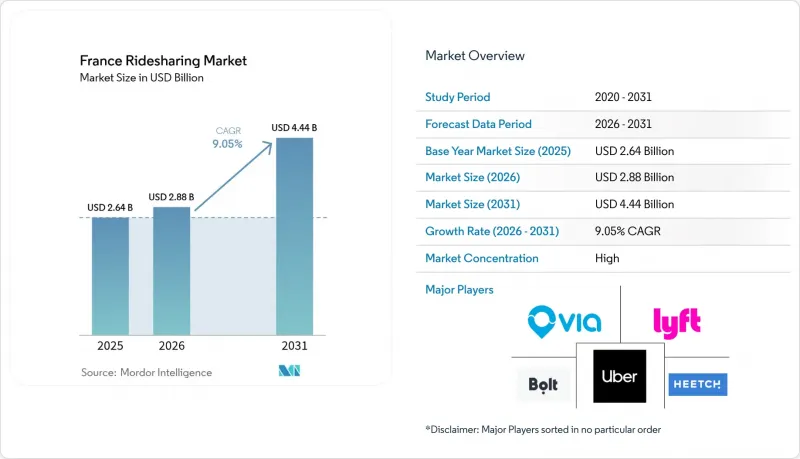
本報告依服務類型(城市叫車、微型公車接駁車、訂閱式旅遊套裝等)、車輛類型(乘用車、摩托車、廂型車、MPV等)、最終用戶(個人消費者、企業客戶)及付款方式(銀行卡/電子錢包、現金、訂閱計費)分類。市場預測以美元計價。
法國叫車市場的趨勢與洞察
政府對低排放出行方式的獎勵
法國每年投資5,000萬歐元設立綠色共乘基金,強制要求到2030年安裝40萬個公共充電站,補貼僅限於歐洲組裝的電動車。零排放平台上的車輛可享有稅額扣抵,駕駛每次符合資格的共乘可獲得100歐元的獎勵,預計到2024年,BlaBlaCar的註冊量將增加35%。優步與比亞迪簽署的批量採購協議確保了歐洲組裝車輛的折扣價格,並使其有資格獲得環保獎勵。巴黎及其他10个低排放氣體区(称为“Crit'Air”)将于2025年1月起禁止柴油车上路,届时运营商必须更换1.8万辆受影响的车辆,否则将面临每辆车每年1万欧元的罚款。因此,受監管的電動車與傳統柴油車之間的成本差異將進一步增強電動車在駕駛招募、定價柔軟性和獲得企業合約方面的先發優勢。
都市區堵塞費的上漲正在促進共享旅遊服務的發展。
在巴黎,SUV的停車費已上漲至每小時18歐元,是之前的兩倍,同時在環城公路(Périphérique)上增設了共享汽車專用車道。預計此舉將使單人通勤交通量減少15%。在里昂,非居住者進入普雷斯基耶區(Preskier)需繳納每日5歐元的費用,但經認證的共乘汽車和共乘服務可免繳此費。這些地方政府政策符合歐盟的《空氣品質指令》,並正在縮小私家車和共享汽車營運成本之間的差距。目前,從巴黎15區到戴高樂機場的私家車行程費用為45歐元,而共享汽車行程費用為30歐元。隨著堵塞費的徵收範圍擴大到波爾多和尼斯,價格彈性將繼續推動法國共享汽車市場的需求成長。
對零工勞動者實施嚴格的勞動分類規定
歐盟的《平台勞動指令》(2024/2831)引入了關於僱傭關係的可證偽推定,而法國已將司機最低時薪提高至9歐元(含雇主繳納的社保)。優步已累計4500萬歐元用於應對與僱用分類變更相關的潛在責任,而Bolt則已暫停在巴黎招聘新司機,直至獲得法律上的明確解釋。法國競爭管理局(Autorite de la concurrence)在2025年2月發布的展望報告對集體談判框架提出了不確定性,進一步加劇了市場的不確定性。勞動成本上漲20%至30%可能導致平均車費上漲12%至18%,可能會對價格敏感型用戶造成壓力,減緩法國叫車市場的短期成長動能。
細分市場分析
訂閱式旅遊服務正以10.05%的複合年成長率成長,優於法國整體叫車市場。預計到2025年,都市區叫車服務將維持53.02%的市場佔有率,主要得益於巴黎、里昂和馬賽的高使用率。 BlaBlaCar的長途共乘服務繼續受益於全國範圍內的100歐元司機獎勵,而微型公車則正在填補圖盧茲和南特郊區的交通缺口。
企業需求正在重塑出行方式的分佈模式。越來越多的公司用乘車積分取代公司用車補貼,促使用戶源源不斷地轉向訂閱服務。這穩定了收入週期,並增強了營運商與車輛租賃公司之間的議價能力。相較之下,傳統的按需計程車產業卻因牌照數量限制而舉步維艱。將共乘服務與火車票和公車票相結合的訂閱套餐在公共交通應用程式中越來越受歡迎,共乘服務也逐漸成為法國通勤者日常生活中不可或缺的一部分。
至2025年,乘用車將佔法國共享出行市場佔有率的71.55%,但隨著「Crit'Air」法規逐步淘汰老舊柴油車,電動車的預訂量正以9.98%的複合年成長率加速成長。摩托車的佔有率將在交通高峰時段激增,但仍將維持小眾市場,僅佔8%。廂型車和多用途汽車(MPV)將滿足日益成長的機場接送和企業接駁車需求。
電動車租賃補貼、可靠的充電設施以及低廉的維護成本,正使電池式電動車(BEV)的經濟效益向駕駛者傾斜。同時,氫燃料電池計程車憑藉著五分鐘的加氫時間,最大限度地提高了運轉率。然而,快速充電網路發展不平衡,尤其是在巴黎郊區,引發了人們對續航里程的擔憂。因此,儘管預計車輛種類將繼續豐富,但到2031年,電動車在法國共享出行市場的佔有率預計將持續成長。
其他好處:
- Excel格式的市場預測(ME)表
- 3個月的分析師支持
目錄
第1章:引言
- 研究假設和市場定義
- 調查範圍
第2章:調查方法
第3章執行摘要
第4章 市場狀況
- 市場概覽
- 市場促進因素
- 政府對低排放量出行方式的獎勵
- 都市區交通費用的上漲正在推動共享旅遊服務的普及。
- 智慧型手機和5G的廣泛普及
- 企業中「交通行動服務(MaaS)」訂閱模式的普及
- 叫車平台與公共運輸應用程式的整合
- 擴大共乘中電動車的數量
- 市場限制因素
- 對零工勞動者實施嚴格的勞動分類規定
- 由於市中心的市場已經飽和,司機供應有限。
- 共享汽車保險費上漲
- 由於微型交通和公共交通的發展,競爭變得異常激烈。
- 產業價值鏈分析
- 監理情勢
- 技術展望
- 宏觀經濟因素的影響
- 波特五力分析
第5章 市場規模與成長預測
- 按服務類型
- 城市叫車服務
- 長途共乘
- 微型公車接駁車
- 訂閱式行動套餐
- 車輛類型
- 搭乘用車
- 摩托車
- 廂型車和多用途汽車
- 電動車
- 最終用戶
- 個人消費者
- 企業客戶
- 透過付款方式
- 卡片和錢包
- 現金
- 定期收費
第6章 競爭情勢
- 市場集中度
- 策略趨勢
- 市佔率分析
- 公司簡介
- Uber Technologies Inc.
- Heetch SAS
- Bolt Technology OU
- Intelligent Apps GmbH
- Via Transportation Inc.
- ANI Technologies Private Limited
- Lyft Inc.
- Gett Inc.
- Careem Networks FZ-LLC
- MLU BV(Yandex Taxi)
- Grab Holdings Limited
- PT Aplikasi Karya Anak Bangsa(Gojek)
- Maxi Mobility Spain SL(Cabify)
- Curb Mobility LLC
- Addison Lee Limited
- Wingz Inc.
- Poparide Inc.
- Drivy SAS(Getaround Europe)
- Kapten SAS
第7章 市場機會與未來展望
According to Mordor Intelligence, the France ridesharing market size was valued at USD 2.64 billion in 2025 and estimated to grow from USD 2.88 billion in 2026 to reach USD 4.44 billion by 2031, at a CAGR of 9.05% during the forecast period (2026-2031).
This report is Segmented by Service Type (Urban Ride-Hailing, Micro-Transit Shuttle, Subscription-Based Mobility Packages, and More), Vehicle Type (Cars, Two-Wheelers, Vans and MPVs, and More), End User (Individual Consumers and Business and Corporate Clients), Payment Mode (Card and Wallet, Cash, and Subscription Invoicing). The Market Forecasts are Provided in Terms of Value (USD).
France Ridesharing Market Trends and Insights
Government incentives for low-emission mobility
France channels EUR 50 million a year into its carpooling green fund, mandates 400,000 public chargers by 2030, and ties subsidies to Europe-assembled EVs. Platform fleets that meet zero-emission thresholds receive tax credits and EUR 100 driver bonuses per qualified shared ride, resulting in a 35% surge in BlaBlaCar registrations in 2024. Uber's volume deal with BYD locks in discounted European-assembled vehicles, ensuring eligibility for the ecological bonus. Crit'Air diesel bans, covering Paris and 10 other low-emission zones, will take effect from January 2025, compelling operators to replace 18,000 affected vehicles or face EUR 10,000 penalties per unit annually. The resulting cost differential between compliant EV fleets and legacy diesel assets amplifies early-mover advantages in driver recruitment, pricing flexibility, and securing corporate contracts.
Rising urban congestion charges push shared mobility
Paris tripled SUV parking fees to EUR 18 per hour and introduced a peripherique car-sharing lane, which is expected to reduce single-occupancy commuter traffic by 15%. Lyon added a EUR 5 daily fee for non-resident cars entering its Presqu'ile, exempting certified ride-hailing and carpooling trips. These local policies align with the EU Ambient Air Quality Directive, narrowing the economic gap between the operating costs of private cars and shared rides. Consumers now spend EUR 45 on a private trip from Paris's 15th arrondissement to Charles de Gaulle versus EUR 30 for a shared ride. As congestion fees expand to Bordeaux and Nice, price elasticity continues to tilt demand toward the France ridesharing market.
Stringent labor classification regulations on gig workers
The EU Platform Work Directive 2024/2831 introduces a rebuttable presumption of employment, and France has already lifted the minimum driver wage to EUR 9.00 per hour plus employer social security contributions. Uber set aside EUR 45 million for potential reclassification liabilities, and Bolt froze new-driver onboarding in Paris pending legal clarity. The Autorite de la concurrence's February 2025 opinion added further uncertainty by questioning collective-bargaining frameworks. Labor cost inflation of 20%-30% could lift average fares 12%-18%, compressing demand among price-sensitive riders and dampening the France ridesharing market's near-term growth trajectory.
Other drivers and restraints analyzed in the detailed report include:
- Widespread smartphone and 5G penetration
- Growing corporate adoption of mobility-as-a-service subscriptions
- Saturation in urban core markets limiting driver supply growth
For complete list of drivers and restraints, kindly check the Table Of Contents.
Segment Analysis
Subscription mobility packages are growing at a 10.05% CAGR, eclipsing the overall France ridesharing market. Urban ride-hailing services retained a 53.02% share in 2025, primarily driven by high utilization in Paris, Lyon, and Marseille. BlaBlaCar's long-distance carpooling continues to benefit from the national EUR 100 driver bonus, while micro-transit shuttles fill suburban gaps in Toulouse and Nantes.
Corporate demand reshapes volume distribution: firms replacing fleet allowances with ride credits pump steady traffic into subscription tiers, stabilizing revenue cycles and increasing operator bargaining power with vehicle lessors. In contrast, legacy on-demand taxi segments struggle under licensing caps. Subscription bundles that merge ride-hailing with rail and bus tickets are gaining traction inside public-transit apps, embedding France ridesharing market services into daily commuter routines.
Cars captured 71.55% of the France ridesharing market share in 2025, but electric bookings are accelerating at a 9.98% CAGR as Crit'Air bans remove older diesel vehicles. Two-wheeler shares spike during congestion peaks yet remain a niche at 8%. Vans and MPVs serve growing airport and corporate shuttle demand.
Subsidized EV leasing, guaranteed charger access, and lower maintenance costs tilt driver economics toward battery-electric options, while hydrogen taxis exploit five-minute refuels to maximize utilization. However, uneven fast-charging coverage keeps range anxiety high outside Paris. The mixed fleet composition is therefore likely to persist, although France ridesharing market size contributions from EV categories will continue to expand through 2031.
Complete Report Scope:
- By Service Type
- Urban Ride-Hailing
- Long-Distance Carpooling
- Micro-Transit Shuttle
- Subscription-Based Mobility Packages
- By Vehicle Type
- Cars
- Two-Wheelers
- Vans and MPVs
- Electric Vehicles
- By End User
- Individual Consumers
- Business and Corporate Clients
- By Payment Mode
- Card and Wallet
- Cash
- Subscription Invoicing
List of Companies Covered in this Report:
- Uber Technologies Inc.
- Heetch SAS
- Bolt Technology OU
- Intelligent Apps GmbH
- Via Transportation Inc.
- ANI Technologies Private Limited
- Lyft Inc.
- Gett Inc.
- Careem Networks FZ-LLC
- MLU B.V. (Yandex Taxi)
- Grab Holdings Limited
- PT Aplikasi Karya Anak Bangsa (Gojek)
- Maxi Mobility Spain SL (Cabify)
- Curb Mobility LLC
- Addison Lee Limited
- Wingz Inc.
- Poparide Inc.
- Drivy SAS (Getaround Europe)
- Kapten SAS
Additional Benefits:
- The market estimate (ME) sheet in Excel format
- 3 months of analyst support
TABLE OF CONTENTS
1 INTRODUCTION
- 1.1 Study Assumptions and Market Definition
- 1.2 Scope of the Study
2 RESEARCH METHODOLOGY
3 EXECUTIVE SUMMARY
4 MARKET LANDSCAPE
- 4.1 Market Overview
- 4.2 Market Drivers
- 4.2.1 Government Incentives For Low-Emission Mobility
- 4.2.2 Rising Urban Congestion Charges Push Shared Mobility
- 4.2.3 Widespread Smartphone And 5G Penetration
- 4.2.4 Growing Corporate Adoption Of Mobility-As-A-Service Subscriptions
- 4.2.5 Integration Of Ride-Hailing Platforms With Public Transit Apps
- 4.2.6 Expansion Of Electric Vehicle Fleets In Ridesharing
- 4.3 Market Restraints
- 4.3.1 Stringent Labor Classification Regulations On Gig Workers
- 4.3.2 Saturation In Urban Core Markets Limiting Driver Supply Growth
- 4.3.3 Escalating Insurance Premiums For Ridesharing Vehicles
- 4.3.4 High Competition From Micro-Mobility And Public Transport Upgrades
- 4.4 Industry Value Chain Analysis
- 4.5 Regulatory Landscape
- 4.6 Technological Outlook
- 4.7 Impact of Macroeconomic Factors
- 4.8 Porter's Five Forces Analysis
5 MARKET SIZE AND GROWTH FORECASTS (VALUE)
- 5.1 By Service Type
- 5.1.1 Urban Ride-Hailing
- 5.1.2 Long-Distance Carpooling
- 5.1.3 Micro-Transit Shuttle
- 5.1.4 Subscription-Based Mobility Packages
- 5.2 By Vehicle Type
- 5.2.1 Cars
- 5.2.2 Two-Wheelers
- 5.2.3 Vans and MPVs
- 5.2.4 Electric Vehicles
- 5.3 By End User
- 5.3.1 Individual Consumers
- 5.3.2 Business and Corporate Clients
- 5.4 By Payment Mode
- 5.4.1 Card and Wallet
- 5.4.2 Cash
- 5.4.3 Subscription Invoicing
6 COMPETITIVE LANDSCAPE
- 6.1 Market Concentration
- 6.2 Strategic Moves
- 6.3 Market Share Analysis
- 6.4 Company Profiles (includes Global Level Overview, Market Level Overview, Core Segments, Financials as available, Strategic Information, Market Rank/Share for key companies, Products and Services, and Recent Developments)
- 6.4.1 Uber Technologies Inc.
- 6.4.2 Heetch SAS
- 6.4.3 Bolt Technology OU
- 6.4.4 Intelligent Apps GmbH
- 6.4.5 Via Transportation Inc.
- 6.4.6 ANI Technologies Private Limited
- 6.4.7 Lyft Inc.
- 6.4.8 Gett Inc.
- 6.4.9 Careem Networks FZ-LLC
- 6.4.10 MLU B.V. (Yandex Taxi)
- 6.4.11 Grab Holdings Limited
- 6.4.12 PT Aplikasi Karya Anak Bangsa (Gojek)
- 6.4.13 Maxi Mobility Spain SL (Cabify)
- 6.4.14 Curb Mobility LLC
- 6.4.15 Addison Lee Limited
- 6.4.16 Wingz Inc.
- 6.4.17 Poparide Inc.
- 6.4.18 Drivy SAS (Getaround Europe)
- 6.4.19 Kapten SAS
7 MARKET OPPORTUNITIES AND FUTURE OUTLOOK
- 7.1 White-Space and Unmet-Need Assessment

 共享旅遊市場:2026-2032年全球市場預測(按服務類型、平台類型、營運模式、車輛類型、車輛所有權和最終用戶分類)
 共乘市場分析及預測(至2035年):類型、服務、技術、組件、應用、部署模式、最終用戶、功能、解決方案與交通方式
 社群共享旅遊市場預測—全球服務類型、經營模式、會員類型、平台類型、資料與服務層、最終用戶與地區分析—2034年
 2026年全球共享旅遊市場報告
 2026-2034年全球共乘市場規模、佔有率、趨勢和成長分析報告
 共乘:市場佔有率分析、產業趨勢與統計、成長預測(2026-2031)社區共享共乘市場預測至2032年:按服務類型、車輛類型、平台類型、支付方式、最終用戶和地區分類的全球分析
 自動駕駛共享出行服務市場機會、成長促進因素、產業趨勢分析及預測(2025-2034年)2025年共享旅遊保險全球市場報告
 共乘市場規模、佔有率及成長分析(按服務類型、資訊服務、車輛類型、距離、類型和地區)-2025 年至 2032 年產業預測