

 |
市場調查報告書
商品編碼
2101631
更年期及更年期後產品市場:商機、成長要素、產業趨勢分析及2026-2035年預測Menopause and Perimenopause Products Market Opportunity, Growth Drivers, Industry Trend Analysis, and Forecast 2026 - 2035 |
||||||

全球更年期及過渡期產品市場預計到 2025 年將達到 125 億美元,到 2035 年將以 7.8% 的複合年成長率成長至 272 億美元。
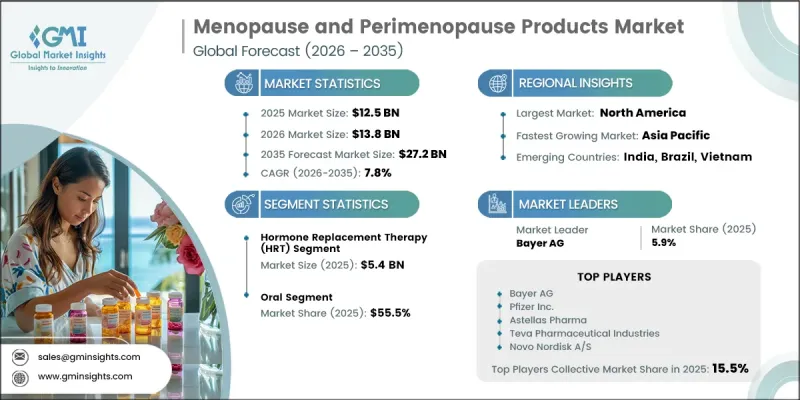
市場成長的促進因素包括:進入更年期的女性人數不斷增加、人們對更年期健康需求的認知不斷提高,以及對臨床支持療法的接受度不斷提高。人們對荷爾蒙補充療法的認知度不斷提高、獲得專業醫療保健服務的管道日益增多,以及數位健康解決方案的進步,都有助於解決更年期管理中長期存在的挑戰。關於女性健康的討論方向轉變也對市場產生了正面影響,促使更多人尋求專業支持和個人化照護方案。數位平台、症狀監測工具和便利的產品交付模式正在推動建立一個更容易取得的更年期照護生態系統。然而,保險覆蓋範圍、報銷機制和產品供應方面的差異,仍影響著全球市場的接受度。
| 市場範圍 | |
|---|---|
| 開始年份 | 2025 |
| 預測期 | 2026-2035 |
| 上市時的市場規模 | 125億美元 |
| 預測金額 | 272億美元 |
| 複合年成長率 | 7.8% |
預計到2025年,荷爾蒙補充療法(HRT)市場銷售額將達到54億美元。由於荷爾蒙療法在透過全身和局部給藥方式管理更年期症狀方面已得到廣泛應用,該市場持續保持領先地位。 HRT產品包括多種劑型,例如口服療法、局部用藥、陰道給藥、聯合荷爾蒙療法以及用於特定症狀管理的特定荷爾蒙製劑。這些療法在臨床實踐中的長期應用,以及醫生對療法的持續理解和患者的需求,正在推動該市場的持續成長。
截至2025年,口服製劑將佔55.5%的市場。由於其使用方便、患者接受度高以及醫護人員熟悉,口服整體是荷爾蒙補充療法和更年期補充劑類產品的首選給藥方式。在補充劑類別中,片劑和軟膠囊仍然是主要的產品形式,進一步鞏固了口服製劑在市場上的地位。
到2025年,北美更年期和閉經產品市佔率將達到33.6%。美國是該地區最大的市場貢獻者,而加拿大也佔據著重要的市場佔有率,這得益於相似的人口趨勢和醫療保健因素。人們對更年期管理的認知不斷提高,對個人化醫療保健解決方案的需求日益成長,以及治療方案的日益豐富,都將繼續推動該地區市場的擴張。
目錄
第1章:調查方法和範圍
第2章執行摘要
第3章 行業洞察
- 產業生態系分析
- 原料和配料供應商
- 製造商和產品開發商
- 監管機構和臨床機構
- 分銷及零售網路
- 終端使用者和患者群體
- 價值鏈盈利分析
- 影響產業的因素
- 促進因素
- 產業潛在風險與挑戰
- 市場機遇
- 成長潛力分析
- 監理情勢
- 美國FDA監管狀態(DSHEA、NDA/ANDA、510(k)、HRT標籤)
- 歐洲藥品管理局(EMA)關於荷爾蒙補充療法(HRT)和非荷爾蒙處方藥的指南
- 亞太地區的法規環境(PMDA、CDSCO、TGA)
- 聯合荷爾蒙療法的監管和風險
- 關於膳食補充劑功效聲明的法規和聯邦貿易委員會的執法行動
- 技術展望
- 新興藥物類別(神經激肽B拮抗劑、選擇性雌激素受體調節劑、新型荷爾蒙替代療法製劑)
- 生物等效荷爾蒙技術的進展
- 營養保健成分(植物雌激素、適應原、益生菌)的創新
- 穿戴式和遠端監控技術
- 數位療法 (DTx) 和人工智慧驅動的個人化護理平台
- 價格趨勢分析
- 對過去價格趨勢的分析
- 依球員類型分類的定價策略(高級球員、超值球員、成本加成球員)
- 價格比較:品牌荷爾蒙替代療法、仿製非專利、處方藥和非處方(OTC)補充劑。
- 目前的還款狀況和自付費用負擔
- 未來市場趨勢
- 波特的分析
- PESTLE分析
- 貿易數據分析
- 按產品類別分類的進出口量和進口額趨勢
- 主要貿易路線以及關稅對荷爾蒙替代療法和補充劑市場的影響
- 人工智慧和生成式人工智慧對市場的影響
- 人工智慧變革現有更年期護理和產品模式
- 按細分領域分類的人工智慧生成用例和實施藍圖(藥物發現、症狀追蹤、個人化營養)。
- 人工智慧驅動的更年期解決方案的風險、局限性和監管考慮。
- 治療基礎設施和臨床實施的現狀
- 按地區分類的醫療機構和治療中心分佈(更年期診所、婦產科診所、綜合醫療中心)
- 醫療服務環境和支付實體(醫院集團、個人執業者、遠端醫療和雇主贊助的員工福利計劃)的實施準備情況
第4章 競爭情勢
- 介紹
- 企業市佔率分析:按地區分類
- 北美洲
- 歐洲
- 亞太地區
- 中東和非洲
- 拉丁美洲
- 主要進展
- 重要合作夥伴關係和合作
- 主要併購活動
- 產品創新和新產品發布
- 市場擴大策略
- 競爭定位矩陣
第5章 市場規模及預測:依產品類型分類,2022-2035年
- 荷爾蒙補充療法(HRT)
- 雌激素單藥治療
- 孕酮/黃體素單藥治療
- 聯合治療(雌激素和黃體素)
- 複合荷爾蒙療法
- 非荷爾蒙處方藥
- 神經激肽B(NKB)受體拮抗劑(非唑啉酮、依利那坦)
- 選擇性血清素再攝取抑制劑(SSRIs)和選擇性血清素和正腎上腺素再攝取抑制劑(SNRIs)
- 選擇性雌激素受體調節(SERMs)
- 其他(Gabapentin、可樂定、雙磷酸鹽類藥物)
- 營養補充品和草藥療法
- 植物雌激素(大豆異黃酮、紅三葉草、亞麻籽)
- 植物萃取物(黑升麻、睡茄、當歸、聖潔莓)
- 維生素和礦物質(鈣、維生素D、鎂、B群維生素)
- 益生菌和特殊複合營養素混合物
- 診斷和監測設備
- 荷爾蒙檢測套組(FSH/LH家用診斷試劑盒)
- 穿戴式月經週期監測器
- 數位診斷平台和晶片實驗室設備
- 數位健康和遠端醫療解決方案
- 症狀追蹤和管理應用程式
- 用於遠端醫療和更年期護理的虛擬平台
- 數位療法(DTx)項目
- 人工智慧驅動的個人化護理計劃
- 生活方式和健康產品
- 陰道保濕劑和潤滑劑
- 降溫和舒適配件
- 非數位認知行為療法和正念療法項目
- 專為更年期女性設計的護膚和個人保健產品
第6章 市場規模與預測:依給藥途徑分類,2022-2035年
- 口服
- 藥片
- 膠囊和軟糖
- 粉狀和機能飲料
- 外用/經皮
- 經皮吸收貼片
- 凝膠霜
- 外部噴塗
- 注射藥物
- 皮下注射
- 肌肉注射/緩釋注射
- 陰道內給藥
- 陰道環
- 陰道乳膏和栓劑
- 陰道錠劑和陰道栓劑
第7章 市場規模及預測:依應用領域分類,2022-2035年
- 血管舒縮症狀(潮熱和盜汗)
- 泌尿生殖系統綜合症(GSM)和閉經相關的陰道乾澀
- 情緒、認知和睡眠障礙
- 骨骼健康(骨質疏鬆症的預防與治療)
- 心血管和代謝健康
- 其他
第8章 市場規模及預測:依更年期階段分類,2022-2035年
- 閉經
- 停經
- 停經後
第9章 市場規模及預測:依最終用戶分類,2022-2035年
- 醫院和醫療機構
- 專科診所(婦科/更年期治療)
- 提供居家照護和自我管理的消費者
- 其他
第10章 市場規模及預測:依通路分類,2022-2035年
- 醫院藥房
- 零售藥局和藥房
- 線上藥局和DTC電子商務
- 超級市場/健康與保健零售
第11章 市場規模及預測:依地區分類,2022-2035年
- 北美洲
- 美國
- 加拿大
- 歐洲
- 德國
- 法國
- 英國
- 荷蘭
- 西班牙
- 義大利
- 亞太地區
- 中國
- 日本
- 韓國
- 印度
- 澳洲
- 中東和非洲
- 沙烏地阿拉伯
- UAE
- 南非
- 拉丁美洲
- 巴西
- 阿根廷
- 墨西哥
第12章:公司簡介
- 世界公司
- Bayer AG
- Pfizer Inc.
- Teva Pharmaceutical Industries
- Novo Nordisk A/S
- Organon & Co.
- Astellas Pharma
- Amneal Pharmaceuticals
- 當地公司
- Gedeon Richter Plc.
- Theramex Group
- Besins Healthcare
- Dr. Reddy's Laboratories
- Sun Pharmaceutical Industries
- Hisamitsu Pharmaceutical
- Mayne Pharma Group
- Niche & Specialist Players
- Exeltis Healthcare
- Padagis LLC
- Bonafide Health
- Kindra Inc.
- Womaness LLC
- Schaper & Brummer
- Tsumura & Co.
The Global Menopause and Perimenopause Products Market was valued at USD 12.5 billion in 2025 and is estimated to grow at a CAGR of 7.8% to reach USD 27.2 billion by 2035.
Market growth is supported by the increasing number of women entering menopause age groups, greater recognition of menopause-related health needs, and improved acceptance of clinically supported treatment options. Growing awareness around hormone replacement therapy, expanding access to specialized healthcare services, and advancements in digital health solutions are helping address long-standing gaps in menopause management. The market is also benefiting from changing conversations around women's health, which are encouraging more individuals to seek professional support and personalized care solutions. Digital platforms, symptom monitoring tools, and convenient product delivery models are contributing to the development of more accessible menopause care ecosystems. However, differences in insurance coverage, healthcare reimbursement structures, and product accessibility continue to influence adoption patterns across global markets.
| Market Scope | |
|---|---|
| Start Year | 2025 |
| Forecast Year | 2026-2035 |
| Start Value | $12.5 Billion |
| Forecast Value | $27.2 Billion |
| CAGR | 7.8% |
The Hormone Replacement Therapy (HRT) segment generated USD 5.4 billion in 2025. The segment continues to maintain its dominant position due to the established clinical use of hormone-based treatments for managing menopause symptoms through systemic and localized approaches. HRT products include various formulations such as oral therapies, skin-applied treatments, vaginal applications, combined hormone therapies, and selected hormone-based options used for specific symptom management. The long-standing presence of these therapies in clinical practice, along with continued physician familiarity and patient demand, supports sustained segment growth.
The oral segment accounted for 55.5% share in 2025. Oral administration remains the preferred delivery method across hormone replacement therapies and supplement-based menopause products due to its ease of use, widespread acceptance among patients, and familiarity among healthcare providers. Tablets and softgel formats continue to represent major product forms within the supplement category, further strengthening the position of oral solutions in the market.
North America Menopause and Perimenopause Products Market held 33.6% share in 2025. The United States represents the largest contributor within the region, while Canada also maintains a significant market presence supported by comparable demographic trends and healthcare factors. Increasing awareness of menopause management, growing demand for personalized healthcare solutions, and improved availability of treatment options continue to support regional market expansion.
Major players operating in the global menopause and perimenopause products industry are: Theramex Group, Pfizer Inc., Besins Healthcare, Bayer AG, Hisamitsu Pharmaceutical, Astellas Pharma, Novo Nordisk A/S, Gedeon Richter Plc., Teva Pharmaceutical Industries, Mayne Pharma Group, Organon & Co., Amneal Pharmaceuticals, Padagis LLC, Dr. Reddy's Laboratories, Sun Pharmaceutical Industries, Exeltis Healthcare, Schaper & Brummer, and Tsumura & Co. Companies operating in the menopause and perimenopause products market are focusing on product innovation, portfolio diversification, digital healthcare integration, and stronger consumer engagement strategies to improve their market position. Leading organizations are developing advanced hormone therapies, wellness-focused solutions, and personalized care platforms to address evolving consumer needs. Businesses are also investing in research and development activities to improve treatment effectiveness, expand product accessibility, and strengthen clinical support. Strategic collaborations, digital service expansion, and enhanced distribution networks are becoming important approaches for increasing customer reach. Companies are also emphasizing education initiatives and awareness campaigns to encourage earlier consultation and treatment adoption.
Table of Contents
Chapter 1 Methodology & Scope
- 1.1 Research approach
- 1.2 Quality commitments
- 1.2.1 GMI AI policy & data integrity commitment
- 1.2.1.1 Source consistency protocol
- 1.2.1 GMI AI policy & data integrity commitment
- 1.3 Research trail & confidence scoring
- 1.3.1 Research trail components
- 1.3.2 Scoring components
- 1.4 Data collection
- 1.4.1 Partial list of primary sources
- 1.5 Data mining sources
- 1.5.1 Paid sources
- 1.5.1.1 Sources, by region
- 1.5.1 Paid sources
- 1.6 Base estimates and calculations
- 1.6.1 Base year calculation for any one approach
- 1.7 Market estimates & forecasts parameters
- 1.8 Forecast model
- 1.8.1 Quantified market impact analysis
- 1.8.1.1 Mathematical impact of growth parameters on forecast
- 1.8.1 Quantified market impact analysis
- 1.9 Research transparency addendum
- 1.9.1 Source attribution framework
- 1.9.2 Quality assurance metrics
- 1.9.3 Our commitment to trust
Chapter 2 Executive Summary
- 2.1 Industry synopsis, 2022 - 2035
- 2.1.1 Business trends
- 2.1.2 Product type trends
- 2.1.3 Sourcing & certification standard trends
- 2.1.4 Distribution channel trends
- 2.1.5 Regional trends
Chapter 3 Industry Insights
- 3.1 Industry ecosystem analysis
- 3.1.1 Raw material & ingredient suppliers
- 3.1.2 Manufacturers & product developers
- 3.1.3 Regulatory & clinical bodies
- 3.1.4 Distribution & retail networks
- 3.1.5 End-users & patient communities
- 3.1.6 Value chain profitability analysis
- 3.2 Industry impact forces
- 3.2.1 Growth drivers
- 3.2.2 Industry pitfalls and challenges
- 3.2.3 Market opportunities
- 3.3 Growth potential analysis
- 3.4 Regulatory landscape (Driven by primary research)
- 3.4.1 U.S. FDA regulatory landscape (DSHEA, NDA/ANDA, 510(k), HRT labeling)
- 3.4.2 European Medicines Agency (EMA) guidelines for HRT & non-hormonal Rx
- 3.4.3 Asia Pacific regulatory environment (PMDA, CDSCO, TGA)
- 3.4.4 Compounded hormone therapy regulatory oversight & risk
- 3.4.5 Dietary supplement claim regulations & FTC enforcement
- 3.5 Technology landscape
- 3.5.1 Emerging drug classes (neurokinin B antagonists, SERMs, novel HRT formulations)
- 3.5.2 Bioidentical hormone technology advancements
- 3.5.3 Nutraceutical ingredient innovation (phytoestrogens, adaptogens, probiotics)
- 3.5.4 Wearable & remote monitoring technologies
- 3.5.5 Digital therapeutics (DTx) & AI-personalized care platforms
- 3.6 Pricing trend analysis (Driven by primary research)
- 3.6.1 Historical price trend analysis (driven by primary research)
- 3.6.2 Pricing strategy by player type (premium / value / cost-plus) (driven by primary research)
- 3.6.3 Price comparison: branded HRT vs. generic vs. compounded vs. OTC supplement
- 3.6.4 Reimbursement landscape & out-of-pocket cost burden
- 3.7 Future market trends
- 3.8 Porter's analysis
- 3.9 PESTEL analysis
- 3.10 Trade data analysis (driven by paid database) (HS code: 33049990)
- 3.10.1 Import/export volume & value trends by product category
- 3.10.2 Key trade corridors & tariff impact on HRT & supplement markets
- 3.11 Impact of AI & generative AI on the market
- 3.11.1 AI-driven disruption of existing menopause care & product models
- 3.11.2 GenAI use cases & adoption roadmap by segment (drug discovery, symptom tracking, personalized nutrition)
- 3.11.3 Risks, limitations & regulatory considerations for AI-enabled menopause solutions
- 3.12 Treatment infrastructure & clinical adoption landscape
- 3.12.1 Facility & treatment center distribution by region (menopause clinics, OB-GYN practices, integrative health centers) (driven by primary research)
- 3.12.2 Adoption readiness by care setting & payer type (hospital systems, private practice, telehealth, employer benefit plans) (driven by primary research)
Chapter 4 Competitive Landscape, 2025
- 4.1 Introduction
- 4.2 Company market share analysis, by region, 2025
- 4.2.1 North America
- 4.2.2 Europe
- 4.2.3 Asia Pacific
- 4.2.4 Middle East & Africa
- 4.2.5 Latin America
- 4.3 Key developments
- 4.3.1 Key partnerships & collaborations
- 4.3.2 Major M&A activities
- 4.3.3 Product innovations & launches
- 4.3.4 Market expansion strategies
- 4.4 Competitive positioning matrix
Chapter 5 Market Size and Forecast, By Product Type, 2022 - 2035 (USD Billion)
- 5.1 Key trends
- 5.2 Hormone Replacement Therapy (HRT)
- 5.2.1 Estrogen-Only Therapy
- 5.2.2 Progesterone / Progestogen-Only Therapy
- 5.2.3 Combination (Estrogen-Progestogen) Therapy
- 5.2.4 Compounded Hormone Therapy
- 5.3 Non-Hormonal Prescription Treatments
- 5.3.1 Neurokinin B (NKB) Receptor Antagonists (Fezolinetant, Elinzanetant)
- 5.3.2 SSRIs & SNRIs
- 5.3.3 Selective Estrogen Receptor Modulators (SERMs)
- 5.3.4 Others (Gabapentin, Clonidine, Bisphosphonates)
- 5.4 Dietary Supplements & Herbal Remedies
- 5.4.1 Phytoestrogens (Soy Isoflavones, Red Clover, Flaxseed)
- 5.4.2 Botanical Extracts (Black Cohosh, Ashwagandha, Dong Quai, Chasteberry)
- 5.4.3 Vitamins & Minerals (Calcium, Vitamin D, Magnesium, B-Complex)
- 5.5 Probiotics & Specialty Multi-Nutrient Blends
- 5.6 Diagnostic & Monitoring Devices
- 5.6.1 Hormone Test Kits (FSH/LH Home Diagnostics)
- 5.6.2 Wearable Physiological Monitors
- 5.6.3 Digital Diagnostic Platforms & Lab-on-Chip Devices
- 5.7 Digital Health & Telemedicine Solutions
- 5.7.1 Symptom Tracking & Management Apps
- 5.7.2 Telehealth & Virtual Menopause Care Platforms
- 5.7.3 Digital Therapeutics (DTx) Programs
- 5.7.4 AI-Powered Personalized Care Programs
- 5.8 Lifestyle & Wellness Products
- 5.8.1 Vaginal Moisturizers & Lubricants
- 5.8.2 Cooling & Comfort Accessories
- 5.8.3 Non-Digital CBT & Mindfulness Programs
- 5.8.4 Menopause-Specific Skincare & Personal Care
Chapter 6 Market Size and Forecast, By Route of Administration, 2022 - 2035 (USD Billion)
- 6.1 Key trends
- 6.2 Oral
- 6.2.1 Tablets
- 6.2.2 Capsules & Gummies
- 6.2.3 Powders & Functional Beverages
- 6.3 Topical / Transdermal
- 6.3.1 Transdermal Patches
- 6.3.2 Gels & Creams
- 6.3.3 Topical Sprays
- 6.4 Injectable
- 6.4.1 Subcutaneous Injections
- 6.4.2 Intramuscular / Depot Injections
- 6.5 Vaginal
- 6.5.1 Vaginal Rings
- 6.5.2 Vaginal Creams & Suppositories
- 6.5.3 Vaginal Tablets & Inserts
Chapter 7 Market Size and Forecast, By Application, 2022 - 2035 (USD Billion)
- 7.1 Key trends
- 7.2 Vasomotor Symptoms (Hot Flashes & Night Sweats)
- 7.3 Genitourinary Syndrome of Menopause (GSM) & Vaginal Dryness
- 7.4 Mood, Cognitive & Sleep Disorders
- 7.5 Bone Health (Osteoporosis Prevention & Management)
- 7.6 Cardiovascular & Metabolic Health
- 7.7 Others
Chapter 8 Market Size and Forecast, By Menopausal Stage, 2022 - 2035 (USD Billion)
- 8.1 Key trends
- 8.2 Perimenopause
- 8.3 Menopause
- 8.4 Postmenopause
Chapter 9 Market Size and Forecast, By End User, 2022 - 2035 (USD Billion)
- 9.1 Key trends
- 9.2 Hospitals & Healthcare Institutions
- 9.3 Specialty Clinics (Gynecology / Menopause Practices)
- 9.4 Homecare & Self-Managed Consumers
- 9.5 Others
Chapter 10 Market Size and Forecast, By Distribution Channel, 2022 - 2035 (USD Billion)
- 10.1 Key trends
- 10.2 Hospital Pharmacies
- 10.3 Retail Pharmacies & Drug Stores
- 10.4 Online Pharmacies & DTC E-commerce
- 10.5 Supermarkets / Health & Wellness Retail
Chapter 11 Market Size and Forecast, By Region, 2022 - 2035 (USD Billion)
- 11.1 Key trends
- 11.2 North America
- 11.2.1 U.S.
- 11.2.2 Canada
- 11.3 Europe
- 11.3.1 Germany
- 11.3.2 France
- 11.3.3 UK
- 11.3.4 Netherlands
- 11.3.5 Spain
- 11.3.6 Italy
- 11.4 Asia Pacific
- 11.4.1 China
- 11.4.2 Japan
- 11.4.3 South Korea
- 11.4.4 India
- 11.4.5 Australia
- 11.5 Middle East & Africa
- 11.5.1 Saudi Arabia
- 11.5.2 UAE
- 11.5.3 South Africa
- 11.6 Latin America
- 11.6.1 Brazil
- 11.6.2 Argentina
- 11.6.3 Mexico
Chapter 12 Company Profiles
- 12.1 Global Players
- 12.1.1 Bayer AG
- 12.1.2 Pfizer Inc.
- 12.1.3 Teva Pharmaceutical Industries
- 12.1.4 Novo Nordisk A/S
- 12.1.5 Organon & Co.
- 12.1.6 Astellas Pharma
- 12.1.7 Amneal Pharmaceuticals
- 12.2 Regional Players
- 12.2.1 Gedeon Richter Plc.
- 12.2.2 Theramex Group
- 12.2.3 Besins Healthcare
- 12.2.4 Dr. Reddy's Laboratories
- 12.2.5 Sun Pharmaceutical Industries
- 12.2.6 Hisamitsu Pharmaceutical
- 12.2.7 Mayne Pharma Group
- 12.3 Niche & Specialist Players
- 12.3.1 Exeltis Healthcare
- 12.3.2 Padagis LLC
- 12.3.3 Bonafide Health
- 12.3.4 Kindra Inc.
- 12.3.5 Womaness LLC
- 12.3.6 Schaper & Brummer
- 12.3.7 Tsumura & Co.

 個人化美容產品市場預測至2034年-全球個人化標準、產品、個人化方法、客製化程度、分銷管道和地區分析
 維生素E抗氧化霜市場規模、佔有率和成長分析:按產品類型、皮膚類型、分銷管道、最終用戶和地區分類-2026-2033年產業預測
 美容及個人保健產品市場-全球市場預測(2026-2032年)2034年水療經濟市場預測-按水療類型、服務項目、客戶群、年齡層、銷售管道和地區分類的全球分析無水個人保健產品市場:預測至2034年-按產品類型、劑型、成分類型、通路、最終用戶和地區分類的全球分析
 零浪費個人護理市場機會、成長要素、產業趨勢分析及 2026-2035 年預測。2034年固態個人保健產品市場預測-按產品類型、成分類型、通路、包裝類型和最終用戶分類的全球分析可補充裝個人保健產品市場預測至2034年-按產品類型、補充裝形式、包裝類型、分銷管道和最終用戶分類的全球分析男士護理及健康產品市場預測至2034年-按產品類型、成分類型、通路、劑型及最終用戶分類的全球分析
 2026-2030年全球美容及個人保健產品市場