

 |
市場調查報告書
商品編碼
2083061
零浪費個人護理市場機會、成長要素、產業趨勢分析及 2026-2035 年預測。Zero-Waste Personal Care Market Opportunity, Growth Drivers, Industry Trend Analysis, and Forecast 2026 - 2035 |
||||||

據估計,到 2025 年,全球零浪費個人護理市場價值將達到 34.8 億美元,年複合成長率為 8.5%,到 2035 年將達到 78.6 億美元。
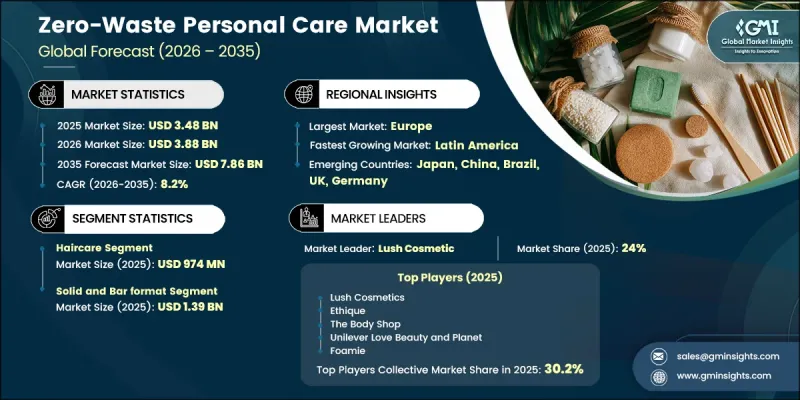
預計該市場將持續以遠超傳統個人護理類別的速度成長。這項持續成長的驅動力來自於對永續包裝解決方案的不斷轉向、對減少廢棄物法規日益重視,以及消費品產業廣泛採用循環經濟實踐。對補充裝基礎設施、替代包裝系統和減少廢棄物措施的投資,透過鼓勵消費者參與和重複購買,進一步推動了市場擴張。在環境永續性和負責任消費意識不斷增強的推動下,消費者需求仍然是市場長期成長的基礎。與永續性相關的產品特性在購買決策中繼續發揮重要作用,尤其是在年輕消費者中。此外,零浪費個人保健產品已證明,與傳統產品相比,它們可以賣出更高的價格,同時保持較高的客戶維繫和重複購買率。這些因素進一步增強了零浪費個人照護市場的長期成長前景。
| 市場範圍 | |
|---|---|
| 開始年份 | 2025 |
| 預測期 | 2026-2035 |
| 上市時的市場規模 | 34.8億美元 |
| 預計金額 | 78.6億美元 |
| 複合年成長率 | 8.5% |
預計到2025年,固態和條狀包裝產品的銷售額將達到13.9億美元,佔市場佔有率的40%。該細分市場的主導地位反映了其較早的商業化以及作為該品類中最成熟的包裝形式之一的廣泛認可。消費者的高度認知、便利的操作以及豐富的產品供應將繼續鞏固該細分市場的主導地位。
預計到2025年,護髮產品銷售額將達到9.74億美元,市佔率為28%。雖然這一成長率低於市場平均水平,但也反映出該市場滲透率已相對成熟。護髮產品廣受消費者認可,並持續受益於已開發市場零售通路的拓展以及消費者對永續個人保健產品日益成長的需求。
預計到2025年,北美零浪費個人護理市場規模將達到10.1億美元,市佔率將達29%。這一成長主要得益於日益嚴格的減廢棄物政策、永續性包裝的推廣以及個人護理產品製造商加速的產品改進。消費者對環保產品的日益重視,並持續推動主流零售通路和天然產品零售通路採用永續產品系列,鞏固了全部區域市場的長期發展。
目錄
第1章:調查方法和範圍
第2章執行摘要
第3章 行業洞察
- 產業生態系分析
- 供應鏈分析
- 主要原物料採購狀況
- 供應鏈風險與中斷評估
- 近岸外包和供應商多元化趨勢
- 影響產業的因素
- 市場促進因素
- 政府對一次性塑膠製品的嚴格監管以及生產者延伸責任制(EPR)的強制實施,正在加速品牌的產品重組。
- 這是由於消費者環保意識增強,並且願意為經過認證的零浪費產品支付更高的價格。
- 市場限制因素
- 與傳統產品相比,零浪費個人保健產品的單位成本明顯更高,這對於價格敏感型消費者來說是一個障礙。
- 消費者對固態和條狀產品的功效持懷疑態度,這阻礙了它們在大眾市場上的廣泛普及。
- 市場機遇
- 男士零浪費護理用品作為一個滲透率低、成長潛力高的細分市場,正在迅速擴張。
- 新興市場(印度、東南亞、拉丁美洲)「補貨即服務」基礎設施的擴展正在開闢新的收入來源。
- 市場促進因素
- 成長潛力分析
- 技術與創新展望
- 監理框架
- 關鍵市場趨勢與顛覆性因素
- 未來市場趨勢
- 價格分析
- 對過去價格趨勢的分析
- 依球員類型分類的定價策略(高級球員、超值球員、成本加成球員)
- 貿易數據分析
- 進出口量及進口額趨勢
- 主要貿易路線及關稅的影響
- 人工智慧和生成式人工智慧對市場的影響
- 利用人工智慧改造現有經營模式
- 按細分市場分類的生成式人工智慧用例和部署藍圖
- 風險、限制和監管考量
- 波特的分析
- PESTLE分析
第4章 競爭情勢
- 介紹
- 企業市佔率分析
- 按地區
- 企業矩陣分析
- 主要市場公司的競爭分析
- 競爭定位矩陣
- 主要進展
- 併購
- 夥伴關係和聯盟
- 新產品發布
- 業務拓展計劃
第5章 市場估算與預測:依產品類型分類,2022-2035年
- 護膚
- 固態洗面乳/潔面皂
- 可補充裝的精華液、保濕霜和化妝水
- 可堆肥面膜和去角質產品
- 護髮
- 固態洗髮精
- 護髮皂
- 固態髮膜和頭皮護理
- 可補充液體護髮產品
- 沐浴及身體護理
- 無包裝沐浴乳和固態沐浴露
- 可堆肥的身體乳液和磨砂膏
- 零浪費浴球和浴鹽
- 口腔護理
- 牙膏片和牙膏粉
- 竹製和植物來源牙刷
- 可堆肥牙線
- 漱口片和濃縮液
- 彩妝
- 可重複填充的緊湊型托盤
- 零浪費唇部產品(紙管唇膏、固體潤唇膏)
- 無包裝睫毛膏及眼部彩妝品
- 男士理容
- 零浪費刮鬍皂、刮鬍塊和刮鬍膏罐
- 無包裝鬍鬚護理產品(採用可堆肥包裝的鬍鬚油和鬍鬚膏)
- 永續刮鬍刀(安全刮鬍刀、帶可堆肥手柄的拋棄式刮鬍刀)
- 其他
- 可重複使用的經期用品(月事杯、可重複使用的衛生棉)
- 零浪費防曬護理(礦物防曬皂,珊瑚礁友善固態)
- 固態除臭皂和可堆肥除臭膏罐
第6章 市場估價與預測:依包裝與規格類型分類,2022-2035年
- 固態/棒狀
- 濃縮固態皂(洗髮皂、護髮皂、香皂)
- 可溶片/片(牙膏、漱口水)
- 可填充和可重複使用的系統
- 可重複使用的硬質容器,附補充裝(鋁、玻璃、不鏽鋼)
- 軟性補充裝和濃縮液
- 店內散裝補充裝分送系統
- 可生物分解和可堆肥包裝
- 紙質和牛皮紙包裝(包裝紙、盒子、紙筒)
- 竹子、菌絲體和植物來源生物聚合物包裝
- COSMOS認證的可堆肥薄膜和包裝袋
- 未包裝/裸裝
- 散裝固態產品(不含外包裝販售的產品)
- 可溶性無水粉末到產品的轉化形式
第7章 市場估價與預測:依通路分類,2022-2035年
- 線上零售
- 直接面對消費者 (DTC) 網站
- 第三方電子商務平台
- 專賣店及天然食品店
- 天然有機化妝品專賣店
- 零浪費精品店和無包裝概念店
- 超級市場和大賣場
- 大型大眾零售連鎖店(設有永續發展專區)
- 量販店的補給站(試點實施和全面部署)
- 藥局/藥局
- 連鎖藥局
- 獨立藥房及配藥藥房
- 零浪費/可補充裝商店和訂閱服務
- 僅供補充裝的零售店
- 精選的零浪費訂閱盒服務
第8章 市場估計與預測:依地區分類,2022-2035年
- 北美洲
- 美國
- 加拿大
- 歐洲
- 德國
- 英國
- 法國
- 義大利
- 西班牙
- 亞太地區
- 中國
- 印度
- 日本
- 韓國
- 澳洲
- 拉丁美洲
- 巴西
- 墨西哥
- 阿根廷
- 中東和非洲
- UAE
- 沙烏地阿拉伯
- 南非
第9章:公司簡介
- Lush Cosmetics Limited
- Unilever PLC(Love Beauty and Planet)
- L'Oreal SA(Garnier Ultra Doux Refillable+La Roche-Posay Refillable Lines)
- HiBAR, Inc.
- Beauty Kitchen Limited
- Meow Meow Tweet LLC
- Davines SpA
- Plaine Products, LLC
- Bare Necessities
- Oway(Acus Srl)
- Axiology Beauty
- Izzy Beauty Inc.
- ATTITUDE Living(Les Laboratoires CONFAB Inc.)
- Foamie(New Flag GmbH)
- Procter & Gamble Co.(Herbal Essences Bio:Renew Refillable)
- EcoRoots LLC
- By Humankind
- The Humble Co. AB
- Ethique Limited
- The Body Shop(Aurea Group)
- Kjaer Weis
- Georganics Oral Care Limited
The Global Zero Waste Personal Care Market was valued at USD 3.48 billion in 2025 and is estimated to grow at a CAGR of 8.5% to reach USD 7.86 billion by 2035.
The market is expected to continue advancing at a pace significantly higher than conventional personal care categories. This sustained growth is being driven by the ongoing transition toward sustainable packaging solutions, increasing regulatory emphasis on waste reduction, and the wider adoption of circular economy practices across the consumer goods sector. Investments in refill infrastructure, alternative packaging systems, and waste-minimization initiatives are further supporting market expansion by encouraging greater consumer participation and repeat purchasing behavior. Consumer demand remains the foundation of long-term market growth, supported by increasing awareness of environmental sustainability and responsible consumption. Sustainability-related product attributes continue to play a significant role in purchasing decisions, particularly among younger consumer groups. In addition, zero waste personal care products have demonstrated the ability to command premium pricing compared with conventional alternatives, while maintaining strong customer retention and repurchase rates. These factors continue to reinforce the long-term growth outlook for the Zero Waste Personal Care Market.
| Market Scope | |
|---|---|
| Start Year | 2025 |
| Forecast Year | 2026-2035 |
| Start Value | $3.48 Billion |
| Forecast Value | $7.86 Billion |
| CAGR | 8.5% |
The solid and bar format segment generated USD 1.39 billion in 2025 and accounting for 40% share. Its leading position reflects its early commercialization and broad acceptance as one of the most established packaging alternatives within the category. Strong consumer familiarity, operational simplicity, and wide product availability continue to support the segment's dominant market position.
The haircare segment generated USD 974 million in 2025, representing 28% share. Although this growth rate remains below the overall market average, it reflects a comparatively mature stage of market penetration. Haircare products have achieved broad consumer recognition and continue to benefit from expanding retail availability and growing adoption of sustainable personal care alternatives across developed markets.
North America Zero Waste Personal Care Market accounted for USD 1.01 billion in 2025, representing 29% share. Growth is supported by increasingly stringent waste-reduction policies, packaging sustainability initiatives, and accelerated product reformulation efforts among personal care manufacturers. The transition toward environmentally responsible product offerings continues to encourage the introduction of sustainable product portfolios across both mainstream and natural retail channels, strengthening long-term market development throughout the region.
Key companies operating in the Global Zero Waste Personal Care Market include Ethique, Lush Cosmetics, Foamie (New Flag), Davines ZW, The Body Shop (ZW lines), HiBAR, Unilever (Love Beauty and Planet ZW), ATTITUDE Living ZW, L'Oreal ZW lines, P&G ZW lines, Oway ZW, The Humble Co., Kjaer Weis, Georganics, and various independent specialty brands. Companies operating in the Zero Waste Personal Care Market are adopting multiple strategies to strengthen their competitive position and expand market presence. Product innovation remains a key focus, with manufacturers developing sustainable formulations, refillable packaging solutions, and plastic-free product formats to meet evolving consumer expectations. Businesses are also investing in refill infrastructure, circular packaging systems, and environmentally responsible sourcing practices to enhance brand differentiation. Strategic partnerships with retailers, sustainability organizations, and packaging suppliers are helping companies improve distribution reach and accelerate market penetration.
Table of Contents
Chapter 1 Methodology & Scope
- 1.1 Research approach
- 1.2 Quality Commitments
- 1.2.1 GMI AI policy & data integrity commitment
- 1.2.1.1 Source consistency protocol
- 1.2.1 GMI AI policy & data integrity commitment
- 1.3 Research Trail & Confidence Scoring
- 1.3.1 Research Trail Components
- 1.3.2 Scoring Components
- 1.4 Data Collection
- 1.4.1 Partial list of primary sources
- 1.5 Data mining sources
- 1.5.1 Paid sources
- 1.5.1.1 Sources, by region
- 1.5.1 Paid sources
- 1.6 Base estimates and calculations
- 1.6.1 Base year calculation for any one approach
- 1.7 Forecast model
- 1.7.1 Quantified market impact analysis
- 1.7.1.1 Mathematical impact of growth parameters on forecast
- 1.7.1 Quantified market impact analysis
- 1.8 Research transparency addendum
- 1.8.1 Source attribution framework
- 1.8.2 Quality assurance metrics
- 1.8.2.1 Our commitment to trust
Chapter 2 Executive Summary
- 2.1 Industry 360° synopsis, 2022 - 2035
- 2.2 Key market trends
- 2.2.1 Region
- 2.2.2 Product Type
- 2.2.3 Packaging and Format Type
- 2.2.4 Distribution channel
Chapter 3 Industry Insights
- 3.1 Industry ecosystem analysis
- 3.2 Supply chain analysis
- 3.2.1 key raw material sourcing landscape
- 3.2.2 Supply chain risks & disruption assessment
- 3.2.3 Nearshoring & supplier diversification trends
- 3.3 Industry impact forces
- 3.3.1 Market drivers
- 3.3.1.1 Stringent Government Regulations on Single-Use Plastics & Extended Producer Responsibility (EPR) Mandates Accelerating Brand Reformulation
- 3.3.1.2 Rising Consumer Eco-Consciousness & Demonstrated Willingness to Pay a Premium for Certified Zero-Waste Products
- 3.3.2 Market restraints
- 3.3.2.1 Significant Unit Cost Premium of Zero-Waste Personal Care vs. Conventional Alternatives Creating Adoption Barriers Among Price-Sensitive Consumers
- 3.3.2.2 Consumer Performance Skepticism Around Solid & Bar Formats Limiting Mass-Market Uptake
- 3.3.3 Market opportunities
- 3.3.3.1 Rapid Expansion of Men's Zero-Waste Grooming as an Underpenetrated, High-Growth Sub-Market
- 3.3.3.2 Rising Refill-as-a-Service Infrastructure in Emerging Markets (India, Southeast Asia, Latin America) Opening New Revenue Streams
- 3.3.1 Market drivers
- 3.4 Growth potential analysis
- 3.5 Technology & innovation landscape
- 3.6 Regulatory framework
- 3.7 Major market trends and disruptions
- 3.8 Future market trends
- 3.9 Pricing analysis (driven by primary research)
- 3.9.1 Historical Price Trend Analysis
- 3.9.2 Pricing Strategy by Player Type (Premium / Value / Cost-plus)
- 3.10 Trade data analysis (driven by primary research)
- 3.10.1 Import/Export Volume & Value Trends (Driven by Primary Research)
- 3.10.2 Key Trade Corridors & Tariff Impact
- 3.11 Impact of AI & generative AI on the market
- 3.11.1 AI-Driven Disruption of Existing Business Models
- 3.11.2 GenAI Use Cases & Adoption Roadmap by Segment
- 3.11.3 Risks, Limitations & Regulatory Considerations
- 3.12 Porter's analysis
- 3.13 PESTEL analysis
Chapter 4 Competitive Landscape, 2025
- 4.1 Introduction
- 4.2 Company market share analysis
- 4.2.1 By Region
- 4.2.1.1 North America
- 4.2.1.2 Europe
- 4.2.1.3 Asia Pacific
- 4.2.1.4 Latin America
- 4.2.1.5 Middle East and Africa
- 4.2.1 By Region
- 4.3 Company matrix analysis
- 4.4 Competitive analysis of major market players
- 4.5 Competitive positioning matrix
- 4.6 Key developments
- 4.6.1 Mergers & acquisitions
- 4.6.2 Partnerships & collaborations
- 4.6.3 New product launches
- 4.6.4 Expansion plans
Chapter 5 Market Estimates and Forecast, By Product Type, 2022 - 2035 (USD Billion) (Thousand Units)
- 5.1 Key trends
- 5.2 Skincare
- 5.2.1 Solid Cleansers & Face Wash Bars
- 5.2.2 Refillable Serums, Moisturizers & Toners
- 5.2.3 Compostable Sheet Masks & Exfoliants
- 5.3 Haircare
- 5.3.1 Shampoo Bars
- 5.3.2 Conditioner Bars
- 5.3.3 Solid Hair Masks & Scalp Treatments
- 5.3.4 Refillable Liquid Haircare
- 5.4 Bath & Body
- 5.4.1 Package-Free Body Soaps & Solid Body Wash
- 5.4.2 Compostable Body Lotions & Scrubs
- 5.4.3 Zero-Waste Bath Bombs & Salts
- 5.5 Oral Care
- 5.5.1 Toothpaste Tablets & Powders
- 5.5.2 Bamboo & Plant-Based Toothbrushes
- 5.5.3 Compostable Dental Floss
- 5.5.4 Mouthwash Tablets & Concentrates
- 5.6 Color Cosmetics & Makeup
- 5.6.1 Refillable Compacts & Palettes
- 5.6.2 Zero-Waste Lip Products (Paper Tube Lipstick, Solid Lip Balm)
- 5.6.3 Package-Free Mascara & Eye Products
- 5.7 Men's Grooming
- 5.7.1 Zero-Waste Shaving Soaps, Bars & Cream Tabs
- 5.7.2 Package-Free Beard Care (Oils, Balms in Compostable Packaging)
- 5.7.3 Sustainable Razors (Safety Razors, Compostable Handle Disposables)
- 5.8 Others
- 5.8.1 Reusable Feminine Care (Menstrual Cups, Reusable Pads)
- 5.8.2 Zero-Waste Sun Care (Mineral SPF Bars, Reef-Safe Solid Formats)
- 5.8.3 Solid Deodorant Bars & Compostable Deodorant Cream Pots
Chapter 6 Market Estimates and Forecast, By Packaging and Format Type, 2022 - 2035 (USD Billion) (Thousand Units)
- 6.1 Key trends
- 6.2 Solid/Bar Format
- 6.2.1 Concentrated Solid Bars (Shampoo, Conditioner, Soap)
- 6.2.2 Dissolvable Tabs & Sheets (Toothpaste, Mouthwash)
- 6.3 Refillable & Reusable Systems
- 6.3.1 Hard Reusable Containers (Aluminum, Glass, Stainless Steel) with Refill Pods
- 6.3.2 Flexible Refill Pouches & Concentrates
- 6.3.3 In-Store Bulk Refill & Dispensing Systems
- 6.4 Biodegradable & Compostable Packaging
- 6.4.1 Paper-Based & Kraft Packaging (Wraps, Boxes, Tubes)
- 6.4.2 Bamboo, Mycelium & Plant-Based Biopolymer Packaging
- 6.4.3 COSMOS-Certified Compostable Films & Pouches
- 6.5 Packaging-Free/Naked Format
- 6.5.1 Unwrapped Solid Products (Sold Without Any Outer Packaging)
- 6.5.2 Dissolvable & Waterless Powder-to-Product Formats
Chapter 7 Market Estimates and Forecast, By Distribution Channel, 2022 - 2035 (USD Billion) (Thousand Units)
- 7.1 Key trends
- 7.2 Online Retail
- 7.2.1 Brand Direct-to-Consumer (DTC) Websites
- 7.2.2 Third-Party E-Commerce Platforms
- 7.3 Specialty & Natural Stores
- 7.3.1 Dedicated Natural & Organic Beauty Retailers
- 7.3.2 Zero-Waste Boutiques & Package-Free Concept Stores
- 7.4 Supermarkets & Hypermarkets
- 7.4.1 Mainstream Mass Retail Chains (Dedicated Sustainable Aisle)
- 7.4.2 Refill Stations in Mass Retail (Pilot & Scaled Deployments)
- 7.5 Pharmacies & Drugstores
- 7.5.1 Chain Pharmacies
- 7.5.2 Independent & Compounding Pharmacies
- 7.6 Zero-Waste/Refill Stores & Subscription Services
- 7.6.1 Dedicated Refill-Only Retail Stores
- 7.6.2 Curated Zero-Waste Subscription Box Services
Chapter 8 Market Estimates & Forecast, By Region, 2022 - 2035, (USD Billion) (Thousand Units)
- 8.1 Key trends
- 8.2 North America
- 8.2.1 U.S.
- 8.2.2 Canada
- 8.3 Europe
- 8.3.1 Germany
- 8.3.2 U.K.
- 8.3.3 France
- 8.3.4 Italy
- 8.3.5 Spain
- 8.4 Asia Pacific
- 8.4.1 China
- 8.4.2 India
- 8.4.3 Japan
- 8.4.4 South Korea
- 8.4.5 Australia
- 8.5 Latin America
- 8.5.1 Brazil
- 8.5.2 Mexico
- 8.5.3 Argentina
- 8.6 MEA
- 8.6.1 UAE
- 8.6.2 Saudi Arabia
- 8.6.3 South Africa
Chapter 9 Company Profiles
- 9.1 Lush Cosmetics Limited
- 9.2 Unilever PLC (Love Beauty and Planet)
- 9.3 L'Oreal S.A. (Garnier Ultra Doux Refillable + La Roche-Posay Refillable Lines)
- 9.4 HiBAR, Inc.
- 9.5 Beauty Kitchen Limited
- 9.6 Meow Meow Tweet LLC
- 9.7 Davines S.p.A.
- 9.8 Plaine Products, LLC
- 9.9 Bare Necessities
- 9.10 Oway (Acus S.r.l.)
- 9.11 Axiology Beauty
- 9.12 Izzy Beauty Inc.
- 9.13 ATTITUDE Living (Les Laboratoires CONFAB Inc.)
- 9.14 Foamie (New Flag GmbH)
- 9.15 Procter & Gamble Co. (Herbal Essences Bio:Renew Refillable)
- 9.16 EcoRoots LLC
- 9.17 By Humankind
- 9.18 The Humble Co. AB
- 9.19 Ethique Limited
- 9.20 The Body Shop (Aurea Group)
- 9.21 Kjaer Weis
- 9.22 Georganics Oral Care Limited

 個人化美容產品市場預測至2034年-全球個人化標準、產品、個人化方法、客製化程度、分銷管道和地區分析
 維生素E抗氧化霜市場規模、佔有率和成長分析:按產品類型、皮膚類型、分銷管道、最終用戶和地區分類-2026-2033年產業預測
 美容及個人保健產品市場-全球市場預測(2026-2032年)2034年水療經濟市場預測-按水療類型、服務項目、客戶群、年齡層、銷售管道和地區分類的全球分析無水個人保健產品市場:預測至2034年-按產品類型、劑型、成分類型、通路、最終用戶和地區分類的全球分析
 更年期及更年期後產品市場:商機、成長要素、產業趨勢分析及2026-2035年預測2034年固態個人保健產品市場預測-按產品類型、成分類型、通路、包裝類型和最終用戶分類的全球分析可補充裝個人保健產品市場預測至2034年-按產品類型、補充裝形式、包裝類型、分銷管道和最終用戶分類的全球分析男士護理及健康產品市場預測至2034年-按產品類型、成分類型、通路、劑型及最終用戶分類的全球分析
 2026-2030年全球美容及個人保健產品市場