


 |
市場調查報告書
商品編碼
2083377
法式門市場機會、成長促進因素、產業趨勢分析及2026-2035年預測French Door Market Opportunity, Growth Drivers, Industry Trend Analysis, and Forecast 2026 - 2035 |
||||||

據估計,到 2025 年,全球法式門市場價值將達到 181 億美元,並以 4.8% 的複合年成長率成長,到 2035 年將達到 287 億美元。
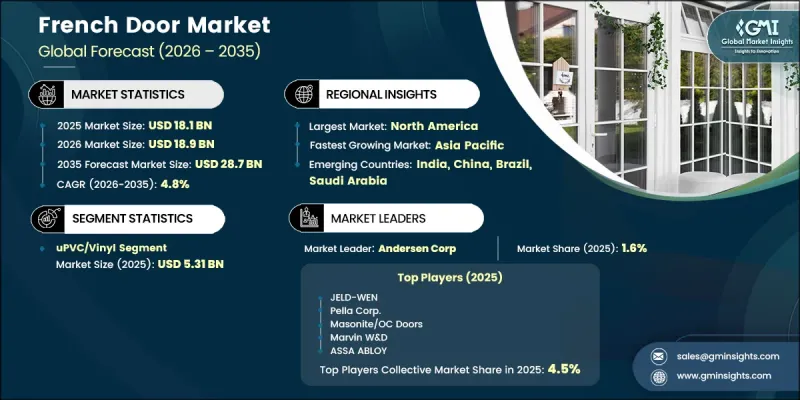
法式門市場的成長主要受以下因素驅動:住宅翻新支出增加、對視覺整合生活空間的需求日益成長,以及全球主要建築市場對建築能源效率法規的日益嚴格。消費者越來越重視兼具美觀和隔熱的建築解決方案,這推動了先進開啟系統的普及。熱最佳化鋁材、增強型uPVC和木紋工程玻璃纖維等材料因其在耐用性、隔熱性能和設計柔軟性的平衡而備受關注。推動市場成長的關鍵結構性因素之一是人們對「室內外無縫銜接」理念的日益青睞,即透過設計住宅佈局,在視覺和物理層面消除室內外之間的界限。這種轉變在翻新主導的需求週期中尤其顯著,住宅投資維修現有房屋,以提高舒適度、能源效率和生活功能性。此外,高階和中端住宅市場的穩定需求也支撐著市場,在這些市場中,美觀性和高能源效率正日益被視為標準配置而非可選功能。總體而言,法式門市場持續受益於不斷變化的建築偏好和住宅建築品質標準的長期改進。
| 市場範圍 | |
|---|---|
| 開始年份 | 2025 |
| 預測期 | 2026-2035 |
| 起始金額 | 181億美元 |
| 預測金額 | 287億美元 |
| 複合年成長率 | 4.8% |
塑鋼/乙烯基材料目前佔據30%的市場佔有率,預計到2025年將達到53.1億美元。其主導地位得益於其卓越的隔熱性能、成本效益以及在較長的產品生命週期內較低的維護需求。由於該材料在保持價格實惠的同時還能提供穩定的能源效率,因此在住宅應用中持續廣泛採用。此外,其在替換和維修項目中的廣泛應用也推動了市場需求,因為在這些項目中,性能可靠性和易於安裝是關鍵因素。
在法式門市場,線下銷售管道仍然佔據主導地位,這主要源於消費者強烈的購買前親自檢查和評估產品的意願。買家通常會優先考慮在最終決定之前核實設計品質、材料飾面、客製化選項和結構耐久性。此外,透過傳統零售網路提供的諮詢、測量服務和安裝協調服務在提高轉換率方面發揮著至關重要的作用。包括專賣店和建材供應管道在內的成熟分銷網路,在大多數區域市場仍是主要的銷售管道。
預計2025年,北美法式門市場規模將達55億美元,市佔率為30.47%。由於該地區建築市場較成熟,市場需求主要來自房屋翻新更換,而非新建住宅。這種穩定的維修週期促進了產品的持續普及,尤其是在注重節能和設計的住宅維修工程中。雖然與新興地區相比,北美法式門市場的成長速度較慢,但消費者在住宅維修的強勁支出以及對建築現代化的持續關注,仍然推動著該市場的發展。
目錄
第1章:調查方法和範圍
第2章執行摘要
第3章 行業洞察
- 產業生態系分析
- 供應鏈分析
- 主要原物料採購狀況
- 供應鏈風險與中斷評估
- 近岸外包和供應商多元化趨勢
- 影響產業的因素
- 市場促進因素
- 住宅裝修和房屋維修支出增加
- 消費者越來越傾向將室內外空間融合在一起的生活方式,以及利用自然光。
- 加強能源效率法規和綠建築標準要求
- 豪華住宅和高階建築設計領域的成長
- 市場限制因素
- 原料價格波動(鋁、玻璃、硬木、UPVC)
- 高昂的實施和定製成本阻礙了價格敏感型市場的採用。
- 市場機遇
- 智慧家庭整合、電氣控制、整合感測器、智慧門鎖
- 亞太和中東地區的快速都市化和新建設活動
- 豪華酒店業的擴張正在推動對豪華商業房地產的需求。
- 電子商務通路的發展將使標準規格產品能夠直接銷售給消費者。
- 市場促進因素
- 成長潛力分析
- 技術與創新展望
- 精準播種技術(GPS、變數施肥技術、RTK)
- 將物聯網和感測器整合到最新的播種機中
- 噴霧式播種機設計中氣動和液壓技術的進步
- 犁地和直播技術的演變
- 一種用於電動和混合動力推進系統的新平台
- 無人機/無人飛行器搭載式空中播種系統
- 監理框架
- 能源效率標準與建築規範(IECC、歐盟建築能源性能指令)
- 消防安全與保全認證(UL、CE 標誌、BS 476)
- 環境與永續性法規(REACH、RoHS、綠建築標準)
- 貿易關稅及進出口法規
- 關鍵市場趨勢與顛覆性因素
- 未來市場趨勢
- 價格分析
- 對過去價格趨勢的分析
- 依球員類型分類的定價策略(高級球員、超值球員、成本加成球員)
- 依材料分類的價格基準(木材 vs. 鋁材 vs. uPVC vs. 玻璃纖維)
- 貿易數據分析
- 按材料分類的進出口量和進口額趨勢
- 主要貿易走廊及關稅影響(美中貿易、歐盟區域內貿易、亞太地區貿易)
- 人工智慧和生成式人工智慧對市場的影響
- 人工智慧驅動的現有經營模式轉型(配置器、客製化設計自動化)
- GenAI 各細分市場應用案例及實施藍圖(虛擬展示室、預測性維護)
- 生產能力和生產情況
- 按地區和主要生產國分類的已安裝製造能力
- 運轉率和擴張計劃
- 投資與資金籌措分析
- 製造業產能資本投資趨勢
- 併購活動與策略收購模式
- 按公司規模分類的研發支出基準
- 波特的分析
- PESTLE分析
第4章 競爭情勢
- 介紹
- 企業市佔率分析
- 按地區
- 企業矩陣分析
- 主要市場公司的競爭分析
- 競爭定位矩陣
- 主要進展
- 併購
- 夥伴關係和聯盟
- 新產品發布
- 業務拓展計劃
第5章 市場估計與預測:依材料分類,2022-2035年
- 木頭
- 實木
- 工程木材
- 覆層材料/覆層木材(鋁塗層、乙烯基塗層)
- 鋁
- 標準鋁
- 絕緣鋁
- uPVC/乙烯基
- 標準型uPVC
- 增強型uPVC
- 玻璃纖維
- 光滑玻璃纖維
- 木紋玻璃纖維
- 鋼
- 複合材料
第6章 市場估算與預測:門配置與類型,2022-2035年
- 雙鉸鏈法式門
- 兩扇門(兩扇門都可以打開和關閉)
- 兩扇門(一扇固定,一扇可開啟)
- 三面板配置
- 單鉸鏈法式門
- 法式拉門(法式露台門)
- 雙面板滑軌
- 四扇滑門
- 折疊門/多扇法式門
- 三折式
- 折疊式,由 4 個或更多面板組成
第7章 市場估計與預測:依應用領域分類,2022-2035年
- 外門
- 面向露台和花園的門
- 陽台露台
- 入口/立面
- 室內門
- 分割
- 日光室/溫室隔間
- 客廳到餐廳的過渡空間。
第8章 市場估算與預測:依最終使用者分類,2022-2035年
- 住宅
- 新建工程
- 維修和更換
- 商業
- 飯店餐飲業(飯店、度假村、餐廳)
- 辦公大樓
- 零售和混合用途開發
- 醫療機構
第9章 市場估價與預測:依通路分類,2022-2035年
- 線上
- 電子商務
- 企業網站
- 離線
- 門窗專賣零售商
- 家居裝修商店和DIY專賣店
- 直接面向企業的銷售/B2B
第10章 市場估價與預測:依地區分類,2022-2035年
- 北美洲
- 美國
- 加拿大
- 歐洲
- 德國
- 英國
- 法國
- 義大利
- 西班牙
- 亞太地區
- 中國
- 印度
- 日本
- 韓國
- 澳洲
- 拉丁美洲
- 巴西
- 墨西哥
- 阿根廷
- 中東和非洲
- UAE
- 沙烏地阿拉伯
- 南非
第11章:公司簡介
- 世界公司
- JELD-WEN, Inc.
- Andersen Corporation
- Pella Corporation
- Masonite International Corporation
- Marvin Windows & Doors
- ASSA ABLOY AB
- 當地公司
- Hormann Group
- Internorm
- LIXIL Corporation
- Therma-Tru Doors
- Allegion plc
- NorDan Group
- OKNOPLAST Group
- 新興企業
- Milgard Windows & Doors
- ProVia
- Vallisco
- APRO Door
- Plastpro Inc.
- Cascadia Windows & Doors
- TruStile Doors
- Woodgrain Inc.
The Global French Door Market was valued at USD 18.1 billion in 2025 and is estimated to grow at a CAGR of 4.8% to reach USD 28.7 billion by 2035.
Growth in the French Door Market is shaped by rising residential renovation spending, stronger demand for visually connected living spaces, and increasingly strict building energy efficiency regulations across major global construction markets. Consumers are steadily prioritizing architectural solutions that combine design aesthetics with thermal insulation performance, supporting wider adoption of advanced fenestration systems. Materials such as thermally optimized aluminum, reinforced uPVC, and engineered fiberglass with wood-style finishes are gaining traction due to their balance of durability, insulation capability, and design flexibility. A key structural driver is the growing preference for seamless indoor-outdoor living concepts, where residential layouts are designed to remove visual and physical barriers between interior and exterior spaces. This shift is particularly strong in renovation-driven demand cycles, where homeowners invest in upgrading existing properties to improve comfort, energy efficiency, and lifestyle functionality. The market is also supported by consistent demand from premium and mid-tier housing segments, where aesthetic appeal and energy-efficient performance are increasingly viewed as standard requirements rather than optional features. Overall, the French Door Market continues to benefit from evolving architectural preferences and long-term improvements in residential construction quality standards.
| Market Scope | |
|---|---|
| Start Year | 2025 |
| Forecast Year | 2026-2035 |
| Start Value | $18.1 Billion |
| Forecast Value | $28.7 Billion |
| CAGR | 4.8% |
The uPVC/Vinyl segment held a 30% share, accounting for USD 5.31 billion in 2025. Its leadership position is attributed to strong thermal insulation performance, cost efficiency, and low maintenance requirements over long product lifecycles. This material category remains widely adopted in residential applications due to its ability to deliver consistent energy efficiency while maintaining affordability. Demand is further supported by its extensive use in replacement and renovation projects, where performance reliability and ease of installation are key decision factors.
The offline distribution channel continues to dominate the french door market, driven by strong consumer preference for in-person product evaluation prior to purchase. Buyers typically rely on physical assessment of design quality, material finish, customization options, and structural durability before making final decisions. In addition, advisory support, measurement services, and installation coordination offered through traditional retail networks play a critical role in driving conversions. Established distribution networks, including specialty outlets and building material supply channels, continue to serve as the primary sales pathway across most regional markets.
North America French Door Market generated USD 5.5 billion, accounting for 30.47% share in 2025. The region's mature construction landscape results in demand being primarily driven by renovation and replacement activities rather than new residential builds. This steady upgrade cycle supports consistent product adoption, particularly in energy-efficient and design-oriented home improvement projects. While growth remains moderate compared to emerging regions, the market continues to benefit from strong consumer spending on housing upgrades and sustained interest in architectural modernization.
Key companies operating in the Global French door market include Marvin Windows & Doors, Andersen Corporation, Pella Corporation, JELD-WEN, Inc., Masonite International Corporation (now OC Doors, an Owens Corning division), LIXIL Corporation, ASSA ABLOY AB, Hormann Group, Therma-Tru Doors, Milgard Windows & Doors, Internorm, Allegion plc, ProVia, APRO Door, and Vallisco. Companies in the French Door Market are actively focusing on product innovation, energy-efficient designs, and material advancements to strengthen their competitive positioning. Manufacturers are enhancing product portfolios with improved insulation technologies, durable composite materials, and customizable design options to meet evolving consumer preferences. Expansion of distribution networks and stronger partnerships with builders, contractors, and retail channels are supporting broader market penetration. Firms are also investing in manufacturing automation, digital product visualization tools, and advanced supply chain optimization to improve operational efficiency.
Table of Contents
Chapter 1 Methodology & Scope
- 1.1 Research approach
- 1.2 Quality Commitments
- 1.2.1 GMI AI policy & data integrity commitment
- 1.2.1.1 Source consistency protocol
- 1.2.1 GMI AI policy & data integrity commitment
- 1.3 Research Trail & Confidence Scoring
- 1.3.1 Research Trail Components
- 1.3.2 Scoring Components
- 1.4 Data Collection
- 1.4.1 Partial list of primary sources
- 1.5 Data mining sources
- 1.5.1 Paid sources
- 1.5.1.1 Sources, by region
- 1.5.1 Paid sources
- 1.6 Base estimates and calculations
- 1.6.1 Base year calculation for any one approach
- 1.7 Forecast model
- 1.7.1 Quantified market impact analysis
- 1.7.1.1 Mathematical impact of growth parameters on forecast
- 1.7.1 Quantified market impact analysis
- 1.8 Research transparency addendum
- 1.8.1 Source attribution framework
- 1.8.2 Quality assurance metrics
- 1.8.2.1 Our commitment to trust
Chapter 2 Executive Summary
- 2.1 Industry 360° synopsis, 2022 - 2035
- 2.2 Key market trends
- 2.2.1 Region
- 2.2.2 Material
- 2.2.3 Door configuration and type
- 2.2.4 Application
- 2.2.5 End-user
- 2.2.6 Distribution channel
Chapter 3 Industry Insights
- 3.1 Industry ecosystem analysis
- 3.2 Supply chain analysis
- 3.2.1 key raw material sourcing landscape
- 3.2.2 Supply chain risks & disruption assessment
- 3.2.3 Nearshoring & supplier diversification trends
- 3.3 Industry impact forces
- 3.3.1 Market drivers
- 3.3.1.1 Rising residential renovation & home improvement spending
- 3.3.1.2 Growing consumer preference for indoor-outdoor living & natural light integration
- 3.3.1.3 Tightening energy efficiency mandates & green building code requirements
- 3.3.1.4 Growth in luxury residential construction & premium architectural design
- 3.3.2 Market restraints
- 3.3.2.1 Raw material price volatility (aluminum, glass, hardwood, upvc)
- 3.3.2.2 High installation & customization costs limiting adoption in price-sensitive segments
- 3.3.3 Market opportunities
- 3.3.3.1 Smart home integration motorized operation, integrated sensors & smart locking
- 3.3.3.2 Rapid urbanization & new construction activity in asia pacific & middle east
- 3.3.3.3 Expansion of luxury hospitality sector driving premium commercial demand
- 3.3.3.4 e-commerce channel growth enabling direct-to-consumer standard-spec sales
- 3.3.1 Market drivers
- 3.4 Growth potential analysis
- 3.5 Technology & innovation landscape
- 3.5.1 Precision seeding technologies (GPS, variable rate technology, RTK)
- 3.5.2 IoT & sensor integration in modern seed drills
- 3.5.3 Pneumatic & hydraulic advances in broadcast seeder design
- 3.5.4 No-till & direct seeding technology evolution
- 3.5.5 Electric & hybrid propulsion emerging platforms
- 3.5.6 Drone / UAV-mounted aerial seeding systems
- 3.6 Regulatory framework
- 3.6.1 Energy Efficiency Standards & Building Codes (IECC, EU Energy Performance of Buildings Directive)
- 3.6.2 Fire Safety & Security Certifications (UL, CE Marking, BS 476)
- 3.6.3 Environmental & Sustainability Regulations (REACH, RoHS, Green Building Standards)
- 3.6.3.1 Trade Tariffs & Import/Export Regulations
- 3.7 Major market trends and disruptions
- 3.8 Future market trends
- 3.9 Pricing analysis (driven by primary research)
- 3.9.1 Historical Price Trend Analysis (Driven by Primary Research)
- 3.9.2 Pricing Strategy by Player Type (Premium / Value / Cost-plus) (Driven by Primary Research)
- 3.9.3 Price Benchmarking by Material Type (Wood vs. Aluminum vs. uPVC vs. Fiberglass)
- 3.10 Trade data analysis (driven by primary research)
- 3.10.1 Import/Export Volume & Value Trends by Material Type (Driven by Primary Research)
- 3.10.2 Key Trade Corridors & Tariff Impact (US-China, EU Intra-Trade, APAC) (Driven by Primary Research)
- 3.11 Impact of AI & generative AI on the market
- 3.11.1 AI-Driven Disruption of Existing Business Models (Configurators, Custom Design Automation)
- 3.11.2 GenAI Use Cases & Adoption Roadmap by Segment (Virtual Showrooms, Predictive Maintenance)
- 3.12 Capacity & production landscape (driven by primary research)
- 3.12.1 Manufacturing capacity installed by region & key producer (driven by primary research)
- 3.12.2 Capacity utilization rates & expansion pipelines (driven by primary research)
- 3.13 Investment & funding analysis
- 3.13.1 Capital Investment Trends in Manufacturing Capacity
- 3.13.2 M&A Activity & Strategic Acquisition Patterns
- 3.13.3 R&D Expenditure Benchmarks by Company Tier
- 3.14 Porter's analysis
- 3.15 PESTEL analysis
Chapter 4 Competitive Landscape, 2025
- 4.1 Introduction
- 4.2 Company market share analysis
- 4.2.1 By Region
- 4.2.1.1 North America
- 4.2.1.2 Europe
- 4.2.1.3 Asia Pacific
- 4.2.1.4 Latin America
- 4.2.1.5 Middle East and Africa
- 4.2.1 By Region
- 4.3 Company matrix analysis
- 4.4 Competitive analysis of major market players
- 4.5 Competitive positioning matrix
- 4.6 Key developments
- 4.6.1 Mergers & acquisitions
- 4.6.2 Partnerships & collaborations
- 4.6.3 New product launches
- 4.6.4 Expansion plans
Chapter 5 Market Estimates and Forecast, By Material, 2022 - 2035 (USD Billion) (Thousand Units)
- 5.1 Key trends
- 5.2 Wood
- 5.2.1 Solid Wood
- 5.2.2 Engineered Wood
- 5.2.3 Cladded/Clad Wood (Aluminum-Clad, Vinyl-Clad)
- 5.3 Aluminum
- 5.3.1 Standard Aluminum
- 5.3.2 Thermally Broken Aluminum
- 5.4 uPVC/Vinyl
- 5.4.1 Standard uPVC
- 5.4.2 Reinforced uPVC
- 5.5 Fiberglass
- 5.5.1 Smooth Fiberglass
- 5.5.2 Wood-Grain Fiberglass
- 5.6 Steel
- 5.7 Composite
Chapter 6 Market Estimates and Forecast, By Door Configuration & Type, 2022 - 2035 (USD Billion) (Thousand Units)
- 6.1 Key trends
- 6.2 Double Hinged French Doors
- 6.2.1 Two-Panel (Both Operable)
- 6.2.2 Two-Panel (One Fixed, One Operable)
- 6.2.3 Three-Panel Configurations
- 6.3 Single Hinged French Door
- 6.4 Sliding French Doors (French Patio Doors)
- 6.4.1 Two-Panel Sliding
- 6.4.2 Four-Panel Sliding
- 6.5 Bifold/Multi-Panel French Doors
- 6.5.1 Three-Panel Bifold
- 6.5.2 Four-Panel & Above Bifold
Chapter 7 Market Estimates and Forecast, By Application, 2022 - 2035 (USD Billion) (Thousand Units)
- 7.1 Key trends
- 7.2 Exterior Doors
- 7.2.1 Patio & Garden-Facing
- 7.2.2 Balcony & Terrace
- 7.2.3 Entry/Facade
- 7.3 Interior Doors
- 7.3.1 Room Dividers
- 7.3.2 Sunroom/Conservatory Separators
- 7.3.3 Living-to-Dining Transitions
Chapter 8 Market Estimates and Forecast, By End User, 2022 - 2035 (USD Billion) (Thousand Units)
- 8.1 Key trends
- 8.2 Residential
- 8.2.1 New Construction
- 8.2.2 Renovation & Replacement
- 8.3 Commercial
- 8.3.1 Hospitality (Hotels, Resorts, Restaurants)
- 8.3.2 Office Buildings
- 8.3.3 Retail & Mixed-Use Developments
- 8.3.4 Healthcare Facilities
Chapter 9 Market Estimates and Forecast, By Distribution Channel, 2022 - 2035 (USD Billion) (Thousand Units)
- 9.1 Key trends
- 9.2 Online
- 9.2.1 E-commerce
- 9.2.2 Company Website
- 9.3 Offline
- 9.3.1 Specialty Doors & Windows Retailers
- 9.3.2 Home Improvement & DIY Stores
- 9.3.3 Direct-to-Contractor / B2B
Chapter 10 Market Estimates & Forecast, By Region, 2022 - 2035, (USD Billion) (Thousand Units)
- 10.1 Key trends
- 10.2 North America
- 10.2.1 U.S.
- 10.2.2 Canada
- 10.3 Europe
- 10.3.1 Germany
- 10.3.2 U.K.
- 10.3.3 France
- 10.3.4 Italy
- 10.3.5 Spain
- 10.4 Asia Pacific
- 10.4.1 China
- 10.4.2 India
- 10.4.3 Japan
- 10.4.4 South Korea
- 10.4.5 Australia
- 10.5 Latin America
- 10.5.1 Brazil
- 10.5.2 Mexico
- 10.5.3 Argentina
- 10.6 MEA
- 10.6.1 UAE
- 10.6.2 Saudi Arabia
- 10.6.3 South Africa
Chapter 11 Company Profiles
- 11.1 Global Companies
- 11.1.1 JELD-WEN, Inc.
- 11.1.2 Andersen Corporation
- 11.1.3 Pella Corporation
- 11.1.4 Masonite International Corporation
- 11.1.5 Marvin Windows & Doors
- 11.1.6 ASSA ABLOY AB
- 11.2 Regional Companies
- 11.2.1 Hormann Group
- 11.2.2 Internorm
- 11.2.3 LIXIL Corporation
- 11.2.4 Therma-Tru Doors
- 11.2.5 Allegion plc
- 11.2.6 NorDan Group
- 11.2.7 OKNOPLAST Group
- 11.3 Emerging Companies
- 11.3.1 Milgard Windows & Doors
- 11.3.2 ProVia
- 11.3.3 Vallisco
- 11.3.4 APRO Door
- 11.3.5 Plastpro Inc.
- 11.3.6 Cascadia Windows & Doors
- 11.3.7 TruStile Doors
- 11.3.8 Woodgrain Inc.

 2026年全球抽屜式冰櫃市場報告
 歐洲家用冷藏庫:市場佔有率分析、產業趨勢與統計及成長預測(2026-2031)印度冷藏庫:市場佔有率分析、產業趨勢與統計及成長預測(2026-2031)美國家用冷藏庫:市場佔有率分析、產業趨勢與統計及成長預測(2026-2031 年)
 商品行銷冷藏庫市場規模、佔有率及成長分析:依產品類型、溫度範圍、應用、最終用戶、冷氣方式及地區分類-2026-2033年產業預測
 太陽能直驅冷藏庫與冷凍庫市場-2026-2032年全球市場預測立式冷藏庫和冷凍庫市場:全球市場預測(2026-2032)
 冷藏庫市場規模、佔有率和成長分析:按產品規格、產品類型、銷售管道、最終用戶和地區分類-2026-2033年產業預測冷藏庫和冷凍庫市場:2026-2032年全球市場預測(按產品類型、除霜技術、門配置、最終用戶和分銷管道分類)房車冷藏庫市場:按類型、容量、銷售管道、價格範圍、應用程式和最終用戶分類-2026-2032年全球市場預測