

 |
市場調查報告書
商品編碼
2124343
印度冷藏庫:市場佔有率分析、產業趨勢與統計及成長預測(2026-2031)India Refrigerator - Market Share Analysis, Industry Trends & Statistics, Growth Forecasts (2026 - 2031) |
||||||

※ 本網頁內容可能與最新版本有所差異。詳細情況請與我們聯繫。
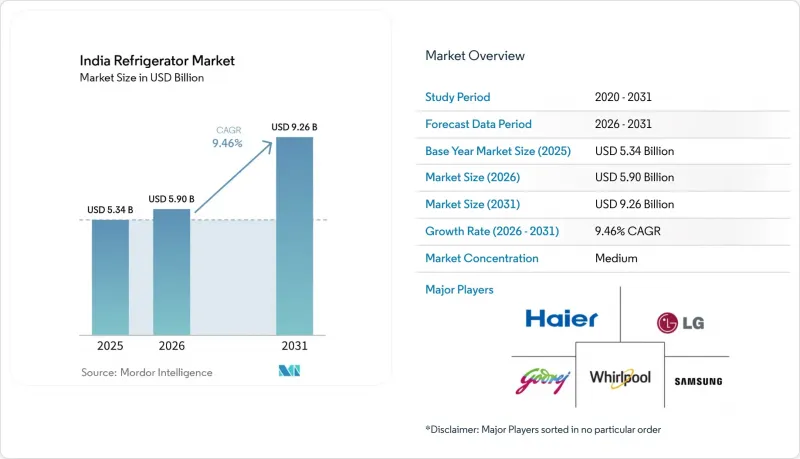
根據 Mordor Intelligence 預測,印度冷藏庫市場規模將從 2025 年的 53.4 億美元成長到 2026 年的 59 億美元,然後在 2031 年達到 92.6 億美元,2026 年至 2031 年的複合年成長率為 9.46%。
本報告按產品類型(單門、雙門等)、結構(嵌入式和獨立式)、容量(小於15立方英尺和大於15立方英尺)、最終用戶(住宅和商用)、配銷通路(B2C/零售和B2B)以及地區(印度北部、印度南部、印度西部、印度東部)進行細分。市場預測以美元(USD)計價。
印度冷藏庫市場趨勢與洞察
二、三線城市居民可支配所得增加,電力普及率提高。
受可支配收入成長和二、三線城市電氣化率提高的推動,印度冷藏庫市場正經歷強勁成長。隨著越來越多的家庭獲得可靠的電力供應,對現代化、節能冷藏庫的需求正從傳統的城市中心擴展到其他地區。中小城市的消費者也越來越有能力購買中高階型號的冰箱,包括雙門和多門冷藏庫。智慧變頻技術的普及進一步促進了這一轉變,該技術提高了能源效率和性能。零售商和製造商正積極回應這些趨勢,在這些新興市場拓展分銷網路和電子商務業務。總而言之,二、三線城市正成為成長的關鍵驅動力,顯著推動了印度整體冷藏庫市場的擴張。
生產關聯激勵計劃和透過「印度製造」計劃對壓縮機製造提供支持
印度政府的生產關聯激勵計劃(PLI)和「印度製造」舉措正顯著促進國內冷藏庫零件(尤其是壓縮機)的生產。國內企業正透過基板升級和引進新的射出成型線來提高冰箱的本地化率,例如海爾在大諾伊達的擴張以及計劃加大產能投資,以深化印刷電路板和冷藏庫件等零件的在地採購生產。同樣,三星宣布投資約2億美元在泰米爾納德邦的斯里佩姆布杜爾建立一家冷藏庫壓縮機製造廠,並與邦政府簽署了合作備忘錄,以擴大本地零件生態系統。這座佔地22英畝的新工廠將生產三星印度製造冷藏庫以及出口所需的壓縮機,從而增強國內產能。這些投資不僅將減少對進口的依賴,還將建立一個強大的本地零件生態系統,提高供應鏈韌性,並降低生產成本。中小製造商也積極參與其中,利用政府激勵措施投資自動化、節能生產和技能型勞動力發展,以提高產品品質標準。這些努力結合起來,有望加速產能擴張,促進創新,增強競爭力,並支持印度一線、二線和三線城市冷藏庫市場的快速成長。
電力和電壓不穩定問題持續影響半都市區的電網。
在印度北部和東部的都市區和小規模城鎮,電壓波動是一個長期存在的問題,尤其是在夏季高峰期。這些波動通常需要使用安定器,導致購置成本增加,並限制了無需安定器的定價模式的選擇。熱浪期間的負載激增會損壞低價冷藏庫的壓縮機零件,導致保固索賠增加,並削弱品牌信心——在口碑對購買決策影響巨大的市場中。雖然中高階冰箱擴大採用變頻技術和無安定器運行,但這些功能在經濟冰箱領域仍然有限,阻礙了農村和都市區家庭的普及。此外,售後服務網路薄弱導致維修時間長、物流成本高,進一步疏遠了電網覆蓋範圍之外和供電不足地區的消費者。目前正在努力推廣太陽能和電池供電的冷藏庫,但其高昂的價格仍然限制了低收入群體的購買。
細分市場分析
到2025年,雙門冷藏庫將佔印度冷藏庫市場39.46%的佔有率。此外,隨著高階機型的普及,預計到2031年,對開門冰箱的成長率將達到11.46%,成為成長最快的產品。法式對開門冷藏庫因其寬敞的保鮮室和位置便利的下置冷凍室而備受青睞。各大品牌正致力於提升冰箱的日常使用體驗,並支持用戶提前冷藏食材以備購物之需。對開門冰箱價格區間廣泛,品牌既能滿足成本績效的消費者,也能滿足追求高級連網功能和智慧顯示特性的高階消費者的需求。同時,在小規模城鎮,入門級單門直冷冷藏庫依然有市場,但首次購買冷藏庫的用戶擴大選擇大容量無霜雙門冰箱。靈活的融資方案進一步推動了這一趨勢,使新興都市區的家庭更容易負擔得起大容量冷藏庫。
為了滿足不斷變化的消費者需求,印度的冷藏庫產品線正在進行革新,重點在於提高能源效率、增強智慧診斷功能並加快冷卻速度。法式對開門冰箱兼具實用容量和高階外觀,採用霧面飾面、玻璃門和類似食品儲藏室的儲物空間,方便存放生鮮食品。並排式冰箱依然廣受歡迎,尤其是在都市區居民可支配收入較高,電費也適合高效變頻系統,因此對大家庭和經常來訪的客人來說更具吸引力。設計師款冰箱降低了高階型號的改造門檻,無需改變廚房結構即可升級。雖然高階價位的冰箱通常配備先進的互聯功能,但配備變頻壓縮機的中檔冷藏庫仍然是最普及的。總體而言,市場正逐漸從入門級基本型號轉向功能豐富的冷藏庫,這些冰箱在容量、便利性和生活方式偏好之間取得了良好的平衡。
2025年,獨立式冷藏庫佔了81.58%的市佔率。但隨著模組化櫥櫃在印度冷藏庫市場(即使在主要大都會圈)的普及,預計到2031年,嵌入式冰箱的市場佔有率將成長10.84%。這種類型的冰箱在注重視覺統一性且能夠滿足安裝要求(例如對齊、通風和麵板整合)的家庭中最為常見。各大品牌正在推出與嵌入式冰箱外觀相似的獨立式冷藏庫,以吸引居住者無法改變廚房佈局的住宅和經常搬家的商務人士。不銹鋼、玻璃和霧面飾面的日益普及反映了家電作為設計元素,與整體室內設計相得益彰的趨勢。然而,安裝複雜性和高昂的價格等因素限制了嵌入式冷藏庫在許多中小城市的普及,獨立式冷藏庫仍然是主流選擇。隨著模組化廚房概念的普及,人們對嵌入式廚房的興趣也逐漸增加,尤其是在高階消費者中。
包括開發人員在內的多家公司,正加速嵌入式和麵板式冰箱的銷售週期,這些開發商將模組化廚房作為標準配置。零售商和品牌工作室現在更加重視彩色面板和設計協調的飾面,這提高了產品的可發現性,並減少了消費者在計劃廚房全面整修的焦慮。服務合作夥伴具備專業的安裝和精準的面板對齊能力,最大限度地減少了安裝後的問題,並提高了整體滿意度。零件在地採購的增加降低了生產成本,並增強了高階產品線的供應穩定性。同時,由於其便攜性、租賃住宅條件和成本方面的考慮,獨立式冰箱在大多數地區仍然更受歡迎。總體而言,雖然嵌入式冷藏庫在都市區和高所得市場正在崛起,但預計在預測期內,獨立式冰箱仍將在印度保持主導地位。
其他好處:
- Excel格式的市場預測(ME)表
- 3個月的分析師支持
目錄
第1章:引言
- 研究假設和市場定義
- 調查範圍
第2章:調查方法
第3章執行摘要
第4章 市場狀況
- 市場概覽
- 市場促進因素
- 二、三線城市居民可支配所得增加,電氣化率提高。
- 生產關聯激勵計劃和透過「印度製造」計劃對壓縮機製造提供支持
- 採用變頻技術和人工智慧壓縮機
- 對高階多門和設計師家電的需求不斷成長
- 重點關注節能產品和獲得BEE認證的產品。
- 有組織的零售和電子商務網路的擴張
- 市場限制因素
- 郊區電網持續受到電力和電壓不穩定的影響。
- 農村地區的售後服務有嚴重不足。
- 智慧電錶基礎設施的部署仍然非常有限。
- 某些地區高度依賴農業是季節性農業需求所造成的。
- 產業價值鏈分析
- 波特五力分析
- 洞察最新市場趨勢與創新
- 近期趨勢分析(新產品發布、策略性舉措、投資、合作、合資、業務擴張、併購等)
第5章 市場規模與成長預測
- 依產品
- 單門冷藏庫
- 雙門冷藏庫
- 上層冷凍室類型
- 底部冷凍庫型
- 對開門冷藏庫
- 法式對開門冷藏庫
- 其他冷藏庫
- 按結構
- 內建
- 自主型
- 按產能
- 小於15立方英尺
- 15立方英尺或以上
- 最終用戶
- 住宅
- 商業的
- 透過分銷管道
- B2C/零售
- 多品牌商店
- 品牌經銷店
- 線上
- 其他分銷管道
- B2B/廠商直銷
- B2C/零售
- 按地區
- 印度北部
- 南印度
- 西印度群島
- 東印度
第6章 競爭情勢
- 市場集中度
- 策略趨勢
- 市佔率分析
- 公司簡介
- Samsung Electronics
- LG Electronics
- Whirlpool Corporation
- Godrej Appliances
- Haier India
- Panasonic Corporation
- Voltas Beko
- Hitachi Global Life Solutions
- Videocon Industries
- BSH Hausgerate GmbH
- Blue Star
- IFB Appliances
- Hisense
- Kelvinator India
- Onida(Mirc Electronics)
- Lloyd(Havells)
- Carrier-Midea
- Croma(Infiniti Retail)
- MarQ(Flipkart Private Label)
- Voltas Beko Home Appliances Pvt. Ltd.
第7章 市場機會與未來展望
According to Mordor Intelligence, the India refrigerator market size is expected to grow from USD 5.34 billion in 2025 to USD 5.90 billion in 2026 and is forecast to reach USD 9.26 billion by 2031 at a 9.46% CAGR over 2026-2031.
This report is Segmented by Product (Single-Door, Double-Door, and More), Structure (Built-In and Freestanding), Capacity (Less Than 15 Cu. Feet and More Than 15 Cu. Feet), End User (Residential and Commercial), Distribution Channel (B2C/Retail and B2B), and Geography (North India, South India, West India, and East India). The Market Forecasts are Provided in Terms of Value (USD).
India Refrigerator Market Trends and Insights
Rising Disposable Incomes and Enhanced Electrification in Electrification in Tier -⅔ Towns
The India refrigerator market is experiencing strong growth, driven in part by rising disposable incomes and increasing electrification in tier-2 and tier-3 towns. As more households gain access to reliable electricity, demand for modern and energy-efficient refrigerators has expanded beyond traditional urban centers. Consumers in smaller cities are increasingly able to afford mid- to premium-range models, including double-door and multi-door refrigerators. This shift is also fueling the adoption of smart, inverter-based technologies, which offer improved energy efficiency and performance. Retailers and manufacturers are responding by expanding their distribution networks and e-commerce presence in these emerging markets. Overall, tier-2 and tier-3 towns are becoming key growth engines, contributing significantly to the country's overall refrigerator market expansion.
Support From PLI Schemes and 'Make in India' for Compressor Manufacturing
The Indian government's PLI scheme and Make in India initiatives are significantly boosting domestic manufacturing of refrigerator components, particularly compressors. Domestic players increased localization in refrigerators, supported by facility upgrades and new lines, as seen in Haier's Greater Noida expansion and planned capacity investments that deepen component in-sourcing across printed circuit boards and injection molded parts. Similarly, Samsung has announced an investment of around USD 200 million to establish a refrigerator compressor manufacturing plant in Sriperumbudur, Tamil Nadu, and has signed an MoU with the state government to expand the local component ecosystem. The new 22-acre facility will produce compressors for Samsung's India-manufactured refrigerators and for export, strengthening domestic production capacity. These investments not only reduce dependency on imports but also create a robust local component ecosystem, enhancing supply chain resilience and lowering production costs. Smaller manufacturers are also participating, leveraging government incentives to invest in automation, energy-efficient production, and skilled workforce development, which improves quality standards. Collectively, these initiatives are expected to accelerate capacity expansion, promote innovation, and drive competitiveness, supporting the rapid growth of the India refrigerator market across tier-1, tier-2, and tier-3 cities.
Power-Voltage Instability Continues to Affect Semi-Urban Grids
Voltage fluctuations are a persistent challenge in semi-urban and smaller towns across North and East India, especially during peak summer periods. These fluctuations often necessitate the use of stabilizers, which increases the effective purchase cost and limits the availability of stabilizer-free budget models. Load spikes during heat waves can damage compressor components in basic refrigerators, leading to higher warranty claims and affecting brand trust in markets where word-of-mouth strongly influences purchase decisions. While mid-range and premium models increasingly incorporate inverter technology and stabilizer-free operation, these features remain scarce in the affordable segment, slowing adoption among rural and semi-urban households. In addition, sparse after-sales service networks prolong repair times and increase logistical costs, further discouraging consumers in off-grid or underserved regions. Efforts to introduce solar- and battery-compatible refrigerators are underway, but high prices continue to restrict penetration in lower-income segments.
Other drivers and restraints analyzed in the detailed report include:
- Adoption of Inverter Technology and AI-Enabled Compressors
- Increased Demand for Premium Multi-Door and Designer Appliances
- Rural Regions Experience Significant After-Sales Service Deficiencies
For complete list of drivers and restraints, kindly check the Table Of Contents.
Segment Analysis
Double-door refrigerators captured a 39.46% market share in the India refrigerator market in 2025, and side-by-side models are projected to grow the fastest at 11.46% through 2031, as premium adoption accelerates. French-door refrigerators are gaining popularity among families seeking spacious, fresh compartments and convenient lower-positioned freezers. Brands are focusing on features like convertible freezer logic, quick-cool modes, and noise reduction to enhance daily usability and support pre-chill routines for planned grocery purchases. Price tiers in the side-by-side segment allow brands to target both value-conscious buyers and high-end consumers with advanced connectivity and smart display options. Meanwhile, entry-level single-door direct-cool refrigerators remain relevant in smaller towns, although first-time buyers increasingly opt for frost-free double-door units with higher capacities. This shift is further supported by flexible financing options that make larger refrigerators more accessible to emerging urban households.
Refrigerator portfolios in India are being refreshed with emphasis on energy efficiency, smart diagnostics, and faster cooling cycles to meet evolving consumer expectations. French-door designs combine functional capacity with premium aesthetics, offering matte finishes, glass doors, and pantry-style compartments for fresh foods. Side-by-side models continue to appeal to large families and frequent entertainers, particularly in cities with higher disposable incomes and electricity tariffs that favor efficient inverter systems. Designer finishes allow kitchens to be upgraded without structural changes, lowering the barrier for retrofitting high-end models. Premium price bands extend to advanced connected features, while mid-tier refrigerators with inverter compressors remain the most widely adopted. Overall, the market is witnessing a gradual shift from basic entry-level models to feature-rich refrigerators that balance capacity, convenience, and lifestyle preferences.
Freestanding refrigerators held 81.58% of the 2025 market size, while built-in lines are on a 10.84% growth path through 2031, as modular cabinetry spreads beyond large metros within the India refrigerator market. Adoption is strongest among households that prioritize seamless visual continuity and can accommodate installation requirements such as alignment, ventilation, and panel integration. Brands are introducing panel-ready freestanding units that mimic built-in aesthetics, appealing to renters and mobile professionals who cannot modify their kitchen layouts. The growing use of stainless steel, glass, and matte finishes reflects the trend of appliances serving as design elements that complement overall interior schemes. Despite this, higher installation complexity and price premiums limit mass adoption of true built-ins in many smaller cities, keeping freestanding refrigerators in the lead. As modular kitchen concepts spread, consumer interest in built-in-compatible formats is gradually increasing, especially among premium buyers.
Developers, including those offering modular kitchens as standard amenities, are accelerating the purchase cycle for built-in and panel-ready models. Retailers and brand studios now emphasize color panels and design-matched finishes, improving product discovery and reducing consumer uncertainty when planning full kitchen upgrades. Service partners are better equipped for professional installation and precise panel alignment, which minimizes post-installation issues and improves overall satisfaction. Higher localization of components has reduced production costs and strengthened supply stability for premium lines. At the same time, portability, rental patterns, and cost considerations continue to favor freestanding units in most regions. Overall, while built-in refrigerators are gaining a foothold in urban and high-income markets, freestanding formats are expected to remain dominant across India during the forecast period.
Complete Report Scope:
- By Product
- Single-Door Refrigerator
- Double-Door Refrigerator
- Top Freezer
- Bottom Freezer
- Side-By-Side Door Refrigerator
- French-Door Refrigerator
- Other Refrigerators
- By Structure
- Built-In
- Freestanding
- By Capacity
- Less Than 15 cu. Feet
- More Than 15 cu. Feet
- By End user
- Residential
- Commercial
- By Distribution Channel
- B2C/Retail
- Multi-brand Stores
- Exclusive Brand Outlets
- Online
- Other Distribution Channels
- B2B/Directly from the Manufacturers
- B2C/Retail
- By Geography
- North India
- South India
- West India
- East India
List of Companies Covered in this Report:
- Samsung Electronics
- LG Electronics
- Whirlpool Corporation
- Godrej Appliances
- Haier India
- Panasonic Corporation
- Voltas Beko
- Hitachi Global Life Solutions
- Videocon Industries
- BSH Hausgerate GmbH
- Blue Star
- IFB Appliances
- Hisense
- Kelvinator India
- Onida (Mirc Electronics)
- Lloyd (Havells)
- Carrier-Midea
- Croma (Infiniti Retail)
- MarQ (Flipkart Private Label)
- Voltas Beko Home Appliances Pvt. Ltd.
Additional Benefits:
- The market estimate (ME) sheet in Excel format
- 3 months of analyst support
TABLE OF CONTENTS
1 Introduction
- 1.1 Study Assumptions & Market Definition
- 1.2 Scope of the Study
2 Research Methodology
3 Executive Summary
4 Market Landscape
- 4.1 Market Overview
- 4.2 Market Drivers
- 4.2.1 Rising Disposable Incomes and Enhanced Electrification in Electrification in Tier -2/3 Towns
- 4.2.2 Support From PLI Schemes and 'Make in India' for Compressor Manufacturing
- 4.2.3 Adoption of Inverter Technology and AI-Enabled Compressors
- 4.2.4 Increased Demand for Premium Multi-Door and Designer Appliances
- 4.2.5 Focus on Energy-Efficient and BEE-Certified Products
- 4.2.6 Expansion of Organized Retail and E-Commerce Networks
- 4.3 Market Restraints
- 4.3.1 Power-Voltage Instability Continues to Affect Semi-Urban Grids
- 4.3.2 Rural Regions Experience Significant After-Sales Service Deficiencies
- 4.3.3 Smart Metering Infrastructure Adoption Remains Minimal
- 4.3.4 Seasonal Agricultural Loads Drive High Dependency in Certain Areas
- 4.4 Industry Value Chain Analysis
- 4.5 Porter's Five Forces Analysis
- 4.5.1 Threat Of New Entrants
- 4.5.2 Bargaining Power Of Suppliers
- 4.5.3 Bargaining Power Of Buyers
- 4.5.4 Threat Of Substitutes
- 4.5.5 Competitive Rivalry
- 4.6 Insights Into The Latest Trends And Innovations In The Market
- 4.7 Insights On Recent Developments (New Product Launches, Strategic Initiatives, Investments, Partnerships, JVs, Expansion, M&As, Etc.)
5 Market Size & Growth Forecasts (Value)
- 5.1 By Product
- 5.1.1 Single-Door Refrigerator
- 5.1.2 Double-Door Refrigerator
- 5.1.2.1 Top Freezer
- 5.1.2.2 Bottom Freezer
- 5.1.3 Side-By-Side Door Refrigerator
- 5.1.4 French-Door Refrigerator
- 5.1.5 Other Refrigerators
- 5.2 By Structure
- 5.2.1 Built-In
- 5.2.2 Freestanding
- 5.3 By Capacity
- 5.3.1 Less Than 15 cu. Feet
- 5.3.2 More Than 15 cu. Feet
- 5.4 By End user
- 5.4.1 Residential
- 5.4.2 Commercial
- 5.5 By Distribution Channel
- 5.5.1 B2C/Retail
- 5.5.1.1 Multi-brand Stores
- 5.5.1.2 Exclusive Brand Outlets
- 5.5.1.3 Online
- 5.5.1.4 Other Distribution Channels
- 5.5.2 B2B/Directly from the Manufacturers
- 5.5.1 B2C/Retail
- 5.6 By Geography
- 5.6.1 North India
- 5.6.2 South India
- 5.6.3 West India
- 5.6.4 East India
6 Competitive Landscape
- 6.1 Market Concentration
- 6.2 Strategic Moves
- 6.3 Market Share Analysis
- 6.4 Company Profiles (includes Global level Overview, Market level overview, Core Segments, Financials as available, Strategic Information, Market Rank/Share for key companies, Products & Services, and Recent Developments)
- 6.4.1 Samsung Electronics
- 6.4.2 LG Electronics
- 6.4.3 Whirlpool Corporation
- 6.4.4 Godrej Appliances
- 6.4.5 Haier India
- 6.4.6 Panasonic Corporation
- 6.4.7 Voltas Beko
- 6.4.8 Hitachi Global Life Solutions
- 6.4.9 Videocon Industries
- 6.4.10 BSH Hausgerate GmbH
- 6.4.11 Blue Star
- 6.4.12 IFB Appliances
- 6.4.13 Hisense
- 6.4.14 Kelvinator India
- 6.4.15 Onida (Mirc Electronics)
- 6.4.16 Lloyd (Havells)
- 6.4.17 Carrier-Midea
- 6.4.18 Croma (Infiniti Retail)
- 6.4.19 MarQ (Flipkart Private Label)
- 6.4.20 Voltas Beko Home Appliances Pvt. Ltd.
7 Market Opportunities & Future Outlook
- 7.1 Rural Electrification & Affordable Models

 2026年全球抽屜式冰櫃市場報告
 歐洲家用冷藏庫:市場佔有率分析、產業趨勢與統計及成長預測(2026-2031)美國家用冷藏庫:市場佔有率分析、產業趨勢與統計及成長預測(2026-2031 年)
 商品行銷冷藏庫市場規模、佔有率及成長分析:依產品類型、溫度範圍、應用、最終用戶、冷氣方式及地區分類-2026-2033年產業預測
 太陽能直驅冷藏庫與冷凍庫市場-2026-2032年全球市場預測立式冷藏庫和冷凍庫市場:全球市場預測(2026-2032)
 法式門市場機會、成長促進因素、產業趨勢分析及2026-2035年預測
 冷藏庫市場規模、佔有率和成長分析:按產品規格、產品類型、銷售管道、最終用戶和地區分類-2026-2033年產業預測冷藏庫和冷凍庫市場:2026-2032年全球市場預測(按產品類型、除霜技術、門配置、最終用戶和分銷管道分類)房車冷藏庫市場:按類型、容量、銷售管道、價格範圍、應用程式和最終用戶分類-2026-2032年全球市場預測