


 |
市場調查報告書
商品編碼
2116313
歐洲家用冷藏庫:市場佔有率分析、產業趨勢與統計及成長預測(2026-2031)Europe Household Refrigerator - Market Share Analysis, Industry Trends & Statistics, Growth Forecasts (2026 - 2031) |
||||||

※ 本網頁內容可能與最新版本有所差異。詳細情況請與我們聯繫。
根據 Mordor Intelligence 預測,歐洲家用冷藏庫市場規模將從 2025 年的 133.6 億美元成長到 2026 年的 137.4 億美元,然後在 2031 年達到 158.4 億美元,2026 年至 2031 年的複合年成長率為 2.8%。
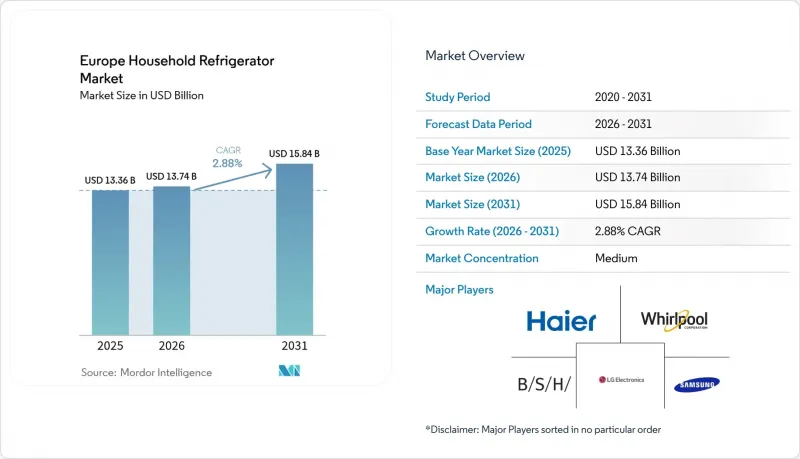
本報告按產品類型(單門冷藏庫、雙門冷藏庫等)、結構(嵌入式和獨立式)、容量(15立方英尺以下和15立方英尺以上)、配銷通路(多品牌商店、專賣店等)和地區(英國、德國等)進行分類。市場預測以美元計價。
歐洲家用冷藏庫市場趨勢與洞察
歐盟能源效率法規與獎勵
歐盟委員會新推出的《永續產品生態設計法規》進一步推動了家用電器製造商的發展。家用電器在2025-2030年議程中被列為重中之重,製造商現在必須生產更耐用、更易於維修且碳足跡清晰標註的產品。 《永續產品生態設計法規》強制要求所有家用冷藏庫產品線揭露其耐用性、可維修性和碳排放量,從而加快了產品更換週期。向A-G能源效率等級的明確過渡將消除標籤檢視混亂,而數位化產品護照將使監管機構能夠追蹤已註冊型號並逐步淘汰不合規庫存。預計到2022年,消費者將節省900億歐元,到2030年將節省1500億歐元,這將鞏固歐洲家用冷藏庫市場在政策主導的成長動能。
智慧家庭設備的快速普及和物聯網的互通性
歐盟於2024年4月發布的《節能家用電器行為準則》統一了相關協議,使冷藏庫能夠無縫參與需求面柔軟性計畫。由於Arcelik、大金和伊萊克斯的努力,符合該準則的冰箱預計將在一年內上市。 LG收購了荷蘭智慧家庭平台Athom 80%的股份,將擁有5萬台設備的Homey Pro生態系統整合到其白色家電產品線中,從而為其互聯功能的高價定價提供了依據。學術研究表明,家庭能源管理可以將家庭用電量降低57%,證明連網功能能帶來可觀的節能效果。
鋼材和壓縮機的投入成本波動很大
歐洲製造商營運130家工廠,能夠承受鋼鐵和壓縮機價格的大幅波動,但由於能源成本是美國的兩到三倍,利潤率正受到擠壓。新的氟化氣體法規進一步推高了高全球暖化潛勢(GWP)冷媒的成本,迫使他們迅速轉向天然來源的替代品。博世家電(BSH)在2023年投入8.5億歐元用於研發,這清楚地表明了透過提高設計效率來應對成本上漲所需的巨額資本投入。
細分市場分析
2025年,雙門冰箱的出貨量佔比達到33.60%,主要得益於其便捷的操作性和中端定位。法式對開冰箱目前仍佔少數,但預計2026年至2031年間將以5.35%的複合年成長率快速成長,超過歐洲家用冷藏庫市場的整體成長率。然而,都市區數量的增加推動了對更大空間和獨立蔬菜抽屜的需求,從而促進了法式對開門冰箱的普及。更大的櫃體容量使製造商能夠將多區冷卻、觸控螢幕和庫存追蹤功能與符合歐盟智慧家電互通性標準的攝影機結合。推動這一成長的主要動力是更換需求。使用老舊雙門冰箱的家庭正在權衡運行成本與最新A級認證法式對開門冰箱所能實現的節能效果。博世家電將5.5%的收入投入研發,用於開發整合「Home Connect」預測性維護平台的高階機型。此舉不僅提升了品牌忠誠度,使其能夠在來自中國的價格壓力下維持利潤率,也凸顯了法式對開門冰箱創新對歐洲家用冷藏庫市場的重要性。
預計到2025年,獨立式家電將佔出貨量的67.40%,深受注重搬遷便利性的居住者和重視成本績效的消費者的青睞。同時,在人口密集的歐洲城市,嵌入式家電預計將以5.70%的複合年成長率成長,因為在翻新過程中,與櫥櫃的無縫整合備受重視。能源標籤系統的改革也進一步推動了嵌入式產品的普及,因為使用者預期這些產品可以長期使用,其較長的使用壽命足以抵消較高的初始成本。製造商正在積極響應,開發可擴展的安裝套件,以在不犧牲容量的情況下增加櫥櫃深度,並採用更纖薄的壓縮機外殼。歐盟納入「生態設計法規」的耐用性標準與嵌入式產品的品質要求相符,確保在15年以上降低故障率和減少維修次數。隨著廚房逐漸演變為開放式社交空間,嵌入式設計不僅滿足了美學需求,還有助於品牌抓住歐洲家用冷藏庫市場高利潤的升級需求。
其他好處:
- Excel格式的市場預測(ME)表
- 3個月的分析師支持
目錄
第1章:引言
- 研究假設和市場定義
- 調查範圍
第2章:調查方法
第3章執行摘要
第4章 市場狀況
- 市場概覽
- 市場促進因素
- 歐盟能源效率法規與獎勵
- 智慧家庭設備的快速普及和物聯網的互通性
- 由於基礎設施老化,對更換的需求很高。
- 有組織的零售和最後一公里低溫運輸物流的擴張
- 相容於 VPP 的冷藏庫可以透過需量反應實現盈利。
- 循環經濟補貼用於修復和修繕項目
- 市場限制因素
- 鋼材和壓縮機原料價格波動劇烈
- 中國OEM廠商對進口商品的競爭日益激烈。
- 消費者對新的歐盟能源標籤感到困惑
- 根據替代性爭議解決(ADR)規則,冷媒和電池的運輸出現交貨延誤。
- 產業價值鏈分析
- 波特五力分析
- 洞察最新市場趨勢與創新
- 洞察近期市場趨勢(新產品發布、策略性舉措、投資、合作、合資、業務擴張、併購等)
第5章 市場規模與成長預測
- 依產品
- 單門冷藏庫
- 雙門冷藏庫
- 上置式冷凍庫櫃
- 底部冷凍庫型
- 對開門冷藏庫
- 法式對開門冷藏庫
- 其他冷藏庫
- 按結構
- 內建
- 自主型
- 按產能
- 小於15立方英尺
- 超過 15 立方英尺
- 透過分銷管道
- 多品牌商店
- 品牌經銷店
- 線上
- 其他分銷管道
- 按地區
- 英國
- 德國
- 法國
- 西班牙
- 義大利
- 比荷盧經濟聯盟(比利時、荷蘭、盧森堡)
- 北歐國家(丹麥、芬蘭、冰島、挪威、瑞典)
- 其他歐洲國家
第6章 競爭情勢
- 市場集中度
- 策略趨勢
- 市佔率分析
- 公司簡介
- BSH Hausgerate GmbH(Bosch-Siemens)
- Whirlpool Corp.
- Samsung Electronics Co. Ltd.
- LG Electronics Inc.
- Haier Smart Home Co. Ltd.
- Liebherr-Hausgerate GmbH
- Electrolux AB
- Midea Group
- Gorenje(Hisense)
- Miele & Cie. KG
- Arcelik AS(Beko, Grundig)
- Vestel Ticaret AS
- Smeg SpA
- CDA Group Ltd.
- Amica SA
- Candy Hoover Group
- Sharp Consumer Electronics
- Severin Elektrogerate
- Atlant Inc.
- Panasonic Corporation
- Teka Group
- Winia Electronics
第7章 市場機會與未來展望
According to Mordor Intelligence, the Europe household refrigerator market size is expected to grow from USD 13.36 billion in 2025 to USD 13.74 billion in 2026 and is forecast to reach USD 15.84 billion by 2031 at 2.88% CAGR over 2026-2031.
This report is Segmented by Product (Single-Door Refrigerator, Double-Door Refrigerator, and More). Structure (Built-In and Freestanding), Capacity (Less Than 15 Cu. Feet and More Than 15 Cu. Feet), Distribution Channel (Multi-Brand Stores, Exclusive Brand Outlets, and More), and Geography (United Kingdom, Germany, and More). The Market Forecasts are Provided in Terms of Value (USD).
Europe Household Refrigerator Market Trends and Insights
EU Energy-Efficiency Regulations and Incentives
The European Commission's new Ecodesign for Sustainable Products Regulation is giving appliance makers an extra push. Under its 2025-2030 agenda, household devices take top billing, and manufacturers must now build products that last longer, can be repaired more easily, and carry clear labels showing their carbon footprint. The Ecodesign for Sustainable Products Regulation accelerates replacement cycles by requiring durability, repairability, and carbon disclosure across household refrigeration lines. Moving to a clear A-G energy scale eliminates label confusion while digital product passports allow authorities to trace registered models, phasing out non-compliant stock. Consumer savings reached EUR 90 billion in 2022 and are projected at EUR 150 billion by 2030, anchoring a policy-led runway for the European household refrigerator market.
Rapid Smart-Appliance Penetration and IoT Interoperability
The EU Code of Conduct for energy-smart appliances, launched in April 2024, harmonizes protocols so refrigerators seamlessly join demand-side flexibility programs. Commitments from Arcelik, Daikin, and Electrolux ensure compliant models within a year. LG's 80% stake in Dutch platform Athom attaches Homey Pro's 50,000-device ecosystem to its white-goods portfolio, affirming that connected features now justify premium pricing. Academic trials show home-energy management can cut household consumption by 57%, translating connectivity into measurable savings.
Volatile Steel and Compressor Input Costs
European manufacturers operate 130 plants that absorb wide swings in steel and compressor pricing, eroding margins just as energy costs run 2-3 times US levels. The new F-gas regime further inflates high-GWP refrigerant costs, forcing swift conversion to natural alternatives. BSH's EUR 850 million R&D outlay in 2023 underscores the capex required to counter cost spikes via design efficiency.
Other drivers and restraints analyzed in the detailed report include:
- High Replacement Demand from Ageing Installed Base
- Expansion of Organised Retail and Last-Mile Cold-Chain Logistics
- Intensifying Price Competition from Chinese OEM Imports
For complete list of drivers and restraints, kindly check the Table Of Contents.
Segment Analysis
Double-door formats anchored 33.60% of 2025 shipments, thriving on familiarity and mid-price positioning. French-door units, though still a minority, will sprint at 5.35% CAGR between 2026-2031, outpacing the European household refrigerator market's overall rhythm. Yet rising urban affluence calls for wider shelf space and discreet vegetable drawers, propelling French-door adoption. The broader cabinet allows manufacturers to bundle multi-zone cooling, touchscreens, and camera-based inventory tracking that meet EU smart-appliance interoperability codes.Growth feeds off replacement demand: households with ageing double-door models weigh operating costs against the energy savings achievable with fresh A-class French-door offerings. BSH dedicates 5.5% of turnover to R&D, channelling funds into premium models that integrate Home Connect platforms for predictive maintenance. This reinforces brand stickiness and cushions margins amid Chinese pricing pressure, underlining why French-door innovation is pivotal for the European household refrigerator market.
Freestanding designs accounted for 67.40% of 2025 shipments, favored by renters and value-seekers who prize easy relocation. Built-in appliances, however, are poised for a 5.70% CAGR as renovation cycles in dense European cities emphasize seamless cabinetry. Energy-label reforms further encourage integrated units because owners anticipate keeping them for longer, diluting the upfront cost premium across an extended lifespan.Manufacturers respond with telescopic installation kits and slimmer compressor housings that reclaim cabinet depth without reducing capacity. The EU's durability criteria, embedded in the Ecodesign regulation, align with built-in quality, ensuring lower failure rates and fewer service calls over 15-plus years. As kitchens evolve into open-plan social spaces, built-in formats satisfy aesthetic demands while helping brands capture high-margin upgrades in the Europe household refrigerator market.
Complete Report Scope:
- By Product
- Single-Door Refrigerator
- Double-Door Refrigerator
- Top Freezer
- Bottom Freezer
- Side-By-Side Door Refrigerator
- French-Door Refrigerator
- Other Refrigerators
- By Structure
- Built-In
- Freestanding
- By Capacity
- Less Than 15 cu. Feet
- More Than 15 cu. Feet
- By Distribution Channel
- Multi-Brand Stores
- Exclusive Brand Outlets
- Online
- Other Distribution Channels
- By Geography
- United Kingdom
- Germany
- France
- Spain
- Italy
- BENELUX (Belgium, Netherlands, Luxembourg)
- NORDICS (Denmark, Finland, Iceland, Norway, Sweden)
- Rest of Europe
List of Companies Covered in this Report:
- BSH Hausgerate GmbH (Bosch-Siemens)
- Whirlpool Corp.
- Samsung Electronics Co. Ltd.
- LG Electronics Inc.
- Haier Smart Home Co. Ltd.
- Liebherr-Hausgerate GmbH
- Electrolux AB
- Midea Group
- Gorenje (Hisense)
- Miele & Cie. KG
- Arcelik A.S. (Beko, Grundig)
- Vestel Ticaret A.S.
- Smeg SpA
- CDA Group Ltd.
- Amica SA
- Candy Hoover Group
- Sharp Consumer Electronics
- Severin Elektrogerate
- Atlant Inc.
- Panasonic Corporation
- Teka Group
- Winia Electronics
Additional Benefits:
- The market estimate (ME) sheet in Excel format
- 3 months of analyst support
TABLE OF CONTENTS
1 Introduction
- 1.1 Study Assumptions & Market Definition
- 1.2 Scope of the Study
2 Research Methodology
3 Executive Summary
4 Market Landscape
- 4.1 Market Overview
- 4.2 Market Drivers
- 4.2.1 EU Energy-Efficiency Regulations and Incentives
- 4.2.2 Rapid Smart-Appliance Penetration and IoT Interoperability
- 4.2.3 High Replacement Demand from Ageing Installed Base
- 4.2.4 Expansion of Organised Retail and Last-Mile Cold-Chain Logistics
- 4.2.5 VPP-Ready Refrigerators Enabling Demand-Response Revenues
- 4.2.6 Circular-Economy Subsidies for Refurbishment and Repair Schemes
- 4.3 Market Restraints
- 4.3.1 Volatile Steel and Compressor Input Costs
- 4.3.2 Intensifying Price Competition from Chinese OEM Imports
- 4.3.3 Consumer Confusion over New EU Energy Labels
- 4.3.4 Delivery Delays from Alternative dispute resolution (ADR) Rules on Refrigerant/Battery Shipping
- 4.4 Industry Value Chain Analysis
- 4.5 Porter's Five Forces Analysis
- 4.5.1 Threat of New Entrants
- 4.5.2 Bargaining Power of Suppliers
- 4.5.3 Bargaining Power of Buyers
- 4.5.4 Threat of Substitutes
- 4.5.5 Competitive Rivalry
- 4.6 Insights Into the Latest Trends and Innovations in the Market
- 4.7 Insights on Recent Developments (New Product Launches, Strategic Initiatives, Investments, Partnerships, JVs, Expansion, M&As, etc.) in the Market
5 Market Size & Growth Forecasts (Value)
- 5.1 By Product
- 5.1.1 Single-Door Refrigerator
- 5.1.2 Double-Door Refrigerator
- 5.1.2.1 Top Freezer
- 5.1.2.2 Bottom Freezer
- 5.1.3 Side-By-Side Door Refrigerator
- 5.1.4 French-Door Refrigerator
- 5.1.5 Other Refrigerators
- 5.2 By Structure
- 5.2.1 Built-In
- 5.2.2 Freestanding
- 5.3 By Capacity
- 5.3.1 Less Than 15 cu. Feet
- 5.3.2 More Than 15 cu. Feet
- 5.4 By Distribution Channel
- 5.4.1 Multi-Brand Stores
- 5.4.2 Exclusive Brand Outlets
- 5.4.3 Online
- 5.4.4 Other Distribution Channels
- 5.5 By Geography
- 5.5.1 United Kingdom
- 5.5.2 Germany
- 5.5.3 France
- 5.5.4 Spain
- 5.5.5 Italy
- 5.5.6 BENELUX (Belgium, Netherlands, Luxembourg)
- 5.5.7 NORDICS (Denmark, Finland, Iceland, Norway, Sweden)
- 5.5.8 Rest of Europe
6 Competitive Landscape
- 6.1 Market Concentration
- 6.2 Strategic Moves
- 6.3 Market Share Analysis
- 6.4 Company Profiles (includes Global Level Overview, Market Level Overview, Core Segments, Financials as Available, Strategic Information, Market Rank/Share for Key Companies, Products & Services, and Recent Developments)
- 6.4.1 BSH Hausgerate GmbH (Bosch-Siemens)
- 6.4.2 Whirlpool Corp.
- 6.4.3 Samsung Electronics Co. Ltd.
- 6.4.4 LG Electronics Inc.
- 6.4.5 Haier Smart Home Co. Ltd.
- 6.4.6 Liebherr-Hausgerate GmbH
- 6.4.7 Electrolux AB
- 6.4.8 Midea Group
- 6.4.9 Gorenje (Hisense)
- 6.4.10 Miele & Cie. KG
- 6.4.11 Arcelik A.S. (Beko, Grundig)
- 6.4.12 Vestel Ticaret A.S.
- 6.4.13 Smeg SpA
- 6.4.14 CDA Group Ltd.
- 6.4.15 Amica SA
- 6.4.16 Candy Hoover Group
- 6.4.17 Sharp Consumer Electronics
- 6.4.18 Severin Elektrogerate
- 6.4.19 Atlant Inc.
- 6.4.20 Panasonic Corporation
- 6.4.21 Teka Group
- 6.4.22 Winia Electronics
7 Market Opportunities & Future Outlook
- 7.1 Adoption of Smart Technology and IoT-Enabled Refrigerators

 2026年全球抽屜式冰櫃市場報告
 印度冷藏庫:市場佔有率分析、產業趨勢與統計及成長預測(2026-2031)美國家用冷藏庫:市場佔有率分析、產業趨勢與統計及成長預測(2026-2031 年)
 商品行銷冷藏庫市場規模、佔有率及成長分析:依產品類型、溫度範圍、應用、最終用戶、冷氣方式及地區分類-2026-2033年產業預測
 太陽能直驅冷藏庫與冷凍庫市場-2026-2032年全球市場預測立式冷藏庫和冷凍庫市場:全球市場預測(2026-2032)
 法式門市場機會、成長促進因素、產業趨勢分析及2026-2035年預測
 冷藏庫市場規模、佔有率和成長分析:按產品規格、產品類型、銷售管道、最終用戶和地區分類-2026-2033年產業預測冷藏庫和冷凍庫市場:2026-2032年全球市場預測(按產品類型、除霜技術、門配置、最終用戶和分銷管道分類)房車冷藏庫市場:按類型、容量、銷售管道、價格範圍、應用程式和最終用戶分類-2026-2032年全球市場預測