


 |
市場調查報告書
商品編碼
2114602
美國家用冷藏庫:市場佔有率分析、產業趨勢與統計及成長預測(2026-2031 年)United States Household Refrigerators - Market Share Analysis, Industry Trends & Statistics, Growth Forecasts (2026 - 2031) |
||||||

※ 本網頁內容可能與最新版本有所差異。詳細情況請與我們聯繫。
據 Mordor Intelligence 稱,2025 年美國家用冷藏庫市場價值為 101.3 億美元,預計到 2031 年將達到 134.8 億美元,而 2026 年為 105.7 億美元,預測期(2026-2031 年)的複合年成長率為 4.98%。
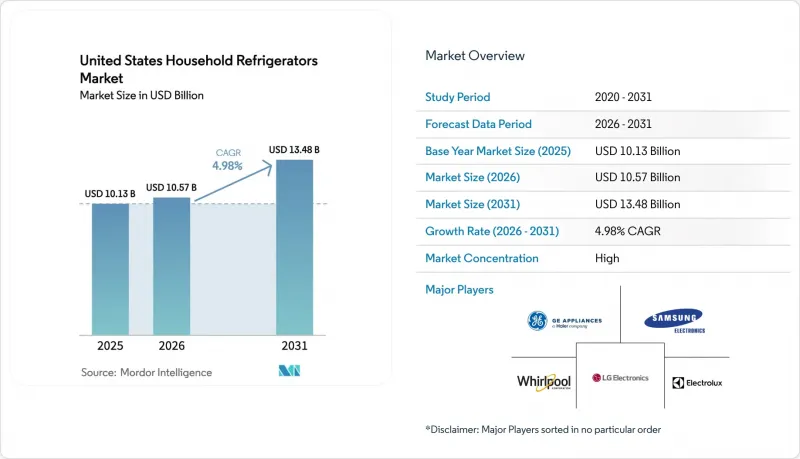
本報告按產品類型(單門冰箱、上置冷凍冰箱、下置冷凍冰箱、對開門冰箱等)、容量(15公升以下、15-18公升、18公升以上)、技術(傳統技術、智慧/物聯網技術)、銷售管道(多品牌商店、專賣店等)和地區(東北、東南等)進行細分。市場預測以美元計價。
美國家用冷藏庫市場趨勢與洞察
大容量法式對開門的需求激增。
法式對開門冷藏庫的複合年成長率 (CAGR) 為 5.85%,比美國家用冷藏庫整體市場高出 87 個基點。建造面積超過 2500 平方英尺(約 232 平方米)住宅的建築商正在將 23 立方英尺(約 7.8 立方米)或更大的嵌入式冰箱作為標準配置,使其能夠無縫融入開放式廚房。三星的 Bespoke 系列冰箱憑藉可自訂的面板飾面和配備庫存管理功能的 32 吋 Family Hub+ 顯示螢幕,正在推動高階市場的成長。 LG 的 InstaView 門進一步推動了這一趨勢,只需輕敲兩下即可點亮冰箱內部,並減少 41% 的冷氣洩漏。零售商正利用這一趨勢,將端架展示空間分配給法式對開門冰箱,從而減少了傳統上置式冷凍冰箱的貨架空間。這種冷藏庫更寬的內部空間使其能夠與商用尺寸的檯面相匹配,並支持倉儲式會員商店的大宗購買,從而在疫情期間消費者大宗購買囤貨的背景下,進一步提升了市場需求。
美國電力公司推出的節能補貼計劃
州政府和公用事業公司為符合條件的冰箱提供100至250美元的獎勵,加速了人們對能源之星認證冷藏庫的更換需求。美國政府的「家庭能源補貼舉措」允許低收入家庭獲得高達14,000美元的補助,從而縮短了高效節能冰箱的投資回收期。俄亥俄州和夏威夷州提供的公用事業補貼最為慷慨,促使零售商增加容量為19至22.9立方英尺的冰箱庫存,這些冰箱的能源效率至少比聯邦標準高出15%。加州更為嚴格的第20號法規要求採用雙規格設計,這增加了物流的複雜性,但也使符合該標準的製造商作為先行者獲得了優勢。儘管電子商務發展迅速,但多品牌商店仍憑藉其內部能源顧問提供的文書指導,保持其在銷售管道中的主導地位。
壓縮機和晶片組供應鏈波動
供應鏈挑戰持續影響美國家用冷藏庫市場。壓縮機和半導體的前置作業時間仍然容易受到運輸成本和地緣政治因素的影響。許多製造商依賴多個供應商,這可能導致家用電器在噪音和能源效率方面存在差異。這種差異使得整個產品線的品管和一致性難以保證。監管部門向天然冷媒的轉變增加了對新型壓縮機設計的需求。開發這些新設計延長了生產週期,並給製造商帶來了更大的壓力。
細分市場分析
預計到2025年,上置式冷凍冰箱將占美國家用冷藏庫市場佔有率的31.92%。同時,法式對開門冰箱正以5.85%的複合年成長率呈現顯著成長,這主要得益於建築商的規格要求和消費者對全寬擱架的需求。三星的「Bespoke」和LG的「InstaView」等高級產品,透過可客製化的飾面和智慧庫存管理功能,提升了高階法式對開冷藏庫的吸引力。另一方面,由於儲存空間狹窄,不適合存放大型餐具和炊具,對開門冷藏庫的市場佔有率正在下降。下置式冷凍冰箱的需求保持穩定,尤其是在注重取用生鮮食品便利性的老年消費者群體中。小型冷藏庫正逐漸成為小眾產品,並在豪華住宅中用作飲料中心或輔助冷藏庫。
監管政策的調整,包括美國能源局對標準的修訂,正在加速老式上置式冷凍冷藏庫的淘汰。同時,變頻壓縮機的普及不僅降低了消費者的運作成本,也提高了整個冰箱領域的能源效率。這些進步正在重塑產品線,法式對開門冰箱和節能技術推動市場的發展。這種轉變反映了消費者偏好的變化和監管壓力,而高階節能型冰箱正成為家用冷藏庫市場的關鍵驅動力。
預計到2025年,容量在19至22.9立方英尺之間的冰箱將佔據38.91%的市場佔有率,這反映出其與平均家庭規模和傳統廚房佈局的契合度較高。同時,預計到2031年,容量為23立方英尺或以上的冷藏庫將以5.46%的複合年成長率成長,這主要得益於陽光地帶新建住宅數量的增加,這些住宅通常適合安裝嵌入式法式對開門冰箱。雖然這些大容量冰箱的能耗更高,但許多型號都符合補貼條件,有助於抵消營運成本。此外,諸如可容納大量食品雜貨的鋼化玻璃層架等功能也逐漸成為標配,以滿足現代家庭的需求。
建築公司和製造商預計,主要年齡在35至50歲之間的「升級型買家」將持續對大容量冰箱產生需求。這些買家更重視儲存容量和便利性,而非略微增加的能耗。這一人口趨勢凸顯了大容量冷藏庫的長期成長潛力。隨著消費者偏好轉向兼具功能性和節能性的家電,市場預計將繼續發展,進一步鞏固超大容量冰箱在家用冷藏庫領域的地位。
其他好處:
- Excel格式的市場預測(ME)表
- 3個月的分析師支持
目錄
第1章:引言
- 研究假設和市場定義
- 調查範圍
第2章:調查方法
第3章執行摘要
第4章 市場狀況
- 市場概覽
- 市場促進因素
- 大容量法式門的需求激增
- 美國電力公司推出的節能補貼計劃
- 智慧家庭設備(配備Wi-Fi和語音功能)的廣泛應用
- 陽光地帶各州千禧世代家庭數量的快速成長
- 向高階飾面(不銹鋼和啞光黑)轉變
- 隨著生鮮食品電子商務的發展,備份儲存變得越來越必要。
- 市場限制因素
- 壓縮機和晶片組供應鏈波動
- 住宅市場放緩導致房屋更換週期也隨之放緩。
- 成本上升導致平均售價上漲
- 關於地方政府「維修權」的法律對利潤率的影響
- 價值鏈分析的考量
- 波特五力模型
- 洞察最新市場趨勢與創新
- 洞察近期市場趨勢(新產品發布、策略性舉措、投資、合作、合資、業務擴張、併購等)
第5章 市場規模與成長預測
- 依產品類型
- 單門冷藏庫
- 上置式冷凍冷藏庫
- 下層冷凍冷藏庫
- 對開門冷藏庫
- 法式對開門冷藏庫
- 迷你冷藏庫
- 以體積(立方英尺)
- 15歲以下
- 15~18.9
- 19~22.9
- 23歲或以上
- 透過技術
- 傳統的
- 智慧/物聯網相容
- 透過分銷管道
- 多品牌商店
- 品牌經銷店
- 線上
- 其他分銷管道
- 按地區
- 東北
- 東南
- 中西部
- 西南
- 西方
第6章 競爭情勢
- 市場集中度
- 策略趨勢
- 市佔率分析
- 公司簡介
- Whirlpool Corporation
- GE Appliances(Haier)
- Samsung Electronics
- LG Electronics
- Electrolux(Frigidaire)
- Bosch Home Appliances(BSH)
- Midea Group
- Sub-Zero Group
- Viking Range(Middleby)
- Panasonic Corporation
- KitchenAid(Whirlpool)
- Danby Appliances
- Hisense USA
- Fisher & Paykel
- SMEG USA
- True Manufacturing
- Dacor(Samsung)
- BlueStar
- Liebherr Appliances
- Avanti Products
第7章 市場機會與未來展望
According to Mordor Intelligence, the United States household refrigerators market size was valued at USD 10.13 billion in 2025 and is estimated to grow from USD 10.57 billion in 2026 to reach USD 13.48 billion by 2031, at a CAGR of 4.98% during the forecast period (2026-2031).
This report is Segmented by Product Type (Single Door, Top-Freezer, Bottom-Freezer, Side-By-Side, and More), Capacity (Less Than 15, 15-18, and More), Technology (Conventional, Smart/IoT-Enabled), Distribution Channel (Multi-Brand Stores, Exclusive Brand Outlets, and More), and Geography (Northeast, Southeast, and More). The Market Forecasts are Provided in Value (USD).
United States Household Refrigerators Market Trends and Insights
Soaring Demand for Large-Capacity French-Door Models
French-door formats are growing at a 5.85% CAGR, outpacing the United States household refrigerators market by 87 basis points. Builders of homes larger than 2,500 square feet routinely specify counter-depth, 23-plus cubic-foot units that integrate seamlessly with open-plan kitchens. Samsung's Bespoke series, available with customizable panel finishes and a 32-inch Family Hub+ screen that tracks inventory, underpins premium-segment gains. LG reinforces the trend with InstaView doors that illuminate contents on a double-knock and cut cold-air loss by 41%. Retailers capitalize by dedicating end-cap displays to French-door models, shifting shelf space away from legacy top-freezer units. The format's larger interior width also accommodates food-service-style sheet pans and bulk purchases from warehouse clubs, dovetailing with consumer stock-up behavior that intensified during the pandemic.
Energy-Efficiency Rebate Programs by United States Utilities
State and utility incentives worth USD 100-250 per qualifying unit accelerate replacement demand for Energy Star-certified refrigerators. The federal Home Energy Rebates initiative authorizes payments up to USD 14,000 for low-income households, compressing payback periods on high-efficiency models. Ohio and Hawaii offer some of the richest utility-level rebates, prompting retailers to increase inventory of 19-22.9 cubic-foot models that exceed federal baselines by at least 15%. California's more stringent Title 20 standards require dual-spec designs, raising logistics complexity but positioning compliant manufacturers for an early-mover advantage. Multi-brand stores benefit from in-house energy advisers who guide paperwork, helping them defend their dominant channel share despite rapid e-commerce growth.
Supply-Chain Volatility in Compressors and Chipsets
Supply-chain challenges continue to impact the United States household refrigerators market. Lead times for compressors and semiconductors remain sensitive to freight costs and geopolitical factors. Many manufacturers rely on multiple suppliers, which can create variability in appliance noise and energy performance. This variability complicates quality control and consistency across product lines. Regulatory shifts toward natural refrigerants are driving the need for new compressor designs. Developing these new designs extends production timelines and adds pressure on manufacturers.
Other drivers and restraints analyzed in the detailed report include:
- Rising Smart-Home Appliance Adoption (Wi-Fi & Voice)
- Millennial Household Formation Surge in Sunbelt States
- Housing-Market Slowdown Dampening Replacement Cycles
For complete list of drivers and restraints, kindly check the Table Of Contents.
Segment Analysis
In 2025, top-freezer units accounted for 31.92% of the United States household refrigerator market share, while French-door models are witnessing significant growth, with a CAGR of 5.85%, driven by builder specifications and consumer demand for full-width shelving. Premium offerings, such as Samsung's Bespoke and LG's InstaView, enhance the appeal of high-end French-door units through customizable finishes and smart inventory management features. Meanwhile, side-by-side refrigerators are losing relevance due to their narrow compartments, which are unsuitable for larger platters and cookware. Bottom-freezer models continue to experience stable demand, particularly among older consumers who prioritize ergonomic access to fresh food. Compact refrigerators are emerging as niche products, serving as beverage centers and secondary units in premium homes.
Regulatory changes, including updated Department of Energy standards, are accelerating the phase-out of older top-freezer designs. Simultaneously, the adoption of inverter compressors is gaining traction, enabling consumers to reduce operating costs while improving energy efficiency across the segment. These advancements are reshaping the product mix, with French-door models and energy-efficient technologies driving market evolution. The shift reflects changing consumer preferences and regulatory pressures, positioning premium and energy-efficient models as key growth drivers in the household refrigerator market.
The 19-22.9 cubic-foot capacity segment held a 38.91% market share in 2025, reflecting its alignment with average household sizes and traditional kitchen layouts, while refrigerators with capacities of 23 cubic feet or more are growing at a CAGR of 5.46% through 2031, driven by the increasing prevalence of new-build homes in Sunbelt states that accommodate counter-depth French-door formats. While these larger units consume more energy, many qualify for rebates that offset operating costs. Features such as reinforced glass shelving, designed to support bulk grocery purchases, have become standard, catering to the needs of modern households.
Builders and manufacturers anticipate sustained demand from move-up buyers, typically aged 35-50, who prioritize storage capacity and convenience over minor increases in energy consumption. This demographic trend underscores the long-term growth potential of larger-capacity refrigerators. The market is expected to continue evolving as consumer preferences shift toward appliances that combine functionality with energy efficiency, further solidifying the position of super-size units in the household refrigerator segment.
Complete Report Scope:
- By Product Type
- Single Door Refrigerators
- Top-Freezer Refrigerators
- Bottom-Freezer Refrigerators
- Side-by-Side Refrigerators
- French-Door Refrigerators
- Compact & Mini Refrigerators
- By Capacity (cu. ft.)
- Less Than 15
- 15 - 18.9
- 19 - 22.9
- Greater Than Equal To 23
- By Technology
- Conventional
- Smart / IoT-Enabled
- By Distribution Channel
- Multi-brand Stores
- Exclusive Brand Outlets
- Online
- Other Distribution Channels
- By Region
- Northeast
- Southeast
- Midwest
- Southwest
- West
List of Companies Covered in this Report:
- Whirlpool Corporation
- GE Appliances (Haier)
- Samsung Electronics
- LG Electronics
- Electrolux (Frigidaire)
- Bosch Home Appliances (BSH)
- Midea Group
- Sub-Zero Group
- Viking Range (Middleby)
- Panasonic Corporation
- KitchenAid (Whirlpool)
- Danby Appliances
- Hisense USA
- Fisher & Paykel
- SMEG USA
- True Manufacturing
- Dacor (Samsung)
- BlueStar
- Liebherr Appliances
- Avanti Products
Additional Benefits:
- The market estimate (ME) sheet in Excel format
- 3 months of analyst support
TABLE OF CONTENTS
1 Introduction
- 1.1 Study Assumptions & Market Definition
- 1.2 Scope of the Study
2 Research Methodology
3 Executive Summary
4 Market Landscape
- 4.1 Market Overview
- 4.2 Market Drivers
- 4.2.1 Soaring demand for large-capacity French-door models
- 4.2.2 Energy-efficiency rebate programs by United States utilities
- 4.2.3 Rising smart-home appliance adoption (Wi-Fi & voice)
- 4.2.4 Millennial household formation surge in Sunbelt states
- 4.2.5 Shift toward premium finishes (stainless & matte black)
- 4.2.6 Growth of grocery e-commerce requiring backup storage
- 4.3 Market Restraints
- 4.3.1 Supply-chain volatility in compressor and chipsets
- 4.3.2 Housing-market slowdown dampening replacement cycles
- 4.3.3 Rising average selling prices due to inflationary costs
- 4.3.4 Municipal right-to-repair legislation affecting margins
- 4.4 Insights into Value Chain Analysis
- 4.5 Porter's Five Forces
- 4.5.1 Competitive Rivalry
- 4.5.2 Threat of New Entrants
- 4.5.3 Bargaining Power of Suppliers
- 4.5.4 Bargaining Power of Buyers
- 4.5.5 Threat of Substitutes
- 4.6 Insights into the Latest Trends and Innovations in the Market
- 4.7 Insights on Recent Developments (New Product Launches, Strategic Initiatives, Investments, Partnerships, JVs, Expansion, M&As, etc.) in the Market
5 Market Size & Growth Forecasts (Value, USD)
- 5.1 By Product Type
- 5.1.1 Single Door Refrigerators
- 5.1.2 Top-Freezer Refrigerators
- 5.1.3 Bottom-Freezer Refrigerators
- 5.1.4 Side-by-Side Refrigerators
- 5.1.5 French-Door Refrigerators
- 5.1.6 Compact & Mini Refrigerators
- 5.2 By Capacity (cu. ft.)
- 5.2.1 Less Than 15
- 5.2.2 15 - 18.9
- 5.2.3 19 - 22.9
- 5.2.4 Greater Than Equal To 23
- 5.3 By Technology
- 5.3.1 Conventional
- 5.3.2 Smart / IoT-Enabled
- 5.4 By Distribution Channel
- 5.4.1 Multi-brand Stores
- 5.4.2 Exclusive Brand Outlets
- 5.4.3 Online
- 5.4.4 Other Distribution Channels
- 5.5 By Region
- 5.5.1 Northeast
- 5.5.2 Southeast
- 5.5.3 Midwest
- 5.5.4 Southwest
- 5.5.5 West
6 Competitive Landscape
- 6.1 Market Concentration
- 6.2 Strategic Moves
- 6.3 Market Share Analysis
- 6.4 Company Profiles (includes Global-level Overview, Market-level Overview, Core Segments, Financials as available, Strategic Information, Market Rank/Share for key companies, Products & Services, and Recent Developments)
- 6.4.1 Whirlpool Corporation
- 6.4.2 GE Appliances (Haier)
- 6.4.3 Samsung Electronics
- 6.4.4 LG Electronics
- 6.4.5 Electrolux (Frigidaire)
- 6.4.6 Bosch Home Appliances (BSH)
- 6.4.7 Midea Group
- 6.4.8 Sub-Zero Group
- 6.4.9 Viking Range (Middleby)
- 6.4.10 Panasonic Corporation
- 6.4.11 KitchenAid (Whirlpool)
- 6.4.12 Danby Appliances
- 6.4.13 Hisense USA
- 6.4.14 Fisher & Paykel
- 6.4.15 SMEG USA
- 6.4.16 True Manufacturing
- 6.4.17 Dacor (Samsung)
- 6.4.18 BlueStar
- 6.4.19 Liebherr Appliances
- 6.4.20 Avanti Products
7 Market Opportunities & Future Outlook
- 7.1 Appliance-subscription/leasing models for high-mobility renters
- 7.2 Carbon-neutral refrigerants (R-600a / R-290) for ESG-driven consumers

 2026年全球抽屜式冰櫃市場報告
 歐洲家用冷藏庫:市場佔有率分析、產業趨勢與統計及成長預測(2026-2031)印度冷藏庫:市場佔有率分析、產業趨勢與統計及成長預測(2026-2031)
 商品行銷冷藏庫市場規模、佔有率及成長分析:依產品類型、溫度範圍、應用、最終用戶、冷氣方式及地區分類-2026-2033年產業預測
 太陽能直驅冷藏庫與冷凍庫市場-2026-2032年全球市場預測立式冷藏庫和冷凍庫市場:全球市場預測(2026-2032)
 法式門市場機會、成長促進因素、產業趨勢分析及2026-2035年預測
 冷藏庫市場規模、佔有率和成長分析:按產品規格、產品類型、銷售管道、最終用戶和地區分類-2026-2033年產業預測冷藏庫和冷凍庫市場:2026-2032年全球市場預測(按產品類型、除霜技術、門配置、最終用戶和分銷管道分類)房車冷藏庫市場:按類型、容量、銷售管道、價格範圍、應用程式和最終用戶分類-2026-2032年全球市場預測