


 |
市場調查報告書
商品編碼
2083373
工業風機及鼓風機市場機會、成長促進因素、產業趨勢分析及2026-2035年預測Industrial Fans and Blowers Market Opportunity, Growth Drivers, Industry Trend Analysis, and Forecast 2026 - 2035 |
||||||

全球工業風扇和鼓風機市場預計到 2025 年將達到 100 億美元,年複合成長率為 5.5%,到 2035 年將達到 171 億美元。
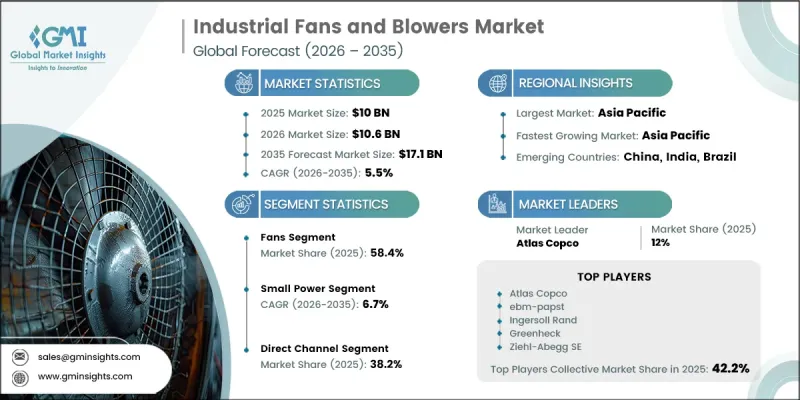
市場成長的驅動力來自工業基礎設施投資的增加、生產設施的現代化以及對節能型空氣傳輸解決方案日益成長的需求。各行各業的製造商都在投資先進的通風、冷卻和空氣處理系統,以提高營運效率、最佳化製程性能並降低能耗。向電子整流馬達技術的轉變以及智慧監控平台的整合正在進一步改變產業格局。新興市場工業活動的擴張持續推動對氣流管理設備的巨大需求,而在成熟市場,人們越來越傾向於升級現有系統以滿足更嚴格的能源效率標準。製造設施的擴建、數位化基礎設施項目以及大規模加工業務的成長,都支撐著對工業風機和鼓風機的長期需求。同時,自動化生產環境和先進工業設施中緊湊型溫度控管解決方案的日益普及,也為製造商創造了新的商機。儘管成長前景強勁,但客製化工業通風系統所需的高額初始投資可能會導致更長的更換週期,尤其是在那些優先考慮最佳化維護而非即時升級設備的行業中。
| 市場範圍 | |
|---|---|
| 開始年份 | 2025 |
| 預測期 | 2026-2035 |
| 起始金額 | 100億美元 |
| 預測金額 | 171億美元 |
| 複合年成長率 | 5.5% |
到2025年,風扇市佔率將達到58.4%。其主導地位得益於風扇在眾多工業應用中的廣泛應用,這些應用對高效的氣流、冷卻、通風和製程支援功能至關重要。風機系統因其多功能性、可靠性以及滿足各種氣流和壓力需求的能力而被廣泛應用於工業設施。預計在預測期內,對工業現代化和節能營運的持續投資將支撐該領域的持續成長。
預計到2025年,低功耗通風設備市佔率將達到22.8%,並在2035年之前以6.7%的複合年成長率成長。技術先進的工業環境中對緊湊型氣流解決方案的需求不斷成長,是推動該細分市場擴張的主要因素。對精確氣流控制、節能、低噪音以及與自動化設施管理系統相容性等要求的應用日益成長,也推動了市場需求。隨著工業營運的自動化程度和數位化程度的提高,對高效低功耗通風設備的需求持續成長,從而支撐了該細分市場強勁的長期成長前景。
到2025年,北美工業風扇和鼓風機市場佔有率將達到34%,使美國成為全球最大的國內市場,無論從銷售額或安裝量來看都是如此。該地區的成長主要得益於工業現代化、節能舉措以及對設施最佳化項目的持續投入。隨著各組織越來越重視降低營運成本和提升系統效能,製造業、加工業、基礎設施和工業營運等各領域的需求依然強勁。先進氣流管理技術的日益普及以及對永續性的日益重視,預計將進一步推動全部區域市場的持續擴張。
目錄
第1章:調查方法
第2章執行摘要
第3章 行業洞察
- 產業生態系分析
- 影響價值鏈的因素
- 利潤率分析
- 中斷
- 未來展望
- 製造商
- 中斷
- 供應商情況
- 主要新聞和舉措
- 技術與創新展望
- 監理情勢
- 影響因素
- 成長促進因素
- 產業潛在風險與挑戰
- 機會
- 波特的分析
- PESTLE分析
- 價格分析
- 2019-2024年歷史價格趨勢分析
- 定價策略:按業務類型分類
- 貿易數據分析
- 進出口量及進口額趨勢
- 主要貿易路線及關稅的影響
- 人工智慧和生成式人工智慧對工業風機和鼓風機市場的影響
- 利用人工智慧改造現有經營模式
- 按細分市場分類的生成式人工智慧用例和部署藍圖
- 風險、限制和監管考量
- 生產能力和生產情況
- 安裝和生產能力:按地區和主要生產商分類
- 運轉率和擴張計劃
第4章 競爭情勢
- 介紹
- 企業市佔率分析
- 競爭定位矩陣
- 戰略展望矩陣
- 主要市場公司的競爭分析
- 主要進展
- 併購
- 夥伴關係和聯盟
- 新產品發布
- 業務拓展計劃
第5章 市場估算與預測:依產品類型分類,2022-2035年
- 扇子
- 軸流風扇
- 螺旋槳風扇
- 管軸流風扇
- 葉片軸流風扇
- 離心風扇
- 前彎葉片風扇
- 後彎/後傾斜葉片風扇
- 徑向葉片風扇
- 混流風扇
- 交叉流風扇
- 軸流風扇
- 鼓風機
- 離心式鼓風機
- 容積式鼓風機
- Roots/Loeb Blower
- 螺旋鼓風機
- 滑葉式鼓風機
第6章 市場估計與預測:依產量分類,2022-2035年
- 5千瓦或以下(小容量)
- 5千瓦至100千瓦(中等容量)
- 100千瓦至500千瓦(大容量)
- 500千瓦或以上(重工業/關鍵任務)
第7章 市場估計與預測:依應用領域分類,2022-2035年
- 暖通空調(家庭通風)
- 商業建築
- 工業設施
- 資料中心及潔淨室
- 發電
- 火力發電
- 核能發電
- 可再生能源
- 石油、天然氣和石化產品
- 上游部門
- 中游
- 下游產業
- 採礦和礦物加工
- 地下礦井的通風和冷卻
- 露天採礦和礦物加工
- 化學處理
- 供水和廢水處理
- 水泥和建築材料
- 食品/飲料
- 紙漿、紙張和印刷
- 其他(紡織品、橡膠、塑膠、農業)
第8章 市場估算與預測:依最終使用者分類,2022-2035年
- 產業
- 重工業-鋼鐵、鋁、金屬
- 製程工業-化工、製藥、食品製造
- 能源與公共產業-發電廠、煉油廠、LNG接收站
- 商業
- 辦公室和零售設施
- 飯店和醫療設施
- 地方政府和基礎設施
- 污水處理廠
- 隧道、地鐵、公共基礎設施
第9章 市場估價與預測:依通路分類,2022-2035年
- 直接的
- 間接
第10章 市場估價與預測:依地區分類,2022-2035年
- 北美洲
- 美國
- 加拿大
- 歐洲
- 德國
- 英國
- 法國
- 義大利
- 西班牙
- 亞太地區
- 中國
- 印度
- 日本
- 韓國
- 澳洲
- 拉丁美洲
- 巴西
- 墨西哥
- 阿根廷
- 中東和非洲
- UAE
- 沙烏地阿拉伯
- 南非
第11章:公司簡介
- 世界公司
- ebm-papst GmbH &Co. KG
- Greenheck Fan Corporation
- Soler &Palau(S&P)Ventilation Group
- Ziehl-Abegg SE
- Systemair AB
- Howden Group
- Ingersoll Rand
- Samsung Electronics company
- 當地公司
- Atlas Copco
- Aerzen GmbH
- SPX Technologies/EAM Division
- Twin City Fan Companies Ltd.
- TLT-Turbo GmbH
- Nicotra Gebhardt
- New York Blower Company
- CG Power and Industrial Solutions
- 新興企業
- Shenyang Blower Works Group Corporation
- Robinson Fans Inc.
- AirPro Fan &Blower Company
- Rosenberg Ventilatoren GmbH
The Global Industrial Fans and Blowers Market was valued at USD 10 billion in 2025 and is estimated to grow at a CAGR of 5.5% to reach USD 17.1 billion by 2035.
Market growth is supported by rising investments in industrial infrastructure, increasing modernization of production facilities, and growing emphasis on energy-efficient air movement solutions. Manufacturers across multiple industries are investing in advanced ventilation, cooling, and air-handling systems to improve operational efficiency, optimize process performance, and reduce energy consumption. The ongoing transition toward electronically commutated motor technologies and the integration of intelligent monitoring platforms are further transforming the industry landscape. Growing industrial activity in emerging economies continues to create substantial demand for airflow management equipment, while mature markets are increasingly focused on upgrading existing systems to meet stricter efficiency standards. Expansion of manufacturing facilities, digital infrastructure projects, and large-scale processing operations is sustaining long-term demand for industrial fans and blowers. At the same time, increasing adoption of compact thermal management solutions within automated production environments and advanced industrial facilities is creating new opportunities for manufacturers. Despite strong growth prospects, higher upfront investment requirements for customized industrial ventilation systems can extend replacement cycles, particularly in industries that prioritize maintenance optimization over immediate equipment upgrades.
| Market Scope | |
|---|---|
| Start Year | 2025 |
| Forecast Year | 2026-2035 |
| Start Value | $10 Billion |
| Forecast Value | $17.1 Billion |
| CAGR | 5.5% |
The fans segment held 58.4% share in 2025. Its leadership position is supported by widespread adoption across numerous industrial applications where efficient airflow, cooling, ventilation, and process support functions are essential. Fan systems are extensively utilized throughout industrial facilities due to their versatility, reliability, and ability to meet varying airflow and pressure requirements. Continued investments in industrial modernization and energy-efficient operations are expected to support sustained growth for this segment over the forecast period.
The small power segment accounted for 22.8% share in 2025 and is projected to grow at a CAGR of 6.7% through 2035. Rising demand for compact airflow solutions across technologically advanced industrial environments is a key factor driving segment expansion. Applications requiring precise airflow control, energy efficiency, reduced noise levels, and compatibility with automated facility management systems are increasingly contributing to demand. As industrial operations become more automated and digitally connected, the need for highly efficient small-power ventilation equipment continues to increase, supporting strong long-term growth prospects for the segment.
North America Industrial Fans and Blowers Market accounted for 34% share in 2025, with the United States representing the largest national market in terms of both revenue generation and installed equipment base. Regional growth is being driven by continued investment in industrial modernization, energy efficiency initiatives, and facility optimization programs. Demand remains strong across manufacturing, processing, infrastructure, and industrial operations as organizations increasingly focus on reducing operating costs and improving system performance. Growing adoption of advanced airflow management technologies and increasing emphasis on sustainability are expected to support continued market expansion throughout the region.
Major companies operating in the global industrial fans and blowers market include Systemair AB, Howden Group, Atlas Copco, Greenheck Fan Corporation, Ingersoll Rand, Aerzen GmbH, Soler & Palau (S&P) Ventilation Group, TLT-Turbo GmbH, Ziehl-Abegg SE, ebm-papst GmbH & Co. KG, New York Blower Company, Twin City Fan Companies Ltd., Rosenberg Ventilatoren GmbH, Robinson Fans Inc., Nicotra Gebhardt, SPX Technologies / EAM Division, Samsung Electronics Company, CG Power and Industrial Solutions Ltd., Shenyang Blower Works Group Corporation, and AirPro Fan & Blower Company. Companies operating in the industrial fans and blowers market are adopting a variety of strategic initiatives to strengthen their market position and expand their global reach. Product innovation remains a primary focus, with manufacturers investing heavily in energy-efficient technologies, intelligent control systems, and advanced motor solutions to meet evolving customer requirements. Many companies are integrating digital monitoring capabilities, predictive maintenance technologies, and IoT-enabled features into their product portfolios to improve performance and reduce operating costs for end users. Strategic partnerships, acquisitions, and regional expansion efforts are helping organizations broaden their customer base and strengthen distribution networks.
Table of Contents
Chapter 1 Research Methodology
- 1.1 Research approach
- 1.2 Quality Commitments
- 1.2.1 GMI AI policy & data integrity commitment
- 1.2.1.1 Source consistency protocol
- 1.2.1 GMI AI policy & data integrity commitment
- 1.3 Research Trail & Confidence Scoring
- 1.3.1 Research Trail Components
- 1.3.2 Scoring Components
- 1.4 Data Collection
- 1.4.1 Partial list of primary sources
- 1.5 Data mining sources
- 1.5.1 Paid sources
- 1.5.1.1 Sources, by region
- 1.5.1 Paid sources
- 1.6 Base estimates and calculations
- 1.6.1 Base year calculation for any one approach
- 1.7 Forecast model
- 1.7.1 Quantified market impact analysis
- 1.7.1.1 Mathematical impact of growth parameters on forecast
- 1.7.1 Quantified market impact analysis
- 1.8 Research transparency addendum
- 1.8.1 Source attribution framework
- 1.8.2 Quality assurance metrics
- 1.8.3 Our commitment to trust
Chapter 2 Executive Summary
- 2.1 Industry 360° synopsis, 2022 - 2035
- 2.2 Key market trends
- 2.2.1 Regional
- 2.2.2 Product type
- 2.2.3 Power
- 2.2.4 End Use
- 2.2.5 Application
- 2.2.6 Distribution Channel
Chapter 3 Industry Insights
- 3.1 Industry ecosystem analysis
- 3.1.1 Factor affecting the value chain
- 3.1.2 Profit margin analysis
- 3.1.3 Disruptions
- 3.1.4 Future outlook
- 3.1.5 Manufacturers
- 3.1.6 Distributors
- 3.2 Supplier landscape
- 3.3 Key news & initiatives
- 3.4 Technology & Innovation Landscape
- 3.5 Regulatory landscape
- 3.6 Impact on forces
- 3.6.1 Growth drivers
- 3.6.2 Industry pitfalls & challenges
- 3.6.3 Opportunities
- 3.7 Porter’s analysis
- 3.8 PESTEL analysis
- 3.9 Pricing analysis (driven by primary research)
- 3.9.1 Historical Price Trend Analysis, 2019-2024 (Driven by Primary Research)
- 3.9.2 Pricing Strategy by Player Type (Driven by Primary Research)
- 3.10 Trade data analysis (driven by paid database)
- 3.10.1 Import/Export Volume & Value Trends (HS Code 8414) (Driven by Primary Research)
- 3.10.2 Key Trade Corridors & Tariff Impact (Driven by Primary Research)
- 3.11 Impact of AI & Generative AI on the Industrial Fans & Blowers Market
- 3.11.1 AI-Driven Disruption of Existing Business Models
- 3.11.2 GenAI Use Cases & Adoption Roadmap by Segment
- 3.11.3 Risks, Limitations & Regulatory Considerations
- 3.12 Capacity & Production Landscape (Driven by Primary Research)
- 3.12.1 Manufacturing Capacity Installed by Region & Key Producer (Driven by Primary Research)
- 3.12.2 Capacity Utilization Rates & Expansion Pipelines
Chapter 4 Competitive Landscape, 2025
- 4.1 Introduction
- 4.2 Company market share analysis
- 4.3 Competitive positioning matrix
- 4.4 Strategic outlook matrix
- 4.5 Competitive analysis of major market players
- 4.6 Key developments
- 4.6.1 Mergers & acquisitions
- 4.6.2 Partnerships & collaborations
- 4.6.3 New product launches
- 4.6.4 Expansion plans
Chapter 5 Market Estimates and Forecast, By Product type, 2022 - 2035 (USD Billion, Thousand Units)
- 5.1 Key trends
- 5.2 Fans
- 5.2.1 Axial Fans
- 5.2.1.1 Propeller Fans
- 5.2.1.2 Tube Axial Fans
- 5.2.1.3 Vane Axial Fans
- 5.2.2 Centrifugal Fans
- 5.2.2.1 Forward-Curved Blade Fans
- 5.2.2.2 Backward-Curved / Backward-Inclined Blade Fans
- 5.2.2.3 Radial Blade Fans
- 5.2.3 Mixed Flow Fans
- 5.2.4 Cross Flow Fans
- 5.2.1 Axial Fans
- 5.3 Blowers
- 5.3.1 Centrifugal Blowers
- 5.3.2 Positive Displacement Blowers
- 5.3.2.1 Roots / Lobe Blowers
- 5.3.2.2 Screw Blowers
- 5.3.2.3 Sliding Vane Blowers
Chapter 6 Market Estimates and Forecast, By Power, 2022 - 2035 (USD Billion, Thousand Units)
- 6.1 Key trends
- 6.2 Up to 5 kW (Small Capacity)
- 6.3 5 kW - 100 kW (Medium Capacity)
- 6.4 100 kW - 500 kW (Large Capacity)
- 6.5 Above 500 kW (Heavy Industrial / Mission-Critical)
Chapter 7 Market Estimates and Forecast, By Application, 2022 - 2035 (USD Billion, Thousand Units)
- 7.1 Key trends
- 7.2 HVAC & Ventilation
- 7.2.1 Commercial Buildings
- 7.2.2 Industrial Facilities
- 7.2.3 Data Centers & Clean Rooms
- 7.3 Power Generation
- 7.3.1 Thermal Power
- 7.3.2 Nuclear power
- 7.3.3 Renewable Energy
- 7.4 Oil, Gas & Petrochemical
- 7.4.1 Upstream
- 7.4.2 Midstream
- 7.4.3 Downstream
- 7.5 Mining & Minerals Processing
- 7.5.1 Underground Mine Ventilation & Cooling
- 7.5.2 Surface Mining & Minerals Processing
- 7.6 Chemical Processing
- 7.7 Water & Waste water Treatment
- 7.8 Cement & Construction Materials
- 7.9 Food & Beverage
- 7.10 Pulp, Paper & Printing
- 7.11 Others (Textile, Rubber, Plastics, Agriculture)
Chapter 8 Market Estimates and Forecast, By End User, 2022 - 2035 (USD Billion, Thousand Units)
- 8.1 Key trends
- 8.2 Industrial
- 8.2.1 Heavy Industry - Steel, Aluminum, Metals
- 8.2.2 Process Industry - Chemical, Pharma, Food Production
- 8.2.3 Energy & Utilities - Power Plants, Refineries, LNG Terminals
- 8.3 Commercial
- 8.3.1 Office and retail buildings
- 8.3.2 Hospitality and healthcare facilities
- 8.4 Municipality and infrastructure
- 8.4.1 Waste water treatment plant
- 8.4.2 Tunnel, subway and public infrastructure
Chapter 9 Market Estimates and Forecast, By Distribution Channel, 2022 - 2035 (USD Billion, Thousand Units)
- 9.1 Key trends
- 9.2 Direct
- 9.3 Indirect
Chapter 10 Market Estimates & Forecast, By Region, 2022 - 2035, (USD Billion, Thousand Units)
- 10.1 Key trends
- 10.2 North America
- 10.2.1 U.S.
- 10.2.2 Canada
- 10.3 Europe
- 10.3.1 Germany
- 10.3.2 U.K.
- 10.3.3 France
- 10.3.4 Italy
- 10.3.5 Spain
- 10.4 Asia Pacific
- 10.4.1 China
- 10.4.2 India
- 10.4.3 Japan
- 10.4.4 South Korea
- 10.4.5 Australia
- 10.5 Latin America
- 10.5.1 Brazil
- 10.5.2 Mexico
- 10.5.3 Argentina
- 10.6 MEA
- 10.6.1 UAE
- 10.6.2 Saudi Arabia
- 10.6.3 South Africa
Chapter 11 Company Profiles
- 11.1 Global players
- 11.1.1 ebm-papst GmbH & Co. KG
- 11.1.2 Greenheck Fan Corporation
- 11.1.3 Soler & Palau (S&P) Ventilation Group
- 11.1.4 Ziehl-Abegg SE
- 11.1.5 Systemair AB
- 11.1.6 Howden Group
- 11.1.7 Ingersoll Rand
- 11.1.8 Samsung Electronics company
- 11.2 Regional players
- 11.2.1 Atlas Copco
- 11.2.2 Aerzen GmbH
- 11.2.3 SPX Technologies / EAM Division
- 11.2.4 Twin City Fan Companies Ltd.
- 11.2.5 TLT-Turbo GmbH
- 11.2.6 Nicotra Gebhardt
- 11.2.7 New York Blower Company
- 11.2.8 CG Power and Industrial Solutions
- 11.3 Emerging players
- 11.3.1 Shenyang Blower Works Group Corporation
- 11.3.2 Robinson Fans Inc.
- 11.3.3 AirPro Fan & Blower Company
- 11.3.4 Rosenberg Ventilatoren GmbH

 工業循環風機市場:全球市場預測,2026-2032年
 智慧吹灰系統市場規模、佔有率和成長分析:按系統類型、吹氣介質、技術、應用、終端用戶產業和地區分類 - 產業預測,2026-2033年
 工業和商業暖通空調應用風機:市場佔有率分析、行業趨勢和統計數據以及成長預測(2026-2031 年)工業風扇:市場佔有率分析、產業趨勢與統計、成長預測(2026-2031)歐洲風機市場:市場佔有率分析、產業趨勢與統計及成長預測(2026-2031)
 風扇和鼓風機市場規模、佔有率和成長分析:按產品類型、應用、最終用戶產業、額定功率、安裝類型、技術和地區分類-2026-2033年產業預測
 2026-2034年全球風扇和鼓風機市場規模、佔有率、趨勢和成長分析報告
 個人風扇市場規模、佔有率和成長分析:按產品類型、電源、葉片配置、價格範圍、銷售管道和地區分類-2026-2033年產業預測工業及商業風機及鼓風機市場:依風機類型、壓力類型、技術、終端用戶產業及通路分類-2026-2032年全球市場預測靜電放電風扇市場:依產品類型、技術、電源、應用和最終用戶分類,全球預測,2026-2032年