


 |
市場調查報告書
商品編碼
2083277
抗體藥物複合體(ADC) 市場機會、成長要素、產業趨勢分析及 2026-2035 年預測。Antibody Drug Conjugates Market Opportunity, Growth Drivers, Industry Trend Analysis, and Forecast 2026 - 2035 |
||||||

全球抗體藥物複合體(ADC) 市場預計到 2025 年將達到 169 億美元,預計到 2035 年將以 11.2% 的複合年成長率成長至 481 億美元。
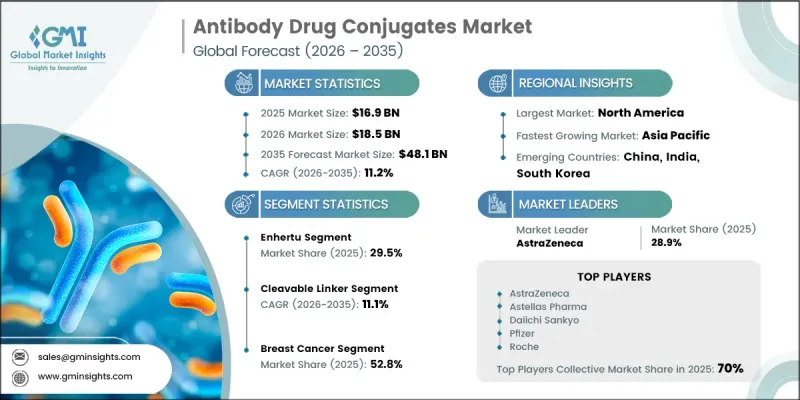
市場擴張的驅動力在於臨床上對精準癌症療法的日益青睞,這類療法與傳統化療相比,能夠增強腫瘤標靶性並降低全身性毒性。抗體藥物偶聯物(ADC)正日益成為一種差異化的治療類別,其抗體成分能夠選擇性地結合腫瘤相關抗原,從而使結合的活性成分以有效的治療濃度發揮局部細胞毒性作用。這種雙重作用機制正在持續改變多種腫瘤適應症的治療模式,並日益納入全球標準治療方案。此外,基於生物標記的患者篩選範圍擴大、連接子化學技術的進步以及從早期到晚期治療的廣泛臨床療效檢驗,都進一步鞏固了市場地位。已開發和新興醫療體系對ADC的日益普及,正推動ADC產業的長期商業性擴充性。
| 市場範圍 | |
|---|---|
| 開始年份 | 2025 |
| 預測期 | 2026-2035 |
| 上市時的市場規模 | 169億美元 |
| 預計金額 | 481億美元 |
| 複合年成長率 | 11.2% |
Enhertu(曲妥珠單抗德魯替康)預計在2025年將佔據29.5%的市場佔有率,並在2035年之前以11.3%的複合年成長率成長。該療法採用第一三共株式會社的DXd平台,該平台包含一個可裂解的胜肽連接子,該連接子與拓撲異構酶I抑制劑有效載荷結合,旨在實現約8的高藥物抗體比。即使在抗原表現量低的癌細胞中,這也能提高細胞內藥物傳遞效率和治療效果。
預計到2025年,醫院和腫瘤診所將佔據57.4%的市場佔有率,並在2035年之前以11.1%的複合年成長率成長。此細分市場佔據主導地位,因為所有已通過核准的抗體偶聯藥物(ADC)療法均需靜脈注射,這需要在配備專業腫瘤醫護人員的嚴格控制的臨床環境中進行。治療主要在醫院輸液中心進行,並在整個治療週期中嚴格遵守患者監測、副作用管理和高活性生技藥品的監管合規規程。
預計到2025年,北美抗體藥物複合體(ADC)市場將佔據41.9%的市場佔有率,並在2035年之前以10.8%的複合年成長率成長,使其成為最發達的區域市場。美國是該地區需求的主要驅動力,這得益於其先進的法規環境,該環境加快了藥物核准速度並促進了早期商業化。與其他全球市場相比,這使得創新型腫瘤生技藥品能夠更快地惠及患者。
目錄
第1章:調查方法和範圍
第2章執行摘要
第3章 行業洞察
- 產業生態系分析
- 影響產業的因素
- 促進因素
- 癌症發生率上升
- 對基於抗體的癌症療法的需求日益成長
- 抗體技術加速發展
- 擴大抗體偶聯藥物的核准範圍
- 產業潛在風險與挑戰
- 高昂的研發和製造成本
- 與抗體藥物偶聯物 (ADC) 相關的安全性和毒性問題
- 市場機遇
- 轉向使用抗體藥物偶聯物(ADC)治療固體癌,因為該領域存在著巨大的未滿足需求。
- 引進下一代ADC技術
- 促進因素
- 成長潛力分析
- 技術與創新展望
- 最新科技趨勢
- 新興技術
- 管道分析
- 監理情勢
- 商業CDMO的現況及其供應鏈結構
- 波特的分析
- PESTLE分析
- 未來市場趨勢
- 人工智慧和生成式人工智慧對市場的影響
第4章 競爭情勢
- 介紹
- 企業市佔率分析
- 北美洲
- 歐洲
- 亞太地區
- 企業矩陣分析
- 主要市場公司的競爭分析
- 競爭定位矩陣
- 主要進展
- 併購
- 夥伴關係和聯盟
- 新產品發布
- 業務拓展計劃
第5章 市場估算與預測:依產品類型分類,2022-2035年
- 恩赫爾圖
- Kadcyla
- Adcetris
- Padcev
- Trodelvy
- Polivy
- 其他產品類型
第6章 市場估計與預測:依技術分類,2022-2035年
- 可切割連接器
- 非切割連接子
第7章 市場估計與預測:依藥物類型分類,2022-2035年
- 小分子藥物
- 高分子量藥物
第8章 市場估計與預測:依應用領域分類,2022-2035年
- 乳癌
- 血癌
- 淋巴瘤
- 白血病
- 多發性骨髓瘤
- 尿路上皮癌和膀胱癌
- 其他用途
第9章 市場估計與預測:依目標類型分類,2022-2035年
- HER2
- CD30
- CD22
- 其他目標類型
第10章 市場估計與預測:依作用機制分類,2022-2035年
- 微管抑制劑
- 拓樸異構酶 I 抑制劑
- DNA損傷劑
- 其他
第11章 市場估計與預測:依最終用途分類,2022-2035年
- 醫院和診所
- 腫瘤中心
- 其他最終用戶
第12章 市場估計與預測:依地區分類,2022-2035年
- 北美洲
- 美國
- 加拿大
- 歐洲
- 德國
- 法國
- 英國
- 西班牙
- 義大利
- 荷蘭
- 亞太地區
- 中國
- 日本
- 印度
- 澳洲
- 韓國
- 拉丁美洲
- 巴西
- 墨西哥
- 阿根廷
- 中東和非洲
- 沙烏地阿拉伯
- 南非
- UAE
第13章:公司簡介
- AbbVie
- ADC Therapeutics
- Astellas Pharma
- AstraZeneca
- Daiichi Sankyo
- Gilead
- GSK
- Pfizer
- Roche
- Takeda Pharmaceutical
The Global Antibody Drug Conjugates (ADC) Market was valued at USD 16.9 billion in 2025 and is estimated to grow at a CAGR of 11.2% to reach USD 48.1 billion by 2035.
The market expansion is supported by a growing clinical preference for precision oncology treatments that offer improved tumor targeting and reduced systemic toxicity compared to conventional chemotherapy. ADCs are increasingly positioned as a differentiated therapeutic class, where the antibody component enables selective binding to tumor-associated antigens while the conjugated payload delivers localized cytotoxic activity at effective therapeutic concentrations. This dual mechanism continues to reshape treatment paradigms across multiple oncology indications, with rising integration into standard-of-care protocols globally. The market is further strengthened by expanding biomarker-driven patient identification, improved linker chemistry technologies, and broader clinical validation across earlier and later lines of therapy. Increasing adoption in both developed and emerging healthcare systems is reinforcing long-term commercial scalability across the ADC landscape.
| Market Scope | |
|---|---|
| Start Year | 2025 |
| Forecast Year | 2026-2035 |
| Start Value | $16.9 Billion |
| Forecast Value | $48.1 Billion |
| CAGR | 11.2% |
Enhertu (trastuzumab deruxtecan), segment held a 29.5% share in 2025 and is projected to grow at a CAGR of 11.3% through 2035. The therapy utilizes Daiichi Sankyo's DXd platform, which incorporates a cleavable peptide linker connected to a topoisomerase I inhibitor payload, engineered to achieve a high drug-to-antibody ratio of around 8, enhancing intracellular drug delivery efficiency and therapeutic potency across tumor cells expressing low antigen levels.
The hospitals and oncology clinics segment accounted for 57.4% share in 2025 and is expected to grow at a CAGR of 11.1% through 2035. The dominance of this segment is linked to the intravenous administration requirement of all approved ADC therapies, which necessitates controlled clinical environments with specialized oncology staff. Treatment delivery is concentrated in hospital-based infusion units where patient monitoring, adverse reaction management, and regulatory compliance protocols for high-potency biologics are strictly maintained throughout therapy cycles.
North America Antibody Drug Conjugates (ADC) Market captured 41.9% share in 2025 and is projected to grow at a CAGR of 10.8% through 2035, making it the most developed regional market. The United States leads regional demand, supported by an advanced regulatory ecosystem that enables accelerated drug approvals and early commercialization pathways, allowing innovative oncology biologics to reach patients more rapidly compared to other global markets.
Key players involved in the Antibody Drug Conjugates (ADC) Market are AbbVie, ADC Therapeutics, Astellas Pharma, AstraZeneca, Daiichi Sankyo, Gilead Sciences, GSK, Pfizer, Roche, and Takeda Pharmaceutical are among the leading companies shaping the antibody drug conjugates market. Key strategies adopted by companies in the ADC market focus on advancing next-generation linker and payload technologies to improve tumor selectivity and reduce off-target toxicity. Firms are heavily investing in clinical pipeline expansion across multiple oncology indications to strengthen lifecycle value and broaden label opportunities. Strategic collaborations between biopharma companies are accelerating R&D capabilities and enabling co-development of novel ADC candidates. Companies are also pursuing biomarker-driven patient stratification approaches to improve clinical trial success rates and treatment precision. In addition, acquisitions and licensing agreements are being used to access innovative ADC platforms and diversify portfolios. Manufacturing scale-up investments are strengthening commercial supply reliability, while geographic expansion into emerging healthcare markets is supporting wider patient access and long-term revenue growth.
Table of Contents
Chapter 1 Methodology & Scope
- 1.1 Research approach
- 1.2 Quality commitments
- 1.2.1 GMI AI policy & data integrity commitment
- 1.2.1.1 Source consistency protocol
- 1.2.1 GMI AI policy & data integrity commitment
- 1.3 Research trail & confidence scoring
- 1.3.1 Research trail components
- 1.3.2 Scoring components
- 1.4 Data collection
- 1.4.1 Partial list of primary sources
- 1.5 Data mining sources
- 1.5.1 Paid sources
- 1.5.1.1 Sources, by region
- 1.5.1 Paid sources
- 1.6 Base estimates and calculations
- 1.6.1 Base year calculation for any one approach
- 1.7 Market estimates & forecasts parameters
- 1.8 Forecast model
- 1.8.1 Quantified market impact analysis
- 1.8.1.1 Mathematical impact of growth parameters on forecast
- 1.8.1 Quantified market impact analysis
- 1.9 Research transparency addendum
- 1.9.1 Source attribution framework
- 1.9.2 Quality assurance metrics
- 1.9.3 Our commitment to trust
Chapter 2 Executive Summary
- 2.1 Industry 360°synopsis
- 2.1.1 Business trends
- 2.1.2 Product type trends
- 2.1.3 Technology trends
- 2.1.4 Application trends
- 2.1.5 Target type trends
- 2.1.6 Mechanism of action trends
- 2.1.7 End use trends
- 2.1.8 Regional trends
- 2.2 CXO perspectives: Strategic imperatives
Chapter 3 Industry Insights
- 3.1 Industry ecosystem analysis
- 3.2 Industry impact forces
- 3.2.1 Growth drivers
- 3.2.1.1 Rising prevalence of cancer
- 3.2.1.2 Growing demand for antibody-based cancer therapies
- 3.2.1.3 Increasing advancements in antibody technology
- 3.2.1.4 Expanding approval of ADCs
- 3.2.2 Industry pitfalls and challenges
- 3.2.2.1 High development and manufacturing costs
- 3.2.2.2 Safety and toxicity concerns associated with ADCs
- 3.2.3 Market opportunities
- 3.2.3.1 Shift toward solid tumor ADCs with higher unmet needs.
- 3.2.3.2 Adoption of next-generation ADC technologies
- 3.2.1 Growth drivers
- 3.3 Growth potential analysis
- 3.4 Technology and innovation landscape
- 3.4.1 Current technological trends
- 3.4.2 Emerging technologies
- 3.5 Pipeline analysis
- 3.6 Regulatory landscape (Driven by primary research)
- 3.6.1 North America
- 3.6.2 Europe
- 3.6.3 Asia Pacific
- 3.6.4 Latin America
- 3.6.5 MEA
- 3.7 Commercial CDMO landscape and supply chain architecture
- 3.8 Porter's analysis
- 3.9 PESTEL analysis
- 3.10 Future market trends
- 3.11 Impact of AI and Generative AI on the market (Driven by primary research)
Chapter 4 Competitive Landscape, 2025
- 4.1 Introduction
- 4.2 Company market share analysis
- 4.2.1 North America
- 4.2.2 Europe
- 4.2.3 Asia Pacific
- 4.3 Company matrix analysis
- 4.4 Competitive analysis of major market players
- 4.5 Competitive positioning matrix
- 4.6 Key developments
- 4.6.1 Merger and acquisition
- 4.6.2 Partnership and collaboration
- 4.6.3 New product launches
- 4.6.4 Expansion plans
Chapter 5 Market Estimates and Forecast, By Product Type, 2022 - 2035 ($ Mn)
- 5.1 Key trends
- 5.2 Enhertu
- 5.3 Kadcyla
- 5.4 Adcetris
- 5.5 Padcev
- 5.6 Trodelvy
- 5.7 Polivy
- 5.8 Other product types
Chapter 6 Market Estimates and Forecast, By Technology, 2022 - 2035 ($ Mn)
- 6.1 Key trends
- 6.2 Cleavable linker
- 6.3 Non-cleavable linker
Chapter 7 Market Estimates and Forecast, By Drug Type, 2022 - 2035 ($ Mn)
- 7.1 Key trends
- 7.2 Small-molecule drugs
- 7.3 Large-molecule drugs
Chapter 8 Market Estimates and Forecast, By Application, 2022 - 2035 ($ Mn)
- 8.1 Key trends
- 8.2 Breast cancer
- 8.3 Blood cancer
- 8.3.1 Lymphoma
- 8.3.2 Leukemia
- 8.3.3 Multiple myeloma
- 8.4 Urothelial cancer & bladder cancer
- 8.5 Other applications
Chapter 9 Market Estimates and Forecast, By Target Type, 2022 - 2035 ($ Mn)
- 9.1 Key trends
- 9.2 HER2
- 9.3 CD30
- 9.4 CD22
- 9.5 Other target types
Chapter 10 Market Estimates and Forecast, By Mechanism of Action, 2022 - 2035 ($ Mn)
- 10.1 Key trends
- 10.2 Microtubule inhibitors
- 10.3 Topoisomerase I inhibitors
- 10.4 DNA-damaging agents
- 10.5 Others
Chapter 11 Market Estimates and Forecast, By End Use, 2022 - 2035 ($ Mn)
- 11.1 Key trends
- 11.2 Hospitals and clinics
- 11.3 Oncology centers
- 11.4 Other end users
Chapter 12 Market Estimates and Forecast, By Region, 2022 - 2035 ($ Mn)
- 12.1 Key trends
- 12.2 North America
- 12.2.1 U.S.
- 12.2.2 Canada
- 12.3 Europe
- 12.3.1 Germany
- 12.3.2 France
- 12.3.3 UK
- 12.3.4 Spain
- 12.3.5 Italy
- 12.3.6 Netherlands
- 12.4 Asia Pacific
- 12.4.1 China
- 12.4.2 Japan
- 12.4.3 India
- 12.4.4 Australia
- 12.4.5 South Korea
- 12.5 Latin America
- 12.5.1 Brazil
- 12.5.2 Mexico
- 12.5.3 Argentina
- 12.6 Middle East & Africa
- 12.6.1 Saudi Arabia
- 12.6.2 South Africa
- 12.6.3 UAE
Chapter 13 Company Profiles
- 13.1 AbbVie
- 13.2 ADC Therapeutics
- 13.3 Astellas Pharma
- 13.4 AstraZeneca
- 13.5 Daiichi Sankyo
- 13.6 Gilead
- 13.7 GSK
- 13.8 Pfizer
- 13.9 Roche
- 13.10 Takeda Pharmaceutical

 抗體藥物複合體(ADC) 市場規模、佔有率、成長率、全球產業分析、區域趨勢以及 2026 年至 2034 年的預測。
 抗體藥物複合體(ADC)市場-2026-2032年全球市場預測
 抗體藥物複合體(ADC) 市場:按產品類型、目標抗原、有效載荷/技術、連接子類型、適應症和最終用戶分類 - 市場規模、行業動態、機會分析和預測 (2026–2035)
 抗體藥物偶聯物(ADC)細胞毒性有效載荷和彈頭市場:趨勢與預測(至2035年)-按產品類型、有效載荷類型、有效載荷/彈頭子類別和地區分類
 抗體療法市場機會、成長要素、產業趨勢分析及2026-2035年預測
 抗體藥物複合體市場-全球產業規模、佔有率、趨勢、機會、預測:按類型、應用、地區和競爭格局分類,2021-2031年全球ADC技術市場(第三版):依技術世代、接合方式、連接器類型和地區分類-產業趨勢及至2040年的預測
 奈米抗體市場規模、佔有率和成長分析:按抗體類型、來源生物類型、應用、最終用戶、分銷管道和地區分類-2026-2033年產業預測
 抗體藥物複合體(ADC) 市場:按產品類型、連接子類型、應用、銷售管道和地區分類
 抗體藥物複合體市場報告:按成分、標靶、應用、最終用戶和地區分類(2026-2034 年)