


 |
市場調查報告書
商品編碼
2083252
水耕系統市場機會、成長要素、產業趨勢分析及2026-2035年預測。Hydroponic System Market Opportunity, Growth Drivers, Industry Trend Analysis, and Forecast 2026 - 2035 |
||||||

全球水耕系統市場預計到 2025 年將價值 68 億美元,預計到 2035 年將以 11.4% 的複合年成長率成長至 200 億美元。
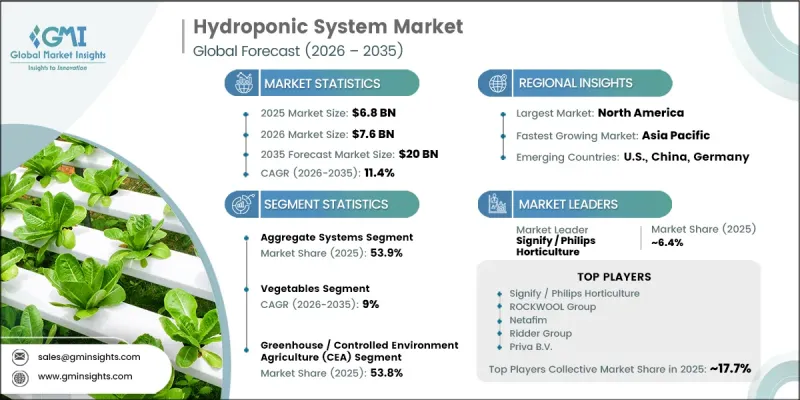
隨著農業生產者日益尋求高效且永續的種植方法以應對現代糧食生產面臨的挑戰,水耕系統產業正展現出強勁的發展勢頭。可耕地面積的持續減少、消費者對有機產品的偏好不斷增強以及對全年作物生產需求的成長,都推動了市場擴張。此外,與傳統耕作方式相比,水耕技術能夠顯著節約用水,使其成為缺水地區的理想選擇。環境控制農業技術的不斷進步進一步加速了市場成長。智慧監控系統、自動化營養輸送平台、節能照明解決方案和精密農業技術的整合,使生產者能夠在提高產量的同時降低營運成本。由於水耕系統能夠顯著提高面積面積產量,因此在各種作物類別中都越來越具有商業性吸引力。對室內和都市農業投資的增加也促進了市場發展。人們對糧食安全、永續農業實踐和優質新鮮農產品的日益關注,預計將繼續為已開發經濟體和新興經濟體的長期成長提供支持。
| 市場範圍 | |
|---|---|
| 開始年份 | 2025 |
| 預測期 | 2026-2035 |
| 初始市場規模 | 68億美元 |
| 預計金額 | 200億美元 |
| 複合年成長率 | 11.4% |
水耕系統市場正日益受益於旨在提高糧食生產效率的受控環境農業計畫的擴展。在人們日益關注耕地資源短缺的背景下,水耕作為一種切實可行的傳統農業替代方案正被更廣泛地接受。政府措施和私營部門投資致力於提高糧食安全和農業永續性,這為市場擴張創造了有利條件。消費者對不含農藥殘留的「潔淨標示」農產品的需求不斷成長,也促使商業生產商採用水耕系統,從而實現全年穩定的產品品質和更高的定價。
預計到2025年,以骨材系統將佔據53.9%的市場佔有率,並預計在2035年之前以11.2%的複合年成長率成長。該細分市場憑藉其運作可靠性、柔軟性和對多種作物的適應性而持續保持領先地位。以骨材為基礎的種植系統採用惰性栽培基質,在提供穩定根系支撐的同時,也能讓種植者精確控制養分和水分供應。其對商業溫室和大型農業設施的高度適應性,極大地促進了這些系統在主要種植區域的廣泛應用。
預計到2025年,蔬菜市佔率將達到42%,並將在2035年之前以9%的複合年成長率持續成長。該領域受益於成熟的種植技術、強勁的商業需求以及豐富的農化知識,這些都為高效的生產實踐提供了支持。水耕蔬菜生產因其能夠提供穩定的產量、高品質的產品和可靠的全年供應,持續受到生產者的青睞。零售和餐飲業的強勁需求進一步鞏固了該領域在市場中的主導地位。
預計到2025年,北美水耕系統市佔率將達到32.8%。該地區的成長主要得益於完善的溫室基礎設施、環境控制農業技術的日益普及以及強大的生鮮食品分銷網路。此外,該地區還持續受益於室內和都市農業計畫投資的增加,這些計畫旨在提高生產力和資源利用效率,並推動先進種植技術的發展。有利的市場環境和消費者對永續生產食品日益成長的需求預計將繼續支撐北美市場的擴張。
目錄
第1章:調查方法和範圍
第2章執行摘要
第3章 行業洞察
- 產業生態系分析
- 原物料供應商
- 系統和設備製造商
- 批發商和零售商
- 最終用戶
- 利潤率
- 每個階段增加的價值
- 影響價值鏈的因素
- 影響產業的因素
- 促進因素
- 耕地減少和對全球糧食安全日益成長的擔憂
- 消費者對全年供應的無農藥新鮮農產品的需求日益成長。
- 水耕系統與傳統農業用水效率的比較。
- 潛在風險和挑戰
- 大量初始資本投資和基礎設施開發成本
- 人工照明和空調導致能源消耗增加。
- 市場機遇
- 整合人工智慧、物聯網和自動化技術,以降低成本並最佳化產量。
- 大麻種植的增加正在推動水耕系統的應用。
- 促進因素
- 成長潛力分析
- 技術與創新展望
- 水耕系統中的新型自動化技術
- 利用物聯網的監控技術取得了進展。
- LED照明創新與能源效率的發展趨勢
- 監理框架
- 食品安全和有機認證標準
- 水資源利用與環境法令遵循
- 各司法管轄區的大麻種植法規
- 國家層級的農業扶持政策與補貼
- 價格分析
- 按產品類型分析歷史價格趨勢
- 依球員類型分類的定價策略(高級球員、超值球員、成本加成球員)
- 供應鏈分析
- 原物料採購
- 設備製造和組裝的現狀
- 分銷網路和最後一公里物流
- 供應鏈脆弱性與風險緩解
- 貿易數據分析
- 進出口量及進口額趨勢
- 關稅對主要貿易路線和系統組成部分的影響
- 人工智慧和生成式人工智慧對市場的影響
- 人工智慧正在改變傳統的農業作業和經營模式。
- 按細分市場分類的生成式人工智慧用例和部署藍圖
- 受控環境農業中人工智慧的風險、限制和監管考量
- 生產能力和生產情況
- 設備產能:按地區和主要生產商分類
- 重點成長區域的運轉率和擴張計劃
第4章 競爭情勢
- 介紹
- 企業市佔率分析
- 按地區
- 企業矩陣分析
- 主要市場公司的競爭分析
- 競爭定位矩陣
- 主要進展
- 併購
- 夥伴關係和聯盟
- 新產品發布
- 業務拓展計劃
第5章 市場估計與預測:依系統類型分類,2022-2035年
- 聚合系統
- 滴灌系統
- 潮汐式(泛光式)系統
- 芯吸系統
- 液體系統
- 深水耕養(DWC)
- 營養膜療法(NFT)
- 氣耕
第6章 市場估算與預測:依作物類型分類,2022-2035年
- 蔬菜
- 番茄
- 生菜和綠葉蔬菜
- 黃瓜
- 青椒
- 香草和微型菜苗
- 羅勒和烹飪香草
- 微型菜苗和芽苗菜
- 水果
- 草莓和漿果
- 瓜類和其他水果
- 開花植物和觀賞植物
- 其他(大麻和特種作物)
第7章 市場估計與預測:依種植環境分類,2022-2035年
- 室內垂直農業
- 多層全人工照明設施
- 貨櫃式和模組化農業單元
- 溫室/受控環境農業(CEA)
- 商業溫室(自然光+輔助照明)
- 用於科學研究和機構用途的溫室
- 戶外/室外水耕系統
第8章 市場估算與預測:依最終使用者分類,2022-2035年
- 商業生產者和溫室種植者
- 城市垂直農場營運商
- 機構和研究設施
- 住宅/家庭園丁
第9章 市場估計與預測:依地區分類,2022-2035年
- 北美洲
- 美國
- 加拿大
- 歐洲
- 德國
- 英國
- 法國
- 義大利
- 西班牙
- 亞太地區
- 中國
- 日本
- 印度
- 澳洲
- 韓國
- 拉丁美洲
- 巴西
- 墨西哥
- 阿根廷
- 中東和非洲
- 南非
- 沙烏地阿拉伯
- UAE
第10章:公司簡介
- 世界公司
- Priva BV
- Ridder Group
- Netafim(Orbia)
- ROCKWOOL Group/Grodan
- Signify/Philips Horticulture
- Fluence
- Hoogendoorn Growth Management
- American Hydroponics
- 本地公司
- Artechno Growsystems
- KG Systems
- Urban Crop Solutions
- Argus Control Systems
- Dosatron International
- Gavita(Hawthorne/Vireo Growth)
- STARFARM
- Lyine Group
- Intelligent Growth Solutions(IGS)
- 新興企業
- Growcer(+Freight Farms assets)
- ZipGrow Inc.
- Valoya
- OnePointOne(OPO)
The Global Hydroponic System Market was valued at USD 6.8 billion in 2025 and is estimated to grow at a CAGR of 11.4% to reach USD 20 billion by 2035.
The hydroponic system industry is witnessing strong momentum as agricultural producers increasingly seek efficient and sustainable cultivation methods capable of addressing modern food production challenges. Market expansion is being supported by the ongoing reduction in available arable land, rising consumer preference for pesticide-free produce, and the growing need for year-round crop production. In addition, hydroponic cultivation offers substantial water-saving benefits compared with conventional farming techniques, making it an attractive solution in regions facing water scarcity. Continuous advancements in controlled-environment agriculture technologies are further accelerating market growth. The integration of smart monitoring systems, automated nutrient delivery platforms, energy-efficient lighting solutions, and precision agriculture technologies is helping growers improve productivity while reducing operational costs. Hydroponic systems can deliver significantly higher yields per unit area than traditional cultivation methods, enhancing their commercial appeal across various crop categories. Growing investments in indoor farming and urban agriculture initiatives are further contributing to market development. Increasing awareness regarding food security, sustainable farming practices, and high-quality fresh produce is expected to continue supporting long-term growth opportunities across both developed and emerging economies.
| Market Scope | |
|---|---|
| Start Year | 2025 |
| Forecast Year | 2026-2035 |
| Start Value | $6.8 Billion |
| Forecast Value | $20 Billion |
| CAGR | 11.4% |
The hydroponic systems market is increasingly benefiting from the expansion of controlled-environment agriculture projects designed to improve food production efficiency. As concerns surrounding agricultural land availability intensify, hydroponic cultivation is gaining wider acceptance as a practical alternative to conventional farming. Government initiatives and private-sector investments focused on enhancing food security and agricultural sustainability are creating favorable conditions for market expansion. Rising demand for clean-label produce free from pesticide residues is also encouraging commercial growers to adopt hydroponic production systems that can support premium pricing and consistent product quality throughout the year.
The aggregate systems accounted for 53.9% share in 2025 and is expected to grow at a CAGR of 11.2% through 2035. The segment continues to lead the market due to its operational reliability, flexibility, and compatibility with a wide range of crops. Aggregate-based growing systems utilize inert substrates that provide stable root support while allowing growers to precisely manage nutrient and water delivery. Their adaptability to commercial greenhouse operations and large-scale agricultural facilities has contributed significantly to their widespread adoption across major cultivation regions.
The vegetables segment held a 42% share in 2025 and advancing at a CAGR of 9% through 2035. The segment benefits from established cultivation techniques, strong commercial demand, and extensive agronomic knowledge supporting efficient production practices. Hydroponic vegetable cultivation continues to gain traction among growers due to its ability to deliver consistent yields, high-quality produce, and reliable year-round supply. Strong demand from retail and foodservice channels further reinforces the segment's leading position within the market.
North America Hydroponic System Market held 32.8% share in 2025. Regional growth is supported by well-developed greenhouse infrastructure, increasing adoption of controlled-environment agriculture technologies, and strong distribution networks for fresh produce. The region continues to benefit from growing investments in indoor farming, urban agriculture projects, and advanced cultivation technologies designed to improve productivity and resource efficiency. Favorable market conditions and increasing consumer demand for sustainably grown food products are expected to support continued market expansion across North America.
Key companies operating in the global hydroponic systems market include Signify/Philips Horticulture (including Fluence), Netafim (Orbia Precision Agriculture), ROCKWOOL Group/Grodan, Priva B.V., and Ridder Group. Companies active in the hydroponic systems market are focusing on technology innovation, strategic partnerships, and product development to strengthen their competitive position and expand market presence. Manufacturers are investing in advanced automation platforms, intelligent monitoring systems, and precision nutrient management solutions to improve operational efficiency and crop productivity. Many companies are also expanding their geographic footprint through collaborations with commercial growers, greenhouse operators, and agricultural technology providers. Product portfolio diversification remains a key strategy, with businesses introducing integrated cultivation systems tailored to varying crop requirements and production scales.
Table of Contents
Chapter 1 Methodology and Scope
- 1.1 Market scope and definition
- 1.2 Research design
- 1.2.1 Research approach
- 1.2.2 Data collection methods
- 1.3 Data mining sources
- 1.3.1 Global
- 1.3.2 Regional/Country
- 1.4 Base estimates and calculations
- 1.4.1 Base year calculation
- 1.4.2 Key trends for market estimation
- 1.5 Primary research and validation
- 1.5.1 Primary sources
- 1.6 Forecast model
- 1.7 Research assumptions and limitations
Chapter 2 Executive Summary
- 2.1 Industry 360° synopsis
- 2.2 Key market trends
- 2.2.1 Regional
- 2.2.2 System type
- 2.2.3 Crop type
- 2.2.4 Growing environment type
- 2.2.5 End user
Chapter 3 Industry Insights
- 3.1 Industry ecosystem analysis
- 3.1.1 Input suppliers
- 3.1.2 System & equipment manufacturers
- 3.1.3 Distributors & retailers
- 3.1.4 End users
- 3.1.5 Profit margin
- 3.1.6 Value addition at each stage
- 3.1.7 Factor affecting the value chain
- 3.2 Industry impact forces
- 3.2.1 Growth drivers
- 3.2.1.1 Shrinking arable land & rising global food security concerns
- 3.2.1.2 Growing consumer demand for pesticide-free, year-round fresh produce
- 3.2.1.3 Superior water-use efficiency of hydroponic systems vs. Conventional agriculture
- 3.2.2 Pitfalls & Challenges
- 3.2.2.1 High initial capital investment & infrastructure setup costs
- 3.2.2.2 Elevated energy consumption for artificial lighting & climate control
- 3.2.3 Market Opportunities
- 3.2.3.1 Integration of AI, IoT & automation for cost reduction & yield optimization
- 3.2.3.2 Rising cannabis cultivation driving hydroponic system adoption
- 3.2.1 Growth drivers
- 3.3 Growth potential analysis
- 3.4 Technology and innovation landscape
- 3.4.1 Emerging automation technologies in hydroponic systems
- 3.4.2 IoT-enabled monitoring & control advancements
- 3.4.3 LED lighting innovations & energy efficiency trends
- 3.5 Regulatory framework
- 3.5.1 Food safety & organic certification standards
- 3.5.2 Water use & environmental compliance regulations
- 3.5.3 Cannabis cultivation regulations by jurisdiction
- 3.5.4 Country-level agricultural support policies & subsidies
- 3.6 Pricing analysis (driven by primary research)
- 3.6.1 Historical price trend analysis by product category
- 3.6.2 Pricing strategy by player type (premium / value / cost-plus)
- 3.7 Supply chain analysis
- 3.7.1 Raw material sourcing
- 3.7.2 Equipment manufacturing & assembly landscape
- 3.7.3 Distribution network & last-mile logistics
- 3.7.4 Supply chain vulnerabilities & risk mitigation
- 3.8 Trade data analysis (driven by paid database) (HS Code 8436.80.90)
- 3.8.1 Import/export volume & value trends
- 3.8.2 Key trade corridors & tariff impact on system components
- 3.9 Impact of AI & generative AI on the market
- 3.9.1 AI-driven disruption of traditional growing operations & business models
- 3.9.2 GenAI use cases & adoption roadmap by segment
- 3.9.3 Risks, limitations & regulatory considerations for AI in controlled environment agriculture
- 3.10 Capacity & production landscape (driven by primary research)
- 3.10.1 Installed capacity by region & key producer
- 3.10.2 Capacity utilization rates & expansion pipelines across major growing hubs
Chapter 4 Competitive Landscape, 2025
- 4.1 Introduction
- 4.2 Company market share analysis
- 4.2.1 By region
- 4.2.1.1 North America
- 4.2.1.2 Europe
- 4.2.1.3 Asia Pacific
- 4.2.1.4 Latin America
- 4.2.1.5 Middle East and Africa
- 4.2.1 By region
- 4.3 Company matrix analysis
- 4.4 Competitive analysis of major market players
- 4.5 Competitive positioning matrix
- 4.6 Key developments
- 4.6.1 Mergers & acquisitions
- 4.6.2 Partnerships & collaborations
- 4.6.3 New product launches
- 4.6.4 Expansion plans
Chapter 5 Market Estimates and Forecast, By System Type, 2022 - 2035 (USD Billion) (Million Units)
- 5.1 Key trends
- 5.2 Aggregate systems
- 5.2.1 Drip systems
- 5.2.2 Ebb & flow (flood & drain) systems
- 5.3 Wick systems
- 5.3.1 Liquid systems
- 5.3.2 Deep water culture (DWC)
- 5.3.3 Nutrient film technique (NFT)
- 5.3.4 Aeroponics
Chapter 6 Market Estimates and Forecast, By Crop type, 2022 - 2035 (USD Billion) (Million Units)
- 6.1 Key trends
- 6.2 Vegetables
- 6.2.1 Tomatoes
- 6.2.2 Lettuce & leafy greens
- 6.2.3 Cucumbers
- 6.2.4 Peppers
- 6.3 Herbs & microgreens
- 6.3.1 Basil & culinary herbs
- 6.3.2 Microgreens & sprouts
- 6.4 Fruits
- 6.4.1 Strawberries & berries
- 6.4.2 Melons & other fruits
- 6.5 Flowers & ornamentals
- 6.6 Others (cannabis & specialty crops)
Chapter 7 Market Estimates and Forecast, By Growing Environment, 2022 - 2035 (USD Billion) (Million Units)
- 7.1 Key trends
- 7.2 Indoor vertical farming
- 7.2.1 Multi-tier fully artificial-lit facilities
- 7.2.2 Containerized & modular farming units
- 7.3 Greenhouse / controlled environment agriculture (CEA)
- 7.3.1 Commercial greenhouses (natural + supplemental light)
- 7.3.2 Research & institutional greenhouses
- 7.4 Outdoor / open-air hydroponic systems
Chapter 8 Market Estimates and Forecast, By End User, 2022 - 2035 (USD Billion) (Million Units)
- 8.1 Key trends
- 8.2 Commercial growers & greenhouse enterprises
- 8.3 Urban vertical farm operators
- 8.4 Institutional & research facilities
- 8.5 Residential / home growers
Chapter 9 Market Estimates and Forecast, By Region, 2022 - 2035 (USD Billion) (Million Units)
- 9.1 Key trends
- 9.2 North America
- 9.2.1 U.S.
- 9.2.2 Canada
- 9.3 Europe
- 9.3.1 Germany
- 9.3.2 UK
- 9.3.3 France
- 9.3.4 Italy
- 9.3.5 Spain
- 9.4 Asia Pacific
- 9.4.1 China
- 9.4.2 Japan
- 9.4.3 India
- 9.4.4 Australia
- 9.4.5 South Korea
- 9.5 Latin America
- 9.5.1 Brazil
- 9.5.2 Mexico
- 9.5.3 Argentina
- 9.6 Middle East and Africa
- 9.6.1 South Africa
- 9.6.2 Saudi Arabia
- 9.6.3 UAE
Chapter 10 Company Profiles
- 10.1 Global players
- 10.1.1 Priva B.V.
- 10.1.2 Ridder Group
- 10.1.3 Netafim (Orbia)
- 10.1.4 ROCKWOOL Group / Grodan
- 10.1.5 Signify / Philips Horticulture
- 10.1.6 Fluence
- 10.1.7 Hoogendoorn Growth Management
- 10.1.8 American Hydroponics
- 10.2 Regional Players
- 10.2.1 Artechno Growsystems
- 10.2.2 KG Systems
- 10.2.3 Urban Crop Solutions
- 10.2.4 Argus Control Systems
- 10.2.5 Dosatron International
- 10.2.6 Gavita (Hawthorne / Vireo Growth)
- 10.2.7 STARFARM
- 10.2.8 Lyine Group
- 10.2.9 Intelligent Growth Solutions (IGS)
- 10.3 Emerging brands
- 10.3.1 Growcer (+ Freight Farms assets)
- 10.3.2 ZipGrow Inc.
- 10.3.3 Valoya
- 10.3.4 OnePointOne (OPO)

 被動式水耕全球市場規模、佔有率、趨勢和成長分析報告(2026-2034)
 南美洲水耕技術:市場佔有率分析、產業趨勢與統計、成長預測(2026-2031)
 無土栽培基質市場-2026-2032年全球市場預測水耕法:市佔率分析、產業趨勢與統計、成長預測(2026-2031)水耕市場:2026-2032年全球市場預測(依系統類型、設備、作物類型、生長環境、生長面積、最終用戶及通路分類)水耕系統市場:按組件、類型、作物類型、面積和應用分類-2026-2032年全球市場預測
 無土栽培市場預測至2034年-按栽培系統、生長介質、設施類型、應用、最終用戶和地區分類的全球分析
 水耕市場:依類型、作物、種植面積及地區分類
 水耕市場規模、佔有率、趨勢和預測:按類型、作物類型、設備和地區分類,2026-2034年
 2026年全球水耕市場報告