


 |
市場調查報告書
商品編碼
2083248
食品切碎機市場機會、成長促進因素、產業趨勢分析及2026-2035年預測。Food Chopper Market Opportunity, Growth Drivers, Industry Trend Analysis, and Forecast 2026 - 2035 |
||||||

全球食品切碎機市場預計到 2025 年價值 19 億美元,預計到 2035 年將以 5.5% 的複合年成長率成長至 33 億美元。
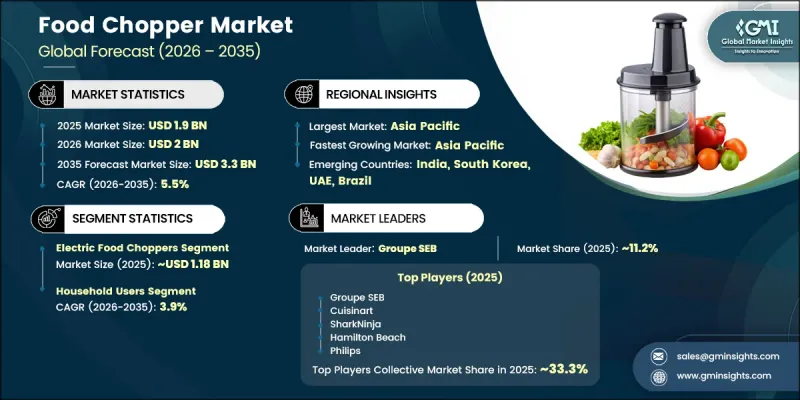
隨著消費者對能夠簡化備餐流程、縮短烹飪時間的廚房電器需求不斷成長,市場正在持續擴張。便利、高效、易用的廚房解決方案日益受到青睞,推動了住宅食物切碎機的普及。與傳統切碎機相比,電動切碎機憑藉其更快的處理速度、更便捷的操作以及更穩定的處理效果,正變得越來越受歡迎。都市化、生活方式的改變以及人們對家庭烹飪日益成長的興趣,進一步推動了已開發市場和新興市場的食物切碎機市場成長。線上零售平台的擴張也提高了產品的可近性,為消費者提供了更多種類的食物切碎機選擇。亞太地區憑藉大規模的消費群體、快速的城市化發展、不斷成長的可支配收入、日益壯大的中產階級以及現代廚房電器的普及,繼續保持著市場領先地位。該地區強大的製造業實力也為市場的持續擴張做出了貢獻。
| 市場範圍 | |
|---|---|
| 開始年份 | 2025 |
| 預測期 | 2026-2035 |
| 起始金額 | 19億美元 |
| 預測金額 | 33億美元 |
| 複合年成長率 | 5.5% |
受家庭烹飪日益普及和消費者對省時家電需求成長的推動,食物切碎機市場前景依然強勁。消費者希望找到能夠提高日常飲食準備效率並減輕體力勞動負擔的產品。消費者對最新廚房技術的認知度不斷提高,加上家庭在小型家電上的支出不斷成長,正在推動先進食物切碎機的普及。實體店和線上零售通路不斷增加的創新產品供應,進一步促進了全球市場的成長。
預計到2025年,電動食物切碎機市場規模將達到11.8億美元,並在2026年至2035年間以5.6%的複合年成長率成長。此細分市場持續推動產品類型的發展,因為它符合消費者對速度、便利性和易用性的需求。快節奏的生活方式促使人們需要能夠縮短備餐時間並最大限度減少烹飪體力消耗的家用電器。電動食物切碎機也因其切碎效果更均勻、處理速度更快、精度更高以及能夠處理多種食材等優勢,成為日常家庭烹飪的首選。
預計到2025年,家庭用戶將佔市場佔有率的60%,並在2026年至2035年間以3.9%的複合年成長率成長。住宅用戶是最大的終端用戶群體,這主要得益於他們對實用、經濟且易於使用的廚房電器在日常烹飪中日益成長的需求。都市化加快、家庭結構變化、生活節奏加快以及人們在家烹飪更健康膳食的願望日益增強,都推動了產品普及。此外,實體店和電商平台提供的豐富產品種類以及多樣化的價格選擇,也進一步增強了家庭用戶的需求。
預計到2025年,北美食物切碎機市場將佔據相當大的佔有率。該地區市場受益於較高的可支配收入、快節奏的生活方式以及家庭烹飪的持續流行。人們對健康飲食習慣的日益關注,推動了能夠簡化新鮮食材烹飪的烹飪設備的普及。先進廚房技術的普及以及對電動和無線食物切碎機需求的成長,進一步促進了市場擴張。包括商用廚房、餐飲企業和雲端廚房在內的餐飲服務業的蓬勃發展,也推動了北美地區對食物切碎機需求的成長。
目錄
第1章:調查方法和範圍
第2章執行摘要
第3章 行業洞察
- 產業生態系分析
- 供應商情況
- 利潤率
- 每個階段增加的價值
- 影響價值鏈的因素
- 影響產業的因素
- 成長促進因素
- 消費者對便捷省時的膳食準備需求日益成長。
- 雲端廚房、食材自煮包宅配和餐飲業的擴張。
- 健康意識增強的家庭烹飪興起和植物性飲食的普及
- 多葉片、變速和智慧切碎系統的產品創新。
- 電子商務的普及使人們能夠進入新興市場。
- 產業潛在風險與挑戰
- 多功能廚房電器(攪拌機、食物處理機)之間的競爭非常激烈。
- 高階智慧車型的高成本阻礙了它們在價格敏感型市場的普及。
- 仿冒品氾濫正在損害消費者信任。
- 塑膠部件相關的環境問題和監管壓力
- 機會
- 亞太和拉丁美洲中產階級的擴張—首次住宅熱潮
- 將人工智慧和物聯網技術融入智慧互聯直升機——高階市場的機會
- 永續且環保的材料創新—採用可生物分解和可回收的組件
- 雲端廚房、餐飲服務和麵向企業買家的專業經營模式
- 無線USB供電可攜式切碎機-適用於緊湊型都市區生活空間
- 成長促進因素
- 成長潛力分析
- 未來市場趨勢
- 技術與創新展望
- 最新科技趨勢
- 新興技術
- 監理情勢
- 標準和合規要求
- 區域監理框架
- 認證標準
- 貿易數據分析
- 主要國家的進出口量及進口額趨勢
- 主要貿易走廊及關稅的影響(美國與中國、歐盟與亞洲、東協之間的貿易趨勢)
- 價格分析
- 對過去價格趨勢的分析
- 按業務類型(高階/低階/大眾市場)分類的定價策略
- 人工智慧和生成式人工智慧對市場的影響
- 利用人工智慧改造現有經營模式(需求預測、庫存最佳化)
- GenAI 的應用案例和實施藍圖(按細分市場分類)(智慧食譜的整合、自主細分市場的調整)
- 風險、限制和監管考量(物聯網直升機的網路安全和資料隱私)
- 2019-2024年歷史價格趨勢分析
- 依球員類型分類的定價策略(高級球員、超值球員、成本加成球員)
- 波特的分析
- PESTLE分析
- 消費者購買行為分析
- 人口趨勢
- 影響購買決策的因素
- 消費者產品採納
- 首選分銷管道
第4章 競爭情勢
- 介紹
- 企業市佔率分析
- 企業矩陣分析
- 主要市場公司的競爭分析
- 競爭定位矩陣
- 主要進展
- 併購
- 夥伴關係和聯盟
- 新產品發布
- 業務拓展計劃
第5章 市場估算與預測:依產品類型分類,2022-2035年
- 主要趨勢
- 手動食物切碎機
- 拉繩式手動切碎機
- 旋轉式手動切碎機
- 推式/擺動式手動切碎機
- 電動食物切碎機
- 迷你/緊湊型電動切碎機
- 全尺寸電動桌上型切菜器
- 多功能電動切碎機(切碎、切片、切丁、食物泥)
- 商用食品切碎機
- 商用、高耐用性電動食物切碎機
- 大容量工業輕型切碎機
第6章 市場估計與預測:依材料分類,2022-2035年
- 主要趨勢
- 不銹鋼
- 陶瓷製品
- 碳鋼
- 不含雙酚A的塑膠
- 其他(複合材料/混合材料)
第7章 市場估計與預測:依產能分類,2022-2035年
- 主要趨勢
- 少於500毫升
- 500 ml~1 Liter
- 1 Liter~2 Liters
- 2升或更多
第8章 市場估算與預測:依最終用途分類,2022-2035年
- 主要趨勢
- 家
- 都市區家庭
- 半都市區和農村地區的家庭
- 商用廚房和餐廳
- 速食店(QSR)
- 全方位服務的餐廳和高級餐廳
- 餐飲和雲端廚房
- 食材自煮包和食品配送服務供應商
- 為活動和組織提供餐飲服務
- 食品加工及包裝設備
- 手工食品生產商
- 小規模輕型食品加工
- 對機構而言
- 飯店及餐飲業
- 醫院和醫療設施
- 教育機構
第9章 市場估價與預測:依通路分類,2022-2035年
- 主要趨勢
- 線上零售商
- 電子商務平台(亞馬遜、Flipkart、Lazada 等)
- 直接面對消費者 (DTC) 網站
- 社群電商和直播購物平台
- 超級市場和大賣場
- 廚房及家用電器專賣店
- 百貨公司
- 批發及會員制倉儲式商店
- 直銷/B2B(從製造商到機構買家)
第10章 市場估價與預測:依地區分類,2022-2035年
- 主要趨勢
- 北美洲
- 美國
- 加拿大
- 歐洲
- 德國
- 法國
- 英國
- 義大利
- 西班牙
- 亞太地區
- 中國
- 日本
- 印度
- 澳洲
- 韓國
- 拉丁美洲
- 巴西
- 墨西哥
- 阿根廷
- 中東和非洲
- 沙烏地阿拉伯
- UAE
- 南非
第11章:公司簡介
- Cuisinart
- Ninja/SharkNinja
- KitchenAid
- Hamilton Beach
- Breville
- Braun Household
- Philips
- Bosch Home Appliances
- BLACK+DECKER
- Morphy Richards
- Havells India
- Dash
- Tefal
- Moulinex
- Kenwood
- Panasonic
- Midea
- Russell Hobbs
- Bajaj Electricals
- Joyoung
- SUPOR
- Preethi
The Global Food Chopper Market was valued at USD 1.9 billion in 2025 and is estimated to grow at a CAGR of 5.5% to reach USD 3.3 billion by 2035.
The market is expanding as consumers continue to seek kitchen appliances that simplify meal preparation and reduce cooking time. Rising demand for convenient, efficient, and user-friendly kitchen solutions has significantly increased the adoption of food choppers across residential kitchens. Electric food choppers have become increasingly popular due to their ability to deliver faster performance, greater convenience, and consistent food processing compared to conventional alternatives. Growing urbanization, changing lifestyles, and rising interest in preparing meals at home are further supporting market growth across both developed and emerging economies. The expansion of online retail platforms has also improved product accessibility, enabling consumers to choose from a wide range of food chopper models. Asia Pacific continues to lead the market in terms of revenue generation, supported by a large consumer base, rapid urban development, rising disposable incomes, expanding middle-class populations, and growing acceptance of modern kitchen appliances. Strong regional manufacturing capabilities are also contributing to sustained market expansion.
| Market Scope | |
|---|---|
| Start Year | 2025 |
| Forecast Year | 2026-2035 |
| Start Value | $1.9 Billion |
| Forecast Value | $3.3 Billion |
| CAGR | 5.5% |
The increasing popularity of home cooking and demand for time-saving appliances continue to strengthen the outlook for the food chopper market. Consumers are looking for products that reduce manual effort while improving efficiency in everyday meal preparation. Greater awareness of modern kitchen technologies, combined with higher household spending on small appliances, is encouraging wider adoption of advanced food choppers. The growing availability of innovative products through both physical stores and digital retail channels is further supporting market growth worldwide.
Electric food choppers generated USD 1.18 billion in 2025 and is projected to grow at a CAGR of 5.6% between 2026 and 2035. This segment continues to dominate the product category because it aligns with consumer demand for speed, convenience, and ease of operation. Busy lifestyles have increased preference for appliances that reduce preparation time while minimizing physical effort during cooking. Electric food choppers also provide greater consistency, higher processing speed, improved precision, and the ability to handle a wide variety of ingredients, making them a preferred choice for everyday household cooking.
The household segment accounted for 60% share in 2025 and is expected to grow at a CAGR of 3.9% during 2026-2035. Residential consumers represent the largest end-user group due to the growing need for practical, affordable, and easy-to-use kitchen appliances for daily meal preparation. Increasing urbanization, changing family structures, fast-paced lifestyles, and rising preference for preparing healthier meals at home are contributing to higher product adoption. In addition, broad product availability through offline retail outlets and e-commerce platforms, along with options across multiple price ranges, continues to strengthen household demand.
North America Food Chopper Market captured a significant share in 2025. The regional market benefits from high disposable incomes, busy lifestyles, and the continued popularity of home cooking. Increasing interest in health-conscious eating habits has encouraged greater use of food preparation appliances that simplify fresh meal preparation. Rising adoption of advanced kitchen technologies and growing demand for electric and cordless food choppers are further supporting market expansion. The expanding foodservice industry, including commercial kitchens, catering operations, and cloud kitchen businesses, is also contributing to increased demand for food choppers across North America.
Major players operating in the global food chopper industry are KitchenAid, Philips, Ninja / SharkNinja, Hamilton Beach, Bosch Home Appliances, Cuisinart, Breville, BLACK+DECKER, Braun Household, Tefal, Morphy Richards, Kenwood, Havells India, Panasonic, Dash, Moulinex, Midea, Russell Hobbs, Bajaj Electricals, Joyoung, SUPOR, and Preethi. Companies operating in the food chopper market are strengthening their competitive position through continuous product innovation, expansion of distribution channels, and investment in advanced appliance technologies. Manufacturers are introducing energy-efficient, multifunctional, and compact products that meet evolving consumer preferences for convenience and performance. Businesses are also enhancing their online presence, expanding retail partnerships, and improving after-sales support to increase customer engagement.
Table of Contents
Chapter 1 Methodology & Scope
- 1.1 Market scope and definition
- 1.2 Research design
- 1.2.1 Research approach
- 1.2.2 Data collection methods
- 1.3 Data mining sources
- 1.3.1 Global
- 1.3.2 Regional/Country
- 1.4 Base estimates and calculations
- 1.4.1 Base year calculation
- 1.4.2 Key trends for market estimation
- 1.5 Primary research and validation
- 1.5.1 Primary sources
- 1.6 Forecast model
- 1.7 Research assumptions and limitations
Chapter 2 Executive Summary
- 2.1 Industry 360° synopsis
- 2.2 Key market trends
- 2.2.1 Region
- 2.2.2 Product type
- 2.2.3 Material
- 2.2.4 Capacity
- 2.2.5 End-use
- 2.2.6 Distribution channel
Chapter 3 Industry Insights
- 3.1 Industry ecosystem analysis
- 3.1.1 Supplier landscape
- 3.1.2 Profit margin
- 3.1.3 Value addition at each stage
- 3.1.4 Factor affecting the value chain
- 3.2 Industry impact forces
- 3.2.1 Growth drivers
- 3.2.1.1 Rising consumer demand for convenience & time-efficient meal preparation
- 3.2.1.2 Proliferation of cloud kitchens, meal-kit delivery & foodservice expansion
- 3.2.1.3 Growing health-conscious home cooking trends & plant-based diet adoption
- 3.2.1.4 Product innovation in multi-blade, adjustable-speed & smart chopper systems
- 3.2.1.5 E-commerce penetration enabling access in emerging markets
- 3.2.2 Industry pitfalls & challenges
- 3.2.2.1 Intense competition from multifunctional kitchen appliances (blenders, food processors)
- 3.2.2.2 High cost of premium & smart models limiting penetration in price-sensitive markets
- 3.2.2.3 Proliferation of counterfeit products undermining consumer trust
- 3.2.2.4 Environmental concerns & regulatory pressure on plastic components
- 3.2.3 Opportunities
- 3.2.3.1 Expanding middle-class population in Asia Pacific & Latin America - first-time ownership wave
- 3.2.3.2 Integration of AI/IoT for connected smart choppers - premium segment opportunity
- 3.2.3.3 Sustainable & eco-friendly material innovation - biodegradable & recycled component adoption
- 3.2.3.4 Specialized commercial models for cloud kitchens, catering & institutional buyers
- 3.2.3.5 Cordless & USB-powered portable choppers - urban compact living segment
- 3.2.1 Growth drivers
- 3.3 Growth potential analysis
- 3.4 Future market trends
- 3.5 Technology and innovation landscape
- 3.5.1 Current technological trends
- 3.5.2 Emerging technologies
- 3.6 Regulatory landscape
- 3.6.1 Standards and compliance requirements
- 3.6.2 Regional regulatory frameworks
- 3.6.3 Certification standards
- 3.7 Trade data analysis (HS Code 8509.40.00,8210.00.00)
- 3.7.1 Import/Export Volume & Value Trends by Key Country (Driven by Primary Research)
- 3.7.2 Key Trade Corridors & Tariff Impact (US-China, EU-Asia, ASEAN Flows) (Driven by Primary Research)
- 3.8 Pricing analysis
- 3.8.1 Historical price trend analysis (driven by primary research)
- 3.8.2 Pricing strategy by player type (premium / value / mass market)
- 3.9 Impact of AI & generative AI on the market
- 3.9.1 AI-Driven Disruption of Existing Business Models (Demand Forecasting, Inventory Optimization)
- 3.9.2 GenAI Use Cases & Adoption Roadmap by Segment (Smart Recipe Integration, Autonomous Chopping Calibration)
- 3.9.3 Risks, Limitations & Regulatory Considerations (Cybersecurity in IoT Choppers, Data Privacy)
- 3.10 Historical Price Trend Analysis (2019-2024) (Driven by Primary Research)
- 3.11 Pricing Strategy by Player Type (Premium / Value / Cost-plus) (Driven by Primary Research)
- 3.12 Porter’s analysis
- 3.13 PESTEL analysis
- 3.14 Consumer buying behavior analysis
- 3.14.1 Demographic trends
- 3.14.2 Factors affecting buying decisions
- 3.14.3 Consumer product adoption
- 3.14.4 Preferred distribution channel
Chapter 4 Competitive Landscape, 2025
- 4.1 Introduction
- 4.2 Company market share analysis
- 4.3 Company matrix analysis
- 4.4 Competitive analysis of major market players
- 4.5 Competitive positioning matrix
- 4.6 Key developments
- 4.6.1 Mergers & acquisitions
- 4.6.2 Partnerships & collaborations
- 4.6.3 New product launches
- 4.6.4 Expansion plans
Chapter 5 Market Estimates & Forecast, By Product Type, 2022 - 2035, (USD Billion) (Million Units)
- 5.1 Key Trends
- 5.2 Manual Food Choppers
- 5.2.1 Pull-Cord Manual Choppers
- 5.2.2 Rotary Manual Choppers
- 5.2.3 Press-Operated / Rocking Manual Choppers
- 5.3 Electric Food Choppers
- 5.3.1 Mini / Compact Electric Choppers
- 5.3.2 Full-Size Electric Countertop Choppers
- 5.3.3 Multi-Function Electric Choppers (Chop, Slice, Dice, Puree)
- 5.4 Commercial-Grade Food Choppers
- 5.4.1 Heavy-Duty Electric Commercial Choppers
- 5.4.2 High-Volume Industrial-Light Choppers
Chapter 6 Market Estimates & Forecast, By Material, 2022 - 2035, (USD Billion) (Million Units)
- 6.1 Key Trends
- 6.2 Stainless Steel
- 6.3 Ceramic
- 6.4 Carbon Steel
- 6.5 BPA-Free Plastic
- 6.6 Others (Composite / Hybrid Materials)
Chapter 7 Market Estimates & Forecast, By Capacity, 2022 - 2035, (USD Billion) (Million Units)
- 7.1 Key Trends
- 7.2 Below 500 ml
- 7.3 500 ml - 1 Liter
- 7.4 1 Liter - 2 Liters
- 7.5 Above 2 Liters
Chapter 8 Market Estimates & Forecast, By End-use, 2022 - 2035, (USD Billion) (Million Units)
- 8.1 Key Trends
- 8.2 Household
- 8.2.1 Urban Households
- 8.2.2 Semi-Urban & Rural Households
- 8.3 Commercial Kitchens & Restaurants
- 8.3.1 Quick Service Restaurants (QSR)
- 8.3.2 Full-Service Restaurants & Fine Dining
- 8.4 Catering & Cloud Kitchens
- 8.4.1 Meal-Kit & Food Delivery Operators
- 8.4.2 Event & Institutional Catering Services
- 8.5 Food Processing & Packaging Units
- 8.5.1 Artisan Food Producers
- 8.5.2 Small-Scale Light Food Processing
- 8.6 Institutional
- 8.6.1 Hotels & Hospitality
- 8.6.2 Hospitals & Healthcare Facilities
- 8.6.3 Educational Institutions
Chapter 9 Market Estimates & Forecast, By Distribution Channel, 2022 - 2035, (USD Billion) (Million Units)
- 9.1 Key Trends
- 9.2 Online Retailers
- 9.2.1 E-Commerce Marketplaces (Amazon, Flipkart, Lazada, etc.)
- 9.2.2 Brand Direct-to-Consumer (DTC) Websites
- 9.2.3 Social Commerce & Live Shopping Platforms
- 9.3 Supermarkets & Hypermarkets
- 9.4 Specialty Kitchen & Appliance Stores
- 9.5 Department Stores
- 9.6 Wholesale & Club Stores
- 9.7 Direct Sales / B2B (Manufacturer to Institutional Buyers)
Chapter 10 Market Estimates & Forecast, By Region, 2022 - 2035, (USD Billion) (Million Units)
- 10.1 Key Trends
- 10.2 North America
- 10.2.1 U.S.
- 10.2.2 Canada
- 10.3 Europe
- 10.3.1 Germany
- 10.3.2 France
- 10.3.3 UK
- 10.3.4 Italy
- 10.3.5 Spain
- 10.4 Asia Pacific
- 10.4.1 China
- 10.4.2 Japan
- 10.4.3 India
- 10.4.4 Australia
- 10.4.5 South Korea
- 10.5 Latin America
- 10.5.1 Brazil
- 10.5.2 Mexico
- 10.5.3 Argentina
- 10.6 MEA
- 10.6.1 Saudi Arabia
- 10.6.2 UAE
- 10.6.3 South Africa
Chapter 11 Company Profiles
- 11.1 Cuisinart
- 11.2 Ninja / SharkNinja
- 11.3 KitchenAid
- 11.4 Hamilton Beach
- 11.5 Breville
- 11.6 Braun Household
- 11.7 Philips
- 11.8 Bosch Home Appliances
- 11.9 BLACK+DECKER
- 11.10 Morphy Richards
- 11.11 Havells India
- 11.12 Dash
- 11.13 Tefal
- 11.14 Moulinex
- 11.15 Kenwood
- 11.16 Panasonic
- 11.17 Midea
- 11.18 Russell Hobbs
- 11.19 Bajaj Electricals
- 11.20 Joyoung
- 11.21 SUPOR
- 11.22 Preethi

 酶基食品加工市場預測至2034年:全球酵素類型、產品類型、原料、形態、加工技術、應用、最終用戶和地區分析
 攜帶式切碎機市場規模、佔有率和成長分析:按產品類型、容量、刀片材料、應用、分銷管道、價格範圍和地區分類-產業預測(2026-2033 年)
 食品加工市場報告:趨勢、預測與競爭分析(至2035年)
 食品工業熱處理設備市場機會、成長要素、產業趨勢分析及2026-2035年預測肉類副產品蛋白水解物市場機會、成長促進因素、產業趨勢分析及預測(2025-2034年)超音波食品加工技術市場機會、成長促進因素、產業趨勢分析及預測(2025-2034年)酵素法食品加工解決方案市場機會、成長促進因素、產業趨勢分析及預測(2025-2034年)
 全球食品加工自動化市場全球植物來源食品加工設備市場全球食品切碎機市場