

 |
市場調查報告書
商品編碼
2071220
航太與國防特種材料市場機會、成長促進因素、產業趨勢分析及2026-2035年預測Aerospace and Defense Specialty Materials Market Opportunity, Growth Drivers, Industry Trend Analysis, and Forecast 2026 - 2035 |
||||||

全球航太和國防特種材料市場預計到 2025 年將達到 276 億美元,年複合成長率為 7.5%,到 2035 年將達到 568 億美元。
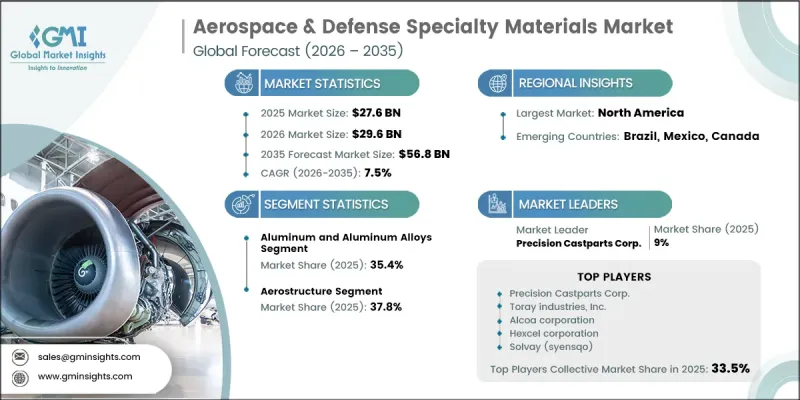
市場擴張的促進因素包括民航機產量的成長、北約成員國和印太地區國防費用的增加,以及日益嚴格的永續性要求加速了輕質高性能材料解決方案的採用。隨著航太製造商追求更高的效率、耐久性和燃油效率,該行業正經歷從傳統鋼基系統向鋁合金、鈦、先進複合材料和高溫合金的明顯結構性轉變。同時,高超音速防禦系統、衛星星系和可重複使用航太發射平台的日益部署,也使得特種材料的應用範圍超越了傳統的飛機結構。此外,盟國的國防現代化努力也支持了戰鬥機、海軍系統、裝甲車輛和飛彈技術等領域的長期需求,進一步強化了先進材料創新在整個航太和國防供應鏈中的戰略重要性。
| 市場範圍 | |
|---|---|
| 開始年份 | 2025 |
| 預測期 | 2026-2035 |
| 起始金額 | 276億美元 |
| 預測金額 | 568億美元 |
| 複合年成長率 | 7.5% |
2025年,鋁及鋁合金佔據了35.4%的市場佔有率,憑藉其卓越的強度重量比、易於加工以及在航太領域各種應用中的成本效益,繼續保持領先材料的地位。這些材料繼續廣泛應用於民用和軍用飛機平台的主要和次要結構部件。其廣泛應用得益於成熟的製造流程以及長期以來與認證航太設計標準的整合,從而確保了整個行業的持續需求。
至2025年,飛機結構應用領域將佔37.8%的市佔率。此類別涵蓋了必須滿足嚴格的安全、性能和認證要求的關鍵飛機結構。飛機設計和材料工程的持續創新正在推動民用和國防航空航太領域結構應用方面先進合金、複合材料和高性能金屬的廣泛應用。
預計到2025年,北美將佔據航太和國防特種材料市場38%的佔有率,成為最大的區域貢獻者。該地區的領先地位得益於其集中的航太製造活動、大規模的國防採購項目以及成熟的飛機和航太系統開發商生態系統。對先進飛機平台和下一代國防技術的巨額投資將繼續鞏固該地區在特殊材料需求方面的主導地位。
目錄
第1章:調查方法和範圍
第2章執行摘要
第3章 行業洞察
- 產業生態系分析
- 供應商情況
- 利潤率
- 每個階段增加的價值
- 影響價值鏈的因素
- 中斷
- 影響產業的因素
- 成長促進因素
- 增加民航機產量和飛機現代化計劃
- 增加國防費用和努力實現軍隊現代化
- 旨在提高燃油效率和排放氣體。
- 產業潛在風險與挑戰
- 供應鏈整合與合格碾磨能力不足
- 地緣政治原料依賴
- 市場機遇
- 開發永續和可回收的航太材料
- 積層製造和近淨成形加工技術的擴展
- 提升國內生產能力
- 成長促進因素
- 成長潛力分析
- 監理情勢
- 波特的分析
- PESTLE分析
- 技術與創新展望
- 最新科技趨勢
- 新興技術
- 價格趨勢
- 按地區
- 按活性成分
- 未來市場趨勢
- 專利趨勢
- 貿易統計
- 主要進口國
- 主要出口國
- 永續性和環境方面
- 永續計劃
- 減少廢棄物策略
- 生產中的能源效率
- 具有環保意識的舉措
- 考慮碳足跡
第4章 競爭情勢
- 介紹
- 企業市佔率分析
- 按地區
- 北美洲
- 歐洲
- 亞太地區
- 拉丁美洲
- 中東和非洲
- 按地區
- 企業矩陣分析
- 主要市場公司的競爭分析
- 競爭定位矩陣
- 主要進展
- 併購
- 夥伴關係和聯盟
- 新產品發布
- 業務拓展計劃
第5章 市場估算與預測:依材料類型分類,2022-2035年
- 鋁及鋁合金
- 2xxx系列(高強度銅型)
- 7xxx系列(高強度鋅基)
- 其他鋁合金
- 鈦及鈦合金
- 5級(Ti-6Al-4V)
- 9級及其他航太級
- BETA鈦合金
- 複合材料
- 高分子複合材料(PMCs)
- 金屬複合材料(MMCs)
- 陶瓷基質複合材料(CMCs)
- 超合金
- 鎳基高溫合金(因科鎳合金、哈氏合金)
- 鈷基高溫合金
- 鋼鐵和特殊鋼
- 不鏽鋼合金(300系列和400系列,17-4PH)
- 高強度結構鋼
- 工具鋼
- 高性能聚合物和塑膠
- PEEK和耐熱熱塑性樹脂
- 熱固性樹脂和預浸料
- 其他
第6章 市場估計與預測:依應用領域分類,2022-2035年
- 飛機結構部件
- 主翼和主翼結構
- 軀幹和尾巴
- 整流罩和引擎艙
- 推進系統
- 渦輪引擎及其部件
- 排氣系統
- 推進系統的安裝和支撐
- 成分
- 起落架系統
- 液壓和氣壓部件
- 執行器和控制面
- 客房內部
- 座椅系統
- 內裝板和襯裡
- 廚房和廁所結構
- 設備、系統和支援
- 航空電子設備機殼
- 緊固組件和支架
- 佈線和電纜管理系統
- 衛星和太空系統
- 衛星結構和匯流排系統
- 熱保護系統
- 運載火箭的結構
第7章 市場估計與預測:依地區分類,2022-2035年
- 北美洲
- 美國
- 加拿大
- 歐洲
- 德國
- 英國
- 法國
- 西班牙
- 義大利
- 其他歐洲國家
- 亞太地區
- 中國
- 印度
- 日本
- 澳洲
- 韓國
- 其他亞太國家
- 拉丁美洲
- 巴西
- 墨西哥
- 阿根廷
- 其他拉丁美洲國家
- 中東和非洲
- 沙烏地阿拉伯
- 南非
- UAE
- 其他中東和非洲國家
第8章:公司簡介
- Toray industries, Inc.
- Hexcel corporation
- Solvay(syensqo)
- Teijin limited
- Precision Castparts Corp.
- Alcoa corporation
- ATI(Allegheny Technologies Incorporated)
- SGL carbon
- Mitsubishi chemical group corporation
- Swiss steel group
- Carpenter technology corporation
- Voestalpine bohler edelstahl gmbh
- Arris composites, Inc.
- Albany international corporation
- Victrex plc
- Huntsman international LLC
The Global Aerospace & Defense Specialty Materials Market was valued at USD 27.6 billion in 2025 and is estimated to grow at a CAGR of 7.5% to reach USD 56.8 billion by 2035.
Market expansion is driven by increasing commercial aircraft production rates, rising defense spending across NATO members and Indo-Pacific economies, and stricter sustainability requirements that are accelerating the adoption of lightweight, high-performance material solutions. The industry is undergoing a clear structural transition away from traditional steel-based systems toward aluminum alloys, titanium, advanced composites, and superalloys as aerospace manufacturers pursue higher efficiency, durability, and fuel performance targets. In parallel, the growing deployment of hypersonic defense systems, satellite constellations, and reusable space launch platforms is widening the application scope for specialty materials beyond conventional aircraft structures. Defense modernization initiatives across allied nations are also sustaining long-term demand across fighter jets, naval systems, armored vehicles, and missile technologies, reinforcing the strategic importance of advanced material innovation across aerospace and defense supply chains.
| Market Scope | |
|---|---|
| Start Year | 2025 |
| Forecast Year | 2026-2035 |
| Start Value | $27.6 Billion |
| Forecast Value | $56.8 Billion |
| CAGR | 7.5% |
The aluminum and aluminum alloys accounted for 35.4% share in 2025, maintaining their position as the leading material category due to their favorable strength-to-weight ratio, ease of fabrication, and cost efficiency across multiple aerospace applications. These materials remain widely utilized in primary and secondary structural components across both commercial and defense aircraft platforms. Their extensive use is supported by established manufacturing processes and long-standing integration into certified aerospace design standards, ensuring continued demand across the industry.
The aerostructure applications segment held a 37.8% share in 2025. This category includes major aircraft structures that must meet stringent safety, performance, and certification requirements. Continuous innovation in aircraft design and material engineering is supporting the increasing use of advanced alloys, composites, and high-performance metals across structural applications in both commercial and defense aviation sectors.
North America Aerospace & Defense Specialty Materials Market held 38% share in 2025, making it the largest regional contributor. The region's dominance is supported by a strong concentration of aerospace manufacturing activity, extensive defense procurement programs, and a well-established ecosystem of aircraft and space system developers. High investment levels in advanced aircraft platforms and next-generation defense technologies continue to reinforce the region's leadership position in specialty materials demand.
Major companies operating in the global aerospace & defense specialty materials market include Hexcel Corporation, Toray Industries, Inc., Solvay (Syensqo), Teijin Limited, Alcoa Corporation, Precision Castparts Corp., ATI (Allegheny Technologies Incorporated), SGL Carbon, Mitsubishi Chemical Group Corporation, Carpenter Technology Corporation, Victrex plc, Huntsman International LLC, Voestalpine Bohler Edelstahl GmbH, Arris Composites, Inc., Albany International Corporation, and Swiss Steel Group. Companies operating in the aerospace & defense specialty materials market are focusing on strategic initiatives to strengthen their competitive positioning and expand market reach. Key strategies include increasing investment in advanced material research and development to enhance strength, durability, thermal resistance, and weight reduction capabilities. Market participants are also prioritizing the development of next-generation composites, titanium alloys, and high-performance polymers tailored for aerospace and defense applications. Strategic collaborations with aircraft manufacturers, defense contractors, and space system developers are helping accelerate product integration and adoption. Companies are expanding production capacities and optimizing supply chains to meet rising demand from commercial aviation and defense programs.
Table of Contents
Chapter 1 Methodology & Scope
- 1.1 Market scope and definition
- 1.2 Research design
- 1.2.1 Research approach
- 1.2.2 Data collection methods
- 1.3 Data mining sources
- 1.3.1 Global
- 1.3.2 Regional/Country
- 1.4 Base estimates and calculations
- 1.4.1 Base year calculation
- 1.4.2 Key trends for market estimation
- 1.5 Primary research and validation
- 1.5.1 Primary sources
- 1.6 Forecast model
- 1.7 Research assumptions and limitations
Chapter 2 Executive Summary
- 2.1 Industry 360° synopsis
- 2.2 Key market trends
- 2.2.1 Material Type
- 2.2.2 Application
- 2.2.3 Regional
- 2.3 TAM Analysis, 2026-2035
- 2.4 CXO perspectives: Strategic imperatives
- 2.5 Future outlook and strategic recommendations
Chapter 3 Industry Insights
- 3.1 Industry ecosystem analysis
- 3.1.1 Supplier landscape
- 3.1.2 Profit margin
- 3.1.3 Value addition at each stage
- 3.1.4 Factor affecting the value chain
- 3.1.5 Disruptions
- 3.2 Industry impact forces
- 3.2.1 Growth drivers
- 3.2.1.1 Rising Commercial Aircraft Production & Fleet Modernization Programs
- 3.2.1.2 Increased Defense Spending & Military Modernization Initiatives
- 3.2.1.3 Lightweighting Mandates for Fuel Efficiency & Emissions Reduction
- 3.2.2 Industry pitfalls and challenges
- 3.2.2.1 Supply Chain Consolidation & Limited Qualified Mill Capacity
- 3.2.2.2 Geopolitical Material Dependencies
- 3.2.3 Market opportunities
- 3.2.3.1 Development of Sustainable & Recycled Aerospace Materials
- 3.2.3.2 Additive Manufacturing & Near-Net-Shape Processing Expansion
- 3.2.3.3 Domestic Production Capacity Building
- 3.2.1 Growth drivers
- 3.3 Growth potential analysis
- 3.4 Regulatory landscape
- 3.4.1 North America
- 3.4.2 Europe
- 3.4.3 Asia Pacific
- 3.4.4 Latin America
- 3.4.5 Middle East & Africa
- 3.5 Porter's analysis
- 3.6 PESTEL analysis
- 3.7 Technology and innovation landscape
- 3.7.1 Current technological trends
- 3.7.2 Emerging technologies
- 3.8 Price trends
- 3.8.1 By region
- 3.8.2 By Active Ingredient
- 3.9 Future market trends
- 3.10 Patent landscape
- 3.11 Trade statistics (HS code)
- 3.11.1 Major importing countries
- 3.11.2 Major exporting countries
- 3.12 Sustainability and environmental aspects
- 3.12.1 Sustainable practices
- 3.12.2 Waste reduction strategies
- 3.12.3 Energy efficiency in production
- 3.12.4 Eco-friendly initiatives
- 3.13 Carbon footprint consideration
Chapter 4 Competitive Landscape, 2025
- 4.1 Introduction
- 4.2 Company market share analysis
- 4.2.1 By region
- 4.2.1.1 North America
- 4.2.1.2 Europe
- 4.2.1.3 Asia Pacific
- 4.2.1.4 LATAM
- 4.2.1.5 MEA
- 4.2.1 By region
- 4.3 Company matrix analysis
- 4.4 Competitive analysis of major market players
- 4.5 Competitive positioning matrix
- 4.6 Key developments
- 4.6.1 Mergers & acquisitions
- 4.6.2 Partnerships & collaborations
- 4.6.3 New product launches
- 4.6.4 Expansion plans
Chapter 5 Market Estimates and Forecast, By Material Type, 2022-2035 (USD Million) (Kilo Tons)
- 5.1 Key trends
- 5.2 Aluminum & aluminum alloys
- 5.2.1 2xxx series (High Strength, Copper-Based)
- 5.2.2 7xxx series (High Strength, Zinc-Based)
- 5.2.3 Other aluminum alloys
- 5.3 Titanium & titanium alloys
- 5.3.1 Grade 5 (Ti-6Al-4V)
- 5.3.2 Grade 9 & other aerospace grades
- 5.3.3 Beta titanium alloys
- 5.4 Composites
- 5.4.1 Polymer matrix composites (PMCs)
- 5.4.2 Metal matrix composites (MMCs)
- 5.4.3 Ceramic matrix composites (CMCs)
- 5.5 Superalloys
- 5.5.1 Nickel-based superalloys (Inconel, Hastelloy)
- 5.5.2 Cobalt-based superalloys
- 5.6 Steel & specialty steels
- 5.6.1 Stainless steel alloys (300 & 400 Series, 17-4PH)
- 5.6.2 High-strength structural steels
- 5.6.3 Tool steels
- 5.7 High-performance polymers & plastics
- 5.7.1 PEEK & high-temperature thermoplastics
- 5.7.2 Thermoset resins & prepregs
- 5.8 Others
Chapter 6 Market Estimates and Forecast, By Application, 2022-2035 (USD Million) (Kilo Tons)
- 6.1 Key trends
- 6.2 Aerostructure
- 6.2.1 Wings & wing structures
- 6.2.2 Fuselage & tail sections
- 6.2.3 Fairings & nacelles
- 6.3 Propulsion systems
- 6.3.1 Turbine engines & components
- 6.3.2 Exhaust systems
- 6.3.3 Propulsion mounts & supports
- 6.4 Components
- 6.4.1 Landing gear systems
- 6.4.2 Hydraulic & pneumatic components
- 6.4.3 Actuators & control surfaces
- 6.5 Cabin interiors
- 6.5.1 Seating systems
- 6.5.2 Interior panels & linings
- 6.5.3 Galley & lavatory structures
- 6.6 Equipment, systems & support
- 6.6.1 Avionics housings
- 6.6.2 Fasteners & brackets
- 6.6.3 Wiring & cable management systems
- 6.7 Satellites & space systems
- 6.7.1 Satellite structures & bus systems
- 6.7.2 Thermal protection systems
- 6.7.3 Launch vehicle structures
Chapter 7 Market Estimates and Forecast, By Region, 2022-2035 (USD Million) (Kilo Tons)
- 7.1 Key trends
- 7.2 North America
- 7.2.1 U.S.
- 7.2.2 Canada
- 7.3 Europe
- 7.3.1 Germany
- 7.3.2 UK
- 7.3.3 France
- 7.3.4 Spain
- 7.3.5 Italy
- 7.3.6 Rest of Europe
- 7.4 Asia Pacific
- 7.4.1 China
- 7.4.2 India
- 7.4.3 Japan
- 7.4.4 Australia
- 7.4.5 South Korea
- 7.4.6 Rest of Asia Pacific
- 7.5 Latin America
- 7.5.1 Brazil
- 7.5.2 Mexico
- 7.5.3 Argentina
- 7.5.4 Rest of Latin America
- 7.6 Middle East and Africa
- 7.6.1 Saudi Arabia
- 7.6.2 South Africa
- 7.6.3 UAE
- 7.6.4 Rest of Middle East and Africa
Chapter 8 Company Profiles
- 8.1 Toray industries, Inc.
- 8.2 Hexcel corporation
- 8.3 Solvay (syensqo)
- 8.4 Teijin limited
- 8.5 Precision Castparts Corp.
- 8.6 Alcoa corporation
- 8.7 ATI (Allegheny Technologies Incorporated)
- 8.8 SGL carbon
- 8.9 Mitsubishi chemical group corporation
- 8.10 Swiss steel group
- 8.11 Carpenter technology corporation
- 8.12 Voestalpine bohler edelstahl gmbh
- 8.13 Arris composites, Inc.
- 8.14 Albany international corporation
- 8.15 Victrex plc
- 8.16 Huntsman international LLC

 填充用消費品包裝市場預測至2034年-按產品類型、材料、包裝形式、最終用戶和地區分類的全球分析
 奢華個人用品市場-全球產業規模、佔有率、趨勢、機會和預測:按產品類型、目標受眾、銷售管道、地區和競爭格局分類,2021-2031年
 奢侈品市場:2026年至2032年全球市場預測(依產品類型、通路、最終用戶、價格範圍及年齡層分類)
 奢侈品市場規模、佔有率、成長及全球產業分析:按類型、應用和地區分類的洞察,以及2026-2034年的預測
 2026-2030年全球個人奢侈品市場
 奢侈品市場分析及預測(至2035年):按類型、產品、服務、技術、組件、應用、最終用戶、材料類型、銷售形式、階段分類全球個人奢侈品市場規模、佔有率、趨勢和成長分析報告(2026-2034)奢侈品市場-全球產業規模、佔有率、趨勢、機會及預測(按類型、通路、地區和競爭格局分類,2021-2031年)可重複灌裝消費品市場預測至2032年:按產品類型、包裝類型、材料、分銷管道、最終用戶和地區分類的全球分析
 日本個人奢侈品市場規模、佔有率、趨勢及預測(按類型、性別、通路和地區分類,2026-2034年)