


 |
市場調查報告書
商品編碼
2045836
復原奶市場商機、成長要素、產業趨勢分析及2026-2035年預測。Reconstituted Milk Market Opportunity, Growth Drivers, Industry Trend Analysis, and Forecast 2026 - 2035 |
||||||

2025年全球復原乳市場價值為2,520億美元,預計到2035年將以3.7%的複合年成長率成長至3,678億美元。
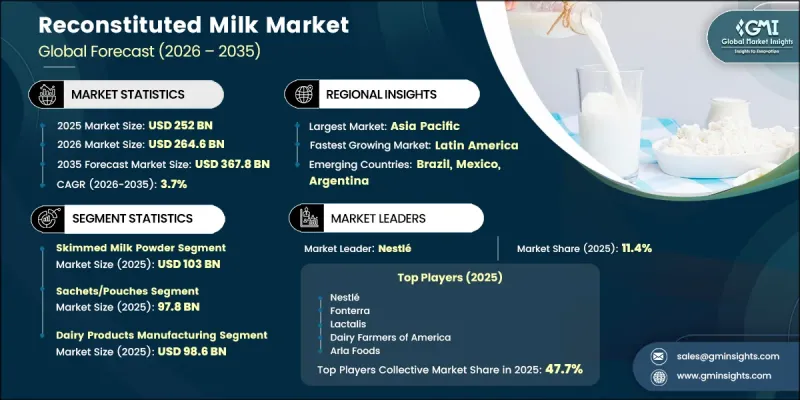
復原奶是將奶粉與安全飲用水混合製成的,可根據所需的脂肪含量,使用脫脂奶粉、全脂奶粉或部分脫脂奶粉進行配製。該產品廣泛用作飲料,也廣泛用於優格、冷凍甜點、烘焙食品和糖果甜點等乳製品加工。由於基礎設施限制、供應鏈中斷或氣候變遷等原因,一些地區難以獲得穩定的原乳供應,因此對保存期限長的乳製品解決方案的需求不斷成長,推動了復原乳市場的擴張。復原奶具有更高的儲存柔軟性和運輸效率,是都市區和偏遠地區居民的重要選擇。此外,人們對食品安全的日益關注以及對經濟實惠的乳製品需求不斷成長,也進一步促進了復原乳在全球商業食品加工企業和機構供應鏈中的應用。
| 市場範圍 | |
|---|---|
| 開始年份 | 2025 |
| 預測期 | 2026-2035 |
| 上市時的市場規模 | 2520億美元 |
| 預測金額 | 3678億美元 |
| 複合年成長率 | 3.7% |
預計到2025年,脫脂奶粉市場規模將達到1,030億美元。隨著生產者致力於開發客製化的復原奶配方以滿足不同的營養需求和脂肪含量要求,脫脂奶粉和全脂奶粉的需求持續成長。這些原料在消費品、商用和工業食品生產中日益廣泛的應用,推動了該市場的成長。為了滿足不斷變化的消費者和加工需求,生產商越來越重視產品的一致性、營養均衡和配方柔軟性。
預計到2025年,袋裝和袋包裝市場規模將達到978億美元,成為復原乳品市場的主要包裝類別。袋裝產品因其價格實惠、易於取用和高效的容量控制能力而備受青睞,需求不斷成長。此外,其包裝的靈活性也使其能夠在價格敏感型市場和高銷量零售環境中廣泛分銷。同時,瓶裝產品因其便利性、可重複使用性和易於儲存管理等優點,在有組織的零售和餐飲產業部門仍保持強勁的需求。消費者對便攜性和包裝效率日益成長的需求,進一步推動了多個消費群體對瓶裝產品的市場需求。
預計北美復原乳品市場規模將從2025年的383億美元成長到2035年的581億美元。該地區的需求成長主要得益於復原乳在食品製造、庫存管理系統和長期儲存應用中的日益普及。在需要穩定乳製品供應、高效運輸和長期保存期限以保障業務永續營運的場合,復原乳品的重要性日益凸顯。此外,加工食品製造商和機構投資者需求的成長也推動了該地區市場的擴張。
目錄
第1章:調查方法和範圍
第2章執行摘要
第3章 行業洞察
- 產業生態系分析
- 供應商情況
- 利潤率
- 每個階段增加的價值
- 影響價值鏈的因素
- 中斷
- 影響產業的因素
- 促進因素
- 與生牛奶相比,它的保存期限更長。
- 都市區人口成長,而冷藏設施有限。
- 為食品加工業提供穩定的供應
- 產業潛在風險與挑戰
- 偏遠和農村地區的需求不斷成長
- 擴大在烘焙和糖果甜點產品的應用
- 市場機遇
- 消費者對生奶替代品的偏好
- 某些區域市場對品質的認知有問題
- 對奶粉價格波動的依賴
- 促進因素
- 成長潛力分析
- 監理情勢
- 波特的分析
- PESTLE分析
- 技術與創新展望
- 最新科技趨勢
- 新興技術
- 價格趨勢
- 按地區
- 按類型
- 未來市場趨勢
- 專利趨勢
- 貿易統計
- 主要進口國
- 主要出口國
- 永續性和環境方面
- 永續計劃
- 減少廢棄物策略
- 生產中的能源效率
- 具有環保意識的舉措
- 考慮碳足跡
第4章 競爭情勢
- 介紹
- 企業市佔率分析
- 按地區
- 北美洲
- 歐洲
- 亞太地區
- LATAM
- 中東和非洲
- 按地區
- 企業矩陣分析
- 主要市場公司的競爭分析
- 競爭定位矩陣
- 主要進展
- 併購
- 夥伴關係和聯盟
- 新產品發布
- 業務拓展計劃
第5章 市場估計與預測:依類型分類,2022-2035年
- 脫脂奶粉
- 全脂奶粉
- 無水乳脂肪
- 其他
第6章 市場估價與預測:依包裝類型分類,2022-2035年
- 小袋子
- 瓶子
- 紙盒
- 其他
第7章 市場估計與預測:依應用領域分類,2022-2035年
- 乳製品生產
- 乳酪生產
- 優格生產
- 冰淇淋和冷凍甜點
- 奶油生產
- 超高溫滅菌奶和復原乳
- 其他乳製品
- 食品/飲料
- 麵包糖果甜點
- 加工食品及調理食品
- 醬汁、調味料和佐料
- 飲料(乳製品除外)
- 零食/鹹味零食
- 其他
- 營養補充品
- 蛋白質補充粉
- 代餐產品
- 運動營養
- 臨床營養
- 其他
- 化妝品和個人護理
- 護膚品
- 護髮產品
- 沐浴及身體保養品
- 化妝品配方
- 其他
- 嬰兒配方奶粉
- 標準嬰兒配方奶粉
- 特製低致敏配方
- 後續配方奶粉與成長配方奶粉
- 其他
- 其他
第8章 市場估算與預測:依通路分類,2022-2035年
- B2B(企業對企業交易)
- 食品和飲料製造
- 飯店餐飲服務業
- 工業和公共部門
- 其他
- B2C(企業對消費者)
- 大賣場和超級市場
- 線上電子商務
- 批發商店
- 便利商店
- 其他
第9章 市場估計與預測:依地區分類,2022-2035年
- 北美洲
- 美國
- 加拿大
- 歐洲
- 德國
- 英國
- 法國
- 西班牙
- 義大利
- 其他歐洲國家
- 亞太地區
- 中國
- 印度
- 日本
- 澳洲
- 韓國
- 其他亞太國家
- 拉丁美洲
- 巴西
- 墨西哥
- 阿根廷
- 其他拉丁美洲國家
- 中東和非洲
- 沙烏地阿拉伯
- 南非
- UAE
- 其他中東和非洲國家
第10章:公司簡介
- Nestle
- Kraft Heinz
- Lactalis
- Fonterra
- Dairy Farmers of America
- Arla Foods
- Yili Group
- Saputo
- China Modern Dairy
- DMK Group
- Schreiber Foods
- Mengniu Dairy
- Meiji Holdings
- Sodiaal
The Global Reconstituted Milk Market was valued at USD 252 billion in 2025 and is estimated to grow at a CAGR of 3.7% to reach USD 367.8 billion by 2035.
Reconstituted milk is produced by blending milk powder with safe drinking water and can be formulated using skimmed milk powder, whole milk powder, or partially skimmed milk powder, depending on the desired fat composition. The product is widely consumed as a beverage and is also extensively utilized in dairy-based applications, including yogurt, frozen desserts, bakery products, and confectionery formulations. Market expansion is being supported by the growing need for shelf-stable dairy solutions in regions where access to fresh milk remains inconsistent due to infrastructure limitations, supply chain disruptions, or fluctuating climatic conditions. Reconstituted milk offers improved storage flexibility and transportation efficiency, making it an important solution for both urban and remote populations. In addition, increasing food security concerns and rising demand for cost-effective dairy products are encouraging broader adoption across commercial food processing operations and institutional supply chains worldwide.
| Market Scope | |
|---|---|
| Start Year | 2025 |
| Forecast Year | 2026-2035 |
| Start Value | $252 Billion |
| Forecast Value | $367.8 Billion |
| CAGR | 3.7% |
The skimmed milk powder segment accounted for USD 103 billion in 2025. Demand for skimmed milk powder and whole milk powder continues to rise as manufacturers focus on creating customized reconstituted milk formulations tailored to varying nutritional and fat-content requirements. The growing use of these ingredients across households, institutional catering, and industrial food production is supporting segment expansion. Manufacturers are increasingly emphasizing product consistency, nutritional balance, and formulation flexibility to meet evolving consumer and processing demands.
The sachets and pouches segment generated USD 97.8 billion in 2025, making it the leading packaging category in the reconstituted milk market. Demand for sachet-based packaging is increasing due to affordability, ease of handling, and efficient portion control capabilities. Flexible packaging formats also support wider distribution across price-sensitive markets and high-volume retail environments. At the same time, bottle packaging continues to maintain strong demand within organized retail and foodservice sectors because of convenience, reusability, and simplified storage management. The growing emphasis on portability and packaging efficiency is further strengthening market demand across multiple consumer segments.
North America Reconstituted Milk Market is expected to rise from USD 38.3 billion in 2025 to USD 58.1 billion by 2035. Demand across the region is being supported by the increasing use of reconstituted milk in food manufacturing, inventory management systems, and long-term storage applications. The product is gaining importance in situations where a predictable dairy supply, transportation efficiency, and extended shelf life are critical for operational continuity. Rising demand from processed food manufacturers and institutional buyers is also contributing to regional market expansion.
Major companies operating in the Global Reconstituted Milk Market include Nestle, Kraft Heinz, Lactalis, Fonterra, Dairy Farmers of America, Arla Foods, Yili Group, Saputo, China Modern Dairy, DMK Group, Schreiber Foods, Mengniu Dairy, Meiji Holdings, and Sodiaal. Companies operating in the reconstituted milk market are focusing on expanding production capabilities and strengthening supply chain efficiency to meet rising global demand. Leading manufacturers are investing in advanced milk powder processing technologies to improve product quality, nutritional consistency, and shelf stability. Many companies are also diversifying packaging formats to address varying consumer preferences and improve convenience across retail and institutional channels. Strategic collaborations with distributors, retailers, and foodservice providers are helping businesses expand market reach and strengthen brand visibility. Sustainability initiatives, including energy-efficient production and waste reduction practices, are becoming increasingly important as companies align with environmental goals. In addition, firms are enhancing product portfolios with fortified and customized dairy formulations to cater to evolving nutritional requirements.
Table of Contents
Chapter 1 Methodology & Scope
- 1.1 Market scope and definition
- 1.2 Research design
- 1.2.1 Research approach
- 1.2.2 Data collection methods
- 1.3 Data mining sources
- 1.3.1 Global
- 1.3.2 Regional/Country
- 1.4 Base estimates and calculations
- 1.4.1 Base year calculation
- 1.4.2 Key trends for market estimation
- 1.5 Primary research and validation
- 1.5.1 Primary sources
- 1.6 Forecast model
- 1.7 Research assumptions and limitations
Chapter 2 Executive Summary
- 2.1 Industry 360° synopsis
- 2.2 Key market trends
- 2.2.1 Type
- 2.2.2 Packaging
- 2.2.3 Application by end use
- 2.2.4 Distribution Channel
- 2.2.5 Regional
- 2.3 TAM Analysis, 2026-2035
- 2.4 CXO perspectives: Strategic imperatives
- 2.5 Future outlook and strategic recommendations
Chapter 3 Industry Insights
- 3.1 Industry ecosystem analysis
- 3.1.1 Supplier landscape
- 3.1.2 Profit margin
- 3.1.3 Value addition at each stage
- 3.1.4 Factor affecting the value chain
- 3.1.5 Disruptions
- 3.2 Industry impact forces
- 3.2.1 Growth drivers
- 3.2.1.1 Increased shelf-life compared to fresh milk
- 3.2.1.2 Expanding urban populations with limited refrigeration
- 3.2.1.3 Stable supply for food processing industries
- 3.2.2 Industry pitfalls and challenges
- 3.2.2.1 Rising demand in remote and rural regions
- 3.2.2.2 Growing use in bakery and confectionery products
- 3.2.3 Market opportunities
- 3.2.3.1 Consumer preference for fresh milk alternatives
- 3.2.3.2 Quality perception issues in some regional markets
- 3.2.3.3 Dependence on milk powder price fluctuations
- 3.2.1 Growth drivers
- 3.3 Growth potential analysis
- 3.4 Regulatory landscape
- 3.4.1 North America
- 3.4.2 Europe
- 3.4.3 Asia Pacific
- 3.4.4 Latin America
- 3.4.5 Middle East & Africa
- 3.5 Porter's analysis
- 3.6 PESTEL analysis
- 3.7 Technology and innovation landscape
- 3.7.1 Current technological trends
- 3.7.2 Emerging technologies
- 3.8 Price trends
- 3.8.1 By region
- 3.8.2 By type
- 3.9 Future market trends
- 3.10 Patent landscape
- 3.11 Trade statistics (HS code)
- 3.11.1 Major importing countries
- 3.11.2 Major exporting countries
- 3.12 Sustainability and environmental aspects
- 3.12.1 Sustainable practices
- 3.12.2 Waste reduction strategies
- 3.12.3 Energy efficiency in production
- 3.12.4 Eco-friendly initiatives
- 3.13 Carbon footprint consideration
Chapter 4 Competitive Landscape, 2025
- 4.1 Introduction
- 4.2 Company market share analysis
- 4.2.1 By region
- 4.2.1.1 North America
- 4.2.1.2 Europe
- 4.2.1.3 Asia Pacific
- 4.2.1.4 LATAM
- 4.2.1.5 MEA
- 4.2.1 By region
- 4.3 Company matrix analysis
- 4.4 Competitive analysis of major market players
- 4.5 Competitive positioning matrix
- 4.6 Key developments
- 4.6.1 Mergers & acquisitions
- 4.6.2 Partnerships & collaborations
- 4.6.3 New product launches
- 4.6.4 Expansion plans
Chapter 5 Market Estimates and Forecast, By Type, 2022-2035 (USD Million) (Kilo Tons)
- 5.1 Key trends
- 5.2 Skimmed milk powder
- 5.3 Whole milk powder
- 5.4 Anhydrous milk fat
- 5.5 Others
Chapter 6 Market Estimates and Forecast, By Packaging, 2022-2035 (USD Million) (Kilo Tons)
- 6.1 Key trends
- 6.2 Sachets/Pouches
- 6.3 Bottles
- 6.4 Cartons
- 6.5 Others
Chapter 7 Market Estimates and Forecast, By Application, 2022-2035 (USD Million) (Kilo Tons)
- 7.1 Key trends
- 7.2 Dairy products manufacturing
- 7.2.1 Cheese manufacturing
- 7.2.2 Yogurt manufacturing
- 7.2.3 Ice cream & frozen desserts
- 7.2.4 Butter & cream production
- 7.2.5 UHT & reconstituted drinking milk
- 7.2.6 Other dairy products
- 7.3 Food & beverage
- 7.3.1 Bakery & confectionery
- 7.3.2 Processed foods & ready meals
- 7.3.3 Sauces, dressings & condiments
- 7.3.4 Beverages (non-dairy)
- 7.3.5 Snacks & savory products
- 7.3.6 Other
- 7.4 Dietary & nutritional supplements
- 7.4.1 Protein supplements & powders
- 7.4.2 Meal replacement products
- 7.4.3 Sports nutrition
- 7.4.4 Clinical nutrition
- 7.4.5 Other
- 7.5 Cosmetics & personal care
- 7.5.1 Skincare products
- 7.5.2 Haircare products
- 7.5.3 Bath & body products
- 7.5.4 Cosmetic formulations
- 7.5.5 Other
- 7.6 Infant formula
- 7.6.1 Standard infant formula
- 7.6.2 Specialty & hypoallergenic formulations
- 7.6.3 Follow-on & growing-up milk
- 7.6.4 Other
- 7.7 Other
Chapter 8 Market Estimates and Forecast, By Distribution channel, 2022-2035 (USD Million) (Kilo Tons)
- 8.1 Key trends
- 8.2 B2B (business-to-business)
- 8.2.1 Food & beverage manufacturing
- 8.2.2 Hospitality & foodservice
- 8.2.3 Industrial/institutional
- 8.2.4 Others
- 8.3 B2C (business-to-consumer)
- 8.3.1 Hypermarkets & supermarkets
- 8.3.2 Online/e-commerce
- 8.3.3 Wholesale stores
- 8.3.4 Convenience stores
- 8.3.5 Others
Chapter 9 Market Estimates and Forecast, By Region, 2022-2035 (USD Million) (Kilo Tons)
- 9.1 Key trends
- 9.2 North America
- 9.2.1 U.S.
- 9.2.2 Canada
- 9.3 Europe
- 9.3.1 Germany
- 9.3.2 UK
- 9.3.3 France
- 9.3.4 Spain
- 9.3.5 Italy
- 9.3.6 Rest of Europe
- 9.4 Asia Pacific
- 9.4.1 China
- 9.4.2 India
- 9.4.3 Japan
- 9.4.4 Australia
- 9.4.5 South Korea
- 9.4.6 Rest of Asia Pacific
- 9.5 Latin America
- 9.5.1 Brazil
- 9.5.2 Mexico
- 9.5.3 Argentina
- 9.5.4 Rest of Latin America
- 9.6 Middle East and Africa
- 9.6.1 Saudi Arabia
- 9.6.2 South Africa
- 9.6.3 UAE
- 9.6.4 Rest of Middle East and Africa
Chapter 10 Company Profiles
- 10.1 Nestle
- 10.2 Kraft Heinz
- 10.3 Lactalis
- 10.4 Fonterra
- 10.5 Dairy Farmers of America
- 10.6 Arla Foods
- 10.7 Yili Group
- 10.8 Saputo
- 10.9 China Modern Dairy
- 10.10 DMK Group
- 10.11 Schreiber Foods
- 10.12 Mengniu Dairy
- 10.13 Meiji Holdings
- 10.14 Sodiaal

 全球牛奶市場
 全球復原乳品市場規模、佔有率、趨勢及成長分析報告(2026-2034)
 豌豆奶市場:按產品類型、包裝、最終用戶和地區分類全球植物奶市場規模、佔有率、趨勢和成長分析報告(2026-2034)
 豌豆奶市場規模、佔有率及成長分析(依口味、包裝類型、通路、最終用戶及地區分類)-2026-2033年產業預測
 非易腐牛奶市場機會、成長動力、產業趨勢分析及 2025 - 2034 年預測
 2032 年配方奶市場預測:按類型、來源、包裝類型、分銷管道、應用和地區進行的全球分析植物奶市場機會、成長動力、產業趨勢分析及2025-2034年預測全球原料乳市場規模依產品類型、通路、包裝類型、地區、範圍及預測