


 |
市場調查報告書
商品編碼
2038755
商業和工業太陽能追蹤器的市場機會、成長要素、產業趨勢分析和預測(2026-2035 年)Commercial and Industrial Solar Tracker Market Opportunity, Growth Drivers, Industry Trend Analysis, and Forecast 2026 - 2035 |
||||||

2025 年全球商業和工業太陽能追蹤器市場規模預計為 68 億美元,預計到 2035 年將以 9.5% 的複合年成長率成長至 168 億美元。
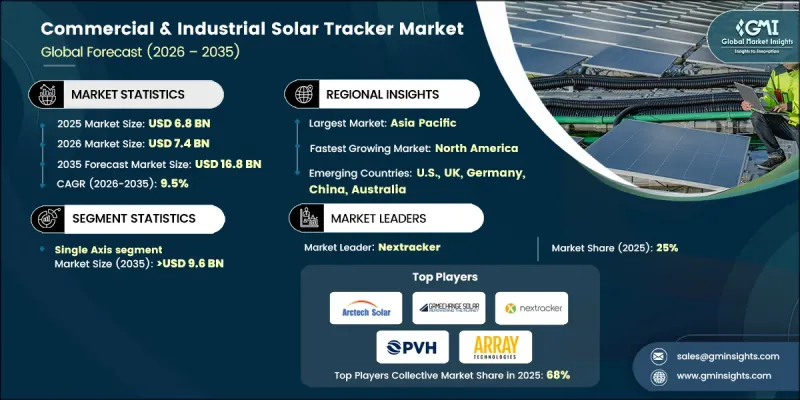
市場成長主要得益於商業和工業設施中大型分散式太陽能發電系統的日益普及。太陽能追蹤器透過持續調整太陽能板的方向以配合太陽全天的運動軌跡,從而提高發電量,與固定式安裝相比,能夠更好地捕獲太陽輻射並提升系統整體效率。其最佳化功率輸出、適應不平坦地形以及滿足多樣化能源應用需求的能力,正推動著專案開發商和投資者的廣泛採用。追蹤系統顯著提高了發電量,而人們對提高太陽能發電工程投資回報率 (ROI) 的日益關注,進一步加速了市場需求。此外,聯邦和地方層級支持可再生能源的法規結構和獎勵,也促進了包括追蹤系統在內的太陽光電技術的更廣泛應用。分散式能源專案的參與度不斷提高,使得共用太陽能發電模式得以實現,並提升了商業用戶的可及性,這些因素共同推動了市場成長。製造商持續的技術創新不斷提升追蹤精度、系統耐用性和成本效益,進一步增強了市場在工業應用領域的吸引力。
| 市場範圍 | |
|---|---|
| 開始年份 | 2025 |
| 預測期 | 2026-2035 |
| 上市時的市場規模 | 68億美元 |
| 預計金額 | 168億美元 |
| 複合年成長率 | 9.5% |
預計到2035年,單軸太陽能追蹤系統市場規模將達到96億美元,主要得益於該系統能夠將能源效率提高20%至30%(具體數值取決於安裝條件和系統設計)。這種性能提升使其對尋求更高效率和更大經濟效益的開發商更具吸引力。此外,該技術透過增加可再生能源發電和減少對石化燃料的依賴,支持永續性目標,最終有助於減少溫室氣體排放並改善環境績效。
預計到2035年,美國商業和工業太陽能追蹤器市場規模將達到6億美元。該地區的成長得益於一項支持性政策框架,該框架旨在促進商業基礎設施中太陽能的普及應用。投資獎勵,例如太陽能發電裝置的稅額扣抵,降低了開發商和投資者的專案成本,並促進了追蹤系統的更廣泛部署。此外,基於績效的獎勵機制,獎勵再生能源來源發電,進一步推動了市場擴張,並促進了全國太陽能追蹤器計畫的長期運作。
目錄
第1章:調查方法和範圍
第2章執行摘要
第3章業界考察
- 產業生態系統
- 監理情勢
- 影響產業的因素
- 促進因素
- 產業潛在風險與挑戰
- 成長潛力分析
- 波特五力分析
- PESTEL 分析
- 成本結構分析
- 價格趨勢分析,2022-2035年
- 透過使用
- 按地區
- 新機會和趨勢
- 數位化和物聯網整合
- 投資分析及未來展望
第4章 競爭情勢
- 介紹
- 企業市佔率分析:按地區分類
- 北美洲
- 歐洲
- 亞太地區
- 中東
- 非洲
- 拉丁美洲
- 競爭定位矩陣
- 主要進展
- 併購
- 夥伴關係與合作
- 新產品發布
- 業務拓展計劃及資金籌措
第5章 市場規模及預測:依產品分類,2022-2035年
- 單軸
- 雙軸
第6章 市場規模及預測:依地區分類,2022-2035年
- 北美洲
- 美國
- 加拿大
- 墨西哥
- 歐洲
- 英國
- 法國
- 荷蘭
- 德國
- 瑞典
- 西班牙
- 奧地利
- 亞太地區
- 中國
- 澳洲
- 印度
- 日本
- 韓國
- 非洲
- 南非
- 埃及
- 阿爾及利亞
- 奈及利亞
- 摩洛哥
- 中東
- 沙烏地阿拉伯
- 阿拉伯聯合大公國
- 約旦
- 以色列
- 拉丁美洲
- 巴西
- 智利
第7章:公司簡介
- Abengoa
- AllEarth Renewables
- Antai Solar
- ArcelorMittal
- Arctech Solar
- Array Technologies
- Convert Italia
- Degerenergie
- GameChange Solar
- Gonvarri Solar Steel
- Haosolar
- Ideematec
- MECASOLAR
- Nclave
- Nextracker
- Powerway Renewable Energy
- PV Hardware
- Scorpius Trackers
- SOLTEC
- Trina Solar
The Global Commercial and Industrial Solar Tracker Market was valued at USD 6.8 billion in 2025 and is estimated to grow at a CAGR of 9.5% to reach USD 16.8 billion in 2035.
Market growth is supported by increasing deployment of utility-scale and distributed solar power systems across commercial and industrial facilities. Solar trackers enhance energy generation by continuously aligning photovoltaic panels with the sun's movement throughout the day, improving sunlight capture and overall system efficiency compared to fixed-tilt installations. Their ability to optimize power output, adapt to uneven terrain, and support diverse energy applications is strengthening adoption among project developers and investors. Rising emphasis on improving return on investment in solar projects is further accelerating demand, as tracking systems significantly enhance energy yield performance. In addition, supportive regulatory frameworks and renewable energy incentives at federal and regional levels are encouraging broader deployment of solar technologies, including tracking systems. Growth is also influenced by increasing participation in distributed energy programs that enable shared solar generation models, improving accessibility for commercial users. Continuous technological advancements by manufacturers are improving tracking precision, system durability, and cost efficiency, further enhancing market attractiveness across industrial applications.
| Market Scope | |
|---|---|
| Start Year | 2025 |
| Forecast Year | 2026-2035 |
| Start Value | $6.8 Billion |
| Forecast Value | $16.8 Billion |
| CAGR | 9.5% |
Single axis solar trackers segment is expected to reach USD 9.6 billion by 2035, supported by their ability to deliver energy yield improvements ranging from 20% to 30% depending on site conditions and system design. These performance gains are making them increasingly attractive for developers seeking higher efficiency and stronger financial returns. The technology also supports sustainability goals by improving renewable energy output and reducing dependence on fossil fuel-based electricity generation, thereby contributing to lower greenhouse gas emissions and improved environmental performance.
U.S. Commercial and Industrial Solar Tracker Market is projected to reach USD 0.6 billion by 2035. Growth in the region is driven by supportive policy frameworks that promote solar energy adoption across commercial infrastructure. Investment incentives such as tax credit mechanisms for solar installations reduce project costs for developers and investors, encouraging wider deployment of tracking systems. In addition, performance-based incentive structures that reward electricity generation from renewable sources are further supporting market expansion and encouraging long-term operation of solar tracker projects across the country.
Key companies operating in the Global Commercial and Industrial Solar Tracker Industry include Abengoa, Array Technologies, Antai Solar, ArcelorMittal, Arctech Solar, AllEarth Renewables, Convert Italia, Degerenergie, GameChange Solar, Gonvarri Solar Steel, Haosolar, Ideematec, MECASOLAR, Nclave, Nextracker, Powerway Renewable Energy, PVHardware, Scorpius Trackers, SOLTEC, and Trina Solar. Companies in the commercial and industrial solar tracker market are focusing on improving system efficiency through advanced tracking algorithms and high-precision mechanical designs that enhance energy output reliability. Many players are investing in research and development to reduce operational costs while improving durability under extreme environmental conditions. Strategic partnerships with solar project developers and engineering procurement firms are being used to secure large-scale installations and expand global reach. Manufacturers are also emphasizing modular and scalable designs to simplify installation and reduce maintenance requirements. Expansion into emerging solar markets is helping companies diversify revenue streams and strengthen regional presence.
Table of Contents
Chapter 1 Methodology & Scope
- 1.1 Research design
- 1.2 Quality commitment
- 1.2.1 GMI AI policy & data integrity commitment
- 1.2.1.1 Source consistency protocol
- 1.2.1 GMI AI policy & data integrity commitment
- 1.3 Research trail & Confidence Scoring
- 1.3.1 Research trail componentsMoracco
- 1.4.1 Partial list of primary sources
- 1.5 Data mining sources
- 1.5.1 Paid sources
- 1.5.1.1 Sources, by region
- 1.5.1 Paid sources
- 1.6 Base estimates and calculations
- 1.6.1 Base year calculation for any one approach
- 1.7 Forecast model
- 1.8 Research transparency addendum
- 1.8.1 Source attribution framework
- 1.8.2 Quality assurance metrics
- 1.8.3 Our commitment to trust
Chapter 2 Executive Summary
- 2.1 Industry 360-degree synopsis, 2022 - 2035
- 2.2 Business trends
- 2.3 Product trends
- 2.4 Regional trends
Chapter 3 Industry Insights
- 3.1 Industry ecosystem
- 3.2 Regulatory landscape
- 3.3 Industry impact forces
- 3.3.1 Growth drivers
- 3.3.2 Industry pitfalls & challenges
- 3.4 Growth potential analysis
- 3.5 Porter's analysis
- 3.5.1 Bargaining power of suppliers
- 3.5.2 Bargaining power of buyers
- 3.5.3 Threat of new entrants
- 3.5.4 Threat of substitutes
- 3.6 PESTEL analysis
- 3.6.1 Political factors
- 3.6.2 Economic factors
- 3.6.3 Social factors
- 3.6.4 Technological factors
- 3.6.5 Legal factors
- 3.6.6 Environmental factors
- 3.7 Cost structure analysis
- 3.8 Price trend analysis, 2022-2035
- 3.8.1 By Application
- 3.8.2 By Region
- 3.9 Emerging opportunities & trends
- 3.9.1 Digitalization & IoT integration
- 3.9.2 Investment analysis & future outlook
Chapter 4 Competitive landscape, 2026
- 4.1 Introduction
- 4.2 Company market share analysis, by region, 2025
- 4.2.1 North America
- 4.2.2 Europe
- 4.2.3 Asia Pacific
- 4.2.4 Middle East
- 4.2.5 Africa
- 4.2.6 Latin America
- 4.3 Competitive positioning matrix
- 4.4 Key developments
- 4.4.1 Mergers & acquisitions
- 4.4.2 Partnerships & collaborations
- 4.4.3 New product launches
- 4.4.4 Expansion plans & funding
Chapter 5 Market Size and Forecast, By Product, 2022 - 2035 (USD Billion & MW)
- 5.1 Key trends
- 5.2 Single axis
- 5.3 Dual axis
Chapter 6 Market Size and Forecast, By Region, 2022 - 2035 (USD Billion & MW)
- 6.1 Key trends
- 6.2 North America
- 6.2.1 U.S.
- 6.2.2 Canada
- 6.2.3 Mexico
- 6.3 Europe
- 6.3.1 UK
- 6.3.2 France
- 6.3.3 Netherlands
- 6.3.4 Germany
- 6.3.5 Sweden
- 6.3.6 Spain
- 6.3.7 Austria
- 6.4 Asia Pacific
- 6.4.1 China
- 6.4.2 Australia
- 6.4.3 India
- 6.4.4 Japan
- 6.4.5 South Korea
- 6.5 Africa
- 6.5.1 South Africa
- 6.5.2 Egypt
- 6.5.3 Algeria
- 6.5.4 Nigeria
- 6.5.5 Morocco
- 6.6 Middle East
- 6.6.1 Saudi Arabia
- 6.6.2 UAE
- 6.6.3 Jordan
- 6.6.4 Israel
- 6.7 Latin America
- 6.7.1 Brazil
- 6.7.2 Chile
Chapter 7 Company Profiles
- 7.1 Abengoa
- 7.2 AllEarth Renewables
- 7.3 Antai Solar
- 7.4 ArcelorMittal
- 7.5 Arctech Solar
- 7.6 Array Technologies
- 7.7 Convert Italia
- 7.8 Degerenergie
- 7.9 GameChange Solar
- 7.10 Gonvarri Solar Steel
- 7.11 Haosolar
- 7.12 Ideematec
- 7.13 MECASOLAR
- 7.14 Nclave
- 7.15 Nextracker
- 7.16 Powerway Renewable Energy
- 7.17 PV Hardware
- 7.18 Scorpius Trackers
- 7.19 SOLTEC
- 7.20 Trina Solar

 太陽能追蹤器市場-2026-2032年全球市場預測雙軸太陽能追蹤器市場—2026-2032年全球市場預測
 雙軸太陽能追蹤器市場規模、佔有率和趨勢分析報告:按類型、應用、地區和細分市場分類(2026-2033 年)太陽能追蹤器市場規模、佔有率和趨勢分析報告:按技術、類型、應用、地區和細分市場分類(2026-2033 年)
 太陽能追蹤器市場機會、成長促進因素、產業趨勢分析及預測(2026-2035)
 單軸太陽能追蹤器市場預測至2034年—按產品類型、旋轉軸、應用和區域分類的全球分析
 太陽能追蹤器市場規模、佔有率和成長分析:按類型、軸類型、應用和地區分類-2026-2033年產業預測
 太陽能追蹤器市場規模、佔有率、趨勢和預測:按類型、追蹤方法、技術、應用和地區分類(2026-2034 年)公用事業太陽能追蹤器市場機會、成長要素、產業趨勢分析及2026-2035年預測住宅太陽能追蹤器市場機會、成長要素、產業趨勢分析及2026-2035年預測