


 |
市場調查報告書
商品編碼
2038645
雙軸太陽能追蹤器市場機會、成長要素、產業趨勢分析及2026-2035年預測。Dual Axis Solar Tracker Market Opportunity, Growth Drivers, Industry Trend Analysis, and Forecast 2026 - 2035 |
||||||

2025 年全球雙軸太陽能追蹤器市場價值為 212 億美元,預計到 2035 年將以 9.8% 的複合年成長率成長至 541 億美元。
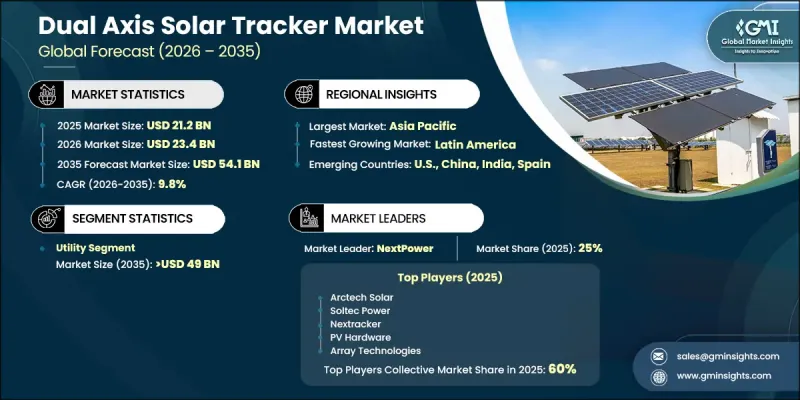
市場成長的驅動力來自對更高太陽能發電效率日益成長的需求、大型太陽能電站部署的擴張以及智慧追蹤技術的不斷進步。雙軸太陽能追蹤器透過調整面板在水平和垂直方向上的方向來提高太陽能發電性能,確保全天以及根據季節變化獲得最佳太陽輻射。人工智慧 (AI)、物聯網 (IoT) 連接和遠端監控系統的整合進一步提升了運作效率和系統智慧。此外,模組化和簡化的安裝設計降低了部署的複雜性,並提高了大規模太陽能發電工程的擴充性。人們對最大化能源產量的日益關注正在推動太陽能技術的更廣泛應用,尤其是在太陽輻射強度高的地區。可再生能源目標、淨計量計劃和獎勵措施等支持性法規結構正在進一步加速市場滲透。全球對清潔能源轉型和脫碳目標的日益關注也促進了對高效能太陽光電技術的投資。隨著各國政府和私人開發商優先考慮最佳化土地利用和提高每個裝置的能源產量,雙軸太陽能追蹤器在大規模可再生能源擴大策略中發揮越來越重要的作用。
| 市場範圍 | |
|---|---|
| 開始年份 | 2025 |
| 預測期 | 2026-2035 |
| 上市時的市場規模 | 212億美元 |
| 預計金額 | 541億美元 |
| 複合年成長率 | 9.8% |
預計2035年,公用事業規模太陽能發電市場規模將達490億美元。市場擴張的驅動力來自公共和私營相關人員投資的增加,以及追蹤系統性能和可靠性的持續提升。太陽能開發商與政府機構之間合作的加強,提高了專案執行和部署效率。此外,涵蓋安全標準、結構要求和安裝指南的法規結構的製定,正在支持系統的市場發展,並促進公用事業規模太陽能發電工程的大規模部署。
預計到2035年,美國雙軸太陽能追蹤器市場規模將達6.2億美元。該地區的成長主要得益於太陽能組件成本的下降以及太陽能和風能等再生能源來源的日益普及。追蹤器設計的技術進步提高了運作效率、耐用性和性能穩定性,從而促進了其更廣泛的市場接受度。此外,土地利用效率的提高和單次安裝功率密度的增加也推動了其應用,尤其是在土地取得困難的地區。
目錄
第1章:調查方法和範圍
第2章執行摘要
第3章業界考察
- 產業生態系統
- 監理情勢
- 影響產業的因素
- 促進因素
- 產業潛在風險與挑戰
- 成長潛力分析
- 波特五力分析
- PESTEL 分析
- 成本結構分析
- 價格趨勢分析,2022-2035年
- 透過使用
- 按地區
- 新機會和趨勢
- 數位化和物聯網整合
- 投資分析及未來展望
第4章 競爭情勢
- 介紹
- 企業市佔率分析:按地區分類
- 北美洲
- 歐洲
- 亞太地區
- 中東
- 非洲
- 拉丁美洲
- 競爭定位矩陣
- 主要進展
- 併購
- 夥伴關係與合作
- 新產品發布
- 業務拓展計劃及資金籌措
第5章 市場規模及預測:依應用領域分類,2022-2035年
- 住宅
- 商業和工業用途
- 公共產業
第6章 市場規模及預測:依地區分類,2022-2035年
- 北美洲
- 美國
- 加拿大
- 墨西哥
- 歐洲
- 英國
- 法國
- 荷蘭
- 德國
- 瑞典
- 西班牙
- 奧地利
- 亞太地區
- 中國
- 澳洲
- 印度
- 日本
- 韓國
- 中東
- 沙烏地阿拉伯
- 阿拉伯聯合大公國
- 約旦
- 以色列
- 非洲
- 南非
- 埃及
- 阿爾及利亞
- 奈及利亞
- 摩洛哥
- 拉丁美洲
- 巴西
- 智利
第7章:公司簡介
- Abengoa
- Arctech Solar
- AllEarth Renewables
- Array Technologies
- Convert Italia
- Degerenergie
- Haosolar
- Ideematec
- Mechatron Solar
- NextPower
- PARU
- PV Hardware
- Scorpius Trackers
- Solar CenTex
- Soltec
- SunPower Corporation
- Stracker Incorporated
- Sun Action Trackers
- Suntactics
- Targray
The Global Dual Axis Solar Tracker Market was valued at USD 21.2 billion in 2025 and is estimated to grow at a CAGR of 9.8% to reach USD 54.1 billion by 2035.
Market growth is driven by the rising demand for higher solar energy efficiency, increasing deployment of utility-scale solar farms, and continuous advancements in smart tracking technologies. Dual-axis solar trackers enhance photovoltaic performance by adjusting panel orientation along both horizontal and vertical planes, enabling optimal solar exposure throughout the day and across seasonal variations. The integration of artificial intelligence, Internet of Things connectivity, and remote monitoring systems is further strengthening operational efficiency and system intelligence. Additionally, modular and simplified installation designs are reducing deployment complexity and improving scalability for large solar projects. Growing emphasis on maximizing energy yield is encouraging wider adoption, particularly in regions with high solar irradiance. Supportive regulatory frameworks, including renewable energy targets, net metering structures, and incentive programs, are further accelerating market penetration. Increasing global focus on clean energy transition and decarbonization goals is also reinforcing investment in high-efficiency solar technologies. As governments and private developers prioritize optimized land utilization and higher energy output per installation, dual-axis solar trackers are becoming increasingly relevant in large-scale renewable energy expansion strategies.
| Market Scope | |
|---|---|
| Start Year | 2025 |
| Forecast Year | 2026-2035 |
| Start Value | $21.2 Billion |
| Forecast Value | $54.1 Billion |
| CAGR | 9.8% |
The utility-scale segment is expected to reach USD 49 billion by 2035. Market expansion is being driven by rising investments from both public and private stakeholders, along with continuous improvements in tracking system performance and reliability. Increasing collaboration between solar developers and government-backed entities is strengthening project execution and deployment efficiency. Additionally, evolving regulatory frameworks covering safety standards, structural requirements, and installation guidelines are supporting structured market development and encouraging large-scale adoption across utility solar projects.
U.S. Dual Axis Solar Tracker Market is projected to reach USD 0.62 billion by 2035. Growth in the region is supported by declining costs of solar components and expanding adoption of renewable energy sources such as solar and wind. Technological improvements in tracker design have enhanced operational efficiency, durability, and performance consistency, contributing to broader market acceptance. Furthermore, improved land utilization and higher energy generation density per installation are driving adoption, especially in regions where land availability is limited.
Key companies operating in the Global Dual Axis Solar Tracker Industry include Arctech Solar, Array Technologies, Ideematec, PV Hardware, Mechatron Solar, Scorpius Trackers, Soltec, SunPower Corporation, Degerenergie, Abengoa, Convert Italia, Haosolar, NextPower, AllEarth Renewables, PARU, Stracker Incorporated, Sun Action Trackers, Suntactics, Solar CenTex, and Targray. Companies in the dual axis solar tracker market are focusing on advanced technology integration such as AI-based tracking optimization, IoT-enabled remote monitoring, and predictive maintenance systems to improve efficiency and reliability. They are investing in modular and lightweight designs to reduce installation time and project costs while improving scalability for large solar installations. Strategic partnerships with utility developers and energy providers are being strengthened to secure long-term project pipelines. Manufacturers are also expanding their global presence through mergers, acquisitions, and regional collaborations. Continuous research and development efforts are focused on improving durability, structural stability, and energy yield performance.
Table of Contents
Chapter 1 Methodology & Scope
- 1.1 Market design
- 1.2 Quality commitment
- 1.2.1 GMI AI policy & data integrity commitment
- 1.2.1.1 Source consistency protocol
- 1.2.1 GMI AI policy & data integrity commitment
- 1.3 Research trail & Confidence Scoring
- 1.3.1 Research trail components
- 1.3.2 Scoring components
- 1.4 Data Collection
- 1.4.1 Partial list of primary sources
- 1.5 Data mining sources
- 1.5.1 Paid sources
- 1.5.1.1 Sources, by region
- 1.5.1 Paid sources
- 1.6 Base estimates and calculations
- 1.6.1 Base year calculation for any one approach
- 1.7 Forecast model
- 1.8 Research transparency addendum
- 1.8.1 Source attribution framework
- 1.8.2 Quality assurance metrics
- 1.8.3 Our commitment to trust
- 1.9 Market definitions
Chapter 2 Executive Summary
- 2.1 Industry synopsis, 2022 - 2035
- 2.2 Business trends
- 2.3 Application trends
- 2.4 Regional trends
Chapter 3 Industry Insights
- 3.1 Industry ecosystem
- 3.2 Regulatory landscape
- 3.3 Industry impact forces
- 3.3.1 Growth drivers
- 3.3.2 Industry pitfalls & challenges
- 3.4 Growth potential analysis
- 3.5 Porter's analysis
- 3.5.1 Bargaining power of suppliers
- 3.5.2 Bargaining power of buyers
- 3.5.3 Threat of new entrants
- 3.5.4 Threat of substitutes
- 3.6 PESTEL Analysis
- 3.6.1 Political factors
- 3.6.2 Economic factors
- 3.6.3 Social factors
- 3.6.4 Technological factors
- 3.6.5 Legal factors
- 3.6.6 Environmental factors
- 3.7 Cost structure analysis
- 3.8 Price trend analysis, 2022-2035
- 3.8.1 By Application
- 3.8.2 By Region
- 3.9 Emerging opportunities & trends
- 3.9.1 Digitalization & IoT integration
- 3.9.2 Investment analysis & future outlook
Chapter 4 Competitive landscape, 2026
- 4.1 Introduction
- 4.2 Company market share analysis, by region, 2025
- 4.2.1 North America
- 4.2.2 Europe
- 4.2.3 Asia Pacific
- 4.2.4 Middle East
- 4.2.5 Africa
- 4.2.6 Latin America
- 4.3 Competitive positioning matrix
- 4.4 Key developments
- 4.4.1 Mergers & acquisitions
- 4.4.2 Partnerships & collaborations
- 4.4.3 New product launches
- 4.4.4 Expansion plans & funding
Chapter 5 Market Size and Forecast, By Application, 2022 - 2035 (USD Million & MW)
- 5.1 Key trends
- 5.2 Residential
- 5.3 Commercial & Industrial
- 5.4 Utility
Chapter 6 Market Size and Forecast, By Region, 2022 - 2035 (USD Million & MW)
- 6.1 Key trends
- 6.2 North America
- 6.2.1 U.S.
- 6.2.2 Canada
- 6.2.3 Mexico
- 6.3 Europe
- 6.3.1 UK
- 6.3.2 France
- 6.3.3 Netherlands
- 6.3.4 Germany
- 6.3.5 Sweden
- 6.3.6 Spain
- 6.3.7 Austria
- 6.4 Asia Pacific
- 6.4.1 China
- 6.4.2 Australia
- 6.4.3 India
- 6.4.4 Japan
- 6.4.5 South Korea
- 6.5 Middle East
- 6.5.1 Saudi Arabia
- 6.5.2 UAE
- 6.5.3 Jordan
- 6.5.4 Israel
- 6.6 Africa
- 6.6.1 South Africa
- 6.6.2 Egypt
- 6.6.3 Algeria
- 6.6.4 Nigeria
- 6.6.5 Morocco
- 6.7 Latin America
- 6.7.1 Brazil
- 6.7.2 Chile
Chapter 7 Company Profiles
- 7.1 Abengoa
- 7.2 Arctech Solar
- 7.3 AllEarth Renewables
- 7.4 Array Technologies
- 7.5 Convert Italia
- 7.6 Degerenergie
- 7.7 Haosolar
- 7.8 Ideematec
- 7.9 Mechatron Solar
- 7.10 NextPower
- 7.11 PARU
- 7.12 PV Hardware
- 7.13 Scorpius Trackers
- 7.14 Solar CenTex
- 7.15 Soltec
- 7.16 SunPower Corporation
- 7.17 Stracker Incorporated
- 7.18 Sun Action Trackers
- 7.19 Suntactics
- 7.20 Targray

 太陽能追蹤器市場機會、成長促進因素、產業趨勢分析及預測(2026-2035)
 單軸太陽能追蹤器市場預測至2034年—按產品類型、旋轉軸、應用和區域分類的全球分析
 太陽能追蹤器市場規模、佔有率和成長分析:按類型、軸類型、應用和地區分類-2026-2033年產業預測
 太陽能追蹤器市場規模、佔有率、趨勢和預測:按類型、追蹤方法、技術、應用和地區分類(2026-2034 年)公用事業太陽能追蹤器市場機會、成長要素、產業趨勢分析及2026-2035年預測商業和工業太陽能追蹤器的市場機會、成長要素、產業趨勢分析和預測(2026-2035 年)住宅太陽能追蹤器市場機會、成長要素、產業趨勢分析及2026-2035年預測單軸太陽能追蹤器市場機會、成長要素、產業趨勢分析及2026-2035年預測。
 2026年全球智慧太陽能追蹤簾子市場報告
 太陽能追蹤器市場:按類型、技術、系統類型和應用分類-2026-2032年全球市場預測