

 |
市場調查報告書
商品編碼
2038464
2026 年至 2035 年豌豆蛋白分離物的市場機會、成長要素、產業趨勢分析與預測。Pea Protein Isolate Market Opportunity, Growth Drivers, Industry Trend Analysis, and Forecast 2026 - 2035 |
||||||

2025 年全球豌豆蛋白分離物市場價值為 2.423 億美元,預計到 2035 年將達到 6.414 億美元,年複合成長率為 10.2%。
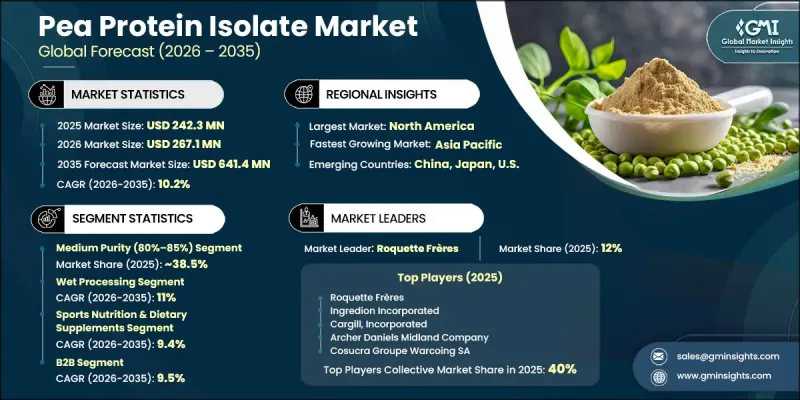
在全球食品體系中,消費者對植物來源、永續和無過敏原蛋白質來源的偏好日益成長,推動了豌豆蛋白分離物市場的發展。消費者健康意識的提高,以及彈性素食、純素和無乳糖飲食的快速普及,顯著提升了豌豆蛋白分離物的需求。豌豆蛋白分離物因其高蛋白含量、均衡的氨基酸組成和易消化性而廣受認可,使其成為動物性蛋白質和其他植物來源蛋白質的理想替代品。消費者對潔淨標示營養、非基因改造認證和無麩質配方的日益關注,進一步促進了食品飲料產業對豌豆蛋白分離物的應用。此外,豌豆蛋白分離物具有多種功能性益處,例如支持肌肉生長、增強飽足感和輔助體重管理,因此被廣泛應用於運動營養和膳食補充劑中。豌豆蛋白分離物口感中性,功能多樣,適用於包括蛋白粉、肉類替代品、機能性食品、烘焙產品、即飲飲料和特殊營養解決方案在內的多種應用領域。市場持續受益於植物蛋白配方技術的進步,該技術正在擴大其在消費者和高階營養品領域的應用。
| 市場範圍 | |
|---|---|
| 開始年份 | 2025 |
| 預測期 | 2026-2035 |
| 初始市場規模 | 2.423億美元 |
| 預計金額 | 6.414億美元 |
| 複合年成長率 | 10.2% |
中等純度(80%–85%)產品預計在2025年佔據38.5%的市場佔有率,並在2035年之前以9.8%的複合年成長率成長。此細分市場需求強勁,得益於其均衡的成本效益和優異的功能性能。它廣泛應用於烘焙產品、零嘴零食、能量棒和植物來源食品中,這些產品對溶解性、質地和營養價值有著至關重要的要求。其多功能性和滿足多樣化配方需求的能力也持續支撐著其穩定的市場地位。
預計到2025年,濕式加工將佔據62.5%的市場佔有率,並在2026年至2035年間以11%的複合年成長率成長。由於該方法能夠提供更高的純度和功能性,因此仍然是高品質豌豆蛋白分離物的主要生產技術。此製程通常包括酸或酵素萃取,然後進行沉澱和乾燥,最終得到高蛋白濃度、溶解性較佳、功能特性更優的產品。儘管濕式加工的生產成本較高,但對於需要優異質地、乳化性和消化率的應用而言,濕式加工至關重要,尤其是在飲料、膳食補充劑和植物來源肉替代品領域。
預計到2025年,北美豌豆蛋白分離物市場佔有率將達到35.4%,主要得益於消費者對植物來源肉類替代品和即飲蛋白飲料的強勁需求。此外,該地區對非基因改造和無過敏原食品配料的監管支持也進一步推動了市場成長,刺激了食品飲料產業對相關產品的廣泛應用。
目錄
第1章:調查方法和範圍
第2章執行摘要
第3章業界考察
- 生態系分析
- 供應商情況
- 利潤率
- 每個階段增加的價值
- 影響價值鏈的因素
- 中斷
- 影響產業的因素
- 促進因素
- 消費者對植物性蛋白質的需求日益成長
- 純素和純素食者人數不斷增加
- 不含過敏原的替代蛋白的需求
- 產業潛在風險與挑戰
- 高昂的生產成本和加工成本
- 原料取得困難和農業限制
- 市場機遇
- 寵物食品和動物營養領域的新興應用
- 嬰兒配方奶粉和臨床營養領域
- 促進因素
- 成長潛力分析
- 監理情勢
- 波特五力分析
- PESTEL 分析
- 價格趨勢
- 按地區
- 純度
- 未來市場趨勢
- 科技與創新趨勢
- 當前技術趨勢
- 新興技術
- 專利趨勢
- 貿易統計(HS編碼)
- 主要進口國
- 主要出口國
- 永續性和環境方面
- 永續計劃
- 減少廢棄物策略
- 生產中的能源效率
- 具有環保意識的舉措
- 考慮碳足跡
第4章 競爭情勢
- 介紹
- 企業市佔率分析
- 按地區
- 北美洲
- 歐洲
- 亞太地區
- 拉丁美洲
- 中東和非洲(MEA)
- 按地區
- 企業矩陣分析
- 主要市場公司的競爭分析
- 競爭定位矩陣
- 主要進展
- 併購
- 夥伴關係與合作
- 新產品發布
- 業務拓展計劃
第5章 市場估計與預測:依純度分類,2022-2035年
- 低純度(75%-80%)
- 中等純度(80%-85%)
- 高純度(>85%)
第6章 市場估算與預測:依加工方式分類,2022-2035年
- 乾處理
- 濕式加工
第7章 市場估計與預測:依應用領域分類,2022-2035年
- 運動營養和營養補充品
- 蛋白粉奶昔
- 能量棒和機能性食品
- 運動前後的營養
- 肉類替代品/植物來源食品
- 素食肉類替代品
- 植物來源漢堡和香腸
- 組織化蛋白質產品
- 麵包糖果甜點
- 蛋白質強化烘焙產品
- 高蛋白零食
- 功能性烘焙原料
- 飲料
- 即飲飲料
- 能量飲料
- 飼料和寵物食品
- 牲畜營養補充品
- 優質寵物食品配方
- 水產養殖飼料的用途
- 其他
第8章 市場估算與預測:依通路分類,2022-2035年
- B2B
- B2C
第9章 市場估計與預測:依地區分類,2022-2035年
- 北美洲
- 美國
- 加拿大
- 歐洲
- 德國
- 英國
- 法國
- 西班牙
- 義大利
- 其他歐洲地區
- 亞太地區
- 中國
- 印度
- 日本
- 澳洲
- 韓國
- 亞太其他地區
- 拉丁美洲
- 巴西
- 墨西哥
- 阿根廷
- 其他拉丁美洲地區
- 中東和非洲
- 沙烏地阿拉伯
- 南非
- 阿拉伯聯合大公國
- 其他中東和非洲地區
第10章:公司簡介
- Archer Daniels Midland Company
- AGT Food and Ingredients Inc.
- Axiom Foods, Inc.
- Burcon NutraScience/Merit Functional Foods
- Cargill, Incorporated
- Cosucra Groupe Warcoing SA
- Emsland Group
- Glanbia Nutritionals
- Ingredion Incorporated
- Louis Dreyfus Company
- NutriPea
- PURIS
- Roquette Freres
- The Scoular Company
- Yantai Shuangta Food Co., Ltd.
The Global Pea Protein Isolate Market was valued at USD 242.3 million in 2025 and is estimated to grow at a CAGR of 10.2% to reach USD 641.4 million by 2035.
The market is witnessing momentum driven by rising consumer preference for plant-based, sustainable, and allergen-free protein sources across global food systems. Increasing health awareness among consumers, along with the rapid shift toward flexitarian, vegan, and lactose-free diets, is significantly strengthening demand for pea protein isolate. The ingredient is widely recognized for its high protein concentration, balanced amino acid composition, and easy digestibility, making it a preferred alternative to animal-based and other plant-derived proteins. Growing focus on clean-label nutrition, non-GMO certification, and gluten-free formulations is further enhancing product adoption across food and beverage applications. In addition, its functional advantages, including muscle support, satiety benefits, and weight management support, are driving its inclusion in sports nutrition and dietary supplement formulations. The neutral taste profile and strong functional versatility of pea protein isolate are enabling its integration into a wide range of applications such as protein powders, meat substitutes, functional foods, bakery products, ready-to-drink beverages, and specialized nutrition solutions. The market continues to benefit from increasing innovation in plant protein formulation technologies and expanding applications across mainstream and premium nutrition categories.
| Market Scope | |
|---|---|
| Start Year | 2025 |
| Forecast Year | 2026-2035 |
| Start Value | $242.3 Million |
| Forecast Value | $641.4 Million |
| CAGR | 10.2% |
The medium purity segment (80%-85%) accounted for 38.5% share in 2025 and is projected to grow at a CAGR of 9.8% through 2035. This segment maintains strong demand due to its balanced combination of cost efficiency and functional performance. It is widely used in bakery formulations, snack products, energy bars, and plant-based food applications where solubility, texture, and nutritional value are key requirements. Its versatility and ability to meet diverse formulation needs continue to support stable market adoption.
The wet processing segment held a 62.5% share in 2025 and is expected to grow at a CAGR of 11% between 2026 and 2035. This method remains the primary production technique for high-quality pea protein isolate due to its ability to deliver superior purity and functional performance. The process typically involves extraction using acid or enzymatic methods followed by precipitation and drying, resulting in a product with high protein concentration, improved solubility, and enhanced functional properties. Despite higher production costs, wet processing is essential for applications requiring superior texture, emulsification, and digestibility, particularly in beverages, supplements, and plant-based meat alternatives.
North America Pea Protein Isolate Market accounted for 35.4% share in 2025, supported by strong consumer demand for plant-based meat alternatives and ready-to-drink protein beverages. The region's growth is further reinforced by regulatory support for non-GMO and allergen-free food ingredients, which is encouraging broader product adoption across the food and nutrition industry.
Key players operating in the Pea Protein Isolate Industry include Roquette Freres, Cargill, Incorporated, Ingredion Incorporated, Archer Daniels Midland Company, Glanbia Nutritionals, Emsland Group, Cosucra Groupe Warcoing SA, Axiom Foods, Inc., AGT Food and Ingredients Inc., Burcon NutraScience / Merit Functional Foods, Louis Dreyfus Company, NutriPea, PURIS, The Scoular Company, and Yantai Shuangta Food Co., Ltd. Companies in the Pea Protein Isolate Market are focusing on expanding production capacities and investing in advanced extraction and processing technologies to improve yield and protein quality. Strong emphasis is being placed on research and development to enhance functional properties such as solubility, texture, and taste neutrality for broader application use. Strategic partnerships with food and beverage manufacturers are enabling companies to strengthen product integration across mainstream and specialty nutrition categories. Firms are also expanding into emerging markets to capture rising demand for plant-based protein solutions. Sustainability initiatives, including environmentally efficient sourcing and low-impact processing methods, are being prioritized to align with clean-label trends.
Table of Contents
Chapter 1 Methodology & Scope
- 1.1 Market scope and definition
- 1.2 Research design
- 1.2.1 Research approach
- 1.2.2 Data collection methods
- 1.3 Data mining sources
- 1.3.1 Global
- 1.3.2 Regional/Country
- 1.4 Base estimates and calculations
- 1.4.1 Base year calculation
- 1.4.2 Key trends for market estimation
- 1.5 Primary research and validation
- 1.5.1 Primary sources
- 1.6 Forecast model
- 1.7 Research assumptions and limitations
Chapter 2 Executive Summary
- 2.1 Industry 360° synopsis
- 2.2 Key market trends
- 2.2.1 Regional
- 2.2.2 Purity level
- 2.2.3 Processing method
- 2.2.4 Application
- 2.2.5 Distribution channel
- 2.3 TAM Analysis, 2026-2035
- 2.4 CXO perspectives: Strategic imperatives
- 2.4.1 Executive decision points
- 2.4.2 Critical success factors
- 2.5 Future Outlook and Strategic Recommendations
Chapter 3 Industry Insights
- 3.1 Industry ecosystem analysis
- 3.1.1 Supplier landscape
- 3.1.2 Profit margin
- 3.1.3 Value addition at each stage
- 3.1.4 Factor affecting the value chain
- 3.1.5 Disruptions
- 3.2 Industry impact forces
- 3.2.1 Growth drivers
- 3.2.1.1 Rising consumer demand for plant-based proteins
- 3.2.1.2 Growing vegan & vegetarian population
- 3.2.1.3 Allergen-free protein alternative demand
- 3.2.2 Industry pitfalls and challenges
- 3.2.2.1 High production costs & processing expenses
- 3.2.2.2 Limited raw material availability & agricultural constraints
- 3.2.3 Market opportunities
- 3.2.3.1 Emerging applications in pet food & animal nutrition
- 3.2.3.2 Infant formula & clinical nutrition segments
- 3.2.1 Growth drivers
- 3.3 Growth potential analysis
- 3.4 Regulatory landscape
- 3.4.1 North America
- 3.4.2 Europe
- 3.4.3 Asia Pacific
- 3.4.4 Latin America
- 3.4.5 Middle East & Africa
- 3.5 Porter's analysis
- 3.6 PESTEL analysis
- 3.7 Price trends
- 3.7.1 By region
- 3.7.2 By Purity level
- 3.8 Future market trends
- 3.9 Technology and Innovation landscape
- 3.9.1 Current technological trends
- 3.9.2 Emerging technologies
- 3.10 Patent Landscape
- 3.11 Trade statistics (HS code)
- 3.11.1 Major importing countries
- 3.11.2 Major exporting countries
- 3.12 Sustainability and environmental aspects
- 3.12.1 Sustainable practices
- 3.12.2 Waste reduction strategies
- 3.12.3 Energy efficiency in production
- 3.12.4 Eco-friendly initiatives
- 3.13 Carbon footprint consideration
Chapter 4 Competitive Landscape, 2025
- 4.1 Introduction
- 4.2 Company market share analysis
- 4.2.1 By region
- 4.2.1.1 North America
- 4.2.1.2 Europe
- 4.2.1.3 Asia Pacific
- 4.2.1.4 LATAM
- 4.2.1.5 MEA
- 4.2.1 By region
- 4.3 Company matrix analysis
- 4.4 Competitive analysis of major market players
- 4.5 Competitive positioning matrix
- 4.6 Key developments
- 4.6.1 Mergers & acquisitions
- 4.6.2 Partnerships & collaborations
- 4.6.3 New Product Launches
- 4.6.4 Expansion Plans
Chapter 5 Market Estimates and Forecast, By Purity Level, 2022-2035 (USD Million) (Kilo Tons)
- 5.1 Key trends
- 5.2 Low purity (75%-80%)
- 5.3 Medium purity (80%-85%)
- 5.4 High purity (>85%)
Chapter 6 Market Estimates and Forecast, By Processing Method, 2022-2035 (USD Million) (Kilo Tons)
- 6.1 Key trends
- 6.2 Dry processing
- 6.3 Wet processing
Chapter 7 Market Estimates and Forecast, By Application, 2022-2035 (USD Million) (Kilo Tons)
- 7.1 Key trends
- 7.2 Sports Nutrition & Dietary Supplements
- 7.2.1 Protein powders & shakes
- 7.2.2 Energy bars & functional foods
- 7.2.3 Pre-/post-workout nutrition
- 7.3 Meat Substitutes & Plant-Based Foods
- 7.3.1 Vegan meat analogs
- 7.3.2 Plant-based burgers & sausages
- 7.3.3 Textured protein products
- 7.4 Bakery & Confectionery
- 7.4.1 Protein-fortified baked goods
- 7.4.2 High-protein snacks
- 7.4.3 Functional bakery ingredients
- 7.5 Beverages
- 7.5.1 Ready-to-drink (RTD) beverages
- 7.5.2 Energy drinks
- 7.6 Animal Feed & Pet Food
- 7.6.1 Livestock nutritional supplements
- 7.6.2 Premium pet food formulations
- 7.6.3 Aquaculture feed applications
- 7.7 Others
Chapter 8 Market Estimates and Forecast, By Distribution Channel, 2022-2035 (USD Million) (Kilo Tons)
- 8.1 Key trends
- 8.2 B2B
- 8.3 B2C
Chapter 9 Market Estimates and Forecast, By Region, 2022-2035 (USD Million) (Kilo Tons)
- 9.1 Key trends
- 9.2 North America
- 9.2.1 U.S.
- 9.2.2 Canada
- 9.3 Europe
- 9.3.1 Germany
- 9.3.2 UK
- 9.3.3 France
- 9.3.4 Spain
- 9.3.5 Italy
- 9.3.6 Rest of Europe
- 9.4 Asia Pacific
- 9.4.1 China
- 9.4.2 India
- 9.4.3 Japan
- 9.4.4 Australia
- 9.4.5 South Korea
- 9.4.6 Rest of Asia Pacific
- 9.5 Latin America
- 9.5.1 Brazil
- 9.5.2 Mexico
- 9.5.3 Argentina
- 9.5.4 Rest of Latin America
- 9.6 Middle East and Africa
- 9.6.1 Saudi Arabia
- 9.6.2 South Africa
- 9.6.3 UAE
- 9.6.4 Rest of Middle East and Africa
Chapter 10 Company Profiles
- 10.1 Archer Daniels Midland Company
- 10.2 AGT Food and Ingredients Inc.
- 10.3 Axiom Foods, Inc.
- 10.4 Burcon NutraScience / Merit Functional Foods
- 10.5 Cargill, Incorporated
- 10.6 Cosucra Groupe Warcoing SA
- 10.7 Emsland Group
- 10.8 Glanbia Nutritionals
- 10.9 Ingredion Incorporated
- 10.10 Louis Dreyfus Company
- 10.11 NutriPea
- 10.12 PURIS
- 10.13 Roquette Freres
- 10.14 The Scoular Company
- 10.15 Yantai Shuangta Food Co., Ltd.

 蛋白質市場報告:趨勢、預測和競爭分析(至2035年)微生物蛋白市場報告:趨勢、預測及競爭分析(至2035年)
 2026 年至 2035 年海洋來源蛋白質的市場機會、成長要素、產業趨勢與預測。
 水解玉米蛋白市場規模、佔有率及成長分析(按類型、應用、理化性質及地區分類)-2026-2033年產業預測
 蛋白質市場規模、佔有率和成長分析(按來源類型、形態、應用、通路和地區分類)-2026-2033年產業預測
 微生物蛋白市場規模、佔有率和成長分析(按微生物來源、功能、生產方法、應用、形態和地區分類)-2026-2033年產業預測
 全球海洋蛋白市場全球水解玉米蛋白市場浮萍蛋白的全球市場全球草飼蛋白質市場