


 |
市場調查報告書
商品編碼
1959326
再生零食市場機會、成長要素、產業趨勢分析及2026年至2035年預測Upcycled Snacks Market Opportunity, Growth Drivers, Industry Trend Analysis, and Forecast 2026 - 2035 |
||||||

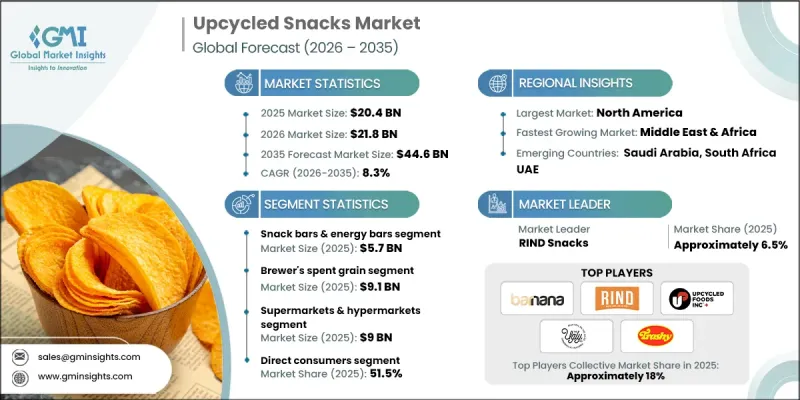
2025 年全球升級再造零食市場價值 204 億美元,預計到 2035 年將達到 446 億美元,年複合成長率為 8.3%。
隨著消費者對環境永續性和減少食物廢棄物的意識不斷增強,市場正呈現強勁成長動能。消費者對負責任消費和資源效率的日益重視正在改變他們的購買行為,他們積極尋找有助於減少環境影響的產品。致力於循環經濟原則的品牌正在贏得消費者的信任和忠誠,製造商也被鼓勵將升級再造的原料融入其主流零食產品線。永續性價值與購買決策的契合正在加速其在全球市場的滲透。同時,健康和保健趨勢也推動了升級再造零食的需求。消費者優先考慮潔淨標示、營養食品和機能性食品,而升級再造的原料不僅提供更優的營養成分,還有助於減少廢棄物。隨著以健康為導向的零食持續影響零售貨架和電商平台,升級再造產品正在拓展其在各個分銷管道的覆蓋範圍。零售通路的增加和產品開發的創新將進一步鞏固市場的長期成長。
| 市場範圍 | |
|---|---|
| 開始年份 | 2025 |
| 預測年份 | 2026-2035 |
| 起始值 | 204億美元 |
| 預測金額 | 446億美元 |
| 複合年成長率 | 8.3% |
預計到2025年,點心棒和零食棒市場銷售額將達到57億美元,並在2026年至2035年間以8%的複合年成長率成長。該品類之所以能夠推動市場擴張,是因為它能夠與營養豐富的再生原料完美融合,並融入人們的日常消費習慣。這些產品符合快節奏的生活方式,可以作為日常代餐,從而促進消費者的持續重複購買。同時,薯片、脆片和餅乾等鹹味零食也因其廣泛的消費者接受度而顯著推動了銷量成長。大規模的消費群體使得在維持主流吸引力和價格競爭力的同時,也能有效融入再生原料。
2025年,釀造殘渣市場規模將達到91億美元,預計2035年將以8.1%的複合年成長率成長。這一原料類別受益於穩定的供應來源和成本,使其成為商業性休閒食品生產的理想選擇。其營養特性使其能夠有效地融入各種烘焙點心和加工休閒食品中。此外,植物來源產品憑藉其天然的風味、口感和纖維含量,正在推動甜味和鹹味零食的創新應用。這些採購模式提高了原料利用效率,並強化了升級再造休閒食品市場的循環生產系統。
預計到2025年,北美再生零食市場規模將達到79億美元,並在整個預測期內保持強勁成長。高度的永續性和產品創新文化正在推動該地區的擴張。食品製造商正在加速將再生原料融入廣受歡迎的零食類別中,以滿足減少廢棄物和潔淨標示的需求。由於消費者對永續食品理念的高度接受度以及專業原料供應商的存在,美國仍然是該地區成長的主要貢獻者。廣泛的零售分銷網路、Start-Ups的積極湧入以及自有品牌的實驗性開發都支持了產量的成長。此外,完善的食品回收系統能夠確保單一產品的穩定供應和大規模零食生產,這也是該地區的另一個優勢。
目錄
第1章:調查方法
第2章執行摘要
第3章業界考察
- 生態系分析
- 供應商情況
- 利潤率
- 每個階段增加的價值
- 影響價值鏈的因素
- 中斷
- 影響產業的因素
- 促進因素
- 產業潛在風險與挑戰
- 市場機遇
- 成長潛力分析
- 監理情勢
- 波特五力分析
- PESTEL 分析
- 價格趨勢
- 按地區
- 依產品
- 未來市場趨勢
- 科技與創新趨勢
- 當前技術趨勢
- 新興技術
- 專利狀態
- 貿易統計(註:僅提供主要國家的貿易統計)
- 主要進口國
- 主要出口國
- 永續性和環境方面
- 永續計劃
- 減少廢棄物策略
- 生產中的能源效率
- 具有環保意識的舉措
- 碳足跡考量
第4章 競爭情勢
- 介紹
- 企業市佔率分析
- 按地區
- 北美洲
- 歐洲
- 亞太地區
- 拉丁美洲
- 中東和非洲
- 按地區
- 公司矩陣分析
- 主要市場公司的競爭分析
- 競爭定位矩陣
- 主要進展
- 併購
- 夥伴關係與合作
- 新產品發布
- 業務拓展計劃
第5章 市場估算與預測:依產品類型分類,2022-2035年
- 點心棒和能量棒
- 洋芋片
- 蔬菜片
- 墨西哥玉米片
- 泡芙零食
- 水果脆
- 乾果和水果零食
- 餅乾和薄脆餅乾
- 餅乾和烘焙點心
- 什錦乾果和Granola
- 其他
第6章 市場估計與預測:依原料來源分類,2022-2035年
- 釀造廢穀物(BSG)
- 蔬果廢棄物
- 冷壓
- 其他產品(依類別)
- 大豆加工
- 咖啡
- 燕麥和堅果奶加工
- 農業和加工
第7章 市場估價與預測:依通路分類,2022-2035年
- 超級市場和大賣場
- 專賣店和健康食品店
- 線上零售
- 餐飲服務業/Horeka
- 批發/B2B
第8章 市場估算與預測:依最終使用者分類,2022-2035年
- 直接消費者
- 食品和飲料製造商
- 餐飲企業經營者
- 營養補充品和機能性食品公司
- 其他
第9章 市場估計與預測:依地區分類,2022-2035年
- 北美洲
- 美國
- 加拿大
- 歐洲
- 德國
- 英國
- 法國
- 義大利
- 西班牙
- 其他歐洲地區
- 亞太地區
- 中國
- 印度
- 日本
- 澳洲
- 韓國
- 亞太其他地區
- 拉丁美洲
- 巴西
- 墨西哥
- 阿根廷
- 其他拉丁美洲地區
- 中東和非洲
- 沙烏地阿拉伯
- 南非
- 阿拉伯聯合大公國
- 其他中東和非洲地區
第10章:公司簡介
- Barnana
- RIND Snacks
- Upcycled Foods, Inc.
- Trashy Chips
- Renewal Mill
- Spudsy
- The Ugly Company
- Confetti Snacks
- Theo's Plant-Based
- Kazoo Snacks
The Global Upcycled Snacks Market was valued at USD 20.4 billion in 2025 and is estimated to grow at a CAGR of 8.3% to reach USD 44.6 billion by 2035.
The market is gaining strong momentum as consumers become increasingly conscious of environmental sustainability and food waste reduction. Rising awareness about responsible consumption and resource efficiency is reshaping purchasing behavior, with shoppers actively seeking products that contribute to lowering overall environmental impact. Brands that demonstrate alignment with circular economy principles are earning greater trust and loyalty, encouraging manufacturers to incorporate upcycled ingredients into mainstream snack portfolios. This alignment between sustainability values and buying decisions is accelerating global market penetration. At the same time, health and wellness trends are reinforcing demand for upcycled snacks. Consumers are prioritizing clean label, nutrient-dense, and functional foods, and upcycled ingredients often deliver strong nutritional profiles while supporting waste reduction initiatives. As wellness-focused snacking continues to influence retail shelves and e-commerce platforms, upcycled products are expanding their presence across distribution channels. Broader retail availability and innovation in product development are further strengthening long-term market growth.
| Market Scope | |
|---|---|
| Start Year | 2025 |
| Forecast Year | 2026-2035 |
| Start Value | $20.4 Billion |
| Forecast Value | $44.6 Billion |
| CAGR | 8.3% |
The snack bars and energy bars segment generated USD 5.7 billion in 2025 and is projected to grow at a CAGR of 8% from 2026 to 2035. This category supports market expansion due to its compatibility with nutrient-rich upcycled inputs and its integration into daily consumption routines. These products align well with on-the-go lifestyles and routine meal replacements, allowing consistent repeat purchases. Meanwhile, savory snack formats such as chips, crisps, and crackers contribute significantly to volume growth because of their widespread consumer acceptance. Their large-scale consumption base enables efficient incorporation of upcycled ingredients while maintaining mainstream appeal and competitive pricing.
The brewer's spent grain segment was valued at USD 9.1 billion in 2025 and is anticipated to grow at a CAGR of 8.1% through 2035. This ingredient category benefits from steady supply streams and cost stability, making it attractive for commercial snack production. Its nutritional characteristics support inclusion in various baked and processed snack applications at meaningful levels. Additional plant-based byproduct streams are also driving innovation across both sweet and savory snack formulations by contributing natural flavor profiles, texture, and fiber content. These sourcing models strengthen raw material efficiency and reinforce circular production systems within the upcycled snacks market.
North America Upcycled Snacks Market accounted for USD 7.9 billion in 2025 and is expected to witness strong growth over the forecast period. Regional expansion is supported by high sustainability awareness and a culture of product innovation. Food manufacturers are increasingly integrating upcycled ingredients into widely consumed snack categories to meet waste reduction commitments and clean label expectations. The United States remains a key contributor to regional growth due to strong consumer acceptance of sustainable food concepts and the presence of specialized ingredient suppliers. Broad retail distribution, active startup participation, and private-label experimentation are supporting volume scaling. The region also benefits from established food recovery systems that enable consistent byproduct sourcing and large-scale snack manufacturing.
Major companies operating in the Global Upcycled Snacks Market include Upcycled Foods, Inc., Barnana, The Ugly Company, RIND Snacks, Trashy Chips, and other emerging participants. These players are actively shaping competitive dynamics through product innovation and sustainability-driven branding strategies. Companies in the upcycled snacks market are reinforcing their competitive positioning by investing in supply chain partnerships that secure consistent access to high-quality byproducts. Many brands are emphasizing transparent sourcing, sustainability certifications, and impact-driven marketing to build consumer trust. Product innovation remains central, with firms developing new flavors, textures, and formats to broaden mainstream appeal. Strategic collaborations with retailers and foodservice operators are expanding shelf presence and improving distribution reach.
Table of Contents
Chapter 1 Methodology
- 1.1 Market scope and definition
- 1.2 Research design
- 1.2.1 Research approach
- 1.2.2 Data collection methods
- 1.3 Data mining sources
- 1.3.1 Global
- 1.3.2 Regional/Country
- 1.4 Base estimates and calculations
- 1.4.1 Base year calculation
- 1.4.2 Key trends for market estimation
- 1.5 Primary research and validation
- 1.5.1 Primary sources
- 1.6 Forecast model
- 1.7 Research assumptions and limitations
Chapter 2 Executive Summary
- 2.1 Industry 360° synopsis
- 2.2 Key market trends
- 2.2.1 Regional
- 2.2.2 Product Type
- 2.2.3 Ingredient Source
- 2.2.4 Distribution Channel
- 2.2.5 End-User
- 2.3 TAM Analysis, 2026-2035
- 2.4 CXO perspectives: Strategic imperatives
- 2.4.1 Executive decision points
- 2.4.2 Critical success factors
- 2.5 Future Outlook and Strategic Recommendations
Chapter 3 Industry Insights
- 3.1 Industry ecosystem analysis
- 3.1.1 Supplier Landscape
- 3.1.2 Profit Margin
- 3.1.3 Value addition at each stage
- 3.1.4 Factor affecting the value chain
- 3.1.5 Disruptions
- 3.2 Industry impact forces
- 3.2.1 Growth drivers
- 3.2.2 Industry pitfalls and challenges
- 3.2.3 Market opportunities
- 3.3 Growth potential analysis
- 3.4 Regulatory landscape
- 3.4.1 North America
- 3.4.2 Europe
- 3.4.3 Asia Pacific
- 3.4.4 Latin America
- 3.4.5 Middle East & Africa
- 3.5 Porter's analysis
- 3.6 PESTEL analysis
- 3.7 Price trends
- 3.7.1 By region
- 3.7.2 By product
- 3.8 Future market trends
- 3.9 Technology and Innovation landscape
- 3.9.1 Current technological trends
- 3.9.2 Emerging technologies
- 3.10 Patent Landscape
- 3.11 Trade statistics (Note: the trade statistics will be provided for key countries only)
- 3.11.1 Major importing countries
- 3.11.2 Major exporting countries
- 3.12 Sustainability and Environmental Aspects
- 3.12.1 Sustainable Practices
- 3.12.2 Waste Reduction Strategies
- 3.12.3 Energy Efficiency in Production
- 3.12.4 Eco-friendly Initiatives
- 3.13 Carbon Footprint Considerations
Chapter 4 Competitive Landscape, 2025
- 4.1 Introduction
- 4.2 Company market share analysis
- 4.2.1 By region
- 4.2.1.1 North America
- 4.2.1.2 Europe
- 4.2.1.3 Asia Pacific
- 4.2.1.4 LATAM
- 4.2.1.5 MEA
- 4.2.1 By region
- 4.3 Company matrix analysis
- 4.4 Competitive analysis of major market players
- 4.5 Competitive positioning matrix
- 4.6 Key developments
- 4.6.1 Mergers & acquisitions
- 4.6.2 Partnerships & collaborations
- 4.6.3 New Product Launches
- 4.6.4 Expansion Plans
Chapter 5 Market Estimates and Forecast, By Product Type, 2022- 2035 (USD Billion, Kilo Tons)
- 5.1 Key trends
- 5.2 Snack Bars & Energy Bars
- 5.3 Chips & Crisps
- 5.3.1 Vegetable Chips
- 5.3.2 Tortilla Chips
- 5.3.3 Puffed Snacks
- 5.3.4 Fruit Crisps
- 5.4 Dried Fruits & Fruit Snacks
- 5.5 Crackers & Biscuits
- 5.6 Cookies & Baked Goods
- 5.7 Trail Mix & Granola
- 5.8 Others
Chapter 6 Market Estimates and Forecast, By Ingredient Source, 2022 - 2035 (USD Billion, Kilo Tons)
- 6.1 Key trends
- 6.2 Brewer's Spent Grain (BSG)
- 6.3 Fruit & Vegetable Waste
- 6.4 Juicing & Cold-Press Pulp
- 6.5 Other by-products
- 6.5.1 Soy Processing
- 6.5.2 Coffee
- 6.5.3 Oat & Nut Milk Processing
- 6.5.4 Agricultural & Processing
Chapter 7 Market Estimates and Forecast, By Distribution Channel, 2022 - 2035 (USD Billion, Kilo Tons)
- 7.1 Key trends
- 7.2 Supermarkets & Hypermarkets
- 7.3 Specialty & Health Food Stores
- 7.4 Online Retail
- 7.5 Foodservice & HoReCa
- 7.6 Wholesale & B2B
Chapter 8 Market Estimates and Forecast, By End-User, 2022 - 2035 (USD Billion, Kilo Tons)
- 8.1 Key trends
- 8.2 Direct Consumers
- 8.3 Food & Beverage Manufacturers
- 8.4 Foodservice Operators
- 8.5 Nutraceutical & Functional Food Companies
- 8.6 Others
Chapter 9 Market Estimates and Forecast, By Region, 2022 - 2035 (USD Billion, Kilo Tons)
- 9.1 Key trends
- 9.2 North America
- 9.2.1 U.S.
- 9.2.2 Canada
- 9.3 Europe
- 9.3.1 Germany
- 9.3.2 UK
- 9.3.3 France
- 9.3.4 Italy
- 9.3.5 Spain
- 9.3.6 Rest of Europe
- 9.4 Asia Pacific
- 9.4.1 China
- 9.4.2 India
- 9.4.3 Japan
- 9.4.4 Australia
- 9.4.5 South Korea
- 9.4.6 Rest of Asia Pacific
- 9.5 Latin America
- 9.5.1 Brazil
- 9.5.2 Mexico
- 9.5.3 Argentina
- 9.5.4 Rest of Latin America
- 9.6 Middle East & Africa
- 9.6.1 Saudi Arabia
- 9.6.2 South Africa
- 9.6.3 UAE
- 9.6.4 Rest of Middle East & Africa
Chapter 10 Company Profiles
- 10.1 Barnana
- 10.2 RIND Snacks
- 10.3 Upcycled Foods, Inc.
- 10.4 Trashy Chips
- 10.5 Renewal Mill
- 10.6 Spudsy
- 10.7 The Ugly Company
- 10.8 Confetti Snacks
- 10.9 Theo's Plant-Based
- 10.10 Kazoo Snacks

 功能性休閒食品市場預測至2034年-按產品類型、原料類型、功能、通路和最終用戶分類的全球分析2034年全球休閒食品市場預測-按產品類型、營養成分、包裝、消費情境、通路和地區分類的全球分析高纖維功能性零食市場預測至2034年—全球產品類型、纖維類型、來源、健康益處、消費情境、最終用戶和地區分析
 關鍵成長機會:歐洲放射學會 (ECR) 2026全球犬類零食及功能性零食市場:預測(至2034年)-依產品、成分類型、形狀、犬隻體型、價格範圍、通路和地區進行分析
 CBD零食市場-全球產業規模、佔有率、趨勢、機會及預測(依成分、產品類型、通路、地區及競爭格局分類,2021-2031年)加工休閒食品市場-全球產業規模、佔有率、趨勢、機會、預測:按類型、分銷通路、地區和競爭格局分類,2021-2031年功能性健康零食市場預測至2032年:按產品類型、成分、分銷管道、應用、最終用戶和地區分類的全球分析
 休閒食品市場規模、佔有率和成長分析(按產品、包裝、分銷和地區分類)-2026-2033年產業預測休閒食品市場-全球產業規模、佔有率、趨勢、機會和預測,依產品類型、包裝、銷售通路、地區和競爭格局分類,2020-2030年預測