


 |
市場調查報告書
商品編碼
1936509
奈米纖維素在複合材料和塗料領域的市場:機會、成長動力、產業趨勢分析和預測(2026-2035年)Nanocellulose in Composites and Coatings Market Opportunity, Growth Drivers, Industry Trend Analysis, and Forecast 2026 - 2035 |
||||||

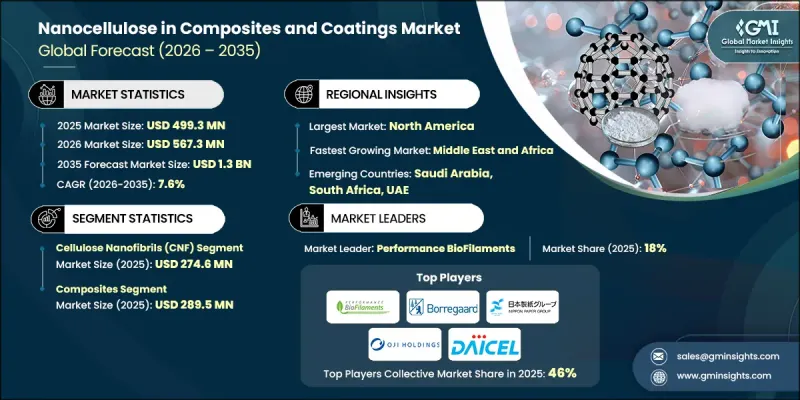
2025 年全球複合材料和塗料用奈米纖維素市場價值為 4.993 億美元,預計到 2035 年將達到 13 億美元,年複合成長率為 7.6%。
奈米纖維素是指至少一個維度尺寸為奈米級的纖維素材料,通常提取自植物纖維、細菌和藻類。該材料包括纖維素奈米晶體、纖維素奈米纖維和細菌纖維素,它們在尺寸、結構和結晶質系統中的功能性添加劑。即使在低添加量下,奈米纖維素也能改善材料的機械性能、耐熱性和阻隔性能。它能夠在增強聚合物基體的同時保持輕質特性,因此在包裝、建築和工業材料應用領域有著廣泛的需求。此外,對永續性關注也進一步加速了奈米纖維素的應用,各產業越來越重視可再生和可生物分解的材料解決方案。
| 市場覆蓋範圍 | |
|---|---|
| 開始年份 | 2025 |
| 預測年份 | 2026-2035 |
| 起始金額 | 4.993億美元 |
| 預測金額 | 13億美元 |
| 複合年成長率 | 7.6% |
奈米纖維素在塗料配方中具有顯著的性能優勢,包括增強成膜性、改善阻隔性能和提高流變控制能力。其對氧氣、水分和油的滲透性降低,使其在防護性和功能性塗料應用中日益重要。奈米纖維素與多種塗料系統的相容性使其能夠在不影響環境性能的前提下,提高表面均勻性和耐久性。這些效能優勢正推動其在多個終端應用領域的需求穩定成長。
預計到2025年,纖維素奈米纖維市場規模將達到2.746億美元。纖維素奈米纖維和微纖化纖維素因其長而柔韌的纖維網路,能夠顯著提高增強性能、韌性和黏度控制,因此在複合材料和塗料領域得到廣泛應用。這些材料能夠高效分散在聚合物和塗料系統中,從而實現均勻的結構形成和表面均勻性的提升。相對簡單的加工要求也進一步促進了它們在各種材料配方中的廣泛應用。
預計到2025年,複合材料市場規模將達到2.895億美元。奈米纖維素能夠提高複合材料系統的剛度、耐久性和負荷分佈,同時保持輕質特性。其天然來源使其能夠開發出更永續的複合材料,作為傳統合成增強材料的替代方案。奈米纖維素與多種基材的相容性使其在眾多產業的結構和半結構複合材料應用中都具有廣泛的應用前景。
預計到2025年,北美複合材料和塗料領域的奈米纖維素市場規模將達到2.833億美元。先進的工業基礎設施、永續材料的高普及率以及交通運輸、航太和包裝行業的穩定需求,都將推動市場成長。持續加大研發投入和材料創新也將進一步增強該地區的市場前景。政府鼓勵使用環保材料的獎勵正在加速其應用,而美國憑藉其大規模生產能力、先進的製造技術以及消費者對永續產品日益增強的意識,在北美奈米纖維素市場中處於領先地位。
目錄
第1章調查方法和範圍
第2章執行摘要
第3章業界考察
- 生態系分析
- 供應商情況
- 利潤率
- 每個階段的附加價值
- 影響價值鏈的因素
- 中斷
- 產業影響因素
- 成長促進因素
- 對永續材料的需求日益成長
- 生產技術進步
- 增強的機械性質和阻隔性能
- 產業潛在風險與挑戰
- 高昂的生產成本
- 分散性和相容性問題
- 市場機遇
- 高性能複合材料的開發
- 與智慧材料的整合
- 致力於循環經濟
- 成長促進因素
- 成長潛力分析
- 監管環境
- 北美洲
- 歐洲
- 亞太地區
- 拉丁美洲
- 中東和非洲
- 波特五力分析
- PESTEL 分析
- 科技與創新趨勢
- 當前技術趨勢
- 新興技術
- 價格趨勢
- 按地區
- 依產品類型
- 未來市場趨勢
- 科技與創新趨勢
- 當前技術趨勢
- 新興技術
- 專利狀態
- 貿易統計(HS編碼)
- 主要進口國
- 主要出口國
- 永續性和環境方面
- 永續努力
- 減少廢棄物策略
- 生產中的能源效率
- 環保舉措
- 考慮到碳足跡
第4章 競爭情勢
- 介紹
- 公司市佔率分析
- 按地區
- 北美洲
- 歐洲
- 亞太地區
- 拉丁美洲
- 中東和非洲
- 按地區
- 企業矩陣分析
- 主要市場公司的競爭分析
- 競爭定位矩陣
- 重大進展
- 併購
- 夥伴關係與合作
- 新產品發布
- 擴張計劃
第5章 依產品類型分類的市場估算與預測,2022-2035年
- 纖維素奈米晶體(CNC)
- 纖維素奈米纖維(CNF)
- 細菌奈米纖維素(BNC)
- 微纖化纖維素(MFC/CMF)
第6章 按應用領域分類的市場估算與預測,2022-2035年
- 複合材料
- 高分子複合材料
- 汽車複合材料
- 建材
- 用於包裝的複合材料
- 電子設備/先進材料
- 塗層
- 紙張和包裝用阻隔塗層
- 纖維塗層/表面處理
- 功能性和保護性塗層
- 農業薄膜和智慧塗層
第7章 2022-2035年各地區市場估算與預測
- 北美洲
- 美國
- 加拿大
- 墨西哥
- 歐洲
- 德國
- 英國
- 法國
- 西班牙
- 義大利
- 其他歐洲地區
- 亞太地區
- 中國
- 印度
- 日本
- 澳洲
- 韓國
- 亞太其他地區
- 拉丁美洲
- 巴西
- 墨西哥
- 阿根廷
- 其他拉丁美洲地區
- 中東和非洲
- 沙烏地阿拉伯
- 南非
- 阿拉伯聯合大公國
- 其他中東和非洲地區
第8章 公司簡介
- Anomera Inc.
- Blue Goose Biorefineries Inc.
- Borregaard AS
- CelluComp Ltd.
- Daicel Corporation
- GranBio Technologies
- Kao Corporation
- Kruger Inc.
- Melodea Ltd.
- Nippon Paper Industries Co., Ltd.
- Oji Holdings Corporation
- Performance BioFilaments
- Seiko PMC Corporation
The Global Nanocellulose in Composites and Coatings Market was valued at USD 499.3 million in 2025 and is estimated to grow at a CAGR of 7.6% to reach USD 1.3 billion by 2035.
Nanocellulose refers to cellulose materials that feature at least one dimension at the nanometer scale and are commonly sourced from plant fibers, bacteria, or algae. The material portfolio includes cellulose nanocrystals, cellulose nanofibrils, and bacterial cellulose, each defined by variations in size, structure, and crystallinity. Nanocellulose offers a unique combination of high mechanical strength, low density, large surface area, biodegradability, and adaptable surface chemistry. These characteristics position it as a valuable reinforcement agent in advanced composites and as a functional additive in coating systems. Even at low loadings, nanocellulose enhances mechanical, thermal, and barrier performance. Its ability to strengthen polymer matrices while preserving lightweight characteristics supports demand across packaging, construction, and industrial material applications. Sustainability considerations further accelerate adoption as industries increasingly favor renewable and biodegradable material solutions.
| Market Scope | |
|---|---|
| Start Year | 2025 |
| Forecast Year | 2026-2035 |
| Start Value | $499.3 Million |
| Forecast Value | $1.3 Billion |
| CAGR | 7.6% |
Nanocellulose also delivers strong performance benefits within coating formulations by supporting film formation, improving barrier efficiency, and enhancing rheological control. The material reduces permeability to oxygen, moisture, and oils, expanding its relevance in protective and functional coating applications. Its compatibility with various coating systems allows manufacturers to achieve improved surface uniformity and durability without compromising environmental performance. These functional advantages continue to support consistent demand growth across multiple end-use sectors.
The cellulose nanofibrils segment reached USD 274.6 million in 2025. Cellulose nanofibrils and microfibrillated cellulose remain widely adopted due to their long, flexible fiber networks that significantly improve reinforcement, toughness, and viscosity control in composites and coatings. These materials disperse efficiently within polymer and coating systems, enabling uniform structure formation and enhanced surface consistency. Their relatively straightforward processing requirements further support their broad adoption across diverse material formulations.
The composites segment generated USD 289.5 million in 2025. Nanocellulose strengthens composite systems by improving stiffness, durability, and load distribution while maintaining low material weight. Its natural origin enables the development of more sustainable composite alternatives to traditional synthetic reinforcements. Compatibility with multiple matrix types allows nanocellulose to support both structural and semi-structural composite applications across a wide range of industries.
North America Nanocellulose in Composites and Coatings Market captured USD 283.3 million in 2025. Growth is supported by advanced industrial infrastructure, high adoption of sustainable materials, and consistent demand from transportation, aerospace, and packaging sectors. Continued investment in research and material innovation further strengthens the regional outlook. Government incentives encouraging environmentally responsible materials accelerate adoption, while the US leads the region through scaled production capabilities, advanced manufacturing technologies, and growing consumer awareness regarding sustainable products.
Key companies active in the Global Nanocellulose in Composites and Coatings Market include Borregaard AS, Anomera Inc., Nippon Paper Industries Co., Ltd., Melodea Ltd., Kruger Inc., Kao Corporation, Performance BioFilaments, Daicel Corporation, CelluComp Ltd., Blue Goose Biorefineries Inc., Seiko PMC Corporation, Oji Holdings Corporation, and GranBio Technologies. Companies operating in the market focus on expanding production capacity and improving material consistency to strengthen their competitive position. Strategic investments in process optimization help reduce costs and enable large-scale commercialization. Many players prioritize partnerships with composite and coating manufacturers to accelerate application development and market penetration. Continuous research into surface modification and performance enhancement supports product differentiation.
Table of Contents
Chapter 1 Methodology & Scope
- 1.1 Market scope and definition
- 1.2 Research design
- 1.2.1 Research approach
- 1.2.2 Data collection methods
- 1.3 Data mining sources
- 1.3.1 Global
- 1.3.2 Regional/Country
- 1.4 Base estimates and calculations
- 1.4.1 Base year calculation
- 1.4.2 Key trends for market estimation
- 1.5 Primary research and validation
- 1.5.1 Primary sources
- 1.6 Forecast model
- 1.7 Research assumptions and limitations
Chapter 2 Executive Summary
- 2.1 Industry 360° synopsis
- 2.2 Key market trends
- 2.2.1 Product Type
- 2.2.2 Application
- 2.2.3 Regional
- 2.3 TAM Analysis, 2026-2035
- 2.4 CXO perspectives: Strategic imperatives
- 2.4.1 Executive decision points
- 2.4.2 Critical success factors
- 2.5 Future outlook and strategic recommendations
Chapter 3 Industry Insights
- 3.1 Industry ecosystem analysis
- 3.1.1 Supplier landscape
- 3.1.2 Profit margin
- 3.1.3 Value addition at each stage
- 3.1.4 Factor affecting the value chain
- 3.1.5 Disruptions
- 3.2 Industry impact forces
- 3.2.1 Growth drivers
- 3.2.1.1 Rising demand for sustainable materials
- 3.2.1.2 Technological advancements in production
- 3.2.1.3 Enhanced mechanical and barrier properties
- 3.2.2 Industry pitfalls and challenges
- 3.2.2.1 High production costs
- 3.2.2.2 Dispersion and compatibility issues
- 3.2.3 Market opportunities
- 3.2.3.1 Development of high-performance composites
- 3.2.3.2 Integration with smart materials
- 3.2.3.3 Circular economy initiatives
- 3.2.1 Growth drivers
- 3.3 Growth potential analysis
- 3.4 Regulatory landscape
- 3.4.1 North America
- 3.4.2 Europe
- 3.4.3 Asia Pacific
- 3.4.4 Latin America
- 3.4.5 Middle East & Africa
- 3.5 Porter's analysis
- 3.6 PESTEL analysis
- 3.7 Technology and innovation landscape
- 3.7.1 Current technological trends
- 3.7.2 Emerging technologies
- 3.8 Price trends
- 3.8.1 By region
- 3.8.2 By product type
- 3.9 Future market trends
- 3.10 Technology and innovation landscape
- 3.10.1 Current technological trends
- 3.10.2 Emerging technologies
- 3.11 Patent landscape
- 3.12 Trade statistics (HS code)
- 3.12.1 Major importing countries
- 3.12.2 Major exporting countries
- 3.13 Sustainability and environmental aspects
- 3.13.1 Sustainable practices
- 3.13.2 Waste reduction strategies
- 3.13.3 Energy efficiency in production
- 3.13.4 Eco-friendly initiatives
- 3.14 Carbon footprint consideration
Chapter 4 Competitive Landscape, 2025
- 4.1 Introduction
- 4.2 Company market share analysis
- 4.2.1 By region
- 4.2.1.1 North America
- 4.2.1.2 Europe
- 4.2.1.3 Asia Pacific
- 4.2.1.4 LATAM
- 4.2.1.5 MEA
- 4.2.1 By region
- 4.3 Company matrix analysis
- 4.4 Competitive analysis of major market players
- 4.5 Competitive positioning matrix
- 4.6 Key developments
- 4.6.1 Mergers & acquisitions
- 4.6.2 Partnerships & collaborations
- 4.6.3 New product launches
- 4.6.4 Expansion plans
Chapter 5 Market Estimates and Forecast, By Product Type, 2022-2035 (USD Million) (Kilo Tons)
- 5.1 Key trends
- 5.2 Cellulose nanocrystals (CNC)
- 5.3 Cellulose nanofibrils (CNF)
- 5.4 Bacterial nanocellulose (BNC)
- 5.5 Microfibrillated cellulose (MFC/CMF)
Chapter 6 Market Estimates and Forecast, By Application, 2022-2035 (USD Million) (Kilo Tons)
- 6.1 Key trends
- 6.2 Composites
- 6.2.1 Polymer matrix composites
- 6.2.2 Automotive composites
- 6.2.3 Construction & building materials
- 6.2.4 Packaging composites
- 6.2.5 Electronics & advanced materials
- 6.3 Coatings
- 6.3.1 Paper & packaging barrier coatings
- 6.3.2 Textile coatings & surface treatments
- 6.3.3 Functional & protective coatings
- 6.3.4 Agricultural films & smart coatings
Chapter 7 Market Estimates and Forecast, By Region, 2022-2035 (USD Million) (Kilo Tons)
- 7.1 Key trends
- 7.2 North America
- 7.2.1 U.S.
- 7.2.2 Canada
- 7.2.3 Mexico
- 7.3 Europe
- 7.3.1 Germany
- 7.3.2 UK
- 7.3.3 France
- 7.3.4 Spain
- 7.3.5 Italy
- 7.3.6 Rest of Europe
- 7.4 Asia Pacific
- 7.4.1 China
- 7.4.2 India
- 7.4.3 Japan
- 7.4.4 Australia
- 7.4.5 South Korea
- 7.4.6 Rest of Asia Pacific
- 7.5 Latin America
- 7.5.1 Brazil
- 7.5.2 Mexico
- 7.5.3 Argentina
- 7.5.4 Rest of Latin America
- 7.6 Middle East and Africa
- 7.6.1 Saudi Arabia
- 7.6.2 South Africa
- 7.6.3 UAE
- 7.6.4 Rest of Middle East and Africa
Chapter 8 Company Profiles
- 8.1 Anomera Inc.
- 8.2 Blue Goose Biorefineries Inc.
- 8.3 Borregaard AS
- 8.4 CelluComp Ltd.
- 8.5 Daicel Corporation
- 8.6 GranBio Technologies
- 8.7 Kao Corporation
- 8.8 Kruger Inc.
- 8.9 Melodea Ltd.
- 8.10 Nippon Paper Industries Co., Ltd.
- 8.11 Oji Holdings Corporation
- 8.12 Performance BioFilaments
- 8.13 Seiko PMC Corporation

 纖維素奈米晶體市場:按類型、原料、形態、製造流程、應用、終端用戶產業分類,全球預測(2026-2032年)
 日本奈米纖維素市場報告(按產品類型(奈米原纖化纖維素、奈米晶纖維素、細菌纖維素、微纖化纖維素及其他)、應用和地區分類,2026-2034年)
 奈米纖維素市場機會、成長要素、產業趨勢分析及2026年至2035年預測
 全球奈米纖維素市場(至 2035 年):依奈米纖維素、應用、分銷管道、地區、產業趨勢和預測
 纖維素奈米晶體增強生物聚合物市場規模、佔有率和趨勢分析報告:按產品、應用、地區和細分市場預測(2025-2033 年)用於包裝應用的纖維素奈米晶體市場機會、成長促進因素、產業趨勢分析及預測(2025-2034年)
 芴:全球市場佔有率和排名、總收入和需求預測(2025-2031年)微纖化纖維素(MFC):全球市場佔有率和排名、總收入和需求預測(2025-2031年)
 奈米纖維素市場-全球產業規模、佔有率、趨勢、機會與預測,按類型(CNF、細菌纖維素、CNC)、按應用、按地區和競爭細分,2020-2030 年預測
 奈米纖維素:全球市場佔有率分析、行業趨勢、統計數據和成長預測(2025-2030 年)