


 |
市場調查報告書
商品編碼
1936487
人工智慧在汽車網路安全領域的市場機會、成長促進因素、產業趨勢分析及預測(2026-2035年)AI in Automotive Cybersecurity Market Opportunity, Growth Drivers, Industry Trend Analysis, and Forecast 2026 - 2035 |
||||||

全球汽車網路安全人工智慧市場預計到 2025 年將達到 15 億美元,到 2035 年將達到 54 億美元,年複合成長率為 12.8%。
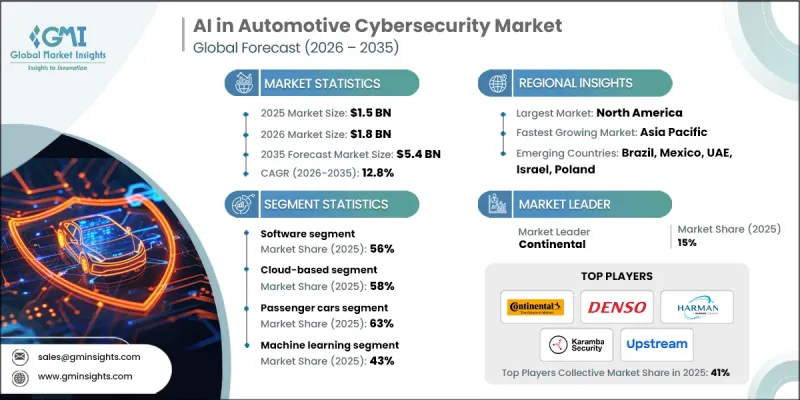
聯網汽車、自動駕駛技術和以軟體為中心的汽車平臺的快速普及正在推動市場成長。現代汽車高度依賴複雜的軟體架構,其電控系統包含超過1億行程式碼,顯著增加了系統面臨的網路風險。隨著車輛數位化程度的提高,網路安全已成為設計和營運的關鍵優先事項。人工智慧正被擴大應用於即時監控、分析和回應網路威脅,從而實現主動防禦機製而非被動防禦。向軟體定義車輛的轉型代表著汽車設計的根本性變革,因為軟體控制著核心功能、遠端特性管理和持續性能改進。傳統手動軟體更新帶來的成本負擔估計每年高達4.5億至5億美元,這加速了原始設備製造商(OEM)採用人工智慧驅動的網路安全平台,以支援遠端更新、威脅緩解和系統完整性,從而在日益互聯的汽車生態系統中發揮作用。
| 市場覆蓋範圍 | |
|---|---|
| 開始年份 | 2025 |
| 預測年份 | 2026-2035 |
| 起始金額 | 15億美元 |
| 預測金額 | 54億美元 |
| 複合年成長率 | 12.8% |
軟體領域的主導地位反映了整個產業向代碼驅動型車輛架構的轉變,在這種架構中,關鍵功能由數位平台而非機械部件控制。基於軟體的網路安全解決方案旨在保護嵌入式韌體、防禦車載應用程式,並創建可信任執行環境以檢驗授權程式碼的行為。這些解決方案還管理加密通訊協定和身份驗證流程,以確保安全的資料交換和更新交付。人工智慧透過持續分析車載網路的行為並識別異常和潛在入侵來增強這些平台。車輛軟體內容的快速成長(跨多個系統的程式碼量超過1億行)持續推動著對能夠隨著系統複雜性的增加而擴展的先進、以軟體為中心的網路安全解決方案的需求。
到2025年,基於硬體的解決方案將佔據27%的市場佔有率,鞏固其作為車輛安全基礎層的地位。這些解決方案將實體安全機制直接整合到車輛電子設備中,保護關鍵系統免受篡改和未授權存取。硬體元件旨在安全地儲存加密憑證、執行加密過程,並建立可信任的啟動環境,從而防止執行被篡改的軟體。其他硬體安全元件支援獨特的設備身份驗證,並分擔複雜的加密處理,從而維持車輛的整體性能。這些技術共同構成了一個安全的物理基礎,與人工智慧驅動的軟體防禦相輔相成。
預計到2025年,隨著汽車網路安全戰略越來越依賴集中式平台來管理龐大的車隊,基於雲端的部署方案將佔據顯著佔有率。雲端解決方案可提供即時威脅情報、系統級分析,並可在分散式車輛網路中快速部署安全性更新。這種方法透過實現集中式通訊管理和可擴展的數據處理,支援聯網汽車服務和遠端軟體交付。聚合來自數百萬輛汽車的網路安全數據,可實現先進的機器學習分析,從而識別新興威脅並協調快速反應措施,而無需人工干預。
預計到2025年,美國汽車網路安全市場將佔據顯著佔有率,這主要得益於配備先進數位化功能的高價值車輛推動了單車網路安全投資的成長。完善的交通基礎設施為先進的車輛互聯提供了支持,而成熟的網路安全生態系統則促進了專用車輛保護解決方案的開發。對互聯出行基礎設施投資的不斷成長,也推動了對強大網路安全框架的需求,以保護車輛通訊、數位道路系統和智慧交通管理平台。
目錄
第1章調查方法
第2章執行摘要
第3章業界考察
- 生態系分析
- 供應商情況
- 利潤率分析
- 成本結構
- 每個階段的附加價值
- 影響價值鏈的因素
- 中斷
- 產業影響因素
- 成長促進因素
- 聯網汽車、電動車和自動駕駛汽車日益普及
- 必須遵守聯合國法規 R155/R156 和 ISO/SAE 21434
- 針對汽車的網路攻擊正變得越來越複雜。
- 軟體定義汽車和空中升級的成長
- V2X 和車載數位服務的擴展
- 產業潛在風險與挑戰
- 高昂的實施和整合成本
- 基於人工智慧的網路安全系統的複雜性
- 汽車網路安全領域熟練人才短缺
- 傳統汽車平臺相容性挑戰
- 市場機遇
- 基於人工智慧的預測性威脅偵測解決方案
- 邊緣人工智慧實現即時、低延遲安全
- 用於車輛訪問和支付的生物識別
- 安全即服務訂閱模式
- 傳統車輛的售後網路安全
- 成長潛力分析
- 監管環境
- 北美洲
- 美國聯邦機動車輛安全標準/國家公路交通安全管理局指南
- 加拿大 - 機動車輛安全法規 (MVSR)
- 歐洲
- 德國/歐盟通用安全法規(GSR)
- 英國- 道路車輛(許可)條例
- 法國-歐盟自動駕駛汽車(AV)和道路安全框架
- 義大利 - 國家道路安全計畫 (PNSS)
- 亞太地區
- 中國-GB/T標準/GB標準
- 印度-機動車輛(修正)法案與AIS標準
- 日本-道路交通法及國土交通省自動駕駛指南
- 澳洲 - 澳洲外觀設計規則 (ADR)
- LATAM
- 墨西哥-NOM汽車安全標準
- 阿根廷 - 交通法第 24.449 號
- 中東和非洲
- 南非共和國 - 國家道路交通法(1996 年)
- 沙烏地阿拉伯—交通法與2030願景交通舉措
- 北美洲
- 波特五力分析
- PESTEL 分析
- 科技與創新趨勢
- 當前技術趨勢
- 人工智慧和機器學習在汽車安全領域的演進
- 用於威脅偵測的深度學習演算法
- 自然語言處理在安全情報的應用
- 新興技術
- 電腦視覺在安全監控上的應用
- 情境感知計算與自動回應
- 量子抗性密碼技術的發展
- 當前技術趨勢
- 專利分析
- 人工智慧安全專利的發展趨勢
- 主要專利擁有者人和技術領導者
- 新興智慧財產權趨勢與申請模式
- 專利授權與合作模式
- 定價分析
- 解決方案定價模式(訂閱、永久授權、收費車輛計費)
- 硬體成本趨勢
- 服務定價趨勢
- 總擁有成本分析
- 用例和成功案例
- 車隊管理安全用例
- 自動駕駛車輛保護場景
- 車載支付和商業安全
- OTA 更新安全實施
- V2X 通訊保護用例
- 互聯資訊娛樂系統的安全應用
- 永續性和環境方面
- 永續實踐
- 減少廢棄物策略
- 生產中的能源效率
- 環保舉措
- 碳足跡考量
- 投資與資金籌措分析
- 創投創業投資
- 併購活動與市場整合
- 策略聯盟與合作
- 政府資助和津貼
- 未來前景與機遇
- 監管演變及其影響
- 戰略機遇
- 未來威脅情勢
- 投資機會
第4章 競爭情勢
- 介紹
- 公司市佔率分析
- 北美洲
- 歐洲
- 亞太地區
- 拉丁美洲
- 中東和非洲
- 主要市場公司的競爭分析
- 競爭定位矩陣
- 戰略展望矩陣
- 重大進展
- 併購
- 夥伴關係與合作
- 新產品發布
- 企業擴張計畫和資金籌措
第5章 按組件分類的市場估算與預測,2022-2035年
- 硬體
- AI加速處理器
- 硬體安全模組(HSM)
- 安全閘道器及網路設備
- 儲存和記憶體組件
- 軟體
- 人工智慧驅動的安全平台
- 獨立安全應用程式
- 整合軟體解決方案
- 服務
- 專業服務
- 諮詢和顧問服務
- 實施和整合服務
- 支援和維護服務
- 資安管理服務
- 威脅監控與偵測
- 事件回應服務
- 安全營運中心 (SOC) 服務
- 專業服務
第6章 依車輛類型分類的市場估計與預測,2022-2035年
- 搭乘用車
- 掀背車
- SUV
- 轎車
- 商用車輛
- 輕型商用車(LCV)
- 中型商用車(MCV)
- 重型商用車(HCV)
- 電動車(EV)
第7章 按技術分類的市場估計與預測,2022-2035年
- 機器學習
- 自然語言處理(NLP)
- 電腦視覺
- 情境感知計算
- 其他
第8章 依部署方式分類的市場估算與預測,2022-2035年
- 本地部署
- 雲
第9章 證券市場估計與預測(2022-2035年)
- 端點安全
- 應用程式安全
- 無線網路安全
- 雲端安全
- 其他
第10章 依應用領域分類的市場估計與預測,2022-2035年
- ADAS(進階駕駛輔助系統)與安全系統
- 資訊娛樂系統
- 車載資訊系統
- 動力傳動系統系統
- 車身控制與舒適系統
- 其他
第11章 2022-2035年各地區市場估計與預測
- 北美洲
- 美國
- 加拿大
- 歐洲
- 德國
- 英國
- 法國
- 義大利
- 西班牙
- 俄羅斯
- 荷蘭
- 瑞典
- 丹麥
- 波蘭
- 亞太地區
- 中國
- 印度
- 日本
- 澳洲
- 韓國
- 新加坡
- 泰國
- 印尼
- 越南
- 拉丁美洲
- 巴西
- 墨西哥
- 阿根廷
- 哥倫比亞
- 中東和非洲
- 南非
- 沙烏地阿拉伯
- 阿拉伯聯合大公國
- 以色列
第12章:公司簡介
- 世界玩家
- Aptiv
- BlackBerry
- Continental
- Denso
- Harman International Industries
- Karamba Security
- NVIDIA
- Robert Bosch
- Siemens
- Upstream Security
- 區域玩家
- Cybellum Technologies
- ESCRYPT
- GuardKnox Cyber Technologies
- Infineon Technologies
- Intertrust Technologies
- NCC
- NXP Semiconductors
- Renesas Electronics
- STMicroelectronics
- Trillium Security
- Vector Informatik
- 新興科技創新者
- Aurora Labs
- C2A Security
- Cymotive Technologies
- VicOneg bmhjb
The Global AI in Automotive Cybersecurity Market was valued at USD 1.5 billion in 2025 and is estimated to grow at a CAGR of 12.8% to reach USD 5.4 billion by 2035.
The rapid proliferation of connected vehicles, autonomous driving technologies, and software-centric vehicle platforms drives market growth. Modern vehicles now rely heavily on complex software architectures, with electronic control units containing more than 100 million lines of code, significantly increasing system exposure to cyber risks. As vehicles become more digitally integrated, cybersecurity has evolved into a critical design and operational priority. Artificial intelligence is increasingly deployed to monitor, analyze, and respond to cyber threats in real time, enabling proactive defense mechanisms rather than reactive protection. The transition toward software-defined vehicles represents a fundamental transformation of automotive design, where software governs core functionality, remote feature management, and continuous performance enhancement. The rising cost burden associated with traditional manual software updates, estimated at USD 450 million to USD 500 million annually for original equipment manufacturers, is accelerating the adoption of AI-enabled cybersecurity platforms that support remote updates, threat mitigation, and system integrity in an increasingly connected automotive ecosystem.
| Market Scope | |
|---|---|
| Start Year | 2025 |
| Forecast Year | 2026-2035 |
| Start Value | $1.5 Billion |
| Forecast Value | $5.4 Billion |
| CAGR | 12.8% |
The dominance of the software segment reflects the industry-wide movement toward code-driven vehicle architectures where digital platforms control critical functions rather than mechanical components. Software-based cybersecurity solutions are designed to secure embedded firmware, protect in-vehicle applications, and establish trusted execution environments that verify authorized code operation. These solutions also manage encryption protocols and authentication processes that ensure secure data exchange and update delivery. Artificial intelligence enhances these platforms by continuously analyzing in-vehicle network behavior to identify anomalies and potential intrusions. The rapid expansion of software content within vehicles, now exceeding 100 million lines of code across multiple systems, continues to drive demand for advanced software-focused cybersecurity solutions that can scale with increasing system complexity.
The hardware-based solutions segment held 27% share in 2025, reinforcing its role as a foundational layer of vehicle security. These solutions integrate physical security mechanisms directly into vehicle electronics to protect critical systems from tampering and unauthorized access. Hardware components are engineered to securely store cryptographic credentials, execute encryption processes, and establish trusted boot environments that prevent compromised software from running. Additional hardware security elements support unique device authentication and offload complex cryptographic operations to preserve overall vehicle performance. Together, these technologies form a secure physical backbone that complements AI-driven software defenses.
The cloud-based deployment segment reached a significant share in 2025 as automotive cybersecurity strategies increasingly rely on centralized platforms to manage large-scale vehicle fleets. Cloud-enabled solutions provide real-time threat intelligence, system-wide analytics, and rapid deployment of security updates across distributed vehicle networks. This approach supports connected vehicle services and remote software delivery by enabling centralized communication management and scalable data processing. Aggregating cybersecurity data from millions of vehicles allows for advanced machine learning analysis that identifies emerging threats and coordinates rapid response actions without requiring physical intervention.
United States AI in Automotive Cybersecurity Market held a notable share in 2025, driven by high-value vehicles equipped with advanced digital features, contributing to elevated per-unit cybersecurity investment. Extensive transportation infrastructure supports advanced vehicle connectivity, while a well-established cybersecurity ecosystem enables the development of specialized automotive protection solutions. Investments in connected mobility infrastructure are increasing the need for robust cybersecurity frameworks to safeguard vehicle communications, digital road systems, and intelligent traffic management platforms.
Key companies operating in the AI in Automotive Cybersecurity Market include NVIDIA, Robert Bosch, Continental, BlackBerry, Harman International, Denso, Upstream Security, Trillium Secure, Karamba Security, and GuardKnox Cyber Technologies. Companies in the AI in Automotive Cybersecurity Market are strengthening their competitive position through continuous innovation, strategic collaborations, and platform expansion. Leading players are investing in AI-driven threat detection, behavioral analytics, and automated response systems to stay ahead of evolving cyber risks. Many firms are forming partnerships with automakers, software vendors, and cloud service providers to integrate security solutions directly into vehicle architectures. Portfolio diversification across software, hardware, and cloud-based offerings is enabling vendors to address varied customer requirements. In parallel, companies are expanding global delivery capabilities and emphasizing regulatory compliance to support international deployments.
Table of Contents
Chapter 1 Methodology
- 1.1 Research approach
- 1.2 Quality commitments
- 1.3 Research trail and confidence scoring
- 1.3.1 Research trail components
- 1.3.2 Scoring components
- 1.4 Data collection
- 1.4.1 Partial list of primary sources
- 1.5 Data mining sources
- 1.5.1 Paid sources
- 1.6 Best estimates and calculations
- 1.6.1 Base year calculation for any one approach
- 1.7 Forecast model
- 1.8 Research transparency addendum
Chapter 2 Executive Summary
- 2.1 Industry 3600 synopsis, 2022 - 2035
- 2.2 Key market trends
- 2.2.1 Regional
- 2.2.2 Component
- 2.2.3 Vehicles
- 2.2.4 Technology
- 2.2.5 Deployment Mode
- 2.2.6 Security
- 2.2.7 Application
- 2.3 TAM Analysis, 2026-2035
- 2.4 CXO perspectives: Strategic imperatives
- 2.4.1 Executive decision points
- 2.4.2 Critical success factors
- 2.5 Future outlook and strategic recommendations
Chapter 3 Industry Insights
- 3.1 Industry ecosystem analysis
- 3.1.1 Supplier landscape
- 3.1.2 Profit margin analysis
- 3.1.3 Cost structure
- 3.1.4 Value addition at each stage
- 3.1.5 Factor affecting the value chain
- 3.1.6 Disruptions
- 3.2 Industry impact forces
- 3.2.1.1 Growth drivers
- 3.2.1.2 Rising connected, electric, and autonomous vehicle adoption
- 3.2.1.3 Mandatory compliance with UN R155/R156 and ISO/SAE 21434
- 3.2.1.4 Increasing cyberattack complexity targeting vehicles
- 3.2.1.5 Growth of software-defined vehicles and OTA updates
- 3.2.1.6 Expansion of V2X and in-vehicle digital services
- 3.2.2 Industry pitfalls and challenges
- 3.2.2.1 High implementation and integration costs
- 3.2.2.2 Complexity of AI-based cybersecurity systems
- 3.2.2.3 Shortage of skilled automotive cybersecurity talent
- 3.2.2.4 Legacy vehicle platform compatibility issues
- 3.2.3 Market opportunities
- 3.2.3.1 AI-driven predictive threat detection solutions
- 3.2.3.2 Edge AI for real-time, low-latency security
- 3.2.3.3 Biometric authentication for vehicle access and payments
- 3.2.3.4 Security-as-a-service and subscription-based models
- 3.2.3.5 Aftermarket cybersecurity for legacy vehicles
- 3.3 Growth potential analysis
- 3.4 Regulatory landscape
- 3.4.1 North America
- 3.4.1.1 US- FMVSS and NHTSA guidelines
- 3.4.1.2 Canada - Motor vehicle safety regulations (MVSR)
- 3.4.2 Europe
- 3.4.2.1 Germany- EU General Safety Regulation (GSR)
- 3.4.2.2 UK- Road Vehicles (Approval) Regulations
- 3.4.2.3 France- EU AV and road safety frameworks
- 3.4.2.4 Italy- National Road Safety Plan (PNSS)
- 3.4.3 Asia Pacific
- 3.4.3.1 China- GB/T and GB standards
- 3.4.3.2 India- Motor Vehicles (Amendment) Act and AIS standards
- 3.4.3.3 Japan- Road Traffic Act and MLIT autonomous driving guidelines
- 3.4.3.4 Australia- Australian Design Rules (ADR)
- 3.4.4 LATAM
- 3.4.4.1 Mexico- NOM vehicle safety standards
- 3.4.4.2 Argentina- National traffic law 24.449
- 3.4.5 MEA
- 3.4.5.1 South Africa- National road traffic act (1996)
- 3.4.5.2 Saudi Arabia- Traffic law & vision 2030 transport initiatives
- 3.4.1 North America
- 3.5 Porter's analysis
- 3.6 PESTEL analysis
- 3.7 Technology and innovation landscape
- 3.7.1 Current technological trends
- 3.7.1.1 AI & machine learning evolution in automotive security
- 3.7.1.2 Deep learning algorithms for threat detection
- 3.7.1.3 Natural language processing for security intelligence
- 3.7.2 Emerging technologies
- 3.7.2.1 Computer vision applications in security surveillance
- 3.7.2.2 Context-aware computing & automated response
- 3.7.2.3 Quantum-resilient encryption development
- 3.7.1 Current technological trends
- 3.8 Patent analysis
- 3.8.1 AI-powered security patent landscape
- 3.8.2 Key patent holders & technology leaders
- 3.8.3 Emerging IP trends & filing patterns
- 3.8.4 Patent licensing & collaboration models
- 3.9 Pricing analysis
- 3.9.1 Solution pricing models (subscription, perpetual license, per-vehicle)
- 3.9.2 Hardware cost trends
- 3.9.3 Service pricing dynamics
- 3.9.4 Total cost of ownership analysis
- 3.10 Use cases & success stories
- 3.10.1 Fleet management security use cases
- 3.10.2 Autonomous vehicle protection scenarios
- 3.10.3 In-vehicle payment & commerce security
- 3.10.4 OTA update security implementation
- 3.10.5 V2X communication protection use cases
- 3.10.6 Connected infotainment security applications
- 3.11 Sustainability and environmental aspects
- 3.11.1 Sustainable practices
- 3.11.2 Waste reduction strategies
- 3.11.3 Energy efficiency in production
- 3.11.4 Eco-friendly Initiatives
- 3.11.5 Carbon footprint considerations
- 3.12 Investment & funding analysis
- 3.12.1 Venture capital investment trends
- 3.12.2 M&A activity & market consolidation
- 3.12.3 Strategic partnerships & collaborations
- 3.12.4 Government funding & grants
- 3.13 Future outlook and opportunities
- 3.13.1 Regulatory evolution & impact
- 3.13.2 Strategic opportunities
- 3.13.3 Future threat landscape
- 3.13.4 Investment opportunities
Chapter 4 Competitive Landscape, 2025
- 4.1 Introduction
- 4.2 Company market share analysis
- 4.2.1 North America
- 4.2.2 Europe
- 4.2.3 Asia Pacific
- 4.2.4 LATAM
- 4.2.5 MEA
- 4.3 Competitive analysis of major market players
- 4.4 Competitive positioning matrix
- 4.5 Strategic outlook matrix
- 4.6 Key developments
- 4.6.1 Mergers & acquisitions
- 4.6.2 Partnerships & collaborations
- 4.6.3 New product launches
- 4.6.4 Expansion plans and funding
Chapter 5 Market Estimates & Forecast, By Component, 2022 - 2035 ($Bn)
- 5.1 Key trends
- 5.2 Hardware
- 5.2.1 AI accelerators & processors
- 5.2.2 Hardware security modules (HSM)
- 5.2.3 Secure gateways & network devices
- 5.2.4 Storage & memory components
- 5.3 Software
- 5.3.1 AI-powered security platforms
- 5.3.2 Standalone security applications
- 5.3.3 Integrated software solutions
- 5.4 Services
- 5.4.1 Professional services
- 5.4.1.1 Consulting & advisory services
- 5.4.1.2 Deployment & integration services
- 5.4.1.3 Support & maintenance Services
- 5.4.2 Managed security services
- 5.4.2.1 Threat monitoring & detection
- 5.4.2.2 Incident response services
- 5.4.2.3 Security operations center (SOC) services
- 5.4.1 Professional services
Chapter 6 Market Estimates & Forecast, By Vehicle, 2022 - 2035 ($Bn)
- 6.1 Key trends
- 6.2 Passenger cars
- 6.2.1 Hatchback
- 6.2.2 SUV
- 6.2.3 Sedan
- 6.3 Commercial vehicles
- 6.3.1 Light commercial vehicles (LCV)
- 6.3.2 Medium commercial vehicles (MCV)
- 6.3.3 Heavy commercial vehicles (HCV)
- 6.4 Electric vehicles (EVs)
Chapter 7 Market Estimates & Forecast, By Technology, 2022 - 2035 ($Bn)
- 7.1 Key trends
- 7.2 Machine learning
- 7.3 Natural language processing (NLP)
- 7.4 Computer vision
- 7.5 Context-aware computing
- 7.6 Others
Chapter 8 Market Estimates & Forecast, By Deployment Mode, 2022 - 2035 ($Bn)
- 8.1 Key trends
- 8.2 On premises
- 8.3 Cloud
Chapter 9 Market Estimates & Forecast, By Security, 2022 - 2035 ($Bn)
- 9.1 Key trends
- 9.2 Endpoint security
- 9.3 Application security
- 9.4 Wireless network security
- 9.5 Cloud security
- 9.6 Others
Chapter 10 Market Estimates & Forecast, By Application, 2022 - 2035 ($Bn)
- 10.1 Key trends
- 10.2 Advanced driver assistance system (ADAS) & safety systems
- 10.3 Infotainment system
- 10.4 Telematics system
- 10.5 Powertrain system
- 10.6 Body control & comfort system
- 10.7 Others
Chapter 11 Market Estimates & Forecast, By Region, 2022 - 2035 ($Bn)
- 11.1 Key trends
- 11.2 North America
- 11.2.1 US
- 11.2.2 Canada
- 11.3 Europe
- 11.3.1 Germany
- 11.3.2 UK
- 11.3.3 France
- 11.3.4 Italy
- 11.3.5 Spain
- 11.3.6 Russia
- 11.3.7 Netherlands
- 11.3.8 Sweden
- 11.3.9 Denmark
- 11.3.10 Poland
- 11.4 Asia Pacific
- 11.4.1 China
- 11.4.2 India
- 11.4.3 Japan
- 11.4.4 Australia
- 11.4.5 South Korea
- 11.4.6 Singapore
- 11.4.7 Thailand
- 11.4.8 Indonesia
- 11.4.9 Vietnam
- 11.5 Latin America
- 11.5.1 Brazil
- 11.5.2 Mexico
- 11.5.3 Argentina
- 11.5.4 Colombia
- 11.6 MEA
- 11.6.1 South Africa
- 11.6.2 Saudi Arabia
- 11.6.3 UAE
- 11.6.4 Israel
Chapter 12 Company Profiles
- 12.1 Global Players
- 12.1.1 Aptiv
- 12.1.2 BlackBerry
- 12.1.3 Continental
- 12.1.4 Denso
- 12.1.5 Harman International Industries
- 12.1.6 Karamba Security
- 12.1.7 NVIDIA
- 12.1.8 Robert Bosch
- 12.1.9 Siemens
- 12.1.10 Upstream Security
- 12.2 Regional Players
- 12.2.1 Cybellum Technologies
- 12.2.2 ESCRYPT
- 12.2.3 GuardKnox Cyber Technologies
- 12.2.4 Infineon Technologies
- 12.2.5 Intertrust Technologies
- 12.2.6 NCC
- 12.2.7 NXP Semiconductors
- 12.2.8 Renesas Electronics
- 12.2.9 STMicroelectronics
- 12.2.10 Trillium Security
- 12.2.11 Vector Informatik
- 12.3 Emerging Technology Innovators
- 12.3.1 Aurora Labs
- 12.3.2 C2A Security
- 12.3.3 Cymotive Technologies
- 12.3.4 VicOneg bmhjb

 互聯社區安全生態系統市場預測至2034年:按組件、部署模式、最終用戶和地區分類的全球分析
 汽車網路安全市場規模、佔有率和趨勢分析報告:按安全類型、車輛類型、服務、應用、地區和細分市場預測(2026-2033 年)
 汽車網路安全市場:按車輛類型、安全類型、部署模式、組件類型和最終用戶分類-2026-2032年全球市場預測
 汽車網路安全市場報告:按安全類型、形式、車輛類型、應用程式和地區分類(2026-2034 年)
 2026年全球汽車網路安全市場報告
 汽車網路安全市場:按應用程式、安全類型和地區分類互聯行動安全解決方案市場預測至2034年:按產品類型、連接類型、技術、應用、最終用戶和地區分類的全球分析2026年全球外部雲端汽車保全服務市場報告
 汽車網路安全市場規模、佔有率、成長率和全球產業分析:按類型、應用和地區分類的洞察,2026-2034 年預測
 汽車軟體開發與安全解決方案