


 |
市場調查報告書
商品編碼
1892844
冷凍烘焙食品市場機會、成長促進因素、產業趨勢分析及預測(2026-2035年)Frozen Bakery Market Opportunity, Growth Drivers, Industry Trend Analysis, and Forecast 2026 - 2035 |
||||||

2025 年全球冷凍烘焙食品市場價值為 115 億美元,預計到 2035 年將以 6.1% 的複合年成長率成長至 207 億美元。
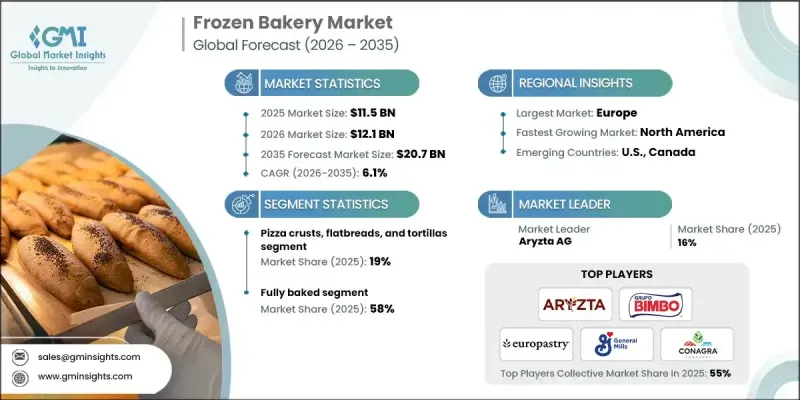
市場擴張的驅動力在於更長的保存期限,這使得冷凍烘焙產品能夠進行更長時間的配送,與新鮮烘焙產品相比,可以減少浪費,同時還能為餐飲服務營運商節省勞動力成本,滿足他們對品質穩定的需求,而無需增加熟練的烘焙人員。隨著冷鏈基礎設施和末端配送網路的完善,冷凍烘焙產品更容易分銷、儲存和上架,尤其是在採用現代零售模式的地區。新的冷凍技術能夠保持麵團的結構和解凍後的品質,縮小冷凍產品和新鮮產品之間的差距。由於冷凍烘焙產品在運輸過程中穩定性好,且交貨時品質穩定,因此電商平台也從中受益。永續的冷鏈有助於減少食物損失(據估計,因冷藏不足造成的食物損失高達12%),並降低排放,尤其是在各國根據全球協議逐步淘汰高全球暖化潛值(GWP)冷媒的情況下。製造商擴大使用全穀物、天然色素和更少的添加劑,同時投資於節能冷氣設備和再生能源。歐洲的生產動態對市場產生了重大影響,歐盟食品和飲料加工業創造了 10,930 億歐元的營業額,其中烘焙產品佔就業佔有率最大,約 34%,既滿足國內消費,也滿足出口規模的生產。
| 市場範圍 | |
|---|---|
| 起始年份 | 2025 |
| 預測年份 | 2026-2035 |
| 起始值 | 115億美元 |
| 預測值 | 207億美元 |
| 複合年成長率 | 6.1% |
預計到2024年,全烘焙產品市佔率將達到58%,其「加熱即食」的便利性使其在零售冷凍櫃、快餐店和機構場所廣受歡迎。這些產品包括麵包、捲餅和糕點,越來越受到追求省時選擇的消費者的青睞。
到2025年,披薩餅皮、薄餅和玉米餅的市佔率將達到19%。其成長得益於消費者的廣泛喜愛、在零售和餐飲通路的廣泛適用性,以及可作為多種菜餚的基底。隨著創新口味、份量和清潔標籤成分的不斷湧現,滿足了消費者不斷變化的需求,該細分市場持續擴張。其他細分市場,例如丹麥酥皮點心、羊角麵包和特色手工烘焙食品,也因高階化趨勢、健康成分的普及以及在電子商務和餐飲管道的日益普及而獲得發展動力。
2025年美國冷凍烘焙食品市場規模為25億美元,預計2035年將達207億美元。北美地區在2025年約佔全球市場的27%。該地區的成長得益於消費者對便捷即食產品和非店內飲食需求的不斷成長。美國市場擁有完善的生產基礎,超過160家烘焙企業銷售額顯著,充分展現了該地區的生產能力。加拿大市場也隨著現代零售和跨境品牌的興起而不斷擴張,但卡車司機短缺和冷鏈設備損耗等物流挑戰仍然存在。
目錄
第1章:方法論與範圍
第2章:執行概要
第3章:行業洞察
- 產業生態系分析
- 供應商格局
- 利潤率
- 每個階段的價值增加
- 影響價值鏈的因素
- 中斷
- 產業影響因素
- 成長促進因素
- 產業陷阱與挑戰
- 市場機遇
- 成長潛力分析
- 監管環境
- 北美洲
- 歐洲
- 亞太地區
- 拉丁美洲
- 中東和非洲
- 波特的分析
- PESTEL 分析
- 價格趨勢
- 按地區
- 未來市場趨勢
- 技術與創新格局
- 當前技術趨勢
- 新興技術
- 專利格局
- 貿易統計(HS編碼)(註:僅提供重點國家的貿易統計資料)
- 主要進口國
- 主要出口國
- 永續性和環境方面
- 永續實踐
- 減少廢棄物策略
- 生產中的能源效率
- 環保舉措
- 碳足跡考量
第4章:競爭格局
- 介紹
- 公司市佔率分析
- 按地區
- 北美洲
- 歐洲
- 亞太地區
- 拉丁美洲
- 中東和非洲
- 按地區
- 公司矩陣分析
- 主要市場參與者的競爭分析
- 競爭定位矩陣
- 關鍵進展
- 併購
- 合作夥伴關係與合作
- 新產品發布
- 擴張計劃
第5章:市場規模及預測:依產品類型分類,2022-2035年
- 麵包和捲餅
- 白麵包和餐包
- 全麥
- 雜糧籽麵包
- 其他
- Viennoiserie 和甜層壓糕點
- 羊角麵包
- 丹麥酥皮點心
- 甜麵團卷
- 其他
- 蛋糕、鬆餅和甜點
- 蛋糕
- 鬆餅
- 布朗尼和條
- 其他
- 派、塔和餡餅
- 甜甜圈和油炸甜點
- 酵母甜甜圈
- 蛋糕甜甜圈
- 夾心甜甜圈
- 其他
- 華夫餅、煎餅和煎鍋產品
- 美味烘焙食品和開胃菜
- 披薩餅皮、薄餅和玉米餅
- 餅乾,曲奇
- 其他
第6章:市場規模及預測:依產品形式分類,2022-2035年
- 準備證明
- 即烤型
- 完全烤熟
第7章:市場規模及預測:依最終用途分類,2022-2035年
- 零售/消費者
- 超市和大型超市
- 便利商店
- 特色食品店
- 線上通路/電子商務
- 餐飲服務
- 飯店、餐廳和餐飲服務 (HORECA)
- 速食店(QSR)
- 自助餐廳和機構餐廳
- 手工麵包店和店內麵包店
- 烘焙連鎖店
- 機構/學校營養計劃
- 其他
第8章:市場規模及預測:依地區分類,2022-2035年
- 北美洲
- 美國
- 加拿大
- 歐洲
- 英國
- 德國
- 法國
- 義大利
- 西班牙
- 歐洲其他地區
- 亞太地區
- 中國
- 印度
- 日本
- 韓國
- 澳洲
- 亞太其他地區
- 拉丁美洲
- 巴西
- 墨西哥
- 阿根廷
- 拉丁美洲其他地區
- 中東和非洲
- 南非
- 沙烏地阿拉伯
- 阿拉伯聯合大公國
- 中東和非洲其他地區
第9章:公司簡介
- Grupo Bimbo
- Europastry
- Pan Pa Ya
- General Mills
- Rich Products Corporation
- Comapan
- Don Maiz
- Vandemoortele
- Patagonia Artisan Bakers
- Aryzta AG
- Canada Bread Company
- Kellogg Company
- BredenMaster
- Conagra Brands
- Associated British Foods
- CSM Bakery Solutions
- Delifrance
- Weston Foods
- Custom Foods
The Global Frozen Bakery Market was valued at USD 11.5 billion in 2025 and is estimated to grow at a CAGR of 6.1% to reach USD 20.7 billion by 2035.
The market expansion is driven by extended shelf life, which enables longer distribution and reduces waste compared to fresh bakery products, as well as labor savings for foodservice operators who require consistent quality without increasing skilled baking staff. As cold chain infrastructure and last-mile delivery networks improve, frozen bakery products become easier to distribute, store, and list, particularly in regions adopting modern retail formats. New freezing technologies preserve dough structure and post-thaw quality, narrowing the gap between frozen and fresh products. E-commerce platforms benefit from frozen bakery due to product stability during transit and consistent quality upon delivery. Sustainable cold chains help reduce food loss, estimated at 12% due to insufficient refrigeration, and lower emissions, especially as countries phase down high-GWP refrigerants under global agreements. Manufacturers are increasingly using whole grains, natural colors, and fewer additives while investing in energy-efficient refrigeration and renewable power. European production dynamics significantly influence the market, with the EU food and drink processing sector generating EUR 1,093 billion in turnover, bakery products representing the largest employment share at around 34%, providing both domestic consumption and export-scale production.
| Market Scope | |
|---|---|
| Start Year | 2025 |
| Forecast Year | 2026-2035 |
| Start Value | $11.5 Billion |
| Forecast Value | $20.7 Billion |
| CAGR | 6.1% |
The fully baked products segment held 58% share in 2024, valued for their "heat-and-serve" convenience across retail freezers, quick-service restaurants, and institutional settings. These products include bread, rolls, and pastries, which are increasingly popular among consumers seeking time-saving options.
The Pizza crusts, flatbreads, and tortillas segment accounted for a 19% share in 2025. Their growth is supported by widespread consumer preference, versatility across retail and foodservice channels, and the ability to serve as bases for various cuisines. The segment continues to expand as innovative flavors, portion sizes, and clean-label ingredients meet evolving consumer demands. Other segments, such as Danish pastries, croissants, and specialty artisan baked goods, are gaining traction due to premiumization trends, health-focused ingredients, and growing adoption in e-commerce and foodservice channels.
U.S. Frozen Bakery Market was valued at USD 2.5 billion in 2025 and is projected to reach USD 20.7 billion by 2035. North America accounted for approximately 27% of the global market in 2025. Growth in the region is supported by rising demand for convenient, ready-to-use products and off-premises dining. The U.S. market benefits from a well-established manufacturing base, with over 160 bakeries reporting significant sales, demonstrating the region's production capacity. Canada's market is expanding alongside modern retail and cross-border brands, though logistics challenges such as truck driver shortages and cold chain equipment losses remain.
Key players operating in the Global Frozen Bakery Market include Grupo Bimbo, Europastry, Pan Pa Ya, General Mills, Rich Products Corporation, Comapan, Don Maiz SAS, Vandemoortele, Patagonia Artisan Bakers, and Aryzta AG. Companies in the Global Frozen Bakery Market are employing diverse strategies to strengthen their presence and market position. They are investing in state-of-the-art freezing and packaging technologies to extend shelf life while preserving taste and texture. Product innovation, including clean-label ingredients, whole grains, and natural flavors, caters to health-conscious consumers and premium segments. Strategic partnerships with foodservice providers and retail chains help expand distribution channels, while cross-border expansions tap into emerging markets. Firms are also enhancing e-commerce logistics, cold chain capacity, and last-mile delivery capabilities to meet growing online demand.
Table of Contents
Chapter 1 Methodology & Scope
- 1.1 Market scope and definition
- 1.2 Research design
- 1.2.1 Research approach
- 1.2.2 Data collection methods
- 1.3 Data mining sources
- 1.3.1 Global
- 1.3.2 Regional/Country
- 1.4 Base estimates and calculations
- 1.4.1 Base year calculation
- 1.4.2 Key trends for market estimation
- 1.5 Primary research and validation
- 1.5.1 Primary sources
- 1.6 Forecast model
- 1.7 Research assumptions and limitations
Chapter 2 Executive Summary
- 2.1 Industry 360° synopsis
- 2.2 Key market trends
- 2.2.1 Product type
- 2.2.2 Product form
- 2.2.3 End use
- 2.3 TAM analysis, 2025-2034
- 2.4 CXO perspectives: Strategic imperatives
- 2.4.1 Executive decision points
- 2.4.2 Critical success factors
- 2.5 Outlook and strategic recommendations
Chapter 3 Industry Insights
- 3.1 Industry ecosystem analysis
- 3.1.1 Supplier landscape
- 3.1.2 Profit margin
- 3.1.3 Value addition at each stage
- 3.1.4 Factor affecting the value chain
- 3.1.5 Disruptions
- 3.2 Industry impact forces
- 3.2.1 Growth drivers
- 3.2.2 Industry pitfalls and challenges
- 3.2.3 Market opportunities
- 3.3 Growth potential analysis
- 3.4 Regulatory landscape
- 3.4.1 North America
- 3.4.2 Europe
- 3.4.3 Asia Pacific
- 3.4.4 Latin America
- 3.4.5 Middle East & Africa
- 3.5 Porter's analysis
- 3.6 PESTEL analysis
- 3.7 Price trends
- 3.7.1 By region
- 3.8 Future market trends
- 3.9 Technology and innovation landscape
- 3.9.1 Current technological trends
- 3.9.2 Emerging technologies
- 3.10 Patent landscape
- 3.11 Trade statistics (HS code) (Note: the trade statistics will be provided for key countries only)
- 3.11.1 Major importing countries
- 3.11.2 Major exporting countries
- 3.12 Sustainability and environmental aspects
- 3.12.1 Sustainable practices
- 3.12.2 Waste reduction strategies
- 3.12.3 Energy efficiency in production
- 3.12.4 Eco-friendly initiatives
- 3.13 Carbon footprint considerations
Chapter 4 Competitive Landscape, 2025
- 4.1 Introduction
- 4.2 Company market share analysis
- 4.2.1 By region
- 4.2.1.1 North America
- 4.2.1.2 Europe
- 4.2.1.3 Asia Pacific
- 4.2.1.4 Latin America
- 4.2.1.5 Middle East & Africa
- 4.2.1 By region
- 4.3 Company matrix analysis
- 4.4 Competitive analysis of major market players
- 4.5 Competitive positioning matrix
- 4.6 Key developments
- 4.6.1 Mergers & acquisitions
- 4.6.2 Partnerships & collaborations
- 4.6.3 New product launches
- 4.6.4 Expansion plans
Chapter 5 Market Size and Forecast, By Product Type, 2022-2035 (USD Billion, Kilo Tons)
- 5.1 Key trends
- 5.2 Bread & rolls
- 5.2.1 White bread & rolls
- 5.2.2 Whole wheat
- 5.2.3 Multigrain & seeded bread
- 5.2.4 Others
- 5.3 Viennoiserie & sweet laminated pastries
- 5.3.1 Croissants
- 5.3.2 Danish pastries
- 5.3.3 Sweet dough rolls
- 5.3.4 Others
- 5.4 Cakes, muffins & sweet goods
- 5.4.1 Cakes
- 5.4.2 Muffins
- 5.4.3 Brownies & bars
- 5.4.4 Others
- 5.5 Pies, tarts & filled pastries
- 5.6 Doughnuts & fried sweet goods
- 5.6.1 Yeast-raised doughnuts
- 5.6.2 Cake doughnuts
- 5.6.3 Filled doughnuts
- 5.6.4 Others
- 5.7 Waffles, pancakes & griddle products
- 5.8 Savory baked goods & appetizers
- 5.9 Pizza crusts, flatbreads & tortillas
- 5.10 Cookies, biscuits
- 5.11 Others
Chapter 6 Market Size and Forecast, By Product Form, 2022-2035 (USD Billion, Kilo Tons)
- 6.1 Key trends
- 6.2 Ready-to-Prove
- 6.3 Ready-to-Bake
- 6.4 Fully Baked
Chapter 7 Market Size and Forecast, By End use, 2022-2035 (USD Billion, Kilo Tons)
- 7.1 Key trends
- 7.2 Retail/consumer
- 7.2.1 Supermarkets & hypermarkets
- 7.2.2 Convenience stores
- 7.2.3 Specialty food stores
- 7.2.4 Online channels/e-commerce
- 7.3 Foodservice
- 7.3.1 Hotels, restaurants, and catering (HORECA)
- 7.3.2 Quick-service restaurants (QSR)
- 7.3.3 Cafeterias & institutional dining
- 7.4 Artisan bakeries & in-store bakeries
- 7.5 Bakery chains
- 7.6 Institutional/school nutrition programs
- 7.7 Others
Chapter 8 Market Size and Forecast, By Region, 2022-2035 (USD Billion, Kilo Tons)
- 8.1 Key trends
- 8.2 North America
- 8.2.1 U.S.
- 8.2.2 Canada
- 8.3 Europe
- 8.3.1 UK
- 8.3.2 Germany
- 8.3.3 France
- 8.3.4 Italy
- 8.3.5 Spain
- 8.3.6 Rest of Europe
- 8.4 Asia Pacific
- 8.4.1 China
- 8.4.2 India
- 8.4.3 Japan
- 8.4.4 South Korea
- 8.4.5 Australia
- 8.4.6 Rest of Asia Pacific
- 8.5 Latin America
- 8.5.1 Brazil
- 8.5.2 Mexico
- 8.5.3 Argentina
- 8.5.4 Rest of Latin America
- 8.6 Middle East & Africa
- 8.6.1 South Africa
- 8.6.2 Saudi Arabia
- 8.6.3 UAE
- 8.6.4 Rest of Middle East & Africa
Chapter 9 Company Profiles
- 9.1 Grupo Bimbo
- 9.2 Europastry
- 9.3 Pan Pa Ya
- 9.4 General Mills
- 9.5 Rich Products Corporation
- 9.6 Comapan
- 9.7 Don Maiz
- 9.8 Vandemoortele
- 9.9 Patagonia Artisan Bakers
- 9.10 Aryzta AG
- 9.11 Canada Bread Company
- 9.12 Kellogg Company
- 9.13 BredenMaster
- 9.14 Conagra Brands
- 9.15 Associated British Foods
- 9.16 CSM Bakery Solutions
- 9.17 Delifrance
- 9.18 Weston Foods
- 9.19 Custom Foods

 全球冷凍烘焙添加劑市場規模、佔有率、趨勢和成長分析報告(2026-2034年)全球冷凍烘焙產品市場規模、佔有率、趨勢和成長分析報告(2026-2034年)
 冷凍烘焙產品市場-全球產業規模、佔有率、趨勢、機會及預測(按類型、消費類型、銷售管道、地區和競爭格局分類,2021-2031年)
 冷凍烘焙產品市場規模、佔有率及成長分析(按類型、分銷通路、消費類型、特色及地區分類)-產業預測(2026-2033 年)
 冷凍烘焙食品市場規模、佔有率及成長分析(按類型、消費類型、特色、通路管道及地區分類)-2026-2033年產業預測冷凍烘焙產品市場-2025-2030年預測
 冷凍烘焙產品:全球市佔率及排名、總收入及需求預測(2025-2031年)
 拉丁美洲冷凍烘焙產品市場規模及預測(2021-2031年)、區域佔有率、趨勢和成長機會分析報告涵蓋範圍:按產品類型分類,包括餅乾和糕點
 全球冷凍烘焙添加劑市場
 冷凍烘焙添加劑市場機會、成長動力、產業趨勢分析及 2025 - 2034 年預測