


 |
市場調查報告書
商品編碼
1876635
乳蛋白水解物市場機會、成長促進因素、產業趨勢分析及預測(2025-2034年)Dairy Protein Hydrolysates Market Opportunity, Growth Drivers, Industry Trend Analysis, and Forecast 2025 - 2034 |
||||||

2024 年全球乳蛋白水解物市場價值為 21 億美元,預計到 2034 年將以 6.7% 的複合年成長率成長至 59 億美元。
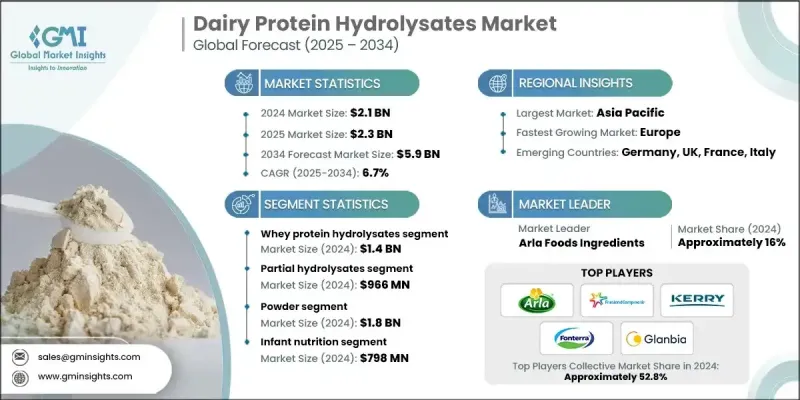
乳蛋白水解物是一類先進的生物活性成分,透過對牛奶蛋白進行嚴格控制的酶解而製成。與完整蛋白質相比,這些蛋白質具有更高的消化率、生物利用度和更低的致敏性,使其成為運動營養、嬰幼兒營養和醫療營養等營養相關行業的重要成分。水解過程將大分子蛋白質分解成更小的胜肽和胺基酸,從而加快人體吸收和利用。隨著人們對功能性營養和個人化營養的日益關注,製造商正在將乳蛋白水解物應用於產品中,以滿足特定的飲食和健康需求。嬰幼兒營養品是最大的消費群,佔全球需求的近38%。水解帶來的低分子量和更高的消化率使這些蛋白質成為配製特殊營養產品的理想選擇。嚴格的品質和安全標準持續推動市場對具有穩定功能和精確水解特性的高品質乳蛋白水解物的需求。先進的酶解技術正在革新生產方法,使製造商能夠更好地控制肽譜和蛋白質結構。
| 市場範圍 | |
|---|---|
| 起始年份 | 2024 |
| 預測年份 | 2025-2034 |
| 起始值 | 21億美元 |
| 預測值 | 59億美元 |
| 複合年成長率 | 6.7% |
2024年,乳清蛋白水解物市場營收達14億美元,預計2025年至2034年將以6.5%的複合年成長率成長,2024年市佔率將達到68%。乳清蛋白水解物以其完整的胺基酸組成、快速吸收和優異的溶解性,持續引領市場。其卓越的營養特性和加工靈活性使其適用於各種對生物利用度和功能性要求極高的產品配方。這些優勢鞏固了在需要高品質蛋白質來源和高效營養輸送的應用領域的領先地位。
2024年,部分水解物市場規模達到9.66億美元,預計2025年至2034年間將以6.6%的複合年成長率成長。其受歡迎程度源自於透過可控酶水解所實現的功能性益處與感官品質之間的平衡。部分水解物具有最佳的胜肽分佈和蛋白質完整性,同時最大限度地降低了苦味,使其成為功能性食品、運動營養和一般飲食應用的理想選擇。其良好的口感和強大的營養特性使其在多個終端應用領域中保持持續的需求。
預計2025年至2034年間,北美乳蛋白水解物市場將以6.5%的複合年成長率成長。消費者對功能性和個人化營養的日益關注正在推動區域需求,尤其是在臨床、運動和嬰幼兒營養等特殊蛋白質應用領域。此外,人們對消化健康和食物過敏的日益重視也加速了向先進蛋白質水解技術的轉變,製造商致力於用更易消化、低致敏性的替代品取代傳統蛋白質成分。
全球乳蛋白水解物市場的主要企業包括:格蘭比亞營養品公司 (Glanbia Nutritionals)、菲仕蘭坎皮納配料公司 (FrieslandCampina Ingredients)、阿拉食品配料公司 (Arla Foods Ingredients)、恆天然/NZMP、凱瑞集團 (Kerry Group)、拉克塔伯里公司 (Lactalis)、卡恆天然組 (Lactalis) Group)、阿格普爾合作社 (Agropur Cooperative)、希爾瑪配料公司 (Hilmar Ingredients)、牛奶特種產品全球/阿克圖斯營養公司 (Milk Specialties Global/Actus Nutrition)、英格瑞亞公司 (Ingredia)、阿莫爾蛋白公司 (Armor Proteines)、AMCO蛋白公司 (AMCOteins)、Costm. Co-operative)、DMK集團/wheyco和薩普托配料公司 (Saputo Ingredients)。這些企業正積極推行以創新、合作和產能擴張為核心的策略舉措,以增強自身的競爭力。許多企業正大力投資研發,以開發具有特定胜肽譜和更佳感官特性的客製化水解物配方。與食品和營養品牌的策略合作有助於企業拓展市場,並加速先進蛋白原料的商業化進程。此外,各企業也透過新一代酵素技術和永續加工實踐來提高生產效率,以滿足全球品質和安全標準。
目錄
第1章:方法論與範圍
第2章:執行概要
第3章:行業洞察
- 產業生態系分析
- 供應商格局
- 利潤率
- 每個階段的價值增加
- 影響價值鏈的因素
- 中斷
- 產業影響因素
- 促進要素
- 陷阱與挑戰
- 機會
- 成長潛力分析
- 監管環境
- 北美洲
- 歐洲
- 亞太地區
- 拉丁美洲
- 中東和非洲
- 波特的分析
- PESTEL 分析
- 價格趨勢
- 按地區
- 按類型
- 未來市場趨勢
- 技術與創新格局
- 當前技術趨勢
- 新興技術
- 專利格局
- 貿易統計(HS編碼)(註:僅提供重點國家的貿易統計資料)
- 主要進口國
- 主要出口國
- 永續性和環境方面
- 永續實踐
- 減少廢棄物策略
- 生產中的能源效率
- 環保舉措
- 碳足跡考量
第4章:競爭格局
- 介紹
- 公司市佔率分析
- 按地區
- 北美洲
- 歐洲
- 亞太地區
- 拉丁美洲
- MEA
- 按地區
- 公司矩陣分析
- 主要市場參與者的競爭分析
- 競爭定位矩陣
- 關鍵進展
- 併購
- 合作夥伴關係與合作
- 新產品發布
- 擴張計劃
第5章:市場估算與預測:依類型分類,2021-2034年
- 主要趨勢
- 乳清蛋白水解物
- 酪蛋白水解物
- 混合乳蛋白水解物
第6章:市場估算與預測:依水解度分類,2021-2034年
- 主要趨勢
- 部分水解產物(DH 2-15%)
- 深度水解產物(DH >15%)
- 高度水解產物(DH >95%)
第7章:市場估計與預測:依形式分類,2021-2034年
- 主要趨勢
- 粉狀
- 貼上形式
- 液體濃縮物
第8章:市場估算與預測:依應用領域分類,2021-2034年
- 主要趨勢
- 嬰兒營養
- 深度水解配方(eHF)
- 部分水解配方(pHF)
- 胺基酸配方(AAF)
- 其他(後續嬰兒食品、成長型嬰兒食品及特殊醫學用途嬰兒食品)
- 運動營養
- 運動前補充劑
- 運動後及恢復補充劑
- 蛋白質粉和即飲飲料
- 其他(能量棒、固體產品和精英運動員營養品)
- 臨床營養
- 腸內營養(管飼)
- 腸外營養(靜脈輸注)
- 特殊醫學用途食品與疾病特異性配方
- 其他(營養不良、重症監護和傷口恢復)
- 動物營養
- 乳牛飼料
- 家禽飼料
- 水產飼料(魚蝦營養)
- 其他(豬、寵物食品和特殊動物營養)
- 生物技術與細胞培養基
- 細胞培養基補充劑(血清替代品)
- 生物加工應用(蛋白質和細胞生產)
- 藥品生產(疫苗和生物製品)
- 其他(研究、再生醫學和分析測試)
第9章:市場估計與預測:依地區分類,2021-2034年
- 主要趨勢
- 北美洲
- 美國
- 加拿大
- 歐洲
- 德國
- 英國
- 法國
- 西班牙
- 義大利
- 歐洲其他地區
- 亞太地區
- 中國
- 印度
- 日本
- 澳洲
- 韓國
- 亞太其他地區
- 拉丁美洲
- 巴西
- 墨西哥
- 阿根廷
- 拉丁美洲其他地區
- 中東和非洲
- 沙烏地阿拉伯
- 南非
- 阿拉伯聯合大公國
- 中東和非洲其他地區
第10章:公司簡介
- Arla Foods Ingredients
- FrieslandCampina Ingredients
- Kerry Group
- Fonterra/NZMP
- Glanbia Nutritionals
- Nestle Health Science
- Lactalis Ingredients
- Carbery Group
- Milk Specialties Global/Actus Nutrition
- Agropur Cooperative
- Hilmar Ingredients
- Ingredia
- AMCO Proteins
- Armor Proteines
- Tatua Co-operative
The Global Dairy Protein Hydrolysates Market was valued at USD 2.1 billion in 2024 and is estimated to grow at a CAGR of 6.7% to reach USD 5.9 billion by 2034.
Dairy protein hydrolysates represent an advanced class of bioactive ingredients produced through carefully controlled enzymatic hydrolysis of milk proteins. These proteins are recognized for their enhanced digestibility, high bioavailability, and reduced allergenic potential compared to intact proteins, making them valuable components in nutrition-focused industries such as sports, infant, and medical nutrition. Through the hydrolysis process, large protein molecules are broken into smaller peptides and amino acids, allowing for faster absorption and efficient utilization by the body. With increasing interest in functional and personalized nutrition, manufacturers are incorporating dairy protein hydrolysates to meet targeted dietary and health needs. The infant nutrition category represents the largest consumer segment, accounting for nearly 38% of global demand. The lower molecular weight and improved digestibility achieved through hydrolysis make these proteins particularly desirable for formulating specialized nutrition products. Stringent quality and safety standards continue to drive demand for high-grade dairy protein hydrolysates with consistent functional performance and precise hydrolysis characteristics. Advanced enzymatic technologies are transforming production methods, enabling manufacturers to better control peptide profiles and protein structure.
| Market Scope | |
|---|---|
| Start Year | 2024 |
| Forecast Year | 2025-2034 |
| Start Value | $2.1 Billion |
| Forecast Value | $5.9 Billion |
| CAGR | 6.7% |
The whey protein hydrolysates segment generated USD 1.4 billion in revenue in 2024 and is forecasted to grow at a CAGR of 6.5% from 2025 to 2034, holding a 68% share in 2024. Whey protein hydrolysates continue to lead the market due to their complete amino acid composition, rapid absorption, and exceptional solubility. Their superior nutritional properties and processing versatility make them suitable for various product formulations where bioavailability and functionality are crucial. These advantages reinforce their dominance in applications that require high-quality protein sources and efficient nutrient delivery.
The partial hydrolysates segment generated USD 966 million in 2024 and is expected to grow at a CAGR of 6.6% during 2025-2034. Their popularity lies in the balance between functional benefits and sensory qualities achieved through controlled enzymatic hydrolysis. Partial hydrolysates exhibit optimal peptide distribution and preserved protein integrity while minimizing bitterness, making them ideal for use in functional foods, sports nutrition, and general dietary applications. Their favorable taste profile and strong nutritional characteristics contribute to consistent demand across multiple end-use categories.
North America Dairy Protein Hydrolysates Market is projected to grow at a CAGR of 6.5% between 2025 and 2034. Growing consumer awareness of functional and personalized nutrition is shaping regional demand, particularly across specialized protein applications in clinical, sports, and infant nutrition. Rising attention to digestive health and food allergies is also accelerating the shift toward advanced protein hydrolysis technologies as manufacturers aim to replace traditional protein ingredients with more digestible, hypoallergenic alternatives.
Key companies operating in the Global Dairy Protein Hydrolysates Market include Glanbia Nutritionals, FrieslandCampina Ingredients, Arla Foods Ingredients, Fonterra/NZMP, Kerry Group, Lactalis Ingredients, Nestle Health Science, Carbery Group, Agropur Cooperative, Hilmar Ingredients, Milk Specialties Global/Actus Nutrition, Ingredia, Armor Proteines, AMCO Proteins, Costantino & C. spa, Tatua Co-operative, DMK Group/wheyco, and Saputo Ingredients. Companies active in the Dairy Protein Hydrolysates Market are pursuing strategic initiatives centered on innovation, partnerships, and capacity expansion to strengthen their competitive standing. Many are investing heavily in research and development to create customized hydrolysate formulations with specific peptide profiles and improved sensory characteristics. Strategic collaborations with food and nutrition brands are enabling broader market access and faster commercialization of advanced protein ingredients. Firms are also enhancing production efficiency through next-generation enzymatic technologies and sustainable processing practices to meet global quality and safety standards.
Table of Contents
Chapter 1 Methodology & Scope
- 1.1 Market scope and definition
- 1.2 Research design
- 1.2.1 Research approach
- 1.2.2 Data collection methods
- 1.3 Data mining sources
- 1.3.1 Global
- 1.3.2 Regional/Country
- 1.4 Base estimates and calculations
- 1.4.1 Base year calculation
- 1.4.2 Key trends for market estimation
- 1.5 Primary research and validation
- 1.5.1 Primary sources
- 1.6 Forecast model
- 1.7 Research assumptions and limitations
Chapter 2 Executive Summary
- 2.1 Industry 3600 synopsis
- 2.2 Key market trends
- 2.2.1 Type trends
- 2.2.2 Degree of hydrolysis trends
- 2.2.3 Form trends
- 2.2.4 Application trends
- 2.2.5 Regional trends
- 2.3 TAM Analysis, 2025-2034
- 2.4 CXO perspectives: Strategic imperatives
- 2.4.1 Executive decision points
- 2.4.2 Critical success factors
- 2.5 Future Outlook and Strategic Recommendations
Chapter 3 Industry Insights
- 3.1 Industry ecosystem analysis
- 3.1.1 Supplier landscape
- 3.1.2 Profit margin
- 3.1.3 Value addition at each stage
- 3.1.4 Factor affecting the value chain
- 3.1.5 Disruptions
- 3.2 Industry impact forces
- 3.2.1 Drivers
- 3.2.2 Pitfalls & Challenges
- 3.2.3 Opportunities
- 3.3 Growth potential analysis
- 3.4 Regulatory landscape
- 3.4.1 North America
- 3.4.2 Europe
- 3.4.3 Asia Pacific
- 3.4.4 Latin America
- 3.4.5 Middle East & Africa
- 3.5 Porter's analysis
- 3.6 PESTEL analysis
- 3.7 Price trends
- 3.7.1 By region
- 3.7.2 By type
- 3.8 Future market trends
- 3.9 Technology and Innovation landscape
- 3.9.1 Current technological trends
- 3.9.2 Emerging technologies
- 3.10 Patent Landscape
- 3.11 Trade statistics (HS code) ( Note: the trade statistics will be provided for key countries only)
- 3.11.1 Major importing countries
- 3.11.2 Major exporting countries
- 3.12 Sustainability and environmental aspects
- 3.12.1 Sustainable practices
- 3.12.2 Waste reduction strategies
- 3.12.3 Energy efficiency in production
- 3.12.4 Eco-friendly initiatives
- 3.13 Carbon footprint consideration
Chapter 4 Competitive Landscape, 2024
- 4.1 Introduction
- 4.2 Company market share analysis
- 4.2.1 By region
- 4.2.1.1 North America
- 4.2.1.2 Europe
- 4.2.1.3 Asia Pacific
- 4.2.1.4 LATAM
- 4.2.1.5 MEA
- 4.2.1 By region
- 4.3 Company matrix analysis
- 4.4 Competitive analysis of major market players
- 4.5 Competitive positioning matrix
- 4.6 Key developments
- 4.6.1 Mergers & acquisitions
- 4.6.2 Partnerships & collaborations
- 4.6.3 New Product Launches
- 4.6.4 Expansion Plans
Chapter 5 Market Estimates and Forecast, By Type, 2021-2034 (USD Million & Kilo Tons)
- 5.1 Key trends
- 5.2 Whey protein hydrolysates
- 5.3 Casein hydrolysates
- 5.4 Mixed milk protein hydrolysates
Chapter 6 Market Estimates and Forecast, By Degree of Hydrolysis, 2021-2034 (USD Million & Kilo Tons)
- 6.1 Key trends
- 6.2 Partial hydrolysates (DH 2-15%)
- 6.3 Extensive hydrolysates (DH >15%)
- 6.4 Highly hydrolyzed products (DH >95%)
Chapter 7 Market Estimates and Forecast, By Form, 2021-2034 (USD Million & Kilo Tons)
- 7.1 Key trends
- 7.2 Powder form
- 7.3 Paste form
- 7.4 Liquid concentrates
Chapter 8 Market Estimates and Forecast, By Application, 2021-2034 (USD Million & Kilo Tons)
- 8.1 Key trends
- 8.2 Infant nutrition
- 8.2.1 Extensively hydrolyzed formulas (eHF)
- 8.2.2 Partially hydrolyzed formulas (pHF)
- 8.2.3 Amino acid-based formulas (AAF)
- 8.2.4 Others (follow-on, growing-up, and special medical purpose infant foods)
- 8.3 Sports nutrition
- 8.3.1 Pre-workout supplements
- 8.3.2 Post-workout & recovery supplements
- 8.3.3 Protein powders & RTD beverages
- 8.3.4 Others (bars, solid form products, and elite athlete nutrition)
- 8.4 Clinical nutrition
- 8.4.1 Enteral nutrition (tube feeding)
- 8.4.2 Parenteral nutrition (IV administration)
- 8.4.3 Medical foods & disease-specific formulations
- 8.4.4 Others (malnutrition, critical care, and wound recovery)
- 8.5 Animal nutrition
- 8.5.1 Dairy cattle feed
- 8.5.2 Poultry feed
- 8.5.3 Aquafeed (fish & shrimp nutrition)
- 8.5.4 Others (swine, pet food, and specialty animal nutrition)
- 8.6 Biotechnology & cell culture media
- 8.6.1 Cell culture media supplements (serum replacements)
- 8.6.2 Bioprocessing applications (protein & cell production)
- 8.6.3 Pharmaceutical manufacturing (vaccines & biologics)
- 8.6.4 Others (research, regenerative medicine, and analytical testing)
Chapter 9 Market Estimates and Forecast, By Region, 2021-2034 (USD Million & Kilo Tons)
- 9.1 Key trends
- 9.2 North America
- 9.2.1 U.S.
- 9.2.2 Canada
- 9.3 Europe
- 9.3.1 Germany
- 9.3.2 UK
- 9.3.3 France
- 9.3.4 Spain
- 9.3.5 Italy
- 9.3.6 Rest of Europe
- 9.4 Asia Pacific
- 9.4.1 China
- 9.4.2 India
- 9.4.3 Japan
- 9.4.4 Australia
- 9.4.5 South Korea
- 9.4.6 Rest of Asia Pacific
- 9.5 Latin America
- 9.5.1 Brazil
- 9.5.2 Mexico
- 9.5.3 Argentina
- 9.5.4 Rest of Latin America
- 9.6 Middle East and Africa
- 9.6.1 Saudi Arabia
- 9.6.2 South Africa
- 9.6.3 UAE
- 9.6.4 Rest of Middle East and Africa
Chapter 10 Company Profiles
- 10.1 Arla Foods Ingredients
- 10.2 FrieslandCampina Ingredients
- 10.3 Kerry Group
- 10.4 Fonterra/NZMP
- 10.5 Glanbia Nutritionals
- 10.6 Nestle Health Science
- 10.7 Lactalis Ingredients
- 10.8 Carbery Group
- 10.9 Milk Specialties Global/Actus Nutrition
- 10.10 Agropur Cooperative
- 10.11 Hilmar Ingredients
- 10.12 Ingredia
- 10.13 AMCO Proteins
- 10.14 Armor Proteines
- 10.15 Tatua Co-operative


