


 |
市場調查報告書
商品編碼
1876634
長時儲能市場機會、成長促進因素、產業趨勢分析及預測(2025-2034年)Long Duration Energy Storage Market Opportunity, Growth Drivers, Industry Trend Analysis, and Forecast 2025 - 2034 |
||||||

2024年全球長時儲能市場價值為31億美元,預計2034年將以10.6%的複合年成長率成長至87億美元。
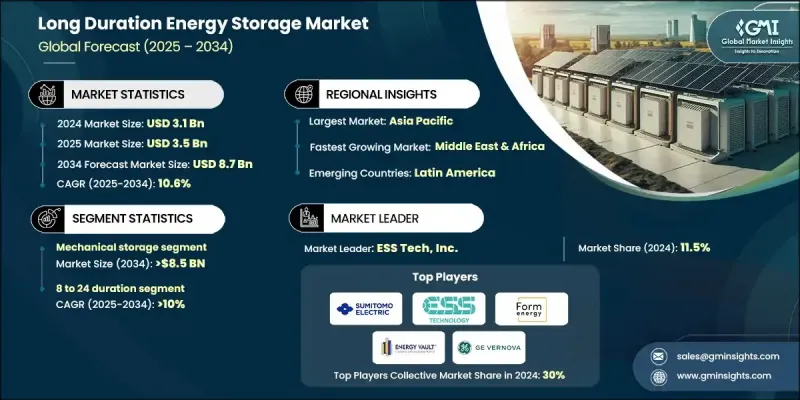
成長的驅動力來自風能和太陽能等再生能源的日益普及,而這些能源需要可靠的儲能解決方案來應對波動性。與短時電池不同,長時儲能系統(LDES)可以儲存能量長達10小時或更久,因此對於在持續多日的極端天氣事件或季節性波動期間維持電網穩定至關重要。政府的支持,特別是美國能源部在2024年承諾投入1億美元用於試點計畫的舉措,正在加速LDES的研發和部署。這些項目旨在降低成本,並鼓勵採用超越傳統鋰離子儲能技術的創新技術。隨著世界各國將脫碳和能源安全置於優先地位,LDES對於整合間歇性再生能源和確保不間斷電力供應正變得不可或缺。
| 市場範圍 | |
|---|---|
| 起始年份 | 2024 |
| 預測年份 | 2025-2034 |
| 起始值 | 31億美元 |
| 預測值 | 87億美元 |
| 複合年成長率 | 10.6% |
預計到2034年,機械儲能解決方案市場規模將達到85億美元,凸顯其在低能耗能源系統(LDES)領域的重要地位。抽水蓄能和壓縮空氣儲能(CAES)等技術循環效率高達79%至98%,且可大規模運行,但需要水庫或洞穴等特定基礎設施。熱能儲能(TES)系統靈活模組化,可利用豐富的熱能資源;而機電儲能則無需專用設施,即可提供快速響應和可擴展的解決方案。
預計到2034年,持續時間為8-24小時的儲能系統市場將以10%的複合年成長率成長。這些系統以及持續時間超過24-36小時的系統對於彌補再生能源間歇性造成的電力缺口至關重要。短時電池可以應對每小時的電力波動,而長時電池則可以應對每日或多日的電力缺口,從而確保可靠的電力供應,並最大限度地減少對化石燃料調峰電廠的依賴,助力實現脫碳目標。
2024年,美國長時儲能市場規模預計將達到7.353億美元,反映出該市場持續成長以及市場對該技術的信心不斷增強。這一上升趨勢預示著,能夠解決再生能源間歇性問題並提高電網可靠性的解決方案將廣泛應用。
長時儲能市場的主要企業包括ESS Tech、GE Vernova、Energy Vault, Inc.、Form Energy和住友電工。市場領導者專注於加大研發投入,以提高效率、延長儲能時長和模組化程度。他們透過建立策略夥伴關係和合作,整合再生能源生態系統中的解決方案,同時提升產能以滿足不斷成長的需求。此外,他們還優先考慮技術差異化,透過申請專利和專有設計來獲得競爭優勢。拓展全球市場並與公用事業公司和電網營運商建立聯盟,有助於鞏固其市場地位。同時,各公司也利用試點計畫、示範工廠和政府支持的計畫來驗證技術並加速應用,從而建立信譽並確立長期的產業領導地位。
目錄
第1章:方法論與範圍
第2章:執行概要
第3章:行業洞察
- 產業生態系分析
- 監管環境
- 產業影響因素
- 成長促進因素
- 產業陷阱與挑戰
- 成長潛力分析
- 波特的分析
- PESTEL 分析
- 新興機會與趨勢
- 數位化與物聯網整合
- 新興市場滲透
- 投資分析及未來展望
第4章:競爭格局
- 介紹
- 按地區分類的公司市佔率分析
- 北美洲
- 歐洲
- 亞太地區
- 中東和非洲
- 拉丁美洲
- 策略舉措
- 競爭基準描述
- 策略儀錶板
- 創新與技術格局
第5章:長時儲能市場規模及預測:依技術分類,2021-2034年
- 主要趨勢
- 機械存儲
- 熱能儲存
- 機電儲能
- 化學品儲存
第6章:長時儲能市場規模及預測:按時長分類,2021-2034年
- 主要趨勢
- 8至24
- 24至36歲
- > 36
第7章:長時儲能市場規模及預測:依容量分類,2021-2034年
- 主要趨勢
- 最高可達 50 兆瓦
- 50-100兆瓦
- 超過100兆瓦
第8章:長時儲能市場規模及預測:依應用領域分類,2021-2034年
- 主要趨勢
- 網格管理
- 備用電源
- 再生能源併網
- 離網和微電網系統
第9章:長時儲能市場規模及預測:按地區分類,2021-2034年
- 北美洲
- 美國
- 加拿大
- 墨西哥
- 歐洲
- 英國
- 法國
- 德國
- 義大利
- 俄羅斯
- 西班牙
- 亞太地區
- 中國
- 澳洲
- 印度
- 日本
- 韓國
- 中東和非洲
- 沙烏地阿拉伯
- 阿拉伯聯合大公國
- 土耳其
- 南非
- 埃及
- 拉丁美洲
- 巴西
- 阿根廷
第10章:公司簡介
- Sumitomo Electric
- ESS Tech, Inc.
- EOS Energy Enterprise
- Invinity Energy Systems
- Energy Vault, Inc.
- MAN, Energy Solutions
- Highview Power
- Primus Power
- CMBlu Energy AG
- Malta Inc.
- RheEnergise Limited
- QuantumScape Battery, Inc.
- Form Energy
- Alsym Energy, Inc.
- Ambri Incorporated
- VFlowTech Pte. Ltd.
- VoltStorage
- MGA Thermal Pty. Ltd.
- Rondo Energy, Inc.
- Lina Energy Ltd.
- e-Zinc Inc.
- GE Vernova
- Enersys
- LG Energy Solutions
- Store electric Ltd.
The Global Long Duration Energy Storage Market was valued at USD 3.1 billion in 2024 and is estimated to grow at a CAGR of 10.6% to reach USD 8.7 billion by 2034.
Growth is driven by the increasing adoption of renewable energy sources like wind and solar, which require reliable storage solutions to manage variability. Unlike short-duration batteries, LDES systems can store energy for 10 hours or more, making them crucial for maintaining grid stability during multi-day weather events or seasonal fluctuations. Government support, particularly from initiatives like the U.S. Department of Energy's pilot programs committing USD 100 million in 2024, is accelerating development and deployment. These programs aim to reduce costs and encourage technologies that extend beyond conventional lithium-ion storage. As the world prioritizes decarbonization and energy security, LDES is becoming indispensable for integrating intermittent renewable sources and ensuring an uninterrupted electricity supply.
| Market Scope | |
|---|---|
| Start Year | 2024 |
| Forecast Year | 2025-2034 |
| Start Value | $3.1 Billion |
| Forecast Value | $8.7 Billion |
| CAGR | 10.6% |
The mechanical storage solutions segment is expected to reach USD 8.5 billion by 2034, highlighting its role in the LDES landscape. Technologies like pumped hydro and compressed air energy storage (CAES) offer high cycle efficiencies of 79-98% and can operate at large scales, though they require specific infrastructure such as reservoirs or caverns. Thermal energy storage (TES) provides flexible, modular systems that utilize abundant thermal resources, while electromechanical storage delivers rapid response and scalable solutions without needing specialized locations.
The energy storage systems segment with durations of 8-24 hours is forecasted to grow at a 10% CAGR through 2034. These systems, along with those exceeding 24-36 hours, are essential for bridging gaps caused by renewable intermittency. While short-duration batteries address hourly fluctuations, long-duration segments manage daily or multi-day energy deficits, ensuring a reliable power supply and minimizing dependence on fossil-fuel peaker plants, supporting decarbonization targets.
U.S Long Duration Energy Storage Market was valued at USD 735.3 million in 2024, reflecting consistent growth and growing confidence in these technologies. The upward trend signals a clear trajectory toward scaling solutions capable of addressing renewable intermittency and enhancing grid reliability.
Key companies in the Long Duration Energy Storage Market include ESS Tech, GE Vernova, Energy Vault, Inc., Form Energy, and Sumitomo Electric. Market leaders in Long Duration Energy Storage Market focus on strategies such as increasing R&D investments to improve efficiency, storage duration, and modularity. Companies form strategic partnerships and collaborations to integrate solutions across renewable energy ecosystems while enhancing manufacturing capacity to meet growing demand. They also prioritize technology differentiation, securing patents and proprietary designs for competitive advantage. Expanding into global markets and forming alliances with utilities and grid operators strengthens their market presence. Additionally, firms are leveraging pilot projects, demonstration plants, and government-backed programs to validate technologies and accelerate adoption, establishing credibility and long-term industry leadership.
Table of Contents
Chapter 1 Methodology & Scope
- 1.1 Research design
- 1.2 Market estimates & forecast parameters
- 1.3 Forecast calculation
- 1.4 Data sources
- 1.4.1 Primary
- 1.4.2 Secondary
- 1.4.2.1 Paid
- 1.4.2.2 Public
Chapter 2 Executive Summary
- 2.1 Industry synopsis, 2021 - 2034
Chapter 3 Industry Insights
- 3.1 Industry ecosystem analysis
- 3.2 Regulatory landscape
- 3.3 Industry impact forces
- 3.3.1 Growth drivers
- 3.3.2 Industry pitfalls & challenges
- 3.4 Growth potential analysis
- 3.5 Porter's analysis
- 3.5.1 Bargaining power of suppliers
- 3.5.2 Bargaining power of buyers
- 3.5.3 Threat of new entrants
- 3.5.4 Threat of substitutes
- 3.6 PESTEL analysis
- 3.6.1 Political factors
- 3.6.2 Economic factors
- 3.6.3 Social factors
- 3.6.4 Technological factors
- 3.6.5 Legal factors
- 3.6.6 Environmental factors
- 3.7 Emerging opportunities & trends
- 3.7.1 Digitalization & IoT integration
- 3.7.2 Emerging market penetration
- 3.8 Investment analysis & future outlook
Chapter 4 Competitive Landscape, 2025
- 4.1 Introduction
- 4.2 Company market share analysis, by Region, 2024
- 4.2.1 North America
- 4.2.2 Europe
- 4.2.3 Asia Pacific
- 4.2.4 Middle East & Africa
- 4.2.5 Latin America
- 4.3 Strategic initiatives
- 4.4 Competitive benchmarking depictions
- 4.5 Strategy dashboard
- 4.6 Innovation & technology landscape
Chapter 5 Long Duration Energy Storage Market Size and Forecast, By Technology, 2021 - 2034 (USD Million)
- 5.1 Key trends
- 5.2 Mechanical storage
- 5.3 Thermal storage
- 5.4 Electromechanical storage
- 5.5 Chemical storage
Chapter 6 Long Duration Energy Storage Market Size and Forecast, By Duration, 2021 - 2034 (USD Million)
- 6.1 Key trends
- 6.2 8 to 24
- 6.3 > 24 to 36
- 6.4 > 36
Chapter 7 Long Duration Energy Storage Market Size and Forecast, By Capacity, 2021 - 2034 (USD Million)
- 7.1 Key trends
- 7.2 Up to 50 MW
- 7.3 50-100 MW
- 7.4 More than 100 MW
Chapter 8 Long Duration Energy Storage Market Size and Forecast, By Application, 2021 - 2034 (USD Million)
- 8.1 Key trends
- 8.2 Grid management
- 8.3 Power backup
- 8.4 Renewable energy integration
- 8.5 Off grid & microgrid systems
Chapter 9 Long Duration Energy Storage Market Size and Forecast, By Region, 2021 - 2034 (USD Million)
- 9.1 North America
- 9.1.1 U.S.
- 9.1.2 Canada
- 9.1.3 Mexico
- 9.2 Europe
- 9.2.1 UK
- 9.2.2 France
- 9.2.3 Germany
- 9.2.4 Italy
- 9.2.5 Russia
- 9.2.6 Spain
- 9.3 Asia Pacific
- 9.3.1 China
- 9.3.2 Australia
- 9.3.3 India
- 9.3.4 Japan
- 9.3.5 South Korea
- 9.4 Middle East & Africa
- 9.4.1 Saudi Arabia
- 9.4.2 UAE
- 9.4.3 Turkey
- 9.4.4 South Africa
- 9.4.5 Egypt
- 9.5 Latin America
- 9.5.1 Brazil
- 9.5.2 Argentina
Chapter 10 Company Profiles
- 10.1 Sumitomo Electric
- 10.2 ESS Tech, Inc.
- 10.3 EOS Energy Enterprise
- 10.4 Invinity Energy Systems
- 10.5 Energy Vault, Inc.
- 10.6 MAN, Energy Solutions
- 10.7 Highview Power
- 10.8 Primus Power
- 10.9 CMBlu Energy AG
- 10.10 Malta Inc.
- 10.11 RheEnergise Limited
- 10.12 QuantumScape Battery, Inc.
- 10.13 Form Energy
- 10.14 Alsym Energy, Inc.
- 10.15 Ambri Incorporated
- 10.16 VFlowTech Pte. Ltd.
- 10.17 VoltStorage
- 10.18 MGA Thermal Pty. Ltd.
- 10.19 Rondo Energy, Inc.
- 10.20 Lina Energy Ltd.
- 10.21 e-Zinc Inc.
- 10.22 GE Vernova
- 10.23 Enersys
- 10.24 LG Energy Solutions
- 10.25 Store electric Ltd.

 資料中心、微電網和住宅應用的長期儲能(LDES):技術趨勢和市場展望(2026-2036)
 長期間能源儲存
 全球長期儲能(LDES)市場:預測至2032年-按時間段、能源容量、技術、應用、最終用戶和地區進行分析
 長時儲能(LDES)概述:技術、材料、專案、公司和研究進展(2025-2026 年)、替代方案和市場趨勢(2026-2046 年)
 長期儲能市場規模、佔有率、成長及全球產業分析:依類型、應用和地區劃分的洞察與預測(2024-2032 年)
 長時儲能市場-全球產業規模、佔有率、趨勢、機會及預測(按類型、應用、地區、競爭細分,2020-2030 年)
 用於長期儲能的氧化還原液流電池 (RFB):電網、微電網、市場和技術(2025-2045)
 長期能源儲存(LDES)的全球市場(2026年~2046年)
 2025年長期能源儲存全球市場報告2032 年長期能源儲存市場預測:按類型、儲能時長、應用、最終用戶和地區進行的全球分析