


 |
市場調查報告書
商品編碼
2128695
6G通訊:可重構智慧表面(RIS)材料與硬體的市場與技術(2027-2047)6G Communications: Reconfigurable Intelligent Surface RIS Materials and Hardware Markets, Technology 2027-2047 |
||||||

概要
隨著無線通訊技術的發展,更高頻率和其他特性的應用有望帶來更廣泛的應用和全新的使用者功能。為了實現預計於2030年推出的6G技術,需要在傳播路徑上廣泛部署可重構智慧表面(RIS)。這份長達579頁的研究報告著重分析商業機會,透過11項SWOT分析、2027年至2047年的24個預測情境以及57項關鍵結論,說明了市場機會。
說明沒有使用冗長的文字,而是採用清晰的資訊圖表。
本報告針對價值鏈上的所有參與者,包括投資者、高價值材料製造商、設備製造商、產品和系統整合商以及設施管理人員。報告也為研究人員、監管機構和其他相關人員提供寶貴的見解。具體而言,報告涵蓋潛在的合作與收購、前景廣闊的方法、最佳實踐以及從失敗中汲取的經驗教訓。報告以SWOT分析、比較圖表、創新資訊圖表、藍圖、預測以及標有「Zhar研究評論」的章節形式呈現了全新的博士級分析。為了便於理解,報告以餅圖的形式對前景廣闊的材料進行優先排序,並在正文中以紅色突出顯示。關鍵點以綠色突出顯示。由於這是個快速發展的領域,報告會持續更新,以提供最新資訊。掌握這些獨特的見解和詳盡的分析,就有可能創造價值數十億美元的商機。
目錄
第1章 執行摘要和結論,以及藍圖和2027-2047年預測
- 本報告的目的
- 本分析的調查方法
- RIS背景
- 對5G很有用,對6G不可或缺
- Google搜尋結果、研究論文、專利趨勢以及與 RIS 相關的值得關注的RIS 主題。
- RIS Everywhere 的理想:資訊圖
- 6G 需要各種的RIS。
- 關於6G 通訊的10個主要結論
- 27 關於 6G RIS 的一般性結論
- 關於6G RIS材料和組件的商業機會的七項關鍵結論
- 關於6G RIS成本問題的七個關鍵結論
- 關於6G RIS和反射器陣列製造技術的六個關鍵結論
- 8項SWOT分析
- 6G RIS 的SWOT 分析
- 對 6G 進行 SWOT 評估,並加入sub-THz、THz、近紅外線和可見光頻率。
- BD-RIS在6G的SWOT評估
- STAR RIS SWOT 評分
- 針對OWC的6G RIS進行SWOT評估
- 對 6G ISAC 和 RIS 利用率的SWOT 評估
- 可見光通訊(VLC)的SWOT分析
- 超材料和超表面的SWOT評估
- 可變形軟性智慧超表面(FIM)的SWOT 評估
- 6G系統、材料和標準藍圖(6項),2026-2047年
- 6G反射器陣列與RIS市場預測及背景預測(24項),2027-2047年
- 6G全被動式超材料反射陣列市場OWC與總額,2029-2047年
- 6G RIS市場規模(價值):依頻率分類的主動式和四種半被動式類別比較,2026-2047年(附說明)
- 2027-2047年6G RIS年度銷售面積(附說明)
- 2028-2047年 6G RIS 平均價格(含電子元件的工廠價格,每平方公尺)(附說明)
- 2027-2047年 6G RIS 銷售面積、平均面板面積、銷售量和累積總部署量比較(附說明)
- 全球RIS硬體市場價值:四大區域市場佔有率(%),2029-2047年
- 2025-2047年全球智慧型手機及其後續機型的銷售
- 6G 和 5G 基地台市場:2025-2047年年度出貨量(數量)
- 6G基地台市場:市場價值(金額),2029-2047年
第2章 2026年前時期概況,包括調查結果
- 概述
- RIS的定義、背景以及推動RIS發展的需求
- RIS 的運作模式、挑戰和設計方法,以實現 6G 的預期優勢
- 與從活動零件到智慧材料的轉變相關的關鍵趨勢
- RIS及相關智慧超表面的多樣化功能與應用
- 目前RIS的設計和功能方法:
- 與傳統方法和組合相比,RIS 的獨特特點
- 液晶作為相位陣列中的可變電容介質
- 與傳統方法競爭的RIS
- 6G系統如何在傳播路徑中融合多種技術
- 主動式RIS的重要性:潛力與發展
- RIS功能及效用 - 詳細分析
- 空間覆蓋範圍和宏觀多樣性得到改善
- 容量提升、綠色通訊和物聯網
- 提高了實體層的安全性、故障隔離保護和可靠性。
- 實現大規模物聯網網路部署
- 無線感測與定位、HRIS、ISAC
- 從系統和安全角度看 RIS
- 與6G RIS相關的標準化機構和重要相關人員相關者的活動
- 6G 和 6G RIS 目標的擴展和收縮,智慧無線環境
- 術語混淆
- 產業和研究趨勢的變化
- 拓展理論研究固然有益,但相對忽略硬體研究是不可取的。
- 改變頻率策略可能會影響服務在上線時的功能。
- 近期的研究主要集中在 5G 頻段;對於 6G,考慮使用 GHz 和毫米波頻段。
- 6G RIS,頻率範圍從 0.1THz 到 3THz
- 提高高頻率通訊距離:軌道工程
- 2025年以後其他研究進展的分析
- 6G RIS、反射陣列和相位陣列。
- 2025年、2026年相關主題的研究與出版計劃
- 針對 6G 世界的提案架構、互補系統
第3章 終極 6G RIS 硬體工具包:隱形、廣域、自供電、自學習、自適應、自癒、自我清潔、無所不在、自主、持久、人工智慧賦能、動態頻譜共用等等(包括到2026年的研究)
- 概述
- 提升6G RIS的可接受性、適用性與效用:透過以下領域的多項進步
- 透過先進的物理特性和RIS特性的協同組合
- 隱形RIS - 透明或超出視線範圍。
- RIS消失的旅程:透明,或超出視線範圍。
- 2025-2026年透明的6G RIS:企業、大學及其雄心
- 透明反射陣列:Sekisui 等
- 對大型智慧表面(LIS)和超大型天線陣列(ELAA)的研究,包括廣域RIS。
- 定義和益處
- 大型智慧表面LIS RIS 可提高安全性、通訊範圍並減少錯誤。
- 大面積能源採集和RIS保護塗層的進展
- RIS 將採用自供電設計,實現零能耗客戶端設備。
- 概述
- 主要ZED技術的成熟度
- 最值得關注的6G ZED 化合物和碳同素異形體研究排名。
- 零能耗建築背景:重疊和相鄰技術以及長期能源獨立性的實例
- SWIPT、STIIPT、AmBC 和 CD-ZED 的目標和最新進展
- 2027年至2047年針對6G零能耗基礎設施及客戶端設備的13種能源採集技術
- 針對 6G 主動式 RIS 和 UM MIMO 基地台的功率需求,根據能源採集方案量身定做。
- 對用於 ZED RIS 和其他應用的無電池儲能技術進行 SWOT 分析。
- 對無需儲能的電路和基礎設施進行SWOT分析
- 人工智慧和機器學習在最佳化、自學習、自適應和自主RIS的應用。
- 多模、多頻、動態頻譜共用(DSS)6G及其RIS
第4章 超越對角線RIS架構的局限,拓展6G RIS的極限
- 定義、主要挑戰、適用性
- 意義
- 簡單描述
- BD-RIS 6G 的SWOT 分析
- 本章內容及可獲得的機會
- BD-RIS的潛在優勢
- BD-RIS的硬體挑戰
- 實用化案例及改進要求
- 課題
- BD-RIS 的首次示範實驗
- 到2025年,地面電波BD-RIS 的進展:許多其他進展和評估
- 非地面電波網路(NTN)中RIS的改進
第5章 多功能和多模式RIS,包括STAR RIS、ISAC和SWIPT,以及到2026年的發展趨勢
- 研究總結、產業趨勢和發展前景
- STAR RIS 兼具透明性和反射性。
- 概述
- STAR-RIS 最佳化
- STAR-RIS-ISAC 整合感測與通訊系統
- TAIS(透明放大智慧表面)
- 資訊和電力同步無線傳輸(SWIPT),包括主動 STAR-RIS 和 THz 版本。
- STAR-RIS 具備能源採集和自適應功率控制能力
- STAR-RIS 的SWOT 分析
- 其他多功能、多模式RIS
- 概述
- 多功能RIS:固態冷卻功能
- 2025年以後,整合感測與通訊系統(ISAC)的發展,包括 RIS 和 SWOT
- 原生 6G 支援功能
- SWOT分析及RIS在6G ISAC的應用
- 基礎
- 用於確保系統安全的多模RIS:結合半被動式和主動式RIS。
第6章 基地台、UM-MIMO、高空通訊系統(HAPS)與UAV RIS及研究進展,2026年
- 相關主題:用於增強 6G 基地台和非地面網路的RIS
- UM-MIMO 的發展進展
- 設計一款與RIS相容、自供電、超大規模的6G UM-MIMO基地台
- 基礎與結構RIS
- 變形超材料MIMO技術
- 大規模MIMO基地台的RIS:Tsinghua University、Emerson
- RIS 作為小型基地台基地台
- 2025年以後,RIS 支援的MIMO 和基地台的其他重大進展
- 衛星和無人機如何支援 6G RIS,有時甚至從中受益
- 於2025年和2026年宣布,重大進展,計劃於以下時期實施的重要進展
- 大型平流層HAPS的RIS
第7章 RIS 調諧硬體及研究進展目標(至2026年)
- 概述
- 從基礎調諧到進階調諧
- 情境中的調節機制
- 研究和測試中使用的RIS外部控制刺激範例
- RIS調諧硬體選項比較
- 資訊圖表:兆赫間隙需要不同的調節材料和裝置。
- 從RIS調優研究中學到的經驗教訓:2026年以前
- 焦點轉移
- 優選電調諧和光調諧,以及高頻率頻寬
- 利用離散調整要素對進展進行詳細分析
- 結論
- 利用肖特基二極體進行RIS調諧並與其他二極體進行比較
- 利用高電子移動性電晶體(HEMT)進行RIS調諧
- 其他一些結果不盡如人意的選擇及其原因
- 優先選擇調諧材料來取代 6G RIS(0.1–1 THz 和近紅外線)中的離散元件
- 目前的有力候選
- 適用於6G高頻率的整合式調諧材料的選項
- 二氧化釩:理論基礎及至2025年的主要發展
- 硫屬化物相變材料(特別是GST和GeTe)
- 石墨烯:理論基礎及至2025年的關鍵發展
- 液晶:理論基礎及至2025年的發展
- 大型RIS及其他市場面臨的挑戰
第8章 針對 6G ORIS 的光無線通訊:2026年前的主要發展
- 為什麼 OWC(包括 RIS)是該頻段 6G 的理想補充
- 光無線通訊(OWC)及其子領域可見光通訊(VLC),以及到2026年的發展進展。
- 多頻 6G 第二階段(包括光纖通訊)對於確保可靠通訊的重要性。
- 3-300 GHz頻段無線光通訊(FSO)參數比較。
- 基於SWOT分析的光學RIS(ORIS)的潛力與挑戰
- 概述
- ORIS 的優勢以及分散式 RIS(DRIS)的選項
- ORIS面臨的挑戰
- OWC 的6G RIS 的SWOT 分析
- 可見光通訊的SWOT分析
- ORIS安裝步驟
- 遠距離、地下、水下和太空中的OWC:RIS:2026年及以前研究進展
- 結論
- RIS增強了OWC車輛網路和移動環境。
- 混合射頻自由空間光RIS
- 水下UOWC系統整合了截至2026年的發展成果。
- 地下OWC需要RIS
- 利用RIS技術的雷射平流層和空間通訊
- 短距離和室內OWC及其 RIS:到2026年及更早的研究進展。
- 室內和空中短程通訊
- 結合 RIS 使用其他室內和短距離室外系統,例如 LiFi。
- 光學材料在6G的應用潛力
- 6G超透鏡(包括到2026年的發展進度)
- 鏡陣列ORIS的設計與應用進展
第9章 6G變形FIM(軟性智慧超表面)、6G超表面和超材料的基礎知識
- 概述
- 6G相關超材料的評估:關鍵進展
- 超材料設計的新進展
- 超表面、堆疊式智慧超表面、群集、雙功能超表面
- 最佳超材料基板和低損耗6G玻璃TIRS
- 包括透明6G玻璃在內的最佳超材料基板
- 超材料基礎
- 超原子和圖形化選擇
- 材料和功能的分類
- 用於 5G 和 6G 通訊的超材料反射陣列
- 超材料模式與材料:
- 用於通訊的超材料:6 種形式及範例
- 超表面基礎知識
- 超表面設計、運行和RIS
- 超材料RIS硬體的運行原理
- RIS和反射陣列的配置和潛在功能
- 總介電和非線性介電超表面
- 整體材料的長期前景概述
- GHz、THz、紅外線和光學超材料的新應用
- 熱超材料
- 超材料和超表面的SWOT分析
- 變形軟性智慧超表面(FIM)的基本原理與研究趨勢
- 基礎
- FIM網路拓樸結構及潛在應用
- 2026年之前FIM研究領域許多進展的評估
- 6G FIM 的SWOT 分析
第10章 RIS和反射陣列的製造、檢驗、測試和成本細分
- 薄膜和透明電子技術的最新趨勢
- 從單一基板和層壓薄膜到智慧材料的完全整合,發展趨勢
- 軟性層狀2D能源採集和感測的重要性。
- 低THz和高THz、6G RIS光元件製造技術的差異
- 候選技術:奈米壓印、奈米光刻、光刻、凹版印刷、噴墨印刷、網版印刷、柔版印刷、噴塗等。
- 特殊案例:採用電子束沉澱的3D列印
- 超高速雷射系統
- 6G RIS檢測與測試:最新進展
- 測試挑戰
- RIS測試進展
- RIS成本分析
- 綜合評估
- NEC 和其他成本估算範例
- 大規模部署區域戶外半被動式和主動式RIS系統的成本分析。
- 半被動式RIS大規模室內部署的成本分析
第11章 6G RIS相關企業:產品、計畫、專利及 Zhar Research 的評估
- 概述/專利收購
- AGC Japan
- Alcan Systems Germany
- Alibaba China
- Alphacore USA
- China Telecom China Mobile、China Unicom、Huawei、ZTE、Lenovo、CICT China collaboration
- Ericsson Sweden
- Fractal Antenna Systems USA
- Greenerwave France
- Huawei China
- ITOCHU Japan
- Kymeta Corp. USA
- Kyocera Japan
- Metacept Systems USA
- Metawave USA
- NEC Japan
- Nokia Finland with LG Uplus South Korea
- NTT DoCoMo and NTT Japan
- Orange France
- Panasonic Japan
- Pivotal Commware USA
- Qualcomm USA
- Samsung Electronic South Korea
- Sekisui Japan
- SensorMetrix USA
- SK Telecom South Korea
- Sony Japan
- Teraview USA
- Vivo Mobile Communications China
- VTT Finland
- ZTE China
Summary
Successive generations of wireless communications promise wider availability and new, must-have user features, partly by adopting higher frequencies. To enable these, 6G, launching in 2030, must widely deploy Reconfigurable Intelligent Surfaces RIS in the propagation path. The new commercially-oriented, 579-page report, "6G Communications: Reconfigurable Intelligent Surface RIS Materials and Hardware Markets, Technology 2027-2047" details your opportunities, clarified with 11 SWOT appraisals, 24 forecast lines 2027-2047, 57 key conclusions.
Clear infograms not rambling text
The report is intended for all in the value chain from investors to added value materials companies, device manufacturers, product and system integrators, and facilities managers. Indeed, there is much to interest academics, regulators and other interested parties. For example, here you will find potential partners and acquisitions, winning approaches, best practice and lessons from failure. The new PhD level analysis is presented as SWOT appraisals, comparison charts, new infograms, roadmaps, forecasts and sections marked “Zhar Research Comment”. For easy understanding, successful materials are prioritised in pie charts and highlighted in red in the text. Key points are highlighted in green. The report is constantly updated so you only get the latest - essential because the progress is now rapid. Billion-dollar businesses can be created by those keeping ahead with this level of original insight and detail.
Deep coverage of the flood of new research
Vitally, there is deep coverage of the flood of new research and company activity through 2025 and 2026. It will assist those seeking opportunities for their existing materials and manufacturing expertise such as flexible and structural electronics, fine metals, conductive inks, graphene, activated carbon, silicon, silicas and liquid crystal, often wide-area. See future progress from GHz to THz and visible-light RIS and to sophisticated forms such as Transparent Amplifying Intelligent Surfaces TAIS and morphing RIS.
Two stages
6G will mostly launch in 2030 with minimal infrastructure expenditure, performance being improved by radical advances above the physical layer. However, later, many advanced forms of RIS will be essential to meet the original promises and reverse the decline in sales of client devices. Those promises include Tbps data rates, sub ms latency, native AI, native sensing and native precise positioning, ten times the client density of 5G, all sufficient to serve the ambitions of real-time brain-computer interfaces, superlative robotics, holographic communication, immersive extended reality XR and so much more. For these, we may widely deploy 0.1-0.3 THz, visible light communication and affordable RIS. This report therefore covers RIS at all likely frequencies from GHz to visible light and ways of limiting the RIS expenditure and improving paybacks by such things as 360-degree RIS, including as windows, multipurpose RIS and fully active RIS that doubles range and provides much better added value services. We also cover RIS technology in aerospace, underwater and underground, all essential if the poor geographical coverage of 5G is not to be repeated.
Report contents
The Executive Summary and Conclusions (74 pages) is self-sufficient for those with limited time. See the basics, conclusions, main SWOT appraisals, roadmaps and all forecasts. The Introduction (117 pages) presents the various RIS variants, objectives and trends emerging and how they support necessary 6G evolution. Learn how a 6G Phase Two will be essential to meet the original promises. Backing up the analysis, 60 research papers from 2026 are listed. Chapter 3. “Ultimate 6G RIS hardware toolkit: invisible, wide area, self-powered, self-learning, self-adaptive, self-healing, self-cleaning, ubiquitous, autonomous, everlasting, AI enabled, dynamic spectrum sharing, other” (38 pages), with other research advances through 2026, details these aspects. Chapter 4. “Beyond diagonal RIS architecture tackles 6G RIS limitations” (22 pages) explains this relatively-new aspect.
Affordable and acceptable RIS everywhere
To be affordable and acceptable. RIS must become more capable and disappear into the fabric of society. Chapter 5. “Multifunctional and multi-mode RIS including STAR RIS, ISAC, SWIPT with research through 2026” (54 pages) explains how this will be achieved, eventually including SWIPT providing enough power in the signal beam to interrogate unpowered 6G client devices such as Internet of Things nodes in billions.
RIS technology will enhance 6G base stations
RIS technology will enhance 6G base stations as their nature changes, and example being “Tower in the Sky”. Chapter 6. “Base station, UM-MIMO, Tower in the Sky HAPS and UAV RIS with research advances 2026” explains. Indeed, Unmanned Aerial Vehicles will both enhance and benefit from RIS-enabled 6G. Chapter 7. “RIS tuning hardware objectives and progress with research through 2026” (52 pages) concerns the formulation and patterning options for materials and components enabling the reconfigurable feature of RIS metasurfaces. The trend is from flip chip to structural electronics, with vanadium dioxide among the likely winners.
Optical and other advanced RIS
Given the inevitability of 6G progressing later to frequencies high enough to provide the ultimate benefits, visible light communication must become part of the mix. Indeed, only this has demonstrated Tbps data rates. Chapter 8. “Optical Wireless Communications ORIS for 6G: major progress through 2026” (61 pages) explains your opportunities arising. They cover indoor up to satellite optical systems. Chapter 9. “6G Morphing Flexible Intelligent Metasurfaces FIM, 6G hypersurfaces, metamaterial basics” (49 pages) covers other options that will appear later in the 2027-2047 timeframe. It also gives metamaterial basics for those that need them. The report closes with Chapter 10. “RIS and reflect-array manufacture, inspection, testing, cost breakdown”.
“6G Communications: Reconfigurable Intelligent Surface RIS Materials and Hardware Markets, Technology 2027-2047” is your essential handbook.
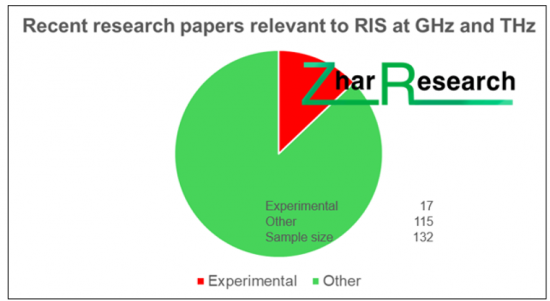
CAPTION: Recent research papers relevant to RIS at GHz and THz showing need for more experimental work as we approach commercialisation. Source: Zhar Research report, “6G Communications: Reconfigurable Intelligent Surface RIS Materials and Hardware Markets, Technology 2027-2047”.
Table of Contents
1. Executive summary and conclusions with roadmap and forecast lines 2027-2047
- 1.1 Purpose of this report
- 1.2 Methodology of this analysis
- 1.3 Background to RIS
- 1.3.1 Useful for 5G but essential for 6G
- 1.3.2 RIS Google, research paper, patent trends, trending RIS topics
- 1.3.3 Dreams of RIS everywhere: infograms
- 1.4 Many types of RIS needed for 6G
- 1.5 Ten key conclusions concerning 6G Communications generally
- 1.6 27 general conclusions concerning 6G RIS
- 1.7 Seven key conclusions concerning 6G RIS materials and component opportunities
- 1.8 Seven key conclusions concerning 6G RIS cost issues
- 1.9 Six key conclusions concerning 6G RIS and reflect-array manufacturing technology
- 1.10 Eight SWOT appraisals
- 1.10.1 6G RIS SWOT appraisal
- 1.10.2 SWOT appraisal of 6G adding sub-THz, THz, near infrared and visible frequencies
- 1.10.3 SWOT appraisal of BD-RIS for 6G
- 1.10.4 STAR-RIS SWOT appraisal
- 1.10.5 SWOT appraisal of 6G RIS for OWC
- 1.10.6 SWOT appraisal of 6G ISAC and its use of RIS
- 1.10.7 SWOT appraisal of visible light communication VLC
- 1.10.8 SWOT appraisal for metamaterials and metasurfaces generally
- 1.10.9 SWOT appraisal of morphing Flexible Intelligent Metasurfaces FIM
- 1.11 6G systems, materials and standards roadmaps in six lines 2026-2047
- 1.12 6G reflectarray and RIS market forecasts and background forecasts in 24 lines 2027-2047
- 1.12.1 6G fully passive metamaterial reflect-array market OWC and total $ billion 2029-2047
- 1.12.2 6G RIS value market $ billion: active vs four semi-passive categories by frequency 2026-2047 with explanation
- 1.12.3 6G RIS area sales yearly billion square meters 2027-2047 with explanation
- 1.12.4 Average 6G RIS price $/ square m. ex-factory including electronics 2028-2047 with explanation
- 1.12.5 6G RIS area sales vs average panel area, sales number and total deployed cumulatively 2027-2047 with explanation
- 1.12.6 Percentage share of global RIS hardware value market by four regions 2029-2047
- 1.12.7 Smartphone and successor billion units sold globally 2025-2047
- 1.12.8 Market for 6G vs 5G base stations units millions yearly 2025-2047
- 1.12.9 Market for 6G base stations market value $bn 2029-2047
2. Introduction with research through 2026
- 2.1 Overview
- 2.1.1 RIS definitions, context, needs driving increased RIS sophistication
- 2.1.2 RIS operation modes, issues and design approaches in providing planned 6G benefits
- 2.1.3 Important trend from moving parts to smart materials
- 2.1.4 Diverse functionalities and applications of RIS and allied intelligent metasurfaces
- 2.1.5 Examples of current approaches to RIS design and capability
- 2.1.6 Unique features of RIS vs traditional approaches and combinations
- 2.1.7 Liquid crystal as a variable capacitive medium in phased arrays
- 2.1.8 RIS competing with traditional approaches
- 2.1.9 How 6G systems will mix and match many technologies in the propagation path
- 2.1.10 Active RIS becomes important: different envisaged potential and advances
- 2.2 RIS functionality and usefulness – a closer look
- 2.2.1 Improved spatial coverage and macro-diversity
- 2.2.2 Capacity enhancement, green communications and Internet of Things
- 2.2.3 Physical layer security, anti-jamming, and reliability enhancement
- 2.2.4 Enabling Large-Scale IoT Network Deployment
- 2.2.5 Wireless Sensing and Localization, HRIS, ISAC
- 2.2.6 RIS from the systems and security viewpoint
- 2.3 Activities of standards bodies and influencers related to 6G RIS
- 2.4 Broadening vs retrenching 6G and 6G RIS objectives, smart radio environments
- 2.5 Terminology thicket
- 2.6 Changing industrial and research trends
- 2.6.1 Broadening theoretical studies useful but relative neglect of hardware is not
- 2.6.2 Backtracking on frequencies compromises capability at launch
- 2.6.3 Latest research focussed on broadly 5G frequencies: GHz and mmWave for 6G
- 2.6.4 0.1THz to 3THz 6G RIS research
- 2.7 Improving reach at the higher frequencies: trajectory engineering
- 2.8 Analysis of other research advances 2025 through
- 2.8.1 Specifically 6G RIS, reflect arrays, phased arrays
- 2.8.2 Adjacent topics research in 2025, 2026 and for scheduled publication in
- 2.9 6G global architecture proposals, complementary systems
3. Ultimate 6G RIS hardware toolkit: invisible, wide area, self-powered, self-learning, self-adaptive, self-healing, self-cleaning, ubiquitous, autonomous, everlasting, AI enabled, dynamic spectrum sharing, other with research through 2026
- 3.1 Overview
- 3.1.1 Making 6G RIS more acceptable, deployable and useful: many advances through
- 3.1.2 Synergistic combination of advanced physical and RIS properties
- 3.2 Invisible RIS – transparent or out of sight
- 3.2.1 The journey to vanishing RIS: transparent or out-of-sight
- 3.2.2 Transparent 6G RIS in 2025-6: companies, universities, ambitions
- 3.2.3 Transparent reflect arrays: Sekisui and others
- 3.3 Large Intelligent Surfaces LIS and Extremely Large-scale Antenna Array ELAA research including wide area RIS
- 3.3.1 Definitions and benefits
- 3.3.2 Large Intelligent Surfaces LIS RIS enhancing security, range, error reduction
- 3.3.3 Advances in protective coatings for wide area energy harvesting and RIS
- 3.4 RIS will become self-powered and enable zero energy client devices
- 3.4.1 Overview
- 3.4.2 Maturity of primary ZED enabling technologies
- 3.4.3 Ranking of most popular 6G ZED compounds and carbon allotropes in research
- 3.4.4 Context of ZED: overlapping and adjacent technologies and examples of long-life energy independence
- 3.4.5 SWIPT, STIIPT, AmBC and CD-ZED objectives and latest progress
- 3.4.6 13 harvesting technologies for 6G ZED infrastructure and client devices 2027-2047
- 3.4.7 6G active RIS and UM MIMO base station power demands matched to energy harvesting options
- 3.4.8 SWOT appraisal of batteryless storage technologies for ZED RIS and more
- 3.4.9 SWOT appraisal of circuits and infrastructure that eliminate storage
- 3.5 Artificial intelligence and machine learning for optimising, self-learning, self-adaptive , autonomous RIS
- 3.6 Multimode and multifrequency, dynamic spectrum sharing DSS 6G and its RIS
4. Beyond diagonal RIS architecture tackles 6G RIS limitations
- 4.1 Definitions, material challenges, applicability
- 4.1.1 Significance
- 4.1.2 The simple description
- 4.1.3 SWOT appraisal of BD-RIS for 6G
- 4.1.4 Coverage in this chapter and your opportunities
- 4.2 Potential benefits of BD-RIS
- 4.3 BD-RIS hardware challenges
- 4.4 Practical implementations and requirement for improvement
- 4.4.1 The challenge
- 4.4.2 First practical demonstrations of BD-RIS
- 4.4.3 Terrestrial BD-RIS progress through 2025: many other advances and appraisals
- 4.4.4 Improving RIS in non terrestrial networks NTN
5. Multifunctional and multi-mode RIS including STAR RIS, ISAC, SWIPT with research through 2026
- 5.1 Overview with review of research, industrial trends and possibilities
- 5.2 Simultaneous transmissive and reflective STAR RIS
- 5.2.1 Overview
- 5.2.2 STAR-RIS optimisation
- 5.2.3 STAR-RIS-ISAC integrated sensing and communication system
- 5.2.4 TAIS Transparent Amplifying Intelligent Surface
- 5.2.5 Simultaneous Wireless Information and Power Transfer SWIPT including active STAR-RIS and THz versions
- 5.2.6 STAR-RIS with energy harvesting and adaptive power
- 5.2.7 STAR RIS SWOT appraisal
- 5.3 Other multifunctional and multi-mode RIS
- 5.3.1 Overview
- 5.3.2 Multifunctional RIS: solid-state cooling functionality
- 5.4 Integrated sensing and communication ISAC including RIS, SWOT, advances 2025 snd
- 5.4.1 Native 6G capability
- 5.4.2 SWOT appraisal of 6G ISAC and its use of RIS
- 5.4.3 Basics
- 5.5 Multimode RIS ensuring system security: combined semi-passive and active RIS
6. Base station, UM-MIMO, Tower in the Sky HAPS and UAV RIS with research advances 2026
- 6.1 Overlapping subjects: RIS enhancing 6G base stations and non-terrestrial networks
- 6.2 Progress to UM-MIMO
- 6.3 RIS-enabled, self-powered ultra-massive 6G UM-MIMO base station design
- 6.3.1 Basic and structural RIS
- 6.3.2 Morphing metamaterial MIMO technology
- 6.4 RIS for massive MIMO base station: Tsinghua University, Emerson
- 6.5 RIS as small cell base station
- 6.6 Other important advances in RIS-enabled MIMO and base stations in 2025 through
- 6.7 How satellites and UAVs will aid and sometimes benefit from 6G RIS
- 6.8 Important advances announced in 2025 and 2026 and scheduled for
- 6.9 Large stratospheric HAPS RIS
7. RIS tuning hardware objectives and progress with research through 2026
- 7.1 Overview
- 7.1.1 Primitive to advanced tuning
- 7.1.2 Tuning mechanisms in context
- 7.1.3 Examples of RIS external control stimuli used in research and trials
- 7.1.4 RIS tuning hardware options compared
- 7.1.5 Infogram: The Terahertz Gap demands different tuning materials and devices
- 7.2 Lessons from research carried out on RIS tuning: 2026 and earlier
- 7.2.1 Changing focus
- 7.2.2 Electrical and optical tuning and higher frequencies favoured
- 7.3 Detailed analysis of progress with discrete tuning components
- 7.3.1 General
- 7.3.2 Schottky diode RIS tuning vs other diodes
- 7.3.3 High-Electron Mobility Transistor HEMT RIS tuning
- 7.3.4 Less successful other options with reasons
- 7.4 Prioritisation of tuning materials replacing discretes for 6G RIS 0.1-1THz and NearIR
- 7.4.1 Winners on current evidence
- 7.4.2 Options for integrated tuning materials for higher frequency 6G
- 7.4.3 Vanadium dioxide: rationale and major progress through 2025,
- 7.4.4 Chalcogenide phase change materials notably GST and GeTe
- 7.4.5 Graphene: rationale and major progress through 2025,
- 7.4.6 Liquid crystal rationale and progress through 2025,
- 7.5 Large RIS and other gaps in the market
8. Optical Wireless Communications ORIS for 6G: major progress through 2026
- 8.1 Why OWC including RIS at its frequencies is an attractive addition for 6G
- 8.1.1 Optical Wireless Communications OWC, subset Visible Light Communications VLC, 2026 advances
- 8.1.2 The case for multi-frequency 6G Phase Two including optical “so one gets through”
- 8.1.3 Parameter comparison of Free Space Optical FSO with 3-300GHz communication
- 8.2 The potential and the challenges of Optical RIS ORIS with SWOT appraisals
- 8.2.1 Overview
- 8.2.2 ORIS benefits and the Distributed RIS DRIS option
- 8.2.3 ORIS challenges
- 8.2.4 SWOT appraisal of 6G RIS for OWC
- 8.2.5 SWOT appraisal of visible light communication
- 8.3 ORIS implementation procedures
- 8.4 Long range, underground, underwater and space OWC: RIS: research advances 2026 and earlier
- 8.4.1 General
- 8.4.2 RIS enhanced OWC vehicular networks and mobile environments
- 8.4.3 Hybrid RF-FSO RIS
- 8.4.4 Underwater UOWC systems with 2026 advances
- 8.4.5 Underground OWC needing RIS
- 8.4.6 Laser stratospheric and space communications with RIS technology
- 8.5 Short range and indoor OWC and its RIS: research advances through 2026 and earlier
- 8.5.1 Indoors and short range in air
- 8.5.2 Leveraging other indoor and short-range outdoor systems such as LiFi with RIS
- 8.6 Potentially 6G optical materials
- 8.7 Metalenses for 6G including advances through
- 8.8 Mirror array ORIS design and application advances through
9. 6G Morphing Flexible Intelligent Metasurfaces FIM, 6G hypersurfaces, metamaterial basics
- 9.1 Overview
- 9.2 Appraisal of 6G-related metamaterial research major advances through
- 9.2.1 New advances in metamaterial design
- 9.2.2 Hypersurfaces, stacked intelligent metasurfaces, swarms, bifunctional metasurfaces
- 9.2.3 Optimal metamaterial substrates and low loss, 6G glass TIRS
- 9.2.4 Optimal metamaterial substrates including transparent 6G glass
- 9.3 Metamaterial basics
- 9.3.1 The meta-atom and patterning options
- 9.3.2 Material and functional families
- 9.3.3 Metamaterial reflect-arrays for 5G and 6G Communications
- 9.3.4 Metamaterial patterns and materials through
- 9.3.5 Six formats of communications metamaterial with examples
- 9.4 Metasurface basics
- 9.4.1 Metasurface design, operation and RIS
- 9.4.2 How metamaterial RIS hardware operates
- 9.4.3 RIS and reflect-array construction and potential capability
- 9.4.4 All dielectric and non-linear dielectric metasurfaces
- 9.5 The long-term picture of metamaterials overall
- 9.6 Emerging applications of GHz, THz, infrared and optical metamaterials
- 9.7 Thermal metamaterials
- 9.8 SWOT appraisal for metamaterials and metasurfaces generally
- 9.9 Morphing Flexible Intelligent Metasurfaces FIM basics and their research through
- 9.9.1 Basics
- 9.9.2 FIM network topology and potential applications targetted
- 9.9.3 Many FIM research advances through 2026 assessed
- 9.9.4 SWOT appraisal of 6G FIM
10. RIS and reflect-array manufacture, inspection, testing, cost breakdown
- 10.1 Thin film and transparent electronics state-of-the-art
- 10.2 Trend from discrete boards, stacked films to full smart material integration
- 10.3 Importance of flexible, laminar and 2D energy harvesting and sensing
- 10.4 How manufacturing technologies differ for 6G RIS optical, low or high THz
- 10.4.1 Candidates: nano-imprinting, nano-lithography, lithography, gravure, inkjet, screen, flexo, spray, other
- 10.4.2 Special case: 3D printing with electron beam evaporation
- 10.4.3 Ultra-fast laser system
- 10.5 6G RIS inspection and testing: new advances
- 10.5.1 Testing challenges
- 10.5.2 Progress in RIS inspection
- 10.6 RIS cost analysis
- 10.6.1General assessment
- 10.6.2 NEC and other costed case studies
- 10.6.3 Outdoor semi-passive and active RIS cost analysis at high areas of deployment
- 10.6.4 Indoor semi-passive RIS cost analysis at volume
11. 6G RIS companies : products, plans, patents, Zhar appraisals
- 11.1 Overview and patenting
- 11.1.1 Rapidly changing situation 2025-6
- 11.1.2 RIS patenting and literature trends
- 11.2 AGC Japan
- 11.3 Alcan Systems Germany
- 11.4 Alibaba China
- 11.5 Alphacore USA
- 11.6 China Telecom China Mobile, China Unicom, Huawei, ZTE, Lenovo, CICT China collaboration
- 11.7 Ericsson Sweden
- 11.8 Fractal Antenna Systems USA
- 11.9 Greenerwave France
- 11.10 Huawei China
- 11.11 ITOCHU Japan
- 11.12 Kymeta Corp. USA
- 11.13 Kyocera Japan
- 11.14 Metacept Systems USA
- 11.15 Metawave USA
- 11.16 NEC Japan
- 11.17 Nokia Finland with LG Uplus South Korea
- 11.18 NTT DoCoMo and NTTJapan
- 11.19 Orange France
- 11.20 Panasonic Japan
- 11.21 Pivotal Commware USA
- 11.22 Qualcomm USA
- 11.23 Samsung Electronic South Korea
- 11.24 Sekisui Japan
- 11.25 SensorMetrix USA
- 11.26 SK Telecom South Korea
- 11.27 Sony Japan
- 11.28 Teraview USA
- 11.29 Vivo Mobile Communications China
- 11.30 VTT Finland
- 11.31 ZTE China

 全球6G技術市場規模、佔有率、趨勢和成長分析報告(2026-2034年)全球6G網路市場規模、佔有率、趨勢和成長分析報告(2026-2034年)
 6G市場-全球及區域分析:按產品、應用和國家分類-分析與預測(2030-2040年)
 6G通訊中光學和光電子技術的機會:傳輸、RIS、接收、佈線、處理、調諧、冷卻、自供電、感測器:市場和技術(2027-2047)
 6G通訊基礎設施和客戶設備的溫度控管材料:商業機會、市場和技術(2027-2047)
 太空船自主市場規模、佔有率和成長分析:按組件、自主等級、應用、太空船類型、最終用戶和地區分類 - 產業預測,2026-2033 年6G全球格局(2027-2047)
 6G部署場景:從簡單的無線設備升級到分散式人工智慧基礎設施全球 6G 市場:按組件、技術、應用和最終用戶分類-市場規模、產業動態、機會分析和預測(2026-2035 年)
 6G:市場佔有率分析、產業趨勢與統計、成長預測(2025-2030)