


 |
市場調查報告書
商品編碼
2123811
太赫茲醫療診斷、治療、硬體與材料:市場與科技(2027-2047)Terahertz Medical Diagnosis, Therapy, Hardware, Materials: Markets, Technology 2027-2047 |
||||||

概要
將太赫波(0.1–10 THz)引入醫學領域,將開啟一個人們健康長壽至120歲的新時代。這份385頁的報告對太赫茲醫學面臨的挑戰和商業機會進行了最新、最全面的分析。
卓越的檢測能力
根據這份報告,太赫茲在醫療領域的應用已經非常廣泛。太赫茲技術能夠比以往更精確地識別食品和環境中的多種有害物質,並可實現微塑膠的原位檢測。此外,由於太赫茲能夠獲得更詳細的信息,因此大大提高了藥品品管和疾病早期診斷的水平。由於太太赫茲屬於非電離輻射,因此可能比X光更安全。此外,太赫茲波還能與人體多種特性相互作用,目前已有應用將其用於癌症的早期檢測。利用太赫茲的醫療感測器、成像器、光譜儀和輻射源正展現出極高的應用價值。
治療效果極佳
其次,在疾病治療方面,尤其是在神經系統疾病、癌症和組織治療領域,已經取得了顯著進展。更廣義地說,它也可能促進細胞修復。所使用的能量水平不會像X光那樣損傷DNA,而是透過微妙的熱振動和非熱分子振動與組織相互作用。太赫茲可以刺激細胞、改善血液循環並提供非侵入性鎮痛。特定頻率可以影響細胞代謝、微循環和與疼痛相關的神經訊號。這開啟了多種可能性,包括減輕關節不適、肌肉緊張和神經性疼痛。許多患者表示在治療過程中感到舒適的溫暖和深度放鬆。
目錄
第1章:摘要整理與結論
- 本報告的目的和範圍
- 太赫茲醫療保健及相關技術的主要及相關主題。
- 報告範圍的圖表
- 本分析的調查方法與重點領域
- 本報告將介紹太赫茲技術在醫療應用上有用的特性。
- 太赫茲技術在醫療保健領域的應用
- 主要總體結論:對應用、設備和系統進行了 11 項 SWOT 評估。
- 4 項總體 SWOT 分析評分
- 對適用於醫療應用的太赫茲硬體進行七項SWOT評估。
- 關於太赫茲醫療設備材料的結論:分析圓餅圖、資訊圖
- 太赫茲醫療硬體藍圖:技術、部署與市場
- 18項市場預測:包含表格、圖表和說明
- 太赫茲硬體市場(包括醫療應用):6 項
- 太赫茲硬體市場在醫療及相關領域:光譜學、成像及其他
- 太赫茲硬體在醫療及相關領域的三個市場:光譜學、成像和其他構成比。
- 醫療及相關領域太赫茲硬體市場規模:依4個地區分類
- 電磁超構裝置市場
- 熱超構裝置市場:按應用領域分類
第2章:太赫茲波:背景、材料、裝置和實行技術
- 概述
- 太赫茲材料和組件選項
- 太赫茲產生:2025-2026 年的挑戰、技術與研究進展
- 用於太赫茲探測和調諧的材料和裝置
- 低損耗太赫茲介質:20種材料的太赫茲頻率與介電常數/介電損耗角正切的關係
- 太赫茲層狀結構:天線、自旋電子學、等離子激元學
- 概述和近期案例研究
- 太赫茲天線:2025-2026 年面臨的挑戰、資訊圖表與研究進展
- 太赫茲自旋電子學和等離子激元學
- 實行技術:超材料與超表面
- 用於醫療及相關應用的太赫茲2D材料
- 太赫茲雷射和其他連貫光源
- 用於醫學成像、光譜學和其他應用的屈光太赫茲透鏡和準光學技術。
第3章:太赫茲的生理效應與接觸評估
- 概述
- 太赫茲的熱效應與非熱效應生理效應
- 太赫茲輻射對神經細胞放電特性和囓齒動物行為的影響。
- 太赫茲接觸評估
第4章:太赫茲在醫學診斷與治療的應用
- 概述
- 太赫茲放射療法:2025-2026年快速研究進展及未來展望概述
- 檢測並立即清除菌血症
- 癌症治療
- 成功修復角膜損傷
- Fentanyl過量後的恢復
- 神經病學:2025 年以後的新療法與未來展望
- 阿茲海默症治療
- 焦慮症
- 認知與記憶障礙,憂鬱症的治療
- 失智症和神經退化性疾病的介入和治療
- 緩解神經病變疼痛
- 中風患者:功能預後改善
- 相關設備的進步
- 太赫茲內視鏡
- 視網膜、人工電子耳和心臟植入的精確刺激和無線控制。
- 生產合適的太赫茲設備的公司
- TeraSense(美國)
- TeraView(英國)
第5章:太赫茲影像在醫學上的應用
- 太赫茲成像、醫用化學顯微鏡、超高解析度成像的基礎知識
- 太赫茲成像的SWOT評估
- 2025-2026年太赫茲成像技術的其他進展
- 奈米顯微鏡
- 全像攝影
- 太赫茲掃描近場光學顯微鏡
- 用於皮膚診斷的太赫茲成像
- 利用超表面增強太赫茲影像技術診斷膠質母細胞瘤
- 最佳化藥片
- 現階段,其他相關研究的進展尚未專門針對醫學應用。
- 太赫茲成像系統十大製造商
第6章:太赫茲光譜在醫療保健中的應用
- 太赫茲光譜儀和頻譜分析儀
- 太赫茲醫學光譜的SWOT評估
- 太赫茲超高解析度光譜性能與工具包
- 2025年至2026年太赫茲超高解析度光譜學的其他進展
- 六家太赫茲光譜儀製造商
第7章:用於醫療保健的太赫茲感測器
- 基礎知識
- 太赫茲醫療及相關感測技術有重大進展
- 癌症檢測:乳癌、腦瘤
- 血糖值檢測
- 非法藥物和有害氣體
- 食品中農藥的檢測
- 藥物和診斷中的胺基酸,例如苯丙胺酸
- 超高靈敏度檢測微量蛋白:血清澱粉樣蛋白A(AA)類澱粉沉積症
- 尿液中膽紅素的檢測
- 其他用於醫療及相關應用的太赫茲感測器:2025-2026年將取得多項重大進展
第8章:用於醫學光譜學和新型醫用同位素生產的太赫茲迴旋管
- 概述
- 太赫茲迴旋管在光譜學的應用:2025-2026 年的進展
- 其他研究將持續到2025-2026年
- SHINE Technologies(美國)
- 京都融合工程(日本)
第9章:用於醫學診斷、感測、樣本檢測和光譜學的太赫茲波導管
- 概述
- 太赫茲電纜波導管的SWOT評估
- 2025-2026 年的挑戰、技術創新與其他發展
- 聚合物太赫茲波導管的製造,包括長捲軸式電纜和 3D 列印,預計將在 2025-2026 年取得進展。
- 醫用波導管或其組件的製造商和供應商。
第10章:醫療領域太赫茲頻段的6G通訊方案
- 概述和SWOT分析
- 2030年至2046年6G的發展演變及太赫茲技術定位
- 6G 有潛力實現真正的物聯網,這將造福醫療保健產業。
- 改善醫院環境、遠端醫療和災害應變。
- 面向醫療保健領域的 6G 架構,包括智慧醫院及其優勢
- 行動醫療高級多媒體應用
- 6G 中的人工智慧有潛力實現真正的物聯網,這將造福醫療保健產業。
- 6G即時整合生活方式和環境訊息,實現高度個人化醫療。
- 材料領域的商業機會:對245項最新太赫茲及其他光學相關6G研究的分析
- 按運作頻率分類的 6G 硬體列印技術選項
- 2025年至2026年其他6G通訊和太赫茲研究進展
- 中興通訊(中國)
Summary
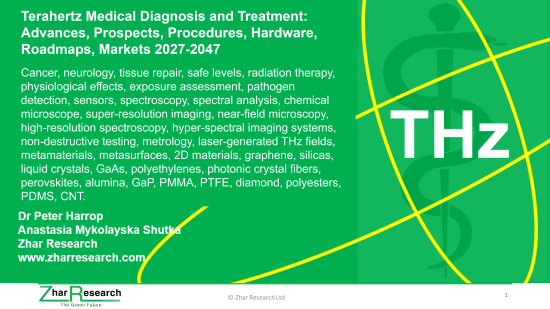
Terahertz Medical Diagnosis and Treatment: Advances, Prospects, Procedures, Hardware, Roadmaps, Markets 2027-2047
Humans will often live healthily to 120 years, partly thanks to the adoption of terahertz frequencies (0.1–10 THz) in medicine. The most up-to-date and comprehensive analysis of the issues and your opportunities in THz medicine is the 385-page, commercially-oriented, Zhar Research report, “Terahertz Medical Diagnosis and Treatment: Advances, Prospects, Procedures, Hardware, Roadmaps, Markets 2027-2047”
Exceptional detection
The report finds that the scope of the healthcare-related use of terahertz frequencies is already remarkable. Terahertz can better identify many food and environmental hazards- including identification of microplastics in situ. Terahertz frequencies are greatly enhancing pharmaceutical quality control and earlier diagnosis, by being more revealing. Terahertz frequency can be safer than x-rays, since it is non-ionising. It interacts with many features of the human body, something already providing earlier cancer detection as just one example. Terahertz frequency medical sensors, imagers, spectrometers and radiation sources are proving very useful.
Exceptional treatment
Next comes treatment of diseases, with particularly impressive advances in neurology, cancer, and tissue treatment. More generally, it can offer cellular repair. The energy level employed does not damage DNA like X-rays, but it interacts with tissues through subtle thermal and non-thermal molecular vibrations. Terahertz can stimulate cells, improve blood circulation, and provide non-invasive pain relief. Specific frequencies can influence cellular metabolism, microcirculation, and nerve signaling related to pain. That creates opportunities including reducing joint discomfort, muscle strain, and neuropathic pain. Users frequently report a pleasant warming sensation and deep relaxation during treatment.
Analysis of your opportunities
The report has an Executive Summary and Conclusions of a full 44 pages because it is sufficient in itself if you have limited time. Here are the basics, the 17 key conclusions, the 11 SWOT appraisals, 3-line roadmaps 2027-2047 and 21 forecast lines. Chapter 2. Terahertz in Context, Materials, Devices and Enabling Technologies (58 pages) sets the picture, including introduction to two important enabling technologies – THz lasers and metamaterials. In this and all subsequent chapters, research advances through 2026 are revealed, essential for understanding where the subject is heading. Chapter 3. THz Physiological Effects and Exposure Assessment (10 pages) gives an honest appraisal of how it is not enough to simply say, “THz is non-ionising so it is safe”. The lowest doses used for diagnostics are safe but long-term effects at higher doses are not yet fully understood. Appropriately, its use for treatment must now progress from many research successes to verification and regulatory approval.
Impressive new advances
Chapter 4. THz Medical Diagnosis and Treatment (38 pages) will startle newcomers with the sheer scope of the progress in earlier and better detection of diseases and particularly the effectiveness and breadth of successful treatments emerging. The examples studied are mostly from latest advances through 2026. They include bacteremia, many cancers, corneal repair, a wide range of neurological interventions, Alzheimers, cognitive and memory disfunction, dementia, neuronal degenerative diseases and improving outcomes for stroke patients. Added to those are Fentanyl overdose reversal, depression, anxiety and neuropathic pain alleviation. See advances in associated equipment 2025-6 and why there is scope for many more companies to become involved.
The next chapters delve into your emerging opportunities to make or use the key equipment, with SWOT appraisals and comparisons, starting with Chapter 5. THz Imaging for Healthcare (24 pages). This includes the activities of ten companies and interprets latest advances, then comes Chapter 6. THz Spectroscopy for Healthcare (28 pages) including basics, what is now being examined – including smoker breath, protein dynamics and food quality. Then comes the new super-resolution spectroscopy and the activities of six manufacturers.
Chapter 7. THz Sensors for Healthcare uses 46 pages with similarly broad scope. That includes basics then better sensing of breast cancer, brain tumour, blood sugar, illegal drugs, hazardous gases, pesticide detection in food, phenylalanine and other amino acids in pharmaceuticals, trace proteins and urine bilrubin. More is revealed in latest 2026 research. Chapter 8. THz gyrotrons for medical spectroscopy and manufacture of new medical isotopes (26 pages) uses basics, latest research and SWOT to explain. Chapter 9. THz waveguides for medical diagnostics, sensing, sample inspection, spectroscopy (36 pages) is similarly comprehensive, critical and forward-looking for this enabling technology. Chapter 10. Planned 6G Communication at THz frequencies for Healthcare (40 pages) closes the report with this aspect, its materials and manufacturers. In prospect are smarter hospitals, healthcare Internet of Things and safer, better remote surgery.
Whether you seek to invest, supply materials or hardware or use the technology, your essential guide is the new Zhar Research report, “Terahertz Medical Diagnosis and Treatment: Advances, Prospects, Procedures, Hardware, Roadmaps, Markets 2027-2047”.
Table of Contents
1. Executive summary and conclusions
- 1.1 Purpose and scope of this report
- 1.2 Core and peripheral topics involving THz medical and allied technology
- 1.3 Report coverage infogram
- 1.4 Methodology and focus of this analysis
- 1.5 Medically-useful THz characteristics appearing in this report
- 1.6 Healthcare applications of THz technology
- 1.7 Key general conclusions: applications, devices, systems with 11 SWOT appraisals
- 1.8 Four general SWOT appraisals
- 1.8.1 SWOT appraisal of THz technology
- 1.8.2 SWOT appraisal of THz use in the medical and allied sectors
- 1.8.3 SWOT appraisal of THz disease diagnosis and treatment
- 1.8.4 SWOT appraisal of 6G adding THz, near infrared and visible frequencies
- 1.9 Seven SWOT appraisals of medically-useful THz hardware
- 1.9.1 SWOT appraisal of THz biosensors
- 1.9.2 SWOT appraisal of THz medical imaging
- 1.9.3 SWOT appraisal of THz medical spectroscopy
- 1.9.4 SWOT appraisal of THz gyrotrons
- 1.9.5 SWOT appraisal of THz cable waveguides
- 1.9.6 SWOT appraisal of THz medical lasers
- 1.9.7 SWOT appraisal for metamaterials, metasurfaces, metadevices
- 1.10 Conclusions concerning THz medical device materials with analysis pie chart, infogram
- 1.10.1 Five conclusions
- 1.10.2 Terahertz Gap with useful materials and device capabilities: 3 infograms
- 1.10.3 Dissipation factor variation for 20 material families 0.1-1THz
- 1.10.4 Components-in-a-box (discrete boards, antennas etc.) trends to THz smart material integration
- 1.11 THz medical hardware roadmaps: technology, deployment, markets 2027-2047
- 1.12 Market forecasts in 18 lines with tables, graphs and explanation 2027-2047
- 1.12.1 THz hardware market including medical in six lines $ billion 2027-2047
- 1.12.2 Medical and allied THz hardware market: spectrometry, imaging, other $ billion 2027-2047
- 1.12.3 Three THz medical and allied hardware markets: spectrometry, imaging, other % 2027-2047
- 1.12.4 THz medical and allied hardware value market by four regions 2027-2047
- 1.12.5 Electromagnetic meta-device market $ billion 2027-2047
- 1.12.6 Thermal meta-device market $ billion 2027-2047 by two application segments
2. Terahertz in context, materials, devices and enabling technologies
- 2.1 Overview
- 2.1.1 THz definition, characteristics, biological impact, medical, and allied applications
- 2.1.2 Challenges being overcome, THz gap,, trend to smart materials
- 2.2 Choices of THz material and component
- 2.2.1 THz generation: challenges, techniques, research advances 2025-6
- 2.2.2 THz detection and tuning materials and devices
- 2.2.3 Low-loss THz dielectrics: permittivity and dissipation factor vs THz frequency for 20 material families
- 2.3 Terahertz laminar constructs: antennas, spintronics, plasmonics
- 2.3.1 Overview with recent examples
- 2.3.2 Terahertz antennas: challenges, infogram, research advances 2025-6
- 2.4 THz spintronics and plasmonics
- 2.5 Enabling technologies: metamaterials and metasurfaces
- 2.5.1 Overview
- 2.5.2 SWOT appraisal for metamaterials and metasurfaces
- 2.5.3 Research advances 2025-6
- 2.6 THz 2D materials for medical and allied applications
- 2.6.1 Overview
- 2.6.2 Research advances 2025-6
- 2.7 THz lasers and other coherent sources
- 2.7.1 Uniques, medical and allied applications, infogram
- 2.7.2 Technologies
- 2.7.3 Materials opportunities
- 2.7.4 THz laser research advances 2025-6
- 2.7.5 Chip-scale, electrically-tunable coherent THz source
- 2.8 Refractive THz lenses, quasi-optics for medical imaging, spectroscopy, other
3. THz physiological effects and exposure assessment
- 3.1 Overview
- 3.2 THz physiological effects thermal and non-thermal
- 3.3 Effects of terahertz radiation on neuronal firing characteristics and rodent behavior
- 3.4 THz exposure assessment
4. THz medical diagnosis and treatment
- 4.1 Overview
- 4.1.1 Diagnosis and treatment
- 4.1.2 SWOT appraisal of THz disease treatment
- 4.2 THz radiation therapy: overview of rapid research advances 2025-6 and future prospects
- 4.3 Bacteremia detection and in situ elimination
- 4.4 Cancer treatment
- 4.4.1 Superior detection, precision oncology, reduced side effects: 2026 advances
- 4.4.2 Optimal terahertz treatment of different cancers
- 4.5 Corneal injury repair succeeds in
- 4.6 Fentanyl overdose reversal
- 4.7 Neurology: new treatments and prospects 2025 through
- 4.7.1 Alzheimers disease therapy
- 4.7.2 Anxiety
- 4.7.3 Cognitive and memory disfunction, depression treatment
- 4.7.4 Dementia and intervening or treating neuronal degenerative diseases
- 4.7.5 Neuropathic pain alleviation
- 4.7.6 Stroke patients: improving functional outcomes
- 4.8 Advances in associated equipment 2025-6
- 4.8.1 Terahertz endoscopy
- 4.8.2 Precise stimulation and wireless control in retinal, cochlear, cardiac implants
- 4.9 Companies making appropriate THz equipment
- 4.9.1 TeraSense USA
- 4.9.2 Teraview UK
5. THz imaging for healthcare
- 5.1 THz imaging basics, medical chemical microscope, super resolution imaging
- 5.2 SWOT appraisal of THz imaging
- 5.3 Other THz imaging advances 2025-6
- 5.3.1 Nanoscopy
- 5.3.2 Holography
- 5.3.3 Terahertz scanning near-field optical microscopy
- 5.3.4 THz imaging for skin diagnostics
- 5.3.5 Metasurface-enhanced THz imaging for glioblastoma
- 5.3.6 Pharmaceutical tablet optimisation
- 5.3.7 Other relevant research advances not specifically medical at this stage
- 5.4 Ten leading manufacturers of THz imaging systems
6. THz spectroscopy for healthcare
- 6.1 THz spectroscopy and spectrum analysers
- 6.1.1 Spectroscopy basics
- 6.1.2 Spectrum analyzers
- 6.1.3 Example: Trace gas signatures in exhaled breath of a human smoker detected by THz
- 6.1.4 Example: Terahertz spectroscopic analysis in protein dynamics
- 6.1.5 Example: THz spectra of amino acids, biopolymers, serotonin, others
- 6.2 SWOT appraisal of THz medical spectroscopy
- 6.3 THz super-resolution spectroscopy capability, toolkit
- 6.3.1 Capability
- 6.3.2 Toolkit
- 6.4 Other THz super-resolution spectroscopy advances through 2025-6
- 6.5 Six THz spectrometer manufacturers
7. THz sensors for healthcare
- 7.1 Basics
- 7.1.1 Biomimetics, inputs, outputs, anatomy, smart sensors
- 7.1.2 THz (far infrared) sensors in context of infrared sensors generally
- 7.1.3 SWOT appraisal of THz biosensors
- 7.2 Some major advances in THz medical and allied sensing
- 7.2.1 Cancer detection: breast cancer, brain tumour
- 7.2.2 Blood sugar detection
- 7.2.3 Illegal drugs and hazardous gases
- 7.2.4 Pesticide detection in food
- 7.2.5 Phenylalanine and other amino acids in pharmaceuticals and diagnostics
- 7.2.6 Ultrasensitive sensing of trace proteins: Serum amyloid AA amyloidosis
- 7.2.7 Urine bilrubin detection
- 7.3 Other THz sensors for medical and allied applications: many major advances 2025-6
8. THz gyrotrons for medical spectroscopy and manufacture of new medical isotopes
- 8.1 Overview
- 8.1.1 Uses and benefits
- 8.1.2 SWOT appraisal of THz gyrotrons
- 8.2 THz gyrotrons for spectroscopy: advances in 2025-6
- 8.3 Other research through 2025-6
- 8.4 SHINE Technologies USA
- 8.5 Kyoto Fusioneering Japan
9. THz waveguides for medical diagnostics, sensing, sample inspection, spectroscopy
- 9.1 Overview
- 9.1.1 Definition, purpose
- 9.1.2 Use in medical spectroscopy and exploring biological samples
- 9.1.3 Basic types of THz waveguides
- 9.1.4 Materials opportunities
- 9.2 SWOT appraisal of terahertz cable waveguides
- 9.3 Challenges, innovations and other 2025-6 advances
- 9.4 Manufacturing polymer THz waveguides including cable in long reels and 3D printing and 2025-6 advances
- 9.5 Manufacturers and suppliers of medical waveguides or their parts
10. Planned 6G Communication at THz frequencies for healthcare
- 10.1 Overview with SWOT appraisal
- 10.2 Evolution of 6G 2030-2046 and the place of THz
- 10.3 6G may enable genuine Internet of Things benefitting healthcare
- 10.3.1 Hospital environment, remote healthcare and disaster response improvement
- 10.3.2 6G architecture and benefits for healthcare including smart hospitals
- 10.3.3 Mobile health multimedia applications improvement
- 10.3.4 AI in 6G may enable genuine Internet of Things benefitting healthcare
- 10.3.5 6G integration of lifestyle and environment in real-time for hyper-personalized medicine
- 10.4 Materials opportunities: Analysis of 245 latest THz and other optical 6G-related research
- 10.5 Printing options for 6G hardware by frequency of operation
- 10.6 Other 6G Communications THz research advances through 2025-6
- 10.7 ZTE China

 2026 年至 2035 年兆赫技術的市場機會、成長要素、產業趨勢與預測。
 兆赫技術市場:全球市場預測,2026-2032年兆赫成像與感測市場機會、成長促進因素、產業趨勢分析及2026-2035年預測
 兆赫技術:市場佔有率分析、產業趨勢與統計、成長預測(2026-2031)
 兆赫成像與探測市場-全球市佔率及排名、總收入及2026-2032年需求預測
 兆赫技術市場規模、佔有率和成長分析:按組件、技術類型、頻寬、應用、最終用戶產業、部署類型和地區分類 - 產業預測,2026-2033年
 兆赫組件與系統市場:按組件、系統、應用、地區分類
 兆赫技術市場規模、佔有率、趨勢和預測:按類型、組件、最終用途行業和地區分類,2026-2034年
 兆赫技術全球市場規模、佔有率、趨勢和成長分析報告(2026-2034)
 兆赫技術市場分析及預測(至2035年):按類型、產品、服務、技術、組件、應用、設備、部署、最終用戶和解決方案分類