


 |
市場調查報告書
商品編碼
2121185
2026 年至 2035 年兆赫技術的市場機會、成長要素、產業趨勢與預測。Terahertz Technology Market Opportunity, Growth Drivers, Industry Trend Analysis, and Forecast 2026 - 2035 |
||||||

全球兆赫技術市場預計到 2025 年將達到 4.13 億美元,到 2035 年將以 15% 的複合年成長率成長,達到 17 億美元。
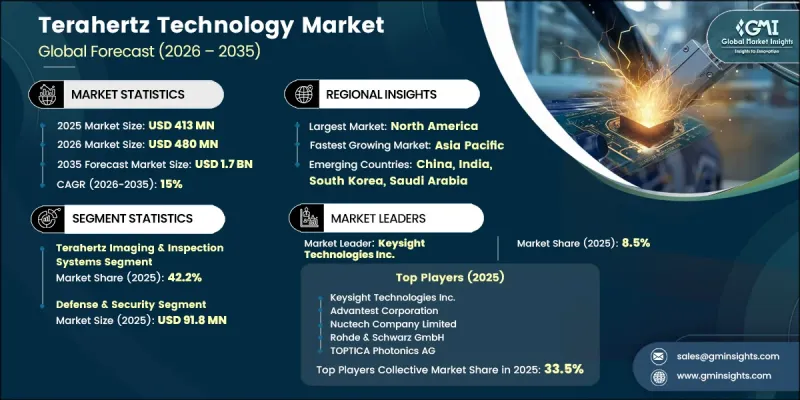
市場擴張的驅動力來自全球對6G通訊研究資金籌措的增加、非電離兆赫成像技術在安全和國防領域的日益普及,以及兆赫光譜技術在醫療診斷和藥品品質保證領域應用範圍的擴大。對高精度半導體檢測和先進材料分析的需求也不斷成長。航太、汽車、電子和工業生產領域對無損檢測技術的廣泛應用,為基於兆赫的解決方案創造了更多機會。高頻電子、感測技術、成像平台和測量系統的持續進步,進一步拓展了兆赫技術的商業性潛力。隨著研究機構、技術開發人員和工業用戶不斷探索更高頻率的應用,市場有望在通訊、檢測、感測、成像和分析應用領域中抓住新的機會。
| 市場範圍 | |
|---|---|
| 開始年份 | 2025 |
| 預測期 | 2026-2035 |
| 初始市場規模 | 4.13億美元 |
| 預測市場規模 | 17億美元 |
| 複合年成長率 | 15% |
兆赫技術市場正受到全球持續加大對6G研發投入的推動,各組織致力於開發速度與頻寬顯著提升的無線系統。人們對先進無線連接日益成長的興趣促使研究人員和製造商深入研究兆赫頻率設備、測量技術及相關系統結構。未來通訊平台向高頻率的轉變,為兆赫技術及相關設備創造了新的機會。此外,半導體技術的進步推動了兆赫收發器和晶片的研發,使其能夠整合到日益複雜的系統中。高頻元件、測量能力、光電技術和半導體工程的進步,不斷拓展兆赫設備的實際應用範圍。
預計在預測期內,兆赫通訊系統市場將以16.6%的複合年成長率成長。對超高速資料傳輸日益成長的需求推動了兆赫收發器、天線及相關通訊組件的持續發展。隨著技術開發人員探索用於未來無線網路的更高頻率解決方案,針對兆赫頻率系統的研究活動也不斷擴展。光子整合、半導體工程、波束成形技術和超低延遲通訊架構的進步,提升了兆赫通訊平台的技術可行性。隨著持續創新,這些系統正逐步朝向下一代行動通訊基礎設施、自動駕駛、智慧城市環境和工業IoT(IIoT)應用等領域的商業部署邁進。不斷成長的頻寬需求和組件層面的持續進步預計將推動兆赫通訊系統領域的強勁成長。
預計2026年至2035年,通訊領域的複合年成長率將達到26.2%。 6G無線通訊研發投入的增加,推動了對能夠處理極高資料傳輸速率和滿足先進連線需求的技術的需求。對兆赫頻率通訊架構的研究不斷深入,為整個通訊生態系統中的技術供應商創造了新的機會。高頻天線、收發器和光子積體電路的持續改進,正在提升兆赫通訊系統的效能和擴充性。隨著網路營運商、設備製造商和研究機構積極尋求用於未來通訊基礎設施的高頻平台,這些技術進步有望進一步加速兆赫解決方案在通訊領域的應用。
預計到2025年,北美兆赫技術市佔率將達到32.8%。這一區域成長主要得益於6G無線通訊測量投入的增加、兆赫成像技術在安防領域的應用日益廣泛,以及對先進半導體檢測和無損檢測(NDT)技術需求的不斷成長。政府機構、國家實驗室、研究機構和技術組織正在大力支援高頻通訊平台、精密測量技術和先進感測系統的研發。這些投資正加速兆赫技術從研究領域轉化為更廣泛的商業應用領域的發展。國防機構、半導體製造商、學術機構和其他技術相關人員正日益關注兆赫光譜學、超高頻測量平台、光子整合和人工智慧成像系統。
目錄
第1章:調查方法和範圍
第2章執行摘要
第3章 行業洞察
- 產業生態系分析
- 供應商情況
- 利潤率
- 成本結構
- 每個階段增加的價值
- 影響價值鏈的因素
- 中斷
- 影響產業的因素
- 促進因素
- 加大對6G通訊和兆赫頻寬研究的投資
- 兆赫成像技術在安全和國防領域的應用日益廣泛
- 兆赫光譜技術在醫療和製藥行業的應用日益廣泛
- 對半導體測試和先進材料表徵的需求日益成長。
- 在所有工業領域推廣兆赫無損檢測(NDT)技術。
- 產業潛在風險與挑戰
- 兆赫元件和系統整合高成本
- 兆赫訊號產生和傳輸的技術限制
- 市場機遇
- 6G通訊網路的擴展和兆赫頻段的利用
- 兆赫技術在醫療、半導體測試和工業無損檢測領域的應用日益廣泛。
- 促進因素
- 成長潛力分析
- 監理情勢
- 北美洲
- 歐洲
- 亞太地區
- 拉丁美洲
- 中東和非洲
- 波特的分析
- PESTLE分析
- 技術與創新展望
- 最新科技趨勢
- 新興技術
- 價格趨勢
- 按地區
- 依產品
- 定價策略
- 新興經營模式
- 合規要求
- 專利和智慧財產權分析
第4章 競爭情勢
- 介紹
- 企業市佔率分析
- 按地區
- 北美洲
- 歐洲
- 亞太地區
- 拉丁美洲
- 中東和非洲
- 市場集中度分析
- 按地區
- 主要公司的競爭標竿分析
- 財務績效比較
- 收入
- 利潤率
- R&D
- 產品系列比較
- 產品線寬度
- 科技
- 創新
- 區域擴張比較
- 全球擴張分析
- 服務網路覆蓋
- 按地區分類的市場滲透率
- 競爭定位矩陣
- 領導者
- 挑戰者
- 追蹤者
- 小眾玩家
- 戰略展望矩陣
- 財務績效比較
- 主要進展
- 併購
- 夥伴關係和聯盟
- 技術進步
- 擴張和投資策略
- 數位轉型計劃
- 新興企業競爭公司和新創企業的發展趨勢
第5章 市場估算與預測:依產品類型分類,2022-2035年
- 兆赫成像和測試系統
- 兆赫光譜、感測和測量系統
- 兆赫通訊系統
第6章 市場估算與預測:依最終用戶分類,2022-2035年
- 工業和製造業
- 國防與安全
- 衛生保健
- 製藥
- 半導體和電子學
- 電訊
- 研究和學術機構
- 其他
第7章 市場估計與預測:依地區分類,2022-2035年
- 北美洲
- 美國
- 加拿大
- 歐洲
- 德國
- 英國
- 法國
- 西班牙
- 義大利
- 亞太地區
- 中國
- 印度
- 日本
- 澳洲
- 韓國
- 拉丁美洲
- 巴西
- 墨西哥
- 阿根廷
- 中東和非洲
- 南非
- 沙烏地阿拉伯
- UAE
第8章:公司簡介
- 全球主要公司
- Hamamatsu Photonics KK
- HUBNER GmbH &Co. KG
- TOPTICA Photonics AG
- Keysight Technologies Inc.
- Advantest Corporation
- Menlo Systems GmbH
- Rohde &Schwarz GmbH
- TeraSense Group Inc.
- 該地區的主要公司
- 北美洲
- Bridger Photonics
- Luna Innovations(TeraMetrix)
- Microtech Instruments Inc.
- 歐洲
- Asqella Oy
- Das-Nano
- Lytid SAS
- TeraView Limited
- 北美洲
- 小眾玩家/顛覆者
- Bakman Technologies LLC
- Helmut Fischer GmbH
- IMT Precision Ltd.
- Nuctech Company Limited
- Bruker Corporation
The Global Terahertz Technology Market was valued at USD 413 million in 2025 and is estimated to grow at a CAGR of 15% to reach USD 1.7 billion by 2035.
Market expansion is supported by rising worldwide funding for 6G communication research, broader use of non-ionizing terahertz imaging in security and defense, and increasing applications of terahertz spectroscopy across medical diagnostics and pharmaceutical quality assurance. Demand is also increasing for highly accurate semiconductor inspection and advanced materials analysis. The wider adoption of non-destructive testing technologies across aerospace, automotive, electronics, and industrial production is creating additional opportunities for terahertz-based solutions. Ongoing advances in high-frequency electronics, sensing technologies, imaging platforms, and measurement systems are further expanding the commercial potential of terahertz technology. As research institutions, technology developers, and industrial users continue to explore higher-frequency applications, the market is gaining opportunities across communication, inspection, sensing, imaging, and analytical applications.
| Market Scope | |
|---|---|
| Start Year | 2025 |
| Forecast Year | 2026-2035 |
| Start Value | $413 Million |
| Forecast Value | $1.7 Billion |
| CAGR | 15% |
The terahertz technology market is propelled by sustained global spending on 6G research and development as organizations work toward wireless systems capable of delivering substantially higher speeds and bandwidth. Growing interest in advanced wireless connectivity is encouraging researchers and manufacturers to investigate terahertz-frequency equipment, measurement techniques, and related system architectures. The move toward higher frequency bands for future communication platforms is creating new opportunities for terahertz technologies and associated devices. Progress in semiconductor technologies is also improving the development of terahertz transceivers and chips, supporting their integration into increasingly sophisticated systems. Improvements in high-frequency components, measurement capabilities, photonic technologies, and semiconductor engineering are helping expand the practical applications of terahertz-based equipment.
The terahertz communication systems segment is projected to grow at a CAGR of 16.6% during the forecast period. Increasing requirements for extremely high-speed data transmission are encouraging continued development of terahertz transceivers, antennas, and related communication components. Research activity focused on terahertz-frequency systems is also expanding as technology developers explore higher-frequency solutions for future wireless networks. Advances in photonic integration, semiconductor engineering, beamforming technologies, and ultra-low-latency communication architectures are helping improve the technical feasibility of terahertz communication platforms. Continued innovation is gradually moving these systems closer to commercial deployment across next-generation mobile communication infrastructure, automated transportation, smart urban environments, and Industrial IoT applications. The combination of increasing bandwidth requirements and ongoing component-level advancements is expected to support strong expansion within the terahertz communication systems segment.
The telecommunications segment is forecast to grow at a CAGR of 26.2% during 2026-2035. Rising expenditure on 6G wireless communication development is increasing demand for technologies capable of supporting extremely high data rates and advanced connectivity requirements. Research into terahertz-frequency communication architectures is also expanding, creating opportunities for technology suppliers operating across the telecommunications ecosystem. Continuous improvements in high-frequency antennas, transceivers, and photonic integrated circuits are enhancing the performance and potential scalability of terahertz communication systems. These technological developments are expected to strengthen the adoption of terahertz solutions within telecommunications as network operators, equipment manufacturers, and research organizations pursue higher-frequency platforms for future communication infrastructure.
North America Terahertz Technology Market held a 32.8% share in 2025. Regional growth is supported by increasing expenditure on 6G wireless communication research, greater utilization of terahertz imaging for security applications, and rising demand for sophisticated semiconductor inspection and non-destructive testing (NDT) technologies. Government agencies, national laboratories, research organizations, and technology institutions are supporting the advancement of high-frequency communication platforms, precision measurement technologies, and advanced sensing systems. These investments are helping accelerate the transition of terahertz technologies from research environments toward broader commercial applications. Defense organizations, semiconductor manufacturers, academic institutions, and other technology stakeholders are increasing their focus on terahertz spectroscopy, ultra-high-frequency measurement platforms, photonic integration, and AI-enabled imaging systems.
Prominent companies operating in the global terahertz technology market include Keysight Technologies Inc., Advantest Corporation, Bruker Corporation, Hamamatsu Photonics K.K., Rohde & Schwarz GmbH, TOPTICA Photonics AG, Applied Research & Photonics Inc., Asqella Oy, Bakman Technologies LLC, das-Nano, Helmut Fischer GmbH, HUBNER GmbH & Co. KG, Luna Innovations (TeraMetrix), Lytid SAS, Menlo Systems GmbH, Microtech Instruments Inc., Nuctech Company Limited, TeraSense Group Inc., TeraView Limited, and Thruvision Ltd. These participants are competing through technological innovation, product development, research initiatives, strategic collaborations, and expansion of application capabilities across the terahertz technology ecosystem. Companies in the terahertz technology market are strengthening their market positions by increasing investments in research and development, expanding product portfolios, and developing solutions for emerging high-frequency applications. Strategic collaborations with research institutions, semiconductor companies, telecommunications organizations, and technology developers are helping participants accelerate innovation and commercial development. Businesses are also focusing on improving the performance, precision, reliability, and integration of terahertz systems to address increasingly sophisticated customer requirements. Expanding into new application areas allows companies to diversify revenue opportunities and broaden their customer base.
Table of Contents
Chapter 1 Methodology and Scope
- 1.1 Market scope and definition
- 1.2 Research design
- 1.2.1 Research approach
- 1.2.2 Data collection methods
- 1.3 Data mining sources
- 1.3.1 Global
- 1.3.2 Regional/Country
- 1.4 Base estimates and calculations
- 1.4.1 Base year calculation
- 1.4.2 Key trends for market estimation
- 1.5 Primary research and validation
- 1.5.1 Primary sources
- 1.6 Forecast model
- 1.7 Research assumptions and limitations
Chapter 2 Executive Summary
- 2.1 Industry 360° synopsis, 2022 - 2035
- 2.2 Key market trends
- 2.2.1 Product type trends
- 2.2.2 End-use industry trends
- 2.2.3 Regional trends
- 2.3 TAM Analysis, 2026-2035
- 2.4 CXO perspectives: Strategic imperatives
Chapter 3 Industry Insights
- 3.1 Industry ecosystem analysis
- 3.1.1 Supplier Landscape
- 3.1.2 Profit Margin
- 3.1.3 Cost structure
- 3.1.4 Value addition at each stage
- 3.1.5 Factor affecting the value chain
- 3.1.6 Disruptions
- 3.2 Industry impact forces
- 3.2.1 Growth drivers
- 3.2.1.1 Growing investments in 6G communication and terahertz spectrum research
- 3.2.1.2 Increasing adoption of terahertz imaging for security and defense applications
- 3.2.1.3 Expanding use of terahertz spectroscopy in healthcare and pharmaceutical industries
- 3.2.1.4 Growing demand for semiconductor inspection and advanced materials characterization
- 3.2.1.5 Rising deployment of terahertz-based non-destructive testing (NDT) across industrial sectors
- 3.2.2 Industry pitfalls and challenges
- 3.2.2.1 High cost of terahertz components and system integration
- 3.2.2.2 Technical limitations in terahertz signal generation and transmission
- 3.2.3 Market opportunities
- 3.2.3.1 Expansion of 6G communication networks and terahertz spectrum utilization
- 3.2.3.2 Growing adoption of terahertz technology in healthcare, semiconductor inspection, and industrial non-destructive testing
- 3.2.1 Growth drivers
- 3.3 Growth potential analysis
- 3.4 Regulatory landscape
- 3.4.1 North America
- 3.4.2 Europe
- 3.4.3 Asia Pacific
- 3.4.4 Latin America
- 3.4.5 Middle East & Africa
- 3.5 Porter’s analysis
- 3.6 PESTEL analysis
- 3.7 Technology and Innovation landscape
- 3.7.1 Current technological trends
- 3.7.2 Emerging technologies
- 3.8 Price trends
- 3.8.1 By region
- 3.8.2 By product
- 3.9 Pricing Strategies
- 3.10 Emerging Business Models
- 3.11 Compliance Requirements
- 3.12 Patent and IP analysis
Chapter 4 Competitive Landscape, 2025
- 4.1 Introduction
- 4.2 Company market share analysis
- 4.2.1 By region
- 4.2.1.1 North America
- 4.2.1.2 Europe
- 4.2.1.3 Asia Pacific
- 4.2.1.4 Latin America
- 4.2.1.5 Middle East & Africa
- 4.2.2 Market concentration analysis
- 4.2.1 By region
- 4.3 Competitive benchmarking of key players
- 4.3.1 Financial performance comparison
- 4.3.1.1 Revenue
- 4.3.1.2 Profit margin
- 4.3.1.3 R&D
- 4.3.2 Product portfolio comparison
- 4.3.2.1 Product range breadth
- 4.3.2.2 Technology
- 4.3.2.3 Innovation
- 4.3.3 Geographic presence comparison
- 4.3.3.1 Global footprint analysis
- 4.3.3.2 Service network coverage
- 4.3.3.3 Market penetration by region
- 4.3.4 Competitive positioning matrix
- 4.3.4.1 Leaders
- 4.3.4.2 Challengers
- 4.3.4.3 Followers
- 4.3.4.4 Niche players
- 4.3.5 Strategic outlook matrix
- 4.3.1 Financial performance comparison
- 4.4 Key developments
- 4.4.1 Mergers and acquisitions
- 4.4.2 Partnerships and collaborations
- 4.4.3 Technological advancements
- 4.4.4 Expansion and investment strategies
- 4.4.5 Digital transformation initiatives
- 4.5 Emerging/ startup competitors landscape
Chapter 5 Market Estimates and Forecast, By Product Type, 2022 - 2035 (USD Million)
- 5.1 Key trends
- 5.2 Terahertz imaging & inspection systems
- 5.3 Terahertz spectroscopy, sensing & measurement systems
- 5.4 Terahertz communication systems
Chapter 6 Market Estimates and Forecast, By End-User, 2022 - 2035 (USD Million)
- 6.1 Key trends
- 6.2 Industrial & manufacturing
- 6.3 Defense & security
- 6.4 Healthcare
- 6.5 Pharmaceutical
- 6.6 Semiconductor & electronics
- 6.7 Telecommunications
- 6.8 Research & academia
- 6.9 Others
Chapter 7 Market Estimates and Forecast, By Region, 2022 - 2035 (USD Million)
- 7.1 Key trends
- 7.2 North America
- 7.2.1 U.S.
- 7.2.2 Canada
- 7.3 Europe
- 7.3.1 Germany
- 7.3.2 UK
- 7.3.3 France
- 7.3.4 Spain
- 7.3.5 Italy
- 7.4 Asia Pacific
- 7.4.1 China
- 7.4.2 India
- 7.4.3 Japan
- 7.4.4 Australia
- 7.4.5 South Korea
- 7.5 Latin America
- 7.5.1 Brazil
- 7.5.2 Mexico
- 7.5.3 Argentina
- 7.6 Middle East and Africa
- 7.6.1 South Africa
- 7.6.2 Saudi Arabia
- 7.6.3 UAE
Chapter 8 Company Profiles
- 8.1 Global Key Players
- 8.1.1 Hamamatsu Photonics K.K.
- 8.1.2 HUBNER GmbH & Co. KG
- 8.1.3 TOPTICA Photonics AG
- 8.1.4 Keysight Technologies Inc.
- 8.1.5 Advantest Corporation
- 8.1.6 Menlo Systems GmbH
- 8.1.7 Rohde & Schwarz GmbH
- 8.1.8 TeraSense Group Inc.
- 8.2 Regional key players
- 8.2.1 North America
- 8.2.1.1 Bridger Photonics
- 8.2.1.2 Luna Innovations (TeraMetrix)
- 8.2.1.3 Microtech Instruments Inc.
- 8.2.2 Europe
- 8.2.2.1 Asqella Oy
- 8.2.2.2 Das-Nano
- 8.2.2.3 Lytid SAS
- 8.2.2.4 TeraView Limited
- 8.2.1 North America
- 8.3 Niche Players/Disruptors
- 8.3.1 Bakman Technologies LLC
- 8.3.2 Helmut Fischer GmbH
- 8.3.3 IMT Precision Ltd.
- 8.3.4 Nuctech Company Limited
- 8.3.5 Bruker Corporation

 太赫茲醫療診斷、治療、硬體與材料:市場與科技(2027-2047)
 兆赫技術市場:全球市場預測,2026-2032年
 兆赫成像與感測市場機會、成長促進因素、產業趨勢分析及2026-2035年預測
 兆赫技術:市場佔有率分析、產業趨勢與統計、成長預測(2026-2031)
 兆赫成像與探測市場-全球市佔率及排名、總收入及2026-2032年需求預測
 兆赫技術市場規模、佔有率和成長分析:按組件、技術類型、頻寬、應用、最終用戶產業、部署類型和地區分類 - 產業預測,2026-2033年
 兆赫組件與系統市場:按組件、系統、應用、地區分類
 兆赫技術市場規模、佔有率、趨勢和預測:按類型、組件、最終用途行業和地區分類,2026-2034年
 兆赫技術全球市場規模、佔有率、趨勢和成長分析報告(2026-2034)
 兆赫技術市場分析及預測(至2035年):按類型、產品、服務、技術、組件、應用、設備、部署、最終用戶和解決方案分類