


 |
市場調查報告書
商品編碼
2125140
奈米顆粒製劑市場:依製劑奈米顆粒類型、製劑有機奈米顆粒類型、企業規模及地區分類-至2035年的趨勢與預測Nanoparticle Formulation Market by Type of Nanoparticle Formulated, Type of Organic Nanoparticle Formulated, Scale of Operation and Geographical Regions - Trends and Forecast Till 2035 |
||||||

奈米顆粒製劑市場概覽
全球奈米顆粒製劑市場規模預計將從今年的68億美元成長到2035年的152億美元,在預測期內(到2035年)的CAGR為 9.3%。
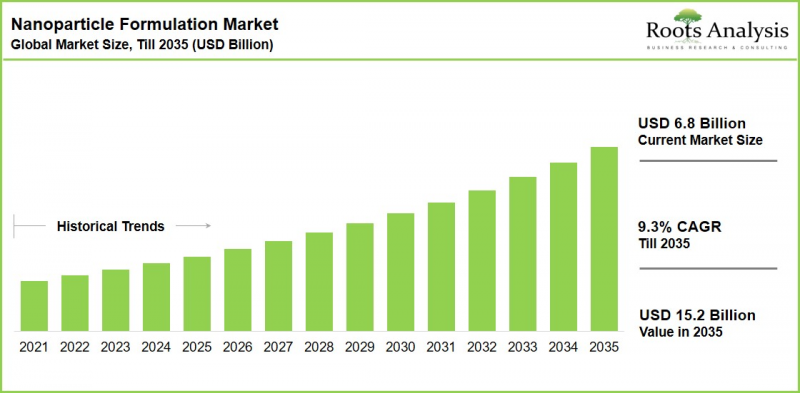
奈米顆粒製劑市場 - 成長與趨勢
奈米顆粒是尺寸通常只有數十億分之一公尺的微量人工顆粒,可由脂質、聚合物、金屬和其他化合物製成。它們微小的尺寸和可調控的表面性質使其能夠在體內更有效率地移動,與目標細胞緊密相互作用,並通常以可控的方式釋放包裹的藥物。奈米顆粒製劑是指將治療劑包裹在這些顆粒內部或表面的過程,以確保它們以所需的速率和濃度到達預期的作用部位。
為了克服傳統劑型的局限性,製藥公司正日益關注基於奈米顆粒的製劑。許多新型候選藥物都存在水溶性低、體內分解快或因組織分佈不均而導致全身毒性等問題。基於奈米顆粒的遞送系統透過保護活性成分、提高其溶解度以及實現更精準地遞送至腫瘤等病變組織來解決這些限制。奈米顆粒製劑可透過提高藥物穩定性、最佳化釋放動力學以及增加目標部位的局部藥物濃度,可以提高治療效果,同時降低脫靶毒性,通常能夠降低有效劑量並善加保護健康組織。
儘管取得了這些進展,但該領域仍面臨許多挑戰。在維持批次間一致性的前提下,商業化生產奈米顆粒製劑仍然是一項技術難題,需要大量的資金投入。針對多種新型奈米技術平台的監管指南仍在不斷變化,為研發人員帶來了不不確定性。此外,特定奈米顆粒材料和設計的長期生物行為仍未完全明了。小規模的研發人員和新興市場公司往往缺乏推動候選產品開發所需的專業知識、設備和測試基礎設施,這持續減緩著整個產業的研發和商業化進程。
奈米顆粒製劑的應用範圍顯著擴展,不僅在感染疾病疫苗領域,而且在腫瘤學和基因療法領域也備受關注。產業對這項變化的投資已顯而易見。Eli Lilly and Company提案高達24億美元的價格收購Orna Therapeutics,目的是加強其基於環狀RNA和脂質奈米顆粒的體內細胞治療平台,凸顯了基於奈米顆粒的基因治療和癌症治療對大型製藥企業日益成長的戰略重要性。
成長要素 - 推動市場擴張的因素
奈米顆粒製劑市場的發展動力源自於製藥業對創新藥物遞送系統日益成長的需求。奈米顆粒非常適合遞送難溶性藥物,能夠實現精準標靶遞送,提高治療效果,同時還能增強藥物溶解度、控制釋放動力學並突破生物屏障。這種特性在癌症治療中尤其重要,因為標靶遞送可以最大限度地減少對健康組織的毒性。
市場成長也得益於藥物遞送技術的不斷進步,這些進步持續拓展著奈米顆粒製劑的功能。這些進步使得對粒徑、表面性質和包封率的控制更加精準,全面提升了製劑的性能。此類先進製造技術的整合改變奈米顆粒的開發格局,並提高整個產業生產流程的精度和效率。
市場挑戰:阻礙進展的主要障礙
將奈米顆粒製劑從實驗室規模放大到商業化生產面臨巨大的技術和操作挑戰。即使是那些在實驗室規模下表現出良好藥物動力學和動態特徵的製劑,在過渡到中試或大規模生產時,由於動量和傳質特性的變化,通常也需要進行大量的重新最佳化。在整個放大過程中保持產品品質的穩定性既困難又昂貴,需要專用設備和嚴格的品管系統。
基於奈米顆粒的藥物和療法的法規核准流程日益複雜,需要進行大量的測試和檢驗以證明其安全性和有效性。由於缺乏基於新型輔料和遞送技術的複雜劑型的統一監管指南,新產品的批准可能會被延誤。加上研發成本高昂,這些監管方面的不確定性可能會阻礙一些製藥公司投資以奈米顆粒為基礎的治療計畫。
奈米顆粒製劑市場 - 關鍵洞察
本報告詳細分析了奈米顆粒製劑市場的現狀,並指出了該行業的潛在成長機會。報告的主要發現包括:
- 僅有機奈米粒子的配製就已在全球範圍內催生了 70 多種不同的技術,反映出創新領域極其活躍且分散的狀態。
- 奈米顆粒製劑領域已提交超過1,700項專利申請,其中超過50%的專利申請來自美國。這表明美國在該領域的知識產權創造方面繼續發揮主導作用。
- 奈米顆粒製劑技術的應用範圍從感染疾病疫苗擴展到腫瘤學和基因治療領域,這得益於靶向脾臟並目的是增強抗腫瘤免疫反應的新型脂質-mRNA複合物的出現。
- Eli Lilly and Company提案以高達 24億美元收購 Orna Therapeutics,這表明其基於環狀 RNA 和脂質奈米顆粒技術的體內細胞治療平台具有日益成長的戰略價值。
- CEPI 向 POP Biotechnologies 授予高達 970萬美元的資金,SNAP 奈米顆粒疫苗平台正推進至 1 期臨床試驗,目的是開發一種針對 H5N1 和「X 疾病」等流行病威脅的快速反應疫苗。
- Advanced NanoTherapies公司在B輪融資中籌集了超過3,100萬美元,用於推進利用奈米顆粒的雙藥球囊平台的研發。這表明該公司在奈米顆粒製劑方面的專業技術已擴展到心血管和介入治療領域。
- 專門的奈米顆粒評估框架,根據臨床試驗活動、專利創新和研究動力,對有機、無機和碳基奈米顆粒進行比較和評估,突顯了全球競爭的集中領域。
- 鑑於技術和服務供應商的擴張趨勢、持續的專利活動以及透過夥伴關係、授權協議和資金籌措輪次增加的資本投資,奈米顆粒製劑市場預計在2035年之前保持穩定成長。
奈米顆粒製劑市場的細分
市場規模和機會分析是根據以下參數細分:
依製劑奈米顆粒類型
- 有機奈米顆粒
- 無機奈米粒子
- 碳基奈米顆粒
依製劑有機奈米顆粒類型
- 聚合物奈米粒子
- 脂質奈米顆粒
- 病毒奈米顆粒
- 蛋白質基奈米顆粒
- 其他有機奈米顆粒
依企業規模
- 臨床前
- 臨床
- 商業
依地區
- 北美洲
- 歐洲
- 亞太地區
- 中東和北非
- 拉丁美洲
奈米顆粒製劑市場:關鍵市場細分洞察
有機奈米顆粒在市場上佔據領先地位。
根據市場評估,有機奈米顆粒(包括脂質奈米顆粒、聚合物奈米顆粒、膠束和樹狀聚合物)目前佔據奈米顆粒製劑市場最大的佔有率。其主導地位歸功於其優異的生物相容性、生物分解性和在藥物傳遞應用中的多功能性。此外,預計該細分市場在預測期內將以較高的CAGR成長。這一高佔有率的成長主要得益於標靶治療、生技藥品、核苷類藥物和個人化醫療的快速發展,以及可生物分解和多功能遞送平台的持續創新。
脂質奈米顆粒(LNP)是有機奈米顆粒領域的主要類型。
預測表明,脂質奈米顆粒(LNP)目前在有機奈米顆粒中佔據最大佔有率,這主要歸功於其在遞送多種治療藥物(包括核酸、蛋白質、胜肽和小分子藥物)方面已被證實的有效性。 LNP具有優異的生物相容性、低毒性,並能保護敏感的活性成分免受分解,加上mRNA疫苗和治療藥物的成功商業化,鞏固了其作為首選遞送平台的地位。聚合物奈米顆粒預計在預測期內將實現顯著成長,這得益於其可調控的理化性質以及實現藥物可控緩釋的能力。
商業規模的生產製造佔了最大的市場佔有率。
分析表明,目前商業規模生產佔據奈米顆粒製劑市場最大的佔有率。這一高佔有率主要得益於獲批的奈米顆粒療法數量的不斷成長,以及由此產生的對穩健、擴充性且合規的生產過程的需求。同時,臨床規模市場預計在預測期內將以較高的CAGR成長。這一可觀的成長歸功於進行腫瘤學、基因治療、mRNA療法和標靶藥物遞送等領域臨床評估的奈米顆粒療法產品線的不斷擴大。
北美在奈米顆粒製劑市場佔據主導地位。
預測表明,北美將佔據最大的市場佔有率,並繼續保持其在奈米顆粒製劑市場中最大區域市場的地位。這一主導地位得益於高度發展的製藥和生物技術生態系統、強大的研發基礎設施以及對奈米醫學和先進藥物遞送技術的巨額投資。此外,該地區還聚集了許多領先的製藥和生物技術公司、學術研究機構以及合約研發生產機構(CDMO),它們積極參與奈米顆粒療法的開發和商業化。
亞太地區崛起成為成長最快的區域市場。
預計亞太地區奈米顆粒製劑市場在預測期內將實現最高的CAGR。該成長主要得益於醫藥研發投入的增加、生技產業的擴張以及對先進療法日益成長的需求。中國、印度、日本和韓國等國家正積極透過政府主導的措施、基礎建設和增加研發投入來加強其奈米技術和生物製藥能力。此外,亞太地區生物技術公司數量的成長以及製劑研發外包給合約研發生產機構(CDMO)的趨勢也進一步推動了這一發展。
奈米顆粒製劑市場主要公司範例
- Ascension Sciences
- DIANT Pharma
- ExonanoRNA
- Nanoform
- NanoVation Therapeutics
- NanoVelos
- NTT Biopharma
- Organoid-X BioTech
- Vaxinano
專家訪談與業界考察
本研究中提出的觀點和見解是基於與多位相關人員的討論。本研究報告包含與以下產業相關人員的詳細訪談記錄:
- 美國中型公司的分析科學副總裁
- 丹麥小規模企業的創辦人
- 美國小規模企業的共同創辦人兼董事
- 小規模的共同創辦人兼執行長,以及美國中型企業的首席醫療長
- 美國小規模企業執行長兼執行長
- 美國小規模企業的執行長
- 德國大型公司擔任早期配方開發和製程設計負責人
- 美國中型公司化學品和輸送技術部門高級總監
- 美國大型公司的科學總監
- 德國領先公司的高級科學家兼分析主管
- 挪威大型企業研究科學家
奈米顆粒製劑市場:研究範圍
- 市場規模和機會分析:本報告對全球奈米顆粒製劑市場進行了詳細分析,重點關注關鍵市場細分,例如 [A] 所配製的奈米顆粒類型、[B] 所配製的有機奈米顆粒類型、[C] 業務規模和 [D] 地區。
- 技術趨勢:本部分詳細評估了奈米顆粒製劑技術的整體情況,包括多種相關參數的資訊,例如所製備的奈米顆粒類型、遞送的分子類型、治療領域、合適的劑型以及給藥途徑。此外,本部分還基於成立年份、公司規模和總部所在地等參數,對技術開發公司進行了詳細分析。
- 服務供應商趨勢:本報告詳細評估了奈米顆粒製劑服務供應商的總體趨勢,包括服務供應商類型、提供的服務、業務規模和應用領域等資訊,並根據服務供應商的成立年份、公司規模和總部所在地對其進行了分析。
- 技術競爭力分析:這是對總部位於北美、歐洲、亞太地區、中東和北非以及世界其他地區的小規模、中型和大規模公司提供的奈米顆粒製劑技術的基準分析。
- 企業競爭力分析:這是對北美、歐洲、亞太和中東及北非地區奈米顆粒製劑服務供應商的基準分析。
- 公司簡介:詳細介紹從事奈米顆粒製劑技術和服務領域的領先公司。資訊包括成立年份、總部所在地、公司規模、技術和服務組合、近期發展以及未來展望。
- 合作關係與合資企業:本分析涵蓋了自2021年以來在該領域建立的合作關係和合資企業,分析依據包括合作年份、合作類型、合作夥伴類型和地區(包括洲際、洲內、區域和國際交易)等參數。
- 專利分析:根據專利類型、公開年份、地區、CPC 代碼、申請人類型、專利基準和專利評估等相關參數,分析與奈米顆粒配方相關的專利申請和已註冊專利。
- 奈米顆粒評估架構:基於臨床試驗數量、創新程度、研究活動趨勢和當前全球競爭格局,對有機、無機和碳基奈米顆粒進行的獨特基準分析。
- 案例研究:技術許可協議:本案例研究概述了近期奈米顆粒製劑技術的許可協議,並分析了此類協議中包含的財務要素。
- 經營團隊見解:透過與分析科學、配方開發和經營團隊方面的高階相關人員的訪談記錄所獲得的第一手觀點。
本報告解答的主要問題
- 奈米顆粒製劑市場的主要參與者有哪些?
- 哪個地區在奈米顆粒製劑市場佔有主導地位?
- 奈米顆粒製劑市場的主要趨勢是什麼?
- 哪些因素可能會影響該市場的未來發展?
- 奈米顆粒製劑研發人員面臨的主要挑戰是什麼?
- 目前和未來的市場規模是多少?
- 這個市場的CAGR是多少?
- 當前和未來的市場機會預計將如何在主要市場區隔中分佈?
購買本報告的理由
- 本報告提供全面的市場分析,並對整體市場及其各個細分市場進行詳細的收入預測。這些資訊對現有市場領導和新興參與企業都極具價值。
- 本報告為相關人員提供全面的市場概覽,包括關鍵促進因素、障礙、機會和挑戰。這些資訊有助於相關人員了解市場趨勢,做出資料驅動的決策,並最大限度地掌握成長機會。
- 本報告將幫助各行各業的公司識別未來的商機,並確定這些商機是否值得追求。
- 本報告透過了解目標受眾的需求、偏好和行為,幫助識別客戶需求,並有效地客製化產品和服務。
- 本報告為新參與企業提供有關特定市場的基本資訊,並幫助他們制定成功的商業策略。
- 這份報告將有助於與目標受眾進行更有效的溝通,並幫助建立更牢固的業務關係。
其他好處
- 免費PPT洞察包
- 免費的Excel資料包,支援報告中的所有分析模組。
- 內容客製化(15%免費)
- 調查團隊將進行詳細的報告說明。
- 如果報告創建至今已超過 6 至 12個月,將免費將其更新至最新版本。
目錄
第1章 背景
第2章 調查方法
第3章 市場動態
第4章 宏觀經濟指標
第5章 執行摘要
第6章 引言
第7章 技術概述
第8章 服務供應商的現狀
第9章 技術競爭力分析
第10章 企業競爭力分析
第11章 公司簡介
- 章節概要
- Ascension Sciences
- DIANT Pharma
- ExonanoRNA
- Nanoform
- NanoVation Therapeutics
- NanoVelos
- NTT Biopharma
- Organoid-X BioTech
- Vaxinano
第12章 夥伴關係與合作
第13章 專利分析
第14章 奈米顆粒評估框架
第15章 市場預測與機會分析
第16章 案例研究:技術許可合約
第17章 結論
第18章 高階主管洞見
第19章 附錄1:表格形式資料
NANOPARTICLE FORMULATION MARKET: OVERVIEW
As per Roots Analysis, the global nanoparticle formulation market is estimated to grow from USD 6.8 billion in the current year to USD 15.2 billion by 2035, at a CAGR of 9.3% during the forecast period, till 2035.
Nanoparticle Formulation Market: Growth and Trends
Nanoparticles are engineered particles, typically measuring only a few billionths of a meter, that can be fabricated from lipids, polymers, metals and other compounds. Owing to their small size and tunable surface properties, they can move through the body more efficiently, interact closely with target cells and, in several cases, release an encapsulated drug in a controlled manner. Nanoparticle formulation refers to the process of packaging a therapeutic agent within or onto such particles so that it reaches the intended site of action, at the desired rate and in the desired concentration.
Drug developers are increasingly turning to nanoparticle-based formulations to overcome limitations associated with conventional dosage forms. A growing share of newer drug candidates suffers from poor aqueous solubility, rapid in vivo degradation or systemic toxicity when distributed indiscriminately across tissues. Nanoparticle-based delivery systems address these limitations by shielding the active ingredient, improving its solubility and enabling more precise delivery to diseased tissue, such as tumours. By enhancing drug stability, optimizing release kinetics and increasing local drug concentration at the target site, nanoparticle formulations can improve therapeutic efficacy while reducing off-target toxicity, often permitting lower effective doses and better preservation of healthy tissue.
Despite this progress, several unmet needs persist within the domain. Manufacturing nanoparticle formulations at commercial scale, while preserving batch-to-batch consistency, remains technically demanding and capital intensive. Regulatory guidelines specific to several newer nanotechnology platforms continue to evolve, creating uncertainty for developers, and the long-term in vivo behaviour of certain nanoparticle materials and designs is not yet completely understood. Smaller developers and companies based in emerging markets frequently lack access to the specialized expertise, equipment and testing infrastructure required to advance such candidates, which continues to slow the pace of development and commercialization across the industry.
The application scope of nanoparticle formulations is expanding well beyond infectious disease vaccines, with growing traction in oncology and gene therapy. Industry investment in this shift is already visible: Eli Lilly's proposed acquisition of Orna Therapeutics, valued at up to USD 2.4 billion, is intended to strengthen its in-vivo cell therapy platform built on circular RNA and lipid nanoparticles, underscoring the rising strategic importance of nanoparticle-enabled gene and cancer therapies to large pharmaceutical players.
Growth Drivers: Factors Propelling the Market Expansion
The nanoparticle formulation market is being propelled by the rising demand for innovative drug delivery systems across the pharmaceutical industry. Nanoparticles enable precise targeting and improved therapeutic outcomes, allowing for enhanced drug solubility, controlled release kinetics and the ability to bypass biological barriers, making them well suited to the delivery of poorly soluble drugs. This capability is proving particularly valuable in oncology, where targeted delivery helps minimize toxicity to healthy tissue.
Market growth is further supported by ongoing advancements in drug delivery technologies that continue to expand nanoparticle formulation capabilities. These improvements are enabling more precise control over particle size, surface properties and encapsulation efficiency, translating into better formulation performance overall. The integration of such advanced manufacturing techniques is reshaping nanoparticle development, improving both the precision and efficiency of production processes across the industry.
Market Challenges: Critical Barriers Hindering Progress
Scaling nanoparticle formulations from laboratory to commercial-scale production presents significant technical and operational hurdles. Formulations that show favourable pharmacokinetic and pharmacodynamic profiles at laboratory scale frequently require substantial re-optimization when transferred to pilot or manufacturing volumes, owing to altered momentum and mass transfer characteristics. Maintaining consistent product quality through this scale-up is both challenging and costly, requiring specialized equipment and stringent quality control systems.
The regulatory approval pathway for nanoparticle-based drugs and therapies adds a further layer of complexity, requiring extensive testing and validation to establish safety and efficacy. The absence of harmonized regulatory guidance for complex dosage forms built on novel excipients or delivery technologies can delay the approval of new products. Combined with substantial R&D costs, this regulatory uncertainty may discourage some pharmaceutical companies from committing capital to nanoparticle-based therapeutic programs.
Nanoparticle Formulation Market: Key Insights
The report delves into the current state of the nanoparticle formulation market and identifies potential growth opportunities within the industry. Some key findings from the report include:
- More than 70 distinct technologies have been developed globally for the formulation of organic nanoparticles alone, reflecting a highly active and fragmented innovation landscape.
- Over 1,700 patents have been filed in the nanoparticle formulation domain, of which more than 50% have been filed in the US, underscoring the country's continued leadership in intellectual property generation within this space.
- The application scope of nanoparticle formulation technologies is broadening beyond infectious disease vaccines into oncology and gene therapy, supported by novel spleen-targeting lipid-mRNA complexes designed to enhance anti-tumour immune responses.
- Eli Lilly's proposed acquisition of Orna Therapeutics, for up to USD 2.4 billion, illustrates the growing strategic premium being placed on in-vivo cell therapy platforms built on circular RNA and lipid nanoparticle technology.
- CEPI's award of up to USD 9.7 million to POP Biotechnologies is advancing the SNAP nanoparticle vaccine platform toward Phase 1 trials, targeting rapid-response vaccines for epidemic threats such as H5N1 and Disease X.
- Advanced NanoTherapies raised over USD 31 million in a Series B round to advance its nanoparticle-enabled dual-drug balloon platform, signaling the extension of nanoparticle formulation expertise into cardiovascular and interventional applications.
- A dedicated nanoparticle evaluation framework, benchmarking organic, inorganic and carbon-based nanoparticles by clinical trial activity, patent-based innovation and research momentum, highlights where global competitive intensity is concentrated.
- Given the expanding technology and service-provider landscape, sustained patent activity and rising capital deployment across partnerships, licensing deals and financing rounds, the nanoparticle formulation market is well positioned for steady growth through 2035.
Nanoparticle Formulation Market Segments
The market sizing and opportunity analysis has been segmented across the following parameters:
By Type of Nanoparticle Formulated
- Organic Nanoparticles
- Inorganic Nanoparticles
- Carbon-based Nanoparticles
By Type of Organic Nanoparticle Formulated
- Polymeric Nanoparticles
- Lipid Nanoparticles
- Viral Nanoparticles
- Protein-based Nanoparticles
- Other Organic Nanoparticles
By Scale of Operation
- Preclinical
- Clinical
- Commercial
By Geographical Regions
- North America
- Europe
- Asia-Pacific
- Middle East and North Africa
- Latin America
Nanoparticle Formulation Market: Key Segmentation Insights
Organic Nanoparticles Lead the Market
Based on our market assessment, organic nanoparticles, including lipid-based nanoparticles, polymeric nanoparticles, micelles and dendrimers, currently holds the highest share of the nanoparticle formulation market. This leadership is attributed to their excellent biocompatibility, biodegradability and versatility in drug delivery applications. Additionally, this segment is expected to grow at a higher CAGR during the forecast period. This highest share is driven by the expanding development of targeted therapeutics, biologics, nucleic acid-based drugs and personalized medicines, alongside continued innovation in biodegradable and multifunctional delivery platforms.
Lipid Nanoparticles (LNPs) Dominate the Organic Nanoparticles Segment
According to our projections, lipid nanoparticles (LNPs) currently account for the largest share among organic nanoparticles, owing to their proven effectiveness in delivering a wide range of therapeutic agents, including nucleic acids, proteins, peptides and small-molecule drugs. Their strong biocompatibility, low toxicity and ability to protect sensitive payloads from degradation, combined with the successful commercialization of mRNA vaccines and therapeutics, have cemented their position as a preferred delivery platform. Polymeric nanoparticles are expected to grow at a significant pace over the forecast period, supported by their tunable physicochemical properties and ability to enable controlled, sustained drug release.
Commercial Scale Operations Hold the Largest Market Share
Based on our analysis, commercial-scale manufacturing currently accounts for the largest share of the nanoparticle formulation market. This highest share is driven by the increasing number of approved nanoparticle-based therapeutics and the corresponding need for robust, scalable and regulatory-compliant production processes. On the other hand, the clinical-scale segment is expected to grow at a higher CAGR during forecast period. This lucrative growth is fueled by the expanding pipeline of nanoparticle-based therapeutics under clinical evaluation in oncology, gene therapy, mRNA therapeutics and targeted drug delivery.
North America Dominates the Nanoparticle Formulation Market
According to our projections, North America holds the highest share and is expected to retain its position as the largest regional market for nanoparticle formulation. This dominance is supported by a highly developed pharmaceutical and biotechnology ecosystem, strong research infrastructure and substantial investment in nanomedicine and advanced drug delivery technologies. Further, the region is home to numerous leading pharmaceutical and biotechnology companies, academic research centers and contract development and manufacturing organizations (CDMOs) actively engaged in the development and commercialization of nanoparticle-based therapeutics.
Asia-Pacific Emerges as the Fastest-Growing Regional Market
The Asia-Pacific nanoparticle formulation market is anticipated to witness the highest CAGR during the forecast period. Growth is being fueled by increasing investment in pharmaceutical research and development, expanding biotechnology sectors and rising demand for advanced therapeutics. Countries such as China, India, Japan and South Korea are actively strengthening their nanotechnology and biopharmaceutical capabilities through government initiatives, infrastructure development and increased research funding, supported by the growing presence of regional biotechnology companies and rising outsourcing of formulation development to Asia-Pacific-based CDMOs.
Example Players In Nanoparticle Formulation Market
- Ascension Sciences
- DIANT Pharma
- ExonanoRNA
- Nanoform
- NanoVation Therapeutics
- NanoVelos
- NTT Biopharma
- Organoid-X BioTech
- Vaxinano
Expert Interview and Industry Insights
The opinions and insights presented in this study were influenced by discussions conducted with multiple stakeholders. The research report features detailed transcripts of interviews held with the following industry stakeholders:
- Vice President of Analytical Sciences, Mid-sized Company, US
- Founder, Small Company, Denmark
- Co-founder, Director, Small Company, US
- Co-founder and Chief Executive Officer, Small Company; Chief Medical Officer, Mid-sized Company, US
- Chief Executive Officer, Consultant, Small Company, US
- Chief Executive Officer, Small Company, US
- Head of Early-stage Formulation Development & Process Design, Very Large Company, Germany
- Senior Director, Chemistry and Delivery Technologies, Mid-sized Company, US
- Scientific Director, Very Large Company, US
- Senior Scientist and Analytical Lead, Very Large Company, Germany
- Research Scientist, Very Large Company, Norway
NANOPARTICLE FORMULATION MARKET: RESEARCH COVERAGE
- Market Sizing and Opportunity Analysis: The report features an in-depth analysis of the global nanoparticle formulation market, focusing on key market segments, including [A] type of nanoparticle formulated, [B] type of organic nanoparticle formulated, [C] scale of operation and [D] geographical regions.
- Technology Landscape: A detailed assessment of the overall nanoparticle formulation technology landscape, featuring information on several relevant parameters, such as type of nanoparticle(s) formulated, type of molecule(s) delivered, therapeutic area(s), compatible dosage form(s) and route(s) of administration. It also features detailed analysis of technology developers, based on parameters such as year of establishment, company size and location of headquarters.
- Service Providers Landscape: A detailed assessment of the overall nanoparticle formulation service providers landscape, featuring information on type of service provider, service(s) offered, scale of operation and application area(s), along with an analysis of service providers by year of establishment, company size and location of headquarters.
- Technology Competitiveness Analysis: A benchmarking analysis of nanoparticle formulation technologies offered by small, mid-sized and large players headquartered in North America, Europe, Asia-Pacific, MENA and the Rest of the World.
- Company Competitiveness Analysis: A benchmarking analysis of nanoparticle formulation service providers based in North America, Europe, Asia-Pacific and MENA.
- Company Profiles: In-depth profiles of prominent players engaged in offering nanoparticle formulation technologies and services, featuring information on their year of establishment, location of headquarters, company size, technology / service portfolio and recent developments and future outlook.
- Partnerships and Collaborations: An analysis of partnerships and collaborations inked in this domain since 2021, based on parameters such as year of partnership, type of partnership, type of partner and geography, including intercontinental, intracontinental, local and international deals.
- Patent Analysis: An analysis of patents filed / granted related to nanoparticle formulation, based on several relevant parameters, such as type of patent, publication year, geography, CPC symbols, type of applicant, patent benchmarking and patent valuation.
- Nanoparticle Evaluation Framework: A proprietary benchmarking analysis of organic, inorganic and carbon-based nanoparticles, based on number of clinical trials, extent of innovation, trends in research activity and current global competition.
- Case Study: Technology Licensing Deals: A review of recent nanoparticle formulation technology licensing deals, including an analysis of the financial components involved in such agreements.
- Executive Insights: First-hand perspectives captured through interview transcripts with senior stakeholders across analytical sciences, formulation development and executive leadership functions.
Key Questions Answered in this Report
- Which are the leading companies in the nanoparticle formulation market?
- Which region dominates the nanoparticle formulation market?
- What are the key trends observed in the nanoparticle formulation market?
- What factors are likely to influence the evolution of this market?
- What are the primary challenges faced by nanoparticle formulation developers?
- What is the current and future market size?
- What is the CAGR of this market?
- How is the current and future market opportunity likely to be distributed across key market segments?
Reasons to Buy this Report
- The report provides a comprehensive market analysis, offering detailed revenue projections of the overall market and its specific sub-segments. This information is valuable to both established market leaders and emerging entrants.
- The report offers stakeholders a comprehensive overview of the market, including key drivers, barriers, opportunities and challenges. This information empowers stakeholders to stay abreast of market trends and make data-driven decisions to capitalize on growth prospects.
- The report can aid businesses in identifying future opportunities in any sector. It also helps in understanding if those opportunities are worth pursuing.
- The report helps in identifying customer demand by understanding the needs, preferences and behaviour of the target audience in order to tailor products or services effectively.
- The report equips new entrants with requisite information regarding a particular market to help them build successful business strategies.
- The report allows for more effective communication with the audience and in building strong business relations.
Additional Benefits
- Complementary PPT Insights Pack
- Complementary Excel Data Packs for all Analytical Modules in the Report
- 15% Free Content Customization
- Detailed Report Walkthrough Session with Research Team
- Free Updated report if the report is 6-12 months old or older
TABLE OF CONTENTS
1. BACKGROUND
- 1.1. Context
- 1.2. Project Objectives
2. RESEARCH METHODOLOGY
- 2.1. Chapter Overview
- 2.2. Research Assumptions
- 2.2.1. Market Landscape and Market Trends
- 2.2.2. Market Forecast and Opportunity Analysis
- 2.2.3. Comparative Analysis
- 2.3. Database Building
- 2.3.1. Project Commencement
- 2.3.2. Data Collection
- 2.3.3. Data Validation
- 2.3.4. Data Analysis
- 2.4. Project Methodology
- 2.4.1. Secondary Research
- 2.4.1.1. Annual Reports
- 2.4.1.2. Academic Research Papers
- 2.4.1.3. Company Websites
- 2.4.1.4. Investor Presentations
- 2.4.1.5. Regulatory Filings
- 2.4.1.6. White Papers
- 2.4.1.7. Industry Publications
- 2.4.1.8. Conferences and Seminars
- 2.4.1.9. Government Portals
- 2.4.1.10. Media and Press Releases
- 2.4.1.11. Newsletters
- 2.4.1.12. Industry Databases
- 2.4.1.13. Roots Proprietary Databases
- 2.4.1.14. Paid Databases and Sources
- 2.4.1.15. Social Media Portals
- 2.4.1.16. Other Secondary Sources
- 2.4.2. Primary Research
- 2.4.2.1. Types of Primary Research
- 2.4.2.1.1. Qualitative Research
- 2.4.2.1.2. Quantitative Research
- 2.4.2.1.3. Hybrid Approach
- 2.4.2.2. Advantages of Primary Research
- 2.4.2.3. Techniques for Primary Research
- 2.4.2.3.1. Interviews
- 2.4.2.3.2. Surveys
- 2.4.2.3.3. Focus Groups
- 2.4.2.3.4. Observational Research
- 2.4.2.3.5. Social Media Interactions
- 2.4.2.4. Key Opinion Leaders Considered in Primary Research
- 2.4.2.4.1. Company Executives (CXOs)
- 2.4.2.4.2. Board of Directors
- 2.4.2.4.3. Company Presidents and Vice Presidents
- 2.4.2.4.4. Research and Development Heads
- 2.4.2.4.5. Technical Experts
- 2.4.2.4.6. Subject Matter Experts
- 2.4.2.4.7. Scientists
- 2.4.2.4.8. Doctors and Other Healthcare Providers
- 2.4.2.5. Ethics and Integrity
- 2.4.2.5.1. Research Ethics
- 2.4.2.5.2. Data Integrity
- 2.4.2.1. Types of Primary Research
- 2.4.3. Analytical Tools and Databases
- 2.4.1. Secondary Research
- 2.5. Robust Quality Control
3. MARKET DYNAMICS
- 3.1. Chapter Overview
- 3.2. Forecast Methodology
- 3.2.1. Top-down Approach
- 3.2.2. Bottom-up Approach
- 3.2.3. Hybrid Approach
- 3.3. Market Assessment Framework
- 3.3.1. Total Addressable Market (TAM)
- 3.3.2. Serviceable Addressable Market (SAM)
- 3.3.3. Serviceable Obtainable Market (SOM)
- 3.3.4. Currently Acquired Market (CAM)
- 3.4. Forecasting Tools and Techniques
- 3.4.1. Qualitative Forecasting
- 3.4.2. Correlation
- 3.4.3. Regression
- 3.4.4. Extrapolation
- 3.4.5. Convergence
- 3.4.6. Sensitivity Analysis
- 3.4.7. Scenario Planning
- 3.4.8. Data Visualization
- 3.4.9. Time Series Analysis
- 3.4.10. Forecast Error Analysis
- 3.5. Key Considerations
- 3.5.1. Demographics
- 3.5.2. Government Regulations
- 3.5.3. Reimbursement Scenarios
- 3.5.4. Market Access
- 3.5.5. Supply Chain
- 3.5.6. Industry Consolidation
- 3.5.7. Pandemic / Unforeseen Disruptions Impact
- 3.6. Limitations
4. MACRO-ECONOMIC INDICATORS
- 4.1. Chapter Overview
- 4.2. Market Dynamics
- 4.2.1. Time Period
- 4.2.1.1. Historical Trends
- 4.2.1.2. Current and Forecasted Estimates
- 4.2.2. Currency Coverage
- 4.2.2.1. Major Currencies Affecting the Market
- 4.2.2.2. Factors Affecting Currency Fluctuations on the Industry
- 4.2.2.3. Impact of Currency Fluctuations on the Industry
- 4.2.3. Foreign Currency Exchange Rate
- 4.2.3.1. Impact of Foreign Exchange Rate Volatility on the Market
- 4.2.3.2. Strategies for Mitigating Foreign Exchange Risk
- 4.2.4. Recession
- 4.2.4.1. Assessment of Current Economic Conditions and Potential Impact on the Market
- 4.2.4.2. Historical Analysis of Past Recessions and Lessons Learnt
- 4.2.5. Inflation
- 4.2.5.1. Measurement and Analysis of Inflationary Pressures in the Economy
- 4.2.5.2. Potential Impact of Inflation on the Market Evolution
- 4.2.6. Interest Rates
- 4.2.6.1. Interest Rates and Their Impact on the Market
- 4.2.6.2. Strategies for Managing Interest Rate Risk
- 4.2.7. Commodity Flow Analysis
- 4.2.7.1. Type of Commodity
- 4.2.7.2. Origins and Destinations
- 4.2.7.3. Values and Weights
- 4.2.7.4. Modes of Transportation
- 4.2.8. Global Trade Dynamics
- 4.2.8.1. Import Scenario
- 4.2.8.2. Export Scenario
- 4.2.8.3. Trade Policies
- 4.2.8.4. Strategies for Mitigating the Risks Associated with Trade Barriers
- 4.2.8.5. Impact of Trade Barriers on the Market
- 4.2.9. War Impact Analysis
- 4.2.9.1. Russian-Ukraine War
- 4.2.9.2. Israel-Hamas War
- 4.2.10. COVID Impact / Related Factors
- 4.2.10.1. Global Economic Impact
- 4.2.10.2. Industry-specific Impact
- 4.2.10.3. Government Response and Stimulus Measures
- 4.2.10.4. Future Outlook and Adaptation Strategies
- 4.2.11. Other Indicators
- 4.2.11.1. Fiscal Policy
- 4.2.11.2. Consumer Spending
- 4.2.11.3. Gross Domestic Product
- 4.2.11.4. Employment
- 4.2.11.5. Taxes
- 4.2.11.6. Stock Market Performance
- 4.2.11.7. Cross Border Dynamics
- 4.2.1. Time Period
- 4.3. Conclusion
5. EXECUTIVE SUMMARY
6. INTRODUCTION
- 6.1. Chapter Overview
- 6.2. Introduction to Nanoparticles
- 6.3. Classification of Nanoparticles
- 6.3.1. Organic Nanoparticles
- 6.3.2. Inorganic Nanoparticles
- 6.3.3. Carbon-based Nanoparticles
- 6.4. Methods of Nanoparticle Formulation
- 6.5. Applications of Nanoparticle-based Systems
- 6.6. Challenges associated with Nanoparticle Formulation
- 6.7. Need for Outsourcing Nanoparticle Formulation
- 6.8. Concluding Remarks
7. TECHNOLOGY LANDSCAPE
- 7.1. Chapter Overview
- 7.2. Nanoparticle Formulation: Technology Landscape
- 7.2.1. Analysis by Type of Nanoparticle(s) Formulated
- 7.2.2. Analysis by Type of Organic Nanoparticle(s) Formulated
- 7.2.3. Analysis by Type of Inorganic Nanoparticle(s) Formulated
- 7.2.4. Analysis by Type of Molecule(s) Delivered
- 7.2.5. Analysis by Therapeutic Area(s)
- 7.2.6. Analysis by Compatible Dosage Form(s)
- 7.2.7. Analysis by Route(s) of Administration
- 7.3. Nanoparticle Formulation: Technology Developer Landscape
- 7.3.1. Analysis by Year of Establishment
- 7.3.2. Analysis by Company Size
- 7.3.3. Analysis by Location of Headquarters
- 7.3.4. Analysis by Company Size and Location of Headquarters
- 7.3.5. Most Active Players: Analysis by Number of Technologies
8. SERVICE PROVIDERS LANDSCAPE
- 8.1. Chapter Overview
- 8.2. Nanoparticle Formulation: Service Providers Landscape
- 8.2.1. Analysis by Year of Establishment
- 8.2.2. Analysis by Company Size
- 8.2.3. Analysis by Location of Headquarters
- 8.2.4. Analysis by Company Size and Location of Headquarters
- 8.2.5. Analysis by Location of Facilities
- 8.2.6. Analysis by Type of Service Provider(s)
- 8.2.7. Analysis by Type of Nanoparticle(s) Formulated
- 8.2.7.1. Analysis by Type of Organic Nanoparticle(s) Formulated
- 8.2.7.2. Analysis by Type of Inorganic Nanoparticle(s) Formulated
- 8.2.8. Analysis by Type of Service Provider(s) and Type of Nanoparticle(s) Formulated
- 8.2.9. Analysis by Service(s) Offered
- 8.2.10. Analysis by Company Size and Service(s) Offered
- 8.2.11. Analysis by Scale of Operation
- 8.2.12. Analysis by Application Area(s)
9. TECHNOLOGY COMPETITIVENESS ANALYSIS
- 9.1. Chapter Overview
- 9.2. Assumptions / Key Parameters
- 9.3. Methodology
- 9.4. Technology Competitiveness Analysis
- 9.4.1. Nanoparticle Formulation Technologies Offered by Players based in North America
- 9.4.1.1. Nanoparticle Formulation Technologies Offered by Small Players based in North America
- 9.4.1.2. Nanoparticle Formulation Technologies Offered by Mid-sized and Large Players based in North America
- 9.4.2. Nanoparticle Formulation Technologies Offered by Players based in Europe
- 9.4.3. Nanoparticle Formulation Technologies Offered by Players based in Asia-Pacific, Middle East and North Africa, and Rest of the World
- 9.4.1. Nanoparticle Formulation Technologies Offered by Players based in North America
10. COMPANY COMPETITIVENESS ANALYSIS
- 10.1. Chapter Overview
- 10.2. Assumptions / Key Parameters
- 10.3. Methodology
- 10.4. Company Competitiveness Analysis
- 10.4.1. Nanoparticle Formulation Service Providers based in North America
- 10.4.2. Nanoparticle Formulation Service Providers based in Europe
- 10.4.3. Nanoparticle Formulation Service Providers based in Asia-Pacific and Middle East and North Africa
11. COMPANY PROFILES
- 11.1. Chapter Overview
- 11.2. Ascension Sciences
- 11.2.1. Company Overview
- 11.2.2. Technology Portfolio
- 11.2.3. Service Portfolio
- 11.2.4. Recent Developments and Future Outlook
- 11.3. DIANT Pharma
- 11.4. ExonanoRNA
- 11.5. Nanoform
- 11.6. NanoVation Therapeutics
- 11.7. NanoVelos
- 11.8. NTT Biopharma
- 11.9. Organoid-X BioTech
- 11.10. Vaxinano
12. PARTNERSHIPS AND COLLABORATIONS
- 12.1. Chapter Overview
- 12.2. Partnership Models
- 12.3. Nanoparticle Formulation Technologies and Services: Partnerships and Collaborations
- 12.3.1. Analysis by Year of Partnership
- 12.3.2. Analysis by Type of Partnership
- 12.3.3. Analysis by Year and Type of Partnership
- 12.3.4. Analysis by Type of Partner
- 12.3.5. Analysis by Location of Headquarters of Partner
- 12.3.6. Analysis by Type of Partnership and Location of Headquarters of Partner
- 12.3.7. Most Active Players: Analysis by Number of Partnerships
- 12.3.8. Analysis by Geography
- 12.3.8.1. Intercontinental and Intracontinental Deals
- 12.3.8.2. Local and International Deals
13. PATENT ANALYSIS
- 13.1. Chapter Overview
- 13.2. Scope and Methodology
- 13.3. Nanoparticle Formulation Domain: Patent Analysis
- 13.3.1. Analysis by Publication Year
- 13.3.2. Analysis by Type of Patent and Publication Year
- 13.3.3. Analysis by Geography
- 13.3.4. Analysis by CPC Symbols
- 13.3.5. Analysis by Type of Organization
- 13.3.6. Leading Industry Players: Analysis by Number of Patents
- 13.4. Patent Benchmark Analysis
- 13.4.1. Analysis by Patent Characteristics
- 13.5. Patent Valuation Analysis
14. NANOPARTICLE EVALUATION FRAMEWORK
- 14.1. Chapter Overview
- 14.2. Key Assumptions and Methodology
- 14.3. Organic Nanoparticles
- 14.3.1. Number of Clinical Trials
- 14.3.2. Extent of Innovation
- 14.3.3. Trends in Research Activity
- 14.3.4. Current Global Competition
- 14.3.5. Nanoparticle Evaluation Framework: Organic Nanoparticles
- 14.4. Inorganic Nanoparticles
- 14.4.1. Number of Clinical Trials
- 14.4.2. Extent of Innovation
- 14.4.3. Trends in Research Activity
- 14.4.4. Current Global Competition
- 14.4.5. Nanoparticle Evaluation Framework: Inorganic Nanoparticles
- 14.5. Carbon-based Nanoparticles
- 14.5.1. Number of Clinical Trials
- 14.5.2. Extent of Innovation
- 14.5.3. Trends in Research Activity
- 14.5.4. Current Global Competition
- 14.5.5. Nanoparticle Evaluation Framework: Carbon-based Nanoparticles
- 14.5.6. Nanoparticle Evaluation Framework: Concluding Remarks
15. MARKET FORECAST AND OPPORTUNITY ANALYSIS
- 15.1. Chapter Overview
- 15.2. Key Assumptions and Forecast Methodology
- 15.3. Global Nanoparticle Formulation Services Market, till 2035
- 15.4. Nanoparticle Formulation Services Market: Analysis by Type of Nanoparticle Formulated
- 15.4.1. Nanoparticle Formulation Services Market: Analysis by Type of Organic Nanoparticle Formulated
- 15.4.1.1. Nanoparticle Formulation Services Market for Polymeric Nanoparticles, till 2035
- 15.4.1.2. Nanoparticle Formulation Services Market for Lipid Nanoparticles, till 2035
- 15.4.1.3. Nanoparticle Formulation Services Market for Viral Nanoparticles, till 2035
- 15.4.1.4. Nanoparticle Formulation Services Market for Protein-based Nanoparticles, till 2035
- 15.4.1.5. Nanoparticle Formulation Services Market for Other Organic Nanoparticles, till 2035
- 15.4.2. Nanoparticle Formulation Services Market: Analysis by Inorganic Nanoparticle Formulated
- 15.4.3. Nanoparticle Formulation Services Market: Analysis by Carbon-based Nanoparticle Formulated
- 15.4.1. Nanoparticle Formulation Services Market: Analysis by Type of Organic Nanoparticle Formulated
- 15.5. Nanoparticle Formulation Services Market: Analysis by Scale of Operation
- 15.5.1. Nanoparticle Formulation Services Market for Preclinical Operations, till 2035
- 15.5.2. Nanoparticle Formulation Services Market for Clinical Operations, till 2035
- 15.5.3. Nanoparticle Formulation Services Market for Commercial Operations, till 2035
- 15.6. Nanoparticle Formulation Services Market: Analysis by Key Geographical Regions
- 15.6.1. Nanoparticle Formulation Services Market in North America, till 2035
- 15.6.2. Nanoparticle Formulation Services Market in Europe, till 2035
- 15.6.3. Nanoparticle Formulation Services Market in Asia-Pacific, till 2035
- 15.6.4. Nanoparticle Formulation Services Market in Middle East and North Africa, till 2035
- 15.6.5. Nanoparticle Formulation Services Market in Latin America, till 2035
16. CASE STUDY: TECHNOLOGY LICENSING DEALS
- 16.1. Chapter Overview
- 16.2. Recent Technology Licensing Deals
- 16.3. Concluding Remarks
17. CONCLUSION
18. EXECUTIVE INSIGHTS
19. APPENDIX 1: TABULATED DATA
List of Tables
- Table 7.1 Nanoparticle Formulation Technologies: Information on Type of Nanoparticle(s) Formulated
- Table 7.2 Nanoparticle Formulation Technologies: Information on Formulation Method(s) Used
- Table 7.3 Nanoparticle Formulation Technologies: Information on T
List of Figures
- Figure 2.1 Research Methodology: Project Methodology
- Figure 2.2 Research Methodology: Data Sources for Secondary Research
- Figure 2.3 Research Methodology: Robust Quality Control
- Figure 3.1 Market Dynamics: Forecast Methodology
- Figure 3.2 Market Dynamics:

 金屬氧化物奈米顆粒:市場佔有率分析、產業趨勢與統計、成長預測(2026-2031)
 奈米顆粒藥物遞送市場分析與預測(至2035年):類型、產品、技術、應用、材料類型、製程、最終用戶、功能、階段
 鈦奈米顆粒市場規模、佔有率和成長分析:按產品類型、晶體結構、應用、最終用戶、形態和地區分類-2026-2033年產業預測
 二氧化鈦奈米顆粒市場:依產品類型、製造流程、粒徑及應用分類-2026-2032年全球市場預測奈米粒子追蹤分析儀市場:2026-2032年全球市場預測(按產品類型、檢測模式、應用、最終用戶和分銷管道分類)金屬氧化物奈米顆粒市場:按類型、製造方法、形態、粒徑、終端用戶產業和應用分類-2026-2032年全球市場預測
 鉑奈米顆粒市場規模、佔有率和成長分析:按應用、粒徑、終端用戶產業、分銷方式和地區分類-2026-2033年產業預測醫藥TIC:市佔率分析、產業趨勢與統計、成長預測(2026-2031)
 金屬和金屬氧化物奈米顆粒市場:按化學類型、應用和地區分類
 2026年全球奈米顆粒分析市場報告