


 |
市場調查報告書
商品編碼
2114947
金屬氧化物奈米顆粒:市場佔有率分析、產業趨勢與統計、成長預測(2026-2031)Metal Oxide Nanoparticles - Market Share Analysis, Industry Trends & Statistics, Growth Forecasts (2026 - 2031) |
||||||

※ 本網頁內容可能與最新版本有所差異。詳細情況請與我們聯繫。
根據 Mordor Intelligence 預測,金屬氧化物奈米顆粒市場規模將從 2025 年的 10.4 億美元成長到 2026 年的 11.1 億美元,然後在 2031 年達到 15.4 億美元,2026 年至 2031 年的複合年成長率為 6.74%。
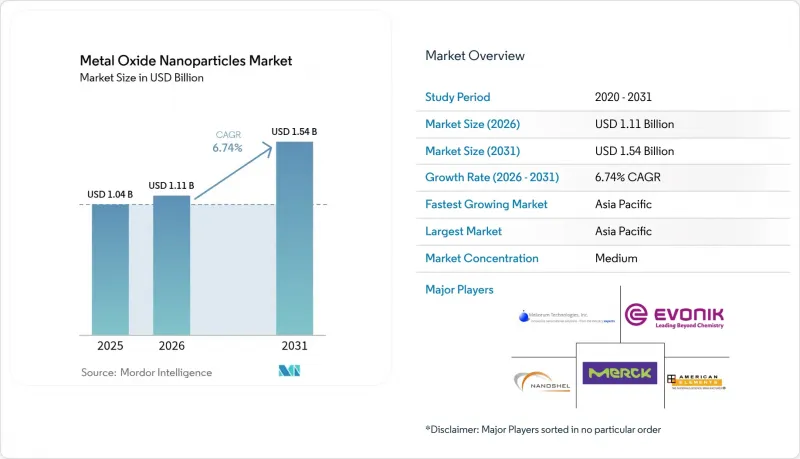
本報告按產品(氧化鋁、二氧化鈦等)、合成方法(物理法、化學法、綠色/生物基法)、終端用戶產業(電子光學、醫療保健等)和地區(亞太地區、北美地區、歐洲地區、南美地區、中東和非洲地區)進行細分。市場預測以美元計價。
全球金屬氧化物奈米顆粒市場趨勢與洞察
電子業對高介電常數(高k)介電材料和透明導電薄膜的需求不斷成長。
5奈米以下的先進節點邏輯晶片需要由二氧化鈦和氧化鉿奈米顆粒製成的超薄閘極堆疊,以最大限度地減少漏電流並保持電容。在美國,有14億美元的撥款用於先進封裝技術,這筆資金有助於選擇依賴半導體級氧化物的材料。觸控螢幕和軟性OLED顯示器依賴氧化銦錫和氧化鋅奈米顆粒薄膜,即使在反覆彎曲循環下也能保持導電性。邊緣人工智慧加速器需要更高的動作溫度,這迫使設計人員指定能夠承受熱尖峰而不產生恆定電漂移的介電層。惠普公司在奧勒岡州投資5000萬美元的擴建計畫旨在擴大微射流微機電技術的規模,該技術採用氧化物薄膜作為噴嘴和通道的絕緣層。這些融合的趨勢支撐著支撐金屬氧化物奈米顆粒市場的高純度材料的供應。
抗菌劑在個人護理和塗料領域的應用日益廣泛。
氧化鋅和氧化銅奈米顆粒可透過釋放活性氧在10分鐘內去活化99.9%的細菌,為傳統防腐劑提供了替代方案。疫情期間的建築維修加速了對含有這些氧化物的抗菌牆面塗料和暖通空調過濾器的需求。歐洲監管機構已正式要求化妝品生產商訂單二氧化鈦(TiO2)和氧化鋅(ZnO)的奈米顆粒專用安全文件。這表明其他地區可能會推出類似措施,從而使符合規定的製造商獲得先發優勢。建築規範擴大採用抗菌塗層來延長維護週期,而智慧紡織品製造商則採用可承受50次以上洗滌循環的奈米顆粒整理劑。這些廣泛的應用持續推動金屬氧化物奈米顆粒市場的新需求。
由於其毒性和在環境中持久存在,相關法規變得更加嚴格。
東京理科大學的研究表明,超細二氧化矽奈米顆粒會改變蛋白質的二級結構,增加與神經退化相關的BETA折疊含量。水處理設施難以捕獲小於50奈米的顆粒,這引發了人們對這些顆粒在水生生態系統中累積的擔憂。歐盟擴大了REACH法規的適用範圍,要求提交奈米材料的生命週期安全資料。這延長了產品認證時間,並增加了合規成本。無法提交慢性毒性數據的製造商可能面臨市場准入延遲的風險,從而阻礙金屬氧化物奈米顆粒市場的短期成長。
細分市場分析
2025年,二氧化鈦在金屬氧化物奈米顆粒市場中保持了38.20%的佔有率,這主要得益於其在紫外線防曬油和5奈米柵極介質中的雙重應用。可見光透過率超過98%的光阻劑依賴二氧化鈦的高屈光,從而在極紫外光微影術中將缺陷密度控制在0.3 cm⁻²以下。氧化鎂的成長速度最快,到2031年年複合成長率(CAGR)將達到7.78%,這主要得益於其在300 度C下穩定陶瓷電解質的能力。二氧化矽的應用範圍擴展到了積層製造粉末領域,而氧化鋅則在抗菌聚合物薄膜領域擴大了市場佔有率。這些變化有助於保持產品差異化,並推動金屬氧化物奈米顆粒市場的價值創造。
日本等離子噴塗技術的突破性進展使得平均粒徑為40奈米的二氧化鈦奈米顆粒的供應成為可能,其處理能力達到12.3克/分鐘,從而彌合了中試生產和大規模生產之間的規模差距。氧化鋁的應用日益鞏固,尤其是在贏創產能擴張之後,其在隔膜塗層和陶瓷基板的應用更加廣泛。氧化銅和氧化鐵在催化劑和磁性記錄領域佔據細分市場,而氧化鈰和氧化鋯則為燃料電池和高溫渦輪機市場做出貢獻。產品系列的日益複雜化推動了策略採購計畫的實施,旨在平衡成本、純度和性能,從而增強整個金屬氧化物奈米顆粒產業的韌性。
區域分析
預計到2025年,亞太地區將佔據金屬氧化物奈米顆粒市場47.40%的佔有率,並在2031年之前以7.55%的複合年成長率成長。在中國,由於多個省份的生產擴張,二氧化鈦產能已接近700萬噸,但歐盟和巴西的反傾銷措施正在擠壓利潤空間。日本大學在磁性奈米顆粒癌症治療領域處於領先地位,並透過提高粉末批次缺陷檢測的準確性來增強國內高附加價值需求。韓國和台灣地區透過提高氧化物的純度來維持晶圓代工廠的競爭力,而印度則正在擴大防曬油和建築塗料的生產。完善的電子產業生態系統和有針對性的補貼政策使該地區能夠保持其在金屬氧化物奈米顆粒市場的主導地位。
在北美,CHIPS法案提供的資金正用於支持多晶矽和基板項目,並將本地氧化物整合到先進封裝供應鏈中。 Hemlock Semiconductor公司在密西根州投資3.25億美元,計畫每年出貨5.9萬噸超高純度多晶矽。每塊矽錠都含有微量的金屬氧化物。廣泛的研發活動正推動生物基合成技術的早期應用,同時航太領域對耐輻射氧化物的需求也不斷成長。與加拿大礦場和墨西哥組裝廠的跨國合作,正在增強該地區金屬氧化物奈米顆粒市場的韌性。
在歐洲,永續性和合規性是重中之重。 REACH法規中關於奈米材料的修訂鼓勵汽車製造商採購低碳氧化鋁用於透明塗層配方,而航太產業則大力投資於依賴氧化釔釔安定氧化鋯鋯奈米粉末的陶瓷基質複合材料。德國引領工業生產,而北歐國家正在推動循環經濟試點項目,以從廢棄電池中回收氧化物。在非洲和南美洲,建築和太陽能發電工程正在推進,這些項目將奈米顆粒添加劑融入隔熱塗層中。在中東和南美洲,氧化物正被用來提高礦石選礦和化學肥料的效率,這進一步刺激了對金屬氧化物奈米顆粒市場的需求。
其他好處:
- Excel格式的市場預測(ME)表
- 3個月的分析師支持
目錄
第1章:引言
- 研究假設和市場定義
- 調查範圍
第2章:調查方法
第3章執行摘要
第4章 市場狀況
- 市場概覽
- 市場促進因素
- 電子業對高介電常數(高k)介電材料和透明導電薄膜的需求不斷成長。
- 擴大抗菌劑在個人保健產品和塗料的應用。
- 鋰離子電池正極材料和固體電解質相關的研究和開發工作激增;
- 過渡到更容易獲得監管部門批准的綠色合成方法。
- 3D列印光敏聚合物對紫外線阻隔添加劑的需求
- 政府對需要高純度氧化物奈米粉末的半導體製造企業提供扶持措施。
- 市場限制因素
- 由於其毒性和在環境中持久存在,相關法規已加強。
- 整個供應鏈中奈米級測量缺乏標準化
- 複雜氧化物稀土元素前驅體的價格波動
- 價值鏈分析
- 波特五力模型
- 專利分析
第5章 市場規模與成長預測
- 依產品
- 氧化鋁
- 二氧化鈦
- 二氧化矽
- 氧化鋅
- 氧化鎂
- 氧化銅
- 氧化鐵
- 其他元素(鈰、鋯等)
- 透過合成方法
- 物理方法(機械性粉碎、沉澱)
- 化學方法(溶膠-凝膠法、沉澱法)
- 綠色/生物基
- 按最終用戶行業分類
- 電子與光學
- 衛生保健
- 建造
- 汽車和運輸業
- 個人護理
- 其他終端用戶產業(能源、環境等)
- 按地區
- 亞太地區
- 中國
- 印度
- 日本
- 韓國
- 東南亞國協
- 其他亞太國家
- 北美洲
- 美國
- 加拿大
- 墨西哥
- 歐洲
- 德國
- 英國
- 法國
- 義大利
- 北歐國家
- 其他歐洲國家
- 南美洲
- 巴西
- 阿根廷
- 其他南美國家
- 中東和非洲
- 沙烏地阿拉伯
- 南非
- 其他中東和非洲國家
- 亞太地區
第6章 競爭情勢
- 市場集中度
- 策略趨勢
- 市佔率分析
- 公司簡介
- American Elements
- ANP CORPORATION
- ATLANTA
- EPRUI Biotech Co., Ltd.
- Evonik Industries AG
- Hongwu International Group Ltd
- MATEXCEL
- Meliorum Technologies, Inc.
- Merck KGaA
- Nanorh
- Nanoshell LLC
- Resonac Holdings Corporation
- SkySpring Nanomaterials, Inc.
- Sumitomo Chemical Co., Ltd.
- US Research Nanomaterials, Inc.
- Xuan Cheng Jing Rui New Material Co.,Ltd
第7章 市場機會與未來展望
According to Mordor Intelligence, the metal oxide nanoparticles market size market is expected to grow from USD 1.04 billion in 2025 to USD 1.11 billion in 2026 and is forecast to reach USD 1.54 billion by 2031 at 6.74% CAGR over 2026-2031.
This report is Segmented by Product (Aluminium Oxide, Titanium Dioxide, and More), Synthesis Method (Physical, Chemical, and Green/Bio-based), End-User Industry (Electronics and Optics, Healthcare, and More), and Geography (Asia-Pacific, North America, Europe, South America, Middle East and Africa). The Market Forecasts are Provided in Terms of Value (USD).
Global Metal Oxide Nanoparticles Market Trends and Insights
Growing electronics demand for high-k dielectric & transparent conductive films
Advanced node logic chips below 5 nm require ultrathin gate stacks made from titanium dioxide and hafnium oxide nanoparticles that minimize leakage currents while preserving capacitance. United States incentives total USD 1.4 billion for advanced packaging, with funds supporting materials down-selection that depends on semiconductor-grade oxides. Touchscreens and flexible OLED displays rely on indium tin oxide and zinc oxide nanoparticle films that remain conductive under repeated bending cycles. AI accelerators positioned at the edge drive higher operating temperatures, compelling designers to specify dielectric layers able to withstand thermal spikes without drifting electrical constants. HP's USD 50 million Oregon expansion aims to scale microfluidic MEMS technologies that incorporate oxide thin films for nozzle and channel insulation. These converging trends sustain a high-purity materials pipeline that anchors the Metal oxide nanoparticles market.
Rising use as antibacterial agents in personal care & coatings
Zinc oxide and copper oxide nanoparticles deactivate 99.9% of bacteria within 10 minutes by releasing reactive oxygen species, offering an alternative to conventional preservatives. Pandemic-era building retrofits accelerated orders for antimicrobial wall paints and HVAC filters embedding these oxides. European regulators formalised nano-specific safety dossiers for TiO2 and ZnO in cosmetics, signalling likely adoption in other jurisdictions and giving compliant producers first-mover advantage. Construction specifications increasingly embed antimicrobial coatings to extend maintenance intervals, while smart-textile manufacturers incorporate nanoparticle finishes that survive 50+ wash cycles. The breadth of applications continues to pull new volumes into the Metal oxide nanoparticles market.
Toxicity and environmental persistence prompting stricter regulations
Tokyo University of Science revealed that ultra-small silica nanoparticles alter protein secondary structures, increasing B-sheet content linked to neurodegeneration. Water-treatment plants struggle to capture sub-50 nm particles, leading to accumulation in aquatic ecosystems. The European Union broadened REACH to mandate full life-cycle safety files for nanomaterials, stretching product qualification timelines and raising compliance costs. Manufacturers unable to furnish chronic toxicity data risk delayed market entry, tempering near-term expansion of the Metal oxide nanoparticles market.
Other drivers and restraints analyzed in the detailed report include:
- Surge in Li-ion battery cathode & solid-state electrolyte R&D
- Transition to green synthesis routes enhancing regulatory acceptance
- Lack of standardized nano-scale metrology across supply chains
For complete list of drivers and restraints, kindly check the Table Of Contents.
Segment Analysis
Titanium Dioxide retained a 38.20% stake in the Metal oxide nanoparticles market in 2025, buoyed by dual roles in UV-blocking sunscreens and 5 nm gate dielectrics. Over 98% visible-light transmission photoresists rely on TiO2's high refractive index, keeping defect densities below 0.3 cm^-2 in extreme-ultraviolet lithography. Magnesium Oxide posts the fastest CAGR at 7.78% through 2031, propelled by its ability to stabilise ceramic electrolytes at 300 °C. Silicon Dioxide broadens its reach into additive manufacturing powders, while Zinc Oxide expands inside antimicrobial polymer films. These shifts keep product differentiation high and support value capture inside the Metal oxide nanoparticles market.
Japanese plasma-spray breakthroughs now deliver TiO2 nanoparticles averaging 40 nm at 12.3 g/min throughput, closing the scale gap between pilot and mass production. Aluminum Oxide's presence in separator coatings and ceramic substrates further entrenches its role, especially following Evonik's capacity build-out. Copper and Iron Oxides occupy catalysis and magnetic-storage niches, and ceria or zirconia oxides serve fuel cell and high-temperature turbine markets. The resulting portfolio complexity encourages strategic sourcing programs that balance cost, purity and functional performance, bolstering resilience across the Metal oxide nanoparticles industry.
Complete Report Scope:
- By Product
- Aluminium Oxide
- Titanium Dioxide
- Silicon Dioxide
- Zinc Oxide
- Magnesium Oxide
- Copper Oxide
- Iron Oxide
- Others (Cerium, Zirconium, etc.)
- By Synthesis Method
- Physical (Mechanical Milling, Vapor Deposition)
- Chemical (Sol-Gel, Precipitation)
- Green / Bio-based
- By End-User Industry
- Electronics and Optics
- Healthcare
- Construction
- Automotive and Transportation
- Personal Care
- Other End-user Industries (Energy and Environment, etc.)
- By Geography
- Asia-Pacific
- China
- India
- Japan
- South Korea
- ASEAN Countries
- Rest of Asia-Pacific
- North America
- United States
- Canada
- Mexico
- Europe
- Germany
- United Kingdom
- France
- Italy
- NORDIC Countries
- Rest of Europe
- South America
- Brazil
- Argentina
- Rest of South America
- Middle East and Africa
- Saudi Arabia
- South Africa
- Rest of Middle-East and Africa
- Asia-Pacific
Geography Analysis
Asia-Pacific held 47.40% of the Metal oxide nanoparticles market in 2025 and is poised for 7.55% CAGR through 2031. China's titanium dioxide capacity nears 7 million tons following multi-province expansions, yet anti-dumping actions by the EU and Brazil tighten margins. Japan's universities pioneer magnetic nanoparticle therapies for cancer and improve defect detection in powder batches, reinforcing domestic high-value demand. South Korea and Taiwan leverage oxide purity to sustain foundry competitiveness, and India grows output for sunscreens and architectural coatings. End-to-end electronics ecosystems and targeted subsidies preserve the region's primacy within the Metal oxide nanoparticles market.
North America benefits from CHIPS Act funding that underwrites polysilicon and substrate projects, pulling local oxides into advanced-packaging supply chains. Hemlock Semiconductor's USD 325 million Michigan investment will ship 59,000 metric tons of hyper-pure polysilicon annually, each ingot doped with metal oxide trace additives. Extensive R&D activity translates to early adoption of bio-based synthesis, while aerospace primes demand for radiation-hard oxides. Cross-border integration with Canada's mining and Mexico's assembly plants underpins a resilient regional Metal oxide nanoparticles market.
Europe prioritises sustainability and compliance. REACH nano-amendments motivate automakers to source low-carbon alumina for clear-coat formulations, and aerospace primes ceramic-matrix composite investments that rely on yttria-stabilised zirconia nanopowders. Germany leads industrial throughput, while Nordic nations incubate circular-economy pilots reclaiming oxides from end-of-life batteries. Middle East and Africa build construction and solar projects that integrate nanoparticle additives for heat-reflective paints. South America deploys oxides to enhance ore beneficiation and fertiliser efficiency, adding incremental volumes to the Metal oxide nanoparticles market.
- American Elements
- ANP CORPORATION
- ATLANTA
- EPRUI Biotech Co., Ltd.
- Evonik Industries AG
- Hongwu International Group Ltd
- MATEXCEL
- Meliorum Technologies, Inc.
- Merck KGaA
- Nanorh
- Nanoshell LLC
- Resonac Holdings Corporation
- SkySpring Nanomaterials, Inc.
- Sumitomo Chemical Co., Ltd.
- US Research Nanomaterials, Inc.
- Xuan Cheng Jing Rui New Material Co.,Ltd
Additional Benefits:
- The market estimate (ME) sheet in Excel format
- 3 months of analyst support
TABLE OF CONTENTS
1 Introduction
- 1.1 Study Assumptions & Market Definition
- 1.2 Scope of the Study
2 Research Methodology
3 Executive Summary
4 Market Landscape
- 4.1 Market Overview
- 4.2 Market Drivers
- 4.2.1 Growing electronics demand for high-k dielectric & transparent conductive films
- 4.2.2 Rising use as antibacterial agents in personal care & coatings
- 4.2.3 Surge in Li-ion battery cathode & solid-state electrolyte R&D
- 4.2.4 Transition to green synthesis routes enhancing regulatory acceptance
- 4.2.5 Demand for UV-blocking additives in 3D-printing photopolymers
- 4.2.6 Government incentives for semiconductor fabs needing high-purity oxide nanopowders
- 4.3 Market Restraints
- 4.3.1 Toxicity and environmental persistence prompting stricter regulations
- 4.3.2 Lack of standardized nano-scale metrology across supply chains
- 4.3.3 Price volatility of rare-earth precursors for complex oxides
- 4.4 Value Chain Analysis
- 4.5 Porter's Five Forces
- 4.5.1 Bargaining Power of Suppliers
- 4.5.2 Bargaining Power of Buyers
- 4.5.3 Threat of New Entrants
- 4.5.4 Threat of Substitutes
- 4.5.5 Degree of Competition
- 4.6 Patent Analysis
5 Market Size & Growth Forecasts
- 5.1 By Product
- 5.1.1 Aluminium Oxide
- 5.1.2 Titanium Dioxide
- 5.1.3 Silicon Dioxide
- 5.1.4 Zinc Oxide
- 5.1.5 Magnesium Oxide
- 5.1.6 Copper Oxide
- 5.1.7 Iron Oxide
- 5.1.8 Others (Cerium, Zirconium, etc.)
- 5.2 By Synthesis Method
- 5.2.1 Physical (Mechanical Milling, Vapor Deposition)
- 5.2.2 Chemical (Sol-Gel, Precipitation)
- 5.2.3 Green / Bio-based
- 5.3 By End-User Industry
- 5.3.1 Electronics and Optics
- 5.3.2 Healthcare
- 5.3.3 Construction
- 5.3.4 Automotive and Transportation
- 5.3.5 Personal Care
- 5.3.6 Other End-user Industries (Energy and Environment, etc.)
- 5.4 By Geography
- 5.4.1 Asia-Pacific
- 5.4.1.1 China
- 5.4.1.2 India
- 5.4.1.3 Japan
- 5.4.1.4 South Korea
- 5.4.1.5 ASEAN Countries
- 5.4.1.6 Rest of Asia-Pacific
- 5.4.2 North America
- 5.4.2.1 United States
- 5.4.2.2 Canada
- 5.4.2.3 Mexico
- 5.4.3 Europe
- 5.4.3.1 Germany
- 5.4.3.2 United Kingdom
- 5.4.3.3 France
- 5.4.3.4 Italy
- 5.4.3.5 NORDIC Countries
- 5.4.3.6 Rest of Europe
- 5.4.4 South America
- 5.4.4.1 Brazil
- 5.4.4.2 Argentina
- 5.4.4.3 Rest of South America
- 5.4.5 Middle East and Africa
- 5.4.5.1 Saudi Arabia
- 5.4.5.2 South Africa
- 5.4.5.3 Rest of Middle-East and Africa
- 5.4.1 Asia-Pacific
6 Competitive Landscape
- 6.1 Market Concentration
- 6.2 Strategic Moves
- 6.3 Market Share Analysis
- 6.4 Company Profiles (includes Global level Overview, Market level overview, Core Segments, Financials as available, Strategic Information, Market Rank/Share for key companies, Products & Services, and Recent Developments)
- 6.4.1 American Elements
- 6.4.2 ANP CORPORATION
- 6.4.3 ATLANTA
- 6.4.4 EPRUI Biotech Co., Ltd.
- 6.4.5 Evonik Industries AG
- 6.4.6 Hongwu International Group Ltd
- 6.4.7 MATEXCEL
- 6.4.8 Meliorum Technologies, Inc.
- 6.4.9 Merck KGaA
- 6.4.10 Nanorh
- 6.4.11 Nanoshell LLC
- 6.4.12 Resonac Holdings Corporation
- 6.4.13 SkySpring Nanomaterials, Inc.
- 6.4.14 Sumitomo Chemical Co., Ltd.
- 6.4.15 US Research Nanomaterials, Inc.
- 6.4.16 Xuan Cheng Jing Rui New Material Co.,Ltd
7 Market Opportunities & Future Outlook
- 7.1 White-space & Unmet-need Assessment

 奈米顆粒製劑市場:依製劑奈米顆粒類型、製劑有機奈米顆粒類型、企業規模及地區分類-至2035年的趨勢與預測
 奈米顆粒藥物遞送市場分析與預測(至2035年):類型、產品、技術、應用、材料類型、製程、最終用戶、功能、階段
 鈦奈米顆粒市場規模、佔有率和成長分析:按產品類型、晶體結構、應用、最終用戶、形態和地區分類-2026-2033年產業預測
 二氧化鈦奈米顆粒市場:依產品類型、製造流程、粒徑及應用分類-2026-2032年全球市場預測奈米粒子追蹤分析儀市場:2026-2032年全球市場預測(按產品類型、檢測模式、應用、最終用戶和分銷管道分類)金屬氧化物奈米顆粒市場:按類型、製造方法、形態、粒徑、終端用戶產業和應用分類-2026-2032年全球市場預測
 鉑奈米顆粒市場規模、佔有率和成長分析:按應用、粒徑、終端用戶產業、分銷方式和地區分類-2026-2033年產業預測
 醫藥TIC:市佔率分析、產業趨勢與統計、成長預測(2026-2031)
 金屬和金屬氧化物奈米顆粒市場:按化學類型、應用和地區分類
 2026年全球奈米顆粒分析市場報告