


 |
市場調查報告書
商品編碼
2107335
層析法耗材市場:依產品、層析法方法、最終用戶及地區分類:趨勢及至2035年的預測Chromatography Consumables Market by Product, Chromatography Technique, End User, and Geographical Regions - Trends and Forecast Till 2035 |
||||||

層析法耗材市場概覽
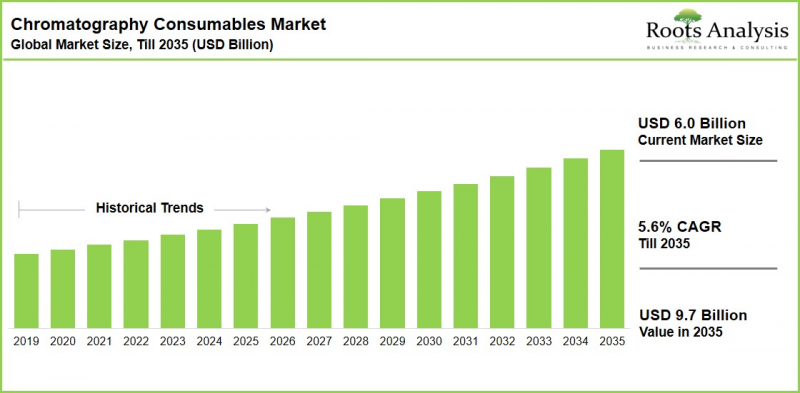
全球層析法耗材市場規模預計將從今年的 60 億美元成長到 2035 年的 97 億美元,預測期內的複合年成長率約為 5.6%。
層析法耗材市場-成長與趨勢
層析法耗材包括層析管、過濾器、試管、管瓶及其他相關用品,用於分離、純化及分析複雜混合物。自20世紀初米哈伊爾·茲維特首次引入該技術以來,市場已發生了顯著變化。如今,高品質的色譜耗材對於提高實驗室的重現性、確保符合法規要求以及提升分析通量至關重要。
製藥、生物技術、化學、食品飲料、石油化工和環境檢測等產業對層析法耗材的需求仍然強勁且多樣化。製藥和生技公司是主要的需求來源,因為它們所進行的分析活動範圍廣泛,涵蓋藥物發現、製程開發和商業化生產。
此外,先進生物製藥、細胞療法和基因療法的日益普及也改變市場格局。同時,提升層析法效率和精確度的技術創新也進一步推動市場發展。例如,Repligen公司近期推出了AVIPure®親和性和樹脂和HiPer™陰離子交換樹脂。這些產品專為AAV基因治療和病毒載體純化流程而設計,凸顯了業界持續向特定療法純化解決方案轉型的趨勢。
未來,層析法耗材可望在法醫學實驗室、臨床診斷和藥物研發等領域廣泛應用。分析技術、實驗室自動化和材料科學的不斷進步也將進一步推動這一趨勢。
成長驅動力:支持市場擴張的因素
製藥和生物製藥研發投入的不斷成長是推動該市場發展的主要動力。特別是,藥物研發活動的活性化、生物製藥生產的成長以及精準醫療計畫的拓展,都催生了對可靠的分析和純化工作流程的需求。層析法耗材,例如色譜柱、過濾器、管瓶和純化樹脂,為從藥物發現到商業化生產的關鍵環節提供支援。慢性病發病率的上升以及疫苗和生物相似藥開發平臺的持續擴展,進一步推動了這一趨勢。
此外,食品安全和環境檢測要求的不斷提高正在擴大目標市場範圍。檢測農藥殘留、黴菌毒素、重金屬、過敏原和雜質需要高靈敏度層析法,導致專用層析管柱、高純度溶劑和固相萃取管柱的消耗量持續成長。因此,層析法耗材需求的不斷增加為市場參與企業提供了拓展核心生命科學終端市場以外的機會。
此外,生物程序和實驗室自動化方面的結構性變革正在重塑市場格局。隨著製造商擴大病毒載體、質體DNA和其他先進生物製藥的生產,對能夠支援高純度和製程一致性的專用層析法耗材的需求持續成長。
市場挑戰:阻礙進展的主要障礙
儘管市場成長勢頭良好,但仍面臨諸多挑戰。高級耗材,尤其是特殊色譜管柱和樹脂,價格昂貴且運作有限,需要頻繁更換。這增加了小規模實驗室、學術機構和預算有限的設施的營運成本。
此外,層析法市場依賴數量有限的全球供應商提供關鍵原料,例如二氧化矽、特殊聚合物和高純度溶劑。因此,供應鏈中斷和價格波動會導致生產延誤,並增加製造商和終端用戶的成本。
層析法耗材市場-關鍵洞察
- 用於細胞和基因療法 (CGT) 的專用樹脂:供應商正將重心從通用分離介質轉向具有特殊化學成分的樹脂,這些樹脂專為純化病毒載體(例如 AAV)和質體DNA 而設計。例如,Repligen 公司推出了 AVIPure®親和性和樹脂和 HiPer™ 陰離子交換樹脂,這些樹脂專為克服先進療法生產中的生物製程瓶頸而設計。
- 將高通量親和性和柱整合到上游工程:層析法耗材正擴大應用於藥物研發流程的早期階段,尤其是在上游生物製程中,以實現即時分析資料的產生。例如,沃特世公司發布了其首款蛋白A親和性和層析管柱專為生技藥品製程開發早期階段的快速滴度測定而設計。
- 數位化和「智慧」耗材追蹤:為了最大限度地減少高通量工作流程中的人為錯誤,並防止色譜柱劣化導致的故障,耗材硬體正日益數位化。例如,像賽默飛世爾科技這樣的儀器領導企業正在將RFID技術整合到色譜柱和保護柱中,以自動監測壓力歷史、進樣次數和洗脫液體積限制。
- 為整合專業下游技術智慧財產權而進行的定向併購:領先的生命科學公司正在收購擁有利基純化技術和樣品製備服務的公司,以擴展其端到端耗材產品組合。例如,默克收購了JSR Life Sciences的層析法業務,以擴大其生物製程樹脂業務範圍;Veralis收購了Marks International,以增強其用於氣相層析法工作流程的自動化樣品製備能力。
- 一次性預注管柱的引入:生物製藥生產商正在用預裝的一次性產品取代傳統的自填充柱。這省去了複雜的就地清洗) 驗證程序,並縮短了多產品生產設施的周轉時間。
- 綠色層析法和微量分析硬體的最佳化:在永續性需求和超高效液相層析 (UHPLC) 的推動下,製造商正在重新設計色譜柱、注射器過濾器和接頭,以便使用惰性材料、處理微量樣品並減少有害溶劑的使用。
層析法耗材市場細分
Roots Analysis 將全球層析法耗材市場細分為以下幾個部分:
副產品
- 柱子
- 注射器過濾器
- 管材和配件
- 管瓶和孔盤
- 其他消耗品
層析法法
- 氣相層析法
- 液相層析法
- 薄層層析法
- 其他
最終用戶
- 製藥和生物技術公司
- 學術和研究機構
- 醫院和診所
- 食品和飲料公司
- 環保組織
- 石油和天然氣相關組織
- 其他
按地區
- 北美洲
- 美國
- 加拿大
- 歐洲
- 德國
- 法國
- 英國
- 義大利
- 西班牙
- 其他歐洲國家
- 亞太地區
- 中國
- 印度
- 日本
- 澳洲
- 韓國
- 亞太其他地區
- 中東和非洲
- 沙烏地阿拉伯
- 阿拉伯聯合大公國
- 埃及
- 拉丁美洲
- 巴西
- 墨西哥
其他好處
- 免費洞察包
- 一個免費的Excel資料包,支援報告中的所有分析模組。
- 15% 免費內容客製化
- 調查團隊將進行詳細的報告說明。
- 如果報告發布至今已超過 6 至 12 個月,我們將免費將其更新至最新版本。
目錄
第1章:序言
第2章:調查方法
第3章 市場動態
第4章 宏觀經濟指標
第5章執行摘要
第6章:引言
第7章 市場狀況
第8章:公司簡介
- 章節概要
- Agilent Technologies
- Bio-Rad Laboratories
- JASCO
- Millipore Sigma
- Revvity
- Sartorius
- Shimadzu Scientific Instruments
- Thermo Fisher Scientific
第9章 專利分析
第10章併購
第11章 市場影響分析
第12章:全球層析法耗材市場
第13章:層析法耗材市場(依產品分類)
第14章:層析法耗材市場(依層析法技術分類)
第15章:層析法耗材市場(依最終用戶分類)
第16章:層析法耗材市場(依地區分類)
第17章 結論
第18章:高階主管洞見
第19章附錄一:表格形式數據
第20章 附錄二:公司和組織列表
CHROMATOGRAPHY CONSUMABLES MARKET: OVERVIEW
As per Roots Analysis, the global chromatography consumables market is estimated to grow from USD 6.0 billion in the current year to USD 9.7 billion by 2035, reflecting a compound annual growth rate (CAGR) of approximately 5.6% during the forecast period.
Chromatography Consumables Market: Growth and Trends
Chromatography consumables are the columns, filters, tubes, vials, and related supplies that support the separation, purification, and analysis of complex mixtures. Since the technique was first introduced by Mikhail Tsvet in the early 1900s, the market has evolved considerably. Laboratories today rely on high-quality consumables to improve reproducibility, sustain regulatory compliance and support higher analytical throughput.
Demand for chromatography consumables remains robust and diversified across pharmaceutical, biotechnology, chemical, food and beverage, petrochemical and environmental testing industries. Pharmaceutical and biotechnology organizations represent the primary source of demand, owing to extensive analytical activity spanning drug discovery, process development and commercial manufacturing operations.
The market is also being reshaped by the growing adoption of advanced biologics, cell therapies and gene therapies. Additionally, growing technological innovations to improve chromatography efficacy and accuracy are further driving the market. For instance, Repligen Corporation recently introduced its AVIPure(R) affinity resins and HiPer(TM) anion-exchange resins. These models are purpose-built for AAV gene therapy and viral vector purification workflows, underscoring the industry's continued shift toward modality-specific purification solutions.
Looking ahead, chromatography consumables are anticipated to gain momentum across forensic laboratories, clinical diagnostics and drug development programs. This is further supported by continued advances in analytical technologies, laboratory automation and material science.
Growth Drivers: Factors Fueling Market Expansion
Escalating pharmaceutical and biopharmaceutical R&D investment is a primary driver of this market. Notably, rising drug development activity, increasing biologics production and expanding precision medicine programs require dependable analytical and purification workflows. Chromatography consumables, including columns, filters, vials and purification resins, support critical activities spanning discovery through commercial manufacturing. This is further reinforced by the growing prevalence of chronic diseases and the continued expansion of vaccine and biosimilar development pipelines.
Expanding food safety and environmental testing requirements are also broadening the addressable base. Detection of pesticide residues, mycotoxins, heavy metals, allergens, and adulterants demands high-sensitivity chromatographic methods that consume application-specific columns, high-purity solvents, and solid-phase extraction cartridges at a steady pace. Therefore, the growing demand for chromatography consumable is giving market players exposure well beyond core life sciences end markets.
The market is further being reshaped by structural shifts in bioprocessing and laboratory automation. As manufacturers scale up production of viral vectors, plasmid DNA and other advanced biologics, demand for specialized chromatography consumables that support high purity and process consistency continues to rise.
Market Challenges: Critical Barriers Hindering Progress
Despite the encouraging growth, the market continues to face several challenges. Advanced consumables, particularly specialty columns and resins, are expensive and require frequent replacement due to their limited operational lifespan. This increases operating costs for smaller laboratories, academic institutions, and budget-constrained facilities.
The chromatography market also depends on a limited number of global suppliers for key raw materials, including silica, specialty polymers, and high-purity solvents. As a result, supply chain disruptions and price fluctuations can delay production and increase costs for manufacturers and end users.
Chromatography Consumables Market: Key Insights
- Modality-Specific Resins for Cell & Gene Therapies (CGT): Vendors are shifting focus from general-purpose separation media toward specialized chemistries designed for viral vectors (e.g., AAVs) and plasmid DNA purification. For instance, Repligen launched AVIPure(R) affinity resins and HiPer(TM) anion-exchange resins specifically engineered to clear bioprocessing bottlenecks in advanced therapy manufacturing.
- Upstream Integration via High-Throughput Affinity Columns: Chromatography consumables are moving earlier into the drug development pipeline specifically upstream bioprocessing to enable real-time analytical data generation. For instance, Waters Corporation introduced its first Protein A affinity chromatography columns dedicated to rapid titer measurement during early-stage biologic process development.
- Digitized & "Smart" Consumable Tracking: To minimize human error and prevent column degradation failures in high-throughput workflows, consumable hardware is becoming digitally active. For instance, Instrumentation leaders like Thermo Fisher Scientific are embedding RFID technology into columns and guard cartridges to automatically monitor pressure history, injection counts, and eluent volume limits.
- Targeted M&A to Consolidate Specialty Downstream IP: Tier-1 life sciences players are acquiring niche purification asset holders and sample preparation providers to expand their end-to-end consumables portfolio. For instance, Merck acquired JSR Life Sciences' chromatography business to expand its bioprocessing resin footprint, while Velaris acquired Markes International to enhance automated sample prep for gas chromatography workflows.
- Single-Use and Pre-Packed Column Adoption: Biopharmaceutical manufacturers are replacing traditional self-packed columns with pre-packed, single-use alternatives to bypass complex Clean-In-Place (CIP) validation steps and reduce turnaround times in multi-product facilities.
- Green Chromatography & Micro-Volume Hardware Optimization: Driven by sustainability mandates and UHPLC adoption, manufacturers are redesigning columns, syringe filters, and fittings to operate with bio-inert materials, micro-sample volumes, and reduced hazardous solvent consumption.
Chromatography Consumables Market Segments
Roots Analysis segments the global chromatography consumables opportunity across the following segments:
By Product
- Columns
- Syringe Filters
- Tubes and Fittings
- Vials and Well Plates
- Other Consumables
By Chromatography Technique
- Gas Chromatography
- Liquid Chromatography
- Thin Layer Chromatography
- Other Chromatography Techniques
By End User
- Pharmaceutical and Biotechnology Companies
- Academic and Research Institutions
- Hospitals and Clinics
- Food and Beverage Companies
- Environmental Agencies
- Oil and Gas Organizations
- Other End Users
By Geographical Regions
- North America
- US
- Canada
- Europe
- Germany
- France
- UK
- Italy
- Spain
- Rest of Europe
- Asia-Pacific
- China
- India
- Japan
- Australia
- South Korea
- Rest of Asia-Pacific
- Middle East and Africa
- Saudi Arabia
- UAE
- Egypt
- Latin America
- Brazil
- Mexico
Chromatography Consumables Market: Key Segments
Instruments Segment Leads the Market
Based on Roots Analysis market assessment, the columns segment is expected to account for the largest share of the chromatography consumables market. This dominance is driven by the essential role of columns in chromatography workflows. They are widely used for quality control, method development, and high-volume testing across the pharmaceutical, biopharmaceutical, food, and environmental industries. Columns are also relatively high-value consumables that require periodic replacement as performance degrades over time, sustaining a recurring revenue base for suppliers.
On the other hand, the syringe filters segment is projected to witness the highest CAGR during the forecast period. Growth is driven by the increasing use of syringe filters in sample preparation, particularly for biopharmaceutical sample cleanup, sterile filtration, and pre-injection processing. These filters improve sample purity, protect analytical instruments, and help reduce assay failure rates.
Liquid Chromatography Dominates the Market
Based on our proprietary market report, the liquid chromatography segment captures the largest share of the chromatography consumables market. This dominance is driven by the high sensitivity, specificity, and versatility of liquid chromatography in separating polar, ionic, and heat-sensitive compounds. Its reliable and reproducible results make it the preferred technique across the pharmaceutical, food and beverage, and environmental industries while supporting regulatory compliance.
On the other hand, the gas chromatography segment is expected to register a comparatively higher CAGR during the forecast period. This growth is driven by the increasing use of gas chromatography for analyzing volatile and semi-volatile compounds. Rising demand across environmental testing, petrochemicals, food safety, and forensic analysis, along with automation and stricter regulations for trace-level detection, continues to support market growth.
Pharmaceutical and Biotechnology Industries Dominate the Market
According to the market projections, pharmaceutical and biotechnology companies hold the largest share of the market. This leadership is driven by the widespread use of chromatography consumables in highly regulated, high-throughput laboratories. These consumables are essential for method development, quality control, analytical validation, lot release, stability testing, and impurity profiling.
On the other hand, the environmental agencies segment is expected to grow at a higher CAGR during the forecast period. This growth is driven by increasing regulatory emphasis on environmental monitoring, the expansion of regulated pollutant classes such as PFAS, and rising frequency of drinking water and soil screening programs that require advanced chromatography-based detection.
North America Leads the Market
According to our market projections, North America holds the largest share of global market revenue in the current year, and this trend is unlikely to change in the future. The region's dominance is driven by its strong life sciences ecosystem in the US and Canada, supported by a high concentration of biopharmaceutical R&D centers and GMP manufacturing facilities. In addition, stringent regulatory standards continue to drive demand for high-quality, validated chromatography consumables.
Asia-Pacific is Witnessing Higher CAGR
Asia-Pacific is expected to grow at a higher CAGR during the forecast period till 2035. This trajectory is supported by rapid capacity expansion and regulatory modernization across China and India. In addition, the expansion of biopharmaceutical manufacturing, CDMO operations, and food, environmental, and clinical testing laboratories is driving the shift from instrument-focused procurement to consumable-intensive workflows.
Example Players in Chromatography Consumables Market
- Agilent Technologies
- Bio-Rad Laboratories
- JASCO
- Millipore Sigma
- Revvity
- Sartorius
- Shimadzu Scientific Instruments
- Thermo Fisher Scientific
Industry Experts
The opinions and insights presented in this study were influenced by discussions conducted with multiple stakeholders. The research report features detailed transcripts of interviews held with the following industry stakeholders:
- The market report includes transcripts of the following third-party discussions:
- Technical Director, Very Large Company, US
- Technology Consultant, Small Company, US
- Senior Product Marketing Manager, Very Large Company, US
- Senior Director, Very Large Company, US
- Vice President, Very Large Company, US
- Senior Principal Tech Support Specialist, Very Large Company, US
- Senior Principal Product Manager, Very Large Company, US
- Analytical Chemist, Very Large Company, US
- Research Senior Principal Scientist, Very Large Company, US
- R&D and Innovation Director, Very Large Company, US
CHROMATOGRAPHY CONSUMABLES MARKET: RESEARCH COVERAGE
- Market Sizing and Opportunity Analysis: The report features an in-depth analysis of the chromatography consumables market, focusing on key market segments, including product, chromatography technique, end user, and geographical regions.
- Chromatography Consumables Landscape: A detailed assessment of the overall chromatography consumables market landscape, featuring information on several relevant parameters, such as type of product, chromatography technique, end user, and regulatory considerations. Additionally, it features detailed analysis of consumable manufacturers, based on parameters such as year of establishment, company size (based on employee count), and location of headquarters.
- Company Profiles: In-depth profiles of prominent players engaged in offering chromatography consumables, featuring information on their year of establishment, location of headquarters, company size (in terms of number of employees), management team, portfolio, and key initiatives.
- Patent Analysis: An analysis of the patents filed / granted related to chromatography consumables, based on parameters such as type of patent, patent application year, patent publication year, patent jurisdiction, CPC symbols, type of applicant, patent benchmarking, and patent valuation.
- Recent Developments: A detailed analysis of the various recent developments in this industry, including partnerships and collaborations, funding and investments, and global events, based on several relevant parameters.
- Porter's Five Forces Analysis: A qualitative analysis of five competitive forces in this domain, namely, threats of new entrants, bargaining power of buyers, bargaining power of providers, threat of substitute products, and rivalry among existing competitors.
- Market Impact Analysis: The report analyzes various factors such as drivers, restraints, opportunities, and challenges affecting market growth.
Key Questions Answered in this Report
- Which are the leading companies in the chromatography consumables market?
- Which region dominates the chromatography consumables market?
- What are the key trends observed in the chromatography consumables market?
- What factors are likely to influence the evolution of this market?
- What are the primary challenges faced by chromatography consumable developers?
- What is the current and future market size?
- What is the CAGR of this market?
- How is the current and future market opportunity likely to be distributed across key market segments?
Reasons to Buy this Report
This report has been specifically developed to support distributors, channel partners, and business development teams evaluating entry into the chromatography consumables market.
- The report provides a comprehensive market analysis, offering detailed revenue projections of the overall market and its specific sub-segments. This information is valuable to both established market leaders and emerging entrants.
- The report offers stakeholders a comprehensive overview of the market, including key drivers, barriers, opportunities, and challenges. This information empowers stakeholders to stay abreast of market trends and make data-driven decisions to capitalize on growth prospects.
- The report can aid businesses in identifying future opportunities in any sector. It also helps in understanding if those opportunities are worth pursuing.
- The report helps in identifying customer demand by understanding the needs, preferences, and behavior of the target audience in order to tailor products or services effectively.
- The report equips new entrants with requisite information regarding a particular market to help them build successful business strategies.
- The report allows for more effective communication with the audience and in building strong business relations.
Additional Benefits
- Complementary Insights Pack
- Complementary Excel Data Packs for all Analytical Modules in the Report
- 15% Free Content Customization
- Detailed Report Walkthrough Session with Research Team
- Free Updated report if the report is 6-12 months old or older
TABLE OF CONTENTS
1. PREFACE
- 1.1. Introduction
- 1.2. Market Share Insights
- 1.3. Key Market Insights
- 1.4. Report Coverage
- 1.5. Key Questions Answered
- 1.6. Chapter Outlines
2. RESEARCH METHODOLOGY
- 2.1. Chapter Overview
- 2.2. Research Assumptions
- 2.2.1. Market Landscape and Market Trends
- 2.2.2. Market Forecast and Opportunity Analysis
- 2.2.3. Comparative Analysis
- 2.3. Database Building
- 2.3.1. Data Collection
- 2.3.2. Data Validation
- 2.3.3. Data Analysis
- 2.4. Project Methodology
- 2.4.1. Secondary Research
- 2.4.1.1. Annual Reports
- 2.4.1.2. Academic Research Papers
- 2.4.1.3. Company Websites
- 2.4.1.4. Investor Presentations
- 2.4.1.5. Regulatory Filings
- 2.4.1.6. White Papers
- 2.4.1.7. Industry Publications
- 2.4.1.8. Conferences and Seminars
- 2.4.1.9. Government Portals
- 2.4.1.10. Media and Press Releases
- 2.4.1.11. Newsletters
- 2.4.1.12. Industry Databases
- 2.4.1.13. Roots Proprietary Databases
- 2.4.1.14. Paid Databases and Sources
- 2.4.1.15. Social Media Portals
- 2.4.1.16. Other Secondary Sources
- 2.4.2. Primary Research
- 2.4.2.1. Types of Primary Research
- 2.4.2.1.1. Qualitative Research
- 2.4.2.1.2. Quantitative Research
- 2.4.2.1.3. Hybrid Approach
- 2.4.2.2. Advantages of Primary Research
- 2.4.2.3. Techniques for Primary Research
- 2.4.2.3.1. Interviews
- 2.4.2.3.2. Surveys
- 2.4.2.3.3. Focus Groups
- 2.4.2.3.4. Observational Research
- 2.4.2.3.5. Social Media Interactions
- 2.4.2.4. Key Opinion Leaders Considered in Primary Research
- 2.4.2.4.1. Company Executives (CXOs)
- 2.4.2.4.2. Board of Directors
- 2.4.2.4.3. Company Presidents and Vice Presidents
- 2.4.2.4.4. Research and Development Heads
- 2.4.2.4.5. Technical Experts
- 2.4.2.4.6. Subject Matter Experts
- 2.4.2.4.7. Scientists
- 2.4.2.4.8. Doctors and Other Healthcare Providers
- 2.4.2.5. Ethics and Integrity
- 2.4.2.5.1. Research Ethics
- 2.4.2.5.2. Data Integrity
- 2.4.2.1. Types of Primary Research
- 2.4.3. Analytical Tools and Databases
- 2.4.1. Secondary Research
- 2.5. Robust Quality Control
3. MARKET DYNAMICS
- 3.1. Chapter Overview
- 3.2. Forecast Methodology
- 3.2.1. Top-down Approach
- 3.2.2. Bottom-up Approach
- 3.2.3. Hybrid Approach
- 3.3. Market Assessment Framework
- 3.3.1. Total Addressable Market (TAM)
- 3.3.2. Serviceable Addressable Market (SAM)
- 3.3.3. Serviceable Obtainable Market (SOM)
- 3.3.4. Currently Acquired Market (CAM)
- 3.4. Forecasting Tools and Techniques
- 3.4.1. Qualitative Forecasting
- 3.4.2. Correlation
- 3.4.3. Regression
- 3.4.4. Extrapolation
- 3.4.5. Convergence
- 3.4.6. Sensitivity Analysis
- 3.4.7. Scenario Planning
- 3.4.8. Data Visualization
- 3.4.9. Time Series Analysis
- 3.4.10. Forecast Error Analysis
- 3.5. Key Considerations
- 3.5.1. Demographics
- 3.5.2. Government Regulations
- 3.5.3. Reimbursement Scenarios
- 3.5.4. Market Access
- 3.5.5. Supply Chain
- 3.5.6. Industry Consolidation
- 3.5.7. Pandemic / Unforeseen Disruptions Impact
- 3.6. Limitations
4. MACRO-ECONOMIC INDICATORS
- 4.1. Chapter Overview
- 4.2. Market Dynamics
- 4.2.1. Time Period
- 4.2.1.1. Historical Trends
- 4.2.1.2. Current and Forecasted Estimates
- 4.2.2. Currency Coverage
- 4.2.2.1. Major Currencies Affecting the Market
- 4.2.2.2. Factors Affecting Currency Fluctuations
- 4.2.2.3. Impact of Currency Fluctuations on the Industry
- 4.2.3. Foreign Currency Exchange Rate
- 4.2.3.1. Impact of Foreign Exchange Rate Volatility on the Market
- 4.2.3.2. Strategies for Mitigating Foreign Exchange Risk
- 4.2.4. Recession
- 4.2.4.1. Assessment of Current Economic Conditions and Potential Impact on the Market
- 4.2.4.2. Historical Analysis of Past Recessions and Lessons Learnt
- 4.2.5. Inflation
- 4.2.5.1. Measurement and Analysis of Inflationary Pressures in the Economy
- 4.2.5.2. Potential Impact of Inflation on the Market Evolution
- 4.2.6. Interest Rates
- 4.2.6.1. Interest Rates and Their Impact on the Market
- 4.2.6.2. Strategies for Managing Interest Rate Risk
- 4.2.7. Commodity Flow Analysis
- 4.2.7.1. Type of Commodity
- 4.2.7.2. Origins and Destinations
- 4.2.7.3. Values and Weights
- 4.2.7.4. Modes of Transportation
- 4.2.8. Global Trade Dynamics
- 4.2.8.1. Import Scenario
- 4.2.8.2. Export Scenario
- 4.2.8.3. Trade Policies
- 4.2.8.4. Strategies for Mitigating the Risks Associated with Trade Barriers
- 4.2.8.5. Impact of Trade Barriers on the Market
- 4.2.9. War Impact Analysis
- 4.2.9.1. Russian-Ukraine War
- 4.2.9.2. Israel-Hamas War
- 4.2.10. COVID Impact / Related Factors
- 4.2.10.1. Global Economic Impact
- 4.2.10.2. Industry-specific Impact
- 4.2.10.3. Government Response and Stimulus Measures
- 4.2.10.4. Future Outlook and Adaptation Strategies
- 4.2.11. Other Indicators
- 4.2.11.1. Fiscal Policy
- 4.2.11.2. Consumer Spending
- 4.2.11.3. Gross Domestic Product
- 4.2.11.4. Employment
- 4.2.11.5. Taxes
- 4.2.11.6. Stock Market Performance
- 4.2.11.7. Cross Border Dynamics
- 4.2.1. Time Period
- 4.3. Conclusion
5. EXECUTIVE SUMMARY
- 5.1. Executive Summary: Market Landscape
- 5.2. Executive Summary: Market Trends
- 5.3. Executive Summary: Market Forecast and Opportunity Analysis
6. INTRODUCTION
- 6.1. Chapter Overview
- 6.2. Overview of Chromatography
- 6.3. Principle of Chromatography
- 6.4. Types of Chromatography
- 6.5. Applications of Chromatography
- 6.6. Future Perspectives
7. MARKET LANDSCAPE
- 7.1. Chapter Overview
- 7.2. Chromatography Consumables Providers: Overall Market Landscape
- 7.2.1. Analysis by Year of Establishment
- 7.2.2. Analysis by Company Size
- 7.2.3. Analysis by Location of Headquarters
- 7.2.4. Analysis by Company Size and Location of Headquarters
- 7.2.5. Analysis by Type of Separation Technique Used
- 7.2.6. Analysis by Type of Solid Phase Offered
- 7.2.7. Analysis by Type of Consumable Format Offered
- 7.2.8. Analysis by Type of Analyte
- 7.2.9. Analysis by Application Area of Chromatography Consumables
8. COMPANY PROFILES
- 8.1. Chapter Overview
- 8.2. Agilent Technologies
- 8.2.1. Company Overview
- 8.2.2. Product Portfolio
- 8.2.3. Recent Initiatives
- Similar details are presented for other companies mentioned below (based on information in the public domain)
- 8.3. Bio-Rad Laboratories
- 8.4. JASCO
- 8.5. Millipore Sigma
- 8.6. Revvity
- 8.7. Sartorius
- 8.8. Shimadzu Scientific Instruments
- 8.9. Thermo Fisher Scientific
9. PATENT ANALYSIS
- 9.1. Chapter Overview
- 9.2. Scope and Methodology
- 9.3. Chromatography Consumables Market: Patent Analysis
- 9.3.1. Analysis by Publication Year
- 9.3.2. Analysis by Type of Patent
- 9.3.3. Analysis by Type of Patent and Publication Year
- 9.3.4. Analysis by Type of Applicant
- 9.3.5. Analysis by Application Year
- 9.3.6. Analysis by Patent Jurisdiction (Region)
- 9.3.7. Analysis by Patent Jurisdiction (Country)
- 9.3.8. Analysis by Patent Age
- 9.3.9. Leading Industry Players: Analysis by Number of Patents
- 9.3.10. Leading Non-Industry Players: Analysis by Number of Patents
- 9.3.11. Leading Individual Assignees: Analysis by Number of Patents
- 9.3.12. Analysis by CPC Symbols
- 9.4. Chromatography Consumables: Patent Benchmarking Analysis
- 9.5. Patent Valuation Analysis
10. MERGERS AND ACQUISITIONS
- 10.1. Chapter Overview
- 10.2. Merger and Acquisition Models
- 10.3. Chromatography Consumables: Mergers and Acquisitions
- 10.3.1. Analysis by Type of Deal
- 10.3.2. Analysis by Year of Deal
- 10.3.3. Analysis by Company Ownership
- 10.3.4. Analysis by Geography
- 10.3.4.1. Intercontinental and Intracontinental Deals
- 10.3.4.2. Local and International Deals
- 10.3.5. Most Active Players: Analysis by Number of Mergers and Acquisitions
- 10.3.6. Analysis by Key Value Drivers
- 10.3.7. Key Acquisitions: Deal Multiples
11. MARKET IMPACT ANALYSIS
- 11.1. Chapter Overview
- 11.2. Market Drivers
- 11.3. Market Restraints
- 11.4. Market Opportunities
- 11.5. Market Challenges
- 11.6. Conclusion
12. GLOBAL CHROMATOGRAPHY CONSUMABLES MARKET
- 12.1. Chapter Overview
- 12.2. Assumptions and Methodology
- 12.3. Global Chromatography Consumables Market, Forecasted Estimates (till 2035)
- 12.4. Roots Analysis Perspective on Market Growth
- 12.5. Scenario Analysis
- 12.5.1. Conservative Scenario
- 12.5.2. Optimistic Scenario
- 12.6. Key Market Segmentations
13. CHROMATOGRAPHY CONSUMABLES MARKET, BY PRODUCT
- 13.1. Chapter Overview
- 13.2. Key Assumptions and Methodology
- 13.3. Chromatography Consumables Market: Distribution by Product
- 13.3.1. Chromatography Consumables Market for Columns, Forecasted Estimates (till 2035)
- 13.3.2. Chromatography Consumables Market for Syringe Filters, Forecasted Estimates (till 2035)
- 13.3.3. Chromatography Consumables Market for Tubes and Fittings, Forecasted Estimates (till 2035)
- 13.3.4. Chromatography Consumables Market for Vials and Well Plates, Forecasted Estimates (till 2035)
- 13.4. Data Triangulation and Validation
14. CHROMATOGRAPHY CONSUMABLES MARKET, BY CHROMATOGRAPHY TECHNIQUE
- 14.1. Chapter Overview
- 14.2. Key Assumptions and Methodology
- 14.3. Chromatography Consumables Market: Distribution by Chromatography Technique
- 14.3.1. Chromatography Consumables Market for Gas Chromatography, Forecasted Estimates (till 2035)
- 14.3.2. Chromatography Consumables Market for Liquid Chromatography, Forecasted Estimates (till 2035)
- 14.3.3. Chromatography Consumables Market for Thin Layer Chromatography, Forecasted Estimates (till 2035)
- 14.3.4. Chromatography Consumables Market for Other Chromatography Techniques, Forecasted Estimates (till 2035)
- 14.4. Data Triangulation and Validation
15. CHROMATOGRAPHY CONSUMABLES MARKET, BY END USER
- 15.1. Chapter Overview
- 15.2. Key Assumptions and Methodology
- 15.3. Chromatography Consumables Market: Distribution by End User
- 15.3.1. Chromatography Consumables Market for Academic and Research Institutions, Forecasted Estimates (till 2035)
- 15.3.2. Chromatography Consumables Market for Environmental Agencies, Forecasted Estimates (till 2035)
- 15.3.3. Chromatography Consumables Market for Food and Beverage Companies, Forecasted Estimates (till 2035)
- 15.3.4. Chromatography Consumables Market for Hospitals and Clinics, Forecasted Estimates (till 2035)
- 15.3.5. Chromatography Consumables Market for Oil and Gas Organizations, Forecasted Estimates (till 2035)
- 15.3.6. Chromatography Consumables Market for Pharmaceutical and Biotechnology Companies, Forecasted Estimates (till 2035)
- 15.3.7. Chromatography Consumables Market for Other End Users, Forecasted Estimates (till 2035)
- 15.4. Data Triangulation and Validation
16. CHROMATOGRAPHY CONSUMABLES MARKET, BY GEOGRAPHICAL REGIONS
- 16.1. Chapter Overview
- 16.2. Key Assumptions and Methodology
- 16.3. Chromatography Consumables Market: Distribution by Geographical Regions
- 16.3.1. Chromatography Consumables Market in North America: Forecasted Estimates (till 2035)
- 16.3.1.1. Chromatography Consumables Market in the US: Forecasted Estimates (till 2035)
- 16.3.1.2. Chromatography Consumables Market in Canada: Forecasted Estimates (till 2035)
- 16.3.2. Chromatography Consumables Market in Europe: Forecasted Estimates (till 2035)
- 16.3.2.1. Chromatography Consumables Market in France: Forecasted Estimates (till 2035)
- 16.3.2.2. Chromatography Consumables Market in Germany: Forecasted Estimates (till 2035)
- 16.3.2.3. Chromatography Consumables Market in Italy: Forecasted Estimates (till 2035)
- 16.3.2.4. Chromatography Consumables Market in Spain: Forecasted Estimates (till 2035)
- 16.3.2.5. Chromatography Consumables Market in the UK: Forecasted Estimates (till 2035)
- 16.3.2.6. Chromatography Consumables Market in Rest of Europe: Forecasted Estimates (till 2035)
- 16.3.3. Chromatography Consumables Market in Asia-Pacific: Forecasted Estimates (till 2035)
- 16.3.3.1. Chromatography Consumables Market in China: Forecasted Estimates (till 2035)
- 16.3.3.2. Chromatography Consumables Market in India: Forecasted Estimates (till 2035)
- 16.3.3.3. Chromatography Consumables Market in Japan: Forecasted Estimates (till 2035)
- 16.3.3.4. Chromatography Consumables Market in Australia: Forecasted Estimates (till 2035)
- 16.3.3.5. Chromatography Consumables Market in South Korea: Forecasted Estimates (till 2035)
- 16.3.3.6. Chromatography Consumables Market in Rest of Asia-Pacific: Forecasted Estimates (till 2035)
- 16.3.4. Chromatography Consumables Market in Middle East and Africa: Forecasted Estimates (till 2035)
- 16.3.4.1. Chromatography Consumables Market in Saudi Arabia: Forecasted Estimates (till 2035)
- 16.3.4.2. Chromatography Consumables Market in UAE: Forecasted Estimates (till 2035)
- 16.3.4.3. Chromatography Consumables Market in Egypt: Forecasted Estimates (till 2035)
- 16.3.5. Chromatography Consumables Market in Latin America: Forecasted Estimates (till 2035)
- 16.3.5.1. Chromatography Consumables Market in Brazil: Forecasted Estimates (till 2035)
- 16.3.5.2. Chromatography Consumables Market in Mexico: Forecasted Estimates (till 2035)
- 16.3.5.3. Chromatography Consumables Market in Rest of Latin America: Forecasted Estimates (till 2035)
- 16.3.1. Chromatography Consumables Market in North America: Forecasted Estimates (till 2035)
- 16.4. Market Dynamics Assessment
- 16.4.1. Penetration-Growth (P-G) Matrix
- 16.5. Data Triangulation and Validation
17. CONCLUDING REMARKS
18. EXECUTIVE INSIGHTS
19. APPENDIX I: TABULATED DATA
20. APPENDIX II: LIST OF COMPANIES AND ORGANIZATIONS

 硼酸親和性和層析法市場規模、佔有率和成長分析:按產品類型、應用、最終用戶、方法和地區分類 - 產業預測,2026-2033年
 層析法市場:依產品類型、層析法設備類型、液相層析法、組成、固定相形式、最終用戶和地區分類:趨勢與預測至2035年
 超臨界流體市場:依產品、設備、製程、最終用戶、國家及地區分類-全球產業分析、市場規模、市場佔有率及2026年至2033年預測層析法市場(2025-2030 年):市場概覽
 層析法設備市場:按組件、儀器類型、分析方法、檢測器類型和應用分類-2026-2032年全球市場預測離子交換層析法市場:2026-2032年全球市場預測(依產品類型、材料類型、方法類型、生產規模、分析類型、結構類型、應用和最終用戶分類)
 層析法資料系統市場:按產品類型、最終用戶產業、部署模式和地區分類芹菜素市場:依純度、原料、型態、應用、地區分類
 全球層析法設備市場規模、佔有率、趨勢和成長分析報告(2026-2034)
 2026年全球一次性膜層析法系統市場報告