


 |
市場調查報告書
商品編碼
2106273
mRNA疫苗市場:按適應症和地區分類的趨勢和預測(至2035年)mRNA Vaccines Market by Target Indication and Geographical Regions - Trends and Forecast Till 2035 |
||||||

mRNA疫苗市場概覽
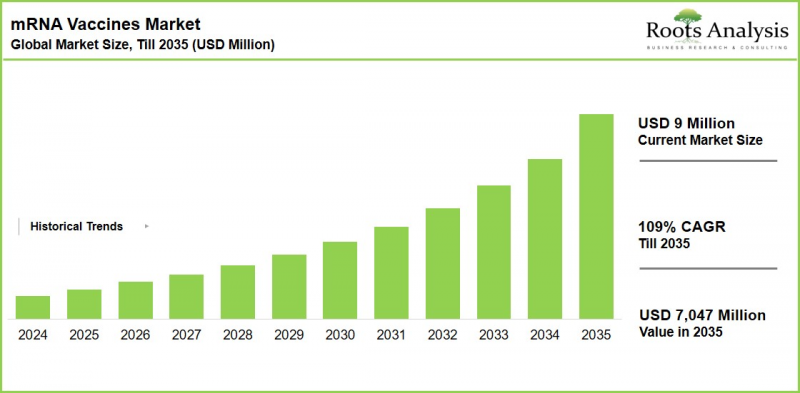
根據 Roots Analysis 的研究,全球 mRNA 疫苗市場(非 COVID 應用)預計將從目前的 900 萬美元成長到 2035 年的 70.47 億美元,預測期內的複合年成長率高達 109%。
mRNA疫苗市場:成長與趨勢
mRNA疫苗代表了預防醫學領域的模式轉移。這類疫苗利用信使核糖核酸(mRNA)引導宿主細胞產生特定的抗原蛋白,進而誘發標靶免疫反應。與依賴活病毒疫苗、去活化疫苗或重組蛋白的傳統疫苗平台不同,mRNA平台具有快速設計、可擴展的無細胞生產以及快速適應新出現的病原體和抗原漂移等優勢。這些關鍵特性在新冠疫情期間引起了全球關注,如今已被應用於更廣泛的適應症領域。
市場正逐漸從最初的疫情驅動階段轉向多元化的mRNA疫苗機遇,這得益於不斷擴充的臨床研發管線和近期內有望實現的商業化。呼吸道融合細胞病毒(RSV)仍然是重點領域,多種基於mRNA的候選藥物正在研發中,旨在滿足老年人和高風險兒童群體中尚未滿足的重大醫療需求。針對其他呼吸道和病毒性疾病(例如流感和巨細胞病毒)的研發活動也不斷加強,這反映了mRNA技術在感染疾病預防方面的多功能性。目前,僅針對癌症相關適應症,就有超過100種基於mRNA的候選藥物正在研究中,這表明該平台的應用範圍已遠遠超出其最初的應用領域。例如,BioNTech公司已發表了其目前正在進行II期臨床試驗的癌症疫苗的數據。這些個人化療法利用患者特異性腫瘤定序來設計與患者特異性新抗原相對應的客製化mRNA序列,目標是在下一個十年末左右上市。
越來越多的中後期臨床試驗證據進一步增強了mRNA疫苗市場的成長勢頭,這些證據支持mRNA疫苗的免疫抗原性、安全性以及快速抗原更新能力。目前已有數種mRNA疫苗獲得監管部門批准,還有更多候選疫苗正在進入後期臨床評估階段。例如,Moderna公司的Spikevax®已獲得美國食品藥物管理局(FDA)的生技藥品許可申請(sBLA)批准,其適應症擴展至高風險兒童(6個月至11歲)和老年人群。儘管疫情爆發以來整體需求已趨於正常,但對非新冠疫苗研發、生產流程最佳化以及支持疫苗遞送的基礎技術的持續投資,預計將在整個預測期內支撐市場的長期成長。
mRNA疫苗市場
市場規模和機會分析根據以下參數進行分類:
根據指示
- 呼吸道合胞感染疾病
- 轉移性/復發性/難治性頭頸癌
- 流感
- 諾羅病毒急性腸胃炎
- 傳染性單核球增多症
按地區
- 北美洲
- 美國
- 加拿大
- 歐洲
- 德國
- 英國
- 法國
- 義大利
- 西班牙
- 其他歐洲國家
- 亞太地區
- 中國
- 日本
- 韓國
- 澳洲
- 中東和北非
- 沙烏地阿拉伯
- 阿拉伯聯合大公國
- 拉丁美洲
- 巴西
- 阿根廷
mRNA疫苗市場:主要細分市場
預計流感將成為主要目標適應症。
市場分析預測,到2035年,流感疫苗將佔整體市場佔有率的相當大一部分。這一成長主要得益於mRNA技術能夠克服傳統流感疫苗的主要限制。由於流感病毒變異迅速,傳統疫苗需要頻繁更換成分。而mRNA技術可以更快地更新疫苗序列,使疫苗更接近流感流行季節進行調整,從而提高其對流行株的適用性和有效性。
此外,流感疫苗每年都會出現週期性的高需求,這與可擴展的無細胞mRNA生產模式完美契合。由於同一套生產基礎設施可以逐季重複使用,且僅需進行序列層面的調整,因此製造商可望提高營運效率和獲利能力。
北美市佔率最大。
根據該公司的預測,北美預計在2035年之前繼續保持其在mRNA疫苗市場中最大、成長最快的區域市場的主導地位。這一主導地位源自於該地區早期對mRNA平台研發的集中投資。在新冠疫情爆發之前,Moderna和輝瑞(與BioNTech合作)就已經建立了各自的mRNA設計技術、脂質奈米顆粒遞送技術和大規模生產能力。
此外,大規模的政府風險分擔支持,特別是「曲速行動」,加速了mRNA疫苗的臨床試驗和法規核准。 FDA高效透明的核准流程也持續推動疫苗更快上市。此外,mRNA合成、修飾和遞送技術方面強大的智慧財產權優勢進一步提高了該地區競爭對手的進入門檻。
歐洲和亞太地區蘊藏長期發展機會。
除北美以外,歐洲預計也將持續為全球市場銷售做出重大貢獻。這得益於不斷發展的生物技術生態系統、公共醫療保健部門協調的採購體系,以及近期監管方面的進展,例如歐盟委員會批准了莫德納公司的流感-新冠病毒聯合疫苗。
同時,亞太地區的mRNA疫苗市場雖然目前絕對規模仍然較小,但預計在預測期內將加速成長。推動這一成長的因素可能包括中國和韓國國內生產能力的提升、各國政府對疫情應對基礎建設的日益重視,以及該地區mRNA技術研發公司數量的不斷增加。
本報告對全球 mRNA 疫苗市場進行了分析,提供了概述、背景、市場影響因素分析、市場規模趨勢和預測、按各個細分市場和地區/主要國家進行的詳細分析、競爭格局以及主要公司的概況。
目錄
第1章:序言
第2章:調查方法
第3章 市場動態
第4章 宏觀經濟指標
第5章摘要整理
第6章:引言
- 章節概要
- 藥效疫苗
- mRNA疫苗的優勢
- mRNA疫苗的主要應用
- mRNA遞送途徑
- mRNA遞送策略
- mRNA疫苗面臨的主要挑戰
- 前景
第7章 市場狀況
- 章節概要
- mRNA疫苗:市場情勢
- mRNA疫苗:研發公司的現狀
第8章:產品競爭力分析
- 章節概要
- 前提條件和關鍵參數
- 調查方法
- mRNA疫苗:產品競爭力分析
- 北美洲
- 歐洲
- 亞太地區及其他地區
第9章 公司簡介:總部位於北美的mRNA疫苗研發公司
- 章節概要
- Arcturus Therapeutics
- Immorna
- Moderna
- Providence Therapeutics
- Innovac Therapeutics
- Kernal Biologics
- Recode Therapeutics
- Rejuvenation Technologies
- RNAimmune
- Turn Biotechnologies
- Strand Therapeutics
第10章 公司簡介:總部位於歐洲的mRNA疫苗研發公司
- 章節概要
- BioNTech
- CureVac
- Ethris
第11章 公司簡介:總部位於亞太地區的mRNA疫苗研發公司
- 章節概要
- Suzhou Abogen Biosciences
- Gennova Biopharmaceuticals
- RNACure
- Walvax
第12章:主要製藥公司的舉措
- 章節概要
- 研究範圍和調查方法
- mRNA疫苗市場:主要公司的努力
- 基準分析:大型製藥企業
- 結論
第13章:新創企業健康指標
- 章節概要
- 專注於mRNA疫苗的新創公司。
- 新創公司基準分析
- 新創公司的健康指標
第14章 臨床試驗分析
- 章節概要
- 研究範圍和調查方法
- mRNA疫苗:臨床試驗分析
第15章 夥伴關係與合作
- 章節概要
- 合作模式
- mRNA疫苗市場:合作與夥伴關係
第16章資金籌措與投資
- 章節概要
- 資金籌措模式
- mRNA疫苗市場:資金籌措與投資分析
- 資金籌措和投資概況
第17章 專利分析
- 章節概要
- 研究範圍和調查方法
- mRNA疫苗:專利分析
- 專利基準分析
- 專利評估
- 被引用次數最多的專利
第18章:FDA核准策略
- 章節概要
- 調查方法
- 關鍵參數
- mRNA疫苗臨床試驗失敗的常見原因
- 基準分析:mRNA疫苗主要策略的分佈
第19章 外包:可行/不可行框架
- 章節概要
- 外包:Go/NoGo 框架
- mRNA疫苗外包:決策框架
第20章 市場影響分析
- 章節概要
- 市場促進因素
- 市場限制因素
- 市場機遇
- 市場挑戰
- 結論
第21章:全球mRNA疫苗市場
- 章節概要
- 先決條件和調查方法
- 全球mRNA疫苗市場:歷史趨勢與預測
- 主要市場區隔
第22章 mRNA疫苗市場:依標靶適應症分類
- 章節概要
- 關鍵假設和調查方法
- mRNA疫苗市場:依適應症分類
- 呼吸道合胞感染疾病
- 轉移性、復發性或難治性頭頸癌
- 流感
- 諾羅病毒急性腸胃炎
- 傳染性單核球增多症
- 數據三角測量與檢驗
第23章:mRNA疫苗市場:依地區分類
- 章節概要
- 關鍵假設和調查方法
- mRNA疫苗市場:依地區分類
- 北美洲
- 歐洲
- 亞太地區
- 滲透成長(PG)矩陣
- 市場波動分析
- 數據三角測量與檢驗
第24章 市場機會分析:北美
- mRNA疫苗市場:依適應症分類
- 呼吸道合胞感染疾病
- 轉移性、復發性或難治性頭頸癌
- 流感
- 諾羅病毒急性腸胃炎
- 傳染性單核球增多症
第25章 市場機會分析:歐洲
- mRNA疫苗市場:依適應症分類
- 呼吸道合胞感染疾病
- 轉移性、復發性或難治性頭頸癌
- 流感
- 諾羅病毒急性腸胃炎
- 傳染性單核球增多症
第26章 市場機會分析:亞太地區
- mRNA疫苗市場:依適應症分類
- 呼吸道合胞感染疾病
- 轉移性、復發性或難治性頭頸癌
- 流感
- 諾羅病毒急性腸胃炎
- 傳染性單核球增多症
第27章 結論
第28章 高階主管洞察
第29章附錄1:表格形式數據
第30章 附錄2:公司與組織列表
mRNA VACCINES MARKET: OVERVIEW
As per Roots Analysis, the global mRNA vaccines market (for non-COVID applications) is estimated to grow from USD 9 million in the current year to USD 7,047 million by 2035, at an impressive CAGR of 109%, during the forecast period, till 2035.
mRNA Vaccines Market: Growth and Trends
mRNA vaccines represent a paradigm shift in preventive medicine. These vaccines rely on messenger ribonucleic acid (mRNA) to instruct host cells to manufacture a specific antigenic protein and, in turn, elicit a targeted immune response. Unlike conventional vaccine platforms that depend on live attenuated organisms, inactivated pathogens or recombinant proteins, the mRNA platform allows rapid design, scalable cell-free manufacturing and quick adaptability to emerging pathogens and antigenic drift. These significant features came to global prominence during the COVID-19 pandemic and are now being leveraged across a much broader set of indications.
The market is increasingly moving beyond its pandemic-driven origins toward a diversified mRNA vaccines opportunity, underpinned by expanding clinical pipelines and near-term commercialization prospects. Respiratory syncytial virus (RSV) remains a key area of focus, with multiple mRNA-based candidates progressing to address a significant unmet need among older adults and high-risk pediatric populations. Development activity is also intensifying across other respiratory and viral indications, including influenza and cytomegalovirus, reflecting the versatility of the mRNA modality across infectious disease prevention. Presently, over 100 mRNA-based candidates are presently being investigated for oncology-related indications alone, underscoring the platform's expansion well beyond its original scope. For instance, BioNTech has published its data on cancer vaccines that are currently in Phase II testing. These specialized therapies utilize patient-specific tumor sequencing to construct customized mRNA sequences matching an individual's unique neoantigens, aiming for a projected market launch window towards the end of the decade.
This market growth momentum is being reinforced by a growing number of mid- and late-stage clinical evidence supporting the immunogenicity, safety profile and rapid antigen-updating capability of mRNA vaccines. At present, several mRNA vaccines have secured regulatory approval, while a considerably larger number of candidates are advancing through late-stage clinical evaluation. For instance, Moderna's Spikevax(R) has received the approval of supplemental Biologics License Application (sBLA) from the FDA, expanding its indication to high-risk pediatric populations (ages 6 months to 11 years) and older adults. While overall demand has normalized in the post-pandemic period, sustained investment in non-COVID vaccine development, manufacturing optimization and enabling delivery technologies is expected to support long-term market growth during the forecast period.
Growth Drivers: Factors Fueling Expansion of the Global mRNA Vaccines Market
Market expansion is being driven by the inherent speed and adaptability of the mRNA platform, which allows vaccine sequences to be designed and modified far more quickly than is possible with conventional approaches. These essential characteristics aid in resolving antigenic drift and emerging pathogens. Further, this has been complemented by steady advances in lipid nanoparticle delivery systems and large-scale, cell-free manufacturing capabilities, which have improved vaccine stability, production efficiency and commercial viability, while easing prior bottlenecks in global-scale distribution. Furthermore, the applications of the mRNA modality are broadening well beyond infectious disease prevention into oncology, rare diseases and personalized medicine, supported by encouraging early clinical results. Meanwhile, an emerging shift towards next-generation RNA platforms, including self-amplifying, circular and trans-amplifying RNA systems, is expected to further extend the durability and reach of the underlying technology, collectively positioning the mRNA vaccines market for sustained growth.
Market Challenges: Critical Barriers Hindering Progress
Despite this progressive outlook, the market continues to witness several challenges that impede overall growth. Demand for COVID-19 mRNA vaccines has normalized below pandemic-era levels, and the sector must now build a durable commercial base around non-COVID indications where reimbursement pathways, physician familiarity and public confidence are comparatively less established. Cold-chain storage and distribution requirements, though improving, continue to limit accessibility in cost-sensitive and infrastructure-constrained markets, while manufacturing capacity remains concentrated among a small number of established players, creating potential supply-side bottlenecks as pipeline candidates approach commercialization.
Moreover, regulatory pathways for novel, non-pandemic mRNA indications are still maturing in several geographies, extending development timelines relative to more established modalities. Additionally, as the number of mRNA-based candidates in active development rises across overlapping indications, such as influenza and RSV, competitive intensity and pricing pressure are likely to increase, requiring differentiated efficacy, dosing convenience or combination-vaccine strategies for developers to sustain commercial advantage.
mRNA Vaccines Market: Key Insights
The report delves into the current state of the mRNA vaccines market and identifies potential growth opportunities within the industry. Some key findings include:
- Presently, seven mRNA vaccines have secured regulatory approval and are commercially available. Moreover, a considerably larger pool of candidates is progressing through mid- and late-stage clinical trials across infectious disease and oncology indications.
- Over 100 mRNA-based candidates are currently being investigated for cancer-related indications, reflecting the platform's expansion well beyond its infectious disease origins.
- Close to 70% of ongoing clinical trials evaluating mRNA vaccines are being managed or funded by industry players, with Moderna emerging as the most active sponsor, followed by BioNTech and Sanofi; over half of the registered trials have already been completed.
- Over 1,060 patents related to mRNA vaccine technologies have been filed or granted worldwide, with filing activity accelerating sharply in the years following the COVID-19 pandemic as developers move to protect intellectual property spanning both infectious diseases and oncology applications.
- Partnership activity in this domain is intensifying. For instance, Moderna's February 2026 collaboration with the Mexican government to build a local mRNA ecosystem, spanning respiratory vaccine supply and technology transfer for domestic production.
- Among big pharma players actively partnering with smaller, specialized mRNA developers to build out their capabilities, Pfizer leads, followed by Sanofi, which has meaningfully expanded its mRNA-focused portfolio through such collaborations.
- In April 2026, Moderna's combination influenza and COVID-19 mRNA vaccine (mRNA-1083) received European Commission authorization, marking the first approved dual respiratory mRNA vaccine globally; separately, its seasonal influenza candidate (mFlusiva) is under active FDA review following data showing superior efficacy versus standard flu shots in adults aged 50-64.
- Given the breadth of the clinical pipeline, rising research and development investment and continued diversification into oncology and next-generation RNA platforms, the mRNA vaccines market is well positioned for sustained, high-growth expansion through the forecast period.
mRNA Vaccines Market
The market sizing and opportunity analysis has been segmented across the following parameters:
By Target Indication
- RSV Infection
- Metastatic / R/R Head and Neck Cancer
- Influenza
- Norovirus Acute Gastroenteritis
- Mononucleosis
By Geographical Regions
- North America
- US
- Canada
- Europe
- Germany
- UK
- France
- Italy
- Spain
- Rest of Europe
- Asia-Pacific
- China
- Japan
- South Korea
- Australia
- Middle East and North Africa
- Saudi Arabia
- UAE
- Latin America
- Brazil
- Argentina
mRNA Vaccines Market: Key Segments
Influenza is Poised to Emerge as the Leading Target Indication
Based on market analysis, the influenza segment is projected to capture the majority of overall market share by 2035. This growth is driven by mRNA's ability to overcome major limitations of traditional flu vaccines. Influenza viruses evolve quickly, requiring frequent reformulation of conventional vaccines. mRNA technology enables much faster updates, allowing manufacturers to adjust the vaccine closer to flu season for a better strain match and improved effectiveness.
Moreover, influenza also offers a recurring, high-volume annual demand cycle that aligns closely with mRNA's scalable, cell-free manufacturing model, allowing the same production infrastructure to be reused each season with only sequence-level modifications, improving operating leverage and margin potential for manufacturers.
North America Holds the Highest Share
According to our projections, North America is expected to maintain its dominance as the largest and fastest-growing regional market for mRNA vaccines through 2035. This dominance is due to the region's early and concentrated investment in mRNA platform development. Recently, Moderna and Pfizer in collaboration with BioNTech established proprietary mRNA design, lipid nanoparticle delivery and large-scale manufacturing capabilities well ahead of the COVID-19 pandemic.
Additionally, substantial government risk-sharing support, most notably Operation Warp Speed, sped up clinical trials and regulatory approvals for mRNA vaccines. The FDA's efficient and well-defined approval processes continue to facilitate faster market entry. A dominant intellectual property position in mRNA synthesis, modification and delivery technologies further reinforces high entry barriers for competitors in the region.
Europe and Asia-Pacific Offer Long-Term Opportunity
Beyond North America, Europe is expected to remain a significant contributor to global revenues, supported by the region's expanding biotech ecosystem, coordinated public health procurement and recent regulatory milestones such as the European Commission's authorization of Moderna's combination influenza-COVID-19 vaccine.
Further, Asia-Pacific's mRNA vaccines market, while smaller in absolute terms, is expected to see growth momentum over the forecast period. This growth is likely to be driven by the growing domestic manufacturing initiatives across China and South Korea, rising government interest in pandemic-preparedness infrastructure, and an expanding base of local mRNA technology developers.
Example Players in mRNA Vaccines Market
- Arcturus Therapeutics
- BioNTech
- CureVac
- Ethris
- Gennova Biopharmaceuticals
- Immorna
- Innovac Therapeutics
- Kernal Biologics
- Moderna
- Providence Therapeutics
- Recode Therapeutics
- Rejuvenation Technologies
- RNACure
- RNAimmune
- Strand Therapeutics
- Suzhou Abogen Biosciences
- Turn Biotechnologies
- Walvax
Expert Interview and Industry Insights
The opinions and insights presented in this study were influenced by discussions conducted with multiple stakeholders. The research report features detailed transcripts of interviews held with the following industry stakeholders:
- Business Development Manager, Mid-sized Organization, Australia
- Senior Director, Business Development, Large Organization, Belgium
- Team Leader, Large Organization, South Korea
In addition, the report features transcripts of third-party discussions with the following individuals:
- Director of Advanced Drug Delivery, Mid-sized Organization, UK
- Deputy Director, Mid-sized Organization, US
- Co-Founder and Chief Executive Officer, Mid-sized Organization, Germany
- Co-Founder, Large Organization, Germany
- Chief Executive Officer, Large Organization, US
- Chief Executive Officer, Mid-sized Organization, US
- Chief Executive Officer, Large Organization, Italy
- President, Mid-sized Organization, Switzerland
- Medical Professional, Large Organization, Germany
mRNA VACCINES MARKET: RESEARCH COVERAGE
- Market Sizing and Opportunity Analysis: The report features an in-depth analysis of the mRNA vaccines market, focusing on key market segments, including, target indication and geographical regions, using a top-down forecasting approach validated against primary research inputs.
- mRNA Vaccines Landscape: A detailed assessment of the overall mRNA vaccines development landscape, featuring information on parameters such as phase of development, target indication, route of administration and type of technology / RNA platform. It also features analysis of developers based on year of establishment, company size and location of headquarters.
- Company Profiles: In-depth profiles of prominent players engaged in the mRNA vaccines industry, featuring information on their year of establishment, location of headquarters, company size, management team, portfolio and key initiatives.
- Clinical Trial Analysis: An analysis of completed and ongoing clinical trials related to mRNA vaccines, based on parameters such as trial registration year, trial phase, trial status, type of sponsor / collaborator, study design and leading industry / non-industry players.
- Patent Analysis: An analysis of patents filed / granted related to mRNA vaccine technologies, based on parameters such as type of patent, publication year, jurisdiction, CPC symbols, type of applicant and patent valuation.
- Recent Developments: A detailed analysis of recent partnerships, funding and investments, and big pharma initiatives within this industry, based on several relevant parameters.
- Porter's Five Forces Analysis: A qualitative analysis of five competitive forces in this domain, namely, threat of new entrants, bargaining power of buyers, bargaining power of suppliers, threat of substitutes, and rivalry among existing competitors.
- Market Impact Analysis: The report analyzes various factors such as drivers, restraints, opportunities and challenges affecting market growth.
Key Questions Answered in this Report
- Which are the leading companies in the mRNA vaccines market?
- Which region dominates the mRNA vaccines market?
- What are the key trends observed in the mRNA vaccines market?
- What factors are likely to influence the evolution of this market?
- What are the primary challenges faced by mRNA vaccine developers?
- What is the current and future market size?
- What is the CAGR of this market?
- How is the current and future market opportunity likely to be distributed across key market segments?
Reasons to Buy this Report
- The report provides a comprehensive market analysis, offering detailed revenue projections of the overall market and its specific sub-segments; this information is valuable to both established market leaders and emerging entrants.
- The report offers stakeholders a comprehensive overview of the market, including key drivers, barriers, opportunities and challenges, empowering data-driven decision-making.
- The report can aid businesses in identifying future opportunities in this sector and in understanding whether those opportunities are worth pursuing.
- The report helps in identifying customer demand by understanding the needs, preferences and behavior of the target audience, in order to tailor products or services effectively.
- The report equips new entrants with requisite information regarding this market to help them build successful business strategies.
- The report allows for more effective communication with the audience and in building strong business relations.
Additional Benefits
- Complementary Excel Data Packs for all Analytical Modules in the Report
- 15% Free Content Customization
- Detailed Report Walkthrough Session with Research Team
- Free Updated report if the report is 6-12 months old or older
TABLE OF CONTENTS
1. PREFACE
- 1.1. Introduction
- 1.2. Market Share Insights
- 1.3. Key Market Insights
- 1.4. Report Coverage
- 1.5. Key Questions Answered
- 1.6. Chapter Outlines
2. RESEARCH METHODOLOGY
- 2.1. Chapter Overview
- 2.2. Research Assumptions
- 2.2.1. Market Landscape and Market Trends
- 2.2.2. Market Forecast and Opportunity Analysis
- 2.2.3. Comparative Analysis
- 2.3. Database Building
- 2.3.1. Data Collection
- 2.3.2. Data Validation
- 2.3.3. Data Analysis
- 2.4. Project Methodology
- 2.4.1. Secondary Research
- 2.4.1.1. Annual Reports
- 2.4.1.2. Academic Research Papers
- 2.4.1.3. Company Websites
- 2.4.1.4. Investor Presentations
- 2.4.1.5. Regulatory Filings
- 2.4.1.6. White Papers
- 2.4.1.7. Industry Publications
- 2.4.1.8. Conferences and Seminars
- 2.4.1.9. Government Portals
- 2.4.1.10. Media and Press Releases
- 2.4.1.11. Newsletters
- 2.4.1.12. Industry Databases
- 2.4.1.13. Roots Proprietary Databases
- 2.4.1.14. Paid Databases and Sources
- 2.4.1.15. Social Media Portals
- 2.4.1.16. Other Secondary Sources
- 2.4.2. Primary Research
- 2.4.2.1. Types of Primary Research
- 2.4.2.1.1. Qualitative Research
- 2.4.2.1.2. Quantitative Research
- 2.4.2.1.3. Hybrid Approach
- 2.4.2.2. Advantages of Primary Research
- 2.4.2.3. Techniques for Primary Research
- 2.4.2.3.1. Interviews
- 2.4.2.3.2. Surveys
- 2.4.2.3.3. Focus Groups
- 2.4.2.3.4. Observational Research
- 2.4.2.3.5. Social Media Interactions
- 2.4.2.4. Key Opinion Leaders Considered in Primary Research
- 2.4.2.4.1. Company Executives (CXOs)
- 2.4.2.4.2. Board of Directors
- 2.4.2.4.3. Company Presidents and Vice Presidents
- 2.4.2.4.4. Research and Development Heads
- 2.4.2.4.5. Technical Experts
- 2.4.2.4.6. Subject Matter Experts
- 2.4.2.4.7. Scientists
- 2.4.2.4.8. Doctors and Other Healthcare Providers
- 2.4.2.5. Ethics and Integrity
- 2.4.2.5.1. Research Ethics
- 2.4.2.5.2. Data Integrity
- 2.4.2.1. Types of Primary Research
- 2.4.3. Analytical Tools and Databases
- 2.4.1. Secondary Research
- 2.5. Robust Quality Control
3. MARKET DYNAMICS
- 3.1. Chapter Overview
- 3.2. Forecast Methodology
- 3.2.1. Top-down Approach
- 3.2.2. Bottom-up Approach
- 3.2.3. Hybrid Approach
- 3.3. Market Assessment Framework
- 3.3.1. Total Addressable Market (TAM)
- 3.3.2. Serviceable Addressable Market (SAM)
- 3.3.3. Serviceable Obtainable Market (SOM)
- 3.3.4. Currently Acquired Market (CAM)
- 3.4. Forecasting Tools and Techniques
- 3.4.1. Qualitative Forecasting
- 3.4.2. Correlation
- 3.4.3. Regression
- 3.4.4. Extrapolation
- 3.4.5. Convergence
- 3.4.6. Sensitivity Analysis
- 3.4.7. Scenario Planning
- 3.4.8. Data Visualization
- 3.4.9. Time Series Analysis
- 3.4.10. Forecast Error Analysis
- 3.5. Key Considerations
- 3.5.1. Demographics
- 3.5.2. Government Regulations
- 3.5.3. Reimbursement Scenarios
- 3.5.4. Market Access
- 3.5.5. Supply Chain
- 3.5.6. Industry Consolidation
- 3.5.7. Pandemic / Unforeseen Disruptions Impact
- 3.6. Limitations
4. MACRO-ECONOMIC INDICATORS
- 4.1. Chapter Overview
- 4.2. Market Dynamics
- 4.2.1. Time Period
- 4.2.1.1. Historical Trends
- 4.2.1.2. Current and Forecasted Estimates
- 4.2.2. Currency Coverage
- 4.2.2.1. Major Currencies Affecting the Market
- 4.2.2.2. Factors Affecting Currency Fluctuations in the Industry
- 4.2.2.3. Impact of Currency Fluctuations on the Industry
- 4.2.3. Foreign Currency Exchange Rate
- 4.2.3.1. Impact of Foreign Exchange Rate Volatility on the Market
- 4.2.3.2. Strategies for Mitigating Foreign Exchange Risk
- 4.2.4. Recession
- 4.2.4.1. Assessment of Current Economic Conditions and Potential Impact on the Market
- 4.2.4.2. Historical Analysis of Past Recessions and Lessons Learnt
- 4.2.5. Inflation
- 4.2.5.1. Measurement and Analysis of Inflationary Pressures in the Economy
- 4.2.5.2. Potential Impact of Inflation on the Market Evolution
- 4.2.6. Interest Rates
- 4.2.6.1. Interest Rates and Their Impact on the Market
- 4.2.6.2. Strategies for Managing Interest Rate Risk
- 4.2.7. Commodity Flow Analysis
- 4.2.7.1. Type of Commodity
- 4.2.7.2. Origins and Destinations
- 4.2.7.3. Values and Weights
- 4.2.7.4. Modes of Transportation
- 4.2.8. Global Trade Dynamics
- 4.2.8.1. Import Scenario
- 4.2.8.2. Export Scenario
- 4.2.8.3. Trade Policies
- 4.2.8.4. Strategies for Mitigating the Risks Associated with Trade Barriers
- 4.2.8.5. Impact of Trade Barriers on the Market
- 4.2.9. War Impact Analysis
- 4.2.9.1. Russia-Ukraine War
- 4.2.9.2. Israel-Hamas War
- 4.2.10. COVID Impact / Related Factors
- 4.2.10.1. Global Economic Impact
- 4.2.10.2. Industry-specific Impact
- 4.2.10.3. Government Response and Stimulus Measures
- 4.2.10.4. Future Outlook and Adaptation Strategies
- 4.2.11. Other Indicators
- 4.2.11.1. Fiscal Policy
- 4.2.11.2. Consumer Spending
- 4.2.11.3. Gross Domestic Product
- 4.2.11.4. Employment
- 4.2.11.5. Taxes
- 4.2.11.6. Stock Market Performance
- 4.2.11.7. Cross Border Dynamics
- 4.2.1. Time Period
- 4.3. Conclusion
5. EXECUTIVE SUMMARY
6. INTRODUCTION
- 6.1. Chapter Overview
- 6.2. mRNA Vaccines
- 6.2.1. Advantages of mRNA Vaccines
- 6.2.2. Key Applications of mRNA Vaccines
- 6.3. mRNA Vaccines
- 6.3.1. Advantages of mRNA Vaccines
- 6.3.2. Key Applications of mRNA Vaccines
- 6.4. mRNA Delivery Routes
- 6.5. mRNA Delivery Strategies
- 6.6. Key Challenges Associated with mRNA Vaccines
- 6.7. Future Perspectives
7. MARKET LANDSCAPE
- 7.1. Chapter Overview
- 7.2. mRNA Vaccines: Overall Market Landscape
- 7.2.1. Analysis by Status of Development
- 7.2.2. Analysis by Type of Drug Candidate
- 7.2.3. Analysis by Type of Program
- 7.2.4. Analysis by Type of Delivery System
- 7.2.5. Analysis by Type of Molecule Encoded
- 7.2.6. Analysis by Route of Administration
- 7.2.7. Analysis by Therapeutic Area
- 7.3. mRNA Vaccines: Developer Landscape
- 7.3.1. Analysis by Year of Establishment
- 7.3.2. Analysis by Company Size
- 7.3.3. Analysis by Location of Headquarters
- 7.3.4. Most Active Developers: Analysis by Number of Drugs Developed
8. PRODUCT COMPETITIVENESS ANALYSIS
- 8.1. Chapter Overview
- 8.2. Assumptions and Key Parameters
- 8.3. Methodology
- 8.4. mRNA Vaccines: Product Competitiveness Analysis
- 8.4.1. mRNA Vaccines Developed by Players based in North America
- 8.4.2. mRNA Vaccines Developed by Players based in Europe
- 8.4.3. mRNA Vaccines Developed by Players based in Asia-Pacific and Rest of the World
9. COMPANY PROFILES: mRNA VACCINE DEVELOPERS BASED IN NORTH AMERICA
- 9.1. Chapter Overview
- 9.2. Leading Developers in mRNA Vaccines Market based in North America
- 9.2.1. Arcturus Therapeutics
- 9.2.1.1. Company Overview
- 9.2.1.2. Financial Information
- 9.2.1.3. mRNA Vaccines Portfolio
- 9.2.1.4. Recent Developments and Future Outlook
- 9.2.2. Immorna
- 9.2.2.1. Company Overview
- 9.2.2.2. mRNA Vaccines Portfolio
- 9.2.2.3. Recent Developments and Future Outlook
- 9.2.3. Moderna
- 9.2.3.1. Company Overview
- 9.2.3.2. Financial Information
- 9.2.3.3. mRNA Vaccines Portfolio
- 9.2.3.4. Recent Developments and Future Outlook
- 9.2.4. Providence Therapeutics
- 9.2.4.1. Company Overview
- 9.2.4.2. Financial Information
- 9.2.4.3. mRNA Vaccines Portfolio
- 9.2.4.4. Recent Developments and Future Outlook
- 9.2.5. Innovac Therapeutics
- 9.2.5.1. Company Overview
- 9.2.5.2. mRNA Vaccines Portfolio
- 9.2.5.3. Recent Developments and Future Outlook
- 9.2.6. Kernal Biologics
- 9.2.6.1. Company Overview
- 9.2.6.2. Financial Information
- 9.2.6.3. mRNA Vaccines Portfolio
- 9.2.6.4. Recent Developments and Future Outlook
- 9.2.7. Recode Therapeutics
- 9.2.7.1. Company Overview
- 9.2.7.2. Financial Information
- 9.2.7.3. mRNA Vaccines Portfolio
- 9.2.7.4. Recent Developments and Future Outlook
- 9.2.8. Rejuvenation Technologies
- 9.2.8.1. Company Overview
- 9.2.8.2. Financial Information
- 9.2.8.3. mRNA Vaccines Portfolio
- 9.2.8.4. Recent Developments and Future Outlook
- 9.2.9. RNAimmune
- 9.2.9.1. Company Overview
- 9.2.9.2. Financial Information
- 9.2.9.3. mRNA Vaccines Portfolio
- 9.2.9.4. Recent Developments and Future Outlook
- 9.2.10. Turn Biotechnologies
- 9.2.10.1. Company Overview
- 9.2.10.2. Financial Information
- 9.2.10.3. mRNA Vaccines Portfolio
- 9.2.10.4. Recent Developments and Future Outlook
- 9.2.11. Strand Therapeutics
- 9.2.11.1. Company Overview
- 9.2.11.2. Financial Information
- 9.2.11.3. mRNA Vaccines Portfolio
- 9.2.11.4. Recent Developments and Future Outlook
- 9.2.1. Arcturus Therapeutics
10. COMPANY PROFILES: mRNA VACCINE DEVELOPERS BASED IN EUROPE
- 10.1. Chapter Overview
- 10.2. Leading Developers in mRNA Vaccines Market based in North America
- 10.2.1. BioNTech
- 10.2.1.1. Company Overview
- 10.2.1.2. Financial Information
- 10.2.1.3. mRNA Vaccines Portfolio
- 10.2.1.4. Recent Developments and Future Outlook
- 10.2.2. CureVac
- 10.2.2.1. Company Overview
- 10.2.2.2. Financial Information
- 10.2.2.3. mRNA Vaccines Portfolio
- 10.2.2.4. Recent Developments and Future Outlook
- 10.2.3. Ethris
- 10.2.3.1. Company Overview
- 10.2.3.2. mRNA Vaccines Portfolio
- 10.2.3.3. Recent Developments and Future Outlook
- 10.2.1. BioNTech
11. COMPANY PROFILES: mRNA VACCINE DEVELOPERS BASED IN ASIA-PACIFIC
- 11.1. Chapter Overview
- 11.2. Leading Developers in mRNA Vaccines Market based in North America
- 11.2.1. Suzhou Abogen Biosciences
- 11.2.1.1. Company Overview
- 11.2.1.2. mRNA Vaccines Portfolio
- 11.2.1.3. Recent Developments and Future Outlook
- 11.2.2. Gennova Biopharmaceuticals
- 11.2.2.1. Company Overview
- 11.2.2.2. Financial Information
- 11.2.2.3. mRNA Vaccines Portfolio
- 11.2.2.4. Recent Developments and Future Outlook
- 11.2.3. RNACure
- 11.2.3.1. Company Overview
- 11.2.3.2. mRNA Vaccines Portfolio
- 11.2.3.3. Recent Developments and Future Outlook
- 11.2.4. Walvax
- 11.2.4.1. Company Overview
- 11.2.4.2. Financial Information
- 11.2.4.3. mRNA Vaccines Portfolio
- 11.2.4.4. Recent Developments and Future Outlook
- 11.2.1. Suzhou Abogen Biosciences
12. BIG PHARMA INITIATIVES
- 12.1. Chapter Overview
- 12.2. Scope and Methodology
- 12.3. mRNA Vaccines Market: Big Player Initiatives
- 12.3.1. Analysis by Year of Initiative
- 12.3.2. Analysis by Type of Initiative
- 12.3.3. Analysis by Year and Type of Initiative
- 12.3.4. Analysis by Type of Partnership
- 12.3.5. Analysis by Type of Expansion
- 12.3.6. Analysis by Year of Initiative and Company
- 12.3.7. Big Pharma Players: Analysis by Number of Initiatives
- 12.4. Benchmarking Analysis: Big Pharma Players
- 12.4.1. Spider Web Analysis: Bayer
- 12.4.2. Spider Web Analysis: Pfizer
- 12.4.3. Spider Web Analysis: Sanofi
- 12.5. Concluding Remarks
13. START-UP HEALTH INDEXING
- 13.1. Chapter Overview
- 13.2. Start-ups focused on mRNA Vaccines
- 13.3. Benchmarking of Start-ups
- 13.4. Startup-Health Indexing
- 13.4.1. Analysis by Location of Headquarters
- 13.4.2. Analysis by Company Strength
- 13.4.3. Analysis by Pipeline Maturity
- 13.4.4. Analysis by Pipeline Strength
- 13.4.5. Analysis by Financial Support
- 13.4.6. Analysis by Investor Strength
- 13.4.7. Analysis by Partnership Activity
- 13.4.8. Start-ups Health Indexing: Roots Analysis Perspective
14. CLINICAL TRIAL ANALYSIS
- 14.1. Chapter Overview
- 14.2. Scope and Methodology
- 14.3. mRNA Vaccines: Clinical Trial Analysis
- 14.3.1. Analysis by Trial Registration Year
- 14.3.2. Analysis of Number of Patients Enrolled by Trial Registration Year
- 14.3.3. Analysis by Trial Phase
- 14.3.4. Analysis of Number of Patients Enrolled by Trial Phase
- 14.3.5. Analysis by Trial Status
- 14.3.6. Analysis by Trial Registration Year and Trial Status
- 14.3.7. Analysis by Patient Gender
- 14.3.8. Analysis by Study Design
- 14.3.8.1. Analysis by Type of Allocation
- 14.3.8.2. Analysis by Type of Intervention Model
- 14.3.8.3. Analysis by Type of Masking
- 14.3.8.4. Analysis by Trial Purpose
- 14.3.9. Analysis by Type of Sponsor / Collaborator
- 14.3.10. Analysis by Geography
- 14.3.10.1. Analysis of Clinical Trials by Geography
- 14.3.10.2. Analysis of Clinical Trials by Geography and Trial Status
- 14.3.10.3. Analysis of Patients Enrolled by Geography and Trial Status
15. PARTNERSHIPS AND COLLABORATIONS
- 15.1. Chapter Overview
- 15.2. Partnership Models
- 15.3. mRNA Vaccines Market: Partnerships and Collaborations
- 15.3.1. Analysis by Year of Partnership
- 15.3.2. Analysis by Type of Partnership
- 15.3.3. Analysis by Year and Type of Partnership
- 15.3.4. Analysis by Therapeutic Area
- 15.3.5. Most Active Players: Analysis by Number of Partnerships
- 15.3.6. Analysis by Geography
- 15.3.6.1. Intercontinental and Intracontinental Agreements
- 15.3.6.2. Local and International Agreements
16. FUNDING AND INVESTMENTS
- 16.1. Chapter Overview
- 16.2. Funding Models
- 16.3. mRNA Vaccines Market: Funding and Investment Analysis
- 16.3.1. Analysis by Year of Funding
- 16.3.1.1. Cumulative Year-wise Trend of Funding Instances
- 16.3.1.2. Cumulative Year-wise Trend of Amount Invested
- 16.3.2. Analysis by Type of Funding
- 16.3.2.1. Analysis of Funding Instances
- 16.3.2.2. Analysis of Amount Invested
- 16.3.3. Analysis by Year and Type of Funding
- 16.3.4. Analysis by Amount Raised by Year and Type of Funding
- 16.3.5. Analysis by Therapeutic Area
- 16.3.6. Most Active Players: Analysis by Number of Funding Instances
- 16.3.7. Most Active Players: Analysis by Amount Raised
- 16.3.8. Analysis by Geography
- 16.3.9. Most Active Players: Analysis by Number of Funding Instances
- 16.3.10. Most Active Players: Analysis by Amount Invested
- 16.3.1. Analysis by Year of Funding
- 16.4. Summary of Funding and Investments
17. PATENT ANALYSIS
- 17.1. Chapter Overview
- 17.2. Scope and Methodology
- 17.3. mRNA Vaccines: Patent Analysis
- 17.3.1. Analysis by Type of Patent
- 17.3.2. Analysis by Patent Publication Year
- 17.3.3. Analysis by Type of Patent and Publication Year
- 17.3.4. Analysis by Patent Application Year
- 17.3.5. Analysis by Patent Jurisdiction
- 17.3.6. Analysis by CPC Symbols
- 17.3.7. Analysis by Type of Applicant
- 17.3.8. Leading Industry Players: Analysis by Number of Patents
- 17.3.9. Leading Non-Industry Players: Analysis by Number of Patents
- 17.3.10. Leading Inventors: Analysis by Number of Patents
- 17.4. Patent Benchmarking Analysis
- 17.4.1. Analysis of Patent Characteristics
- 17.5. Patent Valuation
- 17.6. Leading Patents by Number of Citations
18. FDA APPROVAL STRATEGIES
- 18.1. Chapter Overview
- 18.2. Methodology
- 18.3. Key Parameters
- 18.4. General Reasons for Failure of Trials Focused on mRNA Vaccines
- 18.5. Benchmarking Analysis: Distribution of Key Strategies by mRNA Vaccines
19 OUTSOURCING: GO / NO-GO FRAMEWORK
- 19.1. Chapter Overview
- 19.2. Outsourcing: Go / No-Go Framework
- 19.3. mRNA Vaccines Outsourcing: Go / No-Go Framework
- 19.3.1. Key Parameters and Assumptions
- 19.3.2. Methodology
- 19.3.3. Results and Interpretations
- 19.3.3.1. Outsourcing: Go / No-Go Framework for Small Companies
- 19.3.3.2. Outsourcing: Go / No-Go Framework for Mid-Sized Companies
- 19.3.3.3. Outsourcing: Go / No-Go Framework for Large Companies
20. MARKET IMPACT ANALYSIS
- 20.1. Chapter Overview
- 20.2. Market Drivers
- 20.3. Market Restraints
- 20.4. Market Opportunities
- 20.5. Market Challenges
- 20.6. Conclusion
21. GLOBAL mRNA VACCINES MARKET
- 21.1. Chapter Overview
- 21.2. Assumptions and Methodology
- 21.3. Global mRNA Vaccines Market, Historical Trends (Since 2024) and Forecasted Estimates (Till 2035)
- 21.3.1. Scenario Analysis
- 21.3.1.1. Conservative Scenario
- 21.3.1.2. Optimistic Scenario
- 21.3.1. Scenario Analysis
- 21.4. Key Market Segmentations
22. mRNA VACCINES MARKET, BY TARGET INDICATION
- 22.1. Chapter Overview
- 22.2. Key Assumptions and Methodology
- 22.3. mRNA Vaccines Market: Distribution by Target Indication
- 22.3.1. mRNA Vaccines Market for RSV Infection, Historical Trends (Since 2024) and Forecasted Estimates (Till 2035)
- 22.3.2. mRNA Vaccines Market for Metastatic / R/ R Head and Neck Cancer, Historical Trends (Since 2024) and Forecasted Estimates (Till 2035)
- 22.3.3. mRNA Vaccines Market for Influenza, Historical Trends (Since 2024) and Forecasted Estimates (Till 2035)
- 22.3.4. mRNA Vaccines Market for Norovirus Acute Gastroenteritis, Historical Trends (Since 2024) and Forecasted Estimates (Till 2035)
- 22.3.5. mRNA Vaccines Market for Mononucleosis, Historical Trends (Since 2024) and Forecasted Estimates (Till 2035)
- 22.4. Data Triangulation and Validation
23. mRNA VACCINES MARKET, BY GEOGRAPHICAL REGIONS
- 23.1. Chapter Overview
- 23.2. Key Assumptions and Methodology
- 23.3. mRNA Vaccines Market: Distribution by Geographical Regions
- 23.3.1. mRNA Vaccines Market in North America, Historical Trends (Since 2024) and Forecasted Estimates (Till 2035)
- 23.3.1.1. mRNA Vaccines Market in the US, Historical Trends (Since 2024) and Forecasted Estimates (Till 2035)
- 23.3.1.2. mRNA Vaccines Market in Canada, Historical Trends (Since 2024) and Forecasted Estimates (Till 2035)
- 23.3.2. mRNA Vaccines Market in Europe, Historical Trends (Since 2024) and Forecasted Estimates (Till 2035)
- 23.3.2.1. mRNA Vaccines Market in Germany, Historical Trends (Since 2024) and Forecasted Estimates (Till 2035)
- 23.3.2.2. mRNA Vaccines Market in the France, Historical Trends (Since 2024) and Forecasted Estimates (Till 2035)
- 23.3.2.3. mRNA Vaccines Market in Italy, Historical Trends (Since 2024) and Forecasted Estimates (Till 2035)
- 23.3.2.4. mRNA Vaccines Market in UK, Historical Trends (Since 2024) and Forecasted Estimates (Till 2035)
- 23.3.2.5. mRNA Vaccines Market in Spain, Historical Trends (Since 2024) and Forecasted Estimates (Till 2035)
- 23.3.2.6. mRNA Vaccines Market in Rest of Europe, Historical Trends (Since 2024) and Forecasted Estimates (Till 2035)
- 23.3.3. mRNA Vaccines Market in Asia-Pacific, Historical Trends (Since 2024) and Forecasted Estimates (Till 2035)
- 23.3.3.1. mRNA Vaccines Market in China, Historical Trends (Since 2024) and Forecasted Estimates (Till 2035)
- 23.3.3.2. mRNA Vaccines Market in Japan, Historical Trends (Since 2024) and Forecasted Estimates (Till 2035)
- 23.3.3.3. mRNA Vaccines Market in Australia, Historical Trends (Since 2024) and Forecasted Estimates (Till 2035)
- 23.3.3.4. mRNA Vaccines Market in South Korea, Historical Trends (Since 2024) and Forecasted Estimates (Till 2035)
- 23.3.4. Penetration Growth (P-G) Matrix
- 23.3.5. Market Movement Analysis
- 23.3.1. mRNA Vaccines Market in North America, Historical Trends (Since 2024) and Forecasted Estimates (Till 2035)
- 23.4. Data Triangulation and Validation
24. MARKET OPPORTUNITY ANALYSIS: NORTH AMERICA
- 24.1. mRNA Vaccines Market in North America: Distribution by Target Indication
- 24.1.1. mRNA Vaccines Market in North America for RSV Infection, Historical Trends (Since 2024) and Forecasted Estimates (Till 2035)
- 24.1.2. mRNA Vaccines Market in North America for Metastatic / R/ R Head and Neck Cancer, Historical Trends (Since 2024) and Forecasted Estimates (Till 2035)
- 24.1.3. mRNA Vaccines Market in North America for Influenza, Historical Trends (Since 2024) and Forecasted Estimates (Till 2035)
- 24.1.4. mRNA Vaccines Market in North America for Norovirus Acute Gastroenteritis, Historical Trends (Since 2024) and Forecasted Estimates (Till 2035)
- 24.1.5. mRNA Vaccines Market in North America for Mononucleosis, Historical Trends (Since 2024) and Forecasted Estimates (Till 2035)
25. MARKET OPPORTUNITY ANALYSIS: EUROPE
- 25.1. mRNA Vaccines Market in Europe: Distribution by Target Indication
- 25.1.1. mRNA Vaccines Market in Europe for RSV Infection, Historical Trends (Since 2024) and Forecasted Estimates (Till 2035)
- 25.1.2. mRNA Vaccines Market in Europe for Metastatic / R/ R Head and Neck Cancer, Historical Trends (Since 2024) and Forecasted Estimates (Till 2035)
- 25.1.3. mRNA Vaccines Market in Europe for Influenza, Historical Trends (Since 2024) and Forecasted Estimates (Till 2035)
- 25.1.4. mRNA Vaccines Market in Europe for Norovirus Acute Gastroenteritis, Historical Trends (Since 2024) and Forecasted Estimates (Till 2035)
- 25.1.5. mRNA Vaccines Market in Europe for Mononucleosis, Historical Trends (Since 2024) and Forecasted Estimates (Till 2035)
26. MARKET OPPORTUNITY ANALYSIS: ASIA-PACIFIC
- 26.1. mRNA Vaccines Market in Asia-Pacific: Distribution by Target Indication
- 26.1.1. mRNA Vaccines Market in Asia-Pacific for RSV Infection, Historical Trends (Since 2024) and Forecasted Estimates (Till 2035)
- 26.1.2. mRNA Vaccines Market in Asia-Pacific for Metastatic / R/ R Head and Neck Cancer, Historical Trends (Since 2024) and Forecasted Estimates (Till 2035)
- 26.1.3. mRNA Vaccines Market in Asia-Pacific for Influenza, Historical Trends (Since 2024) and Forecasted Estimates (Till 2035)
- 26.1.4. mRNA Vaccines Market in Asia-Pacific for Norovirus Acute Gastroenteritis, Historical Trends (Since 2024) and Forecasted Estimates (Till 2035)
- 26.1.5. mRNA Vaccines Market in Asia-Pacific for Mononucleosis, Historical Trends (Since 2024) and Forecasted Estimates (Till 2035)
27. CONCLUDING REMARKS
28. EXECUTIVE INSIGHTS
- 28.1. Chapter Overview
- 28.2. Company A
- 28.2.1. Company Snapshot
- 28.2.2. Interview Transcript: Business Development Manager
- 28.3. Company B
- 28.3.1. Company Snapshot
- 28.3.2. Interview Transcript: Senior Director, Business Development
- 28.4. Company C
- 28.4.1. Company Snapshot
- 28.4.2. Interview Transcript: Team Leader
- 28.5. Company D
- 28.5.1. Company Snapshot
- 28.5.2. Interview Transcript: Director of Advanced Drug Delivery
- 28.6. Company E
- 28.6.1. Company Snapshot
- 28.6.2. Interview Transcript: Deputy Director
- 28.7. Company F
- 28.7.1. Company Snapshot
- 28.7.2. Interview Transcript: Co-founder and Chief Executive Officer
- 28.8. Company G
- 28.8.1. Company Snapshot
- 28.8.2. Interview Transcript: Co-founder
- 28.9. Company H
- 28.9.1. Company Snapshot
- 28.9.2. Interview Transcript: Chief Executive Officer
- 28.10. Company I
- 28.10.1. Company Snapshot
- 28.10.2. Interview Transcript: Chief Executive Officer
- 28.11. Company J
- 28.11.1. Company Snapshot
- 28.11.2. Interview Transcript: Chief Executive Officer
- 28.12. Company K
- 28.12.1. Company Snapshot
- 28.12.2. Interview Transcript: Chief Executive Officer
- 28.13. Company L
- 28.13.1. Company Snapshot
- 28.13.2. Interview Transcript: President
- 28.14. Company M
- 28.14.1. Company Snapshot
- 28.14.2. Interview Transcript: Medical Professional
29. APPENDIX 1: TABULATED DATA
30. APPENDIX 2: LIST OF COMPANIES AND ORGANIZATIONS
List of Tables
List of Figures

 mRNA疫苗市場商業機會、成長要素、產業趨勢分析及2026-2035年預測。
 mRNA疫苗和治療市場規模、佔有率、趨勢和預測:按疫苗類型、治療類型、疫苗生產商、應用、最終用戶和地區分類(2026-2034年)
 mRNA疫苗和治療市場(第四版):按應用、目標疾病和地區分類-趨勢和預測(至2035年)
 自擴增RNA合成市場規模、佔有率和成長分析:按產品類型、技術、應用領域、給藥途徑、最終用戶和地區分類-2026-2033年產業預測
 下一代疫苗技術市場分析及預測(至2035年):按類型、產品類型、技術、應用、最終用戶、組件、設備、製程、部署類型和解決方案分類
 全球mRNA疫苗和治療市場規模、佔有率、趨勢和成長分析報告(2026-2034年)全球mRNA疫苗市場規模、佔有率、趨勢和成長分析報告(2026-2034年)
 mRNA疫苗和治療市場:全球產業分析、市場規模、市場佔有率及按治療方法、類型、應用、最終用戶、國家和地區分類的預測——2026-2033年全球mRNA疫苗市場:市場規模、佔有率、成長率、產業分析、依類型、應用和地區劃分的考量因素以及未來預測(2026-2034)
 動物mRNA疫苗:全球市場佔有率和排名、總收入和需求預測(2025-2031年)