


 |
市場調查報告書
商品編碼
2101971
mRNA疫苗市場商業機會、成長要素、產業趨勢分析及2026-2035年預測。mRNA Vaccines Market Opportunity, Growth Drivers, Industry Trend Analysis, and Forecast 2026 - 2035 |
||||||

全球mRNA疫苗市場預計到2025年將達到62億美元,到2035年將以2.8%的複合年成長率成長,達到72億美元。
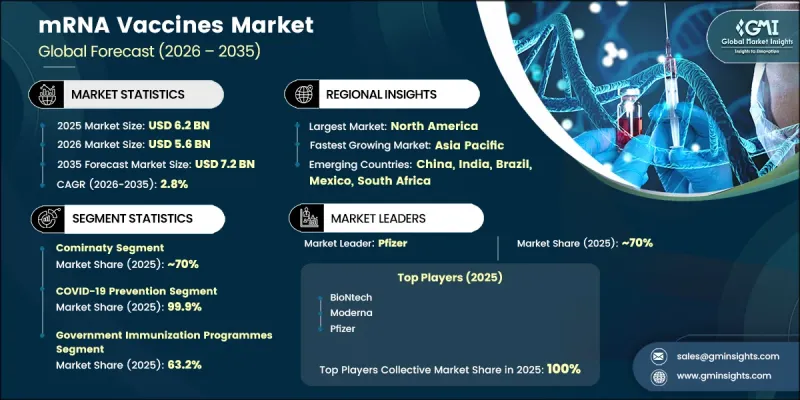
隨著mRNA技術在更廣泛的醫療保健應用領域得到認可,市場預計將穩步復甦。感染疾病預防、治療應用、再生醫學以及下一代疫苗研發等領域的研究活動活性化,正在創造新的成長機會。 mRNA遞送系統、脂質奈米顆粒(LNP)技術和生產能力的進步,進一步提升了這些疫苗的擴充性和有效性。 mRNA疫苗的工作原理是利用傳訊RNA分子誘導細胞產生特定抗原,從而觸發針對特定疾病的免疫反應。 mRNA技術具有快速開發、高度靈活的生產流程和可擴展生產等優勢,使其成為現代疫苗研發的關鍵創新平台。這些優勢持續推動著人們對mRNA解決方案在傳統疫苗應用之外的更廣泛探索。
| 市場範圍 | |
|---|---|
| 開始年份 | 2025 |
| 預測期 | 2026-2035 |
| 初始市場規模 | 62億美元 |
| 預計金額 | 72億美元 |
| 複合年成長率 | 2.8% |
預計到2025年,康美納蒂(Comilnati)的疫苗業務將佔據70%的市場。儘管新冠疫苗的整體需求有所下降,但憑藉其完善的全球分銷網路、持續的法規核准以及在疫苗接種計劃中的持續應用,康美納蒂仍保持主導地位。該產品充分利用了其早期進入市場、豐富的核准歷史以及在關鍵醫療市場的供應優勢。其有效性、安全性以及在重點人口中持續的可靠性,支持季節性疫苗接種工作的持續需求。
預計到2025年,政府免疫規劃領域將佔市場佔有率的63.2%,並在2026年至2035年間達到42億美元。公共衛生機構繼續發揮至關重要的作用,透過資金支持、採購活動和大規模分發計劃,推動mRNA疫苗的引入。政府主導的免疫舉措對於維持弱勢群體的疫苗接種率和支持季節性免疫宣傳活動仍然至關重要。國際衛生合作和公共部門為提高疫苗供應所做的努力也加強了供應網路,並鞏固了政府免疫規劃在市場中的持續重要性。
預計到2025年,北美mRNA疫苗市佔率將達到45.3%。該地區之所以保持強勁的市場地位,得益於許多領先的生物技術和製藥公司在mRNA研發和商業化領域的佈局。持續投資於先進的研究基礎設施、臨床開發項目和生產能力,為下一代mRNA疫苗和治療方案的研發提供了有力支持。該地區強大的創新生態系統和完善的醫療保健基礎設施也將繼續為市場成長做出重要貢獻。
目錄
第1章:調查方法和範圍
第2章執行摘要
第3章 行業洞察
- 產業生態系分析
- 供應商情況
- 每個階段增加的價值
- 影響價值鏈的因素
- 影響產業的因素
- 促進因素
- 對快速疫苗開發平台的需求日益成長
- 拓展至新冠肺炎以外的其他用途
- 脂質奈米顆粒(LNP)遞送技術的進展
- 新冠病毒mRNA疫苗的巨大商業性成功
- 產業潛在風險與挑戰
- 高昂的製造成本和低溫運輸物流成本
- 獲得商業已通過核准的產品數量有限。
- 新冠疫苗需求下降
- 市場機遇
- 擴大個人化癌症疫苗的發放範圍
- 聯合治療和多價療法的開發
- 促進因素
- 成長潛力分析
- 技術與創新展望
- 最新科技趨勢
- 新興技術
- 價格趨勢分析
- 監理情勢
- 波特的分析
- PESTLE分析
- 人工智慧和生成式人工智慧對市場的影響
- 臨床試驗/研發管線分析
- 疫苗產品
- 疫苗以外的產品
- 未來市場趨勢
- 未來市場潛力分析 - 全球(基於在研項目的市場預測)
- 藥效疫苗
- mRNA藥物
- 全球潛在市場總規模
- 藥效疫苗
- mRNA藥物
第4章 競爭情勢
- 介紹
- 企業市佔率分析
- 企業矩陣分析
- 主要市場公司的競爭分析
- 競爭定位矩陣
- 主要進展
- 併購
- 夥伴關係和聯盟
- 新產品發布
- 業務拓展計劃
第5章 市場估價與預測:依產品分類,2022-2035年
- Comirnaty
- Spikevax
- mRESVIA
- 其他產品
第6章 市場估計與預測:依應用領域分類,2022-2035年
- 感染疾病新冠肺炎
- 預防呼吸道融合細胞病毒(RSV)
第7章 市場估計與預測:依病患分類,2022-2035年
- 兒童
- 成人
- 老年人
第8章 市場估算與預測:依最終用途分類,2022-2035年
- 醫院和診所
- 政府免疫計劃
- 其他最終用戶
第9章 市場估計與預測:依地區分類,2022-2035年
- 北美洲
- 美國
- 加拿大
- 歐洲
- 德國
- 英國
- 法國
- 西班牙
- 義大利
- 荷蘭
- 亞太地區
- 中國
- 印度
- 日本
- 澳洲
- 韓國
- 拉丁美洲
- 巴西
- 墨西哥
- 阿根廷
- 中東和非洲
- 南非
- 沙烏地阿拉伯
- UAE
第10章:公司簡介
- 世界公司
- Pfizer
- BioNTech
- Moderna
- Pipeline players
- Daiichi Sankyo
- Ethris
- Meiji Seika Pharma
- Arcturus Therapeutics
- Sanofi
- Providence Therapeutics
- Strand Therapeutics
- Orna Therapeutics
The Global mRNA Vaccines Market was valued at USD 6.2 billion in 2025 and is estimated to grow at a CAGR of 2.8% to reach USD 7.2 billion by 2035.
The market is expected to recover steadily as mRNA technology continues gaining acceptance across a wider range of healthcare applications. Increasing research activity in infectious disease prevention, therapeutic applications, regenerative medicine, and next-generation vaccine development is creating new growth opportunities. Advancements in mRNA delivery systems, lipid nanoparticle (LNP) technologies, and manufacturing capabilities are further improving the scalability and effectiveness of these vaccines. mRNA vaccines work by using messenger RNA molecules to guide cells in producing specific antigens that trigger immune responses against targeted conditions. Their ability to support rapid development, adaptable manufacturing processes, and scalable production has positioned mRNA technology as a significant innovation platform within modern vaccine development. These advantages continue to encourage broader exploration of mRNA-based solutions beyond traditional vaccine applications.
| Market Scope | |
|---|---|
| Start Year | 2025 |
| Forecast Year | 2026-2035 |
| Start Value | $6.2 Billion |
| Forecast Value | $7.2 Billion |
| CAGR | 2.8% |
The comirnaty segment held a 70% share in 2025. Despite the decline in overall COVID-19 vaccine demand, Comirnaty has maintained market leadership due to its established global distribution network, continued regulatory acceptance, and ongoing utilization in vaccination programs. The product benefits from its early market entry, extensive approval history, and availability across major healthcare markets. Continued confidence in its effectiveness, safety profile, and use among priority populations has supported its sustained demand through seasonal vaccination initiatives.
The government immunization programs segment held 63.2% share in 2025 and is projected to reach USD 4.2 billion during 2026-2035. Public health agencies continue to play a critical role in supporting mRNA vaccine adoption through funding, procurement activities, and large-scale distribution programs. Government-led vaccination initiatives remain essential for maintaining coverage among vulnerable groups and supporting seasonal immunization campaigns. International health collaborations and public sector efforts to improve vaccine availability have also strengthened supply networks and supported the continued importance of government immunization programs within the market.
North America mRNA Vaccines Market accounted for 45.3% share in 2025. The region maintains a strong position due to the presence of major biotechnology and pharmaceutical companies involved in mRNA research, development, and commercialization. Continued investments in advanced research infrastructure, clinical development programs, and manufacturing capabilities are supporting the creation of next-generation mRNA vaccines and therapeutic solutions. The region's strong innovation ecosystem and established healthcare infrastructure continue to contribute significantly to market growth.
Prominent players operating in the global mRNA vaccines market include global companies such as Pfizer, BioNTech, and Moderna, along with pipeline-focused companies including Daiichi Sankyo, Ethris, Meiji Seika Pharma, Arcturus Therapeutics, Sanofi, Providence Therapeutics, Strand Therapeutics, and Orna Therapeutics. Companies operating in the mRNA vaccines market are strengthening their market presence through continuous research and development, strategic collaborations, pipeline expansion, and investments in advanced manufacturing capabilities. Key industry participants are focusing on improving mRNA delivery technologies, enhancing vaccine stability, and developing new applications beyond infectious disease prevention. Companies are also expanding clinical trial programs, forming research partnerships, and increasing production capacity to support future demand. Strategic licensing agreements, technology collaborations, and investments in next-generation platforms are helping businesses accelerate innovation and strengthen competitive positioning.
Table of Contents
Chapter 1 Methodology and Scope
- 1.1 Market scope and definition
- 1.2 Research approach
- 1.3 Quality commitments
- 1.3.1 GMI AI policy & data integrity commitment
- 1.3.1.1 Source consistency protocol
- 1.3.1 GMI AI policy & data integrity commitment
- 1.4 Research trail & confidence scoring
- 1.4.1 Research trail components
- 1.4.2 Scoring components
- 1.5 Data collection
- 1.5.1 Partial list of primary sources
- 1.6 Data mining sources
- 1.6.1 Paid sources
- 1.6.1.1 Sources, by region
- 1.6.1 Paid sources
- 1.7 Base estimates and calculations
- 1.7.1 Base year calculation for any one approach
- 1.8 Forecast model
- 1.8.1 Quantified market impact analysis
- 1.8.1.1 Mathematical impact of growth parameters on forecast
- 1.8.1 Quantified market impact analysis
- 1.9 Research transparency addendum
- 1.9.1 Source attribution framework
- 1.9.2 Quality assurance metrics
- 1.9.3 Our commitment to trust
Chapter 2 Executive Summary
- 2.1 Industry 360° synopsis
- 2.2 Key market trends
- 2.2.1 Regional trends
- 2.2.2 Product trends
- 2.2.3 Application trends
- 2.2.4 Patient trends
- 2.2.5 End use trends
- 2.3 CXO perspectives: Strategic imperatives
Chapter 3 Industry Insights
- 3.1 Industry ecosystem analysis
- 3.1.1 Supplier landscape
- 3.1.2 Value addition at each stage
- 3.1.3 Factors affecting the value chain
- 3.2 Industry impact forces
- 3.2.1 Growth drivers
- 3.2.1.1 Growing demand for rapid vaccine development platforms
- 3.2.1.2 Expanding applications beyond COVID-19
- 3.2.1.3 Advancements in Lipid Nanoparticle (LNP) delivery technologies
- 3.2.1.4 Strong commercial success of COVID-19 mRNA vaccines
- 3.2.2 Industry pitfalls and challenges
- 3.2.2.1 High manufacturing and cold-chain logistics costs
- 3.2.2.2 Limited number of commercially approved products
- 3.2.2.3 Declining COVID-19 vaccination demand
- 3.2.3 Market opportunities
- 3.2.3.1 Expansion of personalized cancer vaccines
- 3.2.3.2 Development of combination and multivalent therapies
- 3.2.1 Growth drivers
- 3.3 Growth potential analysis
- 3.4 Technology and innovation landscape
- 3.4.1 Current technological trends
- 3.4.2 Emerging technologies (Driven by Primary Research)
- 3.5 Pricing trend analysis (Driven by Primary Research)
- 3.6 Regulatory landscape (Driven by Primary Research)
- 3.6.1 North America
- 3.6.2 Europe
- 3.6.3 Asia Pacific
- 3.6.4 Latin America
- 3.6.5 MEA
- 3.7 Porter's analysis
- 3.8 PESTEL analysis
- 3.9 Impact of AI and Gen AI on the market
- 3.10 Clinical trial/pipeline analysis (Driven by Primary Research)
- 3.10.1 Vaccine products
- 3.10.2 Non-vaccine products
- 3.11 Future market trends
- 3.12 Future market potential analysis - Global (Pipeline-driven market projection)
- 3.12.1 mRNA vaccines
- 3.12.2 mRNA drugs
- 3.13 Total addressable market - Global
- 3.13.1 mRNA vaccines
- 3.13.2 mRNA drugs
Chapter 4 Competitive Landscape, 2025
- 4.1 Introduction
- 4.2 Company market share analysis
- 4.3 Company matrix analysis
- 4.4 Competitive analysis of major market players
- 4.5 Competitive positioning matrix
- 4.6 Key developments
- 4.6.1 Merger and acquisition
- 4.6.2 Partnership and collaboration
- 4.6.3 New product launches
- 4.6.4 Expansion plans
Chapter 5 Market Estimates and Forecast, By Product, 2022 - 2035 ($ Mn)
- 5.1 Key trends
- 5.2 Comirnaty
- 5.3 Spikevax
- 5.4 mRESVIA
- 5.5 Other products
Chapter 6 Market Estimates and Forecast, By Application, 2022 - 2035 ($ Mn)
- 6.1 Key trends
- 6.2 COVID-19 prevention
- 6.3 Respiratory syncytial virus (RSV) prevention
Chapter 7 Market Estimates and Forecast, By Patient, 2022 - 2035 ($ Mn)
- 7.1 Key trends
- 7.2 Pediatric
- 7.3 Adult
- 7.4 Geriatric
Chapter 8 Market Estimates and Forecast, By End Use, 2022 - 2035 ($ Mn)
- 8.1 Key trends
- 8.2 Hospitals and clinics
- 8.3 Government immunization programmes
- 8.4 Other end users
Chapter 9 Market Estimates and Forecast, By Region, 2022 - 2035 ($ Mn)
- 9.1 Key trends
- 9.2 North America
- 9.2.1 U.S.
- 9.2.2 Canada
- 9.3 Europe
- 9.3.1 Germany
- 9.3.2 UK
- 9.3.3 France
- 9.3.4 Spain
- 9.3.5 Italy
- 9.3.6 Netherlands
- 9.4 Asia Pacific
- 9.4.1 China
- 9.4.2 India
- 9.4.3 Japan
- 9.4.4 Australia
- 9.4.5 South Korea
- 9.5 Latin America
- 9.5.1 Brazil
- 9.5.2 Mexico
- 9.5.3 Argentina
- 9.6 Middle East and Africa
- 9.6.1 South Africa
- 9.6.2 Saudi Arabia
- 9.6.3 UAE
Chapter 10 Company Profiles
- 10.1 Global players
- 10.1.1 Pfizer
- 10.1.2 BioNTech
- 10.1.3 Moderna
- 10.2 Pipeline players
- 10.2.1 Daiichi Sankyo
- 10.2.2 Ethris
- 10.2.3 Meiji Seika Pharma
- 10.2.4 Arcturus Therapeutics
- 10.2.5 Sanofi
- 10.2.6 Providence Therapeutics
- 10.2.7 Strand Therapeutics
- 10.2.8 Orna Therapeutics

 mRNA疫苗市場:按適應症和地區分類的趨勢和預測(至2035年)
 mRNA疫苗和治療市場規模、佔有率、趨勢和預測:按疫苗類型、治療類型、疫苗生產商、應用、最終用戶和地區分類(2026-2034年)mRNA疫苗和治療市場(第四版):按應用、目標疾病和地區分類-趨勢和預測(至2035年)
 自擴增RNA合成市場規模、佔有率和成長分析:按產品類型、技術、應用領域、給藥途徑、最終用戶和地區分類-2026-2033年產業預測
 下一代疫苗技術市場分析及預測(至2035年):按類型、產品類型、技術、應用、最終用戶、組件、設備、製程、部署類型和解決方案分類
 全球mRNA疫苗和治療市場規模、佔有率、趨勢和成長分析報告(2026-2034年)全球mRNA疫苗市場規模、佔有率、趨勢和成長分析報告(2026-2034年)
 mRNA疫苗和治療市場:全球產業分析、市場規模、市場佔有率及按治療方法、類型、應用、最終用戶、國家和地區分類的預測——2026-2033年全球mRNA疫苗市場:市場規模、佔有率、成長率、產業分析、依類型、應用和地區劃分的考量因素以及未來預測(2026-2034)
 動物mRNA疫苗:全球市場佔有率和排名、總收入和需求預測(2025-2031年)