


 |
市場調查報告書
商品編碼
2037827
全球串聯太陽能電池市場(至2040年):按技術、結構、應用、地區、主要參與者、產業趨勢和預測分類Tandem Solar Cell Market, Till 2040: Distribution by Technology, Structure, Application, Geographical Regions, and Key Players: Industry Trends and Global Forecasts |
||||||

串聯太陽能電池市場展望
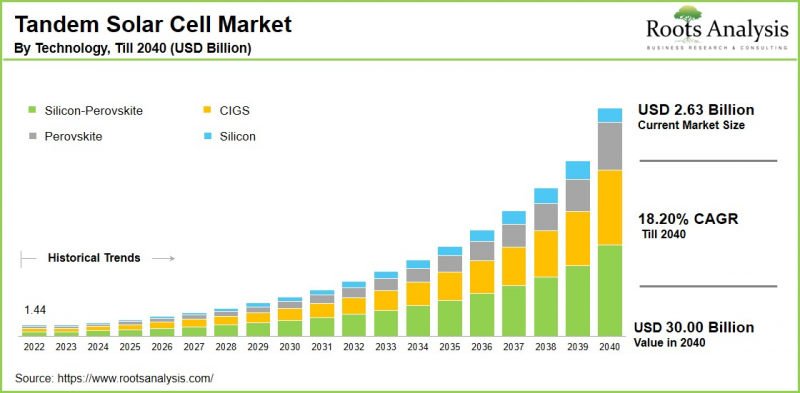
全球串聯太陽能電池市場規模預計將從目前的 26.3 億美元成長到 300 億美元,預計到 2040 年將以 18.20% 的複合年成長率成長。
串聯太陽能電池市場涵蓋了將兩種不同類型的太陽能電池堆疊在一起的先進光伏裝置。典型的結構是將鈣鈦礦太陽能電池放置在傳統的矽基基板。這種結構能夠捕捉更寬的頻譜,顯著提高整體能量轉換效率,超越單結太陽能電池的理論極限。其提案在於能夠在縮小面積的同時實現更高的輸出功率,使其不僅適用於公用事業規模的太陽能發電廠,也適用於空間受限的住宅安裝,在這些安裝中,最大化面積的能量輸出至關重要。
市場擴張的主要驅動力在於解決單結矽技術面臨的性能瓶頸問題,並透過提高效率來降低平準化電力成本(LCOE)。高效技術的進步和系統平衡(BOS)整合的改進進一步推動了其應用,使開發商和電力營運商能夠在不同的地理和法規環境下實現更高的輸出功率和長期可靠性。此外,目前正在進行創新,以提高裝置穩定性並實現大規模生產,從而克服鈣鈦礦材料的耐久性挑戰。隆基綠色能源科技和牛津光伏等公司也已公佈了串聯整合藍圖,目標是在兩年內實現大規模部署。持續的投資和不斷提高的性能標準為市場前景帶來了積極影響。
為高階主管提供策略見解
串聯太陽能電池市場的主要成長促進因素
串聯太陽能電池在多結太陽能電池市場展現出強勁的發展動能。其原理是透過堆疊吸收層來突破傳統單結矽電池的理論效率極限,從而顯著提高單位面積的輸出功率。效率的顯著提升降低了平準化度電成本(LCOE),為公用事業規模的開發商帶來了決定性的優勢,尤其是在太陽輻射強、土地資源有限的項目中。隨著可再生能源部署的加速,對高密度發電的需求不斷成長,進一步推動了串聯技術的發展。該技術能夠在提高面積能量產量的同時,減輕與土地購置、安裝和佈線相關的銷售成本(BOS)。
此外,包括美國「通貨膨脹控制法案」(IRA)和歐洲類似舉措在內的政府支持政策,透過為國產高效太陽能組件提供稅額扣抵和財政獎勵,正在加速其普及應用。雖然串聯組件的初始成本較高,但其卓越的效率可顯著降低系統層面的成本,涵蓋安裝、人事費用、逆變器和整體基礎設施等各個方面。這提高了專案的長期經濟可行性,並提升了其在大規模太陽能發電專案中的價值。
串聯太陽能電池市場:產業內各公司的競爭格局
串聯太陽能電池市場競爭異常激烈,加拿大太陽能(Canadian Solar)、Cubic PV、Hevel、華新(Huasun)、晶澳太陽能(JA Solar)、晶科能源(JinkoSolar)、LG能源解決方案(LG Energy Solution)、隆基(LONGi)、邁耶·伯格(Meyer Burger)、松下(PanasSharp) Frontier和Solaronix等主要廠商佔市場主導地位。這些公司憑藉其豐富的產品系列和全球佈局,鞏固了強大的市場地位。策略合作和業務擴張仍然是關鍵的成長策略,有助於加速創新和規模化發展。
本報告對全球串聯太陽能電池市場進行了分析,提供了市場規模估算、機會分析、競爭格局和公司簡介等資訊。
目錄
第1章:專案概述
第2章:調查方法
第3章 市場動態
第4章 宏觀經濟指標
第5章摘要整理
第6章:引言
第7章 監管情景
第8章:主要公司綜合資料庫
第9章 競爭情勢
第10章:閒置頻段分析
第11章:企業競爭力分析
第12章:創業生態系分析
第13章:公司簡介
- 章節概要
- Canadian Solar
- Cubic PV
- Enel Green Power
- First Solar
- GCL
- Hanwha Solutions
- Hevel
- Huasun
- JA Solar
- JinkoSolar
- LG Energy Solution
- LONGi
- Meyer Burger
- Panasonic Energy
- Qcells
- Renshine Solar
- Saule Technologies
- Sharp
- Solar Frontier
- Solaronix
第14章:分析大趨勢
第15章:未滿足需求的分析
第16章:專利分析
第17章 最新進展
第18章:全球串聯太陽能電池市場
第19章 市場機會:依技術分類
第20章 市場機會:依結構分類
第21章 市場機會:依應用領域分類
第22章 北美串聯太陽能電池的市場機遇
第23章 歐洲串聯太陽能電池的市場機遇
第24章:亞太地區串聯太陽能電池的市場機會
第25章 拉丁美洲串聯太陽能電池的市場機遇
第26章 中東和非洲串聯太陽能電池的市場機會
第27章 市場集中度分析:依主要公司分類
第28章:鄰近市場分析
第29章:關鍵成功策略
第30章:波特五力分析
第31章 SWOT分析
第32章:價值鏈分析
第33章:Roots的戰略建議
第34章:來自初步調查的見解
第35章:報告結論
第36章:表格形式數據
第37章 公司與組織列表
Tandem Solar Cell Market Outlook
As per Roots Analysis, the global tandem solar cell market size is estimated to grow from USD 2.63 billion in current year to USD 30.00 billion by 2040, at a CAGR of 18.20% during the forecast period, till 2040.
The tandem solar cell market encompasses advanced photovoltaic devices that stack two different types of solar cells, typically perovskite on top of a conventional silicon base. This configuration captures broader light spectrum, significantly enhancing overall energy conversion efficiency beyond single-junction theoretical limits. The value proposition lies in delivering higher power output from a reduced physical footprint, applicable in both utility-scale arrays and space-constrained residential installations where maximizing energy yield per area is critical.
Market expansion is primarily driven by the need to reduce levelized cost of energy (LCOE) through increased efficiency, addressing the performance plateau faced by single-junction silicon technologies. Advances in high-efficiency technologies and improved balance-of-system integration are further supporting adoption, enabling developers and utilities to achieve higher output and long-term reliability across diverse geographic and regulatory environments. Further, innovation is focused on enhancing device stability and enabling large-scale manufacturing to overcome perovskite durability challenges. Moreover, companies such as Longi Green Energy Technology and Oxford PV have announced tandem integration roadmaps, targeting large-scale deployment within two years. This is supporting a positive market outlook driven by continued investment and rising performance standards.
Strategic Insights for Senior Leaders
Key Drivers Propelling Growth of Tandem Solar Cell Market
Tandem solar cells are gaining strong momentum in the multi-junction solar cell market. This is achieved by overcoming the theoretical efficiency limits of conventional single-junction silicon through stacked absorber layers, delivering significantly higher power output per unit area. This efficiency breakthrough reduces the levelized cost of energy (LCOE) and provides a compelling advantage for utility-scale developers, especially in high-insolation and land-constrained projects. As renewable energy deployment accelerates, the growing need for high-density power generation further favors tandem technology. This enables higher energy yield per land area while lowering balance-of-system (BOS) costs related to land acquisition, mounting structures, and cabling.
Moreover, supportive government policies, including the US Inflation Reduction Act (IRA) and similar European initiatives, are accelerating adoption by offering tax credits and financial incentives for domestic manufacturing and high-efficiency solar modules. Although tandem modules carry higher upfront costs, their superior efficiency delivers substantial system-level savings across installation, labor, inverters, and infrastructure. This helps in improving long-term project economics and reinforcing their value in large-scale solar deployments.
Tandem Solar Cell Market: Competitive Landscape of Companies in this Industry
The tandem solar cell market is highly competitive, dominated by leading players, such as Canadian Solar, Cubic PV, Hevel, Huasun, JA Solar, JinkoSolar, LG Energy Solution, LONGi, Meyer Burger, Panasonic Energy, Sharp, Solar Frontier, and Solaronix. These companies hold strong market positions through their extensive product portfolios and global reach. Strategic collaborations and expansions remain primary growth strategies, accelerating innovation and scalability. Key examples include Solar Frontier's partnership with King Abdullah University of Science and Technology (KAUST) to develop high-efficiency CIGS-perovskite tandem cells. Further, Sun Drive's AU$21 million funding from the Australian Renewable Energy Agency (ARENA) in collaboration with CSIRO is also advancing the tandem solar cell technology.
Surging Investments and Funding Activity in Tandem Solar Cell Industry
The tandem solar cell industry is witnessing strong funding and investment momentum, with significant capital inflows directed towards new manufacturing facilities, perovskite-silicon integration, and stability enhancements. These investments are accelerating technology development and commercial deployment by funding pilot production lines, interface engineering to minimize energy losses, and seamless compatibility upgrades with existing silicon infrastructure. Notable examples include Swift Solar's successful seed funding round, led by institutional investors, to advance R&D and pilot manufacturing of its flexible tandem cells. These recent funding rounds support the development and commercialization of advanced tandem cell solutions.
Asia-Pacific Dominates the Tandem Solar Cell Market
According to our analysis, in the current year, Asia-Pacific captures the highest share of the global tandem solar cell market. This dominance is primarily attributed to the region's strong control over the solar supply chain, supported by substantial investments driven by ambitious renewable energy targets and robust infrastructure development. Furthermore, China, Japan, India and South Korea collectively account for over 80% of global solar production capacity, allowing companies such as LONGi, JinkoSolar, and Trina Solar to rapidly scale tandem cell manufacturing. Within the Asia-Pacific region, the tandem solar cell segment is experiencing accelerated growth, fueled by surging energy demand from industrialization and urbanization.
Key Challenges in the Tandem Solar Cell Market
Tandem solar cell commercialization faces several interrelated challenges that continue to hinder large-scale adoption. One of the primary concerns is the unproven long-term reliability of perovskite layers under real-world stressors such as heat, humidity, and UV exposure, with limited field data and lack of standardized durability benchmarks undermining lender confidence. This restricts project financing and prevents the provision of conventional 25-year warranties, thereby creating a persistent bankability gap. Further, integrating perovskite layers onto silicon wafers introduces significant manufacturing complexity, requiring new processes such as vacuum deposition or solution processing. These challenges are compounded by environmental and regulatory concerns surrounding lead-based perovskite formulations, with compliance requirements introducing uncertainty related to hazardous material usage. This is ultimately necessitating either the development of lead-free alternatives or substantial investment in advanced containment and recycling solutions.
Tandem Solar Cell Market: Key Market Segmentation
Market Share by Technology
- CIGS
- Perovskite
- Silicon
- Silicon Perovskite
Market Share by Structure
- 2-Terminal
- 4-Terminal
Market Share by Application
- Building Integrated Photovoltaics (BIPV)
- Commercial
- Residential
- Utility-scale
Market Share by Geographical Regions
- North America
- US
- Canada
- Mexico
- Rest of North America
- Europe
- Austria
- Belgium
- Denmark
- France
- Germany
- Ireland
- Italy
- Netherlands
- Norway
- Russia
- Spain
- Sweden
- Switzerland
- UK
- Rest of Europe
- Asia-Pacific
- Australia
- China
- India
- Japan
- New-Zealand
- Singapore
- South Korea
- Rest of Asia-Pacific
- Latin America
- Brazil
- Chile
- Colombia
- Venezuela
- Rest of Latin America
- Middle East and Africa (MEA)
- Egypt
- Iran
- Iraq
- Israel
- Kuwait
- Saudi Arabia
- UAE
- Rest of MEA
Example Players in Tandem Solar Cell Market
- Canadian Solar
- Cubic PV
- Enel Green Power
- First Solar
- GCL
- Hanwha Solutions
- Hevel
- Huasun
- JA Solar
- JinkoSolar
- LG Energy Solution
- LONGi
- Meyer Burger
- Panasonic Energy
- Qcells
- Renshine Solar
- Saule Technologies
- Sharp
- Solar Frontier
- Solaronix
Tandem Solar Cell Market: Report Coverage
The report on the tandem solar cell market features insights on various sections, including:
- Market Sizing and Opportunity Analysis: An in-depth analysis of the tandem solar cell market, focusing on key market segments, including [A] technology, [B] structure, [C] application, [D] geographical regions, and [E] key players.
- Competitive Landscape: A comprehensive analysis of the companies engaged in the tandem solar cell market, based on several relevant parameters, such as [A] year of establishment, [B] company size, [C] location of headquarters and [D] ownership structure.
- Company Profiles: Elaborate profiles of prominent players engaged in the tandem solar cell market, providing details on [A] location of headquarters, [B] company size, [C] company mission, [D] company footprint, [E] management team, [F] contact details, [G] financial information, [H] operating business segments, [I] product / technology portfolio, [J] recent developments, and an informed future outlook.
- Megatrends: An evaluation of ongoing megatrends in the tandem solar cell industry.
- Patent Analysis: An insightful analysis of patents filed / granted in the tandem solar cell domain, based on relevant parameters, including [A] type of patent, [B] patent publication year, [C] patent age and [D] leading players.
- Recent Developments: An overview of the recent developments made in the tandem solar cell market, along with analysis based on relevant parameters, including [A] year of initiative, [B] type of initiative, [C] geographical distribution and [D] most active players.
- Porter's Five Forces Analysis: An analysis of five competitive forces prevailing in the tandem solar cell market, including threats of new entrants, bargaining power of buyers, bargaining power of suppliers, threats of substitute products and rivalry among existing competitors.
- SWOT Analysis: An insightful SWOT framework, highlighting the strengths, weaknesses, opportunities and threats in the domain. Additionally, it provides Harvey ball analysis, highlighting the relative impact of each SWOT parameter.
Key Questions Answered in this Report
- What is the current and future market size?
- Who are the leading companies in this market?
- What are the growth drivers that are likely to influence the evolution of this market?
- What are the key partnership and funding trends shaping this industry?
- Which region is likely to grow at higher CAGR till 2040?
- How is the current and future market opportunity likely to be distributed across key market segments?
Reasons to Buy this Report
- Detailed Market Analysis: The report provides a comprehensive market analysis, offering detailed revenue projections of the overall market and its specific sub-segments. This information is valuable to both established market leaders and emerging entrants.
- In-depth Analysis of Trends: Stakeholders can leverage the report to gain a deeper understanding of the competitive dynamics within the market. Each report maps ecosystem activity across partnerships, funding, and patent landscapes to reveal growth hotspots and white spaces in the industry.
- Opinion of Industry Experts: The report features extensive interviews and surveys with key opinion leaders and industry experts to validate market trends mentioned in the report.
- Decision-ready Deliverables: The report offers stakeholders with strategic frameworks (Porter's Five Forces, value chain, SWOT), and complimentary Excel / slide packs with customization support.
Additional Benefits
- Complimentary Dynamic Excel Dashboards for Analytical Modules
- Exclusive 15% Free Content Customization
- Personalized Interactive Report Walkthrough with Our Expert Research Team
- Free Report Updates for Versions Older than 6-12 Months
TABLE OF CONTENTS
1. PROJECT OVERVIEW
- 1.1. Context
- 1.2. Project Objectives
2. RESEARCH METHODOLOGY
- 2.1. Chapter Overview
- 2.2. Research Assumptions
- 2.3. Database Building
- 2.3.1. Data Collection
- 2.3.2. Data Validation
- 2.3.3. Data Analysis
- 2.4. Project Methodology
- 2.4.1. Secondary Research
- 2.4.1.1. Annual Reports
- 2.4.1.2. Academic Research Papers
- 2.4.1.3. Company Websites
- 2.4.1.4. Investor Presentations
- 2.4.1.5. Regulatory Filings
- 2.4.1.6. White Papers
- 2.4.1.7. Industry Publications
- 2.4.1.8. Conferences and Seminars
- 2.4.1.9. Government Portals
- 2.4.1.10. Media and Press Releases
- 2.4.1.11. Newsletters
- 2.4.1.12. Industry Databases
- 2.4.1.13. Roots Proprietary Databases
- 2.4.1.14. Paid Databases and Sources
- 2.4.1.15. Social Media Portals
- 2.4.1.16. Other Secondary Sources
- 2.4.2. Primary Research
- 2.4.2.1. Introduction
- 2.4.2.2. Types
- 2.4.2.2.1. Qualitative
- 2.4.2.2.2. Quantitative
- 2.4.2.3. Advantages
- 2.4.2.4. Techniques
- 2.4.2.4.1. Interviews
- 2.4.2.4.2. Surveys
- 2.4.2.4.3. Focus Groups
- 2.4.2.4.4. Observational Research
- 2.4.2.4.5. Social Media Interactions
- 2.4.2.5. Stakeholders
- 2.4.2.5.1. Company Executives (CXOs)
- 2.4.2.5.2. Board of Directors
- 2.4.2.5.3. Company Presidents and Vice Presidents
- 2.4.2.5.4. Key Opinion Leaders
- 2.4.2.5.5. Research and Development Heads
- 2.4.2.5.6. Technical Experts
- 2.4.2.5.7. Subject Matter Experts
- 2.4.2.5.8. Scientists
- 2.4.2.5.9. Doctors and Other Healthcare Providers
- 2.4.2.6. Ethics and Integrity
- 2.4.2.6.1. Research Ethics
- 2.4.2.6.2. Data Integrity
- 2.4.3. Analytical Tools and Databases
- 2.4.1. Secondary Research
3. MARKET DYNAMICS
- 3.1. Forecast Methodology
- 3.1.1. Top-Down Approach
- 3.1.2. Bottom-Up Approach
- 3.1.3. Hybrid Approach
- 3.2. Market Assessment Framework
- 3.2.1. Total Addressable Market (TAM)
- 3.2.2. Serviceable Addressable Market (SAM)
- 3.2.3. Serviceable Obtainable Market (SOM)
- 3.2.4. Currently Acquired Market (CAM)
- 3.3. Forecasting Tools and Techniques
- 3.3.1. Qualitative Forecasting
- 3.3.2. Correlation
- 3.3.3. Regression
- 3.3.4. Time Series Analysis
- 3.3.5. Extrapolation
- 3.3.6. Convergence
- 3.3.7. Forecast Error Analysis
- 3.3.8. Data Visualization
- 3.3.9. Scenario Planning
- 3.3.10. Sensitivity Analysis
- 3.4. Key Considerations
- 3.4.1. Demographics
- 3.4.2. Market Access
- 3.4.3. Reimbursement Scenarios
- 3.4.4. Industry Consolidation
- 3.5. Robust Quality Control
- 3.6. Key Market Segmentations
- 3.7. Limitations
4. MACRO-ECONOMIC INDICATORS
- 4.1. Chapter Overview
- 4.2. Market Dynamics
- 4.2.1. Time Period
- 4.2.1.1. Historical Trends
- 4.2.1.2. Current and Forecasted Estimates
- 4.2.2. Currency Coverage
- 4.2.2.1. Overview of Major Currencies Affecting the Market
- 4.2.2.2. Impact of Currency Fluctuations on the Industry
- 4.2.3. Foreign Exchange Impact
- 4.2.3.1. Evaluation of Foreign Exchange Rates and Their Impact on Market
- 4.2.3.2. Strategies for Mitigating Foreign Exchange Risk
- 4.2.4. Recession
- 4.2.4.1. Historical Analysis of Past Recessions and Lessons Learnt
- 4.2.4.2. Assessment of Current Economic Conditions and Potential Impact on the Market
- 4.2.5. Inflation
- 4.2.5.1. Measurement and Analysis of Inflationary Pressures in the Economy
- 4.2.5.2. Potential Impact of Inflation on the Market Evolution
- 4.2.6. Interest Rates
- 4.2.6.1. Overview of Interest Rates and Their Impact on the Market
- 4.2.6.2. Strategies for Managing Interest Rate Risk
- 4.2.7. Commodity Flow Analysis
- 4.2.7.1. Type of Commodity
- 4.2.7.2. Origins and Destinations
- 4.2.7.3. Values and Weights
- 4.2.7.4. Modes of Transportation
- 4.2.8. Global Trade Dynamics
- 4.2.8.1. Import Scenario
- 4.2.8.2. Export Scenario
- 4.2.9. War Impact Analysis
- 4.2.9.1. Russian-Ukraine War
- 4.2.9.2. Israel-Hamas War
- 4.2.10. COVID Impact / Related Factors
- 4.2.10.1. Global Economic Impact
- 4.2.10.2. Industry-specific Impact
- 4.2.10.3. Government Response and Stimulus Measures
- 4.2.10.4. Future Outlook and Adaptation Strategies
- 4.2.11. Other Indicators
- 4.2.11.1. Fiscal Policy
- 4.2.11.2. Consumer Spending
- 4.2.11.3. Gross Domestic Product (GDP)
- 4.2.11.4. Employment
- 4.2.11.5. Taxes
- 4.2.11.6. R&D Innovation
- 4.2.11.7. Stock Market Performance
- 4.2.11.8. Supply Chain
- 4.2.11.9. Cross-Border Dynamics
- 4.2.1. Time Period
- 4.3. Concluding Remarks
5. EXECUTIVE SUMMARY
6. INTRODUCTION
- 6.1. Overview of Tandem Solar Cell Market
- 6.2. Application of Tandem Solar Cell Market
- 6.3. Advantages of Tandem Solar Cell Market
- 6.4. Challenges Associated with Tandem Solar Cell Market
- 6.5. Future Perspective
7. REGULATORY SCENARIO
8. COMPREHENSIVE DATABASE OF LEADING PLAYERS
9. COMPETITIVE LANDSCAPE
- 9.1. Chapter Overview
- 9.2. Tandem Solar Cell Market: Overall Landscape
- 9.2.1. Analysis by Year of Establishment
- 9.2.2. Analysis by Company Size
- 9.2.3. Analysis by Location of Headquarters
- 9.2.4. Analysis by Type of Company
- 9.2.5. Analysis by Component
- 9.2.6. Analysis by Application
- 9.3. Key Findings
10. WHITE SPACE ANALYSIS
11. COMPANY COMPETITIVENESS ANALYSIS
12. STARTUP ECOSYSTEM ANALYSIS
- 12.1. Tandem Solar Cell Market: Startup Ecosystem Analysis
- 12.1.1. Analysis by Year of Establishment
- 12.1.2. Analysis by Company Size
- 12.1.3. Analysis by Location of Headquarters
- 12.1.4. Analysis by Ownership Type
- 12.1.5. Analysis by Component
- 12.1.6. Analysis by Application
- 12.2. Key Findings
13. COMPANY PROFILES
- 13.1. Chapter Overview
- 13.2. Canadian Solar*
- 13.2.1. Company Overview
- 13.2.2. Company Mission
- 13.2.3. Company Footprint
- 13.2.4. Management Team
- 13.2.5. Contact Details
- 13.2.6. Financial Performance
- 13.2.7. Operating Business Segments
- 13.2.8. Service / Product Portfolio (project specific)
- 13.2.9. MOAT Analysis
- 13.2.10. Recent Developments and Future Outlook
- Similar details are presented for other companies mentioned below (based on information in the public domain)
- 13.3. Cubic PV
- 13.4. Enel Green Power
- 13.5. First Solar
- 13.6. GCL
- 13.7. Hanwha Solutions
- 13.8. Hevel
- 13.9. Huasun
- 13.10. JA Solar
- 13.11. JinkoSolar
- 13.12. LG Energy Solution
- 13.13. LONGi
- 13.14. Meyer Burger
- 13.15. Panasonic Energy
- 13.16. Qcells
- 13.17. Renshine Solar
- 13.18. Saule Technologies
- 13.19. Sharp
- 13.20. Solar Frontier
- 13.21. Solaronix
14. MEGA TRENDS ANALYSIS
15. UNMET NEED ANALYSIS
16. PATENT ANALYSIS
17. RECENT DEVELOPMENTS
- 17.1. Chapter Overview
- 17.2. Recent Funding
- 17.3. Recent Partnerships
- 17.4. Other Recent Initiatives
18. GLOBAL TANDEM SOLAR CELL MARKET
- 18.1. Chapter Overview
- 18.2. Key Assumptions and Methodology
- 18.3. Trends Disruption Impacting Market
- 18.4. Demand Side Trends
- 18.5. Supply Side Trends
- 18.6. Global Tandem Solar Cell Market: Historical Trends (Since 2022) and Forecasted Estimates (Till 2040)
- 18.7. Multivariate Scenario Analysis
- 18.7.1. Conservative Scenario
- 18.7.2. Optimistic Scenario
- 18.8. Investment Feasibility Index
- 18.9. Key Market Segmentations
19. MARKET OPPORTUNITIES BASED ON TECHNOLOGY
- 19.1. Chapter Overview
- 19.2. Key Assumptions and Methodology
- 19.3. Revenue Shift Analysis
- 19.4. Market Movement Analysis
- 19.5. Penetration-Growth (P-G) Matrix
- 19.6. Tandem Solar Cell Market for CIGS: Historical Trends (Since 2022) and Forecasted Estimates (Till 2040)
- 19.7. Tandem Solar Cell Market for Perovskite: Historical Trends (Since 2022) and Forecasted Estimates (Till 2040)
- 19.8. Tandem Solar Cell Market for Silicon: Historical Trends (Since 2022) and Forecasted Estimates (Till 2040)
- 19.9. Tandem Solar Cell Market for Silicon Perovskite: Historical Trends (Since 2022) and Forecasted Estimates (Till 2040)
- 19.10. Data Triangulation and Validation
- 19.10.1. Secondary Sources
- 19.10.2. Primary Sources
- 19.10.3. Statistical Modeling
20. MARKET OPPORTUNITIES BASED ON STRUCTURE
- 20.1. Chapter Overview
- 20.2. Key Assumptions and Methodology
- 20.3. Revenue Shift Analysis
- 20.4. Market Movement Analysis
- 20.5. Penetration-Growth (P-G) Matrix
- 20.6. Tandem Solar Cell Market for 2-Terminal: Historical Trends (Since 2022) and Forecasted Estimates (Till 2040)
- 20.7. Tandem Solar Cell Market for 4-Terminal: Historical Trends (Since 2022) and Forecasted Estimates (Till 2040)
- 20.8. Data Triangulation and Validation
- 20.8.1. Secondary Sources
- 20.8.2. Primary Sources
- 20.8.3. Statistical Modeling
21. MARKET OPPORTUNITIES BASED ON APPLICATION
- 21.1. Chapter Overview
- 21.2. Key Assumptions and Methodology
- 21.3. Revenue Shift Analysis
- 21.4. Market Movement Analysis
- 21.5. Penetration-Growth (P-G) Matrix
- 21.6. Tandem Solar Cell Market for Building Integrated Photovoltaics (BIPV): Historical Trends (Since 2022) and Forecasted Estimates (Till 2040)
- 21.7. Tandem Solar Cell Market for Commercial: Historical Trends (Since 2022) and Forecasted Estimates (Till 2040)
- 21.8. Tandem Solar Cell Market for Residential: Historical Trends (Since 2022) and Forecasted Estimates (Till 2040)
- 21.9. Tandem Solar Cell Market for Utility-scale: Historical Trends (Since 2022) and Forecasted Estimates (Till 2040)
- 21.10. Data Triangulation and Validation
- 21.10.1. Secondary Sources
- 21.10.2. Primary Sources
- 21.10.3. Statistical Modeling
22. MARKET OPPORTUNITIES FOR TANDEM SOLAR CELL IN NORTH AMERICA
- 22.1. Chapter Overview
- 22.2. Key Assumptions and Methodology
- 22.3. Revenue Shift Analysis
- 22.4. Market Movement Analysis
- 22.5. Penetration-Growth (P-G) Matrix
- 22.6. Tandem Solar Cell Market in North America: Historical Trends (Since 2022) and Forecasted Estimates (Till 2040)
- 22.6.1. Tandem Solar Cell Market in the US: Historical Trends (Since 2022) and Forecasted Estimates (Till 2040)
- 22.6.2. Tandem Solar Cell Market in Canada: Historical Trends (Since 2022) and Forecasted Estimates (Till 2040)
- 22.6.3. Tandem Solar Cell Market in Mexico: Historical Trends (Since 2022) and Forecasted Estimates (Till 2040)
- 22.6.4. Tandem Solar Cell Market in Rest of North America: Historical Trends (Since 2022) and Forecasted Estimates (Till 2040)
- 22.7. Data Triangulation and Validation
23. MARKET OPPORTUNITIES FOR TANDEM SOLAR CELL IN EUROPE
- 23.1. Chapter Overview
- 23.2. Key Assumptions and Methodology
- 23.3. Revenue Shift Analysis
- 23.4. Market Movement Analysis
- 23.5. Penetration-Growth (P-G) Matrix
- 23.6. Tandem Solar Cell Market in Europe: Historical Trends (Since 2022) and Forecasted Estimates (Till 2040)
- 23.6.1. Tandem Solar Cell Market in Austria: Historical Trends (Since 2022) and Forecasted Estimates (Till 2040)
- 23.6.2. Tandem Solar Cell Market in Belgium: Historical Trends (Since 2022) and Forecasted Estimates (Till 2040)
- 23.6.3. Tandem Solar Cell Market in Denmark: Historical Trends (Since 2022) and Forecasted Estimates (Till 2040)
- 23.6.4. Tandem Solar Cell Market in France: Historical Trends (Since 2022) and Forecasted Estimates (Till 2040)
- 23.6.5. Tandem Solar Cell Market in Germany: Historical Trends (Since 2022) and Forecasted Estimates (Till 2040)
- 23.6.6. Tandem Solar Cell Market in Ireland: Historical Trends (Since 2022) and Forecasted Estimates (Till 2040)
- 23.6.7. Tandem Solar Cell Market in Italy: Historical Trends (Since 2022) and Forecasted Estimates (Till 2040)
- 23.6.8. Tandem Solar Cell Market in the Netherlands: Historical Trends (Since 2022) and Forecasted Estimates (Till 2040)
- 23.6.9. Tandem Solar Cell Market in Norway: Historical Trends (Since 2022) and Forecasted Estimates (Till 2040)
- 23.6.10. Tandem Solar Cell Market in Russia: Historical Trends (Since 2022) and Forecasted Estimates (Till 2040)
- 23.6.11. Tandem Solar Cell Market in Spain: Historical Trends (Since 2022) and Forecasted Estimates (Till 2040)
- 23.6.12. Tandem Solar Cell Market in Sweden: Historical Trends (Since 2022) and Forecasted Estimates (Till 2040)
- 23.6.13. Tandem Solar Cell Market in Switzerland: Historical Trends (Since 2022) and Forecasted Estimates (Till 2040)
- 23.6.14. Tandem Solar Cell Market in the UK: Historical Trends (Since 2022) and Forecasted Estimates (Till 2040)
- 23.6.15. Tandem Solar Cell Market in Rest of Europe: Historical Trends (Since 2022) and Forecasted Estimates (Till 2040)
- 23.7. Data Triangulation and Validation
24. MARKET OPPORTUNITIES FOR TANDEM SOLAR CELL IN ASIA-PACIFIC
- 24.1. Chapter Overview
- 24.2. Key Assumptions and Methodology
- 24.3. Revenue Shift Analysis
- 24.4. Market Movement Analysis
- 24.5. Penetration-Growth (P-G) Matrix
- 24.6. Tandem Solar Cell Market in Asia-Pacific: Historical Trends (Since 2022) and Forecasted Estimates (Till 2040)
- 24.6.1. Tandem Solar Cell Market in China: Historical Trends (Since 2022) and Forecasted Estimates (Till 2040)
- 24.6.2. Tandem Solar Cell Market in India: Historical Trends (Since 2022) and Forecasted Estimates (Till 2040)
- 24.6.3. Tandem Solar Cell Market in Japan: Historical Trends (Since 2022) and Forecasted Estimates (Till 2040)
- 24.6.4. Tandem Solar Cell Market in Singapore: Historical Trends (Since 2022) and Forecasted Estimates (Till 2040)
- 24.6.5. Tandem Solar Cell Market in South Korea: Historical Trends (Since 2022) and Forecasted Estimates (Till 2040)
- 24.6.6. Tandem Solar Cell Market in Rest of Asia-Pacific: Historical Trends (Since 2022) and Forecasted Estimates (Till 2040)
- 24.7. Data Triangulation and Validation
25. MARKET OPPORTUNITIES FOR TANDEM SOLAR CELL IN LATIN AMERICA
- 25.1. Chapter Overview
- 25.2. Key Assumptions and Methodology
- 25.3. Revenue Shift Analysis
- 25.4. Market Movement Analysis
- 25.5. Penetration-Growth (P-G) Matrix
- 25.6. Tandem Solar Cell Market in Latin America: Historical Trends (Since 2022) and Forecasted Estimates (Till 2040)
- 25.6.1. Tandem Solar Cell Market in Argentina: Historical Trends (Since 2022) and Forecasted Estimates (Till 2040)
- 25.6.2. Tandem Solar Cell Market in Brazil: Historical Trends (Since 2022) and Forecasted Estimates (Till 2040)
- 25.6.3. Tandem Solar Cell Market in Chile: Historical Trends (Since 2022) and Forecasted Estimates (Till 2040)
- 25.6.4. Tandem Solar Cell Market in Colombia Historical Trends (Since 2022) and Forecasted Estimates (Till 2040)
- 25.6.5. Tandem Solar Cell Market in Venezuela: Historical Trends (Since 2022) and Forecasted Estimates (Till 2040)
- 25.6.6. Tandem Solar Cell Market in Rest of Latin America: Historical Trends (Since 2022) and Forecasted Estimates (Till 2040)
- 25.7. Data Triangulation and Validation
26. MARKET OPPORTUNITIES FOR TANDEM SOLAR CELL IN MIDDLE EAST AND AFRICA (MEA)
- 26.1. Chapter Overview
- 26.2. Key Assumptions and Methodology
- 26.3. Revenue Shift Analysis
- 26.4. Market Movement Analysis
- 26.5. Penetration-Growth (P-G) Matrix
- 26.6. Tandem Solar Cell Market in Middle East and Africa (MEA): Historical Trends (Since 2022) and Forecasted Estimates (Till 2040)
- 26.6.1. Tandem Solar Cell Market in Egypt: Historical Trends (Since 2022) and Forecasted Estimates (Till 2040)
- 26.6.2. Tandem Solar Cell Market in Iran: Historical Trends (Since 2022) and Forecasted Estimates (Till 2040)
- 26.6.3. Tandem Solar Cell Market in Iraq: Historical Trends (Since 2022) and Forecasted Estimates (Till 2040)
- 26.6.4. Tandem Solar Cell Market in Israel: Historical Trends (Since 2022) and Forecasted Estimates (Till 2040)
- 26.6.5. Tandem Solar Cell Market in Kuwait: Historical Trends (Since 2022) and Forecasted Estimates (Till 2040)
- 26.6.6. Tandem Solar Cell Market in Saudi Arabia: Historical Trends (Since 2022) and Forecasted Estimates (Till 2040)
- 26.6.7. Tandem Solar Cell Market in United Arab Emirates (UAE): Historical Trends (Since 2022) and Forecasted Estimates (Till 2040)
- 26.6.8. Tandem Solar Cell Market in Rest of MEA: Historical Trends (Since 2022) and Forecasted Estimates (Till 2040)
- 26.7. Data Triangulation and Validation
27. MARKET CONCENTRATION ANALYSIS: DISTRIBUTION BY LEADING PLAYERS
28. ADJACENT MARKET ANALYSIS
29. KEY WINNING STRATEGIES
30. PORTER'S FIVE FORCES ANALYSIS
31. SWOT ANALYSIS
32. VALUE CHAIN ANALYSIS
33. ROOTS STRATEGIC RECOMMENDATIONS
- 33.1. Chapter Overview
- 33.2. Key Business-related Strategies
- 33.2.1. Research & Development
- 33.2.2. Product Manufacturing
- 33.2.3. Commercialization / Go-to-Market
- 33.2.4. Sales and Marketing
- 33.3. Key Operations-related Strategies
- 33.3.1. Risk Management
- 33.3.2. Workforce
- 33.3.3. Finance
- 33.3.4. Others
34. INSIGHTS FROM PRIMARY RESEARCH
35. REPORT CONCLUSION
36. TABULATED DATA
37. LIST OF COMPANIES AND ORGANIZATIONS

 下一代太陽能電池市場規模、佔有率和成長分析:按技術、材料、應用、安裝類型、最終用戶、組件和地區分類-2026-2033年產業預測
 拓普康太陽能電池市場-全球產業規模、佔有率、趨勢、機會、預測:按類型、安裝方式、最終用戶、地區和競爭格局分類,2021-2031年雙層異質結有機太陽能電池市場-全球產業規模、佔有率、趨勢、機會、預測:按材料、應用、實體尺寸、最終用戶、地區和競爭格局分類,2021-2031年
 生物混合機器人市場:產業趨勢與全球市場預測(至2035年)
 太陽能電池市場:全球市場按技術、安裝類型、應用和最終用戶分類的預測——2026-2032年下一代太陽能電池市場:按技術、材料、安裝類型和應用分類-2026-2032年全球市場預測
 拓普康太陽能電池市場:按類型、安裝方式、應用和地區分類背接觸式太陽能電池市場依技術、效率等級、製程、封裝及安裝類型分類,全球預測,2026-2032年
 這項突破性創新將推動有機太陽能電池的商業化。
 下一代太陽能電池市場分析及預測(至2035年):按類型、產品類型、技術、組件、應用、材料類型、最終用戶、安裝類型、設備和解決方案分類