


 |
市場調查報告書
商品編碼
1993583
碳足跡管理市場:依產品、部署方式、企業規模、最終用戶產業及地區劃分:產業趨勢及全球預測(至 2035 年)Carbon Footprint Management Market: Distribution by Type of Offering, Deployment Mode, Type of Enterprise, End-use Industry, and Geographical Regions: Industry Trends and Global Forecasts, Till 2035 |
||||||

碳足跡管理市場展望
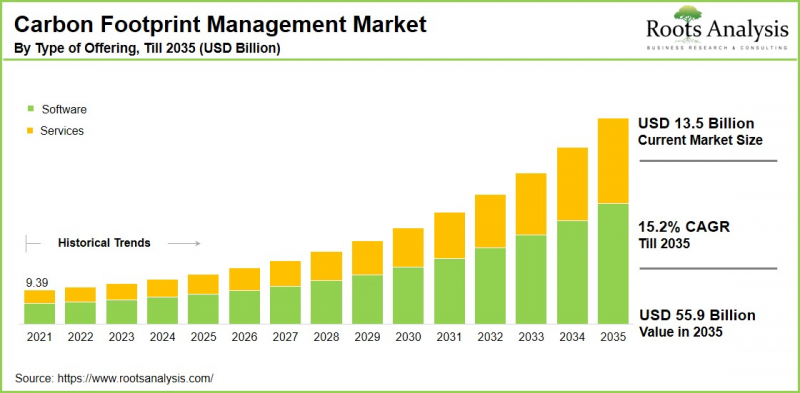
預計到 2035 年,全球碳足跡管理市場將以 15.2% 的複合年增長率成長,從目前的 135 億美元成長至 559 億美元。
碳足跡是對溫室氣體排放量的量化衡量,以二氧化碳當量表示,這些排放量由一項活動、流程或產品直接或間接產生。這些排放來自多種來源,包括能源消耗、工業生產、運輸系統和廢棄物管理實踐。碳足跡管理透過系統性地測量、減少和抵消排放,最大限度地減少對環境的影響,在應對氣候變遷方面發揮至關重要的作用。
這種系統性方法需要關鍵利害關係人(尤其是企業)的積極參與,具體策略包括碳足跡評估、源頭減量以及參與碳抵銷計畫。近年來,在監管措施的強化支持下,碳足跡管理已成為全球永續發展工作的核心要素,世界各國政府都在實施氣候變遷減緩政策,以實現淨零排放目標。從經濟角度來看,由於提高能源效率和減少浪費可以降低成本等實際利益,各組織擴大採用有效的碳管理措施。
預計這些環境和經濟因素的綜合作用將在預測期內顯著推動市場成長。
高階主管策略洞察
推動碳足跡管理市場成長的關鍵因素
推動全球碳足跡管理市場成長的關鍵因素之一是政府主導的旨在減少碳排放的各項舉措的日益普及。這些舉措包括碳信用交易機制(CCTS),該機制對碳排放定價,以幫助遏制溫室氣體排放。此外,各行各業擴大採用淨零排放目標,顯著增加了對先進技術的需求。再加上企業內部永續發展目標的提高和投資者的密切關注,使得準確的碳足跡追蹤和報告成為可能。此外,環境、社會和治理 (ESG) 標準日益重要,進一步推動了市場擴張。投資人越來越青睞那些展現出卓越環境績效和透明永續發展實踐的企業。
碳足跡管理市場 - 產業競爭格局
當前市場格局的特點是,眾多規模各異的企業並存,它們擁有跨多個地區提供解決方案和服務所需的技術專長和營運能力。其中,大多數企業 (45%) 提供基於雲端的碳足跡管理解決方案。另一方面,提供本地部署解決方案的企業比例相對較小,約 4%。主要的雲端解決方案提供者包括 AiDASH、Carbon Footprint、Cority、Diligent 和 Envirosoft。
此外,市場上的小型新進業者正積極拓展產品組合,以滿足細分市場需求,並抓住各產業領域尚未開發的機會。 Carbon Analytics、Carbon Footprint、Carbon Upcycling Technologies、Envirosoft、ESP 和 Green Sutra 等公司正專注於創新,並提供針對性的解決方案以增強其競爭優勢。
不斷發展的碳足跡管理—產業新趨勢
碳足跡管理市場的新趨勢包括人工智慧 (AI)、機器學習和物聯網 (IoT) 等先進技術的加速應用。這些技術能夠實現對碳排放的即時監測和預測。這些創新正在將傳統的碳排放追蹤轉變為數據驅動的決策支援系統,從而提高營運效率和合規性。另一個關鍵趨勢是向基於雲端的整合平台轉型,這些平台提供可擴展性、集中式儀表板和自動化溫室氣體 (GHG) 運算功能。這些平台有助於企業遵守日益嚴格的監管要求和全球揭露標準。
此外,隨著企業加強其 ESG 承諾並增加永續發展報告義務,企業正在將碳管理納入更廣泛的永續發展策略中。
區域分析:歐洲引領碳足跡管理市場
根據我們的分析,歐洲今年佔了碳足跡管理市場最大的佔有率。這主要歸功於其全面而嚴格的監管環境,該環境要求企業測量、揭露並減少溫室氣體排放。諸如 "歐洲綠色協議" 和 "企業永續發展報告指令" (CSRD)等強有力的政策框架,正在製定必要的合規要求,從而推動各行業對先進的碳核算和管理解決方案的需求。此外,政府的大力支持、對綠色技術的大量公共資金投入以及歐洲消費者日益增強的環保意識,都在促進這些解決方案的普及。
碳足跡管理市場的主要挑戰
阻礙碳足跡管理普及的主要挑戰包括缺乏標準化的研究方法和一致的排放報告架構。這導致不同地區和行業之間的溫室氣體數據存在差異且缺乏可比性,使基準測試和監管合規工作變得更加複雜。 此外,許多組織在收集和整合準確數據方面面臨挑戰,尤其是在複雜的供應鏈中收集和整合範圍 3 排放數據時。造成這項挑戰的原因包括供應商報告不一致、系統碎片化以及數位基礎設施不足,這些因素都削弱了碳清單的可靠性。此外,缺乏具備碳核算專業知識的熟練人員以及不斷變化的監管環境也增加了合規和策略規劃的複雜性。
碳足跡管理市場 - 主要市場區隔
產品類型
- 軟體
- 服務
部署方式
- 雲端部署
- 本地部署
企業規模
- 小型企業
- 中型企業
- 大型企業
終端用戶產業
- 能源和公用事業 製造業 住宅及商業建築 運輸和物流 農業 其他
地區
- 北美 美國 加拿大 墨西哥 其他北美地區國家/地區
- 歐洲 奧地利 比利時 丹麥 法國 德國 愛爾蘭 義大利 荷蘭
- 挪威
- 俄羅斯
- 西班牙
- 瑞典
- 瑞士
- 英國
- 其他歐洲國家
- 亞洲
- 中國
- 印度
- 日本
- 新加坡
- 韓國
- 其他亞洲國家
- 拉丁美洲
- 巴西
- 智利
- 哥倫比亞
- 委內瑞拉
- 其他拉丁美洲國家
- 中東和北非
- 埃及
- 伊朗
- 伊拉克
- 以色列
- 科威特
- 沙烏地阿拉伯
- 阿聯酋
- 其他中東和北非國家國家
- 世界其他地區
- 澳大利亞
- 紐西蘭
- 其他國家/地區
碳足跡管理市場主要公司
- Carbon Footprint
- Carbon Trust
- Diligent
- EcoAct
- EnergyCAP
- ENGIE Impact
- Envirosoft
- ESP
- Optimum Energy
- SAP
- GreenSutra
碳足跡管理市場 - 報告範圍
本碳足跡管理市場報告深入分析以下幾個面向:
- 市場規模與機會分析:對碳足跡管理市場進行詳細分析,重點在於以下關鍵市場細分:[A] 產品形式,[B] 部署形式,[C] 公司類型,[D] 最終用戶產業,以及 [E]區域
- 競爭格局:基於相關參數(例如[A]成立年份、[B]公司規模、[C]總部所在地和[D]所有權結構)對進入碳足跡管理市場的公司進行全面分析。
- 公司簡介:對進入碳足跡管理市場的主要公司進行詳細介紹。本文檔提供以下方面的詳細資訊:[A]總部所在地、[B]公司規模、[C]企業理念、[D]業務規模、[E]管理團隊、[F]聯絡資訊、[G]財務資訊、[H]業務板塊、[I]產品和技術組合、[J]近期發展和未來展望。
- 大趨勢:對碳足跡管理產業當前大趨勢的評估。
- 專利分析:基於相關參數(例如[A]專利類型、[B]專利公開年份、[C]專利年齡和[D]主要參與者)對碳足跡管理領域已提交和已註冊的專利進行深入分析。
- 近期發展:概述碳足跡管理市場近期發展情況,並基於以下相關參數進行分析:[A] 實施年限,[B] 專案類型,[C] 地域分佈,以及 [D] 最活躍的進入者。
- 波特五力分析:分析碳足跡管理市場五大主要競爭因素(新進業者的威脅、買方議價能力、供應商議價能力、替代品的威脅、以及現有競爭對手之間的競爭)。
- SWOT 分析:深入剖析特定領域的優勢、劣勢、機會和威脅的 SWOT 框架。此外,哈維鮑爾分析強調了每個 SWOT 參數的相對影響。我們也提供這項服務。
目錄
第一章:專案概述
第二章:研究方法
第三章:市場動態
第四章:宏觀經濟指標
- 章節總結
- 市場動態
- 結論
第五章:摘要整理
第六章:引言
- 碳足跡管理概述
- 碳排放/碳足跡的構成要素
- 未來趨勢
第七章:供應鏈分析
- 流程概述利害關係人
- 碳足跡管理流程示意圖
- 主要挑戰和緩解措施
第八章 監理環境
- 國際和國內監管機構
第九章:碳足跡管理市場 - 主要參與者
- 研究方法與關鍵參數
- 依成立年份分析
- 依公司規模分析
- 依總部所在地分析
- 依公司類型分析
- 以交付方式分析
- 依公司類型和產品類型分析
- 依部署模式分析
第十章:公司競爭分析
- 研究方法與評分標準
- 主要參與者比較:2x2矩陣
- 主要參與者
第十一章 新創企業生態系分析
- 研究方法與關鍵參數
- 依成立年份分析
- 依公司規模分析
- 依總部所在地分析
- 依公司類型分析
- 以交付方式分析
- 依部署方式分析
- 依總部所在地分析碳足跡管理解決方案提供商
- 以公司規模分析雲端碳足跡管理解決方案供應商
第十二章 公司簡介
- 概述
- 碳足跡
- 碳信賴
- 勤勉
- EcoAct
- EnergyCAP
- ENGIE Impact
- Optimum Energy
- SAP
- Envirosoft
- GreenSutra
- ESP
第十三章 大趨勢
- 氣候變遷法規與淨零排放目標
- 技術進步
- 企業脫碳策略
- 以永續發展為中心的消費者需求
- 健全的監理框架
- 將碳管理融入商業策略
第十四章 未滿足的需求
- 缺乏碳核算知識
- 定義排放邊界
- 資料收集
- 資料驗證與準確性
- 標準化與資料一致性
- 後期成果
- 科技與基礎設施
- 價格波動
第15章 碳足跡管理:關鍵策略
- 聚焦再生能源
- 提高能源效率
- 供應鏈優化
- 減少浪費
- 永續交通策略
- 碳中和農業
- 溫室氣體減量方案
- 淨零排放航空
第16章 專利分析
- 研究範圍與方法
- 關鍵參數
- 碳足跡管理:專利分析
第17章 全球碳足跡管理市場
- 關鍵假設與研究方法
- 全球碳足跡管理市場 - 歷史趨勢(2021-2021)與預測(2035)
- 情境分析
- 主要市場細分
第18章 依產品類型劃分的市場機會
第19章 依部署方式劃分的市場機會
第20章 依業務類型劃分的市場機會
第21章 依最終用戶產業劃分的市場機會
第22章 依地區劃分的市場機會
第23章 來自一手研究的洞察
第24章 結論
第25章 附錄一:表格數據
第26章 附錄二、公司與組織清單
Carbon Footprint Management Market Outlook
As per Roots Analysis, the global carbon footprint management market size is estimated to grow from USD 13.5 billion in current year to USD 55.9 billion by 2035, at a CAGR of 15.2% during the forecast period, till 2035.
Carbon footprint represents the quantification of greenhouse gas emissions, measured in carbon dioxide equivalent, generated directly or indirectly by activities, processes, or products. These emissions arise from a wide range of sources, including energy usage, industrial manufacturing, transportation systems, and waste management practices. Carbon footprint management focuses on systematically measuring, reducing, and offsetting emissions to minimize their environmental impact and plays a critical role in addressing climate change.
This structured approach actively involves key stakeholders, particularly businesses, through strategies such as carbon footprint assessment, emission reduction at the source, and participation in carbon offset initiatives. In recent years, carbon footprint management has emerged as a core component of global sustainability efforts, supported by increasing regulatory action as governments worldwide implement climate mitigation policies to achieve net-zero targets. From an economic standpoint, organizations are increasingly adopting robust carbon management practices due to tangible benefits, including cost savings driven by improved energy efficiency and reduced waste.
Collectively, these environmental and economic drivers are expected to significantly propel market growth over the forecast period.
Strategic Insights for Senior Leaders
Key Drivers Propelling Growth of Carbon Footprint Management Market
One of the primary drivers accelerating the growth of the global carbon footprint management market is the increasing implementation of government initiatives aimed at reducing carbon emissions. These initiatives include mechanisms such as carbon credit trading schemes (CCTS), which price carbon to help curb greenhouse gas emissions. Further, the growing adoption of net-zero commitments across multiple industries has significantly increased the demand for advanced technologies. This enables accurate carbon footprint tracking and reporting, driven by both internal sustainability objectives and heightened scrutiny from investors. Moreover, the rising prominence of environmental, social, and governance (ESG) criteria is further supporting market expansion, as investors are increasingly favoring organizations demonstrating strong environmental performance and transparent sustainability practices.
Carbon Footprint Management Market: Competitive Landscape of Companies in this Industry
The current market landscape is characterized by the presence of both small and large companies with technical expertise and operational capabilities to deliver solutions and services across multiple regions. Notably, majority of the companies (45%) offer cloud-based carbon footprint management solutions. However, a comparatively small share, approximately 4%, provides on-premise offerings; notable providers of cloud-based solutions include AiDASH, Carbon Footprint, Cority, Diligent, and Envirosoft.
Further, small players in the market are actively enhancing their portfolios to address niche requirements and capitalize on untapped opportunities across diverse industry verticals. Companies such as Carbon Analytics, Carbon Footprint, Carbon Upcycling Technologies, Envirosoft, ESP, and Green Sutra are focusing on innovation and providing targeted solutions to strengthen their competitive positioning.
Carbon Footprint Management Evolution: Emerging Trends in the Industry
Emerging trends in the carbon footprint management market include the accelerated adoption of advanced technologies, such as artificial intelligence (AI), machine learning, the Internet of Things (IoT), which are enabling real-time emissions monitoring, and forecasting of carbon outputs. These innovations are transforming traditional carbon tracking into data-driven decision support systems that enhance operational efficiency and compliance. Another important trend is the shift toward cloud-based and integrated platforms that offer scalability, centralized dashboards, and automated greenhouse gas (GHG) accounting. These platforms help organizations comply with increasingly stringent regulatory requirements and global disclosure standards.
Additionally, heightened corporate ESG commitments and sustainability reporting obligations are driving enterprises to integrate carbon management into broader sustainability strategies.
Regional Analysis: Europe Leads the Carbon Footprint Management Market
According to our analysis, in the current year, the carbon footprint management market in Europe captures the largest share. This is due to due to its comprehensive and stringent regulatory environment, which compels organizations to measure, disclose, and reduce greenhouse gas emissions. Robust policy frameworks such as the European Green Deal, the Corporate Sustainability Reporting Directive (CSRD), have created mandatory compliance requirements that drive demand for advanced carbon accounting and management solutions across industries. Further, strong governmental support, substantial public funding for green technologies, and rising environmental awareness among European consumers is driving the adoption of such solutions.
Key Challenges in Carbon Footprint Management Market
Key challenges hindering the adoption of carbon footprint management include lack of standardized methodologies and consistent emissions reporting frameworks. This results in variability and limited comparability of greenhouse gas data across regions and industries, thereby complicating benchmarking and regulatory compliance efforts. Additionally, many organizations struggle with accurate data collection and integration, particularly for Scope 3 emissions across complex supply chains. This challenge is driven by inconsistent supplier reporting, fragmented systems, and insufficient digital infrastructure, which undermines the reliability of carbon inventories. Furthermore, there is a shortage of skilled professionals with expertise in carbon accounting and an evolving regulatory landscape that adds complexity to compliance and strategic planning.
Carbon Footprint Management Market: Key Market Segmentation
Type of Offering
- Software
- Service
Deployment Mode
- Cloud-based
- On-premises
Type of Enterprise
- Small Companies
- Mid-sized Companies
- Large Companies
End Use Industry
- Energy Utilities
- Manufacturing Industry
- Residential and Commercial Buildings
- Transportation and Logistics
- Agriculture Industry
- Other Industries
Geographical Regions
- North America
- US
- Canada
- Mexico
- Other North American countries
- Europe
- Austria
- Belgium
- Denmark
- France
- Germany
- Ireland
- Italy
- Netherlands
- Norway
- Russia
- Spain
- Sweden
- Switzerland
- UK
- Other European countries
- Asia
- China
- India
- Japan
- Singapore
- South Korea
- Other Asian countries
- Latin America
- Brazil
- Chile
- Colombia
- Venezuela
- Other Latin American countries
- Middle East and North Africa
- Egypt
- Iran
- Iraq
- Israel
- Kuwait
- Saudi Arabia
- UAE
- Other MENA countries
- Rest of the World
- Australia
- New Zealand
- Other countries
Example Players in Carbon Footprint Management Market
- Carbon Footprint
- Carbon Trust
- Diligent
- EcoAct
- EnergyCAP
- ENGIE Impact
- Envirosoft
- ESP
- Optimum Energy
- SAP
- GreenSutra
Carbon Footprint Management Market: Report Coverage
The report on the carbon footprint management market features insights on various sections, including:
- Market Sizing and Opportunity Analysis: An in-depth analysis of the carbon footprint management market, focusing on key market segments, including [A] type of offering, [B] deployment mode, [C] type of enterprise, [D] end-use industry, and [E] geographical regions.
- Competitive Landscape: A comprehensive analysis of the companies engaged in the carbon footprint management market, based on several relevant parameters, such as [A] year of establishment, [B] company size, [C] location of headquarters and [D] ownership structure.
- Company Profiles: Elaborate profiles of prominent players engaged in the carbon footprint management market, providing details on [A] location of headquarters, [B] company size, [C] company mission, [D] company footprint, [E] management team, [F] contact details, [G] financial information, [H] operating business segments, [I] product / technology portfolio, [J] recent developments, and an informed future outlook.
- Megatrends: An evaluation of ongoing megatrends in the carbon footprint management industry.
- Patent Analysis: An insightful analysis of patents filed / granted in the carbon footprint management domain, based on relevant parameters, including [A] type of patent, [B] patent publication year, [C] patent age and [D] leading players.
- Recent Developments: An overview of the recent developments made in the carbon footprint management market, along with analysis based on relevant parameters, including [A] year of initiative, [B] type of initiative, [C] geographical distribution and [D] most active players.
- Porter's Five Forces Analysis: An analysis of five competitive forces prevailing in the carbon footprint management market, including threats of new entrants, bargaining power of buyers, bargaining power of suppliers, threats of substitute products and rivalry among existing competitors.
- SWOT Analysis: An insightful SWOT framework, highlighting the strengths, weaknesses, opportunities and threats in the domain. Additionally, it provides Harvey ball analysis, highlighting the relative impact of each SWOT parameter.
Key Questions Answered in this Report
- What is the current and future market size?
- Who are the leading companies in this market?
- What are the growth drivers that are likely to influence the evolution of this market?
- What are the key partnership and funding trends shaping this industry?
- Which region is likely to grow at higher CAGR till 2035?
- How is the current and future market opportunity likely to be distributed across key market segments?
Reasons to Buy this Report
- Detailed Market Analysis: The report provides a comprehensive market analysis, offering detailed revenue projections of the overall market and its specific sub-segments. This information is valuable to both established market leaders and emerging entrants.
- In-depth Analysis of Trends: Stakeholders can leverage the report to gain a deeper understanding of the competitive dynamics within the market. Each report maps ecosystem activity across partnerships, funding, and patent landscapes to reveal growth hotspots and white spaces in the industry.
- Opinion of Industry Experts: The report features extensive interviews and surveys with key opinion leaders and industry experts to validate market trends mentioned in the report.
- Decision-ready Deliverables: The report offers stakeholders with strategic frameworks (Porter's Five Forces, value chain, SWOT), and complimentary Excel / slide packs with customization support.
Additional Benefits
- Complimentary Dynamic Excel Dashboards for Analytical Modules
- Exclusive 15% Free Content Customization
- Personalized Interactive Report Walkthrough with Our Expert Research Team
- Free Report Updates for Versions Older than 6-12 Months
TABLE OF CONTENTS
1. PROJECT OVERVIEW
- 1.1. Context
- 1.2. Project Objectives
2. RESEARCH METHODOLOGY
- 2.1. Chapter Overview
- 2.2. Research Assumptions
- 2.2.1. Market Landscape and Market Trends
- 2.2.2. Market Forecast and Opportunity Analysis
- 2.2.3. Comparative Analysis
- 2.3. Database Building
- 2.3.1. Data Collection
- 2.3.2. Data Validation
- 2.3.3. Data Analysis
- 2.4. Project Methodology
- 2.4.1. Secondary Research
- 2.4.1.1. Annual Reports
- 2.4.1.2. Academic Research Papers
- 2.4.1.3. Company Websites
- 2.4.1.4. Investor Presentations
- 2.4.1.5. Regulatory Filings
- 2.4.1.6. White Papers
- 2.4.1.7. Industry Publications
- 2.4.1.8. Conferences and Seminars
- 2.4.1.9. Government Portals
- 2.4.1.10. Media and Press Releases
- 2.4.1.11. Newsletters
- 2.4.1.12. Industry Databases
- 2.4.1.13. Roots Proprietary Databases
- 2.4.1.14. Paid Databases and Sources
- 2.4.1.15. Social Media Portals
- 2.4.1.16. Other Secondary Sources
- 2.4.2. Primary Research
- 2.4.2.1. Types of Primary Research
- 2.4.2.1.1. Qualitative Research
- 2.4.2.1.2. Quantitative Research
- 2.4.2.1.3. Hybrid Approach
- 2.4.2.2. Advantages of Primary Research
- 2.4.2.3. Techniques for Primary Research
- 2.4.2.3.1. Interviews
- 2.4.2.3.2. Surveys
- 2.4.2.3.3. Focus Groups
- 2.4.2.3.4. Observational Research
- 2.4.2.3.5. Social Media Interactions
- 2.4.2.4. Key Opinion Leaders Considered in Primary Research
- 2.4.2.4.1. Company Executives (CXOs)
- 2.4.2.4.2. Board of Directors
- 2.4.2.4.3. Company Presidents and Vice Presidents
- 2.4.2.4.4. Research and Development Heads
- 2.4.2.4.5. Technical Experts
- 2.4.2.4.6. Subject Matter Experts
- 2.4.2.4.7. Scientists
- 2.4.2.4.8. Doctors and Other Healthcare Providers
- 2.4.2.5. Ethics and Integrity
- 2.4.2.5.1. Research Ethics
- 2.4.2.5.2. Data Integrity
- 2.4.2.1. Types of Primary Research
- 2.4.3. Analytical Tools and Databases
- 2.4.1. Secondary Research
- 2.5. Robust Quality Control
3. MARKET DYNAMICS
- 3.1. Chapter Overview
- 3.2. Forecast Methodology
- 3.2.1. Top-down Approach
- 3.2.2. Bottom-up Approach
- 3.2.3. Hybrid Approach
- 3.3. Market Assessment Framework
- 3.3.1. Total Addressable Market (TAM)
- 3.3.2. Serviceable Addressable Market (SAM)
- 3.3.3. Serviceable Obtainable Market (SOM)
- 3.3.4. Currently Acquired Market (CAM)
- 3.4. Forecasting Tools and Techniques
- 3.4.1. Qualitative Forecasting
- 3.4.2. Correlation
- 3.4.3. Regression
- 3.4.4. Extrapolation
- 3.4.5. Convergence
- 3.4.6. Sensitivity Analysis
- 3.4.7. Scenario Planning
- 3.4.8. Data Visualization
- 3.4.9. Time Series Analysis
- 3.4.10. Forecast Error Analysis
- 3.5. Key Considerations
- 3.5.1. Demographics
- 3.5.2. Government Regulations
- 3.5.3. Reimbursement Scenarios
- 3.5.4. Market Access
- 3.5.5. Supply Chain
- 3.5.6. Industry Consolidation
- 3.5.7. Pandemic / Unforeseen Disruptions Impact
- 3.6. Limitations
4. MACRO-ECONOMIC INDICATORS
- 4.1. Chapter Overview
- 4.2. Market Dynamics
- 4.2.1. Time Period
- 4.2.1.1. Historical Trends
- 4.2.1.2. Current and Forecasted Estimates
- 4.2.2. Currency Coverage
- 4.2.2.1. Major Currencies Affecting the Market
- 4.2.2.2. Factors Affecting Currency Fluctuations
- 4.2.2.3. Impact of Currency Fluctuations on the Industry
- 4.2.3. Foreign Currency Exchange Rate
- 4.2.3.1. Impact of Foreign Exchange Rate Volatility on the Market
- 4.2.3.2. Strategies for Mitigating Foreign Exchange Risk
- 4.2.4. Recession
- 4.2.4.1. Assessment of Current Economic Conditions and Potential Impact on the Market
- 4.2.4.2. Historical Analysis of Past Recessions and Lessons Learnt
- 4.2.5. Inflation
- 4.2.5.1. Measurement and Analysis of Inflationary Pressures in the Economy
- 4.2.5.2. Potential Impact of Inflation on the Market Evolution
- 4.2.6. Interest Rates
- 4.2.6.1. Interest Rates and Their Impact on the Market
- 4.2.6.2. Strategies for Managing Interest Rate Risk
- 4.2.7. Commodity Flow Analysis
- 4.2.7.1. Type of Commodity
- 4.2.7.2. Origins and Destinations
- 4.2.7.3. Values and Weights
- 4.2.7.4. Modes of Transportation
- 4.2.8. Global Trade Dynamics
- 4.2.8.1. Import Scenario
- 4.2.8.2. Export Scenario
- 4.2.8.3. Trade Policies
- 4.2.8.4. Strategies for Mitigating the Risks Associated with Trade Barriers
- 4.2.8.5. Impact of Trade Barriers on the Market
- 4.2.9. War Impact Analysis
- 4.2.9.1. Russian-Ukraine War
- 4.2.9.2. Israel-Hamas War
- 4.2.10. COVID Impact / Related Factors
- 4.2.10.1. Global Economic Impact
- 4.2.10.2. Industry-specific Impact
- 4.2.10.3. Government Response and Stimulus Measures
- 4.2.10.4. Future Outlook and Adaptation Strategies
- 4.2.11. Other Indicators
- 4.2.11.1. Fiscal Policy
- 4.2.11.2. Consumer Spending
- 4.2.11.3. Gross Domestic Product (GDP)
- 4.2.11.4. Employment
- 4.2.11.5. Taxes
- 4.2.11.6. Stock Market Performance
- 4.2.11.7. Cross-Border Dynamics
- 4.2.1. Time Period
- 4.3. Conclusion
5. EXECUTIVE SUMMARY
6. INTRODUCTION
- 6.1. Overview of Carbon Footprint Management
- 6.2. Components Contributing to Carbon Emission / Footprint
- 6.3. Future Trends
7. SUPPLY CHAIN ANALYSIS
- 7.1. Brief Overview of Processes and Stakeholders Involved
- 7.2. Schematic Representation of Carbon Footprint Management Process
- 7.3. Key Challenges and Mitigation Strategies
8. REGULATORY SCENARIO
- 8.1. International and National Regulatory Authorities
9. CARBON FOOTPRINT MANAGEMENT MARKET: LEADING PLAYERS
- 9.1. Methodology and Key Parameters
- 9.2. Analysis by Year of Establishment
- 9.3. Analysis by Company Size
- 9.4. Analysis by Location of Headquarters \
- 9.5. Analysis by Type of Company
- 9.6. Analysis by Type of Offering
- 9.7. Analysis by Type of Company and Type of Offering
- 9.8. Analysis by Deployment Mode
10. COMPANY COMPETITIVENESS ANALYSIS
- 10.1. Methodology and Scoring Criteria
- 10.2. Comparison of Leading Players: 2x2 Matrix
- 10.3. Leading Players
11. STARTUP ECOSYSTEM ANALYSIS
- 11.1. Methodology and Key Parameters
- 11.2. Analysis by Year of Establishment
- 11.3. Analysis by Company Size
- 11.4. Analysis by Location of Headquarters
- 11.5. Analysis by Type of Company
- 11.7. Analysis by Type of Offering
- 11.8. Analysis by Type of Deployment Mode
- 11.9. Analysis of Carbon Footprint Management Solution Providers by Location of Headquarters
- 11.10. Analysis of Cloud-based Carbon Footprint Management Solution Providers by Company Size
12. COMPANY PROFILES
- 12.1. Overview
- 12.2. Carbon Footprint
- 12.2.1. Company Overview
- 12.2.2. Management Team
- 12.2.3. Carbon Footprint Management Portfolio
- 12.2.4. Recent Initiatives
- *similar details are presented for other below mentioned companies based on information in the public domain**
- 12.3. Carbon Trust
- 12.4. Diligent
- 12.5. EcoAct
- 12.6. EnergyCAP
- 12.7. ENGIE Impact
- 12.8. Optimum Energy
- 12.9. SAP
- 12.10. Envirosoft
- 12.11. GreenSutra
- 12.12. ESP
13. MEGATRENDS
- 13.1. Climate Regulations and Net-zero Commitments
- 13.2. Technological Advancements
- 13.3. Corporate Decarbonization Strategies
- 13.4. Sustainability Driven Consumer Demands
- 13.5. Robust Regulatory Framework
- 13.6. Integration of Carbon Management into Business Strategy
14. UNMET NEEDS
- 14.1. Lack of Carbon Accounting Knowledge
- 14.2. Defining Emission Boundaries
- 14.3. Data Collection
- 14.4. Data Verification and Accuracy
- 14.5. Standardization and Data Consistency
- 14.6. Late Achievements
- 14.7. Technology and Infrastructure
- 14.8. Price Variations
15. CARBON FOOTPRINT MANAGEMENT: KEY STRATEGIES
- 15.1. Focus on Renewable Energy
- 15.2. Energy Efficiency Improvements
- 15.3. Supply Chain Optimization
- 15.4. Waste Reduction
- 15.5. Sustainable Transportation Strategies
- 15.6. Carbon Neutral Farming
- 15.7. Green House Solutions
- 15.8. Net Zero Aviation
16. PATENT ANALYSIS
- 16.1. Scope and Methodology
- 16.2. Key Parameters
- 16.3. Carbon Footprint Management: Patent Analysis
- 16.3.1. Analysis by Application Year
- 16.3.2. Analysis by Type of Patent
- 16.3.3. Analysis by Patent Jurisdiction
- 16.3.4. Analysis by Patent Publication Year
- 16.3.5. Analysis by Type of Patent and Patent Publication Year
- 16.3.6. Leading Players: Analysis by Number of Patents
- 16.3.7. Leading Individual Patent Assignees: Analysis by Number of Patents
- 16.3.8. Analysis by Type of Applicant
- 16.3.9. Analysis by Patent Age
- 16.3.10. Patent Valuation
17. GLOBAL CARBON FOOTPRINT MANAGEMENT MARKET
- 17.1. Key Assumptions and Methodology
- 17.2. Global Carbon Footprint Management Market, Historical Trends (Since 2021) and Forecasted Estimates (Till 2035)
- 17.2.1. Scenario Analysis
- 17.2.1.1. Conservative Scenario
- 17.2.1.2. Optimistic Scenario
- 17.2.1. Scenario Analysis
- 17.3. Key Market Segmentations
18. MARKET OPPORTUNITIES BASED ON TYPE OF OFFERING
- 18.1. Key Assumptions and Methodology
- 18.2. Carbon Footprint Management Market, by Type of Offering
- 18.2.1. Carbon Footprint Management Market for Software, Historical Trends (Since 2021) and Forecasted Estimates (Till 2035)
- 18.2.2. Carbon Footprint Management Market for Solution, Historical Trends (Since 2021) and Forecasted Estimates (Till 2035)
19. MARKET OPPORTUNITIES BASED ON DEPLOYMENT MODE
- 19.1. Key Assumptions and Methodology
- 19.2. Carbon Footprint Management Market, by Deployment Mode
- 19.2.1. Carbon Footprint Management Market for Cloud-based, Historical Trends (Since 2021) and Forecasted Estimates (Till 2035)
- 19.2.2. Carbon Footprint Management Market for On-Premises, Historical Trends (Since 2021) and Forecasted Estimates (Till 2035)
20. MARKET OPPORTUNITIES BASED ON TYPE OF ENTERPRISE
- 20.1. Key Assumptions and Methodology
- 20.2. Carbon Footprint Management Market, by Type of Enterprise
- 20.2.1. Carbon Footprint Management Market for Small Companies, Historical Trends (Since 2021) and Forecasted Estimates (Till 2035)
- 20.2.2. Carbon Footprint Management Market for Mid-sized Companies, Historical Trends (Since 2021) and Forecasted Estimates (Till 2035)
- 20.2.3. Carbon Footprint Management Market for Large Companies, Historical Trends (Since 2021) and Forecasted Estimates (Till 2035)
21. MARKET OPPORTUNITIES BASED ON END USE INDUSTRY
- 21.1. Key Assumptions and Methodology
- 21.2. Carbon Footprint Management Market, by End Use Industry
- 21.2.1. Carbon Footprint Management Market for Energy Utilities, Historical Trends (Since 2021) and Forecasted Estimates (Till 2035)
- 21.2.2. Carbon Footprint Management Market for Manufacturing Industry, Historical Trends (Since 2021) and Forecasted Estimates (Till 2035)
- 21.2.3. Carbon Footprint Management Market for Residential and Commercial Buildings, Historical Trends (Since 2021) and Forecasted Estimates (Till 2035)
- 21.2.4. Carbon Footprint Management Market for Transportation and Logistics, Historical Trends (Since 2021) and Forecasted Estimates (Till 2035)
- 21.2.5. Carbon Footprint Management Market for Agriculture Industry, Historical Trends (Since 2021) and Forecasted Estimates (Till 2035)
- 21.2.5. Carbon Footprint Management Market for Other Industries, Historical Trends (Since 2021) and Forecasted Estimates (Till 2035)
22. MARKET OPPORTUNITIES BASED ON GEOGRAPHICAL REGIONS
- 22.1. Key Assumptions and Methodology
- 22.2. Carbon Footprint Management Market, by Geographical Regions
- 22.2.1. Carbon Footprint Management Market for in North America, Historical Trends (Since 2021) and Forecasted Estimates (Till 2035)
- 22.2.1.1. Carbon Footprint Management Market in the US, Historical Trends (Since 2021) and Forecasted Estimates (Till 2035)
- 22.2.1.2. Carbon Footprint Management Market in Canada, Historical Trends (Since 2021) and Forecasted Estimates (Till 2035)
- 22.2.2 Carbon Footprint Management Market for in Europe, Historical Trends (Since 2021) and Forecasted Estimates (Till 2035)
- 22.2.2.1. Carbon Footprint Management Market in Germany, Historical Trends (Since 2021) and Forecasted Estimates (Till 2035)
- 22.2.2.2. Carbon Footprint Management Market in the UK, Historical Trends (Since 2021) and Forecasted Estimates (Till 2035)
- 22.2.2.3. Carbon Footprint Management Market in France, Historical Trends (Since 2021) and Forecasted Estimates (Till 2035)
- 22.2.2.4. Carbon Footprint Management Market in Italy, Historical Trends (Since 2021) and Forecasted Estimates (Till 2035)
- 22.2.2.5. Carbon Footprint Management Market in Spain, Historical Trends (Since 2021) and Forecasted Estimates (Till 2035)
- 22.2.2.6. Carbon Footprint Management Market for in Netherlands, Historical Trends (Since 2021) and Forecasted Estimates (Till 2035)
- 22.2.2.7. Carbon Footprint Management Market in Belgium, Historical Trends (Since 2021) and Forecasted Estimates (Till 2035)
- 22.2.2.8. Carbon Footprint Management Market in Austria, Historical Trends (Since 2021) and Forecasted Estimates (Till 2035)
- 22.2.2.9. Carbon Footprint Management Market in Rest of Europe, Historical Trends (Since 2021) and Forecasted Estimates (Till 2035)
- 22.2.3. Carbon Footprint Management Market for in Asia-Pacific, Historical Trends (Since 2021) and Forecasted Estimates (Till 2035)
- 22.2.3.1. Carbon Footprint Management Market in China, Historical Trends (Since 2021) and Forecasted Estimates (Till 2035)
- 22.2.3.2. Carbon Footprint Management Market in India, Historical Trends (Since 2021) and Forecasted Estimates (Till 2035)
- 22.2.3.3. Carbon Footprint Management Market for in Japan, Historical Trends (Since 2021) and Forecasted Estimates (Till 2035)
- 22.3.3.4. Carbon Footprint Management Market in the Indonesia, Historical Trends (Since 2021) and Forecasted Estimates (Till 2035)
- 22.3.3.5. Carbon Footprint Management Market in South Korea, Historical Trends (Since 2021) and Forecasted Estimates (Till 2035)
- 22.3.3.6. Carbon Footprint Management Market for in Rest of Asia-Pacific, Historical Trends (Since 2021) and Forecasted Estimates (Till 2035)
- 22.2.4. Carbon Footprint Management Market in Middle East and Africa, Historical Trends (Since 2021) and Forecasted Estimates (Till 2035)
- 22.2.4.1. Carbon Footprint Management Market in Iran, Historical Trends (Since 2021) and Forecasted Estimates (Till 2035)
- 22.2.4.2. Carbon Footprint Management Market in Saudi Arabia, Historical Trends (Since 2021) and Forecasted Estimates (Till 2035)
- 22.2.4.3. Carbon Footprint Management Market in South Africa, Historical Trends (Since 2021) and Forecasted Estimates (Till 2035)
- 22.2.4.4. Carbon Footprint Management Market in UAE, Historical Trends (Since 2021) and Forecasted Estimates (Till 2035)
- 22.2.4.5. Carbon Footprint Management Market in Kuwait, Historical Trends (Since 2021) and Forecasted Estimates (Till 2035)
- 22.2.4.6. Carbon Footprint Management Market in Oman, Historical Trends (Since 2021) and Forecasted Estimates (Till 2035)
- 22.2.4.7. Carbon Footprint Management Market in Israel, Historical Trends (Since 2021) and Forecasted Estimates (Till 2035)
- 22.2.4.8. Carbon Footprint Management Market in Rest of Middle East and Africa, Historical Trends (Since 2021) and Forecasted Estimates (Till 2035)
- 22.2.5. Carbon Footprint Management Market in Latin America, Historical Trends (Since 2021) and Forecasted Estimates (Till 2035)
- 22.2.5.1. Carbon Footprint Management Market in Brazil, Historical Trends (Since 2021) and Forecasted Estimates (Till 2035)
- 22.2.5.2. Carbon Footprint Management Market in Argentina, Historical Trends (Since 2021) and Forecasted Estimates (Till 2035)
- 22.2.5.3. Carbon Footprint Management Market in Rest of Latin America, Historical Trends (Since 2021) and Forecasted Estimates (Till 2035)
- 22.2.1. Carbon Footprint Management Market for in North America, Historical Trends (Since 2021) and Forecasted Estimates (Till 2035)
- 22.3. Market Movement Analysis
- 22.4. Penetration-Growth (P-G) Matrix
23. INSIGHTS FROM PRIMARY RESEARCH
24. CONCLUDING INSIGHTS
25. APPENDIX I: TABULATED DATA
26. APPENDIX II: LIST OF COMPANIES AND ORGANIZATIONS

 碳足跡管理市場:按組件、組織規模、最終用戶、部署模式和應用分類-2026-2032年全球市場預測
 2026年全球產品碳足跡檢驗市場報告2026年全球碳足跡管理市場報告2026年全球碳足跡管理軟體市場報告
 全球碳足跡管理市場規模、佔有率、趨勢和成長分析報告(2026-2034年)
 碳足跡管理市場 - 全球產業規模、佔有率、趨勢、競爭格局、機會及預測(按組件、部署模式、類型、最終用戶產業、地區和競爭格局分類,2021-2031年)
 碳足跡管理市場規模、佔有率和成長分析(按組件、部署類型、組織規模、垂直產業和地區分類)-2026-2033年產業預測
 2025 年至 2033 年碳足跡管理市場報告(按產品、部署模式、最終用途產業和地區分類)
 全球碳足跡管理市場(至 2030 年)按組件(解決方案/服務)、部署模式(本地/雲端)、組織規模(企業/中型/小型企業)、行業垂直和地區分類
 碳足跡管理市場 - 全球及區域分析:按組件、部署模型、垂直和地理 - 分析與預測(2025-2034)