

 |
市場調查報告書
商品編碼
2184669
歐洲電動車電池系統:市場佔有率分析、行業趨勢和統計數據以及成長預測(2026-2031 年)Europe EV Battery Systems - Market Share Analysis, Industry Trends & Statistics, Growth Forecasts (2026 - 2031) |
||||||

※ 本網頁內容可能與最新版本有所差異。詳細情況請與我們聯繫。
據 Mordor Intelligence 稱,2025 年歐洲電動車電池系統市值為 286 億美元,預計到 2031 年將達到 546 億美元,而 2026 年為 332 億美元,預測期(2026-2031 年)的複合年成長率為 10.5%。
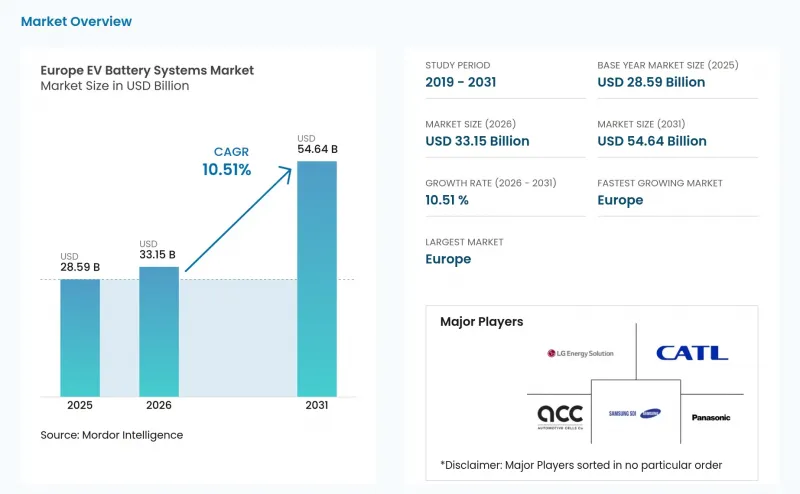
歐洲電動汽車電池系統市場趨勢與洞察
遵守歐盟車輛排放氣體法規,並在2035年前過渡到零排放車輛
歐盟第2019/631號法規於2025年進行了修訂,設定了從2035年起新乘用車和貨車二氧化碳排放量減少100%的目標。該法規也設立了2025年至2027年的多年過渡期。據國際清潔交通委員會(ICCT)稱,製造商提前一年實現了2025年的二氧化碳排放目標。為了達到2030年和2035年的目標,純電動車(BEV)的推廣仍然是必要的。因此,預計歐洲電動車電池系統市場對電池供應商的採購需求將持續成長。隨著針對企業用車的提案措施訂定,從2028年起將為零排放企業用車提供財政支持,預計這將進一步增加對歐洲組裝的車輛和電池系統的需求。
降低電池組成本並提高磷酸鐵鋰電池的普及率
鋰離子電池組價格走低預計將支撐需求。歐洲的電池組價格仍高於中國。磷酸鐵鋰電池(LFP)預計將在歐盟電動車電池需求中獲得更大的市場佔有率,其中中國預計將供應幾乎全部佔有率。雖然磷酸鐵鋰電池有助於降低車輛成本,但也增加了對外部供應的依賴。錳基磷酸鐵鋰電池(LMFP)提供了一種無需使用鈷或鎳即可提高能量密度的方法。其錳含量也為歐洲電動車電池系統市場的在地採購提供了潛在機會。
對進口的依賴以及必需礦產的價格波動
受剛果民主共和國出口限制的影響,鈷價大幅上漲。同時,由於供應受限,儲能需求增加,鋰價也隨之飆漲。這些因素扭轉了先前的價格回檔趨勢。中國在加工後的正極活性材料和石墨的供應方面仍然扮演著重要角色。 《基本原料法》旨在擴大國內的採礦和加工能力。在供應來源多元化之前,材料成本將繼續限制歐洲電動車電池系統市場的利潤前景。
細分市場分析
到2025年,乘用車將佔歐洲電動車電池系統市場的78.63%。乘用車的大規模普及為主流純電動車車型的電池需求奠定了基礎。預計到2031年,中型和重型卡車的年複合成長率將達到13.27%。零排放重型卡車的註冊量正在顯著成長。這個細分市場需要更大的電池組,從而提高了每輛車的電池價值。因此,儘管乘用車仍然是主要的銷售來源,但這種成長正在改變收入結構。
輕型商用車受益於常規的最後一公里配送路線。純電動車在公車和長途客車市場持續成長,城市公車的電氣化進程也正在快速推進。根據國際清潔交通委員會(ICCT)的數據,摩托車和微型交通工具仍然是規模最小的車輛類別。隨著卡車市場佔有率的擴大,歐洲電動車電池系統市場電池組的平均單價正在上漲。車隊採購可能導致電池供應商面臨集中訂單,這些訂單通常對電池的循環壽命性能要求比普通乘用車應用更為嚴格。雖然乘用車專案仍然是銷售的基礎,但商用車正在形成一個高附加價值需求細分市場。這種車輛組合對那些能夠同時滿足大眾乘用車和高要求應用需求的公司來說是有利的。
截至2025年,電池式電動車(BEV)佔歐洲電動車電池系統市場規模的83.15%,預計到2031年將以13.38%的複合年成長率成長。 2025年歐盟純電動車電池的平均容量將接近70度。如此龐大的規模意味著純電動車平台的選擇會對特定電池類型和化學成分的需求產生重大影響。插電式混合動力車(PHEV)由於電池組容量相對較小,目前仍屬於次要管道。然而,從長遠來看,它們在汽車製造商的合規計劃中仍然佔據重要地位。混合動力汽車(HEV)由於採用低容量、低成本的電池組,是動力系統類別中最小的。
純電動車(BEV)銷量的成長促使供應商將投資集中於更窄範圍的電芯和電池組規格上。因此,BEV化學成分的變化對收入的影響遠大於動力系統轉換的影響。磷酸鐵鋰電池(LFP)在歐盟電動車計畫中的應用正在不斷擴大,而液態金屬磷酸鋰電池(LMFP)也開始在BEV計畫中引入。這些趨勢為歐洲電動車電池系統市場創造了平衡成本、能量密度和材料供應的機會。在這個市場中,能夠將多種化學系統應用於大批量BEV平台並開發適用於多種車型系列的通用設計的供應商將佔據優勢。電池組供應商必須在適應電芯規格變化的同時保持性能。大規模BEV專案為成功的設計提供了廣泛的收入基礎,但由於投資集中,此類動力系統領域的採購決策尤其關鍵。
2025年,NMC在歐洲電動車電池系統市場佔據48.89%的市場。 NMC在需要高能量密度的長續航里程車輛和高階車輛專案中仍然佔據重要地位。預計到2031年,LMFP的複合年成長率將達到11.21%。 LMFP無需使用鈷或鎳即可達到比標準LFP更高的能量密度。 「OLiMPUS Horizon Europe」計畫已獲得資金支持,旨在工業化開發LMFP電池,目標是未來在歐洲實現大規模生產。
磷酸鐵鋰電池(LFP)在歐盟電動車電池需求中佔顯著佔有率,幾乎全部由中國供應。 NCA、LTO和其他化學系統則用於高階汽車、圓柱形電池和工業應用。 NMC仍然是歐洲現有計畫中的主要化學體系。 LFP支援對價格敏感型汽車的大規模生產,而LMFP則滿足中檔汽車的在地採購需求。這些化學體系的選擇決定了歐洲電動車電池系統市場的材料供應關係。對NMC的需求使得高能量密度正極材料在高階專案中佔據核心地位,而LFP正成為尋求降低電池組成本的汽車製造商的替代方案。 LMFP旨在將部分成本優勢與更高的能量密度結合。因此,化學成分的組合既影響技術發展,也影響著材料採購的地理分佈。
其他好處:
- Excel格式的市場預測(ME)表
- 3個月的分析師支持
目錄
第1章:引言
- 研究假設和市場定義
- 調查範圍
第2章:調查方法
第3章執行摘要
第4章 市場狀況
- 市場概覽
- 市場促進因素
- 遵守歐盟車輛排放氣體法規,並在 2035 年前過渡到零排放車輛。
- 超級工廠的位置和穩定的電池供應對OEM廠商至關重要
- 更低的包裝成本和更廣泛的LFP應用
- 800伏特平台與快速充電需求
- 電池護照合規系統是供應商認證的競爭優勢。
- 商用車輛和車隊的電氣化以及運轉率運作循環
- 市場限制因素
- 對重要礦產的進口依賴和價格波動
- 歐洲能源成本、人事費用和合規成本都很高。
- 整個價值鏈中電池資料互通性的差距
- 超級工廠運轉率下降和生產擴張延遲
- 價值供應鏈分析
- 監理情勢
- 技術展望
- 波特五力分析
第5章 市場規模、成長預測與交易量
- 車輛類型
- 搭乘用車
- 輕型商用車
- 中型和大型卡車
- 巴士和長途汽車
- 摩托車和微型交通工具
- 依推進類型
- 電池式電動車
- 插電式混合動力電動車
- 油電混合車
- 電池化學成分
- NMC
- LFP
- LMFP
- NCA
- LTO
- 其他
- 單元格格式
- 小袋
- 棱鏡型
- 圓柱形
- 刀片和單元到包裝格式
- 按電池容量
- 小於 15 千瓦時
- 15~40 kWh
- 40~60 kWh
- 60~80 kWh
- 80~100 kWh
- 100~150 kWh
- 150度或以上
- 電壓等級
- 低於400伏
- 400~600 V
- 600~800 V
- 800伏特或以上
- 透過模組配置
- 從電池到模組
- 細胞包裝
- 模組化包裝
- 按類型分類的電池系統組件
- 細胞
- 模組
- 電池組
- 電池管理系統
- 溫度控管系統
- 匯流排、接觸器、熔斷器和高壓配電
- 負極
- 陰極材料
- 電解
- 分隔符
- 按銷售管道
- 目的地設備製造商
- 售後市場和替換
- 國家
- 德國
- 英國
- 法國
- 義大利
- 西班牙
- 荷蘭
- 挪威
- 瑞典
- 波蘭
- 其他歐洲國家
第6章 競爭情勢
- 市場集中度
- 策略趨勢
- 市佔率分析
- 供應商市場佔有率和排名
- 公司簡介
- Contemporary Amperex Technology Co. Limited(CATL)
- LG Energy Solution, Ltd.
- Samsung SDI Co., Ltd.
- Panasonic Holdings Corporation
- BYD Company Limited
- SK On Co., Ltd.
- Automotive Cells Company SE
- Verkor SA
- Volkswagen AG/PowerCo SE
- Mercedes-Benz Group AG
- Renault Group
- Envision AESC Group Ltd.
- Gotion High-Tech Co., Ltd.
- SVOLT Energy Technology Co., Ltd.
- VARTA AG
- Saft Groupe SA
- InoBat Auto as
- FREYR Battery
第7章 市場機會與未來展望
According to Mordor Intelligence, the Europe EV battery system market size was valued at USD 28.6 billion in 2025 and estimated to grow from USD 33.2 billion in 2026 to reach USD 54.6 billion by 2031, at a CAGR of 10.5% during the forecast period (2026-2031).
Europe EV Battery Systems Market Trends and Insights
EU Fleet-Emission Compliance and 2035 Zero-Emission Vehicle Transition
Regulation (EU) 2019/631 was revised in 2025 and set a 100% CO2 reduction target for new passenger cars and vans from 2035. It also established a multiannual compliance window for 2025 through 2027. Manufacturers met their 2025 CO2 target 1 year early, according to the ICCT. The 2030 and 2035 requirements still require continued BEV deployment. This keeps procurement demand visible for battery suppliers in the European EV Battery System market. A proposed corporate fleet measure would direct financial support toward zero-emission corporate vehicles from 2028, reinforcing demand for European-assembled vehicles and battery systems.
Falling Pack Costs and Wider LFP Adoption
Lower lithium-ion battery pack prices are expected to support demand. European battery pack prices remain higher than those in China. LFP is expected to account for a growing share of EU EV battery demand, with China supplying nearly all of this volume. While LFP supports more affordable vehicle programs, it also extends reliance on external supply. LMFP offers a pathway to higher energy density without using cobalt or nickel. Its manganese content also presents a potential localization opportunity for the European EV battery system market.
Critical-Mineral Import Dependence and Price Volatility
Cobalt prices rose significantly following export restrictions in the Democratic Republic of the Congo. Lithium prices rose sharply as energy storage demand grew amid supply constraints. These developments reversed the prior price correction. China continues to play a significant role in supplying processed cathode active materials and graphite. The Critical Raw Materials Act aims to expand domestic extraction and processing capacity. Until supply sources diversify, material costs will continue to constrain margin visibility in the European EV battery system market.
Other drivers and restraints analyzed in the detailed report include:
- Gigafactory Localization and OEM Battery-Supply Security
- 800V Platforms and Faster Charging Requirements
For complete list of drivers and restraints, kindly check the Table Of Contents.
Segment Analysis
Passenger cars accounted for 78.63% of the European EV Battery System market in 2025. Their large installed program base anchors battery demand across mainstream BEV models. Medium and heavy-duty trucks are forecast to grow at a 13.27% CAGR through 2031. Zero-emission heavy-truck registrations are rising significantly. This segment requires larger battery packs, increasing battery value per vehicle. Consequently, its growth shifts the revenue mix, even as passenger cars remain the primary source of volume.
Light commercial vehicles benefit from recurring last-mile delivery routes. Buses and coaches continue to increase their BEV share, while electric adoption in city buses is expanding rapidly. According to the ICCT, two-wheelers and micro-mobility remain the smallest vehicle category. The growing role of trucks increases the average battery pack value in the European EV Battery System market. Fleet purchases can generate concentrated orders for battery suppliers, often requiring more demanding cycle-life performance than private passenger vehicle applications. While passenger-car programs continue to provide the volume base, commercial vehicles add a higher-value layer of demand. This vehicle mix favors companies that can serve both high-volume passenger cars and intensive-duty applications.
Battery electric vehicles accounted for 83.15% of the European EV Battery System market size in 2025 and are forecast to grow at a 13.38% CAGR through 2031. The average EU BEV battery was close to 70 kWh in 2025. This scale gives BEV platform decisions a significant influence on demand for specific cell formats and chemistries. PHEVs remain a secondary channel, using relatively small battery packs. However, they remain relevant to OEM compliance planning over the longer term. HEVs represent the smallest propulsion category because they use lower-capacity, lower-cost battery packs.
BEV volumes concentrate supplier investment on a narrower range of cell and pack specifications. Consequently, changes in BEV chemistry have greater revenue implications than shifts among propulsion types. LFP adoption has expanded across EU EV programs, while LMFP deployment has begun in BEV programs. These trends create opportunities for the European EV Battery System market to balance cost, energy density, and material availability. The market favors suppliers that can support multiple chemistries across high-volume BEV platforms and develop common designs adaptable to several vehicle lines. Pack suppliers must maintain performance while managing changes in cell inputs. Large BEV programs provide successful designs with a broad revenue base, while the concentration of investment makes procurement decisions within this propulsion category particularly important.
NMC held 48.89% market share in the European EV Battery Systems market in 2025. It remains important for long-range and premium vehicle programs that require high energy density. LMFP is forecast to grow at an 11.21% CAGR through 2031. LMFP can deliver higher energy density than standard LFP while avoiding cobalt and nickel. The OLiMPUS Horizon Europe project received funding to develop LMFP cells at an industrial scale and targets future mass production in Europe.
LFP accounted for a notable share of EU EV battery demand, with China supplying nearly all of this demand. NCA, LTO, and other chemistries serve premium, cylindrical, and industrial applications. NMC remains the primary chemistry for established European programs. LFP supports price-sensitive vehicle volumes, while LMFP addresses the mid-range localization opportunity. These chemistry choices will determine the material supply relationships that develop in the European EV Battery System market. Demand for NMC keeps high-energy cathode materials central to premium programs, while LFP provides an alternative for vehicle manufacturers seeking lower battery pack costs. LMFP aims to combine part of this cost advantage with higher energy density. Therefore, the chemistry mix shapes both technical development and the geographic distribution of material sourcing.
Complete Report Scope:
- By Vehicle Type
- Passenger Cars
- Light Commercial Vehicles
- Medium and Heavy-Duty Trucks
- Buses and Coaches
- Two-Wheelers and Micro-Mobility
- By Propulsion Type
- Battery Electric Vehicles
- Plug-in Hybrid Electric Vehicles
- Hybrid Electric Vehicles
- By Battery Chemistry
- NMC
- LFP
- LMFP
- NCA
- LTO
- Other
- By Cell Format
- Pouch
- Prismatic
- Cylindrical
- Blade and Cell-to-Pack Formats
- By Battery Capacity
- Below 15 kWh
- 15-40 kWh
- 40-60 kWh
- 60-80 kWh
- 80-100 kWh
- 100-150 kWh
- Above 150 kWh
- By Voltage Class
- Below 400 V
- 400-600 V
- 600-800 V
- Above 800 V
- By Module Architecture
- Cell-to-Module
- Cell-to-Pack
- Module-to-Pack
- By Battery System Component
- Cells
- Modules
- Battery Packs
- Battery Management Systems
- Thermal Management Systems
- Busbars, Contactors, Fuses, and High-Voltage Distribution
- Anodes
- Cathodes
- Electrolytes
- Separators
- By Sales Channel
- Original Equipment Manufacturers
- Aftermarket and Replacement
- By Country
- Germany
- United Kingdom
- France
- Italy
- Spain
- Netherlands
- Norway
- Sweden
- Poland
- Rest of Europe
List of Companies Covered in this Report:
- Contemporary Amperex Technology Co. Limited (CATL)
- LG Energy Solution, Ltd.
- Samsung SDI Co., Ltd.
- Panasonic Holdings Corporation
- BYD Company Limited
- SK On Co., Ltd.
- Automotive Cells Company SE
- Verkor S.A.
- Volkswagen AG / PowerCo SE
- Mercedes-Benz Group AG
- Renault Group
- Envision AESC Group Ltd.
- Gotion High-Tech Co., Ltd.
- SVOLT Energy Technology Co., Ltd.
- VARTA AG
- Saft Groupe S.A.
- InoBat Auto a.s.
- FREYR Battery
Additional Benefits:
- The market estimate (ME) sheet in Excel format
- 3 months of analyst support
TABLE OF CONTENTS
1 Introduction
- 1.1 Study Assumptions and Market Definition
- 1.2 Scope of the Study
2 Research Methodology
3 Executive Summary
4 Market Landscape
- 4.1 Market Overview
- 4.2 Market Drivers
- 4.2.1 EU Fleet-Emission Compliance and 2035 Zero-Emission Vehicle Transition
- 4.2.2 Gigafactory Localization and OEM Battery-Supply Security
- 4.2.3 Falling Pack Costs and Wider LFP Adoption
- 4.2.4 800-Volt Platforms and Faster Charging Requirements
- 4.2.5 Battery-Passport Readiness as a Supplier Qualification Advantage
- 4.2.6 Commercial-Fleet Electrification and High-Utilization Duty Cycles
- 4.3 Market Restraints
- 4.3.1 Critical-Mineral Import Dependence and Price Volatility
- 4.3.2 High European Energy, Labor, and Compliance Costs
- 4.3.3 Battery-Data Interoperability Gaps Across the Value Chain
- 4.3.4 Gigafactory Underutilization and Ramp-Up Delays
- 4.4 Value / Supply-Chain Analysis
- 4.5 Regulatory Landscape
- 4.6 Technological Outlook
- 4.7 Porter's Five Forces Analysis
- 4.7.1 Threat of New Entrants
- 4.7.2 Bargaining Power of Buyers / Consumers
- 4.7.3 Bargaining Power of Suppliers
- 4.7.4 Threat of Substitute Products
- 4.7.5 Intensity of Competitive Rivalry
5 Market Size and Growth Forecasts (Value, USD) and Volume (Units)
- 5.1 By Vehicle Type
- 5.1.1 Passenger Cars
- 5.1.2 Light Commercial Vehicles
- 5.1.3 Medium and Heavy-Duty Trucks
- 5.1.4 Buses and Coaches
- 5.1.5 Two-Wheelers and Micro-Mobility
- 5.2 By Propulsion Type
- 5.2.1 Battery Electric Vehicles
- 5.2.2 Plug-in Hybrid Electric Vehicles
- 5.2.3 Hybrid Electric Vehicles
- 5.3 By Battery Chemistry
- 5.3.1 NMC
- 5.3.2 LFP
- 5.3.3 LMFP
- 5.3.4 NCA
- 5.3.5 LTO
- 5.3.6 Other
- 5.4 By Cell Format
- 5.4.1 Pouch
- 5.4.2 Prismatic
- 5.4.3 Cylindrical
- 5.4.4 Blade and Cell-to-Pack Formats
- 5.5 By Battery Capacity
- 5.5.1 Below 15 kWh
- 5.5.2 15-40 kWh
- 5.5.3 40-60 kWh
- 5.5.4 60-80 kWh
- 5.5.5 80-100 kWh
- 5.5.6 100-150 kWh
- 5.5.7 Above 150 kWh
- 5.6 By Voltage Class
- 5.6.1 Below 400 V
- 5.6.2 400-600 V
- 5.6.3 600-800 V
- 5.6.4 Above 800 V
- 5.7 By Module Architecture
- 5.7.1 Cell-to-Module
- 5.7.2 Cell-to-Pack
- 5.7.3 Module-to-Pack
- 5.8 By Battery System Component
- 5.8.1 Cells
- 5.8.2 Modules
- 5.8.3 Battery Packs
- 5.8.4 Battery Management Systems
- 5.8.5 Thermal Management Systems
- 5.8.6 Busbars, Contactors, Fuses, and High-Voltage Distribution
- 5.8.7 Anodes
- 5.8.8 Cathodes
- 5.8.9 Electrolytes
- 5.8.10 Separators
- 5.9 By Sales Channel
- 5.9.1 Original Equipment Manufacturers
- 5.9.2 Aftermarket and Replacement
- 5.10 By Country
- 5.10.1 Germany
- 5.10.2 United Kingdom
- 5.10.3 France
- 5.10.4 Italy
- 5.10.5 Spain
- 5.10.6 Netherlands
- 5.10.7 Norway
- 5.10.8 Sweden
- 5.10.9 Poland
- 5.10.10 Rest of Europe
6 Competitive Landscape
- 6.1 Market Concentration
- 6.2 Strategic Moves
- 6.3 Market Share Analysis
- 6.4 Vendor Market Share and Ranking
- 6.5 Company Profiles (Includes Global Level Overview, Market Level Overview, Core Segments, Financials as available, Strategic Information, Market Rank/Share, Products and Services, Recent Developments)
- 6.5.1 Contemporary Amperex Technology Co. Limited (CATL)
- 6.5.2 LG Energy Solution, Ltd.
- 6.5.3 Samsung SDI Co., Ltd.
- 6.5.4 Panasonic Holdings Corporation
- 6.5.5 BYD Company Limited
- 6.5.6 SK On Co., Ltd.
- 6.5.7 Automotive Cells Company SE
- 6.5.8 Verkor S.A.
- 6.5.9 Volkswagen AG / PowerCo SE
- 6.5.10 Mercedes-Benz Group AG
- 6.5.11 Renault Group
- 6.5.12 Envision AESC Group Ltd.
- 6.5.13 Gotion High-Tech Co., Ltd.
- 6.5.14 SVOLT Energy Technology Co., Ltd.
- 6.5.15 VARTA AG
- 6.5.16 Saft Groupe S.A.
- 6.5.17 InoBat Auto a.s.
- 6.5.18 FREYR Battery
7 Market Opportunities and Future Outlook

 電池物流解決方案市場:全球市場預測,2026-2032年電動自行車電池管理系統市場:全球市場預測,2026-2032年
 電動汽車電池管理晶片市場機會、成長要素、產業趨勢分析及2026-2035年預測
 汽車能源管理市場預測至2034年-按組件、車輛動力系統和車輛類型分類的全球分析
 電動汽車電池管理系統:市場佔有率分析、產業趨勢與統計及成長預測(2026-2031)歐洲電動車電池管理系統:市場佔有率分析、產業趨勢與統計及成長預測(2026-2031 年)
 2026年全球電池保固分析市場報告電動車電池管理系統市場預測至2034年:按電池類型、拓撲結構、組件、功能、應用、銷售管道和地區分類的全球分析2026年全球電動車電池管理系統市場報告
 2026-2034年全球電動車電池管理系統市場規模、佔有率、趨勢和成長分析報告