

 |
市場調查報告書
商品編碼
2124643
電動汽車電池管理系統:市場佔有率分析、產業趨勢與統計及成長預測(2026-2031)Electric Vehicle Battery Management System - Market Share Analysis, Industry Trends & Statistics, Growth Forecasts (2026 - 2031) |
||||||

※ 本網頁內容可能與最新版本有所差異。詳細情況請與我們聯繫。
據 Mordor Intelligence 稱,電動車電池管理系統 (BMS) 的市場規模預計在 2026 年達到 195.1 億美元,高於 2025 年的 161.7 億美元,預計到 2031 年將達到 498.3 億美元。
預計 2026 年至 2031 年的複合年成長率為 20.63%。
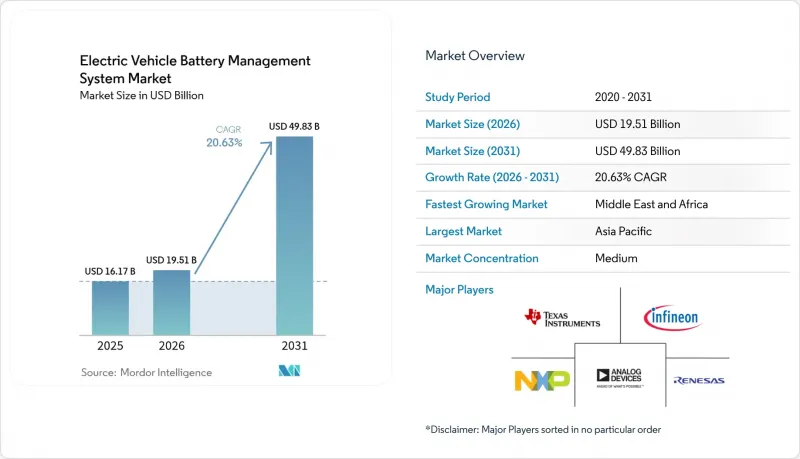
本報告按組件(例如積體電路)、電池化學成分(例如鋰離子電池)、拓撲結構(例如集中式)、通訊技術(例如有線CAN)、驅動系統(例如電池式電動車)、車輛類型(如乘用車)、銷售管道和地區進行細分。市場預測以美元計價。
全球電動汽車電池管理系統市場趨勢與洞察
全球電動車產量快速成長
2024年前五個月,全球電動車電池消耗量達到285.4吉瓦時(GWh),較去年同期成長23%。這一激增迫使製造商採用模組化電池管理系統(BMS)架構,以便透過單一設計相容於多種汽車平臺。隨著電池組電壓轉向800伏特甚至1200伏特轉變,BMS供應商必須提升監控精度、最佳化熱模型並改進故障隔離邏輯。通用汽車(GM)已在其Ultium平台上採用無線BMS,以實現電池組的標準化並省去繁重的線束。為了跟上不斷提升的產能,自動化BMS測試設備正在取代人工檢驗,供應商也在整合雲端儀錶板,以便車隊營運商能夠遠端查看電池單元層級的數據。
鋰離子電池成本更低、能量密度更高
電池組價格迅速下降,使得人工智慧晶片、雲端調變解調器和高精度電流感測器等組件的價格進入了主流電動車的範疇。隨著能量密度從250-300 Wh/kg提升至400-500 Wh/kg,更多的熱量被壓縮到更小的體積內,這要求電池管理系統(BMS)韌體在亞毫秒的時限內做出反應,以避免熱失控。寧德時代(CATL)的500 Wh/kg高密度電芯凸顯了對荷電狀態(SOC)和即時健康狀態(SOH)預測精度達到±1%的必要性。電芯成本的降低使得供應商能夠將更多資金投入先進的微控制器研發中,從而整合片上神經網路,以學習真實運作環境下的劣化模式。
半導體短缺導致BMS IC的前置作業時間延長。
汽車級模擬前端和碳化矽柵極驅動器的前置作業時間仍超過52週。供應商正在重新設計基板,以更大尺寸的晶片取代稀缺的晶片,但這些改變引發了新的檢驗週期。大型一級供應商利用批量訂單合約進行供貨,而小型公司則被迫等待,這推動了行業整合。這種供不應求也影響了電池管理系統市場的定價結構,因為原始設備製造商(OEM)持有緩衝庫存,佔用了營運資金。雖然由於晶圓代工廠長期增加資本投資,預計這種壓力將在2026年下半年有所緩解,但對於在動力傳動系統電子產品領域佔據主導地位的舊28奈米製程節點而言,仍存在不確定性。
細分市場分析
到2025年,積體電路(IC)將佔銷售額的35.62%,充分體現了晶片價值的顯著提升。高精度類比前端、帶有人工智慧加速器的微控制器以及射頻收發器如今都整合在同一晶片上,從而有效縮小了基板面積並降低了成本。無線通訊IC的複合年成長率(CAGR)高達21.05%,推動了模組化封裝和輕量化線束的發展,並且擴大採用,因為OEM廠商會在每個車型週期中推出多個電池平台。
整合類比訊號擷取、無線網路和加密模組的系統晶片(SoC) 設計能夠實現更小的基板和更快的認證流程。更高的整合度提高了可靠性,而生產線上的自動化校準則縮短了產品生命週期結束 (EOL) 的時間。供應商透過將這些晶片與符合 ISO 26262 標準的韌體庫結合,縮短了一級供應商的開發週期。同時,外部電量計 IC 整合了 24 位元類比數位轉換器 (ADC),能夠將充電狀態 (SOC) 誤差控制在 ±1% 以內,這對於從 250 Wh/kg 過渡到 500 Wh/kg 的電池組至關重要。因此,組件創新持續推動電池管理系統市場的發展。
到2025年,鋰離子電池將佔據87.35%的市場佔有率,幾乎涵蓋所有電動車項目。其成熟的供應鏈、已知的老化特性以及不斷下降的成本鞏固了其市場地位。然而,固態電池技術預計到2031年將以21.18%的複合年成長率成長,有望實現更高的體積能量密度和本質安全性。鎳基電池組在低溫性能至關重要的工業牽引應用中仍然具有重要意義,而鉛酸電池在某些平台上仍支援12V輔助電源。液流電池主要用於固定式儲能系統,但其模組化的電池結構允許重複使用汽車電池管理系統(BMS)邏輯,使供應商能夠重新設計並拓展電池管理系統行業的業務機會。
隨著化學成分的變化,感測需求也隨之改變。固態固態電池無需檢測液態電解,但其對電池堆壓力和介面缺陷的敏感度增加,這意味著下一代電池管理系統(BMS)需要整合壓力感測器和聲波感測器。鋰離子電池模組越來越依賴基於機器學習的均衡演算法來延長循環壽命。擁有電化學專業知識的供應商透過最佳化韌體以匹配每種正極材料的成分,從而獲得了設計上的廣泛認可。在對成本敏感的細分市場中,從NMC到LFP的轉變也導致了電壓範圍的變化,這就要求在基板採用16位元微控制器,以便在不降低解析度的情況下處理更寬的ADC範圍。總而言之,化學成分的多樣性使電池管理系統市場保持活力,並為擁有特定領域專業知識的新進者敞開了大門。
模組化設計兼顧成本、冗餘性和易於製造性,預計到2025年將佔銷售額的42.55%。這種以模組、基板設計的方式實現了跨車型電池組配置的標準化,並簡化了現場維護。無線架構正以21.40%的複合年成長率快速成長,它大幅減少了低壓佈線,從而縮短了電池組組裝時間。這對高產能工廠而言是一項關鍵優勢。同時,對於微型出行等低能耗應用,集中式佈局仍是首選,因為基板最具成本效益。分散式拓樸結構則適用於公車、卡車和固定式儲能系統等需要在節點故障時實現平穩降級的應用場景。
模組化和無線系統的興起正在推動電池的二次利用。由於每個模組都擁有獨立的控制器,因此只需進行少量改動,即可將二手汽車電池模組整合到家用儲能系統中。此外,透過在轎車、SUV 和廂型車等車型上採用相同的模組化模具,原始設備製造商 (OEM) 也降低了資本投入。同時,整合到每個模組中的無線微閘道器支援空中下載 (OTA) 更新,從而可以進行售後餘額調整並添加新的化學成分。因此,拓樸結構的選擇不僅影響成本,還會影響長期收入,從而在電池管理系統市場創造硬體以外的價值。
區域分析
到2025年,亞太地區將佔全球銷售額的47.10%。中國電池巨頭寧德時代和比亞迪合計佔據全球電池出貨量的一半以上,支撐著從鋰原料加工到成品電池管理系統(BMS)組裝的整個供應鏈。日本和韓國提供高精度半導體和軟體工具,而印度則擁有60多家本土BMS企業,為本國摩托車品牌客製化基板。憑藉與生產連結獎勵計畫和政府對固體電池試點生產線的資助,即使該地區的電動車普及已進入成熟階段,電池管理系統市場仍在持續大規模擴張。
中東和非洲地區正以21.25%的複合年成長率(CAGR)保持全球最快的成長速度,各國正在突破傳統引擎平台的限制。加納和摩洛哥正積極推動摩托車電氣化,並結合太陽能微電網的建設,刺激了對價格適中的電池管理系統(BMS)單板產品的需求。非洲新創公司正與亞洲積體電路供應商合作,設計能夠承受崎嶇路面和高溫環境的防潮基板。政府支持的電池進口關稅下調,使組裝能夠將資金集中投入到能夠提升電池可靠性差異化的電子元件上。北美正受益於《通貨膨脹控制法案》,該法案將稅額扣抵與當地BMS元件的使用和電池採購掛鉤。美國半導體製造商的擴張,使得高價值模擬前端元件的生產更靠近原始設備製造商(OEM)工廠,從而緩解了未來的供應衝擊。加拿大的採礦業正在確立其作為低碳鎳供應商的地位,而墨西哥的組裝叢集正在吸引一級供應商前來建造配備嵌入式無線BMS的生產線。歐洲正著力推動「電池護照」計劃,該計劃將從2026年起強制實施端到端可追溯性,並積極推廣雲端連接基板的部署,將生命週期資料流傳輸至區塊鏈註冊表。兩個地區都在穩步成長,但亞太地區的規模經濟使其在電池管理系統市場中保持領先地位。
其他好處:
- Excel格式的市場預測(ME)表
- 3個月的分析師支持
目錄
第1章:引言
- 研究假設和市場定義
- 調查範圍
第2章:調查方法
第3章執行摘要
第4章 市場狀況
- 市場概覽
- 市場促進因素
- 全球電動車產量快速成長
- 鋰離子電池成本更低、能量密度更高
- 嚴格的安全法規要求採用先進的建築管理系統(BMS)。
- 政府的獎勵和減排目標正在加速電動車的普及。
- 過渡到無線電池管理系統架構,以減輕線束重量。
- 面向OEM廠商的訂閱式電池分析服務
- 市場限制因素
- 由於半導體短缺,BMS IC 的前置作業時間越來越長。
- ASIL-D功能安全合規高成本。
- 資料所有權糾紛阻礙了基於雲端的建築管理系統的普及。
- 嚴格的網路安全認證導致發布延遲。
- 價值供應鏈分析
- 技術展望
- 波特五力模型
第5章 市場規模與成長預測
- 按組件
- 積體電路
- 截止場效電晶體和驅動器
- 溫度感測器
- 燃油表/電流測量裝置
- 微控制器
- 通訊介面軟體
- 其他規則
- 電池化學成分
- 鋰離子
- 固態電池
- 鎳基
- 鉛酸
- 液流電池
- 拓樸
- 集中
- 模組化的
- 去中心化
- 無線(無電纜)
- 透過通訊技術
- 有線 CAN
- 有線以太網
- 無線射頻
- 依推進類型
- 電池式電動車(BEV)
- 混合動力電動車(HEV)
- 插電式混合動力汽車(PHEV)
- 燃料電池汽車(FCEV)
- 車輛類型
- 搭乘用車
- 輕型商用車
- 中型和重型商用車輛
- 摩托車和微型交通工具
- 非公路用車及特殊車輛
- 按銷售管道
- OEM 原廠設備
- 售後/改裝
- 按地區
- 北美洲
- 美國
- 加拿大
- 其他北美國家
- 南美洲
- 巴西
- 阿根廷
- 其他南美國家
- 歐洲
- 德國
- 英國
- 法國
- 義大利
- 西班牙
- 俄羅斯
- 其他歐洲國家
- 亞太地區
- 中國
- 印度
- 日本
- 韓國
- 澳洲和紐西蘭
- 其他亞太國家
- 中東和非洲
- 阿拉伯聯合大公國
- 沙烏地阿拉伯
- 土耳其
- 南非
- 埃及
- 其他中東和非洲國家
- 北美洲
第6章 競爭情勢
- 市場集中度
- 策略趨勢
- 市佔率分析
- 公司簡介
- Texas Instruments
- Analog Devices
- Infineon Technologies
- NXP Semiconductors
- Renesas Electronics
- Vitesco Technologies
- Visteon Corporation
- CATL
- LG Energy Solution
- BYD Co.
- Panasonic Energy
- Denso Corporation
- TE Connectivity
- Sensata Technologies
- Hitachi Astemo
第7章 市場機會與未來展望
According to Mordor Intelligence, electric vehicle battery management system market size in 2026 is estimated at USD 19.51 billion, growing from 2025 value of USD 16.17 billion with 2031 projections showing USD 49.83 billion, growing at 20.63% CAGR over 2026-2031.
This report is Segmented by Component (Integrated Circuits and More), Battery Chemistry (Lithium-Ion and More), Topology (Centralized and More), Communication Technology (Wired CAN and More), Propulsion Type (Battery Electric Vehicles and More), Vehicle Type (Passenger Car and More), Sales Channel, and Geography. The Market Forecasts are Provided in Terms of Value (USD).
Global Electric Vehicle Battery Management System Market Trends and Insights
Rapid Scale-up of Global EV Production Volumes
Global EV battery consumption hit 285.4 GWh in the first five months of 2024, a 23% year-on-year jump. This surge forces manufacturers to adopt modular battery management system market architectures so that a single design works across multiple vehicle platforms. Transitioning to 800 V and even 1,200 V packs obliges BMS vendors to upgrade monitoring precision, thermal models and fault isolation logic. General Motors adopted a wireless BMS on its Ultium platform to standardize packs while removing heavy harnesses. Automated BMS test rigs replace manual validation to meet higher production cadence, and suppliers bundle cloud dashboards so fleets can view cell-level data remotely.
Declining Lithium-ion Battery Costs and Energy-density Gains
Pack prices fell fast enough that AI chips, cloud modems and precision current sensors now fit inside mainstream EV price points. Rising energy density from 250-300 Wh/kg toward 400-500 Wh/kg compresses more heat into smaller volumes, so BMS firmware must react within sub-millisecond windows to avoid thermal runaway. CATL's 500 Wh/kg condensed cell highlights the need for +-1% state-of-charge accuracy and real-time state-of-health prediction. Lower cell costs free capex for advanced microcontrollers, giving suppliers room to integrate on-chip neural nets that learn degradation patterns in the field.
Semiconductor Shortages Inflating BMS IC Lead-times
Automotive-grade analog front ends and SiC gate drivers still face lead times beyond 52 weeks. Suppliers redesign boards to swap scarce dies for larger-geometry alternatives, yet those changes trigger fresh validation loops. Larger tier-ones leverage volume contracts while smaller firms queue, prompting industry consolidation. Scarcity spills into the battery management system market price stack because OEMs hold buffer stock that ties up working capital. Long-term capital expansion among foundries should ease pressure by late 2026, but uncertainty lingers around older 28 nm nodes that dominate powertrain electronics.
Other drivers and restraints analyzed in the detailed report include:
- Stringent Safety Regulations Mandating Advanced BMS
- Government Incentives and Emissions Targets Accelerating EV Uptake
- High Cost of ASIL-D Functional-safety Compliance
For complete list of drivers and restraints, kindly check the Table Of Contents.
Segment Analysis
Integrated circuits commanded 35.62% of 2025 revenue, signalling how much value has moved onto silicon. High-accuracy analog front ends, microcontrollers with AI accelerators and RF transceivers now live on the same die, trimming board area and cost. Wireless communication ICs record a 21.05% CAGR because they facilitate modular packs and slash harness weight, escalating adoption across OEMs that release multiple battery platforms per model cycle.
System-on-chip designs that fuse analog acquisition, wireless networking and cryptographic blocks enable smaller boards and faster certification. The density improvement lifts reliability, while automated calibration on the production line lowers end-of-line test time. Vendors pair these chips with firmware libraries for ISO 26262 compliance, reducing development cycles for tier-ones. In parallel, external fuel-gauge ICs integrate 24-bit ADCs that push state-of-charge error to +-1%, essential for packs moving from 250 Wh/kg toward 500 Wh/kg. As a result, component innovation remains the heartbeat of the battery management system market.
Lithium-ion held 87.35% share in 2025, underpinning almost every EV program. Its mature supply base, known ageing profile and falling cost curve keep it entrenched. Solid-state technologies, however, post a 21.18% CAGR to 2031 because they promise higher volumetric energy and intrinsic safety. Nickel-based packs survive in industrial traction where low-temperature performance matters, while lead-acid still backs 12 V auxiliaries on some platforms. Flow batteries appear mainly in stationary storage, but the modular nature of their cells invites reuse of automotive BMS logic, letting vendors repurpose designs and widen their serviceable opportunities inside the battery management system industry.
Chemistry shifts alter sensing requirements. Solid-state eliminates liquid electrolyte checks yet raises sensitivity to stack pressure and interface defects, so next-generation BMS integrates pressure and acoustic sensors. Lithium-ion modules increasingly rely on machine-learning balance algorithms that extend cycle life. Suppliers with electrochemistry know-how win design-in because they tune firmware to each cathode composition. The pivot from NMC to LFP in cost-sensitive segments also changes voltage windows, pushing boards to adopt 16-bit micro-controllers that handle wider ADC ranges without losing resolution. All told, chemistry diversity keeps the battery management system market vibrant and open to newcomers with niche expertise.
Modular designs secured 42.55% of 2025 revenue because they balance cost, redundancy and ease of manufacturing. Their board-per-module approach standardizes pack construction across vehicle classes and simplifies field service. Wireless architectures, rising at 21.40% CAGR, remove most low-voltage wiring and reduce pack build times, a decisive benefit for high-throughput plants. Centralized layouts still appeal for low-energy applications such as micro-mobility, where a single board is cheapest. Distributed topologies serve buses, trucks and stationary storage that need graceful degradation if any node fails.
The shift toward modular and wireless schemes supports second-life repurposing. Decommissioned automotive modules can slot into home storage systems with minimal rework because each module carries its own controller. OEMs also leverage the same modular tooling across sedans, SUVs and vans, cutting capital expenditure. In parallel, wireless pico-gateways inside each module enable over-the-air updates that fine-tune balancing or add new chemistries after sale. As a result, topology choice shapes not just cost but long-run revenue streams, embedding value beyond hardware in the battery management system market.
Complete Report Scope:
- By Component
- Integrated Circuits
- Cut-off FETs and Drivers
- Temperature Sensors
- Fuel-Gauge/Current-Measurement Devices
- Microcontrollers
- Communication Interface ICs
- Other Components
- By Battery Chemistry
- Lithium-ion
- Solid-state
- Nickel-based
- Lead-acid
- Flow Batteries
- By Topology
- Centralized
- Modular
- Distributed
- Wireless (Cable-less)
- By Communication Technology
- Wired CAN
- Wired Ethernet
- Wireless RF
- By Propulsion Type
- Battery Electric Vehicles (BEV)
- Hybrid Electric Vehicles (HEV)
- Plug-in Hybrid Vehicles (PHEV)
- Fuel-Cell Electric Vehicles (FCEV)
- By Vehicle Type
- Passenger Cars
- Light Commercial Vehicles
- Medium and Heavy Commercial Vehicles
- Two-Wheelers and Micro-mobility
- Off-highway and Specialty Vehicles
- By Sales Channel
- OEM-fitted
- Aftermarket/Retrofit
- By Geography
- North America
- United States
- Canada
- Rest of North America
- South America
- Brazil
- Argentina
- Rest of South America
- Europe
- Germany
- United Kingdom
- France
- Italy
- Spain
- Russia
- Rest of Europe
- Asia-Pacific
- China
- India
- Japan
- South Korea
- Australia and New Zealand
- Rest of Asia-Pacific
- Middle East and Africa
- United Arab Emirates
- Saudi Arabia
- Turkey
- South Africa
- Egypt
- Rest of Middle East and Africa
- North America
Geography Analysis
Asia-Pacific retained 47.10% revenue in 2025. China's cell giants CATL and BYD jointly shipped more than half of global batteries, anchoring a supply chain that extends from raw lithium processing to finished BMS assembly. Japan and South Korea supply precision semiconductors and software tools, while India hosts more than 60 local BMS firms that tailor boards to indigenous two-wheeler brands. Government funding through production-linked incentives and solid-state pilot lines keeps the battery management system market expanding at scale even as EV adoption in the region matures.
The Middle East and Africa post 21.25% CAGR, the fastest worldwide, because countries leapfrog traditional engine platforms. Ghana and Morocco promote two-wheeler electrification tied to solar micro-grids, spurring demand for affordable BMS single-board products. African start-ups collaborate with Asian IC vendors to design humidity-tolerant boards that handle rough roads and high ambient heat. Agency support lowers import duties on cell imports, so assemblers can focus capital on electronics that differentiate reliability. North America benefits from the Inflation Reduction Act, which links tax credits to local BMS content and cell sourcing. Chip-maker expansion in the United States pulls high-value analog front-end production closer to OEM plants, mitigating future supply shocks. Canada's mining sector positions itself as a low-carbon nickel supplier, and Mexico's assembly clusters attract tier-ones building pack lines with embedded wireless BMS. Europe concentrates on battery passports that require end-to-end traceability from 2026, pushing cloud-connected boards that stream life-cycle data into blockchain registries. Both regions grow steadily, yet Asia-Pacific scale advantages preserve its lead in the battery management system market.
- Texas Instruments
- Analog Devices
- Infineon Technologies
- NXP Semiconductors
- Renesas Electronics
- Vitesco Technologies
- Visteon Corporation
- CATL
- LG Energy Solution
- BYD Co.
- Panasonic Energy
- Denso Corporation
- TE Connectivity
- Sensata Technologies
- Hitachi Astemo
Additional Benefits:
- The market estimate (ME) sheet in Excel format
- 3 months of analyst support
TABLE OF CONTENTS
1 Introduction
- 1.1 Study Assumptions and Market Definition
- 1.2 Scope of the Study
2 Research Methodology
3 Executive Summary
4 Market Landscape
- 4.1 Market Overview
- 4.2 Market Drivers
- 4.2.1 Rapid Scale-up of Global EV Production Volumes
- 4.2.2 Declining Lithium-ion Battery Costs and Energy-density G\ains
- 4.2.3 Stringent Safety Regulations Mandating Advanced BMS
- 4.2.4 Government Incentives and Emissions Targets Accelerating EV Uptake
- 4.2.5 Shift Toward Wireless BMS Architectures to Cut Harness Weight
- 4.2.6 OEM Subscription-based Battery Analytics Services
- 4.3 Market Restraints
- 4.3.1 Semiconductor Shortages Inflating BMS IC Lead-times
- 4.3.2 High Cost of ASIL-D Functional-safety Compliance
- 4.3.3 Data-ownership Disputes Hindering Cloud-BMS Roll-outs
- 4.3.4 Stringent Cyber-security Certification Delaying Launches
- 4.4 Value/Supply-Chain Analysis
- 4.5 Technological Outlook
- 4.6 Porter's Five Forces
- 4.6.1 Bargaining Power of Suppliers
- 4.6.2 Bargaining Power of Consumers
- 4.6.3 Threat of New Entrants
- 4.6.4 Threat of Substitute Products
- 4.6.5 Intensity of Competitive Rivalry
5 Market Size and Growth Forecasts (Value (USD))
- 5.1 By Component
- 5.1.1 Integrated Circuits
- 5.1.2 Cut-off FETs and Drivers
- 5.1.3 Temperature Sensors
- 5.1.4 Fuel-Gauge/Current-Measurement Devices
- 5.1.5 Microcontrollers
- 5.1.6 Communication Interface ICs
- 5.1.7 Other Components
- 5.2 By Battery Chemistry
- 5.2.1 Lithium-ion
- 5.2.2 Solid-state
- 5.2.3 Nickel-based
- 5.2.4 Lead-acid
- 5.2.5 Flow Batteries
- 5.3 By Topology
- 5.3.1 Centralized
- 5.3.2 Modular
- 5.3.3 Distributed
- 5.3.4 Wireless (Cable-less)
- 5.4 By Communication Technology
- 5.4.1 Wired CAN
- 5.4.2 Wired Ethernet
- 5.4.3 Wireless RF
- 5.5 By Propulsion Type
- 5.5.1 Battery Electric Vehicles (BEV)
- 5.5.2 Hybrid Electric Vehicles (HEV)
- 5.5.3 Plug-in Hybrid Vehicles (PHEV)
- 5.5.4 Fuel-Cell Electric Vehicles (FCEV)
- 5.6 By Vehicle Type
- 5.6.1 Passenger Cars
- 5.6.2 Light Commercial Vehicles
- 5.6.3 Medium and Heavy Commercial Vehicles
- 5.6.4 Two-Wheelers and Micro-mobility
- 5.6.5 Off-highway and Specialty Vehicles
- 5.7 By Sales Channel
- 5.7.1 OEM-fitted
- 5.7.2 Aftermarket/Retrofit
- 5.8 By Geography
- 5.8.1 North America
- 5.8.1.1 United States
- 5.8.1.2 Canada
- 5.8.1.3 Rest of North America
- 5.8.2 South America
- 5.8.2.1 Brazil
- 5.8.2.2 Argentina
- 5.8.2.3 Rest of South America
- 5.8.3 Europe
- 5.8.3.1 Germany
- 5.8.3.2 United Kingdom
- 5.8.3.3 France
- 5.8.3.4 Italy
- 5.8.3.5 Spain
- 5.8.3.6 Russia
- 5.8.3.7 Rest of Europe
- 5.8.4 Asia-Pacific
- 5.8.4.1 China
- 5.8.4.2 India
- 5.8.4.3 Japan
- 5.8.4.4 South Korea
- 5.8.4.5 Australia and New Zealand
- 5.8.4.6 Rest of Asia-Pacific
- 5.8.5 Middle East and Africa
- 5.8.5.1 United Arab Emirates
- 5.8.5.2 Saudi Arabia
- 5.8.5.3 Turkey
- 5.8.5.4 South Africa
- 5.8.5.5 Egypt
- 5.8.5.6 Rest of Middle East and Africa
- 5.8.1 North America
6 Competitive Landscape
- 6.1 Market Concentration
- 6.2 Strategic Moves
- 6.3 Market Share Analysis
- 6.4 Company Profiles (Includes Global Level Overview, Market Level Overview, Core Segments, Financials as Available, Strategic Information, Market Rank/Share for Key Companies, Products and Services, SWOT Analysis, and Recent Developments)
- 6.4.1 Texas Instruments
- 6.4.2 Analog Devices
- 6.4.3 Infineon Technologies
- 6.4.4 NXP Semiconductors
- 6.4.5 Renesas Electronics
- 6.4.6 Vitesco Technologies
- 6.4.7 Visteon Corporation
- 6.4.8 CATL
- 6.4.9 LG Energy Solution
- 6.4.10 BYD Co.
- 6.4.11 Panasonic Energy
- 6.4.12 Denso Corporation
- 6.4.13 TE Connectivity
- 6.4.14 Sensata Technologies
- 6.4.15 Hitachi Astemo
7 Market Opportunities and Future Outlook
- 7.1 White-space and Unmet-Need Assessment

 歐洲電動車電池管理系統:市場佔有率分析、產業趨勢與統計及成長預測(2026-2031 年)
 電動車電池管理系統市場-2026-2032年全球市場預測
 2026年全球電池保固分析市場報告
 電動車電池管理系統市場預測至2034年:按電池類型、拓撲結構、組件、功能、應用、銷售管道和地區分類的全球分析
 電動車電池管理系統市場:分析與預測(至2035年)-類型、產品類型、技術、組件、應用、最終用戶、功能、安裝方式、解決方案2026年全球電動車(EV)工廠電池物流監控市場報告2026年全球電動車電池管理系統市場報告
 2026-2034年全球電動車電池管理系統市場規模、佔有率、趨勢和成長分析報告電動汽車電池管理系統市場規模、佔有率、成長及全球產業分析:依類型、應用和地區劃分的洞察與預測(2026-2034)全球電池性能保障市場報告(2026 年)