


 |
市場調查報告書
商品編碼
2122979
歐洲電動車電池管理系統:市場佔有率分析、產業趨勢與統計及成長預測(2026-2031 年)Europe Electric Vehicle Battery Management System - Market Share Analysis, Industry Trends & Statistics, Growth Forecasts (2026 - 2031) |
||||||

※ 本網頁內容可能與最新版本有所差異。詳細情況請與我們聯繫。
據 Mordor Intelligence 稱,2025 年歐洲電動車電池管理系統市值為 44.8 億美元,預計到 2031 年將達到 214.9 億美元,而 2026 年為 58.2 億美元,預測期(2026-2031 年)的複合年成長率為 29.86%。
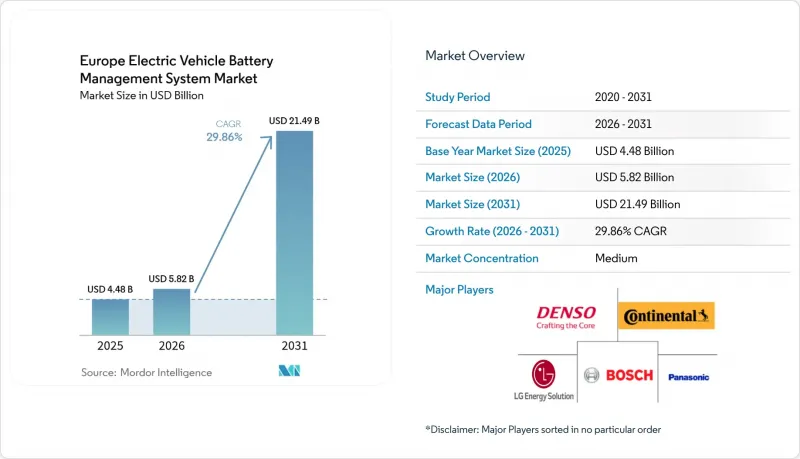
本報告按動力系統(插電式混合動力汽車和電池式電動車)、車輛類型(乘用車、商用車等)、電池化學成分(鋰離子電池、固態固態電池等)、拓撲結構(集中式、分散式等)和國家進行細分。市場預測以美元計價。
歐洲電動汽車電池管理系統市場趨勢與洞察。
2035年電動車二氧化碳排放法規
歐盟規定,到2035年,所有銷售的車輛必須為零排放車輛,並對二氧化碳排放量超標的汽車製造商處以每克95歐元的罰款。這一不可逆轉的因素推動了對先進電池管理系統(BMS)解決方案的需求。該法規結構迫使製造商加快電池式電動車(BEV)的生產,使其市場滲透率超過目前的13.5%,並要求年成長率達到14%。這就需要先進的電池管理能力來適應更大容量和更高能量密度的電池組。作為該法規的衍生影響,保險公司現在強制要求實施全面的電池監控系統,這為能夠證明其具備預測性故障檢測能力並能降低保固成本的BMS供應商創造了新的收入來源。豪華汽車製造商正在積極回應,大力投資800V架構,這需要更先進的溫度控管和電池平衡演算法,而擁有先進電力電子技術的BMS供應商將直接受益。由於監管合規時間表造成了供應鏈瓶頸,而 BMS 認證是一條關鍵路徑,因此已獲得 ISO 26262 功能安全認證的現有公司比新參與企業俱有顯著的競爭優勢。
OEM廠商快速過渡到800V架構
汽車產業向800V電氣架構的轉型代表著一次根本性的變革,這需要全新的電池管理系統(BMS)設計,以應對更高的電壓差和更複雜的熱動力學。 BMW與Rimac Technology合作開發下一代電池組,沃爾沃與Vitesco Technologies合作,都表明豪華汽車製造商正在優先考慮快速充電功能,而這需要先進的電壓監控和電池均衡演算法。對於缺乏高壓技術專長的BMS供應商而言,這種架構轉型構成了巨大的進入門檻,因為在800V工作電壓下,ISO 26262認證的要求變得異常複雜。雖然這種轉型能夠實現10分鐘內充電200英里(約320公里)的續航里程,但它也為電池單元帶來了極端的熱應力,而傳統的BMS設計無法有效應對,這迫使供應商整合先進的冷卻演算法和預測性熱模型。歐洲汽車製造商正利用這項轉型來區別於主要使用400V系統的中國競爭對手,並創造暫時的技術優勢,使擁有先進電力電子技術的本土BMS供應商受益。
收緊半導體供應鏈
全球半導體短缺持續限制電池管理系統(BMS)的產能,車規級晶片的前置作業時間超過26週,導致歐洲電動車生產計畫出現連鎖延誤。對於需要專用電源管理IC和微控制器的先進BMS設計而言,這種限制尤為顯著,這些晶片能夠處理800V架構和複雜的散熱演算法。歐洲BMS供應商面臨更大的壓力,因為他們需要與消費性電子產品製造商爭奪有限的晶片配額。由於BMS的產量承諾低於智慧型手機和運算應用,其優先順序往往較低。這種短缺迫使製造商重新設計BMS架構以適應現有元件,這可能會影響效能最佳化,並將開發週期延長12-18個月。供應鏈的韌性是關鍵的競爭因素,企業需要維持策略庫存緩衝,並與替代供應商建立合作關係,以確保生產的連續性。這種制約為歐洲半導體製造商提供了一個從亞洲供應商手中奪取市場佔有率的機會。然而,這需要大量的資本投入和兩到三年的開發週期,可能無法滿足當前的供應需求。
細分市場分析
預計到2025年,電池式電動車(BEV)將佔據71.83%的市場佔有率,並預計在2031年之前以31.10%的複合年成長率成長。這反映出市場正發生決定性的轉變,轉向純電動動力傳動系統,汽車製造商為了優先簡化平台而放棄混合動力策略。純電動車的主導地位源自於歐盟二氧化碳排放法規的壓力,以及消費者對簡化用車體驗、避免插電式混合動力車複雜續航里程問題的偏好。插電式混合動力汽車在營運柔軟性仍然重要的商業應用中保持著其重要性。然而,隨著製造商將研發資源重新分配給具有更優規模經濟效益的純電動車平台,對插電式混合動力車領域的投資正在下降。該領域的趨勢凸顯了一個關鍵的轉折點,即電池管理系統(BMS)的要求會因動力系統的不同而顯著差異。純電動車需要先進的溫度控管來容納大型電池組,而插電式混合動力車則需要複雜的功率分配演算法來協調雙動力傳動系統的運作。
面向純電動車 (BEV) 的先進電池管理系統 (BMS) 架構正擴大採用機器學習演算法進行預測性熱建模。 LG Energy Solutions 的「B.around」平台分析超過 13 萬個電池單元的數據,以最佳化充電曲線並延長電池組壽命。這種技術上的複雜性為缺乏軟體專業知識的傳統汽車零件供應商設定了准入門檻,使得像 Munich Electrification 這樣的新興參與企業能夠透過為高達 1500V 的能源儲存系統提供專用 BMS 解決方案來搶佔市場佔有率。按動力系統分類的細分市場日益反映出整個產業圍繞純電動車平台的整合趨勢,迫使 BMS 供應商在適應不斷萎縮的插電式混合動力車 (PHEV) 市場或大力投資下一代純電動車技術之間做出選擇。
到2025年,乘用車將佔車輛類型需求的67.12%。同時,受城市物流轉型和歐洲城市共享出行平台擴張的推動,摩托車和微出行領域預計到2031年將呈現31.25%的顯著複合年成長率。商用車佔據著戰略性的中間位置,由於電池管理系統(BMS)要求優先考慮耐久性和預測性維護而非性能最佳化,因此能夠展現具有競爭力的總擁有成本(TCO)的供應商將迎來商機。微出行的激增反映了城市交通模式的根本性轉變,在共享車輛應用中,車輛使用週期短,且暴露於各種環境條件下,因此需要輕量化的BMS設計來平衡成本限制和安全要求。
車隊營運商對先進的電池分析技術的需求日益成長,以實現預測性維護和營運最佳化。這推動了雲端連接電池管理系統 (BMS) 解決方案的普及,此類解決方案能夠匯總整個車隊的性能數據,並在新的故障模式影響服務可用性之前識別它們。戴姆勒卡車與波蘭聯邦經濟合作暨發展部 (BMZ Poland) 在電池系統方面的合作清楚地表明,商用車製造商優先考慮能夠提供全面生命週期管理的 BMS 供應商,而不是獨立的硬體解決方案。按車輛類型分類,技術要求也存在差異。乘用車 BMS 著重於性能和使用者體驗,而商用車系統則優先考慮可靠性和成本效益。同時,微出行應用需要超緊湊的設計以及無線連接功能,以便與車隊管理系統整合。
其他好處:
- Excel格式的市場預測(ME)表
- 3個月的分析師支持
目錄
第1章:引言
- 研究假設和市場定義
- 調查範圍
第2章:調查方法
第3章執行摘要
第4章 市場狀況
- 市場概覽
- 市場促進因素
- 專門針對電動車的二氧化碳排放法規,目標到2035年。
- OEM廠商快速過渡到800V架構
- 中歐超級工廠的建設正在蓬勃發展。
- 透過空中下載 (OTA) 方式更新電池管理系統 (BMS) 並採取網路安全措施
- 保險公司必須採用電池溯源平台
- 歐盟電池護照示範計畫(基於CSRD)
- 市場限制因素
- 收緊半導體供應鏈
- 高壓電池管理系統認證的瓶頸
- 過熱導致的產品召回損害了消費者信心。
- 功能安全工程師短缺
- 價值供應鏈分析
- 監理情勢
- 技術展望
- 波特五力模型
第5章 市場規模與成長預測
- 依推進類型
- 插電式混合動力車(PHEV)
- 電池式電動車(BEV)
- 車輛類型
- 搭乘用車
- 商用車輛
- 摩托車和微型交通工具
- 電池化學成分
- 鋰離子
- 總固體(商業化前)
- 其他化學成分
- 拓樸
- 集中
- 去中心化
- 模組化的
- 國家
- 德國
- 英國
- 法國
- 義大利
- 挪威
- 荷蘭
- 瑞典
- 其他歐洲國家
第6章 競爭情勢
- 市場集中度
- 策略趨勢
- 市佔率分析
- 公司簡介
- Robert Bosch GmbH
- Denso Corporation
- LG Energy Solution
- Panasonic Holdings Corp.
- Marelli
- Continental AG
- Hitachi Astemo
- Mitsubishi Electric Corp.
- Lithium Balance
- Preh GmbH
- NXP Semiconductors
- Renesas Electronics
- Analog Devices Inc.
- Texas Instruments
- Infineon Technologies
- Sensata Technologies
- Johnson Matthey Battery Systems
- CATL(Europe)
- BYD Europe
- Rimac Technology
第7章 市場機會與未來展望
According to Mordor Intelligence, the Europe electric vehicle battery management system market size was valued at USD 4.48 billion in 2025 and estimated to grow from USD 5.82 billion in 2026 to reach USD 21.49 billion by 2031, at a CAGR of 29.86% during the forecast period (2026-2031).
This report is Segmented by Propulsion Type (Plug-In Hybrid Electric Vehicle and Battery Electric Vehicle), Vehicle Type (Passenger Cars, Commercial Vehicles, and More), Battery Chemistry (Lithium-Ion, Solid-State, and More), Topology (Centralized, Distributed, and More), and Country. The Market Forecasts are Provided in Terms of Value (USD).
Europe Electric Vehicle Battery Management System Market Trends and Insights
EV-only CO2-fleet Rules for 2035
The European Union's mandate requiring 100% zero-emission vehicle sales by 2035 creates an irreversible demand catalyst for sophisticated BMS solutions, as automakers face EUR 95 per gram penalties for exceeding CO2 thresholds. This regulatory framework forces manufacturers to accelerate BEV production beyond the current 13.5% market penetration, requiring a 14% annual growth rate that necessitates advanced battery management capabilities for larger pack sizes and higher energy densities. The regulation's secondary effect drives insurance companies to mandate comprehensive battery monitoring systems, creating additional revenue streams for BMS providers who can demonstrate predictive failure detection and warranty cost reduction. Premium automakers are responding by investing heavily in 800V architectures that require more sophisticated thermal management and cell balancing algorithms, directly benefiting BMS suppliers with advanced power electronics expertise. The compliance timeline creates a supply chain bottleneck where BMS certification becomes the critical path item, giving established players with ISO 26262 functional safety credentials significant competitive advantages over new entrants.
Rapid OEM Shift to 800-V Architectures
The automotive industry's migration to 800V electrical architectures represents a fundamental shift that demands entirely new BMS designs capable of managing higher voltage differentials and more complex thermal dynamics. BMW's partnership with Rimac Technology for next-generation battery packs and Volvo's collaboration with Vitesco Technologies demonstrate how premium manufacturers prioritize fast-charging capabilities requiring sophisticated voltage monitoring and cell balancing algorithms. This architectural transition creates significant barriers to entry for BMS suppliers lacking high-voltage expertise, as certification requirements under ISO 26262 become exponentially more complex at 800V operating levels. The shift enables 10-minute charging sessions for 200-mile range, but places extreme thermal stress on battery cells that traditional BMS designs cannot adequately manage, forcing suppliers to integrate advanced cooling algorithms and predictive thermal modeling. European automakers are leveraging this transition to differentiate from Chinese competitors who predominantly use 400V systems, creating a temporary technological moat that benefits local BMS suppliers with advanced power electronics capabilities.
Semiconductor Supply-chain Squeezes
The global semiconductor shortage continues to constrain BMS production capacity, with automotive-grade chips experiencing lead times exceeding 26 weeks and creating cascading delays across European EV manufacturing schedules. This constraint particularly impacts advanced BMS designs that require specialized power management ICs and microcontrollers capable of handling 800V architecture and complex thermal algorithms. European BMS suppliers face additional pressure as they compete with consumer electronics manufacturers for limited chip allocation, often losing priority due to lower volume commitments than smartphone and computing applications. The shortage forces manufacturers to redesign BMS architecture around available components, potentially compromising performance optimization and extending development cycles by 12-18 months. Supply chain resilience becomes a critical competitive factor, with companies maintaining strategic inventory buffers and developing alternative sourcing relationships to ensure production continuity. The constraint creates opportunities for European semiconductor manufacturers to capture market share from Asian suppliers. Still, it requires significant capital investment and 2-3 year development timelines that may not address immediate supply needs.
Other drivers and restraints analyzed in the detailed report include:
- Surging Gigafactory Build-out in Central Europe
- Cyber-secure Over-the-air (OTA) BMS Updates
- High-voltage BMS Certification Bottlenecks
For complete list of drivers and restraints, kindly check the Table Of Contents.
Segment Analysis
Battery Electric Vehicles command a 71.83% market share in 2025 and lead growth projections at 31.10% CAGR through 2031, reflecting the market's decisive shift toward pure electric powertrains as automakers abandon hybrid strategies in favor of platform simplification. The BEV segment's dominance stems from regulatory pressure under EU CO2 fleet rules and consumer preference for simplified ownership experiences without range anxiety associated with plug-in hybrid complexity. Plug-in Hybrid Electric Vehicles (PHEVs) maintain relevance in commercial applications where operational flexibility remains critical. Still, face declining investment as manufacturers reallocate R&D resources toward BEV platforms that offer superior economies of scale. The segment dynamics reveal a critical inflection point where BMS requirements diverge significantly between propulsion types, with BEVs demanding sophisticated thermal management for larger battery packs. At the same time, PHEVs require complex power arbitration algorithms for dual-powertrain coordination.
Advanced BMS architectures for BEVs increasingly incorporate machine learning algorithms for predictive thermal modeling. LG Energy Solution's B.around platform analyzes data from over 130,000 battery cells to optimize charging profiles and extend pack life. This technological sophistication creates barriers to entry for traditional automotive suppliers lacking software expertise, enabling new entrants like Munich Electrification to capture market share through specialized BMS solutions for energy storage systems up to 1500V. The propulsion type segmentation increasingly reflects broader industry consolidation around BEV platforms, with implications for BMS suppliers who must choose between serving declining PHEV markets or investing heavily in next-generation BEV technologies.
Passenger cars represent 67.12% of vehicle type demand in 2025. Still, the two-wheeler and micro-mobility segment exhibits a remarkable 31.25% CAGR growth through 2031, driven by urban logistics transformation and shared mobility platform expansion across European cities. Commercial vehicles occupy a strategic middle ground where BMS requirements emphasize durability and predictive maintenance over performance optimization, creating opportunities for suppliers who can demonstrate total cost of ownership advantages. The micro-mobility surge reflects fundamental changes in urban transportation patterns, where lightweight BMS designs must balance cost constraints with safety requirements for shared vehicle applications that experience intensive usage cycles and varied environmental conditions.
Fleet operators increasingly demand sophisticated battery analytics for predictive maintenance and operational optimization, driving the adoption of cloud-connected BMS solutions that aggregate performance data across vehicle populations and identify emerging failure patterns before they impact service availability. Daimler Truck's partnership with BMZ Poland for battery systems exemplifies how commercial vehicle manufacturers prioritize BMS suppliers who can provide comprehensive lifecycle management rather than standalone hardware solutions. The vehicle type segmentation reveals diverging technology requirements, where passenger car BMS focuses on performance and user experience while commercial vehicle systems emphasize reliability and cost efficiency. At the same time, micro-mobility applications demand ultra-compact designs with wireless connectivity for fleet management integration.
Complete Report Scope:
- By Propulsion Type
- Plug-in Hybrid Electric Vehicle (PHEV)
- Battery Electric Vehicle (BEV)
- By Vehicle Type
- Passenger Cars
- Commercial Vehicles
- Two-Wheeler and Micro-mobility
- By Battery Chemistry
- Lithium-ion
- Solid-state (pre-commercial)
- Other Chemistries
- By Topology
- Centralized
- Distributed
- Modular
- By Country
- Germany
- United Kingdom
- France
- Italy
- Norway
- Netherlands
- Sweden
- Rest of Europe
List of Companies Covered in this Report:
- Robert Bosch GmbH
- Denso Corporation
- LG Energy Solution
- Panasonic Holdings Corp.
- Marelli
- Continental AG
- Hitachi Astemo
- Mitsubishi Electric Corp.
- Lithium Balance
- Preh GmbH
- NXP Semiconductors
- Renesas Electronics
- Analog Devices Inc.
- Texas Instruments
- Infineon Technologies
- Sensata Technologies
- Johnson Matthey Battery Systems
- CATL (Europe)
- BYD Europe
- Rimac Technology
Additional Benefits:
- The market estimate (ME) sheet in Excel format
- 3 months of analyst support
TABLE OF CONTENTS
1 Introduction
- 1.1 Study Assumptions and Market Definition
- 1.2 Scope of the Study
2 Research Methodology
3 Executive Summary
4 Market Landscape
- 4.1 Market Overview
- 4.2 Market Drivers
- 4.2.1 EV-only CO2-fleet rules for 2035
- 4.2.2 Rapid OEM shift to 800-V architectures
- 4.2.3 Surging gigafactory build-out in Central Europe
- 4.2.4 Cyber-secure over-the-air (OTA) BMS updates
- 4.2.5 Insurance-mandated battery traceability platforms
- 4.2.6 EU battery passport pilots (under CSRD)
- 4.3 Market Restraints
- 4.3.1 Semiconductor supply-chain squeezes
- 4.3.2 High-voltage BMS certification bottlenecks
- 4.3.3 Thermal-runaway recalls hurting consumer trust
- 4.3.4 Scarcity of functional-safety engineers
- 4.4 Value / Supply-Chain Analysis
- 4.5 Regulatory Landscape
- 4.6 Technological Outlook
- 4.7 Porter's Five Forces
- 4.7.1 Threat of New Entrants
- 4.7.2 Bargaining Power of Buyers
- 4.7.3 Bargaining Power of Suppliers
- 4.7.4 Threat of Substitutes
- 4.7.5 Intensity of Rivalry
5 Market Size and Growth Forecasts (Value (USD))
- 5.1 By Propulsion Type
- 5.1.1 Plug-in Hybrid Electric Vehicle (PHEV)
- 5.1.2 Battery Electric Vehicle (BEV)
- 5.2 By Vehicle Type
- 5.2.1 Passenger Cars
- 5.2.2 Commercial Vehicles
- 5.2.3 Two-Wheeler and Micro-mobility
- 5.3 By Battery Chemistry
- 5.3.1 Lithium-ion
- 5.3.2 Solid-state (pre-commercial)
- 5.3.3 Other Chemistries
- 5.4 By Topology
- 5.4.1 Centralized
- 5.4.2 Distributed
- 5.4.3 Modular
- 5.5 By Country
- 5.5.1 Germany
- 5.5.2 United Kingdom
- 5.5.3 France
- 5.5.4 Italy
- 5.5.5 Norway
- 5.5.6 Netherlands
- 5.5.7 Sweden
- 5.5.8 Rest of Europe
6 Competitive Landscape
- 6.1 Market Concentration
- 6.2 Strategic Moves
- 6.3 Market Share Analysis
- 6.4 Company Profiles (includes Global level Overview, Market level overview, Core Segments, Financials as available, Strategic Information, Market Rank/Share, Products and Services, Recent Developments)
- 6.4.1 Robert Bosch GmbH
- 6.4.2 Denso Corporation
- 6.4.3 LG Energy Solution
- 6.4.4 Panasonic Holdings Corp.
- 6.4.5 Marelli
- 6.4.6 Continental AG
- 6.4.7 Hitachi Astemo
- 6.4.8 Mitsubishi Electric Corp.
- 6.4.9 Lithium Balance
- 6.4.10 Preh GmbH
- 6.4.11 NXP Semiconductors
- 6.4.12 Renesas Electronics
- 6.4.13 Analog Devices Inc.
- 6.4.14 Texas Instruments
- 6.4.15 Infineon Technologies
- 6.4.16 Sensata Technologies
- 6.4.17 Johnson Matthey Battery Systems
- 6.4.18 CATL (Europe)
- 6.4.19 BYD Europe
- 6.4.20 Rimac Technology
7 Market Opportunities and Future Outlook
- 7.1 White-space and Unmet-Need Assessment

 電動自行車電池管理系統市場:全球市場預測,2026-2032年
 汽車能源管理市場預測至2034年-按組件、車輛動力系統和車輛類型分類的全球分析
 電動汽車電池管理系統:市場佔有率分析、產業趨勢與統計及成長預測(2026-2031)電動車電池管理系統市場-2026-2032年全球市場預測
 2026年全球電池保固分析市場報告電動車電池管理系統市場預測至2034年:按電池類型、拓撲結構、組件、功能、應用、銷售管道和地區分類的全球分析2026年全球電動車電池管理系統市場報告
 2026-2034年全球電動車電池管理系統市場規模、佔有率、趨勢和成長分析報告全球電池性能保障市場報告(2026 年)
 商用車電池管理系統市場 - 全球產業規模、佔有率、趨勢、機會及預測(按電池類型、車輛類型、類型、地區和競爭格局分類),2021-2031年