

 |
市場調查報告書
商品編碼
2184668
亞太地區汽車引擎:市場佔有率分析、產業趨勢與統計及成長預測(2026-2031)Asia Pacific Automotive Engine - Market Share Analysis, Industry Trends & Statistics, Growth Forecasts (2026 - 2031) |
||||||

※ 本網頁內容可能與最新版本有所差異。詳細情況請與我們聯繫。
根據Mordor Intelligence的數據顯示,2025年亞太地區汽車引擎市值為882.9億美元,預計2026年將達到888.5億美元。預計在預測期(2026-2031年)內,該市場將以0.63%的複合年成長率成長,到2031年將達到916.8億美元。
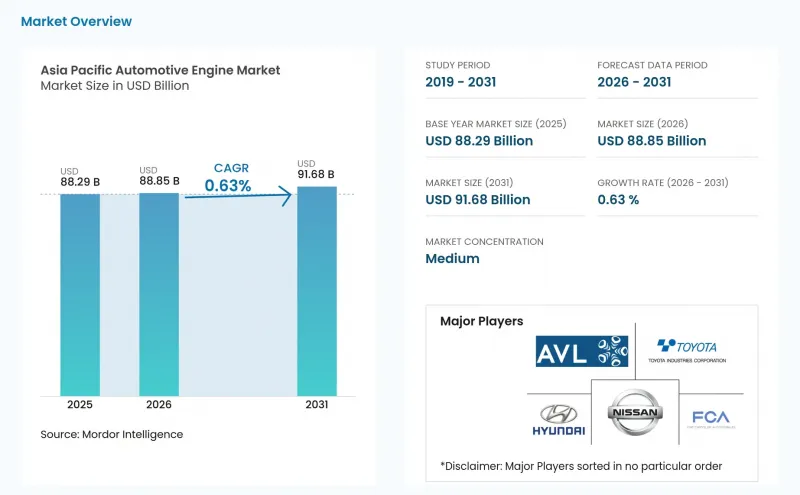
亞太地區汽車引擎市場趨勢及洞察。
亞太地區新興經濟體整車生產和汽車保有量的快速成長
在中國,乘用車產量顯著成長,與前一年相比保持穩定成長。印度也實現了大幅增產,這得益於農村地區貸款管道的重新開放。印尼和泰國利用關稅優勢,共同擴大了汽車組裝業務,而日本和中國的汽車品牌也建立了散件組裝(KD)生產線。預計到2025年,該地區的汽車保有量將達到相當規模,這將強勁推動售後市場對引擎的需求,尤其是對於使用年限適中的車輛。為了應對燃油品質和測試標準的差異,汽車製造商推出了「印度規格」和「中國規格」的引擎。這些引擎的ECU韌體是固定的,這導致了供應鏈中斷和工程預算的增加。儘管新車電氣化勢頭持續強勁,但這些趨勢意味著亞太地區的汽車引擎市場仍與車輛的更換週期密切相關。
嚴格的區域排放氣體法規正在推動內燃機小型化和效率提昇技術的發展。
在中國,已實施「國六b」排放標準,強制要求進行實際道路排放氣體測試,並推廣汽油車採用粒狀物過濾器。在印度,「Bharat Stage VI」排放標準大幅降低了小型柴油車的氮氧化物(NOx)排放限值。這項變更使得採用尿素噴射選擇性催化還原(SCR)系統成為強制性要求,增加了引擎的單一成本。在日本,2025年修訂的「新長期排放氣體法規」進一步加強了對粒狀物排放的限制,加速了雙噴射汽油系統的普及。同時,韓國的LEV III排放標準正促使汽車製造商(OEM)採用渦輪增壓三缸引擎。這些法規共同作用,給亞太地區汽車引擎一級供應商的利潤率帶來了壓力。然而,同時,專注於後處理和輕量化解決方案的公司也迎來了新的商機。
電動車/零排放汽車的加速普及正在削弱對內燃機的長期需求。
在中國,新能源汽車已佔據乘用車市場的大部分佔有率。同時,在日本和韓國,電池式電動車(BEV)的普及速度較為緩慢,這主要得益於大量的購車補貼和廣泛的快速充電網路。在印度,電動二輪車的發展勢頭強勁,這得益於各邦政府提供的可觀經濟效益的獎勵。隨著汽車製造商(OEM)加速推進電氣化以滿足其車輛組合的燃油經濟性標準(CAFE),傳統的內燃機(ICE)平台規模正在縮小,這給全部區域的汽車引擎市場帶來了挑戰。
細分市場分析
目前,對置活塞引擎的市佔率仍然很小,但預計到2031年,這種佈局的複合年成長率將達到1.67%,這主要得益於Akeitz授權的用於端口設備的二行程設計具有更高的熱效率。直列引擎由於易於安裝在小型轎車和輕型卡車上,預計到2025年仍將佔據亞太地區汽車引擎市場45.16%的佔有率。 V型引擎仍用於排氣量3公升及以上的豪華SUV和重型卡車,但隨著V6引擎被渦輪增壓混合動力四缸引擎取代,其市場佔有率正在下降。斯巴魯的水平對臥引擎和大眾集團的W型引擎仍然僅限於小眾跑車和豪華車型。小型化、渦輪增壓技術和內燃機混合動力技術的協同作用,進一步鞏固了直列引擎在亞太地區汽車引擎市場的主導地位。
產品規劃人員目前正投資建造靈活的生產線,這些生產線無需長時間換型即可在汽油引擎缸體和混合動力引擎缸體之間快速切換。這種靈活性確保了投資回報,而對置活塞式引擎則瞄準了需要更低燃油消耗率的長途運輸領域。來自中國港口和澳洲礦業公司的持續研發合約可能會促使更多供應商採用這種佈局,但檢驗週期和不熟悉的維護要求正在減緩其大規模應用。
預計到2025年,在印度、印尼和越南摩托車熱潮的推動下,汽油引擎將佔據市場主導地位,市佔率高達46.18%。同時,受都市區道路限行和更嚴格的排放法規的影響,柴油引擎的市佔率預計將下降至26%左右。氫燃料內燃機雖然仍處於發展初期,但預計成長率最高,到2031年年複合成長率(CAGR)將達到1.75%,主要得益於韓國和日本的示範計畫。天然氣燃氣引擎目前已在印度的三輪車和中型卡車上使用,但在大都會圈尚未廣泛應用。在亞太地區的汽車引擎產業,以豐田和本田為首的混合動力內燃機系統在乘用車領域展現出強勁的發展勢頭,模糊了傳統內燃機和電動化之間的界限。
政策制定者正大力推廣乙醇、液化石油氣和合成燃料混合燃料,以提高老舊車輛的環保性能,但基礎設施的限制和認證方面的挑戰導致其市場佔有率非常有限。因此,供應商正在調整策略,轉而專注於汽油混合動力模組以提高銷量,柴油引擎以滿足扭矩需求,而氫燃料內燃機則面向高需求、特殊用途的場所。
其他好處:
- Excel格式的市場預測(ME)表
- 3個月的分析師支持
目錄
第1章:引言
- 研究假設和市場定義
- 調查範圍
第2章:調查方法
第3章執行摘要
第4章 市場狀況
- 市場概覽
- 市場促進因素
- 亞太地區新興經濟體的整車生產和汽車保有量快速成長。
- 各地區嚴格的排放氣體法規推動了內燃機 (ICE) 的小型化和效率的提高。
- 東協人工智慧驅動的引擎缸體智慧加工本地化競賽
- 面向快速成長的叫車/配送市場的小型引擎ECU重映射售後市場
- 韓國和中國為氫能和內燃機(ICE)研發以及港口設施提供公共津貼。
- 政府主導的低碳合成燃料試點計畫(日本和澳洲)
- 市場限制因素
- 純電動車和零排放車的加速普及正在削弱人們對內燃機汽車的長期需求。
- 成品油價格波動和供應鏈中斷。
- 傳統內燃機(ICE)研發領域的人才正在流失到電動車軟體和電池領域。
- 亞洲主要城市推出城市級禁令,禁止傳統內燃機車上路。
- 價值供應鏈分析
- 監理情勢
- 技術展望
- 波特五力分析
第5章 市場規模與成長預測
- 按佈局類型
- 排隊
- V型
- W 型
- 拳擊手/平角
- 對置活塞式
- 按燃料類型
- 汽油
- 柴油引擎
- 天然氣/壓縮天然氣
- 混合動力內燃機汽車(輕度混合動力、完全混合動力、插電式混合動力)
- 替代燃料(乙醇、液化石油氣、電子燃料)
- 氫內燃機(ICE)
- 車輛類型
- 搭乘用車
- 輕型商用車
- 中型和大型商用車輛
- 摩托車和強力運動
- 越野/農業/建築
- 按引擎排氣量
- 小於1.5升
- 1.5~3 L
- 3公升或以上
- 國家
- 中國
- 印度
- 日本
- 韓國
- 其他亞太國家
第6章 競爭情勢
- 市場集中度
- 策略趨勢
- 市佔率分析
- 公司簡介
- Toyota Motor Corporation
- Honda Motor Co., Ltd.
- Hyundai Motor Group
- Nissan Motor Corporation
- Fiat Chrysler Automotive Group
- SAIC Motor Corporation
- Cummins Inc.
- Mitsubishi Heavy Industries Engine & Turbo
- Suzuki Motor Corporation
- Yanmar Holdings
- Isuzu Motors Ltd.
- Tata Motors Ltd.
- Ashok Leyland Ltd.
- Chongqing Changan Automobile
- Weichai Power Co., Ltd.
- BYD Auto Co., Ltd.
- Kirloskar Oil Engines
- Guangxi Yuchai Machinery
- Great Wall Motor Co.
- Hino Motors Ltd.
- Dongfeng Motor Group
- FAW Jiefang Automotive
- Jiangling Motors
第7章 市場機會與未來展望
According to Mordor Intelligence, the Asia Pacific automotive engine market size was valued at USD 88.29 billion in 2025, and is expected to reach USD 88.85 billion in 2026, and is projected to reach USD 91.68 billion by 2031, at a CAGR of 0.63% during the forecast period (2026-2031).
Asia Pacific Automotive Engine Market Trends and Insights
Rapid Growth in OEM Production and Vehicle Parc Across Emerging Asia Pacific Economies
China experienced a notable increase in passenger vehicle production, reflecting steady growth compared to the previous year. India also achieved significant production growth, supported by the reopening of rural credit lines. Indonesia and Thailand, leveraging tariff advantages, collectively expanded their vehicle assembly operations, with Japanese and Chinese brands establishing knock-down lines. By 2025, the vehicle parc in the region reached a substantial level, driving strong aftermarket demand for engines, particularly those within the mid-life age range. In response to varying fuel-quality and testing standards, automakers have introduced "India-spec" and "China-spec" engines. These engines feature locked ECU firmware, resulting in fragmented supply chains and increased engineering budgets. Such developments ensure that the Asia Pacific automotive engine market remains closely tied to replacement cycles, even as the adoption of new-vehicle electrification continues to gain momentum .
Stringent Regional Emission Norms Driving ICE Downsizing & Efficiency Tech
China has enforced its National VI-b rule, mandating real-driving-emissions testing and promoting the adoption of particulate filters in gasoline vehicles. In India, the Bharat Stage VI regulation significantly reduced permissible NOx emissions in light diesel vehicles. This change necessitated the use of selective catalytic reduction with urea dosing, increasing the cost per engine. Japan's 2025 update to its Post New Long-Term norms tightened limits on particle numbers, hastening the shift to dual-injection gasoline systems. Meanwhile, South Korea's LEV III standards have steered original equipment manufacturers (OEMs) towards adopting turbocharged three-cylinder engines. Collectively, these regulations are squeezing profit margins for Tier-1 suppliers in the Asia Pacific automotive engine sector. However, they simultaneously open doors for specialists in aftertreatment and lightweighting solutions.
Accelerating BEV / ZEV Adoption Eroding Long-Term ICE Demand
New-energy vehicles captured a significant share of passenger-car sales in China. Meanwhile, Japan and South Korea experienced moderate adoption of battery electric vehicles (BEVs), driven by substantial purchase subsidies and extensive fast-charging networks. In India, electric two-wheelers gained notable traction, supported by state incentives offering considerable financial benefits. As original equipment manufacturers (OEMs) accelerate electrification to meet fleet CAFE targets, traditional internal combustion engine (ICE) platforms are losing scale, creating challenges for the automotive engine market across the Asia Pacific region.
Other drivers and restraints analyzed in the detailed report include:
- Localization Race for AI-Driven Smart Machining of Engine Blocks in ASEAN
- Public Grants for Hydrogen-ICE R&D in South Korea and China's Port Equipment
- Fuel-Price Volatility & Supply-Chain Shocks for Refined Products
For complete list of drivers and restraints, kindly check the Table Of Contents.
Segment Analysis
Opposed-piston prototypes currently hold a minute slice, yet the configuration posts a 1.67% CAGR to 2031, as Achates-licensed two-stroke designs for port equipment claim higher thermal efficiency. In-line engines maintained a 45.16% share of the Asia Pacific automotive engine market in 2025 due to packaging ease in compact cars and light trucks. V-type units still power premium SUVs and heavy haulers above 3 liters, though their relevance fades as turbo-hybrid fours replace V6s. Subaru's boxer layout and Volkswagen Group W-types remain confined to niche sports and luxury models. Downsizing, forced induction, and combustion-hybrid synergies reinforce the in-line architecture's dominance within the Asia Pacific automotive engine market.
Product planners now invest in flexible machining lines that switch from gasoline to hybrid block variants without lengthy changeovers. This agility protects capital returns while the opposed-piston concept eyes long-haul segments demanding lower specific fuel consumption. Continued R&D contracts from Chinese ports and Australian miners could draw more suppliers to the layout, but validation cycles and unfamiliar maintenance needs slow mass uptake.
Gasoline led with a 46.18% share in 2025, powered by the two-wheeler boom across India, Indonesia, and Vietnam. Diesel slipped to an estimated 26% share as city bans and tighter soot limits bite. Hydrogen ICE, while embryonic, clocks the fastest 1.75% CAGR through 2031, helped by South Korean and Japanese pilots. While natural-gas engines power Indian three-wheelers and mid-weight trucks, they have yet to make significant inroads beyond metro corridors. In the Asia Pacific automotive engine industry, hybrid-ICE systems, led by Toyota and Honda, have gained notable traction in passenger-car builds, blurring the lines between traditional combustion and electrification.
Despite policymakers promoting ethanol, LPG, and synthetic-fuel blends to greenify older fleets, infrastructure limitations and certification challenges have kept their market share minimal. As a result, suppliers are pivoting: focusing on gasoline hybrid modules for volume, diesel for torque-sensitive fleets, and hydrogen ICE for specialized, high-demand hubs.
Complete Report Scope:
- By Placement Type
- In-line
- V-type
- W-type
- Boxer / Flat
- Opposed-piston
- By Fuel Type
- Gasoline
- Diesel
- Natural Gas / CNG
- Hybrid-ICE (Mild, Full, Plug-in)
- Alternative Fuels (Ethanol, LPG, e-Fuels)
- Hydrogen ICE
- By Vehicle Type
- Passenger Cars
- Light Commercial Vehicles
- Medium & Heavy Commercial Vehicles
- Two-Wheelers & Powersports
- Off-road / Agricultural / Construction
- By Engine Capacity
- Below 1.5 L
- 1.5 to 3 L
- Over 3 L
- By Country
- China
- India
- Japan
- South Korea
- Rest of Asia-Pacific
List of Companies Covered in this Report:
- Toyota Motor Corporation
- Honda Motor Co., Ltd.
- Hyundai Motor Group
- Nissan Motor Corporation
- Fiat Chrysler Automotive Group
- SAIC Motor Corporation
- Cummins Inc.
- Mitsubishi Heavy Industries Engine & Turbo
- Suzuki Motor Corporation
- Yanmar Holdings
- Isuzu Motors Ltd.
- Tata Motors Ltd.
- Ashok Leyland Ltd.
- Chongqing Changan Automobile
- Weichai Power Co., Ltd.
- BYD Auto Co., Ltd.
- Kirloskar Oil Engines
- Guangxi Yuchai Machinery
- Great Wall Motor Co.
- Hino Motors Ltd.
- Dongfeng Motor Group
- FAW Jiefang Automotive
- Jiangling Motors
Additional Benefits:
- The market estimate (ME) sheet in Excel format
- 3 months of analyst support
TABLE OF CONTENTS
1 Introduction
- 1.1 Study Assumptions & Market Definition
- 1.2 Scope of the Study
2 Research Methodology
3 Executive Summary
4 Market Landscape
- 4.1 Market Overview
- 4.2 Market Drivers
- 4.2.1 Rapid Growth in OEM Production and Vehicle PARC Across Emerging Asia Pacific Economies
- 4.2.2 Stringent Regional Emission Norms Driving ICE Downsizing & Efficiency Tech
- 4.2.3 Localization Race for AI-Driven Smart Machining of Engine Blocks in ASEAN
- 4.2.4 Exploding Ride-Hailing/Delivery Aftermarket for ECU Remapping of Small Engines
- 4.2.5 Public Grants for Hydrogen-ICE R&D in South Korea and China's Port Equipment
- 4.2.6 Government Pilots for Low-Carbon Synthetic Fuels (Japan & Australia)
- 4.3 Market Restraints
- 4.3.1 Accelerating BEV / ZEV Adoption Eroding Long-Term ICE Demand
- 4.3.2 Fuel-Price Volatility & Supply-Chain Shocks for Refined Products
- 4.3.3 Talent Flight From Traditional ICE R&D to EV Software & Battery Sectors
- 4.3.4 Metro-Level Bans on Legacy ICE Two-Wheelers in Tier-1 Asian Cities
- 4.4 Value / Supply-Chain Analysis
- 4.5 Regulatory Landscape
- 4.6 Technological Outlook
- 4.7 Porter's Five Forces Analysis
- 4.7.1 Bargaining Power of Suppliers
- 4.7.2 Bargaining Power of Buyers
- 4.7.3 Threat of New Entrants
- 4.7.4 Threat of Substitutes
- 4.7.5 Competitive Rivalry
5 Market Size & Growth Forecasts (Value (USD) and Volume (Units))
- 5.1 By Placement Type
- 5.1.1 In-line
- 5.1.2 V-type
- 5.1.3 W-type
- 5.1.4 Boxer / Flat
- 5.1.5 Opposed-piston
- 5.2 By Fuel Type
- 5.2.1 Gasoline
- 5.2.2 Diesel
- 5.2.3 Natural Gas / CNG
- 5.2.4 Hybrid-ICE (Mild, Full, Plug-in)
- 5.2.5 Alternative Fuels (Ethanol, LPG, e-Fuels)
- 5.2.6 Hydrogen ICE
- 5.3 By Vehicle Type
- 5.3.1 Passenger Cars
- 5.3.2 Light Commercial Vehicles
- 5.3.3 Medium & Heavy Commercial Vehicles
- 5.3.4 Two-Wheelers & Powersports
- 5.3.5 Off-road / Agricultural / Construction
- 5.4 By Engine Capacity
- 5.4.1 Below 1.5 L
- 5.4.2 1.5 to 3 L
- 5.4.3 Over 3 L
- 5.5 By Country
- 5.5.1 China
- 5.5.2 India
- 5.5.3 Japan
- 5.5.4 South Korea
- 5.5.5 Rest of Asia-Pacific
6 Competitive Landscape
- 6.1 Market Concentration
- 6.2 Strategic Moves
- 6.3 Market Share Analysis
- 6.4 Company Profiles (includes Global Level Overview, Market Level Overview, Core Segments, Financials as Available, Strategic Information, Market Rank/Share for Key Companies, Products and Services, SWOT Analysis, and Recent Developments)
- 6.4.1 Toyota Motor Corporation
- 6.4.2 Honda Motor Co., Ltd.
- 6.4.3 Hyundai Motor Group
- 6.4.4 Nissan Motor Corporation
- 6.4.5 Fiat Chrysler Automotive Group
- 6.4.6 SAIC Motor Corporation
- 6.4.7 Cummins Inc.
- 6.4.8 Mitsubishi Heavy Industries Engine & Turbo
- 6.4.9 Suzuki Motor Corporation
- 6.4.10 Yanmar Holdings
- 6.4.11 Isuzu Motors Ltd.
- 6.4.12 Tata Motors Ltd.
- 6.4.13 Ashok Leyland Ltd.
- 6.4.14 Chongqing Changan Automobile
- 6.4.15 Weichai Power Co., Ltd.
- 6.4.16 BYD Auto Co., Ltd.
- 6.4.17 Kirloskar Oil Engines
- 6.4.18 Guangxi Yuchai Machinery
- 6.4.19 Great Wall Motor Co.
- 6.4.20 Hino Motors Ltd.
- 6.4.21 Dongfeng Motor Group
- 6.4.22 FAW Jiefang Automotive
- 6.4.23 Jiangling Motors
7 Market Opportunities & Future Outlook
- 7.1 White-Space & Unmet-Need Assessment

 化油器市場:全球市場預測,2026-2032年
 2026年全球汽車引擎蓋市場報告
 汽車EMS與ECU產業研究報告,2026年
 汽車油底殼市場規模、佔有率和成長分析:按材料、車輛類型、引擎類型、銷售管道、油底殼類型和地區分類-2026-2033年產業預測
 超音速燃燒衝壓引擎市場規模、佔有率、成長、全球產業分析、區域趨勢及 2026-2034 年預測。
 汽車引擎:市場佔有率分析、產業趨勢與統計、成長預測(2026-2031)
 史特靈引擎市場規模、佔有率和成長分析:按類型、功率、熱源、應用、最終用戶產業和地區分類-2026-2033年產業預測汽車引擎皮帶和軟管市場:按產品類型、材質、最終用戶、分銷管道和車輛型號分類-2026-2032年全球市場預測
 全球汽車引擎皮帶和軟管市場
 引擎市場 - 全球產業規模、佔有率、趨勢、機會、預測:按速度類型、功率等級、類型、最終用戶、地區和競爭對手分類,2021-2031 年