


 |
市場調查報告書
商品編碼
2120403
汽車引擎:市場佔有率分析、產業趨勢與統計、成長預測(2026-2031)Automotive Engine - Market Share Analysis, Industry Trends & Statistics, Growth Forecasts (2026 - 2031) |
||||||

※ 本網頁內容可能與最新版本有所差異。詳細情況請與我們聯繫。
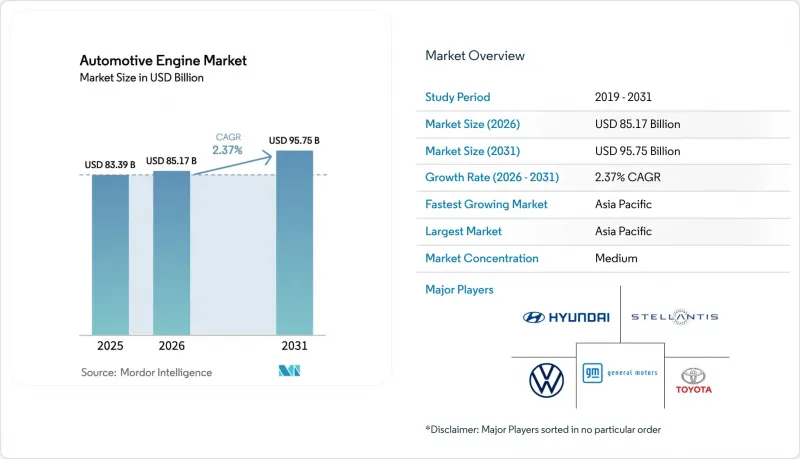
據 Mordor Intelligence 稱,2025 年汽車引擎市值為 833.9 億美元,預計到 2031 年將達到 957.5 億美元,而 2026 年為 851.7 億美元,預測期(2026-2031 年)的複合年成長率為 2.37%。
本報告依引擎配置(直列式、V型、W型、水平對置/平頭式、對置活塞式)、燃料類型(汽油、柴油等)、車輛類型(乘用車、輕型商用車、中型和重型商用車等)、引擎排氣量(小於1.5公升、1.5-3公升、3公升及以上)和地區進行分類。市場預測以貨幣價值(美元)和銷售(輛)兩種形式呈現。
全球汽車引擎市場趨勢與洞察
亞太地區新興經濟體汽車產量成長
到2025年,印度乘用車產量顯著成長,古吉拉突邦和泰米爾納德邦的產能擴張實現了顯著成長。同時,中國保持了其作為輕型汽車主要生產國的地位,專注於混合動力汽車和出口到基礎設施仍面臨挑戰的東南亞地區。印尼和泰國在軟性動力傳動系統總成領域吸引了大量投資,鞏固了其作為東協地區汽油、混合動力汽車和壓縮天然氣汽車主要生產中心的地位,這些汽車均採用通用模具製造。憑藉人事費用優勢,印度製造的引擎以遠低於歐洲同類產品的價格出口到非洲和拉丁美洲,並維持了內燃機(ICE)的競爭力。即使都市區電氣化政策日益嚴格,這種產量成長仍在推動汽車引擎市場的發展。
更嚴格的全球排放氣體法規正在推動內燃機效率的提升。
歐盟7、國六b和美國環保署Tier 4 Final排放標準的綜合實施,進一步收緊了對顆粒物和氮氧化物排放的限制,迫使製造商採用汽油顆粒過濾器、標準化車載診斷系統以及低溫耐久性校準。雖然這些硬體的增加會使每台引擎的成本增加約300美元,但它們確保了量產乘用車符合相關法規。選擇性催化還原(SCR)和高壓缸內直噴技術目前也廣泛應用於小型施工機械和輕型車輛,從而擴大了供應商的目標市場。法規的不斷收緊推動了稀薄燃燒策略、可變氣門正時和米勒循環等技術的研發,旨在將二氧化碳排放量降低哪怕一克。因此,一條永續的技術開發平臺正在形成,即使電動車的佔有率不斷擴大,汽車引擎市場的重要性也將得以維持。
電池式電動車的快速普及正在改變研發預算。
近年來,全球電池式電動車(BEV)銷量顯著成長,在微型車市場佔據了相當大的佔有率。這項轉變迫使汽車製造商將技術研發重點轉向電池組和軟體架構。大眾汽車大膽地為未來十年的電氣化舉措分配了巨額預算。這項決定導致內燃機(ICE)預算大幅削減,並促使內燃機產品線進行整合。同時,通用汽車(GM)宣布將在近期停止開發新的內燃機平台,並將未來的支出限制在合規性和輕度混合動力技術的改進上。一級供應商博世等公司因裁減動力傳動系統總成部門員工而成為新聞焦點,這清楚地展現了產業格局的轉變。此舉凸顯了人們日益成長的通用:曾經蓬勃發展的內燃機產業如今已淪為一項維護技術。隨著資本投資的減少,均質混合氣壓燃和等離子輔助點火等領域的創新步伐放緩,汽車引擎產業正朝著漸進式改進而非突破性創新的方向發展。
細分市場分析
直列式引擎憑藉其模組化擴充性和混合動力相容性(例如豐田「Dynamic Force」系列和大眾「EA888」系列),預計到2025年將佔據汽車引擎市場43.36%的佔有率。對置活塞引擎目前仍屬於小眾市場,但預計到2031年將以2.39%的複合年成長率成長,這主要得益於貨運公司對Akets Power公司2行程引擎設計的認可。與傳統柴油引擎相比,該設計燃油效率提高了三分之一,並且無需使用選擇性催化還原(SCR)技術即可滿足美國環保署(EPA)2027年的氮氧化物排放標準。
福特的3.5升EcoBoost V6引擎和通用汽車的6.2升V8引擎繼續在主要用於牽引的皮卡車型中保持著V型引擎的地位,而斯巴魯的水平對置引擎架構則繼續應用於四驅跨界車,其較低的重心彌補了製造複雜性的增加。隨著監管機構將動力性能置於架構之上,汽車製造商被敦促在保持現有佈局的同時縮小氣缸尺寸,但對置活塞引擎測試中展現出的顯著效率提升可能會在預測期內改變長途貨運的採購趨勢。
預計到2025年,汽油引擎將佔汽車引擎市場63.31%的佔有率,而包括輕度混合動力、全混合動力和插電式混合動力在內的混合動力內燃機動力傳動系統,預計到2031年將以2.47%的複合年成長率成長,成為所有燃料類別中成長最快的。豐田的2.5升「Dynamic Force Hybrid」引擎實現了高熱效率,而Stellantis則在其1.5升直列四缸渦輪增壓引擎中整合了48伏系統,應用於Jeep和標緻的多款車型。
與柴油車在歐洲乘用車市場下滑的趨勢相反,柴油車在重型卡車市場仍佔有一席之地,因為燃料密度和加油速度仍然是決定性因素。在都市區公車領域,天然氣動力車輛的數量正在增加,因為生物甲烷能夠減少車輛整個生命週期的二氧化碳排放。在巴西,彈性燃料引擎憑藉低成本乙醇的優勢依然存在。先導計畫,透過利用現有的鑄造和加工設備,展示了一條實現零碳排放的途徑,其目標是在2025年的耐力賽中達到300馬力的輸出功率。
區域分析
到2025年,亞太地區將佔全球汽車產量的38.71%,預計到2031年將以2.45%的複合年成長率成長,這主要得益於印度產量的激增以及東協作為靈活動力傳動系統總成中心的崛起。中國將生產2,680萬輛汽車,繼續保持全球最大的微型車生產國地位,並將繼續生產混合動力汽車和內燃機汽車用於出口,儘管中國政府的目標是到2030年提高電動車的普及率。同時,在日本,隨著汽車製造商將產能轉移到美墨加協定(USMCA)區域,國內引擎產量將在2025年下降。
近年來,美國輕型汽車銷售保持強勁,隨著消費者對注重牽引能力和加油便利性的全尺寸卡車的需求不斷成長,內燃機汽車和混合動力汽車佔據了市場主導地位。福特位於肯塔基州的卡車工廠和通用汽車位於弗林特的組裝廠繼續滿載運作,生產符合美國環保署(EPA)第三階段排放標準的V6和V8引擎。在歐洲,由於都市區零排放區的擴大,乘用車產量略有下降。然而,德國薩爾茲吉特工廠正在進行大量投資,以轉型生產輕度混合動力模組,同時繼續生產傳統引擎單元,從而保障了數千名員工的就業。
在南美、中東和非洲,汽車需求仍然強勁,但成本和基礎設施的限制阻礙了電池式電動車(BEV)的廣泛普及。巴西正保持著彈性燃料汽車的強勁生產,充分利用甘蔗製乙醇的競爭優勢,乙醇比汽油更具成本效益。同時,沙烏地阿拉伯和阿拉伯聯合大公國(阿拉伯聯合大公國)已啟動先導計畫,利用氫燃料電池內燃機(ICE)為城市物流提供動力,並利用國產氫氣來應對鋰離子電池在惡劣氣候條件下的挑戰。南非則持續專注於生產右舵內燃機汽車,出口到充電基礎設施尚處於發展初期的撒哈拉以南非洲市場。
其他好處:
- Excel格式的市場預測(ME)表
- 3個月的分析師支持
目錄
第1章:引言
- 研究假設和市場定義
- 調查範圍
第2章:調查方法
第3章執行摘要
第4章 市場狀況
- 市場概覽
- 市場促進因素
- 亞太地區新興國家汽車產量增加
- 更嚴格的全球排放法規正在推動內燃機(ICE)效率的提升。
- 48V 微混系統正在提高內燃機 (ICE) 的重要性。
- 電子商務物流正在推動輕型車輛(LCV)對引擎的需求。
- 合成電子燃料的出現將延長內燃機(ICE)的使用壽命。
- 中重型卡車氫燃料內燃機(ICE)試點項目
- 市場限制因素
- 電池式電動車(BEV)的快速普及正在推動研發預算的分配。
- 合金嚴重短缺導致引擎成本上漲。
- 零排放城市地區正在抑制內燃機(ICE)的銷售。
- OTA 改變了電力電子領域的價值。
- 價值供應鏈分析
- 監理情勢
- 技術展望
- 波特五力模型
第5章 市場規模與成長預測
- 按佈局類型
- 排隊
- V型
- W 型
- 拳擊手/平角
- 對置活塞式
- 按燃料類型
- 汽油
- 柴油引擎
- 天然氣/壓縮天然氣
- 混合動力內燃機汽車(輕度混合動力、完全混合動力、插電式混合動力)
- 替代燃料(乙醇、液化石油氣、電子燃料)
- 氫內燃機(ICE)
- 車輛類型
- 搭乘用車
- 輕型商用車
- 中型和重型商用車輛
- 摩托車和強力運動
- 越野/農業/建築
- 按引擎排氣量
- 小於1.5升
- 1.5~3 L
- 3公升或以上
- 按地區
- 北美洲
- 美國
- 加拿大
- 其他北美國家
- 南美洲
- 巴西
- 阿根廷
- 其他南美國家
- 歐洲
- 德國
- 英國
- 法國
- 義大利
- 西班牙
- 其他歐洲國家
- 亞太地區
- 中國
- 印度
- 日本
- 韓國
- 其他亞太國家
- 中東和非洲
- 阿拉伯聯合大公國
- 沙烏地阿拉伯
- 南非
- 土耳其
- 其他中東和非洲國家
- 北美洲
第6章 競爭情勢
- 市場集中度
- 策略趨勢
- 市佔率分析
- 公司簡介
- Toyota Motor Corporation
- Volkswagen AG
- Hyundai Motor Group
- General Motors
- Stellantis NV
- Ford Motor Company
- Mercedes-Benz Group AG
- BMW AG
- Honda Motor Co., Ltd.
- Nissan Motor Co., Ltd.
- Cummins Inc.
- Volvo Group
- Tata Motors Limited
- Scania AB
- Caterpillar Inc.
第7章 市場機會與未來展望
According to Mordor Intelligence, the automotive engine market size was valued at USD 83.39 billion in 2025 and estimated to grow from USD 85.17 billion in 2026 to reach USD 95.75 billion by 2031, at a CAGR of 2.37% during the forecast period (2026-2031).
This report is Segmented by Placement Type (In-Line, V-Type, W-Type, Boxer/Flat, and Opposed-Piston), Fuel Type (Gasoline, Diesel, and More), Vehicle Type (Passenger Cars, Light Commercial Vehicles, Medium and Heavy Commercial Vehicles, and More), Engine Capacity (Below 1. 5 L, 1. 5-3 L, and Over 3 L), and Geography. Market Forecasts are Provided in Value (USD) and Volume (Units).
Global Automotive Engine Market Trends and Insights
Rising Vehicle Production in Emerging Asia-Pacific Economies
In 2025, India significantly increased its passenger vehicle production, achieving notable growth due to capacity expansions in Gujarat and Tamil Nadu. Meanwhile, China maintained its position as a leading producer of light vehicles, focusing on hybrids and exports, particularly to Southeast Asia, where infrastructure challenges persist. Both Indonesia and Thailand attracted substantial investments in flexible powertrains, solidifying their roles as key hubs in the ASEAN region for gasoline, hybrid, and CNG variants, all manufactured using shared tooling. Leveraging labor-cost advantages, Indian-manufactured engines are being exported to Africa and Latin America at significantly lower prices compared to their European counterparts, ensuring the continued competitiveness of internal combustion engines (ICE). This production growth is driving the automotive engine market forward, even as urban electrification policies become increasingly stringent .
Stricter Global Emission Regulations Driving Internal Combustion Engine Efficiency Upgrades
Euro 7, China VI-b, and the United States Environmental Protection Agency (USEPA) Tier 4 Final standards converge to tighten particulate and NOx limits, obliging manufacturers to deploy gasoline particulate filters, on-board diagnostics parity, and low-temperature durability calibrations. The incremental hardware raises per-engine cost by roughly USD 300 yet safeguards regulatory compliance for high-volume passenger cars . Selective catalytic reduction and high-pressure direct injection now permeate compact construction machines as well as light vehicles, expanding supplier addressable markets. Continued tightening propels R&D into lean-burn strategies, variable valve timing, and Miller-cycle adaptations that chase every gram of CO2 abatement. The upshot is a sustained engineering pipeline that keeps the automotive engine market relevant even as electric vehicles gain share.
Rapid Battery Electric Vehicle Adoption Diverting R&D Budgets
In recent years, global sales of battery electric vehicles (BEVs) have experienced significant growth, capturing a notable share of the light-vehicle market. This shift has prompted automakers to pivot their engineering focus towards battery packs and software architectures. Volkswagen, in a bold move, allocated a substantial budget for electrification initiatives over the next decade. This decision came with a significant reduction in its internal combustion engine (ICE) budget and a consolidation of its combustion families. Meanwhile, General Motors announced it would halt the development of new ICE platforms in the near future, confining its future expenditures to compliance adjustments and mild-hybrid enhancements. In a clear sign of the industry's evolving landscape, Tier-1 suppliers like Bosch made headlines by reducing their power-train workforce. This move underscores a growing consensus: the once-thriving combustion sector is now merely a sustaining technology. As capital investments dwindle, innovation in areas like homogeneous-charge compression ignition and plasma-assisted ignition has slowed, steering the automotive engine industry towards incremental improvements rather than groundbreaking breakthroughs.
Other drivers and restraints analyzed in the detailed report include:
- E-Commerce Logistics Boosting Light Commercial Vehicle Engine Demand
- Emergence of Synthetic E-Fuels Extending the Internal Combustion Engine Lifecycle
- Zero-Emission Urban Zones Curbing Internal Combustion Engine Sales
For complete list of drivers and restraints, kindly check the Table Of Contents.
Segment Analysis
In-line engines controlled 43.36% of the automotive engine market in 2025 by leveraging modular scalability and hybrid compatibility across Toyota's Dynamic Force and Volkswagen's EA888 families. Opposed-piston units, although niche, are projected to grow at 2.39% CAGR through 2031 as freight operators validate Achates Power's two-stroke design, which posts one-third of fuel-economy gains versus conventional diesels and meets EPA 2027 NOx rules without selective catalytic reduction.
Ford's 3.5-liter EcoBoost V6 and GM's 6.2-liter V8 maintain V-type relevance for towing-oriented pickups, while Subaru's boxer architecture persists in all-wheel-drive crossovers where a low center of gravity offsets added manufacturing complexity. Regulatory focus on output rather than architecture has encouraged automakers to downsize cylinders yet retain familiar layouts, but the tangible efficiency from opposed-piston trials could swing procurement in long-haul trucking over the forecast window.
Gasoline held 63.31% of the automotive engine market in 2025, but hybrid-ICE powertrains spanning mild, full, and plug-in systems will expand at a 2.47% CAGR to 2031, the fastest among fuel categories. Toyota's 2.5-liter Dynamic Force Hybrid achieves thermal efficiency, while Stellantis integrates 48-volt systems on 1.5-liter turbo fours across Jeep and Peugeot models.
Diesel's retreat in European passenger cars contrasts with its endurance in heavy-duty trucks, where fuel density and refueling speed remain decisive. Natural-gas fleets are growing in urban buses as biomethane delivers sustainable lifecycle CO2 reductions, and Brazil's flex-fuel engines preserve the low-cost ethanol advantages. Hydrogen-ICE pilots showcased 300 horsepower outputs in 2025 endurance racing, illustrating a zero-carbon pathway that leverages existing casting and machining assets.
Complete Report Scope:
- By Placement Type
- In-line
- V-type
- W-type
- Boxer / Flat
- Opposed-piston
- By Fuel Type
- Gasoline
- Diesel
- Natural Gas / CNG
- Hybrid-ICE (Mild, Full, Plug-in)
- Alternative Fuels (Ethanol, LPG, e-Fuels)
- Hydrogen Internal Combustion Engine (ICE)
- By Vehicle Type
- Passenger Cars
- Light Commercial Vehicles
- Medium and Heavy Commercial Vehicles
- Two-Wheelers and Powersports
- Off-road / Agricultural / Construction
- By Engine Capacity
- Below 1.5 L
- 1.5 to 3 L
- Over 3 L
- By Geography
- North America
- United States
- Canada
- Rest of North America
- South America
- Brazil
- Argentina
- Rest of South America
- Europe
- Germany
- United Kingdom
- France
- Italy
- Spain
- Rest of Europe
- Asia Pacific
- China
- India
- Japan
- South Korea
- Rest of Asia Pacific
- Middle East and Africa
- United Arab Emirates
- Saudi Arabia
- South Africa
- Turkey
- Rest of Middle East and Africa
- North America
Geography Analysis
Asia Pacific held 38.71% of 2025 global volume and is projected to expand at a 2.45% CAGR through 2031, driven by India's output surge and ASEAN's rise as a flexible power-train hub. China remains the world's largest light-vehicle producer at 26.8 million units, retaining ICE lines for hybrids and exports even as Beijing targets electric vehicle penetration by 2030. Japan's domestic engine production dipped in 2025 as OEMs shifted capacity to the United States-Mexico-Canada Agreement (USMCA) zones.
In recent years, United States light-vehicle sales have shown strong performance, with internal combustion engine (ICE) vehicles and hybrids dominating the market due to the high demand for full-size trucks that emphasize towing and refueling convenience. Ford's Kentucky Truck Plant and GM's Flint Assembly continue to operate at full capacity, producing V6 and V8 engines that comply with EPA Tier 3 standards. In Europe, passenger-car production has experienced a slight decline, influenced by the increasing implementation of urban zero-emission zones. However, Germany's Salzgitter site has made significant investments to transition towards producing mild-hybrid modules alongside traditional engine units, ensuring job security for thousands of workers.
In South America, the Middle East, and Africa, demand for vehicles remains robust, but the adoption of battery electric vehicles (BEVs) faces challenges due to cost and infrastructure limitations. Brazil has leveraged its competitive advantage in sugarcane ethanol, which is more cost-effective than gasoline, to maintain strong production of flex-fuel vehicles. Meanwhile, Saudi Arabia and the UAE have initiated hydrogen-ICE pilot projects for urban logistics, utilizing their domestic hydrogen production and addressing the thermal challenges associated with lithium-ion batteries in extreme climates. South Africa continues to focus on producing right-hand-drive ICE vehicles for export to sub-Saharan markets, where charging infrastructure is still in its early stages of development.
- Toyota Motor Corporation
- Volkswagen AG
- Hyundai Motor Group
- General Motors
- Stellantis N.V.
- Ford Motor Company
- Mercedes-Benz Group AG
- BMW AG
- Honda Motor Co., Ltd.
- Nissan Motor Co., Ltd.
- Cummins Inc.
- Volvo Group
- Tata Motors Limited
- Scania AB
- Caterpillar Inc.
Additional Benefits:
- The market estimate (ME) sheet in Excel format
- 3 months of analyst support
TABLE OF CONTENTS
1 Introduction
- 1.1 Study Assumptions and Market Definition
- 1.2 Scope of the Study
2 Research Methodology
3 Executive Summary
4 Market Landscape
- 4.1 Market Overview
- 4.2 Market Drivers
- 4.2.1 Rising Vehicle Production in Emerging Asia-Pacific Economies
- 4.2.2 Stricter Global Emission Regulations Driving Internal Combustion Engine (ICE) Efficiency Upgrades
- 4.2.3 48-V Micro-Hybrid Systems Reinforcing Internal Combustion Engine (ICE) Relevance
- 4.2.4 E-Commerce Logistics Boosting LCV Engine Demand
- 4.2.5 Emergence of Synthetic E-Fuels Extending Internal Combustion Engine (ICE) Lifecycle
- 4.2.6 Hydrogen-Fueled Internal Combustion Engine (ICE) Pilots for Medium and Heavy Trucks
- 4.3 Market Restraints
- 4.3.1 Rapid Battery Electric Vehicle (BEV) Adoption Diverting R&D Budgets
- 4.3.2 Critical Alloy Shortages Inflating Engine Costs
- 4.3.3 Zero-Emission Urban Zones Curbing Internal Combustion Engine (ICE) Sales
- 4.3.4 OTA-Driven Value Shift Toward Power Electronics
- 4.4 Value / Supply-Chain Analysis
- 4.5 Regulatory Landscape
- 4.6 Technological Outlook
- 4.7 Porter's Five Forces
- 4.7.1 Bargaining Power of Suppliers
- 4.7.2 Bargaining Power of Buyers
- 4.7.3 Threat of New Entrants
- 4.7.4 Threat of Substitutes
- 4.7.5 Competitive Rivalry
5 Market Size and Growth Forecasts (Value (USD) and Volume (Units))
- 5.1 By Placement Type
- 5.1.1 In-line
- 5.1.2 V-type
- 5.1.3 W-type
- 5.1.4 Boxer / Flat
- 5.1.5 Opposed-piston
- 5.2 By Fuel Type
- 5.2.1 Gasoline
- 5.2.2 Diesel
- 5.2.3 Natural Gas / CNG
- 5.2.4 Hybrid-ICE (Mild, Full, Plug-in)
- 5.2.5 Alternative Fuels (Ethanol, LPG, e-Fuels)
- 5.2.6 Hydrogen Internal Combustion Engine (ICE)
- 5.3 By Vehicle Type
- 5.3.1 Passenger Cars
- 5.3.2 Light Commercial Vehicles
- 5.3.3 Medium and Heavy Commercial Vehicles
- 5.3.4 Two-Wheelers and Powersports
- 5.3.5 Off-road / Agricultural / Construction
- 5.4 By Engine Capacity
- 5.4.1 Below 1.5 L
- 5.4.2 1.5 to 3 L
- 5.4.3 Over 3 L
- 5.5 By Geography
- 5.5.1 North America
- 5.5.1.1 United States
- 5.5.1.2 Canada
- 5.5.1.3 Rest of North America
- 5.5.2 South America
- 5.5.2.1 Brazil
- 5.5.2.2 Argentina
- 5.5.2.3 Rest of South America
- 5.5.3 Europe
- 5.5.3.1 Germany
- 5.5.3.2 United Kingdom
- 5.5.3.3 France
- 5.5.3.4 Italy
- 5.5.3.5 Spain
- 5.5.3.6 Rest of Europe
- 5.5.4 Asia Pacific
- 5.5.4.1 China
- 5.5.4.2 India
- 5.5.4.3 Japan
- 5.5.4.4 South Korea
- 5.5.4.5 Rest of Asia Pacific
- 5.5.5 Middle East and Africa
- 5.5.5.1 United Arab Emirates
- 5.5.5.2 Saudi Arabia
- 5.5.5.3 South Africa
- 5.5.5.4 Turkey
- 5.5.5.5 Rest of Middle East and Africa
- 5.5.1 North America
6 Competitive Landscape
- 6.1 Market Concentration
- 6.2 Strategic Moves
- 6.3 Market Share Analysis
- 6.4 Company Profiles (Includes Global Level Overview, Market Level Overview, Core Segments, Financials as Available, Strategic Information, Market Rank/Share for Key Companies, Products and Services, SWOT Analysis, and Recent Developments)
- 6.4.1 Toyota Motor Corporation
- 6.4.2 Volkswagen AG
- 6.4.3 Hyundai Motor Group
- 6.4.4 General Motors
- 6.4.5 Stellantis N.V.
- 6.4.6 Ford Motor Company
- 6.4.7 Mercedes-Benz Group AG
- 6.4.8 BMW AG
- 6.4.9 Honda Motor Co., Ltd.
- 6.4.10 Nissan Motor Co., Ltd.
- 6.4.11 Cummins Inc.
- 6.4.12 Volvo Group
- 6.4.13 Tata Motors Limited
- 6.4.14 Scania AB
- 6.4.15 Caterpillar Inc.
7 Market Opportunities and Future Outlook
- 7.1 White-space and Unmet-need Assessment

 汽車EMS與ECU產業研究報告,2026年
 汽車油底殼市場規模、佔有率和成長分析:按材料、車輛類型、引擎類型、銷售管道、油底殼類型和地區分類-2026-2033年產業預測
 超音速燃燒衝壓引擎市場規模、佔有率、成長、全球產業分析、區域趨勢及 2026-2034 年預測。
 史特靈引擎市場規模、佔有率和成長分析:按類型、功率、熱源、應用、最終用戶產業和地區分類-2026-2033年產業預測
 汽車引擎皮帶和軟管市場:按產品類型、材質、最終用戶、分銷管道和車輛型號分類-2026-2032年全球市場預測
 汽車性能調校與引擎重映射服務市場分析及預測(至2035年):類型、產品、服務、技術、組件、應用、功能、安裝類型、設備、解決方案
 汽車歧管絕對壓力感知器市場預測至2034年-按感知器類型、車輛類型、燃料類型、應用、銷售管道和地區分類的全球分析
 全球汽車引擎市場全球汽車引擎皮帶和軟管市場
 引擎市場 - 全球產業規模、佔有率、趨勢、機會、預測:按速度類型、功率等級、類型、最終用戶、地區和競爭對手分類,2021-2031 年