


 |
市場調查報告書
商品編碼
2163451
苯乙烯-丁二烯乳膠:市場佔有率分析、產業趨勢與統計數據、成長預測(2026-2031)Styrene Butadiene Latex - Market Share Analysis, Industry Trends & Statistics, Growth Forecasts (2026 - 2031) |
||||||

※ 本網頁內容可能與最新版本有所差異。詳細情況請與我們聯繫。
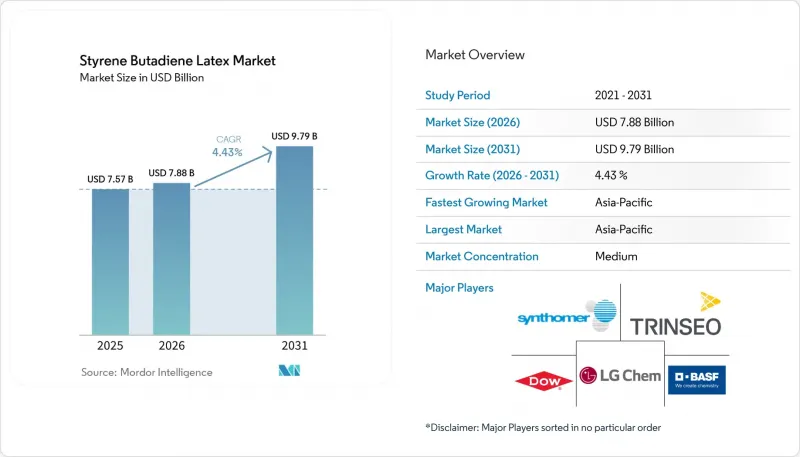
據 Mordor Intelligence 稱,2025 年苯乙烯-丁二烯乳膠市場價值為 75.7 億美元,預計到 2031 年將達到 97.9 億美元,而 2026 年為 78.8 億美元,預測期(2026-2031 年)的複合年成長率為 4.43%。
全球苯乙烯-丁二烯乳膠市場趨勢及洞察
紙張和紙板包裝的加工是推動結構性需求的主要因素。
從一次性塑膠包裝轉向纖維包裝正在推動苯乙烯-丁二烯乳膠市場對紙張塗料黏合劑的需求。用於食品、飲料和電子商務領域的塗佈紙板需要單一配方即可具備光澤度、顏料保持性和防水性。羧基化苯乙烯-丁二烯乳膠 (SBL) 能夠提供這些性能,同時滿足可再製漿包裝的要求。歐洲的紙張和紙板回收率持續超過 70%,推動了水性黏合劑系統的採用,以符合循環包裝的目標。這些對塗佈紙板生產的要求使得水性體系優先於其他不太合適的替代方案。BASF於 2024 年對其位於哈米納的分散體系工廠進行了現代化改造,並於 2025 年擴建了該工廠,以加強其向北歐地區紙張和紙板客戶供應“Styronal”和“Basonal XSB”粘合劑的供應鏈。
採用水性、低 VOC 黏合劑以及高固態含量,提高了認證效果。
隨著塗料和黏合劑配方開發商致力於研發自發性有機化合物 (VOC) 含量較低的黏合劑體系,苯乙烯-丁二烯乳膠市場也從中受益。 2025 年 12 月,歐盟委員會第 2025/2607 號決議確立了最新的歐盟生態標章標準,適用於裝飾塗料、清漆及相關產品。這些標準細化了 VOC 排放限值,並限制了配方中特定物質的使用。水性苯乙烯-丁二烯乳膠 (SBL) 符合低 VOC 產品的發展趨勢,但某些替代體係可能需要對配方進行調整。與化學品註冊、評估、授權和限制 (REACH) 相關的供應商認證可能會延長特種乳膠等級的批准期限,這可能有利於現有符合標準的供應商。此外,高固態配方可以降低乾燥機的能耗,將產品開發與歐洲和北美塗料生產線的營運效率連結起來。
苯乙烯和丁二烯的價格波動給利潤率帶來了壓力,並使認證變得更加複雜。
原料價格的波動限制了苯乙烯-丁二烯乳膠生產商規劃利潤率的能力。儘管丁二烯價格在2025年底觸及週期性低點,但由於中東局勢緊張加劇以及霍爾木茲海峽局勢可能影響石腦油裂解原料供應,丁二烯價格在2026年第二季度出現上漲。與造紙公司和地毯製造商簽訂固定價格合約的生產商可能會在價格波動期間面臨成本壓力。 12至24個月的長期合約可能會阻礙價格上漲的及時轉嫁。分散穩定性要求和高速塗佈線的認證也構成進一步的限制,因為客戶必須在嚴苛的運作條件下檢驗乳膠的性能。這些限制在歐洲和北美尤為突出,因為這些地區現有的塗佈線在嚴格的性能公差範圍內運作,且供應商的核准流程耗時較長。
細分市場分析
2025年,羧基化苯乙烯-丁二烯乳膠佔苯乙烯-丁二烯乳膠整體市場的60.34%。這一佔有率反映了其在兩大應用領域中已確立的規格。羧基能夠增強顏料結合力、提高高固態含量塗料的機械穩定性、對極性基材的附著力。這些特性有助於其在高速紙張塗佈生產線上穩定運作。 2025年,BASF擴建了位於哈米納的工廠,新增了經ISCC PLUS認證的Styronal和Basonal XSB等級產品的產能,這些產品用於永續紡織品包裝。此次擴建表明,在以規格為導向的採購中,認證可以成為羧基化等級產品的差異化優勢。
非羧基化SBL預計將成為成長最快的產品類型,到2031年複合年成長率將達到4.78%。在那些優先考慮製程簡便性和低成本而非羧基化所帶來的額外功能的應用領域,非羧基化SBL的應用日益增加。通用紙張加工、低性能黏合劑以及一些紡織品整理應用都符合這一趨勢。一些特殊改質的SBL也被用於小規模應用,例如玻璃纖維上漿、電池黏合劑和特殊紡織品整理。BASF面向鋰離子電池應用銷售「Licity XSBL」產品,這些材料與紙張塗料一起在哈米納工廠生產。這些特殊應用的技術規格要求與傳統的紙張塗料和黏合劑應用有所不同。
區域分析
到2025年,亞太地區將佔苯乙烯-丁二烯乳膠市場44.18%的佔有率,預計到2031年將維持4.81%的複合年成長率,成為該地區成長最快的市場。中國塗佈紙板的生產和消費基礎支撐著該地區的需求。廣東、江蘇和山東等省份的包裝加工企業正在擴大塗佈紙板的生產,以滿足電子商務履約的需求。印度是全部區域紙張、砂漿和不織布等應用領域成長的主要驅動力。國家基礎設施計劃已承諾投資1.4兆美元,從而支撐了建築需求。日本和韓國正在推動對專用電池黏合劑和玻璃纖維施膠劑的需求,技術性能是其主要採購標準。
北美和歐洲是成熟的市場,對產品規格有嚴格的要求。歐洲的REACH法規和更新後的歐盟生態標章標準正在推動市場對經認證的低VOC苯乙烯-丁二烯乳膠(SBL)產品的需求。這些要求可能會成為供應商獲得認證的障礙。 2025年5月,Trinseo宣布,自2025年7月1日起,其銷往北美地毯市場的苯乙烯-丁二烯乳膠產品價格將上調0.04美元/乾磅。該公司表示,原料和運輸成本的上漲是這項提價的原因。在北美地區,成熟的物流關係和供應商的認證記錄仍然對採購決策產生影響。
南美洲是一個發展中地區,巴西的造紙和包裝業以及建設活動構成了其需求基礎。中東和非洲是建築砂漿應用的新興消費地區。沙烏地阿拉伯和阿拉伯聯合大公國(阿拉伯聯合大公國)的基礎設施項目正在擴張,這可能會增加對聚合物改質水泥混合物的需求。該地區易受霍爾木茲海峽相關原料供應中斷的影響,這可能會影響當地的SBL價格。這可能會促使企業考慮採用本地生產的丙烯酸替代品,從而在短期內降低成本。
其他好處:
- Excel格式的市場預測(ME)表
- 3個月的分析師支持
目錄
第1章:引言
- 研究假設和市場定義
- 調查範圍
第2章:調查方法
第3章執行摘要
第4章 市場狀況
- 市場概覽
- 市場促進因素
- 紙和紙板包裝的加工
- 水性低VOC黏合劑的替代品
- 基礎建設、防水和維修對砂漿的需求。
- 地毯、紡織品和不織布背塗層市場成長
- 高固態含量可降低烘乾機的耗能。
- 市場限制因素
- 苯乙烯和丁二烯的價格波動
- 使用丙烯酸、乙烯基、聚氨酯和生物基黏合劑的替代品。
- 分散穩定性及高速塗佈生產線的合格
- 價值鏈分析
- 波特五力分析
第5章 市場規模與成長預測
- 依產品類型
- 羧基化苯乙烯-丁二烯乳膠
- 非羧基化苯乙烯-丁二烯乳膠
- 特製改質苯乙烯-丁二烯乳膠
- 透過使用
- 紙張和紙板的塗層
- 地毯背襯和紡織品背襯塗層
- 黏合劑和密封劑
- 油漆和塗料
- 玻璃纖維加工
- 砂漿添加劑
- 其他用途
- 按地區
- 亞太地區
- 中國
- 印度
- 日本
- 韓國
- 東南亞國協
- 其他亞太國家
- 北美洲
- 美國
- 加拿大
- 墨西哥
- 歐洲
- 德國
- 英國
- 法國
- 義大利
- 北歐國家
- 其他歐洲國家
- 南美洲
- 巴西
- 阿根廷
- 其他南美國家
- 中東和非洲
- 沙烏地阿拉伯
- 南非
- 其他中東和非洲國家
- 亞太地區
第6章 競爭情勢
- 市場集中度
- 策略趨勢
- 市佔率和排名分析
- 公司簡介
- Apcotex
- Arkema
- Asahi Kasei Corporation
- BASF
- DIC Corporation
- Dow
- JSR Corporation
- Kumho Petrochemical Co., Ltd.
- LANXESS
- LG Chem
- Mallard Creek Polymers
- NANTEX Industry Co., Ltd.
- Synthomer plc
- Trinseo
- ZEON CORPORATION
第7章 市場機會與未來展望
According to Mordor Intelligence, the styrene butadiene latex market size was valued at USD 7.57 billion in 2025 and is estimated to grow from USD 7.88 billion in 2026 to reach USD 9.79 billion by 2031, at a CAGR of 4.43% during the forecast period (2026-2031).
Global Styrene Butadiene Latex Market Trends and Insights
Paper and Paperboard Packaging Conversion Drives Structural Demand
The shift from single-use plastics to fiber-based packaging supports demand for paper-coating binders in the styrene-butadiene latex market. Coated paperboard used in food, beverage, and e-commerce applications requires gloss, pigment holdout, and water resistance in a single formulation. Carboxylated styrene-butadiene latex (SBL) provides these properties while supporting repulpable packaging requirements. Paper and board recycling rates in Europe remain above 70%, reinforcing the use of water-based binder systems that align with circular packaging objectives. The same requirements driving coated-paperboard production also favor water-based systems over less compatible alternatives. BASF modernized its Hamina dispersion site in 2024 and expanded the facility in 2025 to support Nordic paper and board customers with Styronal and Basonal XSB binders.
Water-Based, Low-VOC Binder Substitution and High-Solids Formulations Support Qualification
The styrene-butadiene latex market benefits as coating and adhesive formulators pursue binder systems with lower volatile organic compound (VOC) content. Commission Decision (EU) 2025/2607 established updated EU Ecolabel criteria for decorative paints, varnishes, and related products in December 2025. These criteria differentiate VOC emission limits and restrict certain substances in formulations. Water-based SBL aligns with the shift toward low-VOC products, while some alternative systems may require reformulation. Registration, Evaluation, Authorization and Restriction of Chemicals (REACH)-related supplier qualification can lengthen approval timelines for specialty latex grades, potentially favoring established suppliers with compliant products. High-solids formulations can also reduce dryer energy intensity, linking product development with operational efficiency across European and North American coating lines.
Styrene and Butadiene Price Volatility Compresses Margins and Complicates Qualification
Feedstock volatility limits producers' ability to plan margins in the styrene-butadiene latex market. Butadiene prices fell to cyclical lows by the end of 2025 and rose in Q2 2026, as Middle East tensions and concerns regarding the Strait of Hormuz affected the availability of naphtha-cracking feedstock. Producers operating under fixed-price contracts with paper mills and carpet manufacturers may face cost pressures during these price movements. Contracts spanning 12 to 24 months can hinder timely price pass-through. Dispersion stability requirements and high-speed coating-line qualification present additional constraints, as customers must validate latex performance under demanding operating conditions. These constraints are particularly relevant in Europe and North America, where established coating lines operate within narrow performance tolerances and supplier approval processes are lengthy.
Other drivers and restraints analyzed in the detailed report include:
- Infrastructure, Waterproofing, and Repair-Mortar Demand Opens a High-Growth Application Niche
- Growth of Carpet, Textile, and Nonwoven Backcoating Sustains Demand in Asia
- Substitution by Acrylic, Vinyl, Polyurethane, and Bio-Based Binders Erodes Select Uses
For complete list of drivers and restraints, kindly check the Table Of Contents.
Segment Analysis
Carboxylated styrene-butadiene latex accounted for 60.34% of the styrene-butadiene latex market in 2025. Its position reflects established specifications in the two largest applications. Carboxyl groups support pigment binding, mechanical stability at high coating solids, and adhesion to polar substrates. These properties support consistent operating performance on high-speed paper-coating lines. BASF expanded its Hamina site in 2025, adding ISCC PLUS-certified capacity for Styronal and Basonal XSB grades used in sustainable fiber-based packaging. The expansion indicates how certification can differentiate carboxylated grades in specification-driven procurement.
Non-carboxylated SBL is expected to be the fastest-growing product type, with a CAGR of 4.78% through 2031. Its adoption is increasing in applications where simple, low-cost processing outweighs the additional functionality provided by carboxylation. General-purpose paper treatment, lower-performance adhesives, and select textile-finishing applications align with this profile. Specialty-modified SBL also serves smaller applications, including glass-fiber sizing, battery binders, and specialty textile finishes. BASF markets Licity XSBL for lithium-ion battery applications, and the Hamina site produces these materials alongside paper-coating grades. These specialty applications have technical specification requirements that differ from those of established paper-coating and adhesive applications.
Complete Report Scope:
- By Product Type
- Carboxylated Styrene Butadiene Latex
- Non-Carboxylated Styrene Butadiene Latex
- Specialty Modified Styrene Butadiene Latex
- By Application
- Paper and Paperboard Coating
- Carpet Backing and Textile Backcoating
- Adhesives and Sealants
- Paints and Coatings
- Glass Fiber Processing
- Mortar Additives
- Other Applications
- By Geography
- Asia-Pacific
- China
- India
- Japan
- South Korea
- ASEAN Countries
- Rest of Asia-Pacific
- North America
- United States
- Canada
- Mexico
- Europe
- Germany
- United Kingdom
- France
- Italy
- NORDIC Countries
- Rest of Europe
- South America
- Brazil
- Argentina
- Rest of South America
- Middle East and Africa
- Saudi Arabia
- South Africa
- Rest of Middle East and Africa
- Asia-Pacific
Geography Analysis
Asia-Pacific accounted for 44.18% of the styrene butadiene latex market in 2025 and is projected to register the highest CAGR of 4.81% through 2031. China's base of coated-paperboard production and consumption supports regional demand. Packaging converters in Guangdong, Jiangsu, and Shandong are expanding coated-board production to support e-commerce fulfillment. India is a source of regional growth across paper, mortar, and nonwoven textile applications. The National Infrastructure Pipeline supports construction demand through its USD 1.4 trillion commitment. Japan and South Korea drive demand for specialty battery-binder and glass-fiber-sizing grades, where technical performance is a key purchasing criterion.
North America and Europe are established regions with stringent specification requirements. Europe's REACH regulations and updated EU Ecolabel criteria support demand for certified, low-VOC styrene butadiene latex (SBL) grades. These requirements can create qualification barriers for suppliers. In May 2025, Trinseo announced an increase of USD 0.04 per dry lb for styrene-butadiene latex products sold to the North American carpet market, effective July 1, 2025. The company cited rising raw material and transportation costs as the basis for the increase. Established logistics relationships and supplier qualification histories continue to influence purchasing decisions in the region.
South America is a developing region, with Brazil's paper and packaging industry and construction activity forming its demand base. The Middle East and Africa are emerging consumption regions for construction mortar applications. Saudi Arabia and the UAE are expanding infrastructure projects, which can increase demand for polymer-modified cementitious formulations. The region's exposure to Hormuz-related feedstock disruptions can affect local SBL pricing. This exposure may create short-term incentives to consider locally produced acrylic alternatives.
- Apcotex
- Arkema
- Asahi Kasei Corporation
- BASF
- DIC Corporation
- Dow
- JSR Corporation
- Kumho Petrochemical Co., Ltd.
- LANXESS
- LG Chem
- Mallard Creek Polymers
- NANTEX Industry Co., Ltd.
- Synthomer plc
- Trinseo
- ZEON CORPORATION
Additional Benefits:
- The market estimate (ME) sheet in Excel format
- 3 months of analyst support
TABLE OF CONTENTS
1 Introduction
- 1.1 Study Assumptions and Market Definition
- 1.2 Scope of the Study
2 Research Methodology
3 Executive Summary
4 Market Landscape
- 4.1 Market Overview
- 4.2 Market Drivers
- 4.2.1 Paper and Paperboard Packaging Conversion
- 4.2.2 Water-Based, Low-VOC Binder Substitution
- 4.2.3 Infrastructure, Waterproofing, and Repair-Mortar Demand
- 4.2.4 Growth of Carpet, Textile, and Nonwoven Backcoating
- 4.2.5 High-Solids Formulations Reducing Dryer Energy Intensity
- 4.3 Market Restraints
- 4.3.1 Styrene and Butadiene Price Volatility
- 4.3.2 Substitution by Acrylic, Vinyl, Polyurethane, and Bio-Based Binders
- 4.3.3 Dispersion Stability and High-Speed Coating-Line Qualification
- 4.4 Value Chain Analysis
- 4.5 Porter's Five Forces Analysis
- 4.5.1 Bargaining Power of Suppliers
- 4.5.2 Bargaining Power of Buyers
- 4.5.3 Threat of New Entrants
- 4.5.4 Threat of Substitutes
- 4.5.5 Competitive Rivalry
5 Market Size and Growth Forecasts (Value)
- 5.1 By Product Type
- 5.1.1 Carboxylated Styrene Butadiene Latex
- 5.1.2 Non-Carboxylated Styrene Butadiene Latex
- 5.1.3 Specialty Modified Styrene Butadiene Latex
- 5.2 By Application
- 5.2.1 Paper and Paperboard Coating
- 5.2.2 Carpet Backing and Textile Backcoating
- 5.2.3 Adhesives and Sealants
- 5.2.4 Paints and Coatings
- 5.2.5 Glass Fiber Processing
- 5.2.6 Mortar Additives
- 5.2.7 Other Applications
- 5.3 By Geography
- 5.3.1 Asia-Pacific
- 5.3.1.1 China
- 5.3.1.2 India
- 5.3.1.3 Japan
- 5.3.1.4 South Korea
- 5.3.1.5 ASEAN Countries
- 5.3.1.6 Rest of Asia-Pacific
- 5.3.2 North America
- 5.3.2.1 United States
- 5.3.2.2 Canada
- 5.3.2.3 Mexico
- 5.3.3 Europe
- 5.3.3.1 Germany
- 5.3.3.2 United Kingdom
- 5.3.3.3 France
- 5.3.3.4 Italy
- 5.3.3.5 NORDIC Countries
- 5.3.3.6 Rest of Europe
- 5.3.4 South America
- 5.3.4.1 Brazil
- 5.3.4.2 Argentina
- 5.3.4.3 Rest of South America
- 5.3.5 Middle East and Africa
- 5.3.5.1 Saudi Arabia
- 5.3.5.2 South Africa
- 5.3.5.3 Rest of Middle East and Africa
- 5.3.1 Asia-Pacific
6 Competitive Landscape
- 6.1 Market Concentration
- 6.2 Strategic Moves
- 6.3 Market Share (%)/Ranking Analysis
- 6.4 Company Profiles (includes Global Overview, Market Overview, Core Segments, Financials as available, Strategic Information, Products and Services, and Recent Developments)
- 6.4.1 Apcotex
- 6.4.2 Arkema
- 6.4.3 Asahi Kasei Corporation
- 6.4.4 BASF
- 6.4.5 DIC Corporation
- 6.4.6 Dow
- 6.4.7 JSR Corporation
- 6.4.8 Kumho Petrochemical Co., Ltd.
- 6.4.9 LANXESS
- 6.4.10 LG Chem
- 6.4.11 Mallard Creek Polymers
- 6.4.12 NANTEX Industry Co., Ltd.
- 6.4.13 Synthomer plc
- 6.4.14 Trinseo
- 6.4.15 ZEON CORPORATION
7 Market Opportunities and Future Outlook
- 7.1 White-Space and Unmet-Need Assessment

 溶液聚合丁苯橡膠市場:全球市場預測,2026-2032年
 苯乙烯-丁二烯-苯乙烯(SBS)橡膠:市場佔有率分析、行業趨勢和統計數據以及成長預測(2026-2031 年)苯乙烯-丁二烯乳膠市場:全球市場預測,2026-2032年苯乙烯-丁二烯橡膠(SBR):市場佔有率分析、行業趨勢和統計數據、成長預測(2026-2031)
 SBR乳膠全球市場研究報告,2026年
 全球丁苯橡膠市場:依應用、類型及地區分類-市場規模、產業趨勢、機會分析及2026-2035年預測
 2026-2034年全球苯乙烯-丁二烯橡膠市場規模、佔有率、趨勢和成長分析報告
 2026年全球苯乙烯-丁二烯橡膠(SBR)市場報告溶液聚合苯乙烯-丁二烯橡膠市場-2026-2031年預測
 苯乙烯-丁二烯乳膠市場規模、佔有率及成長分析(依產品類型、應用、終端用戶產業、通路及地區分類)-2026-2033年產業預測