


 |
市場調查報告書
商品編碼
2117344
苯乙烯-丁二烯-苯乙烯(SBS)橡膠:市場佔有率分析、行業趨勢和統計數據以及成長預測(2026-2031 年)Styrene Butadiene Styrene Rubber - Market Share Analysis, Industry Trends & Statistics, Growth Forecasts (2026 - 2031) |
||||||

※ 本網頁內容可能與最新版本有所差異。詳細情況請與我們聯繫。
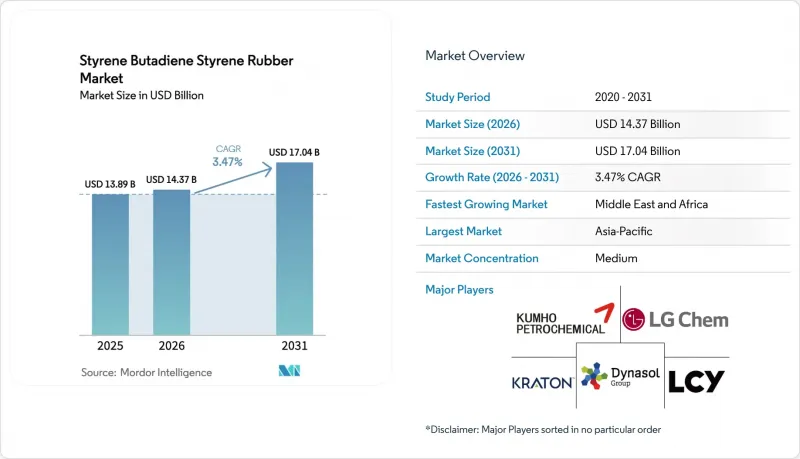
根據 Mordor Intelligence 預測,苯乙烯-丁二烯-苯乙烯 (SBS) 橡膠市場規模將從 2025 年的 138.9 億美元成長到 2026 年的 143.7 億美元,然後在 2031 年達到 170.4 億美元,2026 年的複合年成長率為 2031 年為 3.47%。
本報告按類型(含油型、不含油型)、應用(鞋類、瀝青改質、聚合物改質/複合、黏合劑/密封劑、其他應用)和地區(亞太地區、北美地區、歐洲地區、南美地區、中東和非洲)進行細分。市場預測以美元計價。
全球苯乙烯-丁二烯-苯乙烯(SBS)橡膠市場趨勢及洞察
鞋類製造地快速擴張
目前,越南、中國和印尼構成了一條連續的生產走廊,需要專門用於中底、外底和緩震鞋墊的SBS等級材料。這些高模量等級的材質能夠提供高性能鞋品牌所需的能量回彈特性,同時保持職場和運動場所安全所需的防滑係數。全球鞋類品牌的永續性目標正在推動生物基SBS的試點訂單,而SCG Chemicals在越南LSP工廠投資7億美元擴建乙烷工廠,凸顯了區域鞋底複合材料生產商實現單體自給自足的重要性。生產基地的整合也縮短了前置作業時間,實現了準時制庫存管理模式,並降低了成品組裝的營運資金。
在道路和屋頂施工工程中擴大SBS改質瀝青的使用。
政府資助的高速公路擴建和都市區屋頂維修項目指定使用SBS改性瀝青,以確保其在60 度C下具有抗車轍性能,在-20 度C下具有抗裂性能。流變學測試證實,與傳統瀝青相比,其使用壽命可延長高達40%,從而抵消了聚合物較高的初始成本。沙烏地阿拉伯和印度的國家基礎設施項目均要求使用高性能聚合物改質瀝青,SBS在新建車道和道路重鋪項目的競標規範中均被列為首要考慮因素。
原物料價格劇烈波動
英力士苯領位於薩尼亞的43萬噸苯乙烯生產設施永久關閉,導致北美單體供應緊張,推高了現貨價格。這迫使小規模的SBS混煉企業要麼協商短期進口,要麼支付溢價購買國內採購的原料。科騰公司於2025年4月提高了其全球SBS標價,以保護其利潤率免受苯乙烯價格飆升的影響,並強調原料成本佔產品成本的31%。同時,S-SBR輪胎彈性體產量的擴張也進一步加劇了供需緊張,因為丁二烯正從SBS生產商處釋放出來。
細分市場分析
2025年,含油型SBS仍將佔57.85%的出貨量佔有率。這主要得益於瀝青和鞋類化合物製造商的需求,他們看重透過添加高達25%的加工油來降低熔體黏度的能力。這一佔有率體現了經濟效益的最佳化,因為保持12 MPa以上的拉伸強度滿足了應用閾值,並拓展了高通量擠出加工的範圍。不含油型SBS具有優異的透明度和耐化學性,使其適用於醫療插頭、汽車通風墊片和電子設備機殼等對VOC含量有嚴格要求的應用。在需求不斷成長的推動下,不含油型SBS的消費量正以4.05%的複合年成長率成長,超過了SBS市場的整體成長率。
低黏度油基塑化劑簡化了包裝生產線上180公尺/分鐘熱熔膠的塗覆過程,而非油性塑化劑則適用於需要尺寸穩定性的射出成型成型軟觸感手柄。生物基加工油提供了一種混合方案,既能提高永續性評分,又能保持加工優勢。隨著商業性生產規模的擴大,一些買家可能會重新選擇油基塑化劑。
區域分析
亞太地區預計到2025年將佔全球銷售額的45.75%,並繼續維持苯乙烯-丁二烯-苯乙烯(SBS)市場的基石地位,這主要得益於中國和東協製造走廊的一體化石化產業。越南鞋類出口在2024年成長了11%,直接推動了SBS鞋底化合物的消費。此外,印度和印尼的政府道路發展計畫已指定使用SBS改性瀝青來增強應對氣候變遷的能力,從而支持該地區對SBS的穩定需求。
在北美,煉油廠的合理化調整正在減少國內苯乙烯產量,而薩尼亞工廠的關閉也使得該地區更加依賴通用型SBS的進口。同時,汽車和建築業日益嚴格的標準維持了對低VOC含量優質苯乙烯的需求。製造商正積極利用應用開發服務來對抗進口材料,以保持其市場佔有率。
在歐洲,儘管市場規模已趨於成熟,但可回收消費品的普及仍在穩步推進,SBS熱塑性塑膠的可回收性符合循環經濟的指南。由於REACH法規的嚴格性,混料生產商被迫轉向使用苯乙烯殘留量較低的生物基產品。
在中東和非洲,預計到2031年,年均複合成長率將達到3.75%,這主要得益於各國政府的大型企劃以及該地區石化產業園區的優勢,這些園區擁有豐富的原料,有利於SBS的後向一體化生產。南美洲則依賴宏觀經濟的復甦,而在巴西,儘管當地SBS樹脂產能有限,但汽車產量的成長正在支撐黏合劑和內裝件的應用。
其他好處
- Excel格式的市場預測(ME)表
- 3個月的分析師支持
目錄
第1章:引言
- 研究假設和市場定義
- 調查範圍
第2章:調查方法
第3章執行摘要
第4章 市場狀況
- 市場概覽
- 市場促進因素
- 鞋類製造地快速擴張
- 道路和屋頂施工中擴大使用SBS改性瀝青。
- 黏合劑和密封劑的需求加速成長
- 可回收消費品中熱可塑性橡膠的替代品
- 推出用於製造柔軟性透明零件的 3D 列印技術。
- 市場限制因素
- 原料(苯乙烯、丁二烯)價格波動劇烈。
- 來自氫化SEBS和其他先進TPE的競爭
- 加強揮發性有機化合物(VOC)法規/苯乙烯樹脂相關環境法規
- 價值鏈分析
- 波特五力模型
第5章 市場規模與成長預測
- 按類型
- 延長油
- 非石油擴展
- 透過使用
- 鞋類
- 瀝青改性
- 聚合物改質與複合
- 黏合劑和密封劑
- 其他
- 按地區
- 亞太地區
- 中國
- 印度
- 日本
- 韓國
- 其他亞太國家
- 北美洲
- 美國
- 加拿大
- 墨西哥
- 歐洲
- 德國
- 英國
- 義大利
- 法國
- 俄羅斯
- 其他歐洲國家
- 南美洲
- 巴西
- 阿根廷
- 其他南美國家
- 中東和非洲
- 沙烏地阿拉伯
- 阿拉伯聯合大公國
- 南非
- 埃及
- 其他中東和非洲國家
- 亞太地區
第6章 競爭情勢
- 市場集中度
- 策略趨勢
- 市佔率/排名分析
- 公司簡介
- ARLANXEO
- Asahi Kasei Corporation
- Bridgestone
- China National Petroleum Corporation(CNPC)
- Dycon Chemicals
- Dynasol Group
- Exxon Mobil Corporation
- The Goodyear Tire & Rubber Company
- JSR Corporation
- Kraton Corporation
- Kumho Petrochemical Co., Ltd.
- LCY GROUP
- LG Chem Ltd.
- SIBUR Holding PJSC
- Synthos
- Trinseo
- TSRC Corporation
- Versalis SpA
- ZEON CORPORATION
第7章 市場機會與未來展望
According to Mordor Intelligence, the styrene butadiene styrene rubber market size is expected to grow from USD 13.89 billion in 2025 to USD 14.37 billion in 2026 and is forecast to reach USD 17.04 billion by 2031 at 3.47% CAGR over 2026-2031.
This report is Segmented by Type (Oil-Extended and Non-Oil-Extended), Application (Footwear, Asphalt Modification, Polymer Modification/Compounding, Adhesives and Sealants, and Other Applications), and Geography (Asia-Pacific, North America, Europe, South America, and Middle-East and Africa). The Market Forecasts are Provided in Terms of Value (USD).
Global Styrene Butadiene Styrene Rubber Market Trends and Insights
Rapid Expansion of Footwear Manufacturing Hubs
Vietnam, China, and Indonesia now form a contiguous manufacturing corridor that demands specialized SBS grades engineered for midsoles, outsoles, and cushioning inserts. High-elastic variants deliver energy return properties sought by performance footwear brands while maintaining anti-slip coefficients critical for workplace and athletic safety. Sustainability targets from global shoe brands are spurring pilot orders for bio-attributed SBS, and SCG Chemicals' USD 700 million ethane upgrade at its LSP Vietnam complex underlines the priority of monomer self-sufficiency for regional sole compounders. Clustered production also shortens lead times, enabling just-in-time inventory models that lower working capital for finished-goods assemblers.
Rising SBS-Modified Bitumen Use in Road and Roofing Projects
Government-funded highway expansions and urban roofing retrofits specify SBS-modified binders for resilience against rutting at 60°C and cracking at -20°C. Rheological testing confirms service-life extensions of up to 40% versus conventional asphalt, offsetting the higher initial polymer cost. National infrastructure plans in Saudi Arabia and India require performance-grade asphalt with polymer modification, positioning SBS at the top of bidder specifications for both new lane construction and resurfacing programs.
High Feedstock Price Volatility
The permanent shutdown of INEOS Styrolution's 430 kt styrene unit in Sarnia constrains North American monomer supply and lifts spot prices, prompting smaller SBS formulators to negotiate short-term imports or pay premiums for domestic volumes. Kraton raised global SBS list prices in April 2025 to defend margin against styrene spikes, highlighting the 31% cost-of-goods exposure to raw materials. Parallel expansions in S-SBR tire elastomers siphon butadiene from SBS producers, further tightening balances.
Other drivers and restraints analyzed in the detailed report include:
- Accelerating Demand from Hot-Melt Adhesives and Sealants
- Thermoplastic Elastomer Substitution for Recyclable Consumer Goods
- Competition from Hydrogenated SEBS and Other Advanced TPEs
For complete list of drivers and restraints, kindly check the Table Of Contents.
Segment Analysis
Oil-extended grades continued to command a 57.85% volume share in 2025, sustained by asphalt and footwear compounders who appreciate the melt-viscosity reduction that can be achieved at loadings of up to 25% process oil. This share reflects economic optimization where tensile retention above 12 MPa satisfies application thresholds, and processing windows widen for high-throughput extrusion. Non-oil-extended SBS delivers superior clarity and chemical resistance, positioning it for applications such as medical plugs, automotive vent gaskets, and electronics housings that require passing stringent VOC benchmarks. Rising demand lifts non-oil-extended consumption at a 4.05% CAGR, outpacing overall styrene butadiene styrene market growth.
Lower-viscosity oil-extended grades simplify hot-melt adhesive coating at 180 m/min for packaging lines, while non-oil-extended variants are suitable for injection-molded soft-touch grips that require dimensional stability. Bio-based process oils offer a hybrid approach that retains processing advantages while enhancing sustainability scores, potentially shifting some buyers back toward oil-plasticized offerings as commercial volumes increase.
Complete Report Scope:
- By Type
- Oil-Extended
- Non-Oil-Extended
- By Application
- Footwear
- Asphalt Modification
- Polymer Modification / Compounding
- Adhesives and Sealants
- Other Applications
- By Geography
- Asia-Pacific
- China
- India
- Japan
- South Korea
- Rest of Asia-Pacific
- North America
- United States
- Canada
- Mexico
- Europe
- Germany
- United Kingdom
- Italy
- France
- Russia
- Rest of Europe
- South America
- Brazil
- Argentina
- Rest of South America
- Middle-East and Africa
- Saudi Arabia
- United Arab Emirates
- South Africa
- Egypt
- Rest of Middle-East and Africa
- Asia-Pacific
Geography Analysis
The Asia-Pacific region held 45.75% of 2025 revenue and remains the anchor for the styrene butadiene styrene market due to integrated petrochemicals in China and ASEAN manufacturing corridors. Footwear exports from Vietnam increased by 11% in 2024, directly boosting SBS sole-compound consumption. Government road programs in India and Indonesia also specify SBS-modified bitumen for climate resilience, supporting steady regional drawdown.
North America's refinery rationalization reduces domestic styrene output, and the Sarnia closure shifts the region toward import dependence for commodity SBS, even as elevated automotive and construction standards sustain demand for premium grades with low VOC signatures. Producers leverage application development services to protect their share against imported material.
Europe shows mature volume yet steady uptake for recyclable consumer goods, where SBS's thermoplastic recoverability aligns with circular-economy directives. Stringent REACH protocols are pushing formulators toward low-styrene-residual and bioattributed variants.
The Middle East and Africa's 3.75% CAGR through 2031 is driven by sovereign infrastructure megaprojects and the region's advantage in feedstock-rich petrochemical parks that can backward integrate SBS. South America relies on macroeconomic recovery; Brazil's uptick in automobile production supports adhesives and interior trim applications, despite limited local SBS resin capacity.
- ARLANXEO
- Asahi Kasei Corporation
- Bridgestone
- China National Petroleum Corporation (CNPC)
- Dycon Chemicals
- Dynasol Group
- Exxon Mobil Corporation.
- The Goodyear Tire & Rubber Company
- JSR Corporation
- Kraton Corporation
- Kumho Petrochemical Co., Ltd.
- LCY GROUP
- LG Chem Ltd.
- SIBUR Holding PJSC
- Synthos
- Trinseo
- TSRC Corporation
- Versalis S.p.A.
- ZEON CORPORATION
Additional Benefits:
- The market estimate (ME) sheet in Excel format
- 3 months of analyst support
TABLE OF CONTENTS
1 Introduction
- 1.1 Study Assumptions and Market Definition
- 1.2 Scope of the Study
2 Research Methodology
3 Executive Summary
4 Market Landscape
- 4.1 Market Overview
- 4.2 Market Drivers
- 4.2.1 Rapid expansion of footwear manufacturing hubs
- 4.2.2 Rising SBS-modified bitumen use in road and roofing projects
- 4.2.3 Accelerating demand from hot-melt adhesives and sealants
- 4.2.4 Thermoplastic elastomer substitution for recyclable consumer goods
- 4.2.5 3-D printing adoption for flexible and transparent parts
- 4.3 Market Restraints
- 4.3.1 High feedstock (styrene, butadiene) price volatility
- 4.3.2 Competition from hydrogenated SEBS and other advanced TPEs
- 4.3.3 Tightening VOC / environmental regulations on styrenics
- 4.4 Value Chain Analysis
- 4.5 Porter's Five Forces
- 4.5.1 Bargaining Power of Suppliers
- 4.5.2 Bargaining Power of Buyers
- 4.5.3 Threat of New Entrants
- 4.5.4 Threat of Substitutes
- 4.5.5 Degree of Competition
5 Market Size & Growth Forecasts (Value)
- 5.1 By Type
- 5.1.1 Oil-Extended
- 5.1.2 Non-Oil-Extended
- 5.2 By Application
- 5.2.1 Footwear
- 5.2.2 Asphalt Modification
- 5.2.3 Polymer Modification / Compounding
- 5.2.4 Adhesives and Sealants
- 5.2.5 Other Applications
- 5.3 By Geography
- 5.3.1 Asia-Pacific
- 5.3.1.1 China
- 5.3.1.2 India
- 5.3.1.3 Japan
- 5.3.1.4 South Korea
- 5.3.1.5 Rest of Asia-Pacific
- 5.3.2 North America
- 5.3.2.1 United States
- 5.3.2.2 Canada
- 5.3.2.3 Mexico
- 5.3.3 Europe
- 5.3.3.1 Germany
- 5.3.3.2 United Kingdom
- 5.3.3.3 Italy
- 5.3.3.4 France
- 5.3.3.5 Russia
- 5.3.3.6 Rest of Europe
- 5.3.4 South America
- 5.3.4.1 Brazil
- 5.3.4.2 Argentina
- 5.3.4.3 Rest of South America
- 5.3.5 Middle-East and Africa
- 5.3.5.1 Saudi Arabia
- 5.3.5.2 United Arab Emirates
- 5.3.5.3 South Africa
- 5.3.5.4 Egypt
- 5.3.5.5 Rest of Middle-East and Africa
- 5.3.1 Asia-Pacific
6 Competitive Landscape
- 6.1 Market Concentration
- 6.2 Strategic Moves
- 6.3 Market Share**/Ranking Analysis
- 6.4 Company Profiles (includes Global level Overview, Market level overview, Core Segments, Financials as available, Strategic Information, Market Rank/Share, Products & Services, Recent Developments)
- 6.4.1 ARLANXEO
- 6.4.2 Asahi Kasei Corporation
- 6.4.3 Bridgestone
- 6.4.4 China National Petroleum Corporation (CNPC)
- 6.4.5 Dycon Chemicals
- 6.4.6 Dynasol Group
- 6.4.7 Exxon Mobil Corporation.
- 6.4.8 The Goodyear Tire & Rubber Company
- 6.4.9 JSR Corporation
- 6.4.10 Kraton Corporation
- 6.4.11 Kumho Petrochemical Co., Ltd.
- 6.4.12 LCY GROUP
- 6.4.13 LG Chem Ltd.
- 6.4.14 SIBUR Holding PJSC
- 6.4.15 Synthos
- 6.4.16 Trinseo
- 6.4.17 TSRC Corporation
- 6.4.18 Versalis S.p.A.
- 6.4.19 ZEON CORPORATION
7 Market Opportunities & Future Outlook
- 7.1 White-space and Unmet-Need Assessment

 苯乙烯-丁二烯乳膠市場:全球市場預測,2026-2032年
 苯乙烯-丁二烯橡膠(SBR):市場佔有率分析、行業趨勢和統計數據、成長預測(2026-2031)
 SBR乳膠全球市場研究報告,2026年
 苯乙烯-丁二烯-苯乙烯(SBS)嵌段共聚物市場:依產品種類、應用、最終用途產業及地區分類。
 苯乙烯-丁二烯橡膠市場規模、佔有率、成長及全球產業分析:按類型、應用和地區分類,並提供2026-2034年的洞察和預測
 全球丁苯橡膠市場:依應用、類型及地區分類-市場規模、產業趨勢、機會分析及2026-2035年預測2026-2034年全球苯乙烯-丁二烯橡膠市場規模、佔有率、趨勢和成長分析報告
 2026年全球苯乙烯-丁二烯橡膠(SBR)市場報告溶液聚合苯乙烯-丁二烯橡膠市場-2026-2031年預測
 苯乙烯-丁二烯乳膠市場規模、佔有率及成長分析(依產品類型、應用、終端用戶產業、通路及地區分類)-2026-2033年產業預測