


 |
市場調查報告書
商品編碼
2121771
苯乙烯-丁二烯橡膠(SBR):市場佔有率分析、行業趨勢和統計數據、成長預測(2026-2031)Styrene Butadiene Rubber (SBR) - Market Share Analysis, Industry Trends & Statistics, Growth Forecasts (2026 - 2031) |
||||||

※ 本網頁內容可能與最新版本有所差異。詳細情況請與我們聯繫。
根據 Mordor Intelligence 預測,苯乙烯-丁二烯橡膠(SBR) 市場規模將從 2025 年的 143.9 億美元成長到 2026 年的 149.4 億美元,然後在 2031 年達到 179.9 億美元,2026 年至 2031 年的複合年成長率為 3.80%。
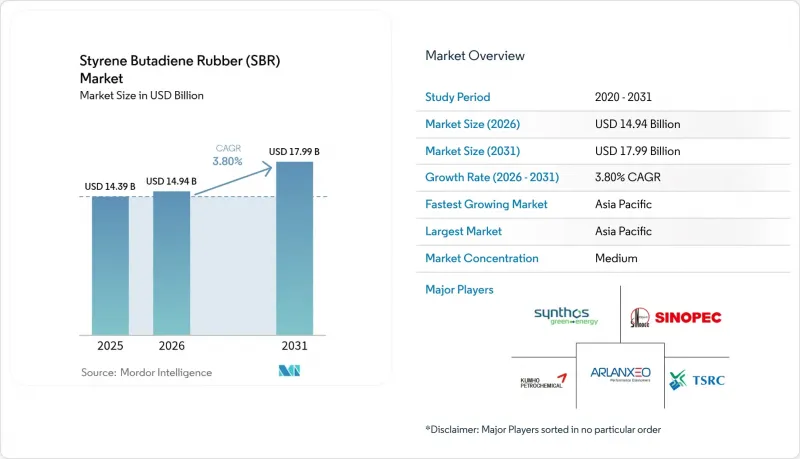
本報告按類型(乳液型丁苯橡膠、溶液型丁苯橡膠)、應用領域(輪胎、黏合劑、鞋類及其他應用)和地區(亞太地區、北美地區、歐洲地區、南美地區以及中東和非洲地區)進行細分。市場預測以美元計價。
全球苯乙烯-丁二烯橡膠(SBR)市場趨勢及洞察
新興國家輪胎更換需求激增
汽車保有量的成長和道路網路的建設導致輪胎損耗率顯著上升,從而推高了輪胎配方中對苯乙烯-丁二烯橡膠)的需求。在印度,替換輪胎已佔輪胎總消耗量的60%,普利司通決定投資8,500萬美元擴大在印度的產能以滿足此需求。子午線輪胎的普及使每條輪胎的SBR用量加倍,進一步擴大了需求。由於替換週期受經濟放緩的影響小於整車需求,因此即使在產業低迷時期,替換週期也能起到防止需求下降的作用。因此,預計亞洲和拉丁美洲等新興市場將在中期為全球銷售量提供強勁的成長動力。
歐盟和中國向低滾動阻力輪胎過渡
旨在提高車隊燃油效率的法規正在推動對溶液型丁苯橡膠(SBR)的需求,這類橡膠具有低滯後性,並可用於添加二氧化矽的胎面膠料。歐盟的消費者標籤檢視法規已經促使消費者轉向滾動阻力等級為「A」的產品,製造商在這些高階產品類別中實現了15-20%的銷售成長。在中國重型車輛領域也出現了類似的趨勢,這為能夠提供先進功能的供應商帶來了龐大的商機。乳液型和溶液型丁苯橡膠之間日益擴大的性能差距將推高高性能聚合物的價格溢價,同時也將為研發主導生產商帶來豐厚的回報。
丁二烯價格波動與原油價格相關
原物料成本通常佔SBR總製造成本的70%之多,原油價格飆漲會擠壓利潤空間。外匯波動也為出口商帶來更多不確定性。儘管2024年天然橡膠價格上漲暫時提升了SBR的成本競爭力,但原油衍生丁二烯價格翻倍迅速削弱了這一優勢。包含固定價格條款的長期供應合約限制了產業將原物料價格的突然上漲轉嫁到產品價格的能力,迫使許多公司採取避險和庫存管理策略,從而增加了營運資金需求。
細分市場分析
2025年,乳液型丁苯橡膠(SBR)產量佔總產量的70.42%,但溶液型丁苯橡膠(SBR)在2031年之前將以4.27%的複合年成長率(CAGR)保持最高成長。按溶液型等級分類,苯乙烯-丁二烯橡膠(SBR)的市場規模預計將從2026年的42.7億美元成長到2031年的52.6億美元,這反映了高性能輪胎胎面的細分需求。功能化溶液聚合物具有更窄的分子量分佈和更優異的填料相容性,能夠在不影響濕地抓地力的前提下減輕胎面重量。阿朗新歐(ARLANXEO)近期在多爾馬根(Dormagen)的產能擴張符合汽車製造商對低滾動阻力輪胎的需求。隨著性能規格日益嚴格,溶液型丁苯橡膠(SBR)的市場佔有率正在擴大,尤其是在歐洲、中國和高階替換輪胎市場,這些地區的消費者認知度最高。由於規模經濟、廣泛的反應器部署以及廣泛的配方靈活性,乳化型序批式反應器(SBR)在大眾市場領域仍然至關重要。然而,其價格主導的定位使其極易受到原物料價格波動的影響。因此,將低成本乳化平台與高階解決方案產品結合的混合行銷策略,將有助於在汽車產業的整個經濟週期中保障收入來源。
預計到2031年,溶液型苯乙烯-丁二烯橡膠(SBR)的市場佔有率將成長2.7個百分點,這主要得益於輪胎標籤法規的不斷完善、電動汽車的興起以及原始設備製造商(OEM)的永續性目標。即使在對成本較為敏感的新興市場,政策主導的濕地抓地力和滾動阻力性能要求也在加速向溶液型SBR的轉型。投資於連續生產流程、先進催化系統和線上功能化的製造商,既能獲得溢價,又能透過提高能源效率和數位化工廠控制來降低可變成本。
區域分析
預計亞太地區在2025年將維持45.10%的銷售佔有率,並在2031年之前以4.17%的複合年成長率成長。中國憑藉其強大的輪胎和合成橡膠自主生產能力,在該地區佔據主導地位,並實現了乳液和溶液級橡膠的快速產能擴張。國內需求受到汽車保有量成長、基礎設施建設獎勵策略以及國家回收配額制度的推動,這些因素共同創造了出口產能。預計到2032年,印度輪胎產業銷售額將加倍,達到220億美元,將刺激對產能擴張和後向整合的投資。泰國和馬來西亞透過天然橡膠生產補充上游供應,為混煉企業提供一體化採購優勢。然而,碳定價機制的實施、更嚴格的空氣排放法規以及污染防治可能會導致成本上升,並促使老舊的丁苯橡膠(SBR)資產在區域內轉移。
在北美,預計消費市場將保持成熟和穩定,這主要得益於對替換輪胎、用於公路維修的聚合物改質瀝青以及電商包裝用黏合劑的需求。美國輪胎製造商繼續專注於輕型卡車和超高性能輪胎等細分市場,這些市場大量使用功能性丁苯橡膠(SBR)解決方案。墨西哥作為汽車組裝近岸外包中心的崛起,進一步推高了汽車橡膠零件的需求。加拿大的採礦和油砂產業對工業用丁苯橡膠的需求依然強勁,尤其是在輸送機和防護塗層領域。總體而言,該地區的成長率接近全球平均水平,但其發展重心偏向高附加價值聚合物。
在歐洲,汽車生產成長乏力拖累了整體市場,但歐盟優先發展先進低碳SBR的永續性議程正為其帶來利多。德國、法國和義大利的輪胎工廠正在加速採用環保性能等級的SBR,而從韓國和新加坡進口的溶液型SBR數量也不斷增加,直到歐洲產能擴張。東歐的高速公路和機場維修計畫正在推廣使用聚合物改質瀝青,這在一定程度上抵消了汽車產業的低迷。即將實施的碳邊境調節措施(CBAM)預計將限制高碳進口,並鼓勵出口國在地採購並向可再生能源轉型。在斯堪地那維亞和比荷盧經濟聯盟市場,再生SBR在地板材料和體育設施表面材料領域處於領先地位,催生了許多利基市場,提升了循環解決方案的價值。
其他好處:
- Excel格式的市場預測(ME)表
- 3個月的分析師支持
目錄
第1章:引言
- 研究假設和市場定義
- 調查範圍
第2章:調查方法
第3章執行摘要
第4章 市場狀況
- 市場概覽
- 市場促進因素
- 新興國家輪胎更換需求激增
- 歐盟和中國向低滾動阻力輪胎過渡
- 高速公路和機場的快速建設推高了對聚合物改質瀝青的需求。
- 原始設備製造商正在推廣使用功能化S-SBR來減輕胎面重量10%。
- 東協國家強制要求對濕地抓地力性能進行標籤標註,這推動了高乙烯基含量 S-SBR 輪胎的普及。
- 市場限制因素
- 丁二烯價格波動與原油價格相關
- 鞋類產業中TPE替代品的興起
- 從 2027 年起,歐盟的 CBAM(以消費者為基礎的製造和有效性)也將適用於合成橡膠的進口。
- 中國的回收配額制度正在降低輸送機對原生SBR的需求。
- 價值鏈分析
- 波特五力模型
第5章 市場規模與成長預測
- 按類型
- 乳液SBR
- SBR溶液
- 透過使用
- 胎
- 黏合劑
- 鞋類
- 其他用途
- 按地區
- 亞太地區
- 中國
- 日本
- 印度
- 韓國
- 泰國
- 馬來西亞
- 越南
- 印尼
- 其他亞太國家
- 北美洲
- 美國
- 加拿大
- 墨西哥
- 歐洲
- 德國
- 法國
- 英國
- 義大利
- 西班牙
- 北歐國家
- 土耳其
- 俄羅斯
- 其他歐洲國家
- 南美洲
- 巴西
- 阿根廷
- 哥倫比亞
- 其他南美國家
- 中東和非洲
- 沙烏地阿拉伯
- 阿拉伯聯合大公國
- 卡達
- 埃及
- 奈及利亞
- 南非
- 其他中東和非洲國家
- 亞太地區
第6章 競爭情勢
- 市場集中度
- 策略趨勢
- 市佔率分析
- 公司簡介
- ARLANXEO
- Asahi Kasei Corporation
- China Petrochemical Corporation(Sinopec)
- Dynasol Group
- ENEOS Corporation
- Eni SpA
- JSR Corporation
- Kemipex
- Kumho Petrochemical
- LANXESS
- LG Chem
- PETKIM
- SIBUR Holding PJSC
- Sumitomo Chemical Co. Ltd.
- Synthos
- The Goodyear Tire & Rubber Company
- Trinseo
- TSRC
第7章 市場機會與未來展望
According to Mordor Intelligence, the styrene butadiene rubber market size is expected to grow from USD 14.39 billion in 2025 to USD 14.94 billion in 2026 and is forecast to reach USD 17.99 billion by 2031 at 3.80% CAGR over 2026-2031.
This report is Segmented by Type (Emulsion SBR, Solution SBR), Application (Tyres, Adhesives, Footwear, Other Applications), and Geography (Asia-Pacific, North America, Europe, South America, Middle East and Africa). The Market Forecasts are Provided in Terms of Value (USD).
Global Styrene Butadiene Rubber (SBR) Market Trends and Insights
Tire Replacement Demand Spike in Emerging Economies
Vehicle fleet expansion combined with improved road networks significantly raises tire wear rates, pushing Styrene Butadiene Rubber market demand for tire compounds. Replacement tires already contribute 60% of total tire consumption in India, and Bridgestone has responded by committing USD 85 million to expand local production capacity. Radial tire adoption multiplies SBR usage per unit, further escalating volumes. Replacement cycles remain less affected by economic slowdowns than OEM demand, providing downside protection during industry troughs. Emerging Asia and Latin America therefore deliver a reliable mid-term uplift to global sales.
Shift Toward Low-Rolling-Resistance Tires in EU & China
Regulations aimed at fleet fuel efficiency elevate demand for solution SBR grades that enable silica-filled tread compounds with lower hysteresis. EU consumer labeling has already shifted purchasing toward A-rated rolling-resistance products, with manufacturers recording 15-20% volume growth in these premium categories. China mirrors the trend in heavy-duty segments, translating to sizeable opportunities for suppliers capable of advanced functionalisation. The widening performance gap between emulsion and solution SBR reinforces price premiums for high-spec polymers while rewarding R&D-driven producers.
Crude-Linked Butadiene Price Volatility
Feedstock costs typically represent up to 70% of total SBR manufacturing expenses, leaving margins exposed when crude prices spike. Currency swings add a further layer of unpredictability for exporters. While natural rubber rallies in 2024 temporarily improved SBR's relative cost position, dual increases in crude derived butadiene quickly eroded that advantage. Long-term supplier contracts with fixed pricing clauses limit the industry's ability to pass on sudden feedstock hikes, forcing many firms to adopt hedging and inventory strategies that raise working capital requirements.
Other drivers and restraints analyzed in the detailed report include:
- Rapid Highway & Airport Construction Boosting Polymer-Modified Asphalt
- OEM Push for 10% Tread Weight Reduction via Functionalised S-SBR
- Growing TPE Substitutes in Footwear
For complete list of drivers and restraints, kindly check the Table Of Contents.
Segment Analysis
Solution SBR recorded the highest 4.27% CAGR through 2031, even though emulsion SBR controlled 70.42% of 2025 volumes. The Styrene Butadiene Rubber market size attributed to solution grades is projected to expand from USD 4.27 billion in 2026 to USD 5.26 billion in 2031, reflecting granular demand for high-performance tire treads. Functionalised solution polymers achieve tighter molecular weight distributions and superior filler compatibility, enabling tread weight reductions without compromising wet grip. ARLANXEO's recent capacity addition in Dormagen aligns with automaker requirements for low-rolling-resistance tires. As performance specifications tighten, solution SBR gains share, particularly in Europe, China, and premium replacement markets where consumer awareness is highest. Emulsion SBR remains indispensable in mass-market segments thanks to scale advantages, extensive installed reactor base, and wide compounding latitude. Yet its price-driven positioning leaves margins vulnerable to feedstock swings. Blended distribution strategies that pair low-cost emulsion platforms with premium solution offerings thus protect revenue streams across automotive cycles.
The Styrene Butadiene Rubber market share commanded by solution grades is likely to rise by 2.7 percentage points by 2031, supported by ongoing tire label regulation, electric vehicle proliferation, and OEM sustainability targets. Even in cost-sensitive emerging economies, policy-driven requirements for wet-grip and rolling-resistance performance accelerate migration to solution SBR. Producers investing in continuous processes, advanced catalyst systems, and in-line functionalisation can capture premium pricing while lowering variable costs via energy efficiency improvements and digitalised plant control.
Complete Report Scope:
- By Type
- Emulsion SBR
- Solution SBR
- By Application
- Tyres
- Adhesives
- Footwear
- Other Applications
- By Geography
- Asia-Pacific
- China
- Japan
- India
- South Korea
- Thailand
- Malaysia
- Vietnam
- Indonesia
- Rest of Asia-Pacific
- North America
- United States
- Canada
- Mexico
- Europe
- Germany
- France
- United Kingdom
- Italy
- Spain
- Nordic
- Turkey
- Russia
- Rest of Europe
- South America
- Brazil
- Argentina
- Colombia
- Rest of South America
- Middle East and Africa
- Saudi Arabia
- United Arab Emirates
- Qatar
- Egypt
- Nigeria
- South Africa
- Rest of Middle East and Africa
- Asia-Pacific
Geography Analysis
Asia-Pacific maintained 45.10% revenue share in 2025 and is projected to grow at 4.17% CAGR through 2031. China anchors regional dominance with extensive captive tire and synthetic rubber capacity, enabling fast scale-up for both emulsion and solution grades. Domestic demand receives a boost from rising car parc, infrastructure stimulus, and national recycling quotas that release capacity for export. India's market is propelled by a forecast doubling of tire industry revenue to USD 22 billion by 2032, spurring incremental capacities and backward integration investments. Thailand and Malaysia complement upstream supply via natural rubber output, affording compounders integrated sourcing advantages. However, carbon pricing, stricter air-emission norms, and water-pollution controls could trigger cost escalations or relocation of older SBR assets within the bloc.
North America delivers mature yet steady consumption underpinned by replacement tires, polymer-modified asphalt for highway rehabilitation, and adhesive uptake in e-commerce packaging. United States tire makers continue to emphasise performance niches such as light-truck and ultra-high-performance variants that lean heavily on functionalised solution SBR. Mexico's emergence as a near-shoring hub for motor vehicle assembly adds incremental demand for automotive rubber parts. Canadian mining and oil sands operations keep industrial SBR uses buoyant, particularly in conveyor belts and protective coatings. Overall, regional growth hovers close to the global average but skews toward higher value polymers.
Europe is constrained by a lower vehicle production trajectory but benefits from the EU's sustainability agenda that favours advanced and lower-carbon SBR. German, French, and Italian tire plants intensify adoption of eco-performance grades, amplifying imports of solution SBR from Korea and Singapore until European capacity expands. Eastern European highway and airport upgrades stimulate polymer-modified asphalt usage, partially offsetting automotive softness. The upcoming CBAM will likely curtail high-carbon imports and encourage local sourcing or renewable-energy upgrades in exporting countries. Scandinavian and Benelux markets lead on recycled SBR applications in flooring and sports surfaces, fostering niches that valorise circular solutions.
- ARLANXEO
- Asahi Kasei Corporation
- China Petrochemical Corporation (Sinopec)
- Dynasol Group
- ENEOS Corporation
- Eni S.p.A
- JSR Corporation
- Kemipex
- Kumho Petrochemical
- LANXESS
- LG Chem
- PETKIM
- SIBUR Holding PJSC
- Sumitomo Chemical Co. Ltd.
- Synthos
- The Goodyear Tire & Rubber Company
- Trinseo
- TSRC
Additional Benefits:
- The market estimate (ME) sheet in Excel format
- 3 months of analyst support
TABLE OF CONTENTS
1 Introduction
- 1.1 Study Assumptions & Market Definition
- 1.2 Scope of the Study
2 Research Methodology
3 Executive Summary
4 Market Landscape
- 4.1 Market Overview
- 4.2 Market Drivers
- 4.2.1 Tire replacement demand spike in emerging economies
- 4.2.2 Shift toward low-rolling-resistance tires in EU & China
- 4.2.3 Rapid highway & airport construction boosting polymer-modified asphalt
- 4.2.4 OEM push for 10% tread weight reduction via functionalised S-SBR
- 4.2.5 Mandatory wet-grip labelling in ASEAN spurring high-vinyl S-SBR uptake
- 4.3 Market Restraints
- 4.3.1 Crude-linked butadiene price volatility
- 4.3.2 Growing TPE substitutes in footwear
- 4.3.3 EU CBAM extending to synthetic rubber imports post-2027
- 4.3.4 Recycling quotas in China cutting virgin SBR demand for conveyor belts
- 4.4 Value Chain Analysis
- 4.5 Porter's Five Forces
- 4.5.1 Bargaining Power of Suppliers
- 4.5.2 Bargaining Power of Buyers
- 4.5.3 Threat of New Entrants
- 4.5.4 Threat of Substitutes
- 4.5.5 Competitive Rivalry
5 Market Size & Growth Forecasts (Value)
- 5.1 By Type
- 5.1.1 Emulsion SBR
- 5.1.2 Solution SBR
- 5.2 By Application
- 5.2.1 Tyres
- 5.2.2 Adhesives
- 5.2.3 Footwear
- 5.2.4 Other Applications
- 5.3 By Geography
- 5.3.1 Asia-Pacific
- 5.3.1.1 China
- 5.3.1.2 Japan
- 5.3.1.3 India
- 5.3.1.4 South Korea
- 5.3.1.5 Thailand
- 5.3.1.6 Malaysia
- 5.3.1.7 Vietnam
- 5.3.1.8 Indonesia
- 5.3.1.9 Rest of Asia-Pacific
- 5.3.2 North America
- 5.3.2.1 United States
- 5.3.2.2 Canada
- 5.3.2.3 Mexico
- 5.3.3 Europe
- 5.3.3.1 Germany
- 5.3.3.2 France
- 5.3.3.3 United Kingdom
- 5.3.3.4 Italy
- 5.3.3.5 Spain
- 5.3.3.6 Nordic
- 5.3.3.7 Turkey
- 5.3.3.8 Russia
- 5.3.3.9 Rest of Europe
- 5.3.4 South America
- 5.3.4.1 Brazil
- 5.3.4.2 Argentina
- 5.3.4.3 Colombia
- 5.3.4.4 Rest of South America
- 5.3.5 Middle East and Africa
- 5.3.5.1 Saudi Arabia
- 5.3.5.2 United Arab Emirates
- 5.3.5.3 Qatar
- 5.3.5.4 Egypt
- 5.3.5.5 Nigeria
- 5.3.5.6 South Africa
- 5.3.5.7 Rest of Middle East and Africa
- 5.3.1 Asia-Pacific
6 Competitive Landscape
- 6.1 Market Concentration
- 6.2 Strategic Moves
- 6.3 Market Share Analysis
- 6.4 Company Profiles {(includes Global level Overview, Market level overview, Core Segments, Financials as available, Strategic Information, Market Rank/Share for key companies, Products & Services, and Recent Developments)}
- 6.4.1 ARLANXEO
- 6.4.2 Asahi Kasei Corporation
- 6.4.3 China Petrochemical Corporation (Sinopec)
- 6.4.4 Dynasol Group
- 6.4.5 ENEOS Corporation
- 6.4.6 Eni S.p.A
- 6.4.7 JSR Corporation
- 6.4.8 Kemipex
- 6.4.9 Kumho Petrochemical
- 6.4.10 LANXESS
- 6.4.11 LG Chem
- 6.4.12 PETKIM
- 6.4.13 SIBUR Holding PJSC
- 6.4.14 Sumitomo Chemical Co. Ltd.
- 6.4.15 Synthos
- 6.4.16 The Goodyear Tire & Rubber Company
- 6.4.17 Trinseo
- 6.4.18 TSRC
7 Market Opportunities & Future Outlook
- 7.1 White-Space & Unmet-Need Assessment

 苯乙烯-丁二烯-苯乙烯(SBS)橡膠:市場佔有率分析、行業趨勢和統計數據以及成長預測(2026-2031 年)
 苯乙烯-丁二烯乳膠市場:全球市場預測,2026-2032年
 SBR乳膠全球市場研究報告,2026年
 苯乙烯-丁二烯-苯乙烯(SBS)嵌段共聚物市場:依產品種類、應用、最終用途產業及地區分類。
 苯乙烯-丁二烯橡膠市場規模、佔有率、成長及全球產業分析:按類型、應用和地區分類,並提供2026-2034年的洞察和預測
 全球丁苯橡膠市場:依應用、類型及地區分類-市場規模、產業趨勢、機會分析及2026-2035年預測2026-2034年全球苯乙烯-丁二烯橡膠市場規模、佔有率、趨勢和成長分析報告
 2026年全球苯乙烯-丁二烯橡膠(SBR)市場報告溶液聚合苯乙烯-丁二烯橡膠市場-2026-2031年預測
 苯乙烯-丁二烯乳膠市場規模、佔有率及成長分析(依產品類型、應用、終端用戶產業、通路及地區分類)-2026-2033年產業預測