


 |
市場調查報告書
商品編碼
2163444
防火塗料:市場佔有率分析、產業趨勢與統計、成長預測(2026-2031 年)Fire-resistant Coatings - Market Share Analysis, Industry Trends & Statistics, Growth Forecasts (2026 - 2031) |
||||||

※ 本網頁內容可能與最新版本有所差異。詳細情況請與我們聯繫。
據 Mordor Intelligence 稱,2025 年防火塗料市場價值為 17.8 億美元,預計在預測期(2026-2031 年)內將以 5.13% 的複合年成長率成長,從 2026 年的 18.7 億美元成長到 2031 年的 24 億美元。
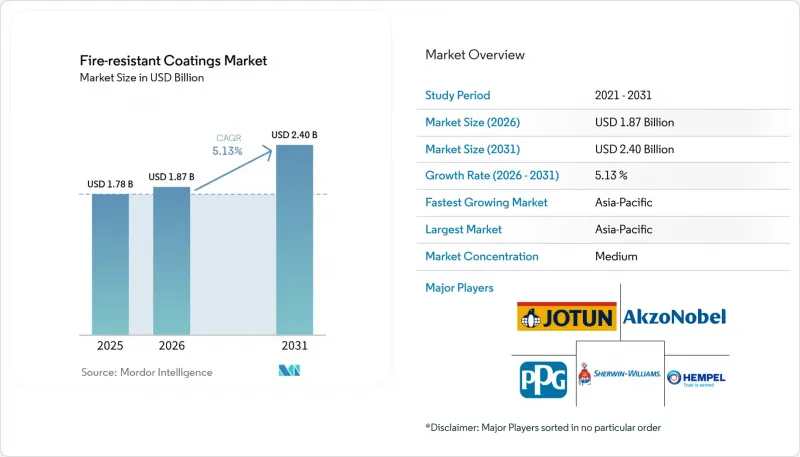
全球防火塗料市場趨勢及洞察
執行消防安全標準和認證要求
消防安全標準的變更正在擴大對防火塗料的需求。在英國,2025年12月從BS 476過渡到BS EN 13501-1標準,提高了對18米以上建築物易燃覆材的要求。此次過渡要求新建高層建築工程和現有商業建築的維修必須採用經歐洲標準認證的可擴展防火系統。印度的「2024年國家建築標準」強制要求15公尺以上的商業建築使用通過IS 3809測試的塗料,這將促進孟買和班加羅爾的維修工程。修訂後的建築產品法規要求從2027年第三季起提交ISO 17025認證的性能聲明,這提高了不具備認證測試能力的供應商的合規要求。這些要求將刺激新建和現有設施的需求,儘管維修項目可能會分階段實施,歷時數年。
高層建築、基礎設施和維修項目的成長
在高層建築中,由於承重鋼結構需要在整個建築框架內得到保護,因此必須採用經認證的被動防火措施。與水泥基防火塗料相比,當鋼材裸露或需要更潔淨的表面處理時,企劃團隊擴大選擇薄膜膨脹型防火系統。亞太地區的基礎設施投資推動了地鐵系統、機場、資料中心和半導體設施等領域的防火塗料需求。這些終端用戶領域的投資週期各不相同,從而支撐了對防火塗料的整體需求。在商業項目中,快速施工仍然至關重要,尤其是在無氣噴塗系統能夠以更少的塗層覆蓋大面積鋼骨的情況下。資料中心和先進製造設施需要更高規格的防火系統,因為結構鋼在高濕度運作環境中需要長達四小時的耐火性和耐腐蝕性。
高昂的表面處理成本和專業承包商費用
高昂的安裝成本限制了防火塗料市場中價格敏感型細分市場的採用。膨脹型塗料系統需要經過認證的安裝人員,他們具備精確測量乾膜厚度、控制施工條件以及對整個系統(包括底漆、膨脹層和麵漆)的專業知識。在複雜的項目中,戶外環氧樹脂膨脹型防火系統的成本可能在45平方公尺到80美元之間。在南亞、東南亞和撒哈拉以南非洲地區,認證安裝人員數量有限,進一步限制了這些系統的實際應用。乾膜厚度監測不足會導致檢驗不合格和代價高昂的返工。即使在法規明確支持被動防火的地區,這些要求也阻礙了市場滲透。
細分市場分析
2025年,膨脹型塗料佔據了防火塗料市場58.13%的佔有率。這一地位反映了其完善的認證系統、承包商對施工技術的熟悉程度,以及在商業和能源相關設施的結構鋼應用領域長期累積的良好應用經驗。這類塗料遇熱膨脹,形成一層隔熱的碳化層,進而保護底層結構。 2025年3月,漢高公司推出了“Hempafire Extreme 550”,這是一款基於環氧基的被動防火塗料,與傳統配方相比,每平方公尺塗料用量最多可減少40%。該產品滿足了降低施工成本的規範要求。薄膜膨脹型塗料也應用於大型木結構專案中,其中透明或淺色塗料能夠使木材表面清晰可見。經過同行評審的測試結果表明,塗料的類型和厚度會影響大塊木結構中的碳化現象。在外觀、重量和空間限制至關重要的領域,防火塗料市場仍然依賴膨脹型塗料。此外,這些系統久經考驗的良好記錄也支撐了持續的維護和維修需求。設計人員往往更傾向於選擇擁有成熟記錄的系統,因為產品變更可能需要獲得新的批准、修訂施工流程,甚至需要客戶、承包商和檢驗員之間進行額外的協調。
預計2026年至2031年間,水泥基塗料的複合年成長率將達到5.65%,在所有塗料類型中增速最高。由於工業設施中鋼結構表面面積巨大,單位成本經濟性比外觀更為重要,因此水泥基塗料的低成本優勢在工業設施中仍然是一個重要因素。這些塗料也應用於液化天然氣(LNG)設施,這些設施需要對地基、管道支架和其他區域進行廣泛的表面保護。水泥基體系無需滿足商業建築中常見的表面處理標準即可滿足這些要求。因此,防火塗料市場可能會保持對兩種塗料的需求,而不是轉向單一產品類別。 「其他塗料類型」類別包括無機聚合物和生物基混合體系。 2025年發表在《材料科學雜誌》上的一篇綜述說明了無機聚合物,它無需依賴有機碳化物的化學反應即可形成緻密的絕緣層。雖然這些材料仍處於商業開發的早期階段,但它們有望成為需要不可燃防火措施的應用領域的替代方案。其市場地位取決於製造商能否將耐火性、實用性、可靠的測試數據以及產業建設項目所需的成本控制完美結合。
截至2025年,水性配方佔防火塗料市場(依技術分類)的46.36%。環境法規的實施以及對配方研發的持續投入,正在鞏固水性配方相對於溶劑型產品的地位。溶劑型系統在腐蝕或處理不當的鋼材的維護工作中仍然適用。承包商在棕地工業專案中繼續使用這些體系,因為它們能夠承受更嚴苛的表麵條件。阿克蘇諾貝爾的「Interchar 1150」於2026年獲得歐洲技術評估(ETA)26/0098和CE認證,成為一種用於結構鋼的水性保護塗料。本產品具有塗料用量少、乾燥時間短的特性。 2025年,贏創推出“VISIOMER HEMA-P”,用於支援水性木器塗料中的透明阻燃面漆。這些發展正在拓展塗料製造商可用的配方選擇。水性產品適用於那些優先考慮減少溶劑接觸的建築項目。但是,它們的選擇取決於乾燥條件、現場表面處理,以及承包商是否能夠滿足製造商和專案文件中規定的應用要求。
預計2026年至2031年間,粉末塗料的複合年成長率將達到5.78%,在所有技術領域中增速最高。這種一次性工廠塗裝製程完全不含揮發性有機化合物(VOC),適用於預製和模組化建築。工廠塗裝還能減少溶劑處理、廢棄物以及相關的合規要求。隨著建築材料在運抵現場前進行預處理的需求日益成長,這一趨勢正在推動防火塗料市場的發展。 2025年,Qualicoat英國和愛爾蘭公司宣布,指定的建築粉末塗料可達EN 13501-1標準下的A2-s1,d0防火等級。這項進步正在擴大粉末塗料系統在高層建築和多功能設施外牆應用的使用範圍。其他技術包括輻射固化和高固態含量產品,這些產品專為船舶和鐵路內飾等特定應用而設計。雖然這些系統的市場佔有率較小,但它們能夠滿足特定的性能要求。各種技術的組合將繼續反映建築工地、被塗材料和監管要求的差異。由於工廠建設條件、現場維修、保護裸露的鋼材和木材以及特殊運輸應用需要不同的施工方法和性能特點,因此沒有單一技術可以滿足所有使用情況。
區域分析
亞太地區預計到2025年將佔全球防火塗料市場佔有率的35.02%,並預計在2026年至2031年間以6.22%的複合年成長率成長。中國是該地區防火塗料需求的領頭羊,這主要得益於GB 14907標準的要求、商業建築維修以及包括機場、地鐵系統和能源設施在內的基礎設施項目。在印度,2024年《國家建築標準法》的實施強制要求15公尺以上的商業建築使用符合IS 3809標準的塗料,這促使市場轉向規範驅動型模式。相關的維修需求包括孟買和班加羅爾約120萬平方公尺的辦公空間。在日本和韓國,市場對裸露鋼結構和大型木結構項目有需求。在越南、印尼和泰國,隨著建築標準符合EN和UL標準,市場正從水泥基體系轉向薄膜膨脹塗料。這些區域差異導致全部區域各應用需求各不相同。供應商必須針對每個地區的特定標準、施工方法、承包商能力和最終用戶優先事項做出相應的調整,而不是將該地區視為單一的統一環境。
北美是第二大區域市場,其主要驅動力來自資料中心建設、先進製造項目和商業建築維修。 2000 年前安裝的被動式防火系統設施,在維修後越來越需要延長使用壽命並重新認證。在歐洲,技術標準完善,城市基礎建設成熟。歐盟委員會授權條例 (EU) 2026/557 於 2026 年 5 月生效,統一了歐盟範圍內的防火性能聲明框架。該條例加強了對未認證供應商的合規要求,同時為 ISO 認證的國際公司提供了市場優勢。英國將於 2025 年過渡到 BS EN 13501-1 標準,這將推動對 Euroclass 認證的可擴展防火產品的需求。維修活動仍然是現有商業建築區域需求的重要來源,因為內部佈局的變化和被動防火系統的劣化都需要進行評估。這種需求較少受到新城市發展速度的影響。
在中東和非洲,每個項目在被動防火方面的支出正在增加。沙烏地阿拉伯上游產業的投資計畫、卡達液化天然氣 (LNG) 業務的擴張以及阿拉伯聯合大公國的近海項目都需要符合 UL 1709 標準的碳氫化合物防火系統。這些項目要求供應商提供認證產品並支援本地交貨。南美洲市場規模相對小規模,但隨著產業建設和建築規範的現代化,其市場正在擴大。除了能源和礦業客戶外,巴西和阿根廷也在推動該地區需求的成長。由於建築規範、項目類型和安裝能力的差異,防火塗料市場在不同地區呈現多樣性。供應商需要本地化的認證和承包商支援來應對這些差異。即使是全球知名的產品品牌,在地化服務仍然至關重要。本地技術支援、可靠的供應以及與訓練有素的承包商建立的良好關係,都會影響複雜專案中認證產品的採用。
其他好處:
- Excel格式的市場預測(ME)表
- 3個月的分析師支持
目錄
第1章:引言
- 研究假設和市場定義
- 調查範圍
第2章:調查方法
第3章執行摘要
第4章 市場狀況
- 市場概覽
- 市場促進因素
- 執行消防安全標準和認證要求
- 高層建築、基礎設施和維修項目的擴建
- 液化天然氣、石油天然氣、電力和加工設施的擴建
- 過渡到低揮發性有機化合物和水基消防系統
- 對輕易安裝的防護裝置的需求日益成長
- 市場限制因素
- 表面處理成本高昂,且需支付專業承包商費用。
- 長期耐火性測試和認證過程
- 原物料價格波動與供應風險
- 價值鏈分析
- 波特五力分析
第5章 市場規模與成長預測
- 按塗層類型
- 膨脹塗層
- 水泥基塗料
- 其他
- 透過技術
- 水溶液
- 溶劑型
- 粉末塗裝
- 其他技術
- 按基礎材料
- 金屬
- 樹
- 其他
- 透過應用技術
- 噴
- 刷子和滾筒
- 其他
- 按最終用戶行業分類
- 建築/施工
- 石油和天然氣
- 工業和製造業
- 航太/國防
- 其他最終用戶
- 按地區
- 亞太地區
- 中國
- 印度
- 日本
- 韓國
- 東南亞國協
- 其他亞太國家
- 北美洲
- 美國
- 加拿大
- 墨西哥
- 歐洲
- 德國
- 英國
- 法國
- 義大利
- 北歐國家
- 其他歐洲國家
- 南美洲
- 巴西
- 阿根廷
- 其他南美國家
- 中東和非洲
- 沙烏地阿拉伯
- 南非
- 其他中東和非洲國家
- 亞太地區
第6章 競爭情勢
- 市場集中度
- 策略趨勢
- 市佔率和排名分析
- 公司簡介
- 3M
- Akzo Nobel NV
- BASF
- Carboline Company
- Contego International
- Etex Group
- Hempel A/S
- Isolatek International
- Jotun
- Kansai Paint Co., Ltd.
- Nippon Paint Holdings Co., Ltd.
- PPG Industries, Inc.
- RPM International Inc.
- Sika AG
- The Sherwin-Williams Company
- Tremco Incorporated
第7章 市場機會與未來展望
According to Mordor Intelligence, the fire-resistant coatings market size was valued at USD 1.78 billion in 2025 and is estimated to grow from USD 1.87 billion in 2026 to USD 2.40 billion by 2031, at a CAGR of 5.13% during the forecast period (2026-2031).
Global Fire-resistant Coatings Market Trends and Insights
Enforcement of Fire-Safety Codes and Certification Requirements
Changes in fire safety codes are expanding the demand base for the fire-resistant coatings market. The United Kingdom transitioned from BS 476 to BS EN 13501-1 in December 2025, increasing requirements for combustible cladding on structures above 18 meters. This transition requires Euroclass-rated intumescent systems for new high-rise projects and upgrades across parts of the existing commercial building stock. India's National Building Code 2024 requires IS 3809-tested coatings for commercial buildings above 15 meters, supporting retrofit activity in Mumbai and Bengaluru. The revised Construction Products Regulation will require ISO 17025-verified performance declarations from Q3 2027, increasing compliance requirements for suppliers without accredited testing capabilities. These requirements generate demand from both new construction and existing facilities, while retrofit projects may be phased over several years.
Growth of High-Rise, Infrastructure, and Retrofit Construction
High-rise construction requires certified passive fire protection because load-bearing steel requires protection across the building frame. Project teams increasingly select thin-film intumescent systems where steel remains exposed and a cleaner finish is required compared with cementitious alternatives. Infrastructure investment in Asia-Pacific supports demand across metro systems, airports, data centers, and semiconductor facilities. These end-use segments follow different investment cycles, supporting demand across the fire-resistant coatings market. Faster installation remains important for commercial projects, particularly when airless spray equipment covers large steel areas with fewer passes. Data centers and advanced manufacturing facilities require higher-specification systems, as structural steel may require up to four hours of fire protection and corrosion resistance in humid operating conditions.
High Surface-Preparation and Specialist-Applicator Costs
Installation costs limit adoption in price-sensitive segments of the fire-resistant coatings market. Intumescent systems require precise dry-film-thickness measurements, controlled application conditions, and certified applicators with expertise in the complete primer-intumescent layer-topcoat system. On complex projects, installed exterior epoxy intumescent systems can cost USD 45-80 per m2. The limited availability of certified applicators in South and Southeast Asia and Sub-Saharan Africa further constrains the practical deployment of these systems. Inadequate dry-film-thickness monitoring can lead to inspection failures and costly rework. These requirements slow market penetration, even where regulations clearly support passive fire protection.
Other drivers and restraints analyzed in the detailed report include:
- Expansion Of Liquefied Natural Gas (LNG), Oil And Gas, Power, and Process Facilities
- Shift Toward Low-Volatile Organic Compound (VOC) And Waterborne Fire-Protection Systems
- Lengthy Fire Testing and Certification Cycles
For complete list of drivers and restraints, kindly check the Table Of Contents.
Segment Analysis
Intumescent coatings accounted for 58.13% of the fire-resistant coatings market in 2025. Their position reflects established certification libraries, contractor familiarity, and long-standing use on structural steel in commercial and energy applications. These systems expand when exposed to heat, forming an insulating char layer that protects the underlying structure. In March 2025, Hempel introduced Hempafire Extreme 550, an epoxy passive fire protection coating designed to reduce paint consumption per square meter by up to 40% compared with earlier formulations. This product addresses specification requirements for lower applied costs. Thin-film intumescent coatings are also used in mass timber projects, where transparent or lightly tinted products preserve visible wood surfaces. Peer-reviewed testing has demonstrated that coating type and thickness influence charring in mass-timber assemblies. The fire-resistant coatings market continues to depend on intumescent systems where appearance, weight, and space constraints are important. Their installed base also supports recurring demand from maintenance and renovation activities. Specifiers often favor systems with documented performance histories, as product changes may require new approvals, revised application procedures, and additional coordination among owners, contractors, and inspectors.
Cementitious coatings are projected to grow at a CAGR of 5.65% from 2026 to 2031, the fastest rate among coating types. Their lower cost remains relevant for industrial facilities, where large steel areas make unit economics more important than appearance. Liquefied natural gas (LNG) facilities use these coatings because foundations and pipe racks require protection across extensive surface areas. Cementitious systems can meet these requirements without the finish standards commonly associated with commercial architecture. Therefore, the fire-resistant coatings market will retain demand for both coating approaches rather than shift toward a single product class. The other coating types category includes geopolymer and bio-based hybrid systems. A 2025 Journal of Materials Science review described geopolymers that form dense, insulating layers without relying on organic char chemistry. These materials remain at an earlier stage of commercial development but may provide an alternative for applications requiring non-combustible fire protection. Their market relevance will depend on manufacturers' ability to combine fire performance with practical installation, recognized test evidence, and the cost discipline required for industrial construction projects.
Waterborne formulations accounted for 46.36% of the fire-resistant coatings market by technology in 2025. Environmental regulations and sustained formulation investments have strengthened their position relative to solvent-borne products. Solvent-borne systems remain useful for maintenance work involving corroded or imperfectly prepared steel. Contractors continue to use these systems in brownfield industrial projects because they can tolerate more challenging surface conditions. AkzoNobel's Interchar 1150 received European Technical Assessment (ETA) 26/0098 and CE Mark certification in 2026 for waterborne protection of structural steel. The product emphasizes lower material loadings and faster drying. In 2025, Evonik introduced VISIOMER HEMA-P to support transparent flame-retardant finishes in water-based wood coatings. These developments broaden the formulation options available to coating manufacturers. Waterborne products are relevant for building projects that prioritize lower solvent exposure. However, their selection also depends on drying conditions, job-site preparation, and contractors' ability to meet the application requirements specified by the manufacturer and project documentation.
Powder coatings are projected to grow at a CAGR of 5.78% from 2026 to 2031, the highest rate within the technology category. Their zero-volatile organic compound (VOC), single-pass, factory-applied process is suited to prefabricated and modular construction. Factory application also reduces solvent handling, waste, and related compliance requirements. This trend supports the fire-resistant coatings market, as construction components are increasingly prepared before arriving at project sites. In 2025, Qualicoat UK & Ireland stated that specified architectural powder coatings can achieve an A2-s1,d0 fire reaction classification under EN 13501-1. This development expands the use of powder systems in high-rise and multi-occupancy facade applications. Other technologies include radiation-cured and high-solids products designed for niche marine and rail interior applications. While these systems hold a smaller market share, they address specialized performance requirements. The technology mix will continue to reflect differences in sites, substrates, and regulatory requirements. No single technology can serve every use case, as factory conditions, field repairs, exposed steel, wood protection, and specialized transport applications require distinct application methods and performance characteristics.
Complete Report Scope:
- By Coating Type
- Intumescent Coatings
- Cementitious Coatings
- Others
- By Technology
- Water-Borne
- Solvent-Borne
- Powder Coatings
- Other Technologies
- By Substrate
- Metal
- Wood
- Others
- By Application Technique
- Spray
- Brush and Roller
- Others
- By End-User Industry
- Building and Construction
- Oil and Gas
- Industrial and Manufacturing
- Aerospace and Defense
- Other End Users
- By Geography
- Asia-Pacific
- China
- India
- Japan
- South Korea
- ASEAN Countries
- Rest of Asia-Pacific
- North America
- United States
- Canada
- Mexico
- Europe
- Germany
- United Kingdom
- France
- Italy
- NORDIC Countries
- Rest of Europe
- South America
- Brazil
- Argentina
- Rest of South America
- Middle East and Africa
- Saudi Arabia
- South Africa
- Rest of Middle East and Africa
- Asia-Pacific
Geography Analysis
Asia-Pacific accounted for 35.02% of the fire-resistant coatings market in 2025 and is projected to grow at a CAGR of 6.22% during 2026-2031. China leads regional demand, driven by GB 14907 requirements, commercial property retrofits, and infrastructure projects, including airports, metro systems, and energy facilities. India is becoming a more specification-led market following the National Building Code 2024, which requires IS 3809-tested coatings for commercial buildings exceeding 15 meters in height. Related retrofit requirements include an estimated 1.2 million m2 of office space in Mumbai and Bengaluru. Japan and South Korea have a demand for exposed architectural steel and mass timber projects. Vietnam, Indonesia, and Thailand are transitioning from cementitious systems to thin-film intumescent coatings as construction standards align with EN and UL benchmarks. This regional mix creates diverse application requirements across the Asia-Pacific. Suppliers must address varying local standards, construction methods, contractor capabilities, and end-user priorities rather than treat the region as a single specification environment.
North America is the second-largest regional market, supported by data center construction, advanced manufacturing projects, and commercial building renovations. Facilities with passive fire protection systems installed before 2000 increasingly require life-extension work or recertification following renovation. Europe has established technical standards and a mature urban construction base. Commission Delegated Regulation (EU) 2026/557 entered into force in May 2026 and harmonizes frameworks for fire-resistance performance declarations across the European Union. The regulation increases compliance requirements for non-certified suppliers and provides a market-access advantage to ISO-accredited international companies. The United Kingdom's 2025 transition to BS EN 13501-1 supports demand for Euroclass-rated intumescent products. Renovation activity remains an important source of regional demand, as existing commercial buildings require assessment when internal layouts change or passive fire protection systems deteriorate. This demand is less dependent on the pace of new urban development.
The Middle East and Africa have high passive fire protection spending per project. Saudi Arabia's upstream investment pipeline, Qatar's liquefied natural gas (LNG) expansions, and UAE offshore projects require UL 1709-certified hydrocarbon fire protection systems. These projects require suppliers to provide certified products and regional delivery support. South America is a smaller market and is expanding through industrial construction and the modernization of building codes. Brazil and Argentina lead the region's developing demand base beyond energy and mining customers. The fire-resistant coatings market varies by geography because codes, project types, and installation capabilities differ. Suppliers require regional certifications and applicator support to address these variations. Local presence remains important even for globally recognized product brands. Regional technical support, supply reliability, and relationships with trained applicators can influence the adoption of a certified product for complex projects.
- 3M
- Akzo Nobel N.V.
- BASF
- Carboline Company
- Contego International
- Etex Group
- Hempel A/S
- Isolatek International
- Jotun
- Kansai Paint Co., Ltd.
- Nippon Paint Holdings Co., Ltd.
- PPG Industries, Inc.
- RPM International Inc.
- Sika AG
- The Sherwin-Williams Company
- Tremco Incorporated
Additional Benefits:
- The market estimate (ME) sheet in Excel format
- 3 months of analyst support
TABLE OF CONTENTS
1 Introduction
- 1.1 Study Assumptions and Market Definition
- 1.2 Scope of the Study
2 Research Methodology
3 Executive Summary
4 Market Landscape
- 4.1 Market Overview
- 4.2 Market Drivers
- 4.2.1 Enforcement of Fire-Safety Codes and Certification Requirements
- 4.2.2 Growth of High-Rise, Infrastructure and Retrofit Construction
- 4.2.3 Expansion of LNG, Oil and Gas, Power and Process Facilities
- 4.2.4 Shift Toward Low-VOC and Water-Borne Fire-Protection Systems
- 4.2.5 Rising Demand for Lightweight and Faster-to-Install Protection
- 4.3 Market Restraints
- 4.3.1 High Surface-Preparation and Specialist-Applicator Costs
- 4.3.2 Lengthy Fire Testing and Certification Cycles
- 4.3.3 Raw-Material Price Volatility and Supply Exposure
- 4.4 Value Chain Analysis
- 4.5 Porter's Five Forces Analysis
- 4.5.1 Bargaining Power of Suppliers
- 4.5.2 Bargaining Power of Buyers
- 4.5.3 Threat of New Entrants
- 4.5.4 Threat of Substitutes
- 4.5.5 Competitive Rivalry
5 Market Size and Growth Forecasts (Value)
- 5.1 By Coating Type
- 5.1.1 Intumescent Coatings
- 5.1.2 Cementitious Coatings
- 5.1.3 Others
- 5.2 By Technology
- 5.2.1 Water-Borne
- 5.2.2 Solvent-Borne
- 5.2.3 Powder Coatings
- 5.2.4 Other Technologies
- 5.3 By Substrate
- 5.3.1 Metal
- 5.3.2 Wood
- 5.3.3 Others
- 5.4 By Application Technique
- 5.4.1 Spray
- 5.4.2 Brush and Roller
- 5.4.3 Others
- 5.5 By End-User Industry
- 5.5.1 Building and Construction
- 5.5.2 Oil and Gas
- 5.5.3 Industrial and Manufacturing
- 5.5.4 Aerospace and Defense
- 5.5.5 Other End Users
- 5.6 By Geography
- 5.6.1 Asia-Pacific
- 5.6.1.1 China
- 5.6.1.2 India
- 5.6.1.3 Japan
- 5.6.1.4 South Korea
- 5.6.1.5 ASEAN Countries
- 5.6.1.6 Rest of Asia-Pacific
- 5.6.2 North America
- 5.6.2.1 United States
- 5.6.2.2 Canada
- 5.6.2.3 Mexico
- 5.6.3 Europe
- 5.6.3.1 Germany
- 5.6.3.2 United Kingdom
- 5.6.3.3 France
- 5.6.3.4 Italy
- 5.6.3.5 NORDIC Countries
- 5.6.3.6 Rest of Europe
- 5.6.4 South America
- 5.6.4.1 Brazil
- 5.6.4.2 Argentina
- 5.6.4.3 Rest of South America
- 5.6.5 Middle East and Africa
- 5.6.5.1 Saudi Arabia
- 5.6.5.2 South Africa
- 5.6.5.3 Rest of Middle East and Africa
- 5.6.1 Asia-Pacific
6 Competitive Landscape
- 6.1 Market Concentration
- 6.2 Strategic Moves
- 6.3 Market Share (%)/Ranking Analysis
- 6.4 Company Profiles (includes Global Overview, Market Overview, Core Segments, Financials as available, Strategic Information, Products and Services, and Recent Developments)
- 6.4.1 3M
- 6.4.2 Akzo Nobel N.V.
- 6.4.3 BASF
- 6.4.4 Carboline Company
- 6.4.5 Contego International
- 6.4.6 Etex Group
- 6.4.7 Hempel A/S
- 6.4.8 Isolatek International
- 6.4.9 Jotun
- 6.4.10 Kansai Paint Co., Ltd.
- 6.4.11 Nippon Paint Holdings Co., Ltd.
- 6.4.12 PPG Industries, Inc.
- 6.4.13 RPM International Inc.
- 6.4.14 Sika AG
- 6.4.15 The Sherwin-Williams Company
- 6.4.16 Tremco Incorporated
7 Market Opportunities and Future Outlook
- 7.1 White-Space and Unmet-Need Assessment

 耐火密封膠市場:全球市場預測(2026-2032年)
 全球被動防火塗料市場
 木材防火塗料:市場佔有率分析、行業趨勢和統計數據以及成長預測(2026-2031 年)阻燃塗料:市場佔有率分析、產業趨勢與統計、成長預測(2026-2031 年)防火塗料市場-2026-2032年全球市場預測阻燃噴霧劑市場按產品類型、銷售管道、應用和最終用戶分類,全球預測(2026-2032年)
 被動防火塗料市場規模、佔有率和成長分析(按產品、技術、分銷管道、最終用途產業和地區分類)—產業預測(2026-2033 年)
 防火木器塗料市場-2025-2030年預測