


 |
市場調查報告書
商品編碼
2114102
木材防火塗料:市場佔有率分析、行業趨勢和統計數據以及成長預測(2026-2031 年)Fireproofing Coatings For Wood - Market Share Analysis, Industry Trends & Statistics, Growth Forecasts (2026 - 2031) |
||||||

※ 本網頁內容可能與最新版本有所差異。詳細情況請與我們聯繫。
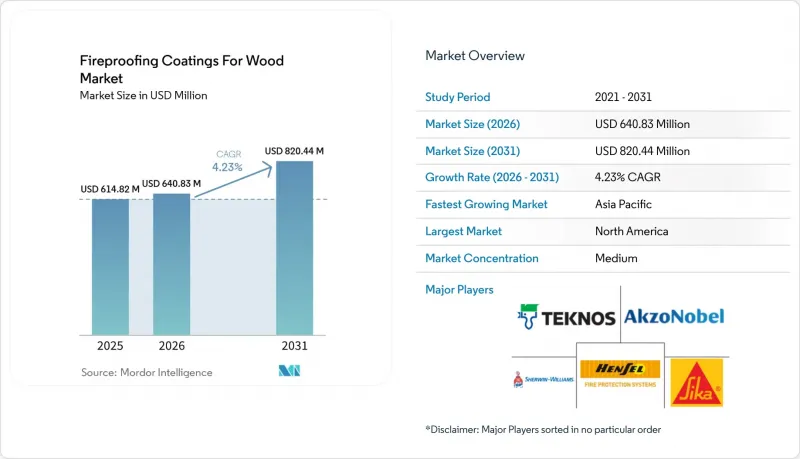
根據 Mordor Intelligence 預測,木材防火塗料市場規模預計在 2025 年達到 6.1482 億美元,在 2026 年達到 6.4083 億美元,在 2031 年達到 8.2044 億美元,2026 年至 2031 年的複合成長率為 4.23%。
本報告按技術(水性、溶劑型、紫外光固化及其他技術)、樹脂類型(丙烯酸樹脂、聚氨酯/氨基甲酸酯樹脂、矽胺甲酸乙酯、醇酸樹脂及其他樹脂類型)、塗料類型(無鹵塗料和含鹵塗料)、應用領域(建築領域和非建築領域)以及地區(亞太地區、北美地區及其他地區)進行北美地區及其他地區。市場預測以美元(USD)為單位。
全球木材防火塗料市場趨勢及洞察
嚴格的消防安全標準和認證要求
2024 年國際建築規範允許建造中高層大型木造建築,前提是裸露木材的火焰傳播指數保持在可接受的範圍內。只有使用膨脹塗料才能達到此標準。同時,2025 年修訂的歐洲規範 5 為設計人員帶來了經濟效益,因為這些塗料的認可允許縮小木材的截面尺寸。在日本,類似的法規適用於地震多發地區的中高層 CLT住宅,要求使用符合 ASTM E119 標準評估標準的認證塗料。此外,NFPA 703 引入了強制性的第三方認證,擴大了擁有認可測試實驗室的供應商的市場佔有率。這些法規共同確立了膨脹塗料作為中高木結構建築設計框架的地位。
亞太地區大型木造建築的擴張
2024年至2025年間,日本CLT建築數量顯著成長,多棟新建築超過10樓。在澳大利亞,根據“2025年國家建築標準”,在易發野火地區使用CLT是被允許的,前提是塗漆表面符合BAL 40的防火要求。到2027年,中國批准新建CLT生產線運作,用於供應住宅,並強制要求平方公尺塗刷防火塗料。 2025年,韓國為使用CLT建造的學校提供補貼,以確保符合KS F 3111標準。這些措施共同推動了對木材防火塗料的需求顯著成長。
溶劑技術的VOC/HAP法規
加州第1113號規則實際上已使傳統的二甲苯含量高的環氧樹脂無法使用。同時,歐盟計劃在2027年之前進一步收緊相關限制。在美國,2024年有害空氣污染物(HAP)規則大幅降低了丁酮的容許含量。這項變更導致潮濕地區的固化時間延長,擾亂了承包商的施工進度。在中國,隨著GB 38507-2020標準的訂定,相關法規開始實施。然而,除一線城市外,這些法規的執行力度不足,使用溶劑的灰色市場依然猖獗。隨著產業快速轉向水性化學技術,缺乏分散技術專業知識的中小型化合物生產商正面臨日益沉重的負擔。
細分市場分析
截至2025年,水性塗料將佔木材阻燃塗料市場68.09%的佔有率,預計到2031年將以4.47%的複合年成長率成長。這些塗料不僅符合法規標準,而且施工過程中不會起泡,同時還能有效控制木材的含水率。單組分包裝的採用進一步增強了這項技術的優勢,因為它降低了塗料適用期延長的風險,並簡化了施工人員的工作流程。同時,溶劑型產品(主要用於鐵路車輛內裝和船舶艙壁)雖然佔據了相當大的市場佔有率,但正面臨日益嚴格的監管,限制了其成長。紫外線固化塗料因其在工廠快速固化的特性而受到斯堪地那維亞板材製造商的關注,但由於其厚而易膨脹的塗層導致透光率有限,因此仍屬於小眾產品。
向水性體系的轉變正在改變物流格局。高密度配方會增加每公升的運輸成本,但降低的現場通風要求簡化了授權流程。擁有分散生產線的大型製造商可以承擔這些額外成本,但這給小型企業帶來了挑戰,並正在改變競爭格局。隨著法規擴展到新興地區,水性體系的優勢預計將進一步鞏固綜合性跨國公司在木材防火塗料領域的市場規模優勢。
丙烯酸樹脂預計在2025年佔消費量的74.69%,並預計在2031年之前維持4.37%的複合年成長率。丙烯酸樹脂因其發泡體而備受建築師青睞,這種泡沫在特定溫度下活化,並能抵抗窯乾木材中的水分。聚氨酯具有耐磨性,這在學校和醫院等場所尤其重要。然而,其雙組分混合製程較為人事費用費力。矽酮的疏水網路在沿海和熱帶氣候條件下表現出色。儘管如此,其高昂的價格限制了其應用,使其僅限於野火高風險地區。環氧樹脂和乙烯基酯的成長較為緩慢,在海上平台等對耐化學性要求高於VOC排放法規的場所中更受歡迎。
丙烯酸塗料的優點包括原料供應穩定,特別是聚磷酸銨和膨脹石墨。這一趨勢也有助於降低本地塗料生產商的學習難度。此外,丙烯酸塗料正在提升「木材阻燃塗料」市場的長期前景。尤其值得一提的是,隨著建築規範即將修訂,VOC(揮發性有機化合物)閾值預計將日益嚴格,而丙烯酸塗料解決方案是應對這項挑戰的最佳選擇。
區域分析
2025年,北美以39.98%的市佔率領先木材防火塗料市場。這主要得益於美國農業部津貼計畫下啟動的眾多大型木造計畫。加州對符合ASTM E84 A級標準的木材提供的優惠折扣進一步增強了易發野火地區的市場成長勢頭。在加拿大,2025年修訂的建築規範將允許在全國範圍內建造12層高的建築,而卑詩省將強制要求在新公共建築中使用木材,預計這將帶動維修工程的強勁需求。這些因素預計將推動市場在2031年之前保持穩定成長。
亞太地區是成長最快的地區,年複合成長率達4.87%。 2024年至2025年間,日本建造了多座超過10層樓的CLT高層建築。在澳大利亞,易受山火侵襲地區的建築許可進一步刺激了當地需求;在中國,大力發展木造住宅推動了需求成長;在韓國,大量的補貼政策也促進了需求成長。同時,印尼和越南正面臨與濕度相關的風化問題,但矽氧烷偶聯劑等技術解決方案正在緩解這些挑戰。
預計到2025年,歐洲將佔據相當大的佔有率。德國、英國和北歐國家正引領大規模木造建築的普及,並採用歐洲規範5(Eurocode 5)的「縮減截面法」。英國的《消防安全法》引發了一波維修,而法國的RE2020碳排放法規也鼓勵住宅建築商使用木材。同時,南歐由於地震隱患而持謹慎態度,但正在嘗試混合設計,這種設計因其美觀性而偏愛塗層木材。預計該地區將保持穩定成長。
南美洲與中東和非洲一樣,佔據了相當大的市場。 2024年,巴西批准高層木造建築後,聖保羅的需求激增。同時,杜拜和利雅德也制定了木材使用目標,作為其更廣泛的永續性舉措的一部分,並將「木材防火塗料」市場引入先前由鋼材主導的地區。然而,諸如本地CLT(交錯層壓木材)生產限制和進口關稅等挑戰正在阻礙市場成長。
其他好處:
- Excel格式的市場預測(ME)表
- 3個月的分析師支持
目錄
第1章:引言
- 研究假設和市場定義
- 調查範圍
第2章:調查方法
第3章執行摘要
第4章 市場狀況
- 市場概覽
- 市場促進因素
- 嚴格的消防安全標準和認證要求
- 亞太地區大體量木結構建築的擴張
- 過渡到無鹵和低VOC配方
- 塗層結構木材的保險折扣
- 與BIM相關的數位化耐火性能評估規範
- 市場限制因素
- 與傳統飾面相比,成本差異很大
- 溶劑技術中VOC/HAP的監管限值
- 熱帶濕潤條件下的早期風化
- 價值鏈分析
- 監理情勢
- 波特五力模型
第5章 市場規模與成長預測
- 透過技術
- 水溶液
- 溶劑型
- 紫外線固化型
- 其他技術
- 依樹脂類型
- 丙烯酸纖維
- 聚氨酯/胺甲酸乙酯
- 矽酮
- 阿爾基多
- 其他樹脂類型
- 按塗層類型
- 無鹵素
- 鹵化
- 透過使用
- 建築應用
- 非建築應用
- 按地區
- 亞太地區
- 中國
- 印度
- 日本
- 韓國
- 馬來西亞
- 印尼
- 越南
- 泰國
- 澳洲和紐西蘭
- 其他亞太國家
- 北美洲
- 美國
- 加拿大
- 墨西哥
- 歐洲
- 德國
- 英國
- 法國
- 義大利
- 北歐的
- 其他歐洲國家
- 南美洲
- 巴西
- 阿根廷
- 其他南美國家
- 中東和非洲
- 沙烏地阿拉伯
- 南非
- 阿拉伯聯合大公國
- 埃及
- 伊朗
- 土耳其
- 摩洛哥
- 其他中東和非洲國家
- 亞太地區
第6章 競爭情勢
- 市場集中度
- 策略趨勢
- 市佔率/排名分析
- 公司簡介
- Akzo Nobel NV
- ASTRA VERNICI SRL
- Contego International Inc.
- Envirograf
- Jazeera Paints
- Remmers GmbH
- Rudolf Hensel GmbH
- Sika AG
- Teknos Group
- The Sherwin-Williams Company
- Tikkurila Oyj
- Treet
第7章 市場機會與未來展望
According to Mordor Intelligence, the fireproofing coatings for wood market size is projected to be USD 614.82 million in 2025, USD 640.83 million in 2026, and reach USD 820.44 million by 2031, growing at a CAGR of 4.23% from 2026 to 2031.
This report is Segmented by Technology (Water-Borne, Solvent-Borne, UV-Cured, and Other Technologies), Resin Type (Acrylic, Polyurethane/Urethane, Silicone, Alkyd, and Other Resin Types), Coating Type (Halogen-Free and Halogenated), Application (Architectural and Non-Architectural), and Geography (Asia-Pacific, North America, and More). Market Forecasts are Provided in Terms of Value (USD).
Global Fireproofing Coatings For Wood Market Trends and Insights
Stringent Fire-Safety Codes and Certification Mandates
Under the 2024 International Building Code, mass-timber structures can rise to mid- and high-rise levels, provided the exposed wood achieves a flame-spread index within acceptable standards. This benchmark is only attainable through the application of intumescent coatings. Meanwhile, Eurocode 5's 2025 update offers designers a financial edge: by recognizing the protective char from these coatings, they can reduce timber dimensions. In Japan, similar provisions apply to mid-rise CLT residences in seismic zones. Here, the stipulation is that certified coatings must achieve a rating on the ASTM E119 scale. Furthermore, NFPA 703 has introduced a mandate for third-party certification, a move that has bolstered market share for suppliers with accredited laboratories. Together, these regulations firmly integrate intumescent coatings into the design framework for mid- and high-rise timber structures.
Expansion of Mass-Timber Construction in Asia-Pacific
Between 2024 and 2025, Japan saw a significant increase in the construction of CLT buildings, adding several structures taller than 10 stories. Under its 2025 National Construction Code, Australia now permits the use of CLT in bushfire-prone areas, provided the coated surfaces adhere to BAL 40 flow conditions. By 2027, China greenlit new CLT production lines, targeting a supply for timber housing; each square meter will require fire-rated coating. In 2025, South Korea allocated funding to subsidize CLT schools, ensuring they meet the KS F 3111 standards. Collectively, these initiatives are significantly boosting the demand for Fireproofing Coatings for Wood.
VOC/HAP Limits on Solvent Technologies
California's Rule 1113 effectively sidelines traditional xylene-rich epoxies. Meanwhile, the EU is set to tighten its caps by 2027. In the U.S., a 2024 HAP rule drastically reduced permissible levels of methyl ethyl ketone. This change has led to extended cure times in humid areas, throwing contractor schedules into disarray. Over in China, the introduction of GB 38507-2020 set limits. However, with weak enforcement outside of tier-1 cities, a solvent-heavy gray market continues to thrive. As the industry rapidly shifts towards water-borne chemistries, smaller formulators, lacking expertise in dispersion, find themselves increasingly burdened.
Other drivers and restraints analyzed in the detailed report include:
- Shift Toward Halogen-Free, Low-VOC Formulations
- Insurance Discounts for Coated Structural Wood
- Premature Weathering in Tropical Humidity
For complete list of drivers and restraints, kindly check the Table Of Contents.
Segment Analysis
Water-borne systems accounted for 68.09% of the Fireproofing Coatings For Wood market share in 2025 and are projected to grow at a 4.47% CAGR through 2031. These systems not only adhere to compliance standards but also manage timber moisture without blistering. The adoption of single-component packaging mitigates pot-life risks and simplifies contractor tooling, further solidifying this technology's lead. While solvent-borne products, preferred for rail interiors and marine bulkheads, commanded a significant portion of the demand, they grapple with tightening regulations, constraining their growth. UV-cured coatings, though enticing Scandinavian panel makers with rapid factory cures, remain a niche due to thick intumescent films limiting light penetration.
Transitioning to water-borne systems alters logistics dynamics: denser formulations elevate freight costs per liter, yet reduce onsite ventilation needs, streamlining permitting processes. Major producers, equipped with dispersion lines, can absorb these added costs, posing challenges for smaller firms and shifting the competitive balance. As regulations extend into emerging regions, the dominance of water-borne systems is poised to bolster the market size advantage for integrated multinationals in the Fireproofing Coatings for Wood sector.
Acrylic resins captured 74.69% of consumption in 2025 and will maintain a 4.37% CAGR to 2031. Their phosphorus-rich char foams, which activate at specific temperatures and resist moisture in kiln-dried lumber, have made them the preferred choice for architects. Polyurethane boasts abrasion strength that is particularly valued in schools and hospitals. However, its two-component mixing process strains labor budgets. Silicone's hydrophobic network performs exceptionally in coastal and tropical climates. Still, its pricing limits its adoption to premium bushfire zones. Epoxy and vinyl ester are favored on offshore platforms, where chemical resistance is prioritized over VOC limits, and they are witnessing modest growth.
Acrylic's dominance is stabilizing the supply of raw materials, particularly ammonium polyphosphate and expandable graphite. This trend is also streamlining the learning curves for regional blenders. Furthermore, acrylics are bolstering long-term forecasts for the Fireproofing Coatings For Wood market, especially as upcoming code changes seem to favor increasingly stringent VOC thresholds, a challenge best addressed by acrylic solutions.
Complete Report Scope:
- By Technology
- Water-borne
- Solvent-borne
- UV-cured
- Other technologies
- By Resin Type
- Acrylic
- Polyurethane/Urethane
- Silicone
- Alkyd
- Other Resin Types
- By Coating Type
- Halogen-free
- Halogenated
- By Application
- Architectural
- Non-architectural
- By Geography
- Asia-Pacific
- China
- India
- Japan
- South Korea
- Malaysia
- Indonesia
- Vietnam
- Thailand
- Australia and New Zealand
- Rest of Asia-Pacific
- North America
- United States
- Canada
- Mexico
- Europe
- Germany
- United Kingdom
- France
- Italy
- Nordics
- Rest of Europe
- South America
- Brazil
- Argentina
- Rest of South America
- Middle-East and Africa
- Saudi Arabia
- South Africa
- United Arab Emirates
- Egypt
- Iran
- Turkey
- Morocco
- Rest of Middle-East and Africa
- Asia-Pacific
Geography Analysis
North America led the Fireproofing Coatings for Wood market with a 39.98% share in 2025. This was bolstered by numerous mass-timber projects initiated under the USDA grant program. California's premium discount for ASTM E84 Class A timber invigorated momentum in areas prone to wildfires. Canada's updated 2025 code permits 12-story structures across the nation, while British Columbia mandates a significant timber usage in new public buildings, ensuring a robust stream for retrofitting. Collectively, these factors contribute to steady growth projected until 2031.
Asia-Pacific is the fastest-growing region at a 4.87% CAGR. Between 2024 and 2025, Japan constructed several CLT towers exceeding 10 stories. Australia's approvals in bushfire zones further amplify regional demand, China's commitment to timber housing, and South Korea's substantial subsidy. While Indonesia and Vietnam grapple with humidity-related weathering issues, technological solutions like siloxane couplers are bridging the gap.
Europe commanded a significant share in 2025. Leading the charge in mass-timber adoption are Germany, the UK, and Nordic countries, utilizing Eurocode 5's reduced cross-section method. The UK's Fire Safety Act has spurred a wave of retrofits, and France's RE2020 carbon regulations are nudging residential builders towards timber. While Southern Europe hesitates due to seismic worries, it's experimenting with hybrid designs, favoring coated timber for its aesthetic appeal. The region is projected to grow steadily.
South America, alongside the Middle-East and Africa, collectively holds a notable share. In 2024, Brazil greenlit multi-story timber structures, igniting demand in Sao Paulo. Meanwhile, Dubai and Riyadh, under broader sustainability agendas, have established timber content targets, introducing the Fireproofing Coatings For Wood market to regions traditionally dominated by steel. Challenges like limited local CLT production and import tariffs moderate growth.
- Akzo Nobel N.V.
- ASTRA VERNICI SRL
- Contego International Inc.
- Envirograf
- Jazeera Paints
- Remmers GmbH
- Rudolf Hensel GmbH
- Sika AG
- Teknos Group
- The Sherwin-Williams Company
- Tikkurila Oyj
- Treet
Additional Benefits:
- The market estimate (ME) sheet in Excel format
- 3 months of analyst support
TABLE OF CONTENTS
1 Introduction
- 1.1 Study Assumptions and Market Definition
- 1.2 Scope of the Study
2 Research Methodology
3 Executive Summary
4 Market Landscape
- 4.1 Market Overview
- 4.2 Market Drivers
- 4.2.1 Stringent fire-safety codes and certification mandates
- 4.2.2 Expansion of mass-timber construction in Asia-Pacific
- 4.2.3 Shift toward halogen-free, low-VOC formulations
- 4.2.4 Insurance discounts for coated structural wood
- 4.2.5 BIM-integrated digital fire-rating specifications
- 4.3 Market Restraints
- 4.3.1 High cost differential vs. conventional finishes
- 4.3.2 VOC/HAP limits on solvent technologies
- 4.3.3 Premature weathering in tropical humidity
- 4.4 Value Chain Analysis
- 4.5 Regulatory Landscape
- 4.6 Porter's Five Forces
- 4.6.1 Bargaining Power of Suppliers
- 4.6.2 Bargaining Power of Buyers
- 4.6.3 Threat of New Entrants
- 4.6.4 Threat of Substitutes
- 4.6.5 Degree of Competition
5 Market Size and Growth Forecasts (Value)
- 5.1 By Technology
- 5.1.1 Water-borne
- 5.1.2 Solvent-borne
- 5.1.3 UV-cured
- 5.1.4 Other technologies
- 5.2 By Resin Type
- 5.2.1 Acrylic
- 5.2.2 Polyurethane/Urethane
- 5.2.3 Silicone
- 5.2.4 Alkyd
- 5.2.5 Other Resin Types
- 5.3 By Coating Type
- 5.3.1 Halogen-free
- 5.3.2 Halogenated
- 5.4 By Application
- 5.4.1 Architectural
- 5.4.2 Non-architectural
- 5.5 By Geography
- 5.5.1 Asia-Pacific
- 5.5.1.1 China
- 5.5.1.2 India
- 5.5.1.3 Japan
- 5.5.1.4 South Korea
- 5.5.1.5 Malaysia
- 5.5.1.6 Indonesia
- 5.5.1.7 Vietnam
- 5.5.1.8 Thailand
- 5.5.1.9 Australia and New Zealand
- 5.5.1.10 Rest of Asia-Pacific
- 5.5.2 North America
- 5.5.2.1 United States
- 5.5.2.2 Canada
- 5.5.2.3 Mexico
- 5.5.3 Europe
- 5.5.3.1 Germany
- 5.5.3.2 United Kingdom
- 5.5.3.3 France
- 5.5.3.4 Italy
- 5.5.3.5 Nordics
- 5.5.3.6 Rest of Europe
- 5.5.4 South America
- 5.5.4.1 Brazil
- 5.5.4.2 Argentina
- 5.5.4.3 Rest of South America
- 5.5.5 Middle-East and Africa
- 5.5.5.1 Saudi Arabia
- 5.5.5.2 South Africa
- 5.5.5.3 United Arab Emirates
- 5.5.5.4 Egypt
- 5.5.5.5 Iran
- 5.5.5.6 Turkey
- 5.5.5.7 Morocco
- 5.5.5.8 Rest of Middle-East and Africa
- 5.5.1 Asia-Pacific
6 Competitive Landscape
- 6.1 Market Concentration
- 6.2 Strategic Moves
- 6.3 Market Share/Ranking Analysis
- 6.4 Company Profiles {(includes Global level Overview, Market level overview, Core Segments, Financials as available, Strategic Information, Products and Services, and Recent Developments)}
- 6.4.1 Akzo Nobel N.V.
- 6.4.2 ASTRA VERNICI SRL
- 6.4.3 Contego International Inc.
- 6.4.4 Envirograf
- 6.4.5 Jazeera Paints
- 6.4.6 Remmers GmbH
- 6.4.7 Rudolf Hensel GmbH
- 6.4.8 Sika AG
- 6.4.9 Teknos Group
- 6.4.10 The Sherwin-Williams Company
- 6.4.11 Tikkurila Oyj
- 6.4.12 Treet
7 Market Opportunities and Future Outlook
- 7.1 White-space and Unmet-need Assessment

 耐火密封膠市場:全球市場預測(2026-2032年)
 全球被動防火塗料市場
 阻燃塗料:市場佔有率分析、產業趨勢與統計、成長預測(2026-2031 年)防火塗料市場-2026-2032年全球市場預測被動式防火塗料:市場佔有率分析、產業趨勢與統計、成長預測(2026-2031)阻燃噴霧劑市場按產品類型、銷售管道、應用和最終用戶分類,全球預測(2026-2032年)
 被動防火塗料市場規模、佔有率和成長分析(按產品、技術、分銷管道、最終用途產業和地區分類)—產業預測(2026-2033 年)
 防火木器塗料市場-2025-2030年預測全球木材防火塗料市場規模(按產品、應用、地區、範圍和預測)