


 |
市場調查報告書
商品編碼
2122488
阻燃塗料:市場佔有率分析、產業趨勢與統計、成長預測(2026-2031 年)Fire Retardant Coatings - Market Share Analysis, Industry Trends & Statistics, Growth Forecasts (2026 - 2031) |
||||||

※ 本網頁內容可能與最新版本有所差異。詳細情況請與我們聯繫。
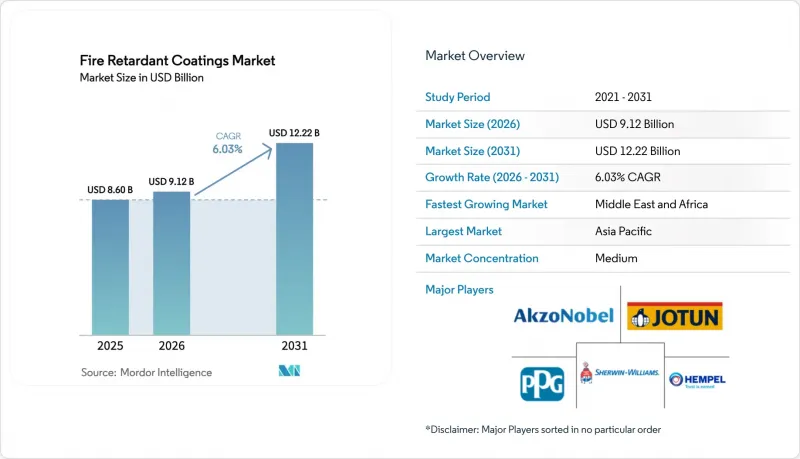
據 Mordor Intelligence 稱,2025 年阻燃塗料市場價值 86 億美元,預計到 2031 年將從 2026 年的 91.2 億美元成長至 122.2 億美元,預測期(2026-2031 年)複合年成長率為 6.03%。
本報告按樹脂類型(矽橡膠、環氧樹脂、丙烯酸樹脂、乙烯基樹脂、聚氨酯樹脂及其他)、技術(水性、溶劑型、粉末塗料及其他)、塗料類型(可膨脹塗料、水泥基塗料)、終端用戶產業(建築、石油天然氣、電力等)和地區(亞太地區、北美地區等)進行細分。市場預測以美元計價。
全球阻燃塗料市場趨勢及洞察
全球建設活動增加
2024年,中國建築業產量的成長推動了對符合GB 14907-2018多層鋼骨標準的環氧基膨脹塗料的強勁需求。同時,作為印度「智慧城市計畫」的一部分,大規模公共住宅計畫強制要求使用符合國家建築規範的水性組合藥物。在沙烏地阿拉伯,NEOM、紅海和吉迪亞等項目對塗層鋼材的需求激增,促使歐洲主要供應商在當地建立混合設施。在歐洲和北美,模組化建築的興起使得預塗粉末基膨脹塗料的應用日益普及,顯著減少了現場施工所需的人工。目前,此細分市場僅面臨少數OEM塗料供應商的競爭。因此,阻燃塗料市場不僅受益於使用面積(平方公尺)的增加,也受益於製程的轉變,後者更重視高效化學技術的應用。
石油和天然氣基礎設施的擴張正在加速。
API 推薦實務 752 (2024) 量化了煉油廠內永久性建築的熱危害,要求工程師選擇能夠承受 1100 度C碳氫化合物火災四小時的燒蝕和混合系統。隨著卡達和沙烏地阿拉伯液化天然氣計畫的不斷發展,規範範圍也不斷擴大。同時,北美頁岩油氣業者正在對現有工廠維修,以符合修訂後的 49 CFR 194緊急應變法規。粉末塗料在電纜配線架和小直徑管道中的應用日益普及。這些塗料不僅可以減少密閉空間內溶劑的暴露,還有助於縮短週轉時間。雖然目前的採用率仍然較低,但預計到 2028 年,被動防火和供應商培訓的投入增加將彌補這一差距,從而擴大阻燃塗料的市場。
低成本替代品的可用性
在印度、印尼和奈及利亞,注重成本的開發商擴大選擇更實惠的石膏板,而非噴塗式膨脹阻燃劑。雖然水泥基抹灰具有優異的性能,耐火等級達4小時,但其重量限制了其在抗震加固工程的應用。為了提高建築安全性,保險公司開始對未採用認證塗層的建築物徵收額外保費。這項策略正逐步為膨脹阻燃塗料創造有利的市場環境,縮小其價格與性能之間的差距。為了維持市場佔有率,供應商現在提供包括承包工程和多年保固在內的打包服務。透過將討論的重點從觀點的材料成本轉移到更廣闊的生命週期經濟效益觀點,他們正在確保阻燃塗料行業的持續需求。
細分市場分析
到2031年,矽橡膠的複合年成長率將達到6.24%,滿足電池組和航太領域在600 度C以上高溫環境下的需求,而環氧樹脂在該溫度下會失去結構完整性。丙烯酸酯類材料正在建築領域佔據一個細分市場,而聚氨酯則作為整合防火屏障的噴塗泡沫隔熱材料嶄露頭角。環氧樹脂和矽橡膠的混合體係正在德國和韓國的電池工廠進行初步試驗,目標是在2027年推出。這種多元化發展將有助於拓展供應商的開發平臺,並防止阻燃塗料市場趨於同質化。
環氧樹脂依然成本績效,但由於其原料雙酚A受到嚴格的環境監管,化合物開發商正在探索木質素基固化劑。矽酮樹脂雖然價格昂貴,但具有無與倫比的耐熱衝擊性,隨著其在電動車領域的應用不斷擴展,其總消耗量也在增加。酚醛樹脂和聚酯樹脂等小眾材料仍用於船舶隔板和鐵路車輛內部裝潢建材,但隨著總合標準的日益嚴格,它們的市場佔有率正在下降。因此,樹脂的演變為阻燃塗料產業的相關人員帶來了機會和挑戰。
2025年,水性產品佔銷售額的46.37%,主要得益於歐盟和加州將VOC(揮發性有機化合物)含量限制在250克/公升。粉末產品雖然市佔率較小,但預計將以6.18%的複合年成長率成長,這主要得益於汽車和消費性電子產業對一次性無溶劑製程的青睞。溶劑型系統仍用於表面處理不足的腐蝕鋼材的維護工作。輻射固化型和高固態含量產品則在寒冷氣候地區和工期緊迫的專案中佔據著一定的市場。
粉末膨脹塗料對顆粒尺寸和靜電調節要求嚴格,目前只有少數供應商克服了這些挑戰。儘管如此,此技術廢棄物產生率低且能顯著節省人力成本,從整體成本角度來看極具吸引力。在熱帶地區,水性塗料因濕度過高而固化時間過長仍然是其一大弱點,為了解決這個問題,配方研發人員正在添加閃銹抑制劑。隨著法規日益嚴格,耐火塗料市場的發展將繼續受到市場歡迎。
區域分析
亞太地區在中國的強勁建築產能和印度雄心勃勃的國家基礎設施規劃的推動下,預計到2025年將佔據45.28%的市場佔有率。日本維修工程的激增以及韓國電動車的生產,正在推動對富含矽酮配方產品的需求。同時,在東南亞,對工業園區的投資——這項旨在實現供應鏈多元化的策略性舉措——正在取得成效。 「一帶一路」舉措正在促進粉末塗層預製模組的出口,擴大區域出口,並將先進塗料引入新興市場的項目中。
在北美,受美國基礎設施立法的推動,建設勢頭正在加速成長。此外,橋樑維修需要被動防火措施,以及電網升級改造,都凸顯了該地區活躍的建設態勢。加拿大的油砂開採和墨西哥蓬勃發展的汽車組裝業進一步推動了這項需求。然而,合格承包商的嚴重短缺迫使承包商提前數月調整工期。這種人手不足有時會導致專案延期和需求激增,從而為擁有高流動性工作團隊的供應商創造了機會。
歐洲雄心勃勃的「翻新浪潮」正在將消防安全措施與碳減排目標結合,惠及數百萬處房產。德國和北歐國家正在推廣無鹵配方。雖然這會增加材料成本,但卻能顯著降低保險公司的風險保費。格倫費爾大火之後,英國收緊了市場准入要求,改革強制要求第三方產品檢驗。法國正在推廣生物基阻燃劑,以配合其低碳目標。同時,由於制裁限制了俄羅斯獲取西方化學品,當地生產商正嘗試對環氧樹脂進行逆向工程,但結果品質參差不齊。
中東和非洲是成長最快的地區,年複合成長率達5.94%。這項快速成長主要歸功於NEOM計畫對鋼鐵的巨大需求,以及阿拉伯聯合大公國嚴格的高層建築規範(要求防火等級達到兩小時)。南非正依照SANS 10177標準對其石化工廠進行現代化改造。然而,主要省份以外的物流挑戰阻礙了標準的快速實施。許多非洲國家缺乏經認可的檢測實驗室,因此進口認證十分普遍。這增加了成本,但也提高了人們對品質的期望。
南美洲市場正在擴張。在巴西,四層以上建築必須採用ABNT NBR 14432標準;而在阿根廷,揮發性有機化合物(VOC)法規迫使工廠轉向水性塗料系統。受外匯波動的影響,原料避險和囤積成為一種趨勢。在智利採礦業,安全是重中之重,關鍵支撐結構必須使用耐火4小時的塗料,這推動了對自燃型阻燃產品的小眾需求。這些趨勢共同擴大了阻燃塗料市場的範圍,並使其收入來源更加多元化。
其他好處:
- Excel格式的市場預測(ME)表
- 3個月的分析師支持
目錄
第1章:引言
- 研究假設和市場定義
- 調查範圍
第2章:調查方法
第3章執行摘要
第4章 市場狀況
- 市場促進因素
- 世界各地的建設活動都在增加。
- 石油和天然氣(包括頁岩氣)基礎設施的擴張正在加速。
- 更嚴格的消防安全法規與建築規範
- 電動車和電池系統對被動防火措施的需求日益成長。
- 向生物基、無鹵塗料化學轉型
- 市場限制因素
- 低成本替代品的可用性(水泥基抹灰、阻燃板)
- 環氧樹脂、矽膠樹脂及添加劑的價格波動很大。
- 由於合格安裝人員短缺,導致安裝問題頻繁發生。
- 價值鏈分析
- 波特五力模型
第5章 市場規模與成長預測
- 依樹脂類型
- 矽橡膠
- 環氧樹脂
- 丙烯酸纖維
- 乙烯基樹脂
- 聚氨酯
- 其他樹脂類型
- 透過技術
- 水溶液
- 溶劑型
- 粉末塗裝
- 其他
- 按塗層類型
- 可擴充
- 水泥基
- 按最終用戶行業分類
- 建築/施工
- 石油和天然氣
- 發電
- 運輸
- 工業和製造業
- 其他終端用戶產業
- 按地區
- 亞太地區
- 中國
- 印度
- 日本
- 韓國
- 其他亞太國家
- 北美洲
- 美國
- 加拿大
- 墨西哥
- 歐洲
- 德國
- 英國
- 法國
- 義大利
- 西班牙
- 俄羅斯
- 北歐國家
- 其他歐洲國家
- 南美洲
- 巴西
- 阿根廷
- 其他南美國家
- 中東和非洲
- 沙烏地阿拉伯
- 南非
- 其他中東和非洲國家
- 亞太地區
第6章 競爭情勢
- 市場集中度
- 策略趨勢
- 市佔率和排名分析
- 公司簡介
- 3M
- Akzo Nobel NV
- Albi Protective Coatings
- Benjamin Moore & Co.
- Carboline
- Contego International Inc.
- Hempel AS
- Isolatek International
- Jotun
- NIPPON PAINT(M)SDN. BHD.
- No-Burn, Inc.
- PPG Industries, Inc.
- RPM International Inc
- The Sherwin-Williams Company
- TREMCO ILLBRUCK
第7章 市場機會與未來展望
According to Mordor Intelligence, the fire retardant coatings market size was valued at USD 8.60 billion in 2025 and is estimated to grow from USD 9.12 billion in 2026 to reach USD 12.22 billion by 2031, at a CAGR of 6.03% during the forecast period (2026-2031).
This report is Segmented by Resin Type (Silicone Elastomers, Epoxy, Acrylics, Vinyl, Polyurethane, and Others), Technology (Water-Borne, Solvent-Borne, Powder, and Others), Coating Type (Intumescent and Cementitious), End-User Industry (Building and Construction, Oil and Gas, Power, and More), and Geography (Asia-Pacific, North America, and More). Market Forecasts are Provided in Terms of Value (USD).
Global Fire Retardant Coatings Market Trends and Insights
Increasing Construction Activities Across the Globe
In 2024, China's construction output bolstered consistent demand for epoxy-based intumescent coatings that meet GB 14907-2018 standards for multi-story steel frames. Meanwhile, as part of India's Smart Cities Mission, large-scale municipal housing projects are now mandating water-borne formulas in line with the National Building Code. In Saudi Arabia, the NEOM, Red Sea, and Qiddiya projects have a combined requirement for coated steel, leading European suppliers to establish local blending facilities. In Europe and North America, the trend towards modular construction is leaning towards factory-applied powder intumescent layers, which significantly reduce on-site labor. This niche market currently sees competition from only a select few OEM applicators. As a result, the fire retardant coatings market is not just witnessing growth in square meters but is also benefiting from procedural shifts that emphasize high-efficiency chemistries.
Accelerating Oil and Gas Infrastructure Expansion
API Recommended Practice 752 (2024) now quantifies thermal hazards for permanent buildings in refineries, leading engineers to select ablative and hybrid systems able to withstand 1,100 °C hydrocarbon fires for four hours. As LNG projects expand in Qatar and Saudi Arabia, the specification scope broadens. Simultaneously, North American shale operators are retrofitting legacy plants to align with the updated 49 CFR 194 emergency-response regulations. Powder coatings are becoming popular for cable trays and small-bore piping. These coatings not only reduce solvent exposure in confined spaces but also expedite turnaround times. While current adoption remains low, passive fire-protection spending and supplier investments in training are poised to bridge this gap by 2028, thereby enlarging the market for fire-retardant coatings.
Availability of Low-Cost Substitutes
In India, Indonesia, and Nigeria, cost-sensitive developers are increasingly opting for gypsum boards, which are more affordable compared to spray intumescents. While cementitious plasters offer a commendable four-hour fire rating, their weight limits their application in seismic retrofits. In a bid to enhance building safety, insurance firms have begun levying premium penalties on structures without certified coatings. This strategy is gradually tipping the scales in favor of intumescents, narrowing the price-performance divide. To maintain their market share, suppliers are now offering bundled services, including turnkey applications and multi-year warranties. By shifting the conversation from just the upfront material cost to the broader perspective of lifecycle economics, they are ensuring sustained demand in the fire retardant coatings sector.
Other drivers and restraints analyzed in the detailed report include:
- Stricter Fire-Safety Regulations and Building Codes
- Rising Demand for Passive Fire Protection in E-Mobility and Battery Systems
- Volatile Epoxy and Silicone Raw-Material Prices
For complete list of drivers and restraints, kindly check the Table Of Contents.
Segment Analysis
Epoxy resins sustained 34.48% of the fire-retardant coatings market share in 2025 due to robust adhesion and predictable intumescence. Silicone elastomers, expanding at 6.24% CAGR to 2031, answer battery-pack and aerospace needs beyond 600 °C, a temperature realm where epoxies lose structural integrity. Acrylics fill architectural niches, while polyurethane systems are emerging in spray-foam insulation with integrated fire barriers. Hybrid epoxy-silicone stacks are under pilot in German and Korean battery plants for 2027 launches. Such diversification enlarges supplier research and development pipelines and helps guard against commoditization in the fire retardant coatings market.
Epoxies remain cost-effective, yet their bisphenol-A feedstock lines up alongside environmental scrutiny, motivating formulators to explore lignin-based hardeners. Silicones, though premium-priced, offer unmatched thermal shock resistance, and their expanding use in e-mobility raises total consumption. Niche phenolics and polyesters continue to serve marine bulkheads and rail interiors, but their collective share slips as performance standards climb. Resin evolution, therefore, signals both risk and opportunity for stakeholders across the fire retardant coatings industry.
Water-borne products held 46.37% of 2025 revenue, aided by EU and California VOC caps of 250 g/L. Powder variants, although a small share, are forecast to grow at a 6.18% CAGR, powered by automotive and appliance lines that favor single-pass, zero-solvent processes. Solvent-borne systems still serve maintenance jobs on corroded steel where surface prep is imperfect. Radiation-cured and high-solids blends occupy small niches in cold-weather or rapid-turnaround projects.
Powder intumescents require tight particle-size control and electrostatic tuning, challenges that only a limited number of suppliers have mastered. Nonetheless, the technology's low waste rate and significant labor savings render a compelling total-cost argument. Extended humidity cure times remain the Achilles heel for water-borne layers in tropical regions, prompting formulators to add flash-rust inhibitors. As regulations tighten further, adoption curves will continue to support value growth in the fire-retardant coatings market.
Complete Report Scope:
- By Resin Type
- Silicone Elastomers
- Epoxy Resins
- Acrylics
- Vinyl Resins
- Polyurethane
- Other Resin Types
- By Technology
- Water-borne
- Solvent-borne
- Powder Coatings
- Others
- By Coating Type
- Intumescent
- Cementitious
- By End-user Industry
- Building and Construction
- Oil and Gas
- Power Generation
- Transportation
- Industrial and Manufacturing
- Other End-User Industries
- By Geography
- Asia-Pacific
- China
- India
- Japan
- South Korea
- Rest of Asia-Pacific
- North America
- United States
- Canada
- Mexico
- Europe
- Germany
- United Kingdom
- France
- Italy
- Spain
- Russia
- NORDIC Countries
- Rest of Europe
- South America
- Brazil
- Argentina
- Rest of South America
- Middle-East and Africa
- Saudi Arabia
- South Africa
- Rest of Middle-East and Africa
- Asia-Pacific
Geography Analysis
Asia-Pacific commanded a 45.28% share in 2025, bolstered by China's impressive construction output and India's ambitious National Infrastructure Pipeline. Japan's surge in retrofitting, coupled with South Korea's production of electric vehicles, has heightened the demand for silicone-rich formulations. Meanwhile, Southeast Asia is reaping the rewards of industrial park investments, a strategic move linked to supply-chain diversification. The Belt and Road initiative sees powder-coated prefab modules being shipped, expanding regional export flows, and integrating advanced coatings into projects in emerging markets.
North America is riding a wave of momentum, fueled by the United States' infrastructure law. This, alongside bridge rehabilitations and grid upgrades necessitating passive fire protection, underscores the region's robust activity. Canada's oil sands and Mexico's impressive vehicle assembly bolster these volumes. However, a notable shortage of certified applicators has led contractors to negotiate schedules months in advance. This scarcity sometimes results in project deferrals and creates spikes in demand, benefiting suppliers with agile mobile crews.
Europe's ambitious Renovation Wave is harmonizing fire safety with carbon reduction efforts across millions of properties. In Germany and the Nordics, there's a push for halogen-free formulas. While these add extra material costs, they offer insurers significant savings on risk premiums. Following the Grenfell incident, the UK has tightened its market entry with reforms mandating third-party product verification. France is championing bio-based retardants, aligning them with its low-carbon objectives. Meanwhile, sanctions have curtailed Russia's access to Western chemistries, prompting local producers to attempt reverse-engineering of epoxies, though with mixed results in quality.
The Middle East and Africa are the fastest-expanding regions at 5.94% CAGR. This surge is largely attributed to NEOM's colossal steel demands and the UAE's stringent high-rise codes, which mandate two-hour fire ratings. South Africa is modernizing its petrochemical sites in line with SANS 10177 standards. However, logistical challenges outside major provinces are hindering swift adoption. A scarcity of accredited test labs in many African nations means imported certifications are the norm. While this elevates costs, it also raises the bar for quality expectations.
South America is on the upswing. Brazil is enforcing the ABNT NBR 14432 standard for buildings taller than four stories, while Argentina's VOC restrictions are nudging factories towards water-borne systems. In the face of currency fluctuations, there's a trend of hedging and stockpiling raw materials. Chile's mining sector, emphasizing safety, mandates four-hour coatings on critical supports, spurring a niche demand for ablative products. Together, these developments are expanding the horizons of the fire retardant coatings market and diversifying its revenue streams.
- 3M
- Akzo Nobel N.V.
- Albi Protective Coatings
- Benjamin Moore & Co.
- Carboline
- Contego International Inc.
- Hempel AS
- Isolatek International
- Jotun
- NIPPON PAINT (M) SDN. BHD.
- No-Burn, Inc.
- PPG Industries, Inc.
- RPM International Inc
- The Sherwin-Williams Company
- TREMCO ILLBRUCK
Additional Benefits:
- The market estimate (ME) sheet in Excel format
- 3 months of analyst support
TABLE OF CONTENTS
1 Introduction
- 1.1 Study Assumptions and Market Definition
- 1.2 Scope of the Study
2 Research Methodology
3 Executive Summary
4 Market Landscape
- 4.1 Market Drivers
- 4.1.1 Increasing construction activities across the globe
- 4.1.2 Accelerating oil and gas (incl. shale) infrastructure expansion
- 4.1.3 Stricter fire-safety regulations and building codes
- 4.1.4 Rising demand for passive fire protection in e-mobility and battery systems
- 4.1.5 Shift toward bio-based/halogen-free coating chemistries
- 4.2 Market Restraints
- 4.2.1 Availability of low-cost substitutes (cementitious plasters, FR boards)
- 4.2.2 Volatile epoxy/silicone resin and additive prices
- 4.2.3 Shortage of qualified applicators causing installation defects
- 4.3 Value Chain Analysis
- 4.4 Porter's Five Forces
- 4.4.1 Bargaining Power of Suppliers
- 4.4.2 Bargaining Power of Consumers
- 4.4.3 Threat of New Entrants
- 4.4.4 Threat of Substitute Products and Services
- 4.4.5 Degree of Competition
5 Market Size and Growth Forecasts (Value)
- 5.1 By Resin Type
- 5.1.1 Silicone Elastomers
- 5.1.2 Epoxy Resins
- 5.1.3 Acrylics
- 5.1.4 Vinyl Resins
- 5.1.5 Polyurethane
- 5.1.6 Other Resin Types
- 5.2 By Technology
- 5.2.1 Water-borne
- 5.2.2 Solvent-borne
- 5.2.3 Powder Coatings
- 5.2.4 Others
- 5.3 By Coating Type
- 5.3.1 Intumescent
- 5.3.2 Cementitious
- 5.4 By End-user Industry
- 5.4.1 Building and Construction
- 5.4.2 Oil and Gas
- 5.4.3 Power Generation
- 5.4.4 Transportation
- 5.4.5 Industrial and Manufacturing
- 5.4.6 Other End-User Industries
- 5.5 By Geography
- 5.5.1 Asia-Pacific
- 5.5.1.1 China
- 5.5.1.2 India
- 5.5.1.3 Japan
- 5.5.1.4 South Korea
- 5.5.1.5 Rest of Asia-Pacific
- 5.5.2 North America
- 5.5.2.1 United States
- 5.5.2.2 Canada
- 5.5.2.3 Mexico
- 5.5.3 Europe
- 5.5.3.1 Germany
- 5.5.3.2 United Kingdom
- 5.5.3.3 France
- 5.5.3.4 Italy
- 5.5.3.5 Spain
- 5.5.3.6 Russia
- 5.5.3.7 NORDIC Countries
- 5.5.3.8 Rest of Europe
- 5.5.4 South America
- 5.5.4.1 Brazil
- 5.5.4.2 Argentina
- 5.5.4.3 Rest of South America
- 5.5.5 Middle-East and Africa
- 5.5.5.1 Saudi Arabia
- 5.5.5.2 South Africa
- 5.5.5.3 Rest of Middle-East and Africa
- 5.5.1 Asia-Pacific
6 Competitive Landscape
- 6.1 Market Concentration
- 6.2 Strategic Moves
- 6.3 Market Share/Ranking Analysis
- 6.4 Company Profiles (includes Global level Overview, Market level overview, Core Segments, Financials as available, Strategic Information, Market Rank/Share for key companies, Products and Services, and Recent Developments)
- 6.4.1 3M
- 6.4.2 Akzo Nobel N.V.
- 6.4.3 Albi Protective Coatings
- 6.4.4 Benjamin Moore & Co.
- 6.4.5 Carboline
- 6.4.6 Contego International Inc.
- 6.4.7 Hempel AS
- 6.4.8 Isolatek International
- 6.4.9 Jotun
- 6.4.10 NIPPON PAINT (M) SDN. BHD.
- 6.4.11 No-Burn, Inc.
- 6.4.12 PPG Industries, Inc.
- 6.4.13 RPM International Inc
- 6.4.14 The Sherwin-Williams Company
- 6.4.15 TREMCO ILLBRUCK
7 Market Opportunities and Future Outlook
- 7.1 White-space and Unmet-Need Assessment


