


 |
市場調查報告書
商品編碼
2163391
生物基丙二醇:市佔率分析、產業趨勢與統計、成長預測(2026-2031)Bio-Based Propylene Glycol - Market Share Analysis, Industry Trends & Statistics, Growth Forecasts (2026 - 2031) |
||||||

※ 本網頁內容可能與最新版本有所差異。詳細情況請與我們聯繫。
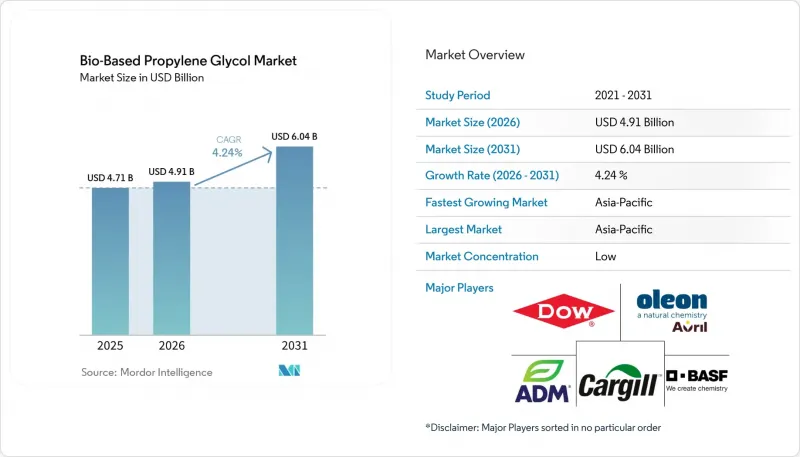
據 Mordor Intelligence 稱,2025 年生物基丙二醇市值為 47.1 億美元,預計到 2031 年將達到 60.4 億美元,而 2026 年為 49.1 億美元,預測期(2026-2031 年)的複合年成長率為 4.24%。
全球生物基丙二醇市場趨勢及洞察
提高生物柴油生產過程中可再生甘油的價值。
2024年全年,生質柴油產能持續成長,甘油產量也超越了傳統肥皂和油脂化學品的需求管道。由於每生產100磅生物柴油就會產生10磅粗甘油,因此生質燃料的擴張與可再生乙二醇原料的供應直接相關。這一原料流使得生物基丙二醇市場與生質燃料生產和可再生原料供應直接相關。使用混合原料的生產流程所獲得的粗甘油可能含有甲醇殘留物、催化劑鹽和著色劑。去除這些雜質需要對原料進行進一步精煉,然後才能用於食品級或醫藥級加氫反應。 ADM公司在其位於伊利諾州迪凱特市的製造地對甘油進行催化轉化前的提純,使一體化生產商能夠更嚴格地控制原料品質。據液化空氣集團(Air Liquide)稱,其BioPG製程採用銅催化劑,在175 度C至195 度C、75至200巴的條件下進行液相加氫裂化,以可再生甘油為原料生產醫藥級和工業級產品。液化空氣集團也表示,與石化路線相比,此製程可減少高達70%的溫室氣體排放。這滿足了那些既重視可再生原料含量又重視環境績效的買家的需求。如果轉化效率能夠同時滿足這兩個要求,生物基丙二醇市場將從中受益。
受監管配方的永續規範
消費品、製藥和食品公司正通過供應商合格流程和永續發展報告,實施可再生原料採購要求。這些要求將公司的範圍3報告與客戶對成品配方中可再生成分含量的期望聯繫起來。陶氏化學提供丙二醇REN,該產品採用已獲得國際永續碳認證PLUS(ISC-C&C PLUS)的製程生產,並聲明其含有至少50%的生物基成分。美國食品藥物管理局(FDA)指南要求對包括丙二醇在內的高風險藥物成分進行二伸乙甘醇和乙二醇污染檢測。這項要求提高了液體藥物製劑可追溯性採購的重要性,並進一步強化了檢驗的品管系統的重要性。 ADM公司聲明其EVO-100產品符合美國藥典(USP)、美國國家處方集(NF)、美國食品化學品法典(FCC)和歐洲藥典(EP)的要求。因此,在生物基丙二醇市場,能夠同時宣稱原料為可再生材料、提供品質證明文件和檢驗的供應鏈的供應商備受青睞。這種組合可以減輕買家對污染、認證狀態和供應商可追溯性的擔憂。當配方必須同時滿足產品品質和原料來源的要求時,這一點尤其重要。
與石油化學衍生的丙二醇相比,價格溢價較高
在歐洲,生物基丙二醇的價格比化石基丙二醇高出20%至30%,具體溢價取決於等級和認證等級。在北美,溢價幅度高達20%至50%,因為專用的煉油基礎設施和可再生資源的文件要求會導致成本增加。認證、生產歷史審核和特殊製作流程都會影響認證等級產品的交付成本。隨著產能和轉換效率的提高,這項價格溢價已從2015年的45%降至2025年的18%至20%。將乙二醇用作溶劑、防凍劑基料或樹脂二醇的工業買家仍然對這種價格差異非常敏感。生物基丙二醇市場的發展將受到採購法規以及客戶在這些成本敏感型應用中對檢驗的低碳含量的重視程度的驅動。
細分市場分析
截至2025年,工業級丙二醇將佔生物基丙二醇市佔率的52.67%。此等級產品廣泛應用於防凍劑配方、工業溶劑、不飽和聚酯樹脂的生產、功能性流體。與藥典級產品相比,工業級產品通常需要較少的蒸餾和純化步驟。這項加工特性使其成為新建可再生乙二醇生產設施的首選實用產品。此等級產品廣泛的應用基礎確保其在整個生物基丙二醇產業鏈中持續佔據重要地位。
預計到2031年,USP/藥用級原料的年複合成長率將達到5.04%。製藥公司正在尋求可追溯的液體製劑和輔料體係原料。據ADM公司稱,EVO-100符合多項藥典標準,並通過了ASTM D6866認證,其碳含量為100%生物基。製造商若要將其工業生產能力升級為藥用級生產,則需要在純化、驗證和品管投入大量資金。這些投資使獲得認證的供應商能夠滿足客戶更高附加價值的需求。
區域分析
預計到2025年,亞太地區將佔據34.23%的市場佔有率,並在2031年之前以5.11%的複合年成長率持續成長。中國透過位於河南、山東和江蘇省的工廠為該地區的供應基地提供支援。陶氏化學位於泰國的工廠在2024年擴建後,年產能達25萬噸。該廠於2025年3月獲得國際永續發展與碳認證PLUS認證。在製藥產能的支撐下,印度生物基丙二醇進口量在2020年至2024年間以13.43%的複合年成長率成長。日本和韓國對高附加價值藥品、個人護理和汽車應用領域的需求旺盛。泰國棕櫚油衍生生物柴油甘油的基礎設施為東協生產商提供了經濟高效的可再生原料。這些生產商能夠同時供應區域買家和出口市場。
北美是生物基丙二醇市場的重要生產和消費中心。 ADM 和嘉吉擁有大豆和菜籽加工網路,能夠取得甘油原料。 ADM 位於伊利諾州迪凱特的工廠每年商業化生產 10 萬噸生物基丙二醇,供應工業、食品、製藥和個人護理行業的客戶。該工廠使用的甘油源自大豆和菜籽護理行業客戶的需求。生物基丙二醇在食品加工廠的冷卻應用中也日益重要,在這些應用中,安全性和產品接觸需求是流體選擇的關鍵標準。這些因素支撐著超越單純環保聲明的需求。這使得供應商能夠在需要技術合規性的受監管冷卻和加工應用中發揮作用。此類應用案例可支援經認證設施的持續消費。這種定位結合了原料管理、認證和應用支持,從而打造長期競爭優勢。
在歐洲,買家對物料平衡文件和經認證的可再生原料的需求正在塑造市場格局。利安德巴塞爾工業公司(LyondellBasell Industries NV)提供低碳解決方案,並採用物料平衡方法獲得國際永續發展和碳認證PLUS(International Sustainability and Carbon Certification PLUS)認證。BASF)的甘油製丙二醇轉化觸媒技術支持使用生物柴油衍生甘油的工廠生產可再生丙二醇。在南美洲,巴西蘊藏著巨大的機遇,其甘蔗衍生甘油和工業生物技術基礎設施為生產提供了支持。中東和非洲仍處於發展初期。埃及、摩洛哥和南非製藥業的擴張可能會增加對符合美國藥典(USP)標準的原料的需求,因為這些工廠都致力於達到出口品質標準。這些區域需求擴大了生物基丙二醇市場的地域機會。它們也催生了對能夠提供藥典級產品並擁有一致認證文件的生產商的需求。因此,區域擴張取決於產能的保障和獲得認證的能力。生產商需要使當地原料的供應與其目標客戶的純度要求相匹配。在藥品生產能力不斷擴大的地區,這種平衡尤其重要。
其他好處:
- Excel格式的市場預測(ME)表
- 3個月的分析師支持
目錄
第1章:引言
- 研究假設和市場定義
- 調查範圍
第2章:調查方法
第3章執行摘要
第4章 市場狀況
- 市場概覽
- 市場促進因素
- 提高生物柴油生產過程中所獲得的可再生甘油的價值。
- 受監管配方的永續規範
- 電動車的溫度控管和低毒冷卻劑的應用
- 建築複合材料中生物基成分的添加要求
- 可可再生丙二醇的直接替代相容性
- 市場限制因素
- 原物料價格和純度的波動
- 成本溢價與石油化學衍生丙二醇的比較
- 經認證的藥品和食品級產品的供應有限。
- 價值鏈分析
- 波特五力分析
第5章 市場規模與成長預測
- 按年級
- 工業級
- USP/藥用級
- 其他年級
- 透過使用
- 防凍液和冷卻液
- 溶劑
- 化學中間體
- 不飽和聚酯樹脂
- 其他用途
- 按最終用途行業分類
- 車
- 食品/飲料
- 建築/施工
- 製藥
- 化妝品和個人護理
- 其他終端用戶產業
- 按地區
- 亞太地區
- 中國
- 印度
- 日本
- 韓國
- 東南亞國協
- 其他亞太國家
- 北美洲
- 美國
- 加拿大
- 墨西哥
- 歐洲
- 德國
- 英國
- 法國
- 義大利
- 北歐國家
- 其他歐洲國家
- 南美洲
- 巴西
- 阿根廷
- 其他南美國家
- 中東和非洲
- 沙烏地阿拉伯
- 南非
- 其他中東和非洲國家
- 亞太地區
第6章 競爭情勢
- 市場集中度
- 策略趨勢
- 市佔率和排名分析
- 公司簡介
- ADM
- Ashland
- BASF
- Braskem
- Cargill, Incorporated
- Dow
- Global Bio-Chem Technology Group Company Limited
- Huntsman International LLC
- LyondellBasell Industries NV
- Oleon NV
- Repsol
- Shell plc
- SKC
第7章 市場機會與未來展望
According to Mordor Intelligence, the Bio-Based propylene glycol market size was valued at USD 4.71 billion in 2025 and is estimated to grow from USD 4.91 billion in 2026 to reach USD 6.04 billion by 2031, at a CAGR of 4.24% during the forecast period (2026-2031).
Global Bio-Based Propylene Glycol Market Trends and Insights
Renewable Glycerin Valorization from Biodiesel Streams
Biodiesel capacity additions continued through 2024 and sustained glycerin output beyond traditional soap and oleochemical demand channels. Every 100 pounds of biodiesel generates 10 pounds of crude glycerin, directly linking biofuel expansion to renewable glycol feedstock availability. This feedstock stream gives the bio-based propylene glycol market a direct link to biofuel production and renewable feedstock availability. Crude glycerin from mixed-feedstock operations can contain methanol residues, catalyst salts, and color bodies. Those impurities require further refining before the material can enter food grade or pharmaceutical grade hydrogenolysis. ADM refines glycerol before catalytic conversion at its Decatur, Illinois, operation, giving integrated producers greater control over feedstock quality. Air Liquide states that its BioPG process uses liquid-phase hydrogenolysis at 175 °C to 195 °C and 75 to 200 bar over a copper catalyst, producing pharmaceutical grade and technical grade material from renewable glycerin. Air Liquide also reports that the process can reduce greenhouse gas emissions by up to 70% compared with petrochemical routes. This supports demand from buyers that assesses renewable content and environmental performance together. The bio-based propylene glycol market can benefit when conversion performance supports both requirements.
Sustainability Specifications in Regulated Formulations
Consumer goods, pharmaceutical, and food companies are applying renewable sourcing requirements through supplier qualification processes and sustainability reporting. These requirements connect corporate Scope 3 reporting with customer expectations for renewable content in finished formulations. Dow offers Propylene Glycol REN from an International Sustainability and Carbon Certification PLUS certified process and states that the product contains at least 50% bio-based content. The U.S. Food and Drug Administration guidance requires testing of high-risk drug components, including propylene glycol, for diethylene glycol and ethylene glycol contamination. This requirement raises the importance of traceable sourcing for liquid pharmaceutical formulations and puts greater weight on validated quality systems. ADM states that its EVO-100 product meets United States Pharmacopeia, National Formulary, Food Chemicals Codex, and European Pharmacopoeia requirements. The bio-based propylene glycol market, therefore, rewards suppliers that can combine renewable-content claims with quality documentation and a validated supply chain. This combination can reduce buyer concern over contamination, certification status, and supplier traceability. It is particularly relevant where a formulation must meet both product quality and sourcing expectations.
Cost Premium Versus Petrochemical Propylene Glycol
Bio-based propylene glycol carried a 20% to 30% price premium over fossil-derived grades in Europe, depending on grade and certification level. The premium ranged from 20% to 50% in North America, where dedicated renewable refining infrastructure and documentation requirements could add cost. Certification, chain-of-custody audits, and specialized processing affect the delivered cost of certified grades. The premium had narrowed from 45% in 2015 to 18% to 20% by 2025 as capacity and conversion efficiency improved. Industrial buyers using glycol as a solvent, antifreeze base, or resin diol remain sensitive to the price gap. The bio-based propylene glycol market will depend on procurement rules and customer willingness to value verified lower-carbon content in these cost-sensitive applications.
Other drivers and restraints analyzed in the detailed report include:
- EV Thermal-Management and Low-Toxicity Coolant Adoption
- Drop-In Qualification of Renewable Propylene Glycol
- Feedstock Price and Purity Volatility
For complete list of drivers and restraints, kindly check the Table Of Contents.
Segment Analysis
Industrial grade held 52.67% of the bio-based propylene glycol market share in 2025. It serves antifreeze formulations, industrial solvents, unsaturated polyester resin production, and functional fluids. Industrial grade output generally needs less distillation and purification than pharmacopeial grade material. This processing profile makes it a practical first product for new renewable glycol capacity. The grade's broad application base keeps it important to the bio-based propylene glycol industry across industrial value chains.
USP/pharmaceutical grade is projected to advance at a 5.04% CAGR through 2031. Pharmaceutical companies are seeking traceable inputs for liquid dosage forms and excipient systems. ADM states that EVO-100 meets several pharmacopeial standards and has 100% bio-based carbon content certified under ASTM D6866. Producers that upgrade industrial capacity to pharmaceutical grade output must make material investments in purification, validation, and quality control. Those investments can give certified suppliers access to higher-value customer requirements.
Complete Report Scope:
- By Grade
- Industrial Grade
- USP/Pharmaceutical Grade
- Other Grades
- By Application
- Antifreeze and Coolant
- Solvent
- Chemical Intermediates
- Unsaturated Polyester Resin
- Other Applications
- By End-Use Industry
- Automotive
- Food and Beverages
- Building and Construction
- Pharmaceuticals
- Cosmetics and Personal Care
- Other End-Use Industries
- By Geography
- Asia-Pacific
- China
- India
- Japan
- South Korea
- ASEAN Countries
- Rest of Asia-Pacific
- North America
- United States
- Canada
- Mexico
- Europe
- Germany
- United Kingdom
- France
- Italy
- NORDIC Countries
- Rest of Europe
- South America
- Brazil
- Argentina
- Rest of South America
- Middle East and Africa
- Saudi Arabia
- South Africa
- Rest of Middle East and Africa
- Asia-Pacific
Geography Analysis
Asia-Pacific held 34.23% in 2025 and is projected to advance at a 5.11% CAGR through 2031. China supports the regional supply base through facilities in Henan, Shandong, and Jiangsu provinces. Dow's Thailand site reached 250,000 metric tons per year after its 2024 expansion. The site earned International Sustainability and Carbon Certification PLUS certification in March 2025. India's bio-based propylene glycol imports grew at a 13.43% CAGR from 2020 to 2024, supported by pharmaceutical manufacturing capacity. Japan and South Korea create demand for higher-value pharmaceutical, personal care, and automotive applications. Thailand's palm-oil biodiesel glycerin infrastructure also gives ASEAN producers a cost-advantaged renewable feedstock base. These producers can serve both regional buyers and export markets.
North America is an important production and consumption center for the bio-based propylene glycol market. ADM and Cargill, Incorporated have soybean and canola processing networks that provide access to glycerin feedstock. ADM's Decatur, Illinois, plant has produced bio-based propylene glycol commercially at 100,000 metric tons per year and serves industrial, food, pharmaceutical, and personal care customers. The plant uses soybean and canola-derived glycerin that ADM identifies as 100% bio-based under the United States Department of Agriculture BioPreferred Program. The BioPreferred Program provides federal purchasing preference for qualified products. ADM expanded North American capacity in December 2025 to meet demand from pharmaceutical and personal care customers. Food-facility cooling applications also value bio-based propylene glycol, where safety and product-contact requirements guide fluid selection. These factors support demand beyond environmental claims alone. They can give suppliers a role in regulated cooling and processing applications where technical suitability is required. Such use cases can support recurring consumption by qualified facilities. This positioning links feedstock management, certification, and application support in a way that shapes competitive performance over time.
Europe is shaped by buyer demand for mass-balance documentation and certified renewable inputs. LyondellBasell Industries N.V. offers International Sustainability and Carbon Certification PLUS certified low-carbon solutions using a mass-balance approach. BASF's glycerin-to-propylene glycol catalyst technology supports renewable glycol production for plants using biodiesel-derived glycerin. South America has an opportunity in Brazil, where sugarcane-derived glycerin and industrial biotechnology infrastructure can support production. The Middle East and Africa remain at an earlier stage of development. Pharmaceutical manufacturing expansion in Egypt, Morocco, and South Africa can increase demand for United States Pharmacopeia grade material as facilities target export-quality standards. These regional needs broaden the geographic opportunity for the bio-based propylene glycol market. They also create demand for producers that can supply pharmacopeial quality with consistent certification documentation. Regional expansion is therefore tied to both capacity availability and qualification capability. Producers need to align local feedstock conditions with the purity requirements of target customers. This balance is particularly relevant where pharmaceutical manufacturing capacity is expanding.
- ADM
- Ashland
- BASF
- Braskem
- Cargill, Incorporated
- Dow
- Global Bio-Chem Technology Group Company Limited
- Huntsman International LLC
- LyondellBasell Industries N.V.
- Oleon NV
- Repsol
- Shell plc
- SKC
Additional Benefits:
- The market estimate (ME) sheet in Excel format
- 3 months of analyst support
TABLE OF CONTENTS
1 Introduction
- 1.1 Study Assumptions and Market Definition
- 1.2 Scope of the Study
2 Research Methodology
3 Executive Summary
4 Market Landscape
- 4.1 Market Overview
- 4.2 Market Drivers
- 4.2.1 Renewable Glycerin Valorization from Biodiesel Streams
- 4.2.2 Sustainability Specifications in Regulated Formulations
- 4.2.3 EV Thermal-Management and Low-Toxicity Coolant Adoption
- 4.2.4 Bio-Based Content Requirements in Construction Composites
- 4.2.5 Drop-In Qualification of Renewable Propylene Glycol
- 4.3 Market Restraints
- 4.3.1 Feedstock Price and Purity Volatility
- 4.3.2 Cost Premium Versus Petrochemical Propylene Glycol
- 4.3.3 Limited Certified Supply for Pharma and Food Grades
- 4.4 Value Chain Analysis
- 4.5 Porter's Five Forces Analysis
- 4.5.1 Threat of New Entrants
- 4.5.2 Bargaining Power of Suppliers
- 4.5.3 Bargaining Power of Buyers
- 4.5.4 Threat of Substitutes
- 4.5.5 Competitive Rivalry
5 Market Size and Growth Forecasts (Value)
- 5.1 By Grade
- 5.1.1 Industrial Grade
- 5.1.2 USP/Pharmaceutical Grade
- 5.1.3 Other Grades
- 5.2 By Application
- 5.2.1 Antifreeze and Coolant
- 5.2.2 Solvent
- 5.2.3 Chemical Intermediates
- 5.2.4 Unsaturated Polyester Resin
- 5.2.5 Other Applications
- 5.3 By End-Use Industry
- 5.3.1 Automotive
- 5.3.2 Food and Beverages
- 5.3.3 Building and Construction
- 5.3.4 Pharmaceuticals
- 5.3.5 Cosmetics and Personal Care
- 5.3.6 Other End-Use Industries
- 5.4 By Geography
- 5.4.1 Asia-Pacific
- 5.4.1.1 China
- 5.4.1.2 India
- 5.4.1.3 Japan
- 5.4.1.4 South Korea
- 5.4.1.5 ASEAN Countries
- 5.4.1.6 Rest of Asia-Pacific
- 5.4.2 North America
- 5.4.2.1 United States
- 5.4.2.2 Canada
- 5.4.2.3 Mexico
- 5.4.3 Europe
- 5.4.3.1 Germany
- 5.4.3.2 United Kingdom
- 5.4.3.3 France
- 5.4.3.4 Italy
- 5.4.3.5 NORDIC Countries
- 5.4.3.6 Rest of Europe
- 5.4.4 South America
- 5.4.4.1 Brazil
- 5.4.4.2 Argentina
- 5.4.4.3 Rest of South America
- 5.4.5 Middle East and Africa
- 5.4.5.1 Saudi Arabia
- 5.4.5.2 South Africa
- 5.4.5.3 Rest of Middle East and Africa
- 5.4.1 Asia-Pacific
6 Competitive Landscape
- 6.1 Market Concentration
- 6.2 Strategic Moves
- 6.3 Market Share (%)/Ranking Analysis
- 6.4 Company Profiles (includes Global Overview, Market Overview, Core Segments, Financials as available, Strategic Information, Products and Services, and Recent Developments)
- 6.4.1 ADM
- 6.4.2 Ashland
- 6.4.3 BASF
- 6.4.4 Braskem
- 6.4.5 Cargill, Incorporated
- 6.4.6 Dow
- 6.4.7 Global Bio-Chem Technology Group Company Limited
- 6.4.8 Huntsman International LLC
- 6.4.9 LyondellBasell Industries N.V.
- 6.4.10 Oleon NV
- 6.4.11 Repsol
- 6.4.12 Shell plc
- 6.4.13 SKC
7 Market Opportunities and Future Outlook
- 7.1 White-Space and Unmet-Need Assessment

 戊二醇市場:全球市場預測,2026-2032年
 2026-2030年全球丙二醇市場工業級限制性丙二醇市場:全球市場預測,2026-2032年
 丙二醇:市佔率分析、產業趨勢與統計、成長預測(2026-2031)丙二醇市場-2026-2032年全球市場預測
 丙二醇海藻酸酯市場規模、佔有率和成長分析:按產品類型、配方類型、應用、最終用戶和地區分類-2026-2033年產業預測
 日本丙二醇市場規模、佔有率、趨勢和預測:按原料、應用、終端用戶產業和地區分類,2026-2034年
 2026年丙二醇全球市場報告2026年生物基丙二醇全球市場報告1,2-丙二醇市場按等級、生產流程、通路和應用分類 - 全球預測(2026-2032年)