


 |
市場調查報告書
商品編碼
2116337
丙二醇:市佔率分析、產業趨勢與統計、成長預測(2026-2031)Propylene Glycol - Market Share Analysis, Industry Trends & Statistics, Growth Forecasts (2026 - 2031) |
||||||

※ 本網頁內容可能與最新版本有所差異。詳細情況請與我們聯繫。
根據 Mordor Intelligence 預測,丙二醇市場規模將從 2025 年的 498 萬噸成長到 2026 年的 536 萬噸,然後在 2031 年達到 776 萬噸,2026 年至 2031 年的複合年成長率為 7.68%。
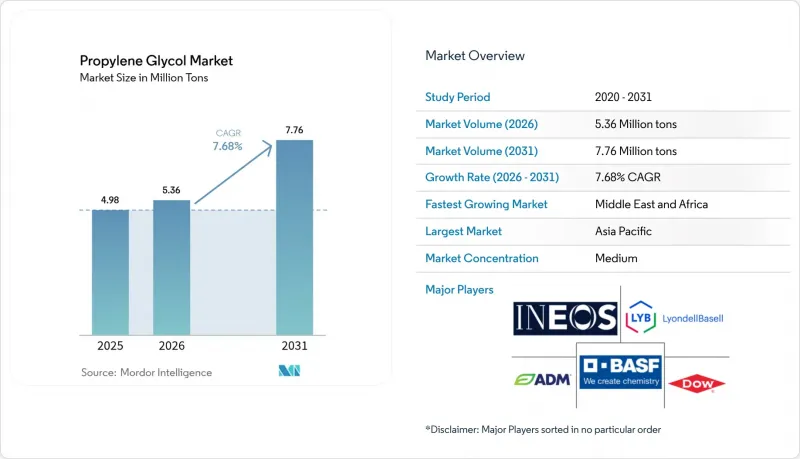
本報告按應用領域(香料、防凍劑/除冰劑、不飽和聚酯樹脂、化學中間體及其他)、終端用戶行業(交通運輸、建築施工、食品飲料等)和地區(亞太地區、北美地區、歐洲地區、南美地區、中東和非洲)進行細分。市場預測以噸為單位。
全球丙二醇市場趨勢與洞察
食品和飲料配料商的需求激增。
美國食品藥物管理局(FDA) 根據 21 CFR 184.1666 法規批准丙二醇,並在歐洲食品安全局 (EFSA) 根據 E1520 法規註冊,使得配方生產商能夠無限制地使用丙二醇,使其成為主流和低成本配方中少數幾種被接受的合成保濕劑之一。酒精飲料生產商使用丙二醇來輸送風味濃縮液,並保持低糖產品的口感;烘焙商則利用丙二醇在常溫下保持水分並延長保存期限。 2024 年 9 月,美國環保署 (EPA) 將新的丙二醇衍生物列入“更安全化學品清單”,這進一步證實了監管機構對丙二醇化學特性的認可。在潮濕的亞洲市場,乳製品加工商現在也開始指定使用丙二醇基質地改良劑來防止產品變質。雖然甘油仍然是高階有機品牌的首選,但丙二醇在大眾市場產品中保持著較高的滲透率,尤其是在濕零食和糖果甜點產品線中,從而實現了顯著的整體成長率成長 1.2 個百分點。
汽車冷卻液和除冰液消耗量增加。
電動車電池組需要溫度控管液來維持電池溫度在 15 度C至 35 度C之間。對於此規格,丙二醇優於乙二醇,因為其毒性較低,且在低溫下流動性較佳。每輛電池式電動車在整個生命週期中都會消耗丙二醇基冷卻液,導致其需求量顯著增加。航空安全標準也是推動這項需求成長的重要因素。 I 類飛機除冰劑的配方依賴丙二醇來降低冰點,預計到 2030 年,全球除冰劑的使用量將逐年增加。雖然北美和北歐等寒冷市場佔據了冷卻液消費的大部分佔有率,但隨著中國和韓國等國家碳中和政策加速商用車電氣化,亞太地區的市場佔有率也在不斷成長。
丙烯氧化物價格的波動是由於原油價格的波動所造成的。
由於環氧丙烷(PO)的價格與原油價格密切相關,其價格全年波動劇烈,產品特定收入和裂解裝置運轉率也隨之變化。當布蘭特原油運作跌破某一閾值時,石腦油裂解裝置會停產,導致下游需求疲軟,而供不應求則會導致PO價格上漲。相反,當原油價格飆升時,裂解活動會加速,導致丙烯市場供應過剩,擠壓PO利潤空間。這種不穩定性迫使買家持有大量庫存,也使生產商的前景變得不明朗。
細分市場分析
至2025年,不飽和聚酯樹脂將佔丙二醇市場的32.02%。這主要是由於風力發電機葉片和耐腐蝕基礎設施吸收了大量樹脂。汽車電氣化和航空安全法規推動了對防凍劑和除冰劑的需求,而碳酸丙烯酯和二丙二醇等化學中間體則為聚氨酯和表面活性劑的生產提供了支持。個人護理中間體的成長速度最快,複合年成長率達8.03%,因為酯類和醚類在駐留型化妝品的應用日益廣泛。
尤其在個人護理領域,越來越多的配方師願意為獲得ISCC PLUS認證的生物循環級產品支付更高的價格。另一方面,注重成本的UPR混配商僅在需要綠建築認證時才使用這些產品。丙二醇單甲醚用於半導體光阻劑剝線鉗。儘管它是一種小眾產品,但由於其電子級純度,價格很高。特種和通用應用領域需求的多元化使生產商能夠規避經濟波動帶來的風險,但他們的成功取決於對提高溶劑純度的投資以及能夠處理多等級產品系列的快速物流系統。
區域分析
預計到2025年,亞太地區將佔全球丙二醇市場的46.11%。這主要得益於中國一體化的丙烷脫氫裝置和環氧丙烷(PO)生產線,以及泰國面向出口的工廠。泰國近期擴建的瑪塔普工廠目前已向日本和韓國出口符合ISCC PLUS認證標準的丙二醇。在印度,馬納利石化公司一旦獲得營運許可證,預計將大幅提升國內產能,目標客戶為高利潤的食品和製藥業。然而,由於中國產運轉率較低,現貨價格承壓,該地區短期利潤率仍面臨挑戰。
預計2026年至2031年間,中東和非洲地區將錄得8.66%的最高成長率,主要得益於沙烏地阿拉伯將煉油廠廢氣轉化為丙烯衍生物的計畫。乙烷成本低廉為該地區生產商帶來了能源優勢,並支撐了對歐洲和印度的出口,但近期原料價格的調整正對利潤率構成壓力。
北美地區的需求量很大,主要由美國的汽車、製藥和飲料產業驅動。雖然位於德州德克薩斯州內爾維尤的新丙烯複分解裝置有望帶來原料供應的柔軟性,但美國環保署的NESHAP法規可能會迫使缺乏排放氣體控制資金的小型企業進行整合。
歐洲在全球產量中佔據重要佔有率。歐盟的碳邊境調節措施和2030年再生材料含量目標正在加速生物基丙二醇(bio-PG)的普及,其中來自德國和泰國的ISCC PLUS認證等級產品佔據了高階市場。德國初步試驗的電熱裂解裝置展現了未來脫碳丙烯的潛力,但其經濟可行性取決於碳價格能否達到一定閾值。
南美洲的市佔率相對較小,主要由巴西的飲料和個人護理用品製造商主導。由於當地丙烯(PO)生產設施有限,該產業依賴進口,但進口關稅阻礙了其成長。儘管如此,甘蔗製乙醇和生質柴油製甘油作為生物基原料,仍具有長期發展潛力。
其他好處:
- Excel格式的市場預測(ME)表
- 3個月的分析師支持
目錄
第1章:引言
- 研究假設和市場定義
- 調查範圍
第2章:調查方法
第3章執行摘要
第4章 市場狀況
- 市場概覽
- 市場促進因素
- 食品飲料配方開發商對GRAS認證的需求激增
- 汽車冷卻液和除冰液消耗量增加。
- 不飽和聚酯樹脂在複合材料和建築領域的應用成長
- 亞洲生物基前列腺素(PG)生產能力的擴張正在加速其應用。
- 丙烯氧化物直接催化轉化為丙二醇可降低單位成本。
- 市場限制因素
- 丙烯氧化物價格的波動是由於原油價格的波動所造成的。
- 對高劑量應用中殘留雜質的監管審查
- 由於中國產能快速擴張,人們對供應過剩感到擔憂
- 價值鏈分析
- 波特五力模型
第5章 市場規模與成長預測
- 透過使用
- 香料
- 防凍劑和除冰劑
- 不飽和聚酯樹脂
- 化學中間體
- 其他用途(抗氧化劑、家用產品等)
- 按最終用戶行業分類
- 運輸
- 建築/施工
- 食品/飲料
- 個人護理
- 製藥
- 其他終端用戶產業(電子設備、油漆和塗料等)
- 按地區
- 亞太地區
- 中國
- 印度
- 日本
- 韓國
- 東南亞國協
- 其他亞太國家
- 北美洲
- 美國
- 加拿大
- 墨西哥
- 歐洲
- 德國
- 英國
- 義大利
- 法國
- 西班牙
- 俄羅斯
- 其他歐洲國家
- 南美洲
- 巴西
- 阿根廷
- 其他南美國家
- 中東和非洲
- 沙烏地阿拉伯
- 南非
- 其他中東和非洲國家
- 亞太地區
第6章 競爭情勢
- 市場集中度
- 策略趨勢
- 市佔率和排名分析
- 公司簡介
- ADEKA Corporation
- ADM
- AGC Chemicals
- BASF
- Cargill, Incorporated.
- Chaoyang Chemicals Inc.
- Dow
- Eastman Chemical Company
- Global Bio-chem Technology Group Co. Ltd
- Golden Dyechem
- Huntsman International LLC
- Indorama Ventures Public Company Limited.
- INEOS
- KLK Temix
- Lonza
- LyondellBasell Industries Holdings BV
- Manali Petrochemicals Limited
- Repsol
- Shell plc
- SKC Chemicals
- Sumitomo Chemical Co., Ltd.
第7章 市場機會與未來展望
According to Mordor Intelligence, the propylene glycol market size is expected to grow from 4.98 million tons in 2025 to 5.36 million tons in 2026 and is forecast to reach 7.76 million tons by 2031 at 7.68% CAGR over 2026-2031.
This report is Segmented by Application (Flavoring Agent, Antifreeze and Deicer Agent, Unsaturated Polyester Resins, Chemical Intermediates, and Other Applications), End-User Industry (Transportation, Building and Construction, Food and Beverages, and More), and Geography (Asia-Pacific, North America, Europe, South America, and Middle-East and Africa). Market Forecasts are Provided in Terms of Volume (Tons).
Global Propylene Glycol Market Trends and Insights
Surging Demand from Food and Beverage Formulators
Regulatory recognition by the U.S. Food and Drug Administration under 21 CFR 184.1666 and the European Food Safety Authority's E1520 listing allows formulators to use propylene glycol without labeling hurdles, making it one of the few synthetic humectants accepted in mainstream and value formulations. Beverage-alcohol producers rely on the molecule to carry flavor concentrates and preserve mouthfeel in reduced-sugar products, while bakery manufacturers use it to retain moisture and lengthen shelf life in ambient distribution. The September 2024 addition of new PG derivatives to the Environmental Protection Agency Safer Chemical Ingredients List confirmed regulators' comfort with PG chemistry, and dairy processors across humid Asian markets now specify PG-based texture modifiers to prevent spoilage. Although premium organic brands still favor glycerin, mass-market products maintain high PG penetration in wet-snack and confectionery lines, resulting in a measurable 1.2 percentage-point lift to overall growth.
Growing Automotive Coolant and De-Icing Fluid Consumption
Electric-vehicle battery packs require thermal-management fluids that maintain cell temperatures between 15 °C and 35 °C, a specification that favors propylene glycol over ethylene glycol due to its lower toxicity and excellent low-temperature fluidity. Each battery electric vehicle consumes PG-based coolant during its lifetime, and incremental demand is substantial. Aviation safety norms also underpin growth, as Type I aircraft de-icing formulations depend on PG for freeze-point depression, and worldwide departures are projected to increase annually through 2030. Cold-climate markets in North America and Northern Europe account for a significant share of coolant volumes, but the Asia-Pacific region's share is rising as national carbon-neutrality mandates in China and South Korea accelerate commercial-fleet electrification.
Propylene-Oxide Price Volatility Linked to Crude Swings
Propylene oxide prices can fluctuate significantly within a single year because co-product credits and cracker run rates move in tandem with crude oil prices. When Brent drops beneath a certain threshold, naphtha crackers idle and propylene scarcity lifts PO prices, just as downstream demand weakens. Conversely, crude rallies encourage cracking, flooding the propylene pool, and compressing PO margins. Such instability forces buyers to hold larger inventories and erodes producer visibility.
Other drivers and restraints analyzed in the detailed report include:
- Unsaturated Polyester Resin Growth in Composites and Construction
- Bio-Based PG Capacity Build-Out in Asia Accelerates Adoption
- Regulatory Scrutiny Over Residual Impurities in High-Dose Uses
For complete list of drivers and restraints, kindly check the Table Of Contents.
Segment Analysis
Unsaturated polyester resins accounted for 32.02% of the propylene glycol market size in 2025, as wind-turbine blades and corrosion-resistant infrastructure absorbed large volumes of resin. Vehicle electrification and aviation safety rules demand antifreeze and de-icing agents, while chemical intermediates such as propylene carbonate and dipropylene glycol underpin the production of polyurethane and surfactants. Personal-care intermediates grow at the fastest rate, with an 8.03% CAGR, as esters and ethers penetrate leave-on cosmetics.
More formulators now pay premiums for ISCC PLUS-certified bio-circular grades, especially in the personal care sector, whereas cost-sensitive UPR compounders adopt them only when green-building certifications are required. Semiconductor photoresist strippers rely on propylene glycol monomethyl ether, a niche product that commands a premium price due to its electronics-grade purity. The diversification of demand across specialty and commodity uses enables producers to hedge cyclical exposure; however, success hinges on solvent-purity investments and quick-change logistics for multi-grade portfolios.
Complete Report Scope:
- By Application
- Flavoring Agent
- Antifreeze and Deicer Agent
- Unsaturated Polyester Resins
- Chemical Intermediates
- Other Applications (Antioxidants, Household Care, etc.)
- By End-user Industry
- Transportation
- Building and Construction
- Food and Beverages
- Personal Care
- Pharmaceuticals
- Other End-user Industries (Electronics, Paints and Coatings, etc.)
- By Geography
- Asia-Pacific
- China
- India
- Japan
- South Korea
- ASEAN Countries
- Rest of Asia-Pacific
- North America
- United States
- Canada
- Mexico
- Europe
- Germany
- United Kingdom
- Italy
- France
- Spain
- Russia
- Rest of Europe
- South America
- Brazil
- Argentina
- Rest of South America
- Middle-East and Africa
- Saudi Arabia
- South Africa
- Rest of Middle-East and Africa
- Asia-Pacific
Geography Analysis
Asia-Pacific controlled 46.11% of the global propylene glycol market volume in 2025, driven by integrated propane dehydrogenation and PO chains in China, as well as export-oriented plants in Thailand. The Map Ta Phut site in Thailand, which has recently expanded, now ships ISCC PLUS-certified grades to Japan and South Korea. India is set to significantly increase its domestic capacity once Manali Petrochemicals gains operating consent, targeting high-margin food and pharmaceutical users. Yet the region's near-term margins remain pressured by under-utilized Chinese assets that weigh on spot prices.
The Middle-East and Africa are expected to record the fastest growth rate of 8.66% from 2026 to 2031, driven by Saudi Arabian projects that monetize refinery off-gases into propylene derivatives. Low ethane costs give regional producers an energy advantage that supports exports to Europe and India, although recent feedstock price adjustments have compressed margins.
North America represents a notable portion of demand, primarily driven by the United States' automotive, pharmaceutical, and beverage sectors. New propylene metathesis capacity at Channelview, Texas, promises feedstock flexibility, while EPA NESHAP rules could force consolidation among smaller players that lack capital for emission controls.
Europe accounts for a significant share of the global volume. The bloc's carbon-border measures and 2030 recycled-content targets accelerate bio-PG uptake, with ISCC PLUS-certified grades from Germany and Thailand filling premium channels. Electrically heated crackers, pilot-tested in Germany, hint at a future decarbonized propylene; however, their economics depend on carbon prices reaching certain thresholds.
South America holds a smaller share, led by Brazil's beverage and personal-care manufacturers. Limited local PO assets compel imports, which face duties and restrain growth, even though sugarcane ethanol and biodiesel glycerol present long-term bio-feedstock opportunities.
- ADEKA Corporation
- ADM
- AGC Chemicals
- BASF
- Cargill, Incorporated.
- Chaoyang Chemicals Inc.
- Dow
- Eastman Chemical Company
- Global Bio-chem Technology Group Co. Ltd
- Golden Dyechem
- Huntsman International LLC
- Indorama Ventures Public Company Limited.
- INEOS
- KLK Temix
- Lonza
- LyondellBasell Industries Holdings B.V.
- Manali Petrochemicals Limited
- Repsol
- Shell plc
- SKC Chemicals
- Sumitomo Chemical Co., Ltd.
Additional Benefits:
- The market estimate (ME) sheet in Excel format
- 3 months of analyst support
TABLE OF CONTENTS
1 Introduction
- 1.1 Study Assumptions and Market Definition
- 1.2 Scope of the Study
2 Research Methodology
3 Executive Summary
4 Market Landscape
- 4.1 Market Overview
- 4.2 Market Drivers
- 4.2.1 Surging demand from food and beverage formulators (GRAS status)
- 4.2.2 Growing automotive coolant and de-icing fluid consumption
- 4.2.3 Unsaturated polyester resin growth in composites and construction
- 4.2.4 Bio-based PG capacity build-out in Asia accelerates adoption
- 4.2.5 Direct propylene-oxide-to-PG catalytic routes cut unit costs
- 4.3 Market Restraints
- 4.3.1 Propylene-oxide price volatility linked to crude swings
- 4.3.2 Regulatory scrutiny over residual impurities in high-dose uses
- 4.3.3 Looming oversupply from rapid Chinese capacity additions
- 4.4 Value Chain Analysis
- 4.5 Porter's Five Forces
- 4.5.1 Bargaining Power of Suppliers
- 4.5.2 Bargaining Power of Buyers
- 4.5.3 Threat of New Entrants
- 4.5.4 Threat of Substitutes
- 4.5.5 Degree of Competition
5 Market Size and Growth Forecasts (Volume)
- 5.1 By Application
- 5.1.1 Flavoring Agent
- 5.1.2 Antifreeze and Deicer Agent
- 5.1.3 Unsaturated Polyester Resins
- 5.1.4 Chemical Intermediates
- 5.1.5 Other Applications (Antioxidants, Household Care, etc.)
- 5.2 By End-user Industry
- 5.2.1 Transportation
- 5.2.2 Building and Construction
- 5.2.3 Food and Beverages
- 5.2.4 Personal Care
- 5.2.5 Pharmaceuticals
- 5.2.6 Other End-user Industries (Electronics, Paints and Coatings, etc.)
- 5.3 By Geography
- 5.3.1 Asia-Pacific
- 5.3.1.1 China
- 5.3.1.2 India
- 5.3.1.3 Japan
- 5.3.1.4 South Korea
- 5.3.1.5 ASEAN Countries
- 5.3.1.6 Rest of Asia-Pacific
- 5.3.2 North America
- 5.3.2.1 United States
- 5.3.2.2 Canada
- 5.3.2.3 Mexico
- 5.3.3 Europe
- 5.3.3.1 Germany
- 5.3.3.2 United Kingdom
- 5.3.3.3 Italy
- 5.3.3.4 France
- 5.3.3.5 Spain
- 5.3.3.6 Russia
- 5.3.3.7 Rest of Europe
- 5.3.4 South America
- 5.3.4.1 Brazil
- 5.3.4.2 Argentina
- 5.3.4.3 Rest of South America
- 5.3.5 Middle-East and Africa
- 5.3.5.1 Saudi Arabia
- 5.3.5.2 South Africa
- 5.3.5.3 Rest of Middle-East and Africa
- 5.3.1 Asia-Pacific
6 Competitive Landscape
- 6.1 Market Concentration
- 6.2 Strategic Moves
- 6.3 Market Share(%)/Ranking Analysis
- 6.4 Company Profiles (includes Global-level Overview, Market-level Overview, Core Segments, Financials, Strategic Info, Rank/Share, Products and Services, Recent Developments)
- 6.4.1 ADEKA Corporation
- 6.4.2 ADM
- 6.4.3 AGC Chemicals
- 6.4.4 BASF
- 6.4.5 Cargill, Incorporated.
- 6.4.6 Chaoyang Chemicals Inc.
- 6.4.7 Dow
- 6.4.8 Eastman Chemical Company
- 6.4.9 Global Bio-chem Technology Group Co. Ltd
- 6.4.10 Golden Dyechem
- 6.4.11 Huntsman International LLC
- 6.4.12 Indorama Ventures Public Company Limited.
- 6.4.13 INEOS
- 6.4.14 KLK Temix
- 6.4.15 Lonza
- 6.4.16 LyondellBasell Industries Holdings B.V.
- 6.4.17 Manali Petrochemicals Limited
- 6.4.18 Repsol
- 6.4.19 Shell plc
- 6.4.20 SKC Chemicals
- 6.4.21 Sumitomo Chemical Co., Ltd.
7 Market Opportunities and Future Outlook
- 7.1 White-space and Unmet-need Assessment

 丙二醇市場-2026-2032年全球市場預測
 丙二醇海藻酸酯市場規模、佔有率和成長分析:按產品類型、配方類型、應用、最終用戶和地區分類-2026-2033年產業預測
 全球丙二醇市場規模、佔有率、趨勢和成長分析報告(2026-2034年)
 日本丙二醇市場規模、佔有率、趨勢和預測:按原料、應用、終端用戶產業和地區分類,2026-2034年
 2026年丙二醇全球市場報告2026年生物基丙二醇全球市場報告1,2-丙二醇市場按等級、生產流程、通路和應用分類 - 全球預測(2026-2032年)丙二醇月桂酸酯市場按類型、形態、等級、應用和銷售管道,全球預測,2026-2032年生物基單丙二醇市場按形態、純度等級、通路、應用和最終用途產業分類-2026-2032年全球預測
 丙二醇市場規模、佔有率和成長分析(按原料、等級、應用、終端用戶產業和地區分類)-2026-2033年產業預測