


 |
市場調查報告書
商品編碼
2157117
中國高爾夫球車市場:市場佔有率分析、產業趨勢與統計及成長預測(2026-2031年)China Golf Cart - Market Share Analysis, Industry Trends & Statistics, Growth Forecasts (2026 - 2031) |
||||||

※ 本網頁內容可能與最新版本有所差異。詳細情況請與我們聯繫。
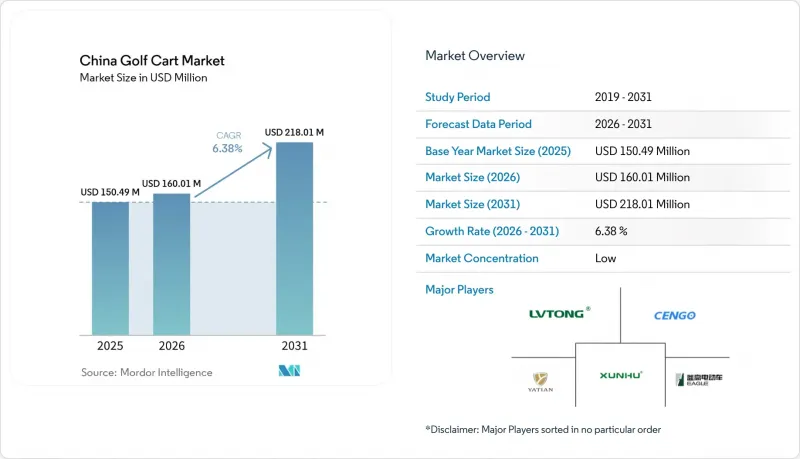
據 Mordor Intelligence 稱,2025 年中國高爾夫球車市值為 1.5049 億美元,預計到 2031 年將達到 2.1801 億美元,而 2026 年為 1.6001 億美元,預測期(2026-2031 年)的複合年成長率為 6.38%。
中國高爾夫球車市場趨勢與洞察
透過電動出行和排放氣體法規提供支持
國家新能源汽車政策框架正在推動電動高爾夫球車的普及。 2026年和2027年的稅收減免要求提高了技術標準,老舊的汽油和鉛酸電池車輛難以達到。中國於2025年5月發布了GB 36980.1-2025標準,並於2026年1月生效。該標準提高了對電池式電動車能耗的要求。省級政府鼓勵在風景區和生態敏感地區推廣電動交通工具的法規,為電動高爾夫球車的普及提供了更穩定的基礎。因此,中國的電動高爾夫球車市場很可能會先在沿海度假區和風景區擴張,之後內陸地區的充電網路才會進一步發展。
提高鋰電池的成本績效
電池成本對電動高爾夫球車的營運和更換經濟性有顯著影響。磷酸鋰鐵鋰電池組的每千瓦時成本比鎳錳鈷電池低40%以上。中國大規模生產磷酸鋰鐵鋰電池正極材料,為本土製造商在生產適用於高爾夫球車的電池時提供了成本優勢。這種成本優勢可以提高企業客戶電動車隊的經濟效益,並有助於製造商開發符合續航里程和性能要求的車款。更長的電池壽命減少了更換需求,同時提升了服務、軟體和電池升級服務的價值。
初始購買成本高
雖然鋰離子電池驅動的高爾夫球車在多年營運中具有許多優勢,但其初始購買成本仍高於鉛酸電池高爾夫球車。中檔48V鋰離子高爾夫球車的價格通常高於同級的鉛酸電池車型。對於小規模度假村、縣級風景園區和正在開發的住宅而言,密封式和太陽能混合模式會進一步增加成本。在主要大都會圈以外,租賃和「電池即服務 (BaaS)」合約仍然有限。即使營運商認知到電動車的長期營運價值,這也可能導致購買延遲。因此,中國高爾夫球車市場依賴資金籌措方案,以幫助小規模企業買家減輕初始成本負擔。
細分市場分析
到2025年,電動高爾夫球車將佔據中國高爾夫球車市場83.15%的佔有率。這一領先地位反映了消費者逐漸淘汰汽油車型以及磷酸鋰鐵鋰電池經濟性提升的趨勢。 2026年和2027年即將推出的新能源汽車法規將進一步推動高效能電動平台的普及。此外,景區相關法規的推出也降低了內燃機車輛在某些特定場所的適用性。電動高爾夫球車能夠滿足高爾夫球場、度假村、校園和住宅等場所的營運需求。供應商可以透過提升電池管理能力和驗證安全性能來打造差異化的電動高爾夫球車產品。以磷酸鋰鐵鋰電池為基礎的電池組相比鎳錳鈷電池具有成本優勢,這使得國內製造商更容易控制典型車型配置的零件成本。成熟的電動高爾夫球車市場為製造商提供了清晰的售後市場平台,同時也促進了連網車隊能力的進一步發展。
預計到2031年,太陽能混合動力高爾夫球車的年複合成長率將達到8.76%。這種車型將太陽能充電控制與鋰電池系統結合,適用於那些優先考慮續航里程的應用場景。 HKBG在2026年4月舉行的第139屆廣交會上推出了一系列太陽能高爾夫球車。該系列產品配備了即時太陽能充電儀錶板、整合式磷酸鋰鐵鋰電池和鋁合金車架。在適當的條件下,太陽能板可以將運作里程比僅依賴電網供電的車型延長20%至30%。這項優勢在海南島和廣東省等氣候條件良好的沿海地區和度假勝地尤為顯著。對於白天經常使用的設施,該系統可以降低每公里的充電成本。對於電網覆蓋有限的景點來說,這也是一個切實可行的選擇。隨著鋰離子電池和鉛酸電池系統的技術標準日益嚴格,符合標準的平台價值也隨之提升。這為能夠將太陽能技術與可靠的售後服務相結合的供應商創造了新的商機。
預計到2025年,雙座高爾夫球車將佔據中國高爾夫球車市場49.03%的佔有率。這種配置仍然適合在高爾夫球場上進行雙人球賽。其緊湊的尺寸也使其能夠輕鬆停放在球場通道和標準停車位中。高爾夫球場在日常車輛更換方面也繼續採用這種配置。它為營運商提供了熟悉的車輛佈局和便捷的部署。因此,在以高爾夫為主要用途的球場,雙座高爾夫球車將繼續佔據重要地位。現有車隊對維修、電池更換和車輛升級的需求持續存在。製造商可以透過提供可靠的零件和現場服務來維持這項業務。營運商也重視旺季期間可預測的續航里程和車輛運轉率。這些需求將確保雙座高爾夫球車在現有高爾夫球場中繼續發揮作用。
預計到2031年,四座高爾夫球車市場將以7.11%的複合年成長率成長。度假村、主題樂園和校園等場所使用大型高爾夫球車來提高園區內乘客的通行效率。採用多座交通工具可以減少某些路線所需的車輛數量。除了座位容量外,這些業者通常還會考慮舒適性、續航里程和車輛操控的便利性。大型車輛還可配備GPS導航和數位儀錶板等高級功能。六人座、八人座及更大尺寸的車款則主要用於機場、大規模景點及會展中心的接駁服務。這些車輛的單價較高,因此可以簽訂長期服務合約。這些應用場景與高爾夫球場的主要用途不同,因為乘客通行需要全天候不間斷。因此,產品設計必須重視耐用性和運轉率。這種需求正推動中國高爾夫球車產業突破傳統的雙座車型限制,拓展產品線。
其他好處:
- Excel格式的市場預測(ME)表
- 3個月的分析師支持
目錄
第1章:引言
- 研究假設和市場定義
- 調查範圍
第2章:調查方法
第3章執行摘要
第4章 市場狀況
- 市場概覽
- 市場促進因素
- 政策支持電動車和排放氣體法規
- 提高鋰電池的成本績效
- 擴大高爾夫和休閒的參與範圍
- 度假村、公園和校園中的微出行
- 因電池劣化或法規原因導致車輛更換
- 擴大出口導向OEM業務將降低交付成本。
- 市場限制因素
- 初始購買成本高
- 充電和售後服務基礎設施的差異
- 每個市政區域的道路使用分類各不相同
- 電池殘值低,電池回收的經濟性問題
- 價值和供應鏈分析
- 監理情勢
- 技術展望
- 波特五力分析
第5章 市場規模與成長預測
- 依推進類型
- 電動高爾夫球車
- 汽油動力高爾夫球車
- 太陽能混合動力高爾夫球車
- 按座位數
- 雙座
- 四座
- 6座
- 8人或以上
- 車輛類型
- 敞篷
- 封閉式/防風雨式
- 透過使用
- 高爾夫球場
- 個人/住宅出行
- 商業服務(度假村、主題樂園、校園)
- 工業和機場用途
- 按銷售管道
- 線下(零售商和批發商)
- 線上/直接向消費者銷售
- 按地區
- 華南
- 中國北方
- 華中地區
- 中國西南地區
- 中國西北地區
- 中國東北
- 海南
- 應用推進方法
- 電動高爾夫球車
- 高爾夫球場
- 個人/住宅出行
- 商業服務(度假村、主題樂園、校園)
- 工業和機場用途
- 汽油動力高爾夫球車
- 高爾夫球場
- 個人/住宅出行
- 商業服務(度假村、主題樂園、校園)
- 工業和機場用途
- 太陽能混合動力高爾夫球車
- 高爾夫球場
- 個人/住宅出行
- 商業服務(度假村、主題樂園、校園)
- 工業和機場用途
- 電動高爾夫球車
第6章 競爭情勢
- 市場集中度
- 策略趨勢
- 市佔率分析
- 公司簡介
- Club Car LLC
- Yamaha Golf-Car Company
- Textron Specialized Vehicles Inc.
- HDK Electric Vehicles
- Suzhou Eagle Electric Vehicle Manufacturing Co., Ltd.
- JH Global Services(Star EV)
- Dongguan Excar Electric Vehicle Co., Ltd
- Marshell Electric Vehicle
- Bintelli Electric Vehicles
- Kandi Technologies Group, Inc.
- Guangdong Lvtong New Energy Electric Vehicle Technology Co., Ltd.
- Guangdong Yatian Industrial Co., Ltd.
- Shandong Winner Electric Vehicles Manufacturing Co., Ltd.
- CENGOCAR
- XUNHU
- Hangzhou Suncart Vehicle Co., Ltd.
- Yorquin Golf Cart
- Guangzhou Langqing Electric Car Co., Ltd.
- Guangzhou BorCart Electric Vehicle Co., Ltd.
- Shining Vehicles Co., Ltd.
- LOBO EV Technologies Ltd.
第7章 市場機會與未來展望
According to Mordor Intelligence, the China golf cart market size was valued at USD 150.49 million in 2025 and estimated to grow from USD 160.01 million in 2026 to reach USD 218.01 million by 2031, at a CAGR of 6.38% during the forecast period (2026-2031).
China Golf Cart Market Trends and Insights
Electric Mobility and Emissions Policy Support
The national new-energy vehicle policy framework supports electric golf cart procurement. The 2026 and 2027 tax-exemption requirements raised the technology thresholds that older gasoline and lead-acid vehicles may struggle to satisfy . China issued GB 36980.1-2025 in May 2025, and the standard became effective in January 2026. The standard tightened the energy-consumption requirements for battery-electric vehicles. Provincial rules that favor electric transport in scenic and ecologically sensitive areas provide a more stable basis for adoption. The Chinese golf cart market may therefore expand first in coastal resorts and scenic parks before inland charging networks become more developed.
Lithium Battery Cost-Performance Gains
Battery costs shape the operating case for electric golf carts and their replacement economics. Lithium iron phosphate battery packs cost more than 40% less per kilowatt-hour than nickel-manganese-cobalt alternatives. China's scale in lithium iron phosphate cathode production gives local producers a cost advantage in suitable golf cart applications. This cost advantage can improve the economics of electric fleets for institutional buyers. It also helps manufacturers build models that meet range and performance requirements. Longer battery life can reduce replacement needs, while also increasing the value of service, software, and battery-upgrade offerings.
High Upfront Purchase Cost
Lithium-powered carts can offer operating advantages over several years, but their initial purchase price remains higher than lead-acid alternatives. A mid-range 48V lithium golf cart typically costs more than a comparable lead-acid model. Enclosed and solar-hybrid models add further cost for small resorts, county scenic parks, and developing residential communities. Leasing and battery-as-a-service arrangements remain limited outside major metropolitan areas. This can delay purchases even where operators recognize the longer-term operating value of electric fleets. The Chinese golf cart market, therefore, depends on financing options that help smaller commercial buyers manage the upfront commitment.
Other drivers and restraints analyzed in the detailed report include:
- Expanding Golf and Leisure Participation
- Resort, Park, and Campus Micro-Mobility
- Charging and After-Sales Infrastructure Gaps
For complete list of drivers and restraints, kindly check the Table Of Contents.
Segment Analysis
Electric carts held 83.15% of the Chinese golf cart market share in 2025. Their leading position reflects the shift away from gasoline models and the improving economics of lithium iron phosphate batteries. The 2026 and 2027 new-energy vehicle rules favor efficient electric platforms. Scenic-zone restrictions also make combustion vehicles less suitable for some applications. Electric fleets meet the operating needs of golf courses, resorts, campuses, and residential properties. Suppliers can use battery management capabilities and verified safety performance to differentiate their electric offerings. Battery packs based on lithium iron phosphate chemistry have a cost advantage over nickel-manganese-cobalt alternatives. This helps domestic manufacturers manage the bill of materials for common cart configurations. The established electric base gives producers a clear platform for replacement sales. It also supports further development of connected fleet functions.
Solar-hybrid carts are forecast to expand at an 8.76% CAGR through 2031. The format combines solar charging controls with lithium battery systems for sites that value additional operating range. HKBG presented a series of solar-powered golf carts at the 139th Canton Fair in April 2026. The series included real-time solar charging dashboards, lithium iron phosphate battery integration, and aluminum frames. Solar panels can add 20% to 30% of operating range compared with grid-only models in suitable settings. This benefit is relevant to high-insulation coastal and resort locations, including Hainan and Guangdong. The format can reduce per-kilometer charging costs at properties with regular daytime use. It also provides a practical option for scenic locations with limited grid access. Technical standards for lithium and lead-acid systems increase the value of compliant platforms. This creates room for suppliers that can combine solar capability with dependable service support.
The 2-seater configuration held 49.03% of the Chinese golf cart market share in 2025. It remains well-suited to pair play on golf courses. Its compact footprint also fits course paths and standard storage arrangements. Golf facilities continue to rely on this configuration for routine fleet replacement. The format offers operators a familiar vehicle layout and straightforward deployment. It is therefore likely to remain important where golf remains the primary use. The installed base creates regular demand for maintenance, battery replacement, and fleet renewal. Producers can protect this business through reliable parts availability and local service. Operators also value a predictable range and vehicle uptime during busy periods. These needs preserve the role of 2-seater carts across established golf sites.
The 4-seater segment is projected to grow at a 7.11% CAGR through 2031. Resorts, theme parks, and campuses use larger carts to improve passenger movement within contained properties. Multi-passenger transport can reduce the number of units needed for some routes. These operators often consider seating capacity together with comfort, range, and fleet oversight. Larger vehicles can also support premium specifications such as GPS navigation and digital dashboards. The 6-seater and 8+-seater categories serve shuttle functions at airports, large scenic parks, and convention facilities. Their higher unit values can support longer-term service arrangements. These applications differ from core golf use because passenger movement is often continuous through the day. Product design must therefore emphasize durability and operational availability. This demand broadens the Chinese golf cart industry beyond its traditional two-passenger base.
Complete Report Scope:
- By Propulsion Type
- Electric Golf Carts
- Gasoline Golf Carts
- Solar-Hybrid Golf Carts
- By Seating Capacity
- 2 Seater
- 4 Seater
- 6 Seater
- 8+Seater
- By Vehicle Format
- Open-Top
- Enclosed / Weather-proof
- By Application
- Golf Courses
- Personal / Residential Mobility
- Commercial Services (Resorts, Theme-Parks, Campuses)
- Industrial and Airport Utility
- By Sales Channel
- Offline (Dealers and Distributors)
- Online / Direct-to-Consumer
- By Geography
- South China
- North China
- Central China
- Southwest China
- Northwest China
- Northeast China
- Hainan
- Propulsion Type by Application
- Electric Golf Carts
- Golf Courses
- Personal / Residential Mobility
- Commercial Services (Resorts, Theme-Parks, Campuses)
- Industrial and Airport Utility
- Gasoline Golf Carts
- Golf Courses
- Personal / Residential Mobility
- Commercial Services (Resorts, Theme-Parks, Campuses)
- Industrial and Airport Utility
- Solar-Hybrid Golf Carts
- Golf Courses
- Personal / Residential Mobility
- Commercial Services (Resorts, Theme-Parks, Campuses)
- Industrial and Airport Utility
- Electric Golf Carts
List of Companies Covered in this Report:
- Club Car LLC
- Yamaha Golf-Car Company
- Textron Specialized Vehicles Inc.
- HDK Electric Vehicles
- Suzhou Eagle Electric Vehicle Manufacturing Co., Ltd.
- JH Global Services (Star EV)
- Dongguan Excar Electric Vehicle Co., Ltd
- Marshell Electric Vehicle
- Bintelli Electric Vehicles
- Kandi Technologies Group, Inc.
- Guangdong Lvtong New Energy Electric Vehicle Technology Co., Ltd.
- Guangdong Yatian Industrial Co., Ltd.
- Shandong Winner Electric Vehicles Manufacturing Co., Ltd.
- CENGOCAR
- XUNHU
- Hangzhou Suncart Vehicle Co., Ltd.
- Yorquin Golf Cart
- Guangzhou Langqing Electric Car Co., Ltd.
- Guangzhou BorCart Electric Vehicle Co., Ltd.
- Shining Vehicles Co., Ltd.
- LOBO EV Technologies Ltd.
Additional Benefits:
- The market estimate (ME) sheet in Excel format
- 3 months of analyst support
TABLE OF CONTENTS
1 Introduction
- 1.1 Study Assumptions and Market Definition
- 1.2 Scope of the Study
2 Research Methodology
3 Executive Summary
4 Market Landscape
- 4.1 Market Overview
- 4.2 Market Drivers
- 4.2.1 Electric Mobility and Emissions Policy Support
- 4.2.2 Lithium Battery Cost-Performance Gains
- 4.2.3 Expanding Golf and Leisure Participation
- 4.2.4 Resort, Park, and Campus Micro-Mobility
- 4.2.5 Fleet Replacement Triggered by Battery Aging and Standards
- 4.2.6 Export-Oriented OEM Scale Lowers Delivered Cost
- 4.3 Market Restraints
- 4.3.1 High Upfront Purchase Cost
- 4.3.2 Charging and After-Sales Infrastructure Gaps
- 4.3.3 Fragmented Road-Use Classification Across Localities
- 4.3.4 Weak Residual-Value and Battery-Recycling Economics
- 4.4 Value and Supply-Chain Analysis
- 4.5 Regulatory Landscape
- 4.6 Technological Outlook
- 4.7 Porter's Five Forces Analysis
- 4.7.1 Competitive Rivalry
- 4.7.2 Threat of New Entrants
- 4.7.3 Bargaining Power of Suppliers
- 4.7.4 Bargaining Power of Buyers
- 4.7.5 Threat of Substitutes
5 Market Size and Growth Forecasts (Value (USD) and Volume (Units))
- 5.1 By Propulsion Type
- 5.1.1 Electric Golf Carts
- 5.1.2 Gasoline Golf Carts
- 5.1.3 Solar-Hybrid Golf Carts
- 5.2 By Seating Capacity
- 5.2.1 2 Seater
- 5.2.2 4 Seater
- 5.2.3 6 Seater
- 5.2.4 8+Seater
- 5.3 By Vehicle Format
- 5.3.1 Open-Top
- 5.3.2 Enclosed / Weather-proof
- 5.4 By Application
- 5.4.1 Golf Courses
- 5.4.2 Personal / Residential Mobility
- 5.4.3 Commercial Services (Resorts, Theme-Parks, Campuses)
- 5.4.4 Industrial and Airport Utility
- 5.5 By Sales Channel
- 5.5.1 Offline (Dealers and Distributors)
- 5.5.2 Online / Direct-to-Consumer
- 5.6 By Geography
- 5.6.1 South China
- 5.6.2 North China
- 5.6.3 Central China
- 5.6.4 Southwest China
- 5.6.5 Northwest China
- 5.6.6 Northeast China
- 5.6.7 Hainan
- 5.7 Propulsion Type by Application
- 5.7.1 Electric Golf Carts
- 5.7.1.1 Golf Courses
- 5.7.1.2 Personal / Residential Mobility
- 5.7.1.3 Commercial Services (Resorts, Theme-Parks, Campuses)
- 5.7.1.4 Industrial and Airport Utility
- 5.7.2 Gasoline Golf Carts
- 5.7.2.1 Golf Courses
- 5.7.2.2 Personal / Residential Mobility
- 5.7.2.3 Commercial Services (Resorts, Theme-Parks, Campuses)
- 5.7.2.4 Industrial and Airport Utility
- 5.7.3 Solar-Hybrid Golf Carts
- 5.7.3.1 Golf Courses
- 5.7.3.2 Personal / Residential Mobility
- 5.7.3.3 Commercial Services (Resorts, Theme-Parks, Campuses)
- 5.7.3.4 Industrial and Airport Utility
- 5.7.1 Electric Golf Carts
6 Competitive Landscape
- 6.1 Market Concentration
- 6.2 Strategic Moves
- 6.3 Market Share Analysis
- 6.4 Company Profiles (Includes Global Level Overview, Market Level Overview, Core Segments, Financials as Available, Strategic Information, Market Rank/Share for Key Companies, Products and Services, SWOT Analysis, and Recent Developments)
- 6.4.1 Club Car LLC
- 6.4.2 Yamaha Golf-Car Company
- 6.4.3 Textron Specialized Vehicles Inc.
- 6.4.4 HDK Electric Vehicles
- 6.4.5 Suzhou Eagle Electric Vehicle Manufacturing Co., Ltd.
- 6.4.6 JH Global Services (Star EV)
- 6.4.7 Dongguan Excar Electric Vehicle Co., Ltd
- 6.4.8 Marshell Electric Vehicle
- 6.4.9 Bintelli Electric Vehicles
- 6.4.10 Kandi Technologies Group, Inc.
- 6.4.11 Guangdong Lvtong New Energy Electric Vehicle Technology Co., Ltd.
- 6.4.12 Guangdong Yatian Industrial Co., Ltd.
- 6.4.13 Shandong Winner Electric Vehicles Manufacturing Co., Ltd.
- 6.4.14 CENGOCAR
- 6.4.15 XUNHU
- 6.4.16 Hangzhou Suncart Vehicle Co., Ltd.
- 6.4.17 Yorquin Golf Cart
- 6.4.18 Guangzhou Langqing Electric Car Co., Ltd.
- 6.4.19 Guangzhou BorCart Electric Vehicle Co., Ltd.
- 6.4.20 Shining Vehicles Co., Ltd.
- 6.4.21 LOBO EV Technologies Ltd.
7 Market Opportunities and Future Outlook
- 7.1 White-Space and Unmet-Need Assessment

 全球太陽能高爾夫球車市場規模、佔有率、趨勢和成長分析報告(2026-2034年)
 高爾夫球車市場機會、成長要素、產業趨勢分析及2026-2035年預測。
 北美高爾夫球車市場:市場佔有率分析、產業趨勢與統計及成長預測(2026-2031 年)高爾夫球車:市場佔有率分析、產業趨勢與統計、成長預測(2026-2031)高爾夫球車市場規模、市場佔有率、成長、全球產業分析、區域趨勢及2026-2034年預測。
 高爾夫球車市場-2026-2032年全球市場預測
 2026年全球高爾夫球車市場報告
 高爾夫球車市場報告:按產品類型、應用、座位容量和地區分類(2026-2034 年)日本高爾夫球車市場報告(按產品類型、座位容量(小型、中型、大型)、應用和地區分類,2026-2034年)
 電動高爾夫球童:全球市佔率及排名、總銷售量及需求預測(2025-2031年)