


 |
市場調查報告書
商品編碼
2117359
北美高爾夫球車市場:市場佔有率分析、產業趨勢與統計及成長預測(2026-2031 年)North America Golf Cart - Market Share Analysis, Industry Trends & Statistics, Growth Forecasts (2026 - 2031) |
||||||

※ 本網頁內容可能與最新版本有所差異。詳細情況請與我們聯繫。
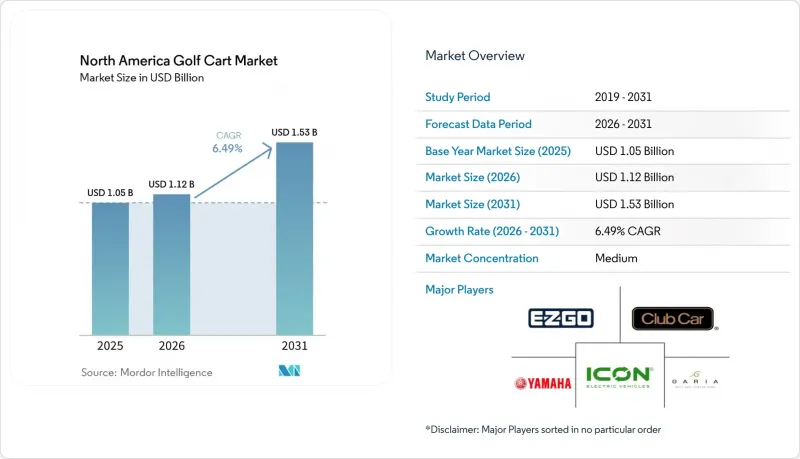
據 Mordor Intelligence 稱,2025 年北美高爾夫球車市場價值 10.5 億美元,預計將從 2026 年的 11.2 億美元成長到 2031 年的 15.3 億美元,2026 年至 2031 年的複合年成長率為 6.49%。
本報告按驅動方式(電動、汽油等)、應用領域(高爾夫球場、個人交通等)、座位數(2座、4座等)、所有權類型(個人所有、車隊/企業所有等)和國家/地區(美國、加拿大等)進行分類。市場預測以美元計價。
北美高爾夫球車市場趨勢與洞察
磷酸鋰鐵(LFP)電池的快速普及
與鉛酸電池相比,使用磷酸鋰電池的車隊營運商可享有更長的使用壽命,從而大幅節省長期成本。像奧卡拉高爾夫球車租賃公司這樣的租賃公司正在全面過渡到鋰電池,並充分利用其在租賃間隙快速充電的優勢。Yamaha將於2025年中期發布的G31EP電池採用了專有的磷酸鐵鋰電池模組,與傳統化學電池相比,電力消耗降低了30%。隨著電池價格的下降,個人買家也能更輕鬆地購買到電池,這導致二手市場對改裝電池的需求激增。
封閉社區強制通電
在傑克遜維爾的諾卡蒂(Nocatee)等總體規劃社區,汽油高爾夫球車受到監管,以保護空氣品質並降低噪音,使其從單純的便利設施轉變為受監管的基礎設施。計畫於2026年開放的EverRange計畫從規劃階段就設計了電動低速車道,以確保未來的需求。住宅協會透過罰款和拒絕註冊等方式強制執行,從而確保了持續的更換需求。佛羅裡達州、德克薩斯州和亞利桑那州等退休人口眾多的州走在前列,這些地區的人們正逐漸用短程汽車出行取代日常使用高爾夫球車。 「僅限電動車」條款透過將旅遊規則納入房產法規,正在改變人們的購屋決策方式。
高爾夫球車用半導體供不應求
由於OEM廠商與搭乘用電動車製造商競相爭奪相同的電池管理晶片,預計從2025年起,控制器前置作業時間將翻倍。德事隆在2025年年度報告中指出供應受限,並正在將稀缺組件轉向利潤更高的等級。功能豐富的太陽能混合動力車型和配備車載資訊系統的車型受影響最大,因為它們需要額外的微控制器,一些品牌正在簡化入門級車型的規格,以維持組裝線的運作。供應狀況的改善取決於晶圓代工廠將於2027年下半年開始運作。
細分市場分析
到2025年,在電池價格下降和充電基礎設施擴張的推動下,電動代步車將佔據北美高爾夫球車市場67.15%的佔有率。然而,隨著度假村和市政車隊優先考慮每天15-25公里的離網續航里程,配備300-620瓦軟性太陽能電池板的太陽能混合動力高爾夫球車正以8.59%的複合年成長率快速成長。雖然純電動車輛預計仍將主導併網車輛市場,但遠端營運商擴大將太陽能套件作為標準配置。汽油動力高爾夫球車仍然在一些需要即時加油的當地高爾夫俱樂部中使用,但由於排放氣體法規日益嚴格,因此數量正在下降。到2031年,在統一的電氣化框架下,隨著混合動力汽車和氫燃料實驗原型車的出現,電池動力平台將推動北美高爾夫球車市場實現顯著成長。
在陽光地帶的度假區,隨著太陽能發電的投資回收期縮短至兩年以內,太陽能混合動力系統的普及速度正在加快,無需昂貴的充電站即永續運作。根據原始設備製造商(OEM)的藍圖,隨著專利覆蓋範圍的擴大和組件成本的降低,預計到2028年,屋頂整合式太陽能系統將從售後套件轉變為原廠選配。
到2025年,高爾夫球場仍將佔據北美高爾夫球車市場46.35%的佔有率,但隨著退休人員和家庭在封閉式住宅將高爾夫球車作為第二輛車的替代選擇,個人交通工具市場將以6.93%的複合年成長率成長。商業和公用事業應用,例如校園接駁車和倉儲物流,也不斷擴展。這主要得益於企業為實現脫碳目標而優先考慮在50公里以下的路線上使用低速電動車。配備頭燈、安全帶和車輛識別碼(VIN)的合法上路低速車輛(LSV)的各種版本,目前在整車製造商(OEM)的出貨量中所佔比例越來越高,表明高爾夫球車的應用範圍正在高爾夫球場之外不斷擴大。
點對點租賃應用程式和度假村的「車隊即服務」模式讓高爾夫球車的使用更加便捷,「先試駕後購買」的體驗也促使一些偶爾使用者最終成為車主。隨著有利於高爾夫球車使用的總體規劃日益普及,預計到2031年,北美高爾夫球場的高爾夫球車市場佔有率將顯著下降,但透過該管道對高爾夫球車的絕對需求將保持穩定。
其他好處:
- Excel格式的市場預測(ME)表
- 3個月的分析師支持
目錄
第1章:引言
- 研究假設和市場定義
- 調查範圍
第2章:調查方法
第3章執行摘要
第4章 市場狀況
- 市場概覽
- 市場促進因素
- 磷酸鋰鐵(LFP)電池的快速普及
- 封閉社區強制通電
- 度假式房地產開發熱潮
- 企業車輛脫碳計劃
- 整合太陽能發電功能的座艙罩建築的出現。
- 國家層級為低速電動車提供補貼
- 市場限制因素
- 高爾夫球車用半導體供不應求
- 城市中心非道路車輛分區規定
- 加強處理規定
- 竊盜和財產損失保險費正在上漲。
- 價值供應鏈分析
- 監理情勢
- 技術展望
- 波特五力模型
- 價格分析
第5章 市場規模與成長預測
- 依推進類型
- 電的
- 汽油
- 太陽能混合動力
- 透過使用
- 高爾夫球場
- 個人交通工具
- 商業和公共產業服務
- 按座位數
- 雙座
- 四座
- 6座或以上
- 自有車型
- 個人所有
- 艦隊/公司
- 租賃和共享服務
- 國家
- 美國
- 加拿大
- 其他北美國家
第6章 競爭情勢
- 市場集中度
- 策略趨勢
- 市佔率分析
- 公司簡介
- Textron Specialized Vehicles Inc.(EZ-GO)
- Club Car
- Yamaha Motor Co., Ltd.
- ICON Electric Vehicles
- Garia A/S
- Cruise Car Inc.
- Suzhou Eagle Electric Vehicle Mfg. Co. Ltd.
- JH Global Services Inc.(Star EV)
- Polaris Inc.
- Nordic Group of Companies Ltd.
- AEV Technologies
- Marshell Electric Vehicle
- Bintelli Electric Vehicles
- Evolution Electric Vehicles
- HDK Electric Vehicles
第7章 市場機會與未來展望
According to Mordor Intelligence, the North America golf cart market size was valued at USD 1.05 billion in 2025 and is projected to expand from USD 1.12 billion in 2026 to USD 1.53 billion by 2031, registering a 6.49% CAGR between 2026 and 2031.
This report is Segmented by Propulsion Type (Electric, Gasoline, and More), Application (Golf Course, Personal Transportation, and More), Seating Capacity (2-Seater, 4-Seater, and More), Ownership Model (Personal Ownership, Fleet/Corporate, and More), and Country (United States, Canada, and More). The Market Forecasts are Provided in Terms of Value (USD).
North America Golf Cart Market Trends and Insights
Rapid Uptake of Lithium-Iron-Phosphate (LFP) Batteries
Fleet operators, leveraging LFP packs, enjoy significantly longer lifespans compared to lead-acid batteries, resulting in notable long-term cost savings. Rental firms, like Ocala Golf Cart Rentals, have made a complete shift to lithium, capitalizing on its rapid charging capabilities between hires. Yamaha's G31EPs, launched mid-2025, integrate proprietary LFP modules that reduce power use 30% from prior chemistries . As pack prices decline, they have become more accessible for personal buyers, spurring a surge in secondary-market conversions.
Electrification Mandates in Gated Communities
Master-planned communities such as Nocatee in Jacksonville restrict gasoline carts to preserve air quality and reduce noise, converting carts from amenities to regulated infrastructure. EverRange, opening in 2026, is engineering its pathways for electric low-speed vehicles from inception, locking in future demand. Homeowners' associations enforce compliance through fines and registration denials, ensuring sustained replacement demand. States with high retiree in-migration-Florida, Texas, Arizona-are the epicenter, where daily cart use displaces short automobile trips. Electric-only clauses reshape purchasing decisions by integrating mobility rules into real-estate covenants.
Under-Supply of Golf-Cart-Grade Semiconductors
Controller lead times have doubled since 2025 as OEMs compete with passenger-EV manufacturers for identical battery-management chips. Textron flagged supply constraints in its 2025 annual report, redirecting scarce components to higher-margin trims. Feature-rich solar-hybrid and telematics variants are most affected because they require additional microcontrollers, prompting some brands to de-content entry models to keep assembly lines running. Relief hinges on incremental foundry capacity expected online from late 2027.
Other drivers and restraints analyzed in the detailed report include:
- Boom in Resort-Based Real-Estate Developments
- Corporate Fleet Decarbonization Programs
- Zoning Restrictions on Non-Road Vehicles in Urban Cores
For complete list of drivers and restraints, kindly check the Table Of Contents.
Segment Analysis
Electric carts dominated the North American golf cart market with 67.15% share in 2025 as battery prices fell and charging infrastructure spread. However, solar-hybrid configurations, which integrate 300-620 W flexible panels, are expanding at an 8.59% CAGR because resort and municipal fleets value 15-25 km of daily off-grid range. Grid-connected fleets are expected to stay all-battery, yet operators in remote locations increasingly specify solar kits as standard equipment. Gasoline carts endure in rural clubs that require instantaneous refueling, but emissions scrutiny is eroding their install base. By 2031, North America's golf cart market, driven by battery-based platforms, is expected to grow significantly, as hybrid and exploratory hydrogen prototypes emerge under a unified electric umbrella.
Solar-hybrid adoption is accelerating in Sun Belt resort corridors where photovoltaic payback windows shrink below two years, unlocking continuous duty cycles without costly charging pedestals. OEM roadmaps indicate roof-integrated solar will migrate from aftermarket kits to factory options by 2028 as patent coverage broadens and module costs fall.
Golf courses retained 46.35% share of the North America golf cart market in 2025, yet personal transportation is advancing at 6.93% CAGR as retirees and families replace second cars with carts in gated neighborhoods. Commercial and utility uses-campus shuttles, warehouse logistics-are also expanding, urged by corporate decarbonization goals that favor low-speed electric vehicles for sub-50 km routes. Street-legal low-speed-vehicle (LSV) variants with headlights, seatbelts, and VINs now account for a rising portion of OEM shipments, signifying normalization beyond golf turf.
Peer-to-peer rental apps and resort fleet-as-a-service models further democratize cart access, enabling try-before-buy experiences that convert occasional users into owners. As cart-friendly master plans proliferate, the North American golf cart market share held by golf courses will likely fall significantly by 2031, though absolute unit demand in that channel should remain stable.
Complete Report Scope:
- By Propulsion Type
- Electric
- Gasoline
- Solar-Hybrid
- By Application
- Golf Course
- Personal Transportation
- Commercial/Utility Services
- By Seating Capacity
- 2-Seater
- 4-Seater
- 6-Seater and Above
- By Ownership Model
- Personal Ownership
- Fleet/Corporate
- Rental and Shared Services
- By Country
- United States
- Canada
- Rest of North America
List of Companies Covered in this Report:
- Textron Specialized Vehicles Inc. (E-Z-GO)
- Club Car
- Yamaha Motor Co., Ltd.
- ICON Electric Vehicles
- Garia A/S
- Cruise Car Inc.
- Suzhou Eagle Electric Vehicle Mfg. Co. Ltd.
- JH Global Services Inc. (Star EV)
- Polaris Inc.
- Nordic Group of Companies Ltd.
- AEV Technologies
- Marshell Electric Vehicle
- Bintelli Electric Vehicles
- Evolution Electric Vehicles
- HDK Electric Vehicles
Additional Benefits:
- The market estimate (ME) sheet in Excel format
- 3 months of analyst support
TABLE OF CONTENTS
1 Introduction
- 1.1 Study Assumptions & Market Definition
- 1.2 Scope of the Study
2 Research Methodology
3 Executive Summary
4 Market Landscape
- 4.1 Market Overview
- 4.2 Market Drivers
- 4.2.1 Rapid Uptake of Lithium-Iron-Phosphate (LFP) Batteries
- 4.2.2 Electrification Mandates in Gated Communities
- 4.2.3 Boom in Resort-Based Real-Estate Developments
- 4.2.4 Corporate Fleet Decarbonization Programs
- 4.2.5 Emergence of Solar-Integrated Canopy Roofs
- 4.2.6 State-Level Subsidies for Low-Speed EVs
- 4.3 Market Restraints
- 4.3.1 Under-Supply of Golf-Cart-Grade Semiconductors
- 4.3.2 Zoning Restrictions on Non-Road Vehicles in Urban Cores
- 4.3.3 Lead-Acid Disposal Regulations Tightening
- 4.3.4 Rising Theft and Vandalism Insurance Premiums
- 4.4 Value / Supply-Chain Analysis
- 4.5 Regulatory Landscape
- 4.6 Technological Outlook
- 4.7 Porter's Five Forces
- 4.7.1 Bargaining Power of Buyers
- 4.7.2 Bargaining Power of Suppliers
- 4.7.3 Threat of New Entrants
- 4.7.4 Threat of Substitutes
- 4.7.5 Degree of Competition
- 4.8 Pricing Analysis
5 Market Size & Growth Forecasts (Value, USD)
- 5.1 By Propulsion Type
- 5.1.1 Electric
- 5.1.2 Gasoline
- 5.1.3 Solar-Hybrid
- 5.2 By Application
- 5.2.1 Golf Course
- 5.2.2 Personal Transportation
- 5.2.3 Commercial/Utility Services
- 5.3 By Seating Capacity
- 5.3.1 2-Seater
- 5.3.2 4-Seater
- 5.3.3 6-Seater and Above
- 5.4 By Ownership Model
- 5.4.1 Personal Ownership
- 5.4.2 Fleet/Corporate
- 5.4.3 Rental and Shared Services
- 5.5 By Country
- 5.5.1 United States
- 5.5.2 Canada
- 5.5.3 Rest of North America
6 Competitive Landscape
- 6.1 Market Concentration
- 6.2 Strategic Moves
- 6.3 Market Share Analysis
- 6.4 Company Profiles (includes Global Level Overview, Market Level Overview, Core Segments, Financials as Available, Strategic Information, Market Rank/Share for Key Companies, Products and Services, SWOT Analysis, and Recent Developments)
- 6.4.1 Textron Specialized Vehicles Inc. (E-Z-GO)
- 6.4.2 Club Car
- 6.4.3 Yamaha Motor Co., Ltd.
- 6.4.4 ICON Electric Vehicles
- 6.4.5 Garia A/S
- 6.4.6 Cruise Car Inc.
- 6.4.7 Suzhou Eagle Electric Vehicle Mfg. Co. Ltd.
- 6.4.8 JH Global Services Inc. (Star EV)
- 6.4.9 Polaris Inc.
- 6.4.10 Nordic Group of Companies Ltd.
- 6.4.11 AEV Technologies
- 6.4.12 Marshell Electric Vehicle
- 6.4.13 Bintelli Electric Vehicles
- 6.4.14 Evolution Electric Vehicles
- 6.4.15 HDK Electric Vehicles
7 Market Opportunities & Future Outlook
- 7.1 White-space & Unmet-Need Assessment

 高爾夫球車:市場佔有率分析、產業趨勢與統計、成長預測(2026-2031)
 高爾夫球車市場-2026-2032年全球市場預測
 高爾夫球車和社區型電動車(NEV) 市場規模、佔有率和成長分析:按車輛類型、驅動系統、應用、最終用戶和地區分類-2026-2033 年產業預測高爾夫球車和社區型電動車市場:2026-2032年全球市場預測(按車輛類型、電池電壓、續航里程、座位數、應用和銷售管道)
 高爾夫球車市場分析及預測(至2035年):類型、產品類型、服務、技術、組件、應用、最終用戶、功能、使用模式
 全球高爾夫球車市場規模、佔有率、趨勢和成長分析報告(2026-2034年)全球高爾夫球車和新能源汽車市場:市場規模、佔有率、趨勢和成長分析(2026-2034 年)
 高爾夫球車市場:按類型、應用和地區分類
 2026年全球高爾夫球車及周邊電動車(NEV)市場報告2026年全球高爾夫球車市場報告