

 |
市場調查報告書
商品編碼
2157114
日本金屬成型設備:市場佔有率分析、產業趨勢與統計及成長預測(2026-2031)Japan Metal Forming Equipment - Market Share Analysis, Industry Trends & Statistics, Growth Forecasts (2026 - 2031) |
||||||

※ 本網頁內容可能與最新版本有所差異。詳細情況請與我們聯繫。
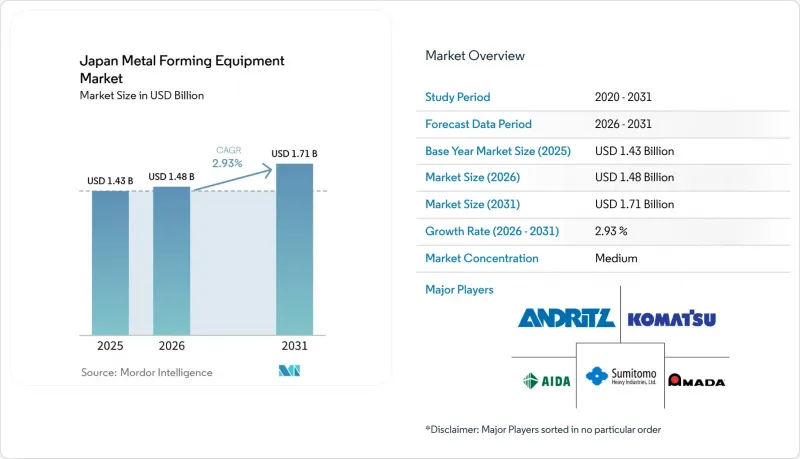
據 Mordor Intelligence 稱,2025 年日本金屬成型設備市值為 14.3 億美元,預計到 2031 年將達到 17.1 億美元,而 2026 年為 14.8 億美元,預測期內(2026-2031 年)的複合年成長率為 2.9%。預計為 2.9%。
日本金屬成型設備市場趨勢與洞察
日本老舊沖壓成型設備的更新
日本金屬成型設備市場由大規模需要更換、維護和維修的設備支撐。在2025會計年度,更換、維護和維修佔大型企業製造設備投資計畫的30.8%,成為最大的投資動機。同樣,在2025會計年度,此用途佔中小型製造商設備投資計畫的37.8%,成為調查中最大的目標類別。這些數據表明,超過使用壽命的設備正在進入更換週期。此外,與新型伺服驅動壓平機相比,老式機械壓平機需要更多的維護,生產效率也更低。隨著製造業向高附加價值應用轉型,日本經濟產業省的「2025願景」呼籲對機械零件和模具基礎設施進行現代化改造。
電動車輕量化和電池組件成型
日本金屬成型設備市場正因電池式電動車(BEV)的生產需求而重組。本田的「0系列」生產計畫採用了一台6000噸的巨型鑄造機,並將電池外殼組件的數量從60個減少到5個。這項變化導致部分多道沖壓工序減少,同時對高精度、高功率生產系統的需求也隨之增加。日本汽車產業的資本投資在2024年達到了1.6兆日圓(約102.4億美元),預計2025會計年度交通運輸設備的資本投資將成長28.2%。 UACJ為Lexus生產的6000系列鋁合金車門內板的一體成型工藝,充分展現了材料選擇如何改變成型要求。這種變化使得能夠處理鋁材深拉延和可控運動型材的設備變得更加重要,同時也導致傳統機械壓力機在某些應用中的作用範圍縮小。
智慧印刷生產線的初始成本高,投資回收期長。
日本國內汽車產業的投資為日本金屬成型設備市場帶來了週期性波動。預計到2025年,汽車和交通運輸設備產業的需求將占到總需求的38%,因此,整車製造商(OEM)資本投資計畫的波動將對設備供應商產生重大影響。主要製造商原計劃在2025會計年度將交通運輸設備產業的資本投資增加28.2%。這一成長反映了對電氣化領域的投資,但可能並不代表永久性的年度支出水準。 2025年7月,日產汽車宣布將把其大濱工廠的汽車生產轉移並整合到日產汽車九州工廠。根據日本金屬成型設備製造商協會(JFMA)的數據,2025會計年度日本國內交通運輸設備成型機械的訂單成長了5.2%,而電氣設備的訂單則下降了18.7%。
細分市場分析
到2025年,壓平機將佔日本金屬成型設備市場佔有率的41.5%,成為最大的設備類別。機械式和液壓式壓平機將繼續為成熟的汽車車身和動力傳動系統製造業務提供支援。彎折壓床和彎曲機廣泛應用於液壓、伺服電動和機械式等各種配置。根據日本金屬加工製造商協會(JFMA)的報告,2025會計年度彎折壓床的訂單較去年同期成長14.6%,在鈑金相關子類別中表現最為強勁。
隨著用戶對可程式設計操作、模具保護功能以及與先進鋼材和鋁材相容性的需求不斷成長,伺服壓力機預計將呈現最高的成長率,到2031年複合年成長率將達到5.2%。 2026年6月,日本小松公司工業株式會社開始接受改良H1F200-2伺服壓力機的訂單,該機型具有更高的運行速度、更高精度的控制以及更強大的ICT連接功能。日本金屬成型設備產業正朝著產品創新方向發展,力求在滿足用戶對全新性能期望的同時,維持現有機型系列的價值。截至2026年1月1日,日本金屬成型機械製造商協會(JFMA)已註冊了涵蓋44個產品系列的158款認證機型,這表明伺服和混合動力設備市場徵兆。鍛造、輥壓成型、線材和管材成型、擠壓和液壓成型設備供應給汽車、航太和工業機械產業的使用者。雖然液壓成型和擠壓設備的安裝數量仍然較少,但這一趨勢與鋁和鈦的使用量不斷成長的趨勢相吻合。
預計到2025年,沖壓和沖孔將佔日本金屬成形設備市場規模的30.5%,主要得益於鈑金的大規模生產。深拉延、彎曲、鍛造、軋製、輥壓成型和擠壓等製造地的個人需求。這種加工能力尤其適用於設計電池式電動車的底盤和電池機殼。由於製造商既需要大規模生產,也需要精密加工,日本金屬成形設備市場擁有豐富的加工流程。
預計到2031年,液壓成形製程的複合年成長率將達到5.8%,位居行業之首,因為它能夠以更少的步驟成型複雜的鋁和鋼管結構。超級鑄造和巨型鑄造有望在某些車身面板的製造中取代多級沖壓製程。它們還可以增加對液壓成形和深拉延結構件的需求,而這些結構件的鑄造在經濟上是不可行的。 2025會計年度,國內金屬製品製造業的成形設備訂單增8.2%。由於航太緊固件和精密傳動系統零件的需求,鍛造設備的需求正在擴大。擠壓成型過程滿足了電池托盤和溫度控管系統對鋁型材的需求。
其他好處:
- Excel格式的市場預測(ME)表
- 3個月的分析師支持
目錄
第1章:引言
- 研究假設和市場定義
- 調查範圍
第2章:調查方法
第3章執行摘要
第4章 市場狀況
- 市場概覽
- 市場促進因素
- 日本老舊沖壓成型設備的更新
- 電動車輕量化和電池組件成型
- 引入伺服動力和混合動力壓平機以提高能源效率
- 擴大半導體、電子元件和精密元件的生產能力。
- 熟練模具製造人員的短缺正在推動對自主工藝窗口的需求增加。
- 日本製造的精密工具作為出口相關需求的乘數效應
- 市場限制因素
- 智慧印刷生產線初始成本高,投資回收期長。
- 國內汽車產業資本投資的波動
- 日本傳統工廠維修和數據整合面臨的挑戰
- 專業工具和服務技術在老舊供應商的集中
- 價值和供應鏈分析
- 印刷機製造商和系統整合商
- 控制設備、驅動裝置、感測器和自動化相關供應商
- 模具、工具和工件夾具
- 分銷、安裝和售後服務
- 進口依賴性和區域供應鏈
- 監理情勢
- 關於合理化能源利用和「領跑者原則」的法案
- 工業安全和壓力防護設備的要求
- 符合JIS、ISO和CE相關標準的設備
- 網路安全與互聯機器管治
- 技術展望
- 機械式、液壓式和伺服壓力機技術
- CNC工具機、可程式邏輯控制器和運動控制系統
- 基於機器人的自動化和線上檢測
- 數位孿生、預測性維護、網路安全
- 熱沖壓、液壓成形和漸進成形
- 評估地緣政治事件對市場的影響
第5章 市場規模與成長預測
- 依設備類型
- 壓平機
- 機械壓力機
- 油壓機
- 伺服壓力機
- 其他通用印刷機
- 彎折壓床和彎曲機
- 液壓彎折壓床
- 伺服/電動彎折壓床
- 機械彎折壓床
- 其他折彎機
- 鍛造設備
- 鍛壓機
- 鍛造錘
- 軋機和鐓機
- 其他鍛造設備
- 輥壓成型及板材/型材軋製設備
- 輥壓成型機
- 板材軋機
- 結構鋼和型材軋機
- 其他二次軋製成型設備
- 線材/管材/型材成型設備
- 線材/棒材拉拔/成型設備
- 管材成型和彎曲設備
- 型材機
- 擠出機
- 液壓成型設備
- 其他金屬成型設備
- 壓平機
- 透過成型工藝
- 壓制和沖壓
- 深畫
- 彎曲過程
- 鍛造
- 軋製和輥壓成型
- 擠壓
- 液壓成型
- 其他成型工藝
- 透過模壓材料
- 碳鋼和低合金鋼
- 不銹鋼
- 鋁及鋁合金
- 銅及銅合金
- 鈦、鎳和其他非鐵金屬
- 其他材料
- 按最終用途行業分類
- 汽車和運輸業
- 航太/國防
- 工業機械及資本財
- 金屬製品及加工
- 電氣和電子設備
- 建築和基礎設施
- 能源與電力
- 家用電器耐用消費品
- 醫療和精密製造
- 其他終端用戶產業
第6章 競爭情勢
- 市場集中度
- 策略趨勢
- 市佔率分析
- 公司簡介
- AMADA Co., Ltd.
- AIDA ENGINEERING, LTD.
- Komatsu Ltd.
- Sumitomo Heavy Industries, Ltd.
- ANDRITZ Schuler Group
- DMG MORI Co., Ltd.
- Mitsubishi Heavy Industries Machine Tool Co., Ltd.
- Yamada Dobby Co., Ltd.
- ASAI CORPORATION
- Enshu Limited
- Kojima Iron Works Co., Ltd.
- Kuroda Precision Industries Ltd.
- Nidec Minster Corporation
- Toyokoki Co., Ltd.
- Mitsubishi Electric Corporation
- FANUC Corporation
- Murata Machinery, Ltd.
- Bystronic AG
- TRUMPF SE+Co. KG
- Salvagnini Italia SpA
- Prima Industrie SpA
- Fagor Arrasate S. Coop.
第7章 市場機會與未來展望
According to Mordor Intelligence, the Japan metal forming equipment market size was valued at USD 1.43 billion in 2025, and is estimated to grow from USD 1.48 billion in 2026 to reach USD 1.71 billion by 2031, at a CAGR of 2.9% during the forecast period (2026-2031).
Japan Metal Forming Equipment Market Trends and Insights
Replacement of Japan's Aging Press and Forming Equipment Base
The Japan metal forming equipment market is supported by a large installed base that requires renewal, maintenance, and repair. Renewal, maintenance, and repair represented 30.8% of planned manufacturing capital expenditure among major firms in FY2025, the highest share among investment motives. The same purpose accounted for 37.8% of FY2025 planned capital expenditure among small and medium-sized manufacturers, making it the largest purpose category in that survey. These figures point to a backlog of time-expired assets moving into replacement cycles. Older mechanical presses also carry higher maintenance needs and lower productivity than newer servo platforms. METI's 2025 vision called for the modernization of the machine parts and tooling base as manufacturers move toward higher-value applications.
EV Lightweighting and Battery-Component Forming
The Japan metal forming equipment market is being reshaped by battery electric vehicle production requirements. Honda's 0 Series production plan uses a 6,000-ton megacasting machine to reduce 60 battery-case parts to 5 parts. This change reduces some multi-stage stamping work while increasing the need for high-precision, high-force production systems. Automotive equipment investment in Japan reached JPY 1.6 trillion in 2024 (USD 10.24 billion), and transport equipment capital expenditure was planned to rise 28.2% in FY2025. UACJ's work on one-piece 6000-series aluminum door inners for Lexus shows how material choices are changing forming requirements. The shift favors equipment that can manage aluminum deep drawing and controlled motion profiles. It also narrows the role of conventional mechanical presses in selected applications.
High Upfront Cost and Long Payback for Smart Press Lines
Domestic automotive investment introduces a cyclical element to the Japan metal forming equipment market. Automotive and transportation held 38% of demand in 2025, which makes changes in OEM capital plans important to equipment suppliers. Major manufacturers planned a 28.2% increase in transport equipment capital expenditure in FY2025. The increase reflected electrification spending and may not represent a lasting annual spending level. Nissan announced in July 2025 that it would transfer and consolidate vehicle production from Oppama to Nissan Motor Kyushu. JFMA data showed domestic transport-equipment orders for forming machinery rose 5.2% in FY2025, while electrical machinery orders fell 18.7%.
Other drivers and restraints analyzed in the detailed report include:
- Servo-Electric and Hybrid Press Adoption for Energy Productivity
- Semiconductor, Electronics, and Precision-Component Capacity Expansion
- Cyclical Domestic Automotive Capital Expenditure
For complete list of drivers and restraints, kindly check the Table Of Contents.
Segment Analysis
Press machines held 41.5% of the Japan metal forming equipment market share in 2025, making them the largest equipment category. Mechanical and hydraulic presses continue to support established automotive bodies and powertrain operations. Press brakes and bending machines are used across hydraulic, servo-electric, and mechanical configurations. JFMA reported that press brake orders increased 14.6% year over year in FY2025, the strongest result among sheet metal sub-categories.
Servo presses are expected to post the highest 5.2% CAGR through 2031 as users seek programmable motion, die protection, and compatibility with advanced steels and aluminum. Komatsu Industries began taking orders for an upgraded H1F200-2 servo press in June 2026, with faster operation, higher-precision control, and expanded ICT connectivity. The Japan metal forming equipment industry is moving toward product refreshes that retain machine-family value while meeting newer performance expectations. JFMA had 158 certified models across 44 product lines registered as of January 1, 2026, a signal that favors servo and hybrid-electric equipment. Forging, roll forming, wire and tube forming, extrusion, and hydroforming equipment serve automotive, aerospace, and industrial machinery users. Hydroforming and extrusion equipment have a smaller installed base but align with growing aluminum and titanium use.
Stamping and punching accounted for 30.5% of the Japan metal forming equipment market size in 2025, supported by high-volume sheet processing. Deep drawing, bending, forging, rolling, roll forming, and extrusion serve separate production requirements across the manufacturing base. This capability suits battery electric vehicle chassis and battery enclosure designs. The Japan metal forming equipment market retains a broad process base because manufacturers require both high-volume and precision work.
Hydroforming has the highest projected CAGR at 5.8% through 2031 because it forms complex aluminum and steel tubular structures with fewer operations. Gigacasting and megacasting can replace multi-stage stamping for selected body panels. They can also increase demand for hydroforming and deep drawing of structural parts that are not economical to cast. Domestic forming equipment orders from the metal products manufacturing sector rose 8.2% year over year in FY2025. Forging equipment benefits from aerospace fasteners and precision drivetrain components. Extrusion serves aluminum profile requirements in battery trays and heat management systems.
Complete Report Scope:
- By Equipment Type
- Press Machines
- Mechanical Presses
- Hydraulic Presses
- Servo Presses
- Other General-Purpose Presses
- Press Brakes and Bending Machines
- Hydraulic Press Brakes
- Servo / Electric Press Brakes
- Mechanical Press Brakes
- Other Bending Machines
- Forging Equipment
- Forging Presses
- Forging Hammers
- Upsetting and Heading Machines
- Other Forging Equipment
- Roll Forming and Plate/Profile Rolling Equipment
- Roll Forming Machines
- Plate Rolling Machines
- Section and Profile Rolling Machines
- Other Secondary Rolling/Forming Equipment
- Wire, Tube and Profile Forming Equipment
- Wire and Bar Drawing/Forming Equipment
- Tube Forming and Bending Equipment
- Profile Forming Equipment
- Extrusion Presses
- Hydroforming Equipment
- Other Metal Forming Equipment
- Press Machines
- By Forming Process
- Stamping and Punching
- Deep Drawing
- Bending
- Forging
- Rolling and Roll Forming
- Extrusion
- Hydroforming
- Other Forming Processes
- By Material Formed
- Carbon and Low-Alloy Steel
- Stainless Steel
- Aluminum and Aluminum Alloys
- Copper and Copper Alloys
- Titanium, Nickel and Other Non-Ferrous Metals
- Other Materials
- By End-Use Industry
- Automotive and Transportation
- Aerospace and Defense
- Industrial Machinery and Capital Equipment
- Metal Products and Fabrication
- Electrical and Electronics
- Construction and Infrastructure
- Energy and Power
- Consumer Appliances and Durable Goods
- Medical and Precision Manufacturing
- Other End-Use Industries
List of Companies Covered in this Report:
- AMADA Co., Ltd.
- AIDA ENGINEERING, LTD.
- Komatsu Ltd.
- Sumitomo Heavy Industries, Ltd.
- ANDRITZ Schuler Group
- DMG MORI Co., Ltd.
- Mitsubishi Heavy Industries Machine Tool Co., Ltd.
- Yamada Dobby Co., Ltd.
- ASAI CORPORATION
- Enshu Limited
- Kojima Iron Works Co., Ltd.
- Kuroda Precision Industries Ltd.
- Nidec Minster Corporation
- Toyokoki Co., Ltd.
- Mitsubishi Electric Corporation
- FANUC Corporation
- Murata Machinery, Ltd.
- Bystronic AG
- TRUMPF SE + Co. KG
- Salvagnini Italia S.p.A.
- Prima Industrie S.p.A.
- Fagor Arrasate S. Coop.
Additional Benefits:
- The market estimate (ME) sheet in Excel format
- 3 months of analyst support
TABLE OF CONTENTS
1 INTRODUCTION
- 1.1 Study Assumptions and Market Definition
- 1.2 Scope of the Study
2 RESEARCH METHODOLOGY
3 EXECUTIVE SUMMARY
4 MARKET LANDSCAPE
- 4.1 Market Overview
- 4.2 Market Drivers
- 4.2.1 Replacement of Japan's Aging Press and Forming Equipment Base
- 4.2.2 EV Lightweighting and Battery-Component Forming
- 4.2.3 Servo-Electric and Hybrid Press Adoption for Energy Productivity
- 4.2.4 Semiconductor, Electronics and Precision-Component Capacity Expansion
- 4.2.5 Skilled-Die-Maker Scarcity Increasing Demand for Autonomous Process Windows
- 4.2.6 Japan-Based Precision Tooling as an Export-Linked Demand Multiplier
- 4.3 Market Restraints
- 4.3.1 High Upfront Cost and Long Payback for Smart Press Lines
- 4.3.2 Cyclical Domestic Automotive Capital Expenditure
- 4.3.3 Retrofit and Data-Integration Friction Across Legacy Japanese Factories
- 4.3.4 Concentration of Specialized Tooling and Service Expertise in Aging Suppliers
- 4.4 Value and Supply-Chain Analysis
- 4.4.1 Press Manufacturers and System Integrators
- 4.4.2 Controls, Drives, Sensors, and Automation Suppliers
- 4.4.3 Dies, Tooling, and Workholding
- 4.4.4 Distribution, Installation, and Aftermarket Services
- 4.4.5 Import Dependencies and Regional Supply Chain
- 4.5 Regulatory Landscape
- 4.5.1 Act on the Rationalization of Energy Use and Top Runner Principles
- 4.5.2 Industrial Safety and Press-Guarding Requirements
- 4.5.3 JIS, ISO and CE-Linked Equipment Compliance
- 4.5.4 Cybersecurity and Connected-Machine Governance
- 4.6 Technological Outlook
- 4.6.1 Mechanical, Hydraulic and Servo Press Technologies
- 4.6.2 CNC, PLC, and Motion-Control Systems
- 4.6.3 Robotic Automation and In-Line Inspection
- 4.6.4 Digital Twins, Predictive Maintenance, and Cybersecurity
- 4.6.5 Hot Stamping, Hydroforming, and Incremental Forming
- 4.7 Impact Assessment of Geopolitical Events on the Market
5 MARKET SIZE AND GROWTH FORECASTS
- 5.1 By Equipment Type
- 5.1.1 Press Machines
- 5.1.1.1 Mechanical Presses
- 5.1.1.2 Hydraulic Presses
- 5.1.1.3 Servo Presses
- 5.1.1.4 Other General-Purpose Presses
- 5.1.2 Press Brakes and Bending Machines
- 5.1.2.1 Hydraulic Press Brakes
- 5.1.2.2 Servo / Electric Press Brakes
- 5.1.2.3 Mechanical Press Brakes
- 5.1.2.4 Other Bending Machines
- 5.1.3 Forging Equipment
- 5.1.3.1 Forging Presses
- 5.1.3.2 Forging Hammers
- 5.1.3.3 Upsetting and Heading Machines
- 5.1.3.4 Other Forging Equipment
- 5.1.4 Roll Forming and Plate/Profile Rolling Equipment
- 5.1.4.1 Roll Forming Machines
- 5.1.4.2 Plate Rolling Machines
- 5.1.4.3 Section and Profile Rolling Machines
- 5.1.4.4 Other Secondary Rolling/Forming Equipment
- 5.1.5 Wire, Tube and Profile Forming Equipment
- 5.1.5.1 Wire and Bar Drawing/Forming Equipment
- 5.1.5.2 Tube Forming and Bending Equipment
- 5.1.5.3 Profile Forming Equipment
- 5.1.6 Extrusion Presses
- 5.1.7 Hydroforming Equipment
- 5.1.8 Other Metal Forming Equipment
- 5.1.1 Press Machines
- 5.2 By Forming Process
- 5.2.1 Stamping and Punching
- 5.2.2 Deep Drawing
- 5.2.3 Bending
- 5.2.4 Forging
- 5.2.5 Rolling and Roll Forming
- 5.2.6 Extrusion
- 5.2.7 Hydroforming
- 5.2.8 Other Forming Processes
- 5.3 By Material Formed
- 5.3.1 Carbon and Low-Alloy Steel
- 5.3.2 Stainless Steel
- 5.3.3 Aluminum and Aluminum Alloys
- 5.3.4 Copper and Copper Alloys
- 5.3.5 Titanium, Nickel and Other Non-Ferrous Metals
- 5.3.6 Other Materials
- 5.4 By End-Use Industry
- 5.4.1 Automotive and Transportation
- 5.4.2 Aerospace and Defense
- 5.4.3 Industrial Machinery and Capital Equipment
- 5.4.4 Metal Products and Fabrication
- 5.4.5 Electrical and Electronics
- 5.4.6 Construction and Infrastructure
- 5.4.7 Energy and Power
- 5.4.8 Consumer Appliances and Durable Goods
- 5.4.9 Medical and Precision Manufacturing
- 5.4.10 Other End-Use Industries
6 COMPETITIVE LANDSCAPE
- 6.1 Market Concentration
- 6.2 Strategic Moves
- 6.3 Market Share Analysis
- 6.4 Company Profiles (includes Global Level Overview, Market Level Overview, Core Segments, Financials as available, Strategic Information, Products and Services, Recent Developments)
- 6.4.1 AMADA Co., Ltd.
- 6.4.2 AIDA ENGINEERING, LTD.
- 6.4.3 Komatsu Ltd.
- 6.4.4 Sumitomo Heavy Industries, Ltd.
- 6.4.5 ANDRITZ Schuler Group
- 6.4.6 DMG MORI Co., Ltd.
- 6.4.7 Mitsubishi Heavy Industries Machine Tool Co., Ltd.
- 6.4.8 Yamada Dobby Co., Ltd.
- 6.4.9 ASAI CORPORATION
- 6.4.10 Enshu Limited
- 6.4.11 Kojima Iron Works Co., Ltd.
- 6.4.12 Kuroda Precision Industries Ltd.
- 6.4.13 Nidec Minster Corporation
- 6.4.14 Toyokoki Co., Ltd.
- 6.4.15 Mitsubishi Electric Corporation
- 6.4.16 FANUC Corporation
- 6.4.17 Murata Machinery, Ltd.
- 6.4.18 Bystronic AG
- 6.4.19 TRUMPF SE + Co. KG
- 6.4.20 Salvagnini Italia S.p.A.
- 6.4.21 Prima Industrie S.p.A.
- 6.4.22 Fagor Arrasate S. Coop.
7 MARKET OPPORTUNITIES AND FUTURE OUTLOOK
- 7.1 White-Space and Unmet-Need Assessment
- 7.1.1 Automation and Flexible Forming Solutions for SMEs
- 7.1.2 Energy-Efficient Retrofits for Legacy Forming Equipment
- 7.1.3 Local Service and Aftermarket Support for Imported Equipment
- 7.1.4 Forming Solutions for EV, Battery, and Emerging Industrial Applications
- 7.1.5 Machine Connectivity and Data Interoperability

 一次性紙杯製造機市場:全球市場預測,2026-2032年
 2026-2030年全球輥壓成型機市場
 旋壓成型機市場規模、佔有率和成長分析:按機器類型、操作方式、應用領域、最終用戶、產能和地區分類-2026-2033年產業預測
 輥壓成型機市場機會、成長要素、產業趨勢分析及2026-2035年預測。
 北美金屬成型設備:市場佔有率分析、產業趨勢與統計及成長預測(2026-2031 年)美國金屬成型設備:市場佔有率分析、產業趨勢與統計、成長預測(2026-2031 年)金屬成型機械:市場佔有率分析、產業趨勢與統計、成長預測(2026-2031)多功能三軸攪拌機市場:依功能、攪拌技術、容量範圍、設計類型、驅動機構和終端用戶產業分類-全球預測,2026-2032年輥壓成型機及生產線市場:依材料、機器類型、控制技術及最終用戶分類,全球預測,2026-2032年全球輥壓成型系統市場(按產品類型、材料類型、機器類型、驅動類型、運行速度和最終用途產業分類)預測(2026-2032年)